

Go-to-Market Strategy for IT Services: The 2026 Playbook
A RevOps lead we know spent months building a "full-funnel GTM machine" for his managed services firm. Multiple channels, outside help, a content calendar that would make HubSpot proud. Pipeline after all that effort? Flat. He was everywhere and nowhere, speaking to everyone and resonating with no one.
Building a go-to-market strategy for IT services isn't about more channels - it's about the right ones. Gartner forecasts $1.87T in IT services spending for 2026, up 8.7% year-over-year, with North America accounting for roughly 41% of the global market. But as Robin Robins put it, we're in a "trust recession" - AI-generated outreach is driving down response rates and driving up acquisition costs. More money flowing into IT services doesn't mean more money flowing to you.
What You Need (Quick Version)
Three moves matter more than everything else combined:
- Pick a vertical and own its compliance language. Healthcare, finance, manufacturing - regulated industries where expertise commands premium pricing.
- Commit to 3-4 channels max. Data across 30+ MSPs shows that doubling down beats spreading thin, every time.
- Price per-user with tiered packaging. Outcome-based framing wins deals. "We keep you HIPAA-compliant" beats "$175/user/month for monitoring."
The numbers behind each step follow.
Pick a Vertical and Own It
"Managed services" means nothing to non-IT buyers. One MSP owner on r/msp put it bluntly - nobody in his market understood the term. He was considering rebranding to "Tech Care." That's not a branding problem. It's a positioning problem, and it starts with your value proposition.
When you specialize in a vertical, you stop selling technology and start selling compliance, risk reduction, and uptime. A healthcare-focused MSP doesn't pitch "24/7 monitoring." They pitch HIPAA compliance, breach prevention, and audit readiness. A financial services MSP leads with GLBA and PCI DSS. A defense contractor MSP talks ITAR and NIST. Your buyer persona shifts from "any business owner who needs IT" to a specific decision-maker with specific regulatory fears - and that specificity is what closes deals.
We've watched generalist MSPs lose deals to smaller, less technically capable competitors who simply spoke the buyer's language. The healthcare IT specialist who can walk a clinic administrator through a HIPAA risk assessment will beat the generalist who talks about "proactive monitoring and remediation" every single time.
Use this if: you're willing to narrow your TAM in exchange for higher win rates, bigger deal sizes, and pricing power that generalists can't touch.
Skip this if: you genuinely serve a geographic market where vertical depth isn't viable - but even then, pick two verticals, not zero.
GTM Readiness Scorecard
Before you launch or relaunch your GTM motion, score yourself honestly:
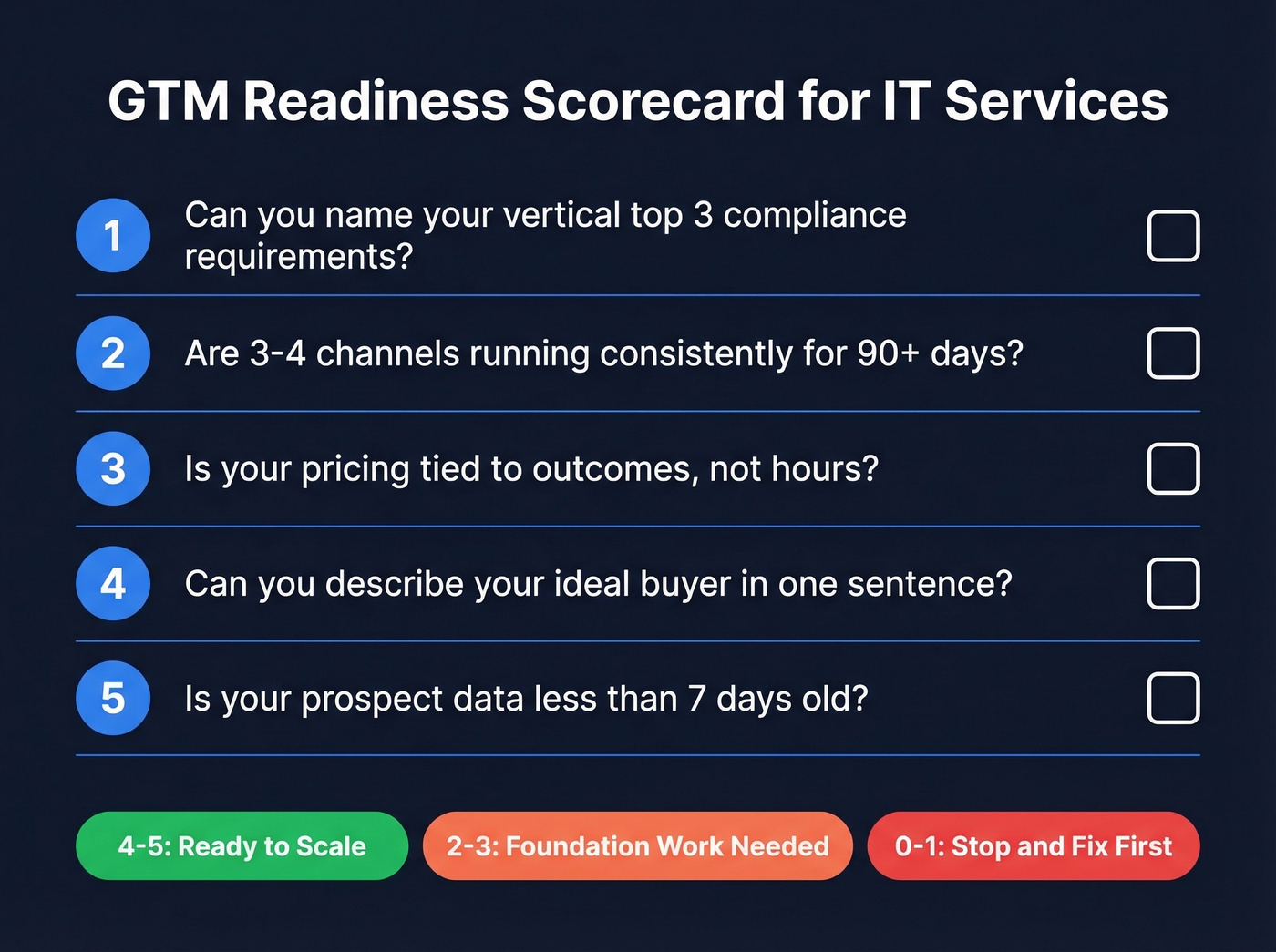
- Can you name your target vertical's top 3 compliance requirements? If not, you aren't specialized enough to command premium pricing.
- Do you have 3-4 channels running consistently for 90+ days? If you've restarted your marketing approach in the last quarter, you're channel-hopping.
- Is your pricing tied to outcomes, not hours? Per-user with compliance tiers beats hourly billing in every metric that matters.
- Can you describe your ideal buyer in one sentence without using the word "business"? "CFO at a 100-person dental group worried about HIPAA audit exposure" is a buyer persona. "Small to mid-size businesses" is not.
- Is your prospect data less than 7 days old? If your contact database refreshes monthly or less, your outbound is built on sand.
Score 4-5 and you're ready to scale. Score 2-3 and you have foundation work to do. Score 0-1? This article is going to save you a year of wasted budget.
Price and Package Your Services
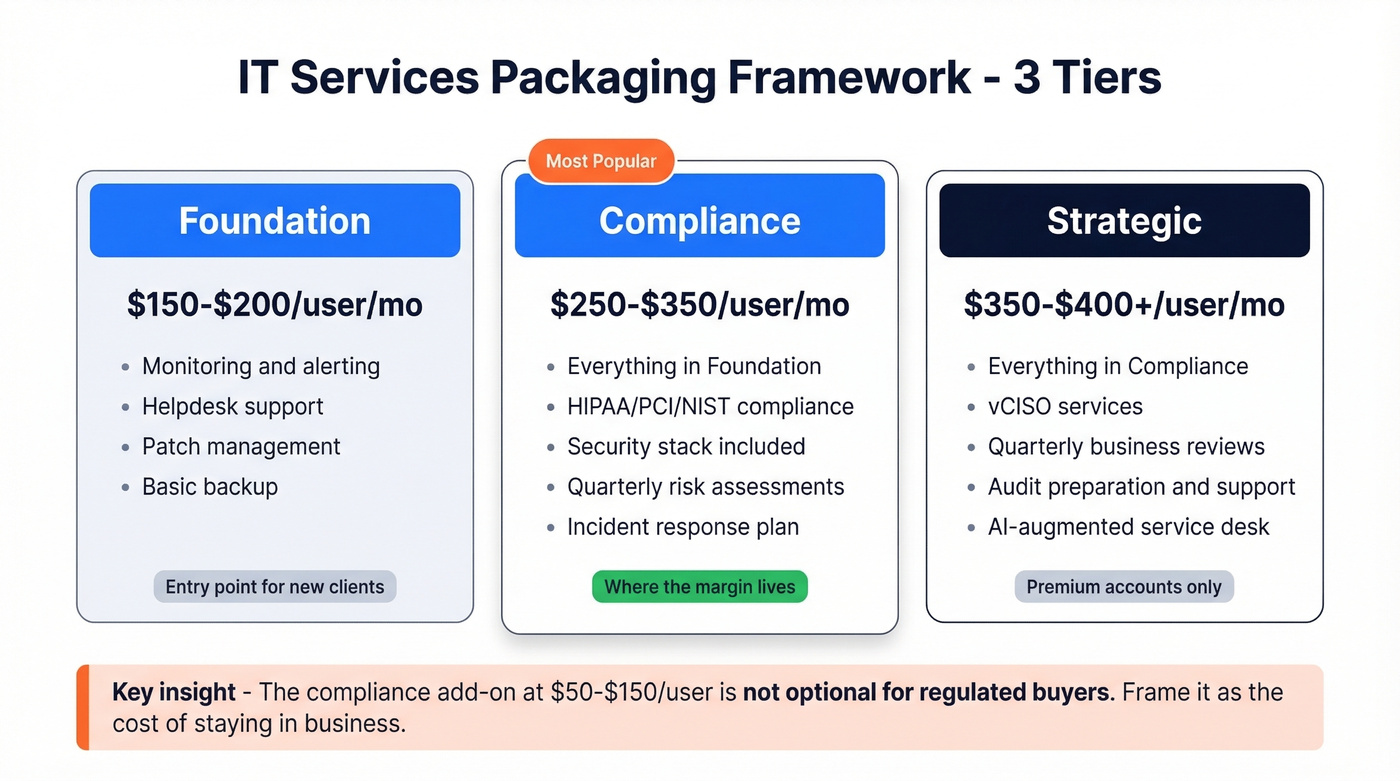
Per-user pricing is the dominant model for managed IT, and for good reason - it scales predictably for both you and the buyer. Here are the current benchmarks:
| Model | Range |
|---|---|
| Per-user (managed IT) | $150-$400/user/mo |
| Per-device: servers | $200-$250/mo |
| Per-device: workstations | $50-$100/mo |
| Per-device: network gear | $25-$75/mo |
| Compliance add-on | +$50-$150/user/mo |
The compliance add-on is where margin lives. If you've specialized in a regulated vertical, that $50-$150/user premium isn't optional for your buyers - it's the cost of staying in business. Frame it that way.
Build three tiers: monitoring and helpdesk at the base, security and compliance in the middle, and vCISO services with quarterly business reviews and audit support at the top. Buyers in 2026 expect AI-augmented support, so if you aren't operationalizing AI in your service desk for faster triage and resolution, your competitors are. Package security into every tier, not as an upsell. Your packaging should reflect outcomes and risk reduction, not tools and hours.
Here's the thing: if your average contract sits below $10k/year, you don't need a complex GTM strategy. You need to raise your prices. The MSPs struggling hardest are the ones charging $100/user/month and trying to make up the margin on volume. That's a race to the bottom, and the bottom is break-even.

Your GTM strategy is only as good as your prospect data. Prospeo gives you 30+ filters to target IT buyers by vertical, company size, tech stack, and intent - with 98% email accuracy and a 7-day refresh cycle. Stop building outbound on stale contacts.
Find every IT decision-maker in your target vertical for $0.01 per email.
Choose Your Channels (and Commit)
The data across 30+ MSPs is clear: pick 3-4 channels and run them consistently. Growth came from doubling down, not from restarting quarterly with a new tactic.
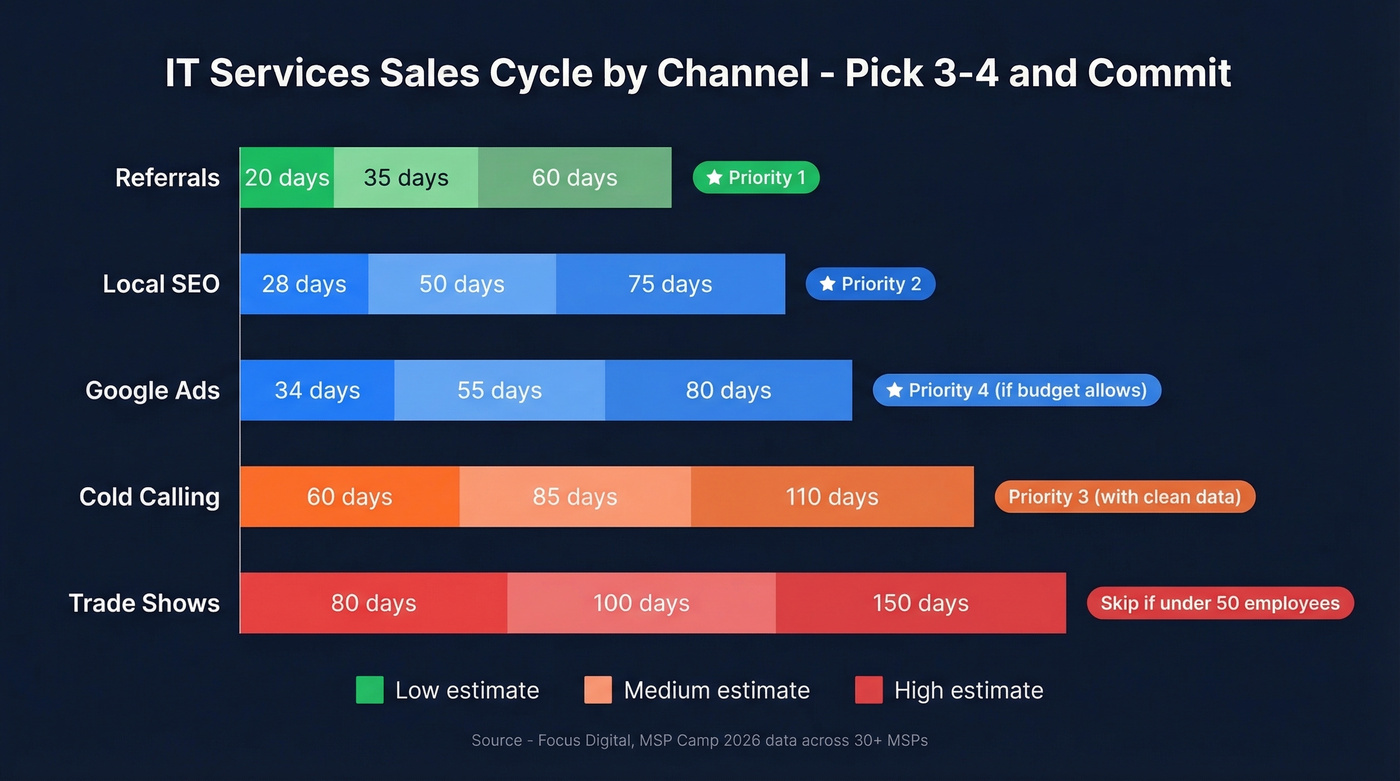
Here's how sales cycles break down by channel:
| Channel | Low | Medium | High |
|---|---|---|---|
| Referrals | 20 days | 35 days | 60 days |
| SEO | 28 days | 50 days | 75 days |
| Google Ads | 34 days | 55 days | 80 days |
| Cold calling | 60 days | 85 days | 110 days |
| Trade shows | 80 days | 100 days | 150 days |
Our recommended stack for most IT services companies: referrals first (always), local SEO second, and personal social profiles plus direct outreach third. Google Ads works if you're spending $2k-$4k/month in ad spend and optimizing weekly - but it's a fourth channel, not a first one.
Trade shows are the slowest, most expensive channel on this list. If you're a sub-50-person MSP, a five-figure booth plus travel is almost certainly better spent on 6 months of local SEO and a referral incentive program. I've seen MSPs blow their entire Q1 marketing budget on a single conference and come home with a fishbowl of business cards that never convert.
Build Your Prospect List
Once you've defined your ICP and picked a vertical, the execution bottleneck shifts to data. You need verified contact information for the decision-makers in your target accounts - IT directors, CFOs, office managers at 50-500 person companies in your chosen vertical.
Let's be honest about how this usually goes wrong. An outbound agency sends 500 cold emails from a list they scraped together. Forty-seven bounce. Their domain reputation tanks within a week, and it takes three months to recover. Your outbound channel is only as good as your data, and stale data is the silent killer of domain reputation.
Prospeo's database covers 300M+ professional profiles with 98% email accuracy and refreshes every 7 days - compared to the 6-week industry average - so your outreach isn't built on records that expired last month. You can filter by industry, job title, company size, and tech stack to build a list that matches your vertical ICP exactly. One agency we work with cut bounce rates from 35% to under 4%. Another scaled from $0 to $1M ARR without a single domain flag. The free tier gives you 75 verified emails per month, enough to test your targeting before committing budget.
If you want to go deeper on list quality, data enrichment and firmographic filters are the two levers that move results fastest.

You scored yourself on the GTM Readiness Scorecard. If your prospect data isn't refreshed weekly, your outbound is built on sand. Prospeo refreshes 300M+ profiles every 7 days - not every 6 weeks like competitors - so your cold outreach actually reaches real buyers.
Get verified emails and direct dials for the exact ICP you just defined.
Set Your Pipeline Math
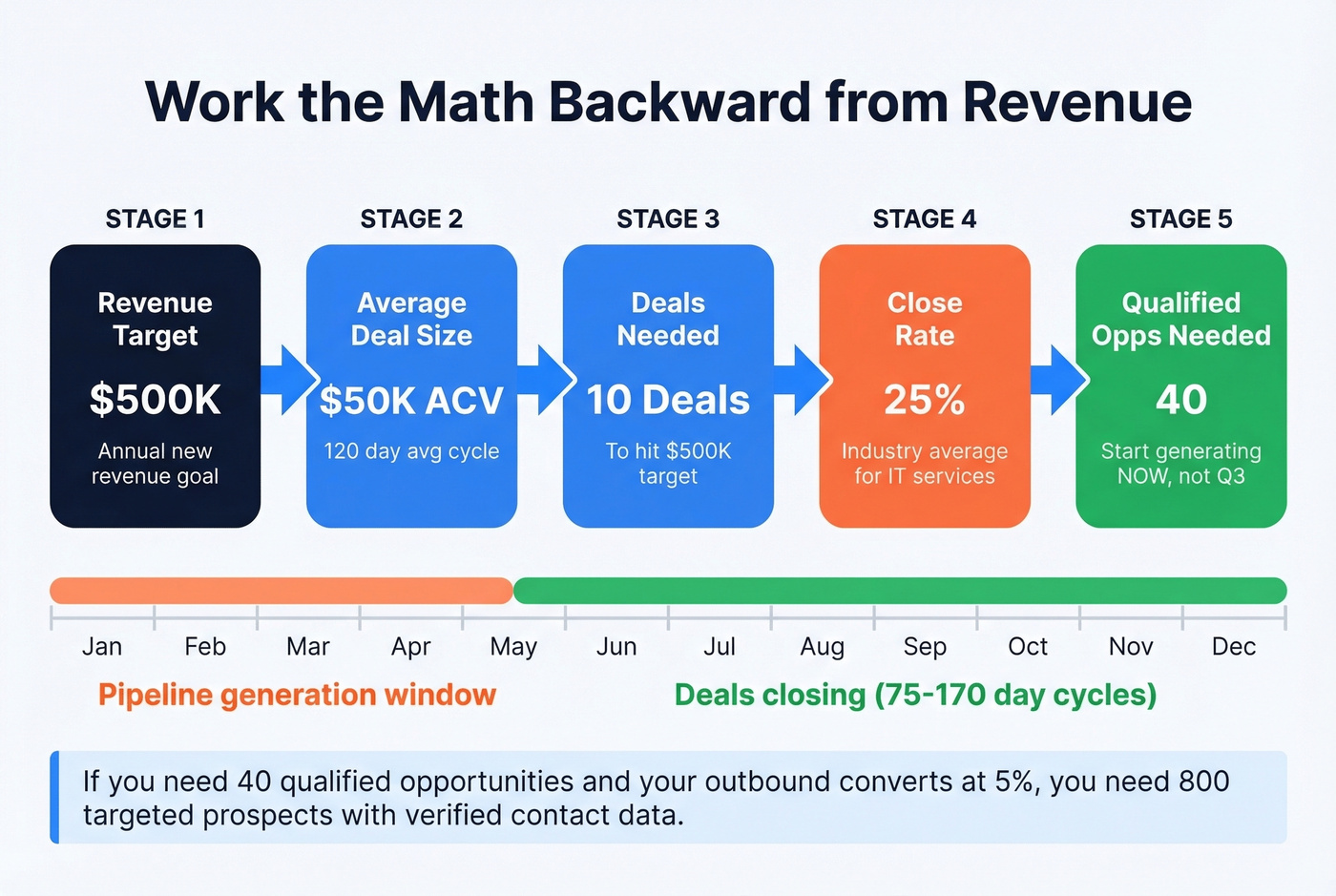
Don't judge your GTM motion after 30 days. Technology sales cycles average 121 days. Consulting runs 103. Cycle length scales directly with deal size:
| Deal Size (ACV) | Avg. Cycle |
|---|---|
| $10k-$50k | 75 days |
| $50k-$100k | 120 days |
| $100k-$250k | 170 days |
| >$500k | 270 days |
If you need $500k in new revenue this year and your average deal is $50k at a 25% close rate, you need 40 qualified opportunities in the pipe - and you need them generating now, not in Q3. Work the math backward from your revenue target, not forward from your activity metrics.
GTM Mistakes That Kill IT Services Companies
Four patterns we see repeatedly:
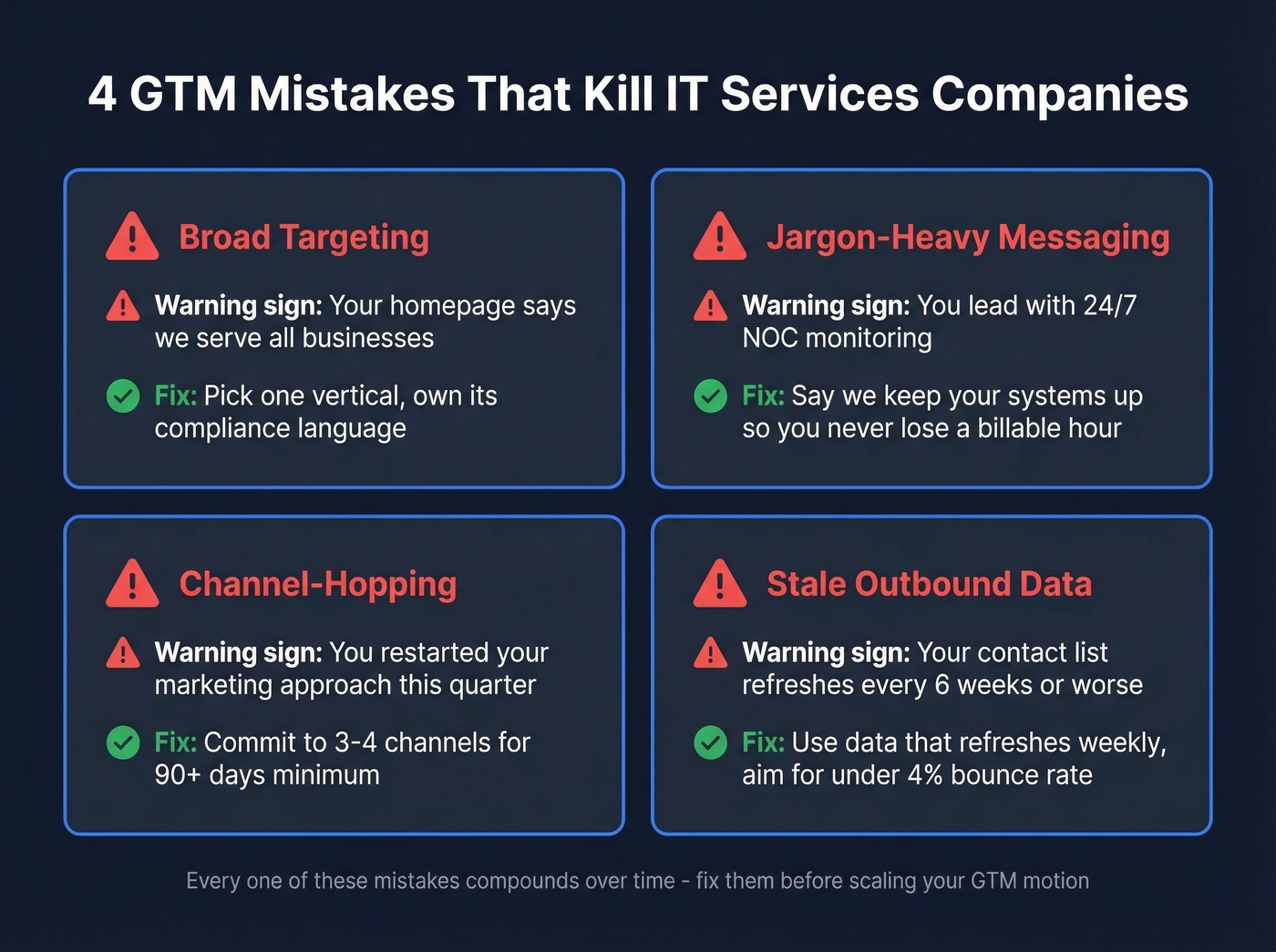
Broad targeting. "We serve all businesses" is a positioning death sentence. It means you compete on price with every other MSP in your metro. Without a clear buyer persona, your messaging resonates with no one.
Jargon-heavy messaging. If your homepage says "proactive managed services with 24/7 NOC monitoring," you've already lost the non-technical buyer. Speak their language, not yours. The consensus on r/msp backs this up - buyers don't care about your NOC. They care about whether their systems will be up when they need them.
Channel-hopping. Switching tactics every quarter means you never build momentum. SEO takes 6+ months. Referral programs take a quarter to ramp. Consistency is the antidote to the trust recession Robin Robins warned about.
Stale data in outbound. If your database refreshes every six weeks, you're emailing people who changed jobs last month. Bad data doesn't just waste time - it burns your sender reputation, and recovering from that is a months-long project. If you're running cold email, treat email deliverability and sender reputation like core infrastructure.
FAQ
How long does an IT services GTM strategy take to show results?
Expect 90-120 days for pipeline to build meaningfully. Technology sales cycles average 121 days, and referral-driven deals close fastest at 20-60 days. Plan for a full quarter before judging any channel's performance.
How much should an IT services company spend on marketing?
MSPs seeing results spend $2,000-$4,000/month on Google Ads alone, excluding management fees. Consistency matters more than volume - 3-4 channels funded steadily beats 8 channels funded sporadically.
Should I specialize in a vertical or stay a generalist?
Specialize. IT services companies targeting regulated industries - healthcare, finance, manufacturing - command higher margins because compliance expertise in HIPAA, PCI DSS, or GLBA is worth more than a lower price. Win rates and deal sizes more than compensate for the smaller addressable market.
What's the best way to build a prospect list for IT services outbound?
Use a B2B data platform with industry and job-title filters to match your vertical ICP. Look for platforms with frequent data refresh cycles and high email accuracy - bounce rates above 5% will damage your domain reputation fast. The free tiers most platforms offer are enough to validate your targeting before scaling spend.