

Go-to-Market Strategy for Lean Startups: A 2026 Guide
Slide 8 says "Go-to-Market Strategy" - you and your co-founder both know it's fiction. You wrote it to match the investor deck's revenue forecast, not because you've validated a single acquisition channel. A thread on r/ycombinator nails this: founders get locked into grand plans because they must forecast for investors, then treat assumptions as a roadmap instead of hypotheses to test. Plans are guesses. Your go-to-market strategy as a lean startup should be too - just structured guesses with a system for learning fast.
The Short Version
- Your GTM strategy is a set of hypotheses, not a plan. Structure it as Build-Measure-Learn loops, not a 30-slide deck.
- Run 2-week GTM sprints testing one channel and message at a time. Measure with actionable metrics, not vanity ones.
- Start with the cheapest experiment that validates your riskiest assumption. A landing page, a 50-email outbound test, concierge fulfillment - whatever gets you signal fastest.
The Build-Measure-Learn GTM Loop
Most founders know the Build-Measure-Learn framework from Eric Ries. Few actually apply it to customer acquisition. They'll run it for product features but then write a traditional GTM plan with channels, budgets, and timelines as if they already know what works. That disconnect kills startups.
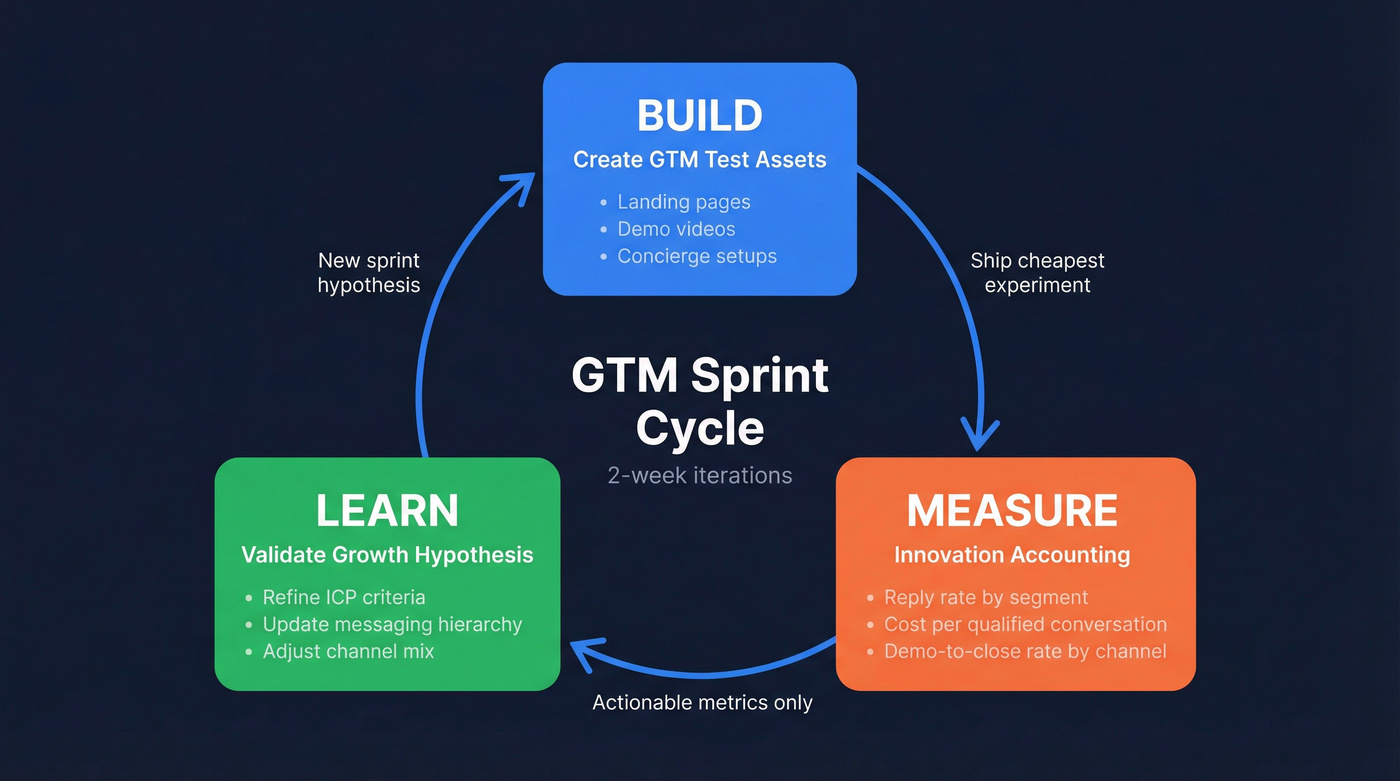
Build: MVPs as GTM Test Assets
"Build" doesn't mean "write code." Eric Ries defined the MVP as the fastest way to get through the Build-Measure-Learn feedback loop with minimum effort. For go-to-market, your MVPs are test assets - a landing page, a demo video, a Wizard of Oz setup where you manually fulfill what the product will eventually automate.
Buffer's founding team didn't build a product first. They put up a landing page explaining the concept, showed pricing, and collected email addresses. Dropbox took a different route: a 3-minute demo video that drove thousands of beta signups overnight. Neither team spent months building before testing whether anyone cared.
Plan your GTM experiments in reverse: start with what you need to learn, decide how you'll measure it, then build the cheapest artifact that produces that measurement. Your "build" phase should produce something that captures real buyer behavior - clicks, signups, replies - not opinions from friends who say "yeah, I'd totally use that."
Measure: Innovation Accounting
When your company is pre-revenue, traditional metrics are useless. Eric Ries calls this innovation accounting: evaluating progress when all the metrics established companies use are effectively zero. 67% of corporate startups fail because teams chase vanity metrics instead of validated learning.
Total signups and page views feel good. They tell you nothing about acquisition quality.
Track cost per qualified conversation, reply rate by segment, and demo-to-close rate by channel. For benchmarking context, average SaaS CAC runs $273 for B2B and $166 for B2C - but don't benchmark yourself against industry averages until you've moved past concierge selling. Everything else is noise at this stage. (If you want to go deeper on CAC definitions and what to include, see cost per qualified conversation.)
Learn: The Growth Hypothesis
The Growth Hypothesis is the most neglected concept in lean methodology, and it's the one that matters most for GTM. Teams obsess over whether customers want the product (the Value Hypothesis) but never systematically test how they'll acquire customers at scale. You can have product-market fit and still die because you never validated a repeatable acquisition channel. Steve Blank called this "customer development" - the acquisition side matters as much as the product side.
When a channel experiment fails, change the channel or the message. Not the vision.
Operationalize every sprint's learnings into three outputs: ICP refinement, messaging hierarchy, and channel mix. By sprint six, your ICP doc should have specific firmographic and behavioral criteria - not "Series A SaaS companies" but "Series A fintech companies with 20-50 employees who just hired a compliance lead." That precision comes from testing, not guessing.

Your 2-week GTM sprint is only as good as your contact data. Bad emails don't just waste credits - they corrupt your experiment results. Prospeo delivers 98% email accuracy on a 7-day refresh cycle, so when your reply rate is 2%, you know it's the message, not the data.
Eliminate bad data as a variable. Start testing for free.
Running Lean GTM Sprints
Two-week sprints are the execution unit. Each sprint tests one hypothesis with a defined experiment, a success metric, and a pre-committed decision. The Heinz Marketing framework puts it well: a strong test answers what decision it informs, what metric defines success, which segment you're testing, how narrow the scope is, and what the timeframe looks like.
| Sprint Element | What to Define | Example |
|---|---|---|
| Hypothesis | Channel + segment + message | "Compliance-angle cold email to fintech CTOs" |
| Experiment | Scope + timeframe | 50 cold emails over 5 days |
| Success metric | Threshold for persevere | >5% reply rate, >2 qualified demos |
| Decision | Pre-committed action | Below threshold: pivot message or segment |
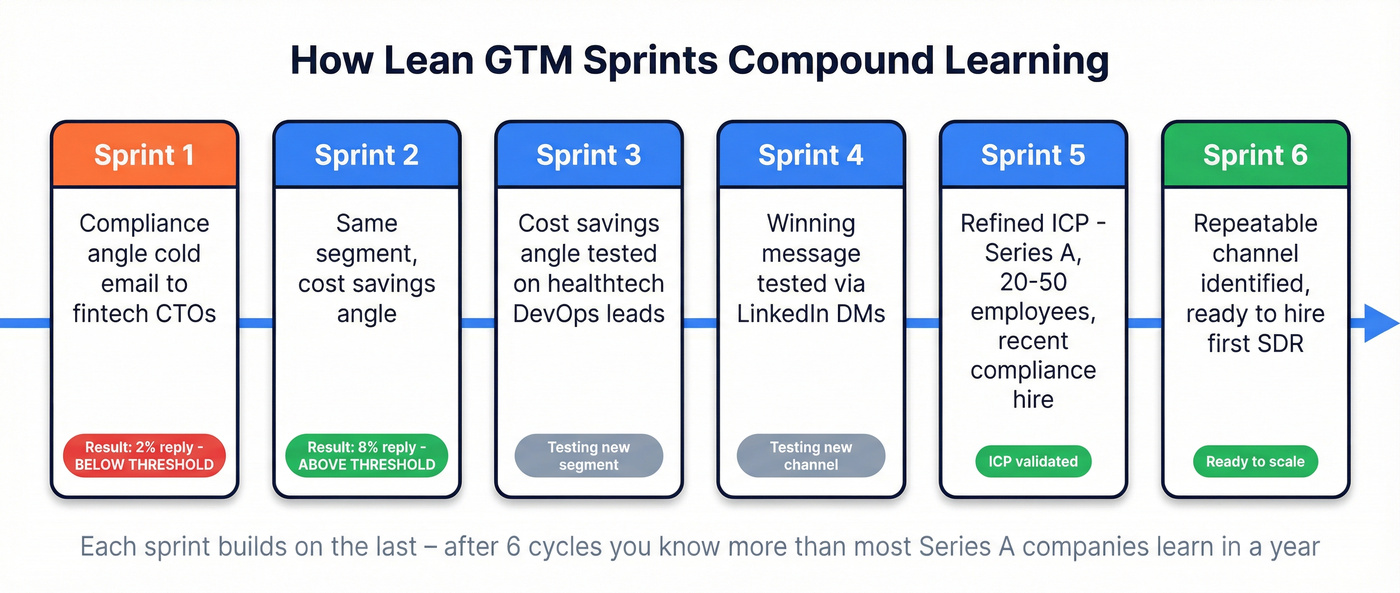
Here's a worked example. Say you're selling an API monitoring tool. Sprint 1 hypothesis: "DevOps leads at Series A fintech companies will book a demo from a cold email about compliance logging." You pull 50 contacts matching that ICP, send a 3-sentence email, and measure reply rate over 5 days. You get a 2% reply rate - below threshold. Sprint 2: same segment, different angle (cost savings instead of compliance). Reply rate jumps to 8%. Now you've learned something real. Sprint 3 tests whether that angle works for healthtech DevOps leads. This is how lean GTM compounds - each sprint builds on the last, and after six cycles you know more about your market than most Series A companies learn in a year.

Customer discovery runs in parallel. Winware's founder spoke to 300+ companies before building anything - 2-4 interviews per day. Vistaly's team runs 15-20 customer conversations per week with defined learning goals. For recruitment, start with your personal and investor networks, then graduate to content that creates inbound leads for learning.
Your outbound sprint needs verified contact data, not a 50K-record database. Pull 50-100 contacts matching your ICP hypothesis. Prospeo's free tier gives you 75 verified emails plus 100 Chrome extension credits per month at 98% accuracy on a 7-day refresh cycle - enough to test whether your messaging and ICP hold up without bad data polluting results. If 15 of your 50 emails bounce, you can't tell whether the message failed or the data did. Eliminate that variable first. (If you need a lightweight stack for early outbound, compare options in free lead generation tools and SDR tools.)
Choosing Your GTM Motion
PLG vs sales-led isn't a religion - it's a hypothesis. Test it like one.
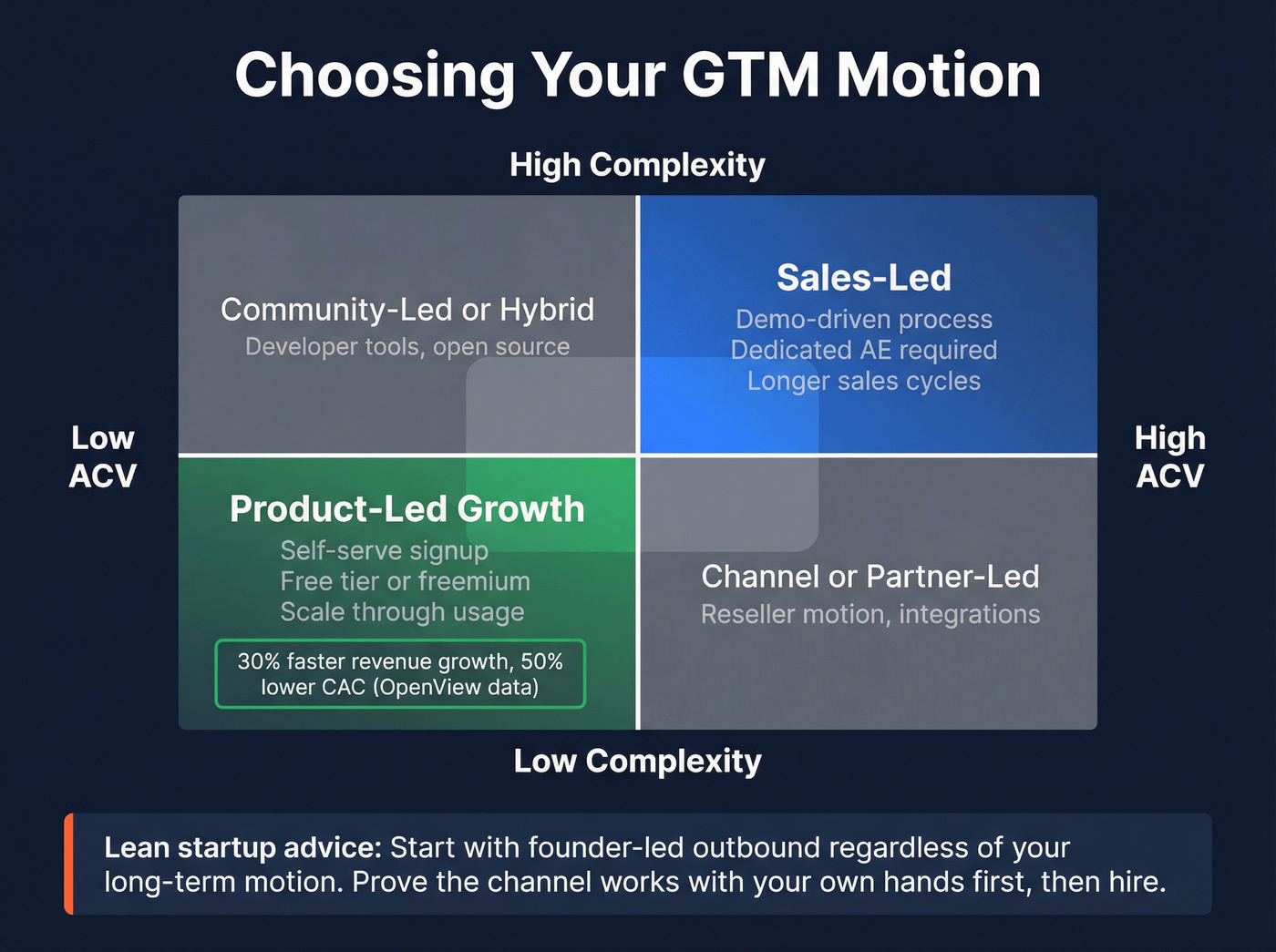
The decision breaks along two axes: low product complexity plus low ACV points toward product-led growth, while high complexity plus high ACV points toward sales-led. OpenView portfolio tracking shows PLG companies grow revenue 30% faster and have 50% lower CAC compared to sales-led peers.
Here's the thing: outbound remains the fastest lean validation channel, and most early-stage founders should start there regardless of their long-term motion. Founder-led conversations with 50 prospects over five days give you direct feedback loops - replies, objections, meeting quality - that no analytics dashboard can replicate. A PLG motion takes months to instrument properly. We've seen founders burn $50K on SDR hires before validating a single channel with founder-led outbound. Don't be that founder. Prove the channel works with your own hands first, then hire.
Lean GTM Mistakes That Kill Startups
Treating MVP as "small product." An MVP is a learning artifact, not a feature-reduced version of your vision. Zappos fulfilled orders by buying shoes from local stores. That's not a product - it's an experiment.
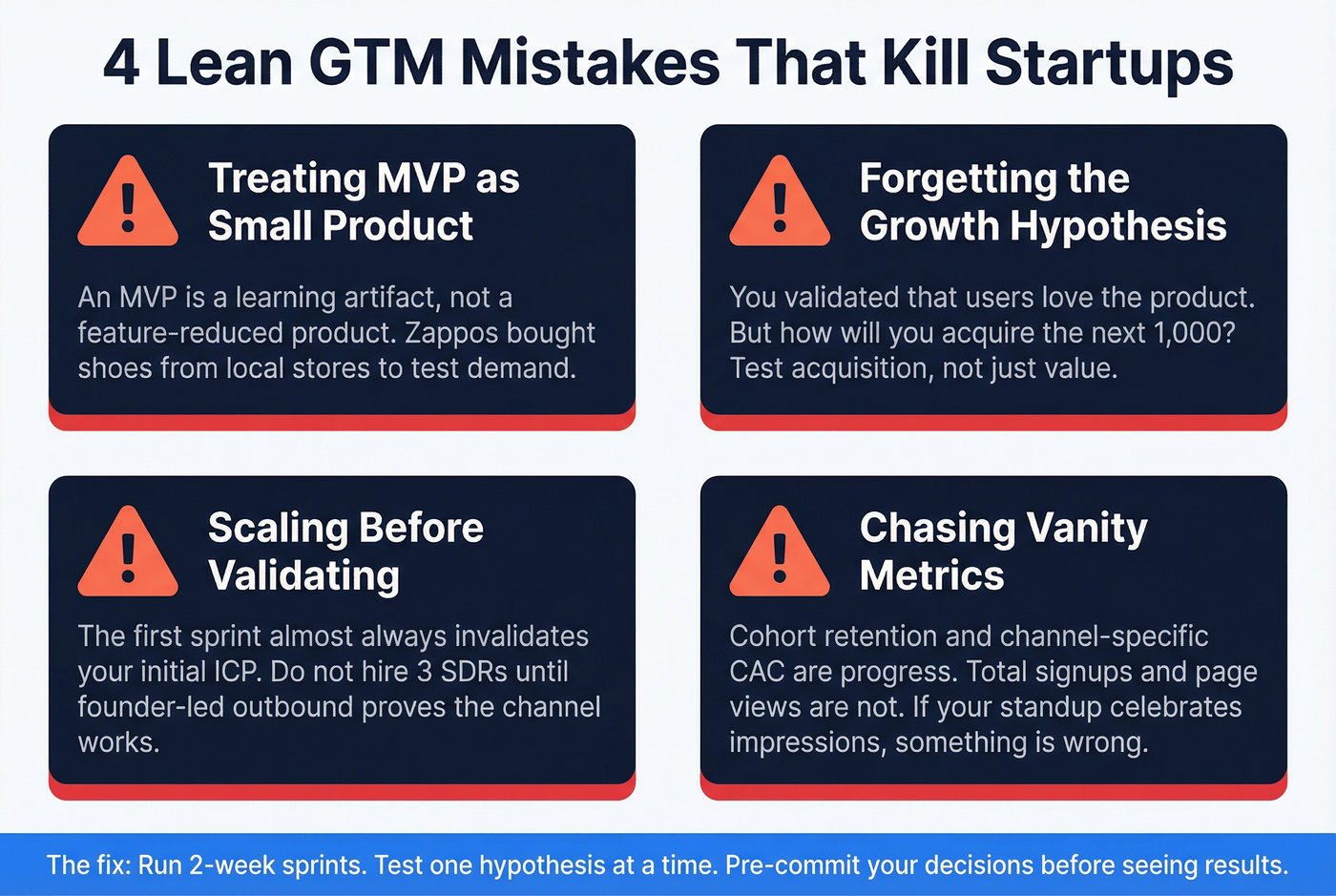
Forgetting the Growth Hypothesis. You've validated that users love the product. Great. How will you acquire the next 1,000? If you can't answer that with data from actual experiments, you haven't validated GTM.
Scaling before validating. In our experience, the first sprint almost always invalidates the initial ICP hypothesis - that's the point. Don't hire three SDRs until you've proven the channel works with founder-led outbound. Let's be honest: most founders skip this because founder-led selling feels beneath them. It isn't. (If you're tightening your outbound process, use these sales prospecting techniques and cold email follow-up templates.)
Chasing vanity metrics. Cohort retention and channel-specific CAC are progress. Total signups and page views are not. If your weekly standup celebrates "impressions," something's wrong. (For a clean KPI set, start with funnel metrics.)
Skip the 30-page GTM doc. A go-to-market strategy for a lean startup isn't a document you finish - it's a system you run. Every sprint sharpens your ICP, your messaging, and your channel confidence. After six sprints, you'll have more validated acquisition knowledge than most funded companies accumulate in a year.
Stop guessing your ICP - test it. Prospeo's 30+ search filters let you slice by funding stage, headcount growth, tech stack, and department size. Pull 50 contacts matching your sprint hypothesis at $0.01 per email and know exactly who you're reaching.
Build your first ICP test list in under 5 minutes.
FAQ
What's the difference between a GTM strategy and a marketing plan?
A GTM strategy validates how you'll acquire your first customers through structured hypotheses and experiments. A marketing plan is an ongoing operational document for scaling proven channels. For lean startups, your GTM strategy should be a living set of sprint results that evolve weekly - not a static slide deck you revisit quarterly.
How long should a lean GTM experiment run?
Two weeks per sprint. That's long enough to collect meaningful signal from 50-100 outreach attempts or 200-500 landing page visitors, but short enough to iterate before burning runway. If you're spending more than two weeks before measuring, you're running a traditional campaign, not an experiment.
What tools do I need for a lean GTM sprint?
Keep the stack minimal: a verified contact data source for outbound experiments (Prospeo's free tier covers early sprints), a sequencing tool like Instantly or Lemlist, and a shared doc for hypothesis tracking. Add tools only when a validated channel demands them - premature tooling is its own form of waste.