

Go-to-Market Strategy for Professional Services That Actually Works
Your managing partner just asked why revenue is flat despite a 95% client satisfaction score. Happy clients aren't the same as growing pipeline - and most go-to-market strategy advice out there is built for SaaS companies launching products, not professional services firms selling expertise. The playbook is different here.
We've seen this pattern across dozens of firms: great delivery, anemic BD, and a "strategy" that's really just a to-do list. Getting it wrong means another year of flat growth while smaller, sharper competitors eat your lunch.
Three Priorities Before Anything Else
If you take nothing else from this article, nail these three things. First, pick a niche and differentiate aggressively - generalists lose proposals to specialists, every time. Second, fix the seller-doer problem with training and incentives, not motivational speeches. Third, launch ABM for your top 20 accounts - 87% of marketers say it outperforms every other investment, and firms that implement it see a 171% increase in average contract value per TOPO research.
Why Professional Services GTM Is Its Own Animal
Most GTM frameworks assume you're selling a product someone can demo. Professional services don't work that way. You're selling expertise and outcomes - buyers can't trial your advisory work before signing. That creates a trust gap that only positioning and proof can close.
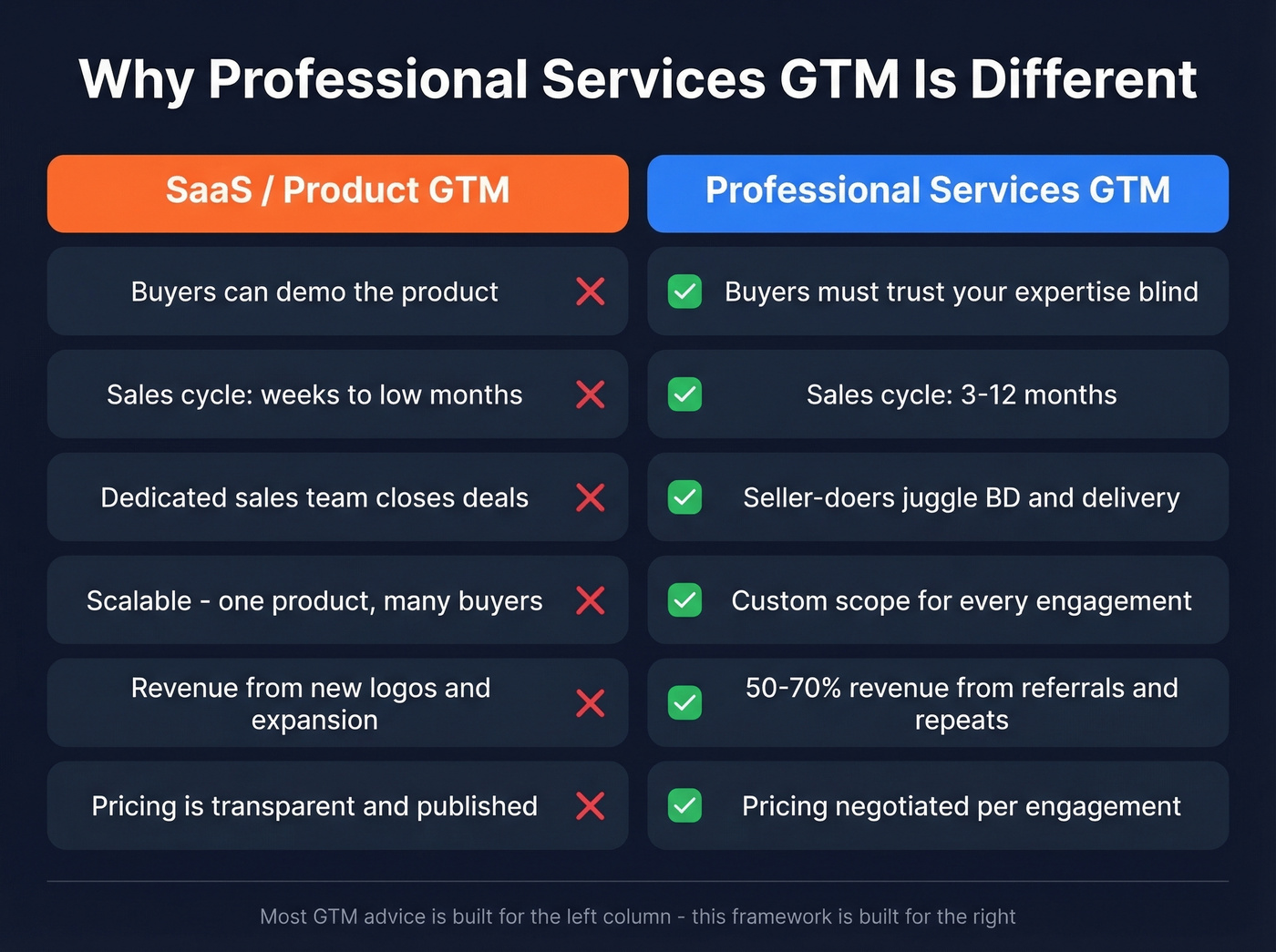
Then there's the seller-doer tension. Your best salespeople are also your best delivery people, and delivery urgency always wins. BD gets pushed to "next quarter" indefinitely. Mid-market engagements run 3-6 months from first conversation to signed SOW; enterprise and complex advisory stretches to 6-12+ months, which means your pipeline needs to be full today for revenue you won't see until next year.
Most firms derive 50-70% of revenue from referrals and repeat clients, but referral use as a search method has dropped 15% over recent years. You can't rely on referrals alone anymore.
The 7-Step GTM Framework
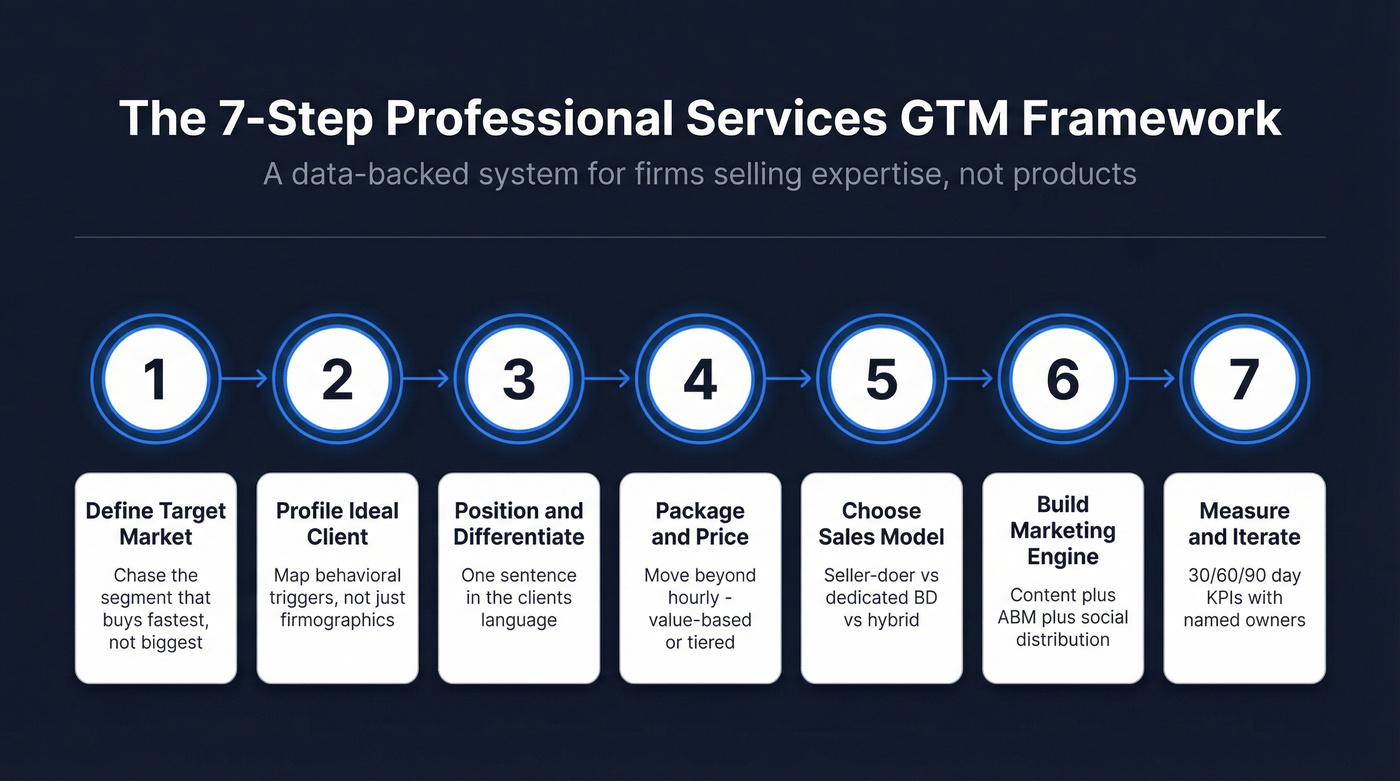
1. Define Your Target Market
Chase the segment that buys fastest, not the biggest one. Evaluate by urgency of problem, ease of adoption, and sales cycle length. A pre-seed B2B startup completed this exercise in two months by narrowing to the segment with the shortest path to revenue. Most firms skip this step and pay for it with bloated proposals that try to be everything to everyone.
2. Profile Your Ideal Client
Go beyond firmographics. Map the behavioral triggers - risk mitigation, budget certainty, procurement frameworks, time pressure - that tell you when to reach out, not just who. A CFO hiring their first VP of Finance is a different buyer than a CFO replacing one who left. Same title, completely different urgency.
3. Position and Differentiate
Differentiation is the #2 marketing priority of High Growth professional services firms, per Hinge's 2025 study of 770 firms. Here's the thing: you've lost a proposal to a smaller firm that positioned as specialists while you pitched as generalists. That's a positioning failure, not a capability one.
Write your positioning statement in one sentence using the client's language, not yours. "We help mid-market SaaS CFOs close their books in 5 days instead of 15" beats "We provide comprehensive financial advisory services" every single time.
4. Package and Price Your Services
Don't default to hourly billing - it's dying as AI compresses delivery hours. The key calculation: $120K fully loaded cost / 1,600 billable hours = $75/hr cost. At a 50% margin target, your floor rate is $150/hr. Work backward from there.
We'll cover pricing models in more detail below, but the short version: if you're still billing exclusively by the hour in 2026, you're subsidizing your own disruption.
5. Choose Your Sales Model
Two-thirds of firms using seller-doers provide zero sales training. That's not a model - it's a hope. If you're selling bespoke C-suite advisory, seller-doer works because the relationship is the product. Standardized services? Dedicated BD scales better and frees your experts to deliver.
6. Build Your Marketing Engine
High Growth firms typically invest 7-10% of revenue in marketing - roughly double the industry average of 3-5% - and that 2X investment yields 4X growth. Three channels matter most:
- Educational content - the #1 priority for High Growth firms. Not thought leadership fluff, but genuinely useful frameworks your ICP can apply immediately. (If you need a baseline, start with B2B content marketing.)
- ABM for your top accounts - 91% of companies using ABM increase average deal size. Target 20 accounts, not 200.
- Professional social platforms as your primary distribution channel. Your content doesn't matter if nobody sees it.
Once you've defined target accounts, you need verified contact data to reach decision-makers. Prospeo covers 300M+ professional profiles with 98% email accuracy and a 7-day data refresh cycle, so you're reaching buyers with current data rather than spraying cold emails into the void. Layer in intent data across 15,000 topics to find accounts actively researching your category.
7. Measure and Iterate
Billable utilization should sit at 70-80%. Win rate for shortlisted proposals ranges 25-40% at average firms, 40-60% at top performers. SPI Research's annual benchmark tracks firms across five performance pillars - use it to calibrate your KPIs against industry standards.
Watch for "shadow ops" - fragmented finance and HR support that makes pipeline data unreliable. If you can't trust your numbers, you can't improve them. High Growth firms that invest 2X in marketing and measure rigorously grow 4X faster and run up to 30% more profitable than peers.

Your GTM framework targets 20 accounts - but are you reaching the right people with current data? Prospeo's 300M+ profiles refresh every 7 days, so you're never pitching a buyer who changed roles last month. Layer Bombora intent data across 15,000 topics to find accounts actively researching your service category.
Stop guessing which accounts are in-market. Start knowing.
Pricing Models That Work in 2026
| Model | Best For | Risk Level | AI Impact |
|---|---|---|---|
| Hourly / T&M | Uncertain scope | Low (for firm) | High - hours shrink |
| Fixed Fee | Clear scope | Medium | Medium |
| Retainer | Ongoing relationships | Low | Low |
| Value-Based | Measurable ROI | High | Low - tied to outcomes |
| Tiered Packages | Client self-selection | Medium | Medium |
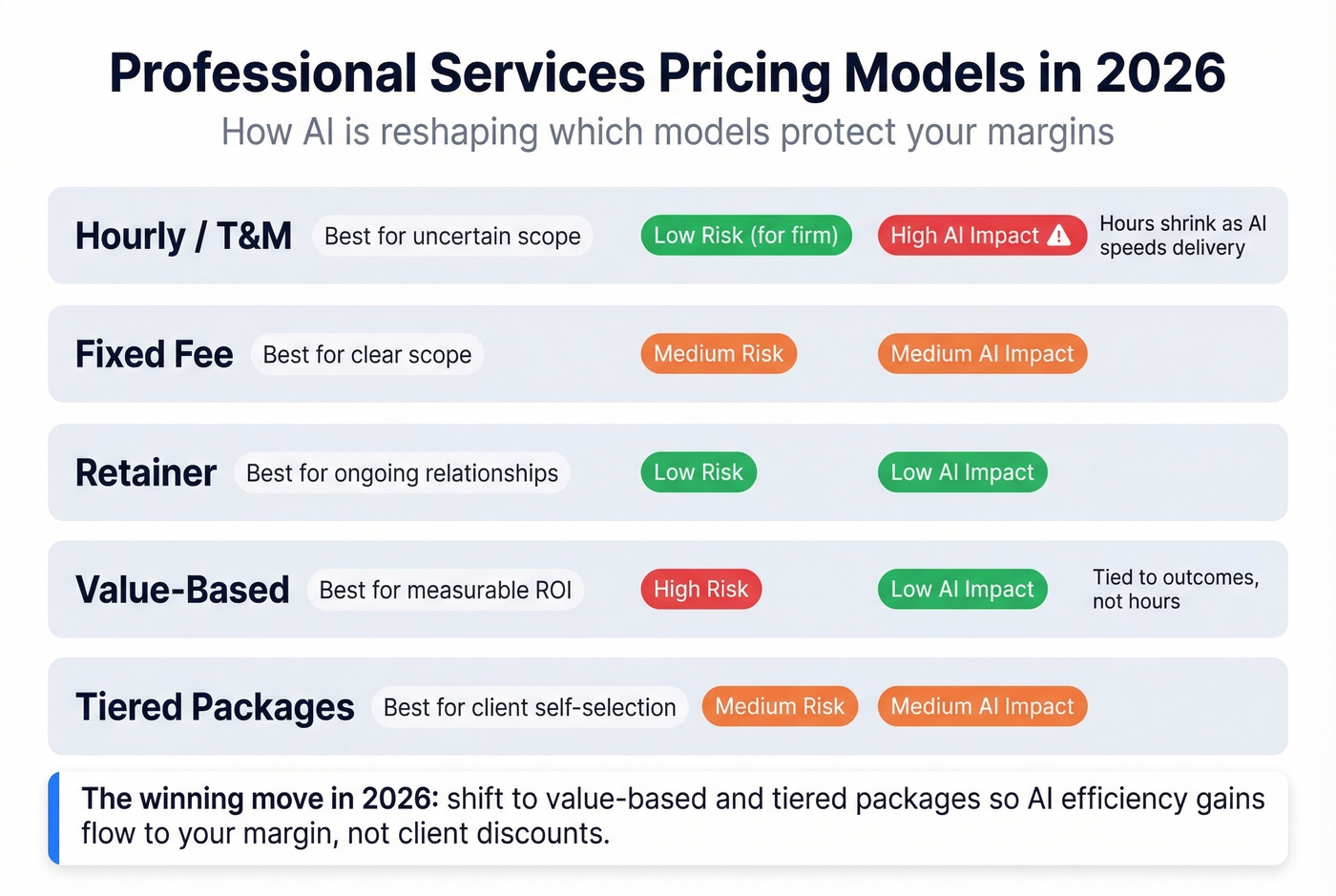
AI is the #1 business challenge High Growth firms identified in Hinge's latest study - and the firms adapting fastest are shifting to value-based and tiered packages where efficiency gains flow to margin, not client discounts. Build annual price review triggers into every contract. Skip this if your firm has no AI exposure in delivery, but let's be honest - that's almost nobody in 2026.
Common GTM Mistakes to Avoid
Confusing activity with progress. BD plans that list "attend 3 conferences" and "publish 4 articles" are to-do lists, not strategies. A strategy explains why those activities will generate pipeline and how you'll measure them. (If you want a clearer definition of what “activity” looks like, use these sales activities examples.)
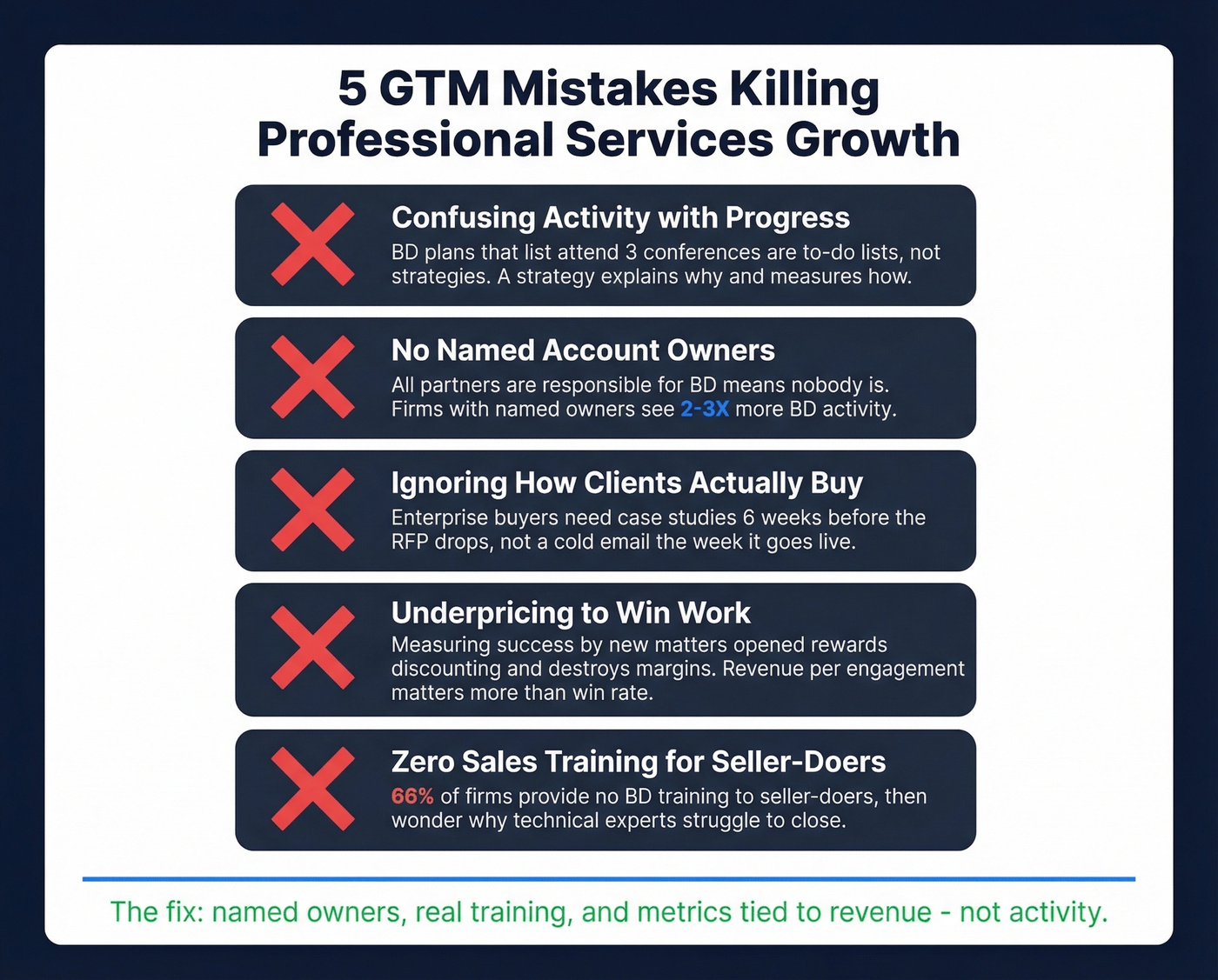
No accountability. "All partners are responsible for BD" is operationally useless. In our experience, firms that name specific account owners see 2-3X the BD activity of those that don't. No named owner means no owner.
Ignoring how clients buy. Most BD plans are inward-looking. Align yours with client buying behavior, not internal org charts. A procurement-heavy enterprise buyer needs case studies and references six weeks before the RFP drops - not a cold email the week it goes live.
Underpricing to win work. Measuring success by "new matters opened" rewards discounting and destroys margins. Win rate matters less than revenue per engagement.
No sales training for seller-doers. Two-thirds provide none. Then they wonder why technical experts struggle to close. The consensus on r/consulting is blunt: firms that treat BD as a skill to develop, not a personality trait, win more.
One-Page GTM Plan Template
Fill this out this week. Iterate monthly.
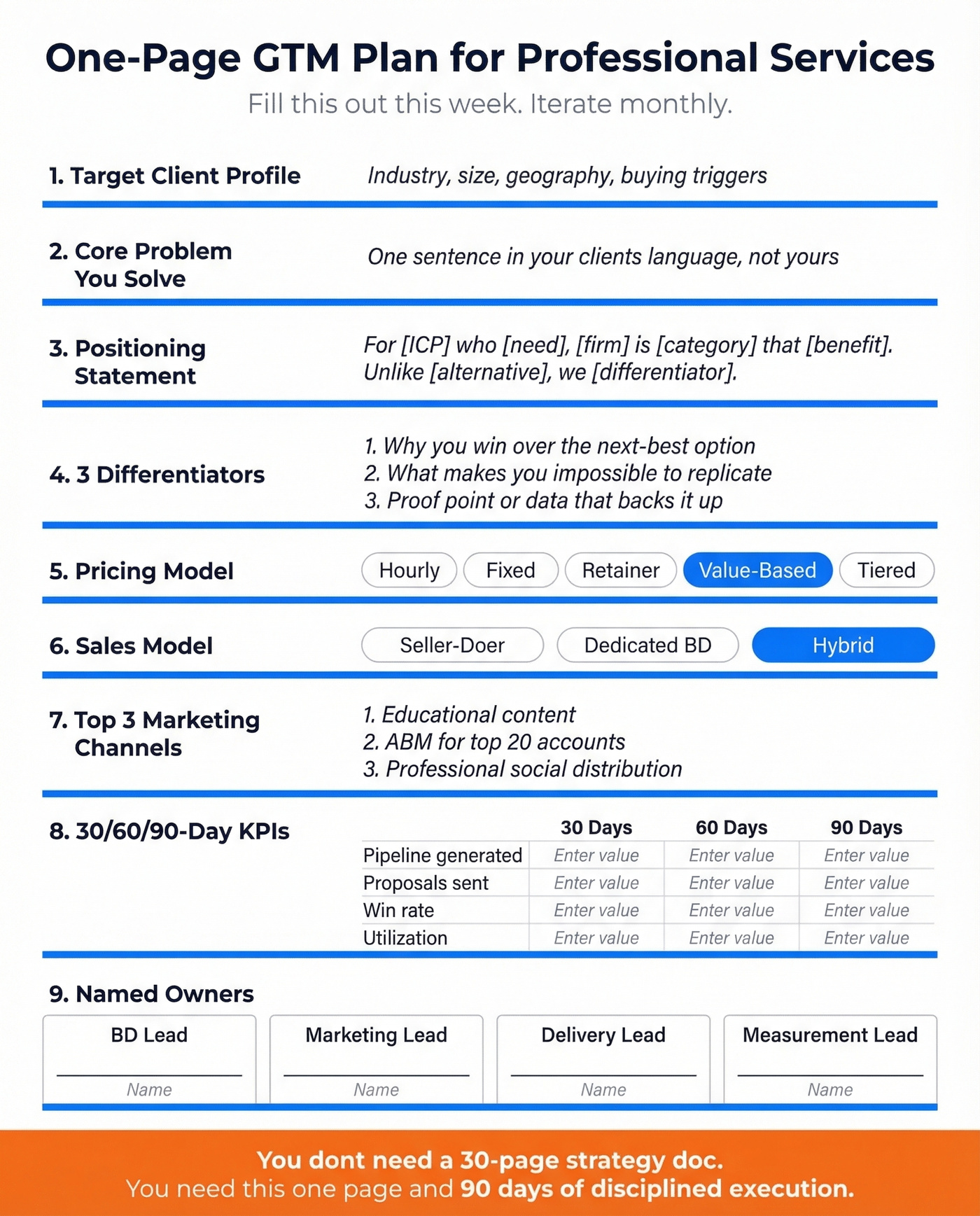
- Target client profile: Industry, size, geography, buying triggers
- Core problem you solve: One sentence, client's language
- Positioning statement: For [ICP] who [need], [firm] is [category] that [benefit]. Unlike [alternative], we [differentiator]. (Use an elevator pitch format if you get stuck.)
- 3 differentiators: Why you win over the next-best option
- Pricing model: Hourly / fixed / retainer / value-based / tiered
- Sales model: Seller-doer / dedicated BD / hybrid
- Top 3 marketing channels: Educational content, ABM, outbound, events
- 30/60/90-day KPIs: Pipeline generated, proposals sent, win rate, utilization (Borrow a structure from a 30/60/90-day plan.)
- Named owners: Who owns BD, marketing, delivery, measurement
You don't need a 30-page strategy document. You need this one page and 90 days of disciplined execution. A strong go-to-market strategy for professional services firms isn't a document that lives in a shared drive - it's a living system with named owners, clear metrics, and quarterly iteration. Start here, measure ruthlessly, and adjust. (If you’re struggling to keep pipeline honest, audit your pipeline health monthly.)
Seller-doers don't have 6 hours a week for bad data. Prospeo delivers 98% email accuracy and 30% mobile pickup rates, so every minute your experts spend on BD actually connects them with decision-makers. At $0.01 per email, it costs less than a single billable hour to fill your entire pipeline.
Give your seller-doers verified contacts, not bounced emails.
FAQ
How long does it take to build a professional services GTM strategy?
A focused team can complete a working plan in 6-12 weeks. Launch with your one-page plan, measure at 30/60/90 days, and iterate. Firms that ship a "good enough" plan and refine it quarterly outperform those stuck in planning mode every time.
What's the biggest GTM mistake consulting firms make?
Treating BD as everyone's responsibility with no named owners, no training, and no accountability. Firms that assign specific people to specific accounts with measurable targets see 2-3X the pipeline activity of those relying on vague "all partners sell" mandates.
How do you find decision-makers at target accounts?
Use a B2B data platform like Prospeo to pull verified emails and direct dials for your ICP, filtered by buyer intent and company growth signals. With 30+ search filters and 98% email accuracy, you skip the guesswork and reach the right contacts from day one.
What marketing budget should a professional services firm allocate?
High Growth firms invest 7-10% of revenue in marketing, roughly double the 3-5% industry average. That 2X investment correlates with 4X growth and up to 30% higher profitability, according to Hinge Research's study of 770 firms.