

The Go-to-Market Strategy Template That Actually Gets Used
Your CEO wants the GTM plan by Friday. You've got a new product, a half-baked ICP, and a slide deck from the last launch that nobody opened after week two. Somewhere between 40% and 80% of product launches fail, and it's rarely because the go-to-market strategy template was missing a section. It's because the template became checkbox theater - filled out once, filed away, never revisited.
What follows isn't another 30-slide deck you'll abandon. It's a working framework with real benchmarks, a PLG vs. sales-led decision tree, and the five failure modes your plan should actively prevent. Whether you need a simple one-pager or a full launch document, this covers both.
The Complete GTM Template
If you just want the skeleton, here it is. Four phases, copy-paste ready, format-agnostic - Notion, Google Docs, Sheets, whatever your team actually uses. Think of it as a planning scaffold that scales from a single-page brief to a full launch plan.
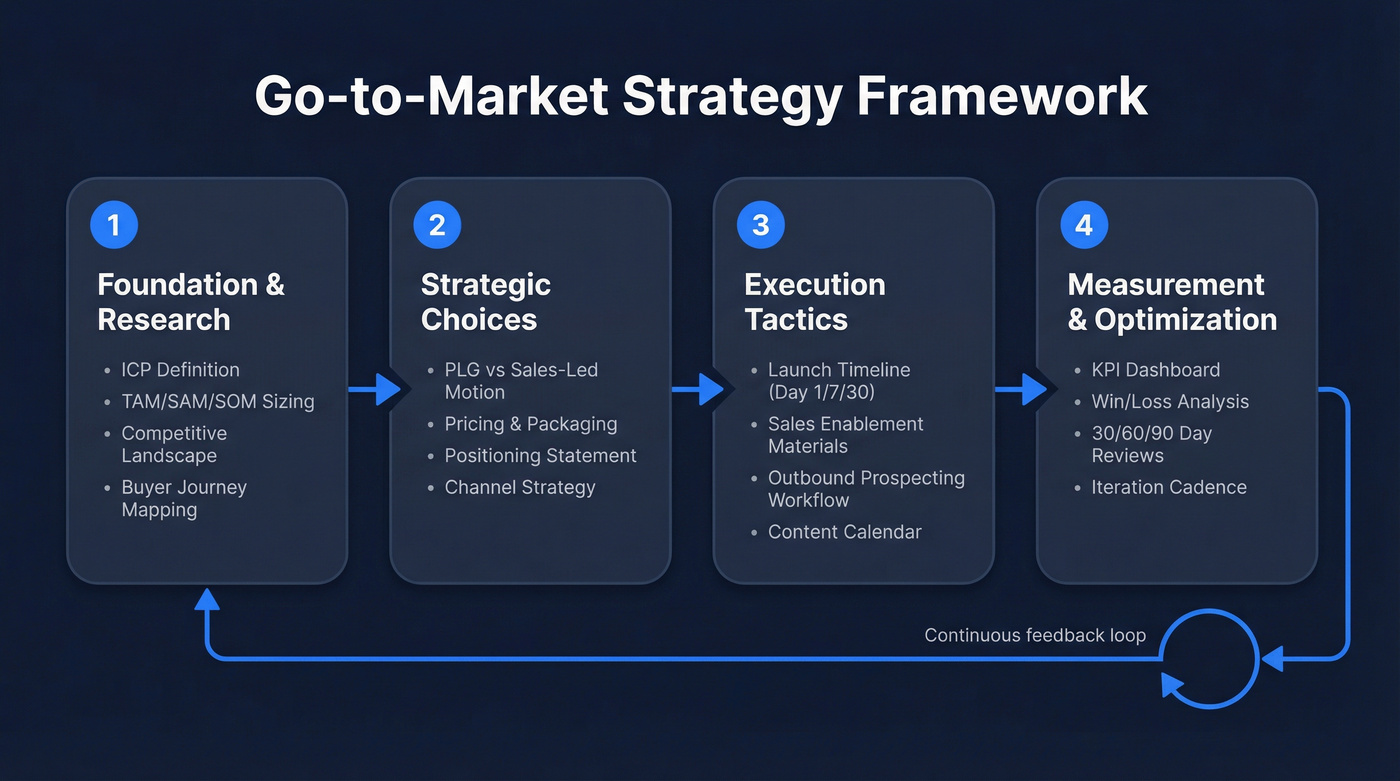
Phase 1 - Foundation & Research: ICP definition, TAM/SAM/SOM sizing, competitive landscape audit, buyer journey mapping.
Phase 2 - Strategic Choices: Motion selection (PLG vs. sales-led vs. hybrid), pricing and packaging, positioning statement, channel strategy.
Phase 3 - Execution Tactics: Launch timeline, channel activation plan, sales enablement materials, content calendar, outbound prospecting workflow.
Phase 4 - Measurement & Optimization: KPI dashboard, feedback loops through win/loss analysis and churn interviews, iteration cadence at 30/60/90-day reviews.
Copy-Paste GTM Strategy Doc
Copy this into your doc tool. Fill in the blanks. Delete the instructions.
============================================
GO TO MARKET STRATEGY - [PRODUCT NAME]

Owner: _______________

Last updated: _______________

Launch date: _______________
============================================

PHASE 1: FOUNDATION & RESEARCH
-------------------------------

Target ICP:
  Job title(s): _______________
  Company size: _______________
  Industry: _______________
  Pain trigger: _______________
  Buying committee: _______________
  Budget authority: _______________

Market Sizing:
  TAM: $_______________
  SAM: $_______________
  SOM: $_______________

Competitive Landscape:
  Primary competitor: _______________
  Their positioning: _______________
  Our differentiation (one sentence): _______________

ICP Validation:
  Customer interview 1: _______________
  Customer interview 2: _______________
  Customer interview 3: _______________
  Customer interview 4: _______________
  Customer interview 5: _______________

Regulatory/Compliance Notes: _______________

PHASE 2: STRATEGIC CHOICES
-------------------------------

GTM Motion: [ ] PLG/Self-Serve  [ ] Hybrid  [ ] Sales-Led
  ACV justification: $_______________

Positioning Statement:
  For [target customer] who [pain point],
  [product] is the [category] that [key outcome].
  Unlike [competitor], we [differentiator].

Pricing & Packaging:
  Free tier: _______________
  Core plan: $_______________
  Enterprise plan: _______________

Channel Strategy:
  Primary channel: _______________
  Secondary channel: _______________
  Experimental channel: _______________

PHASE 3: EXECUTION TACTICS
-------------------------------

Launch Timeline:
  Day 1: _______________
  Day 7: _______________
  Day 30: _______________

Sales Enablement Checklist:
  [ ] Battle cards
  [ ] Objection handling doc
  [ ] Demo script
  [ ] Competitive one-pagers
  [ ] Case study / proof points

Outbound Workflow:
  Contact data source: _______________
  Verification method: _______________
  Sequence tool: _______________
  Cadence: ___ emails over ___ days

Content Calendar:
  Launch blog post: _______________
  Product demo video: _______________
  Customer story: _______________

RACI Matrix:
  ICP definition - Owner: ___ Reviewer: ___ Sign-off: ___
  Positioning - Owner: ___ Reviewer: ___ Sign-off: ___
  Enablement - Owner: ___ Reviewer: ___ Sign-off: ___
  Launch comms - Owner: ___ Reviewer: ___ Sign-off: ___

PHASE 4: MEASUREMENT & OPTIMIZATION
-------------------------------

KPI Targets:
  Activation rate: ___%
  Pipeline coverage: ___x
  Win rate: ___%
  CAC payback: ___ months
  NRR: ___%

Review Cadence:
  Day 30 review date: _______________
  Day 60 review date: _______________
  Day 90 review date: _______________

Win/Loss Analysis:
  Wins - top 3 reasons: _______________
  Losses - top 3 reasons: _______________

Iteration Notes:
  What's working: _______________
  What's not: _______________
  Next experiment: _______________
============================================
That's the frame. The rest of this article teaches you how to fill each section with numbers that actually mean something - not placeholder text that sounds strategic but says nothing.
How to Fill In Each Section
Foundation & Research
Your ICP isn't "mid-market SaaS companies." That's a category, not a customer. A useful ICP specifies the job title, the pain trigger, the buying committee structure, and the conversion benchmarks you're targeting. If you need a starting point, use an ICP scoring rubric instead of guessing.
Buyers complete 70% of their learning before talking to sales, which means your research phase determines whether your messaging lands or gets ignored entirely.
Start with TAM/SAM/SOM - not because investors demand it, but because it forces you to quantify how many accounts you can realistically reach. Then map the competitive landscape. Not a feature matrix. A positioning map that answers one question: "Why would someone switch from their current solution to ours?" If you can't answer that in one sentence, you're not ready to launch.
We've seen teams spend six weeks on a GTM plan and skip the ICP validation entirely. Don't do that. Add a validation checkpoint that requires at least five customer interviews before the positioning section gets filled in. If you're selling into regulated industries or handling EU data, add a regulatory compliance checkpoint here too - GDPR and CCPA requirements can reshape your entire data strategy.
Strategic Choices
This is where most templates go wrong. They list "positioning" as a section header and leave a blank text box. Your positioning statement needs to lead with outcomes, not features. "We reduce pipeline review time by 60%" beats "AI-powered pipeline analytics platform" every single time. If you want a deeper framework, treat this as B2B brand positioning, not copywriting.
The biggest strategic fork is your motion. We'll dig into the PLG vs. sales-led math in the next section, but the shortcut is ACV-based: under $5K, go self-serve; $5K-$25K, run a hybrid motion; above $25K, invest in sales-led with proper enablement. Your pricing and packaging should reinforce whichever motion you pick. A $3K/year product with a "request demo" gate is fighting itself.
Channel strategy matters more than most teams realize. The average software company runs 10.5 simultaneous GTM efforts - five core channels plus five-plus experimental ones. That sounds aggressive, but it reflects a real shift: 94% of B2B decision makers say omnichannel selling is as effective or more effective than pre-pandemic models, and B2B SaaS deals now touch 15-20 marketing and product interactions before close. You don't need 10 channels on day one, but planning for two to three from launch is the minimum.
Execution - Your Launch Checklist
Your launch timeline isn't a Gantt chart that lives in Asana and dies after week one. It's a sequenced activation plan: what happens on day one, day seven, day thirty. Sales enablement goes here - and it's chronically underfunded. Only 28% of a rep's time is spent actually selling. The rest is admin, research, and CRM hygiene. Your GTM plan should include a specific enablement checklist: battle cards, objection handling docs, demo scripts, and competitive one-pagers.
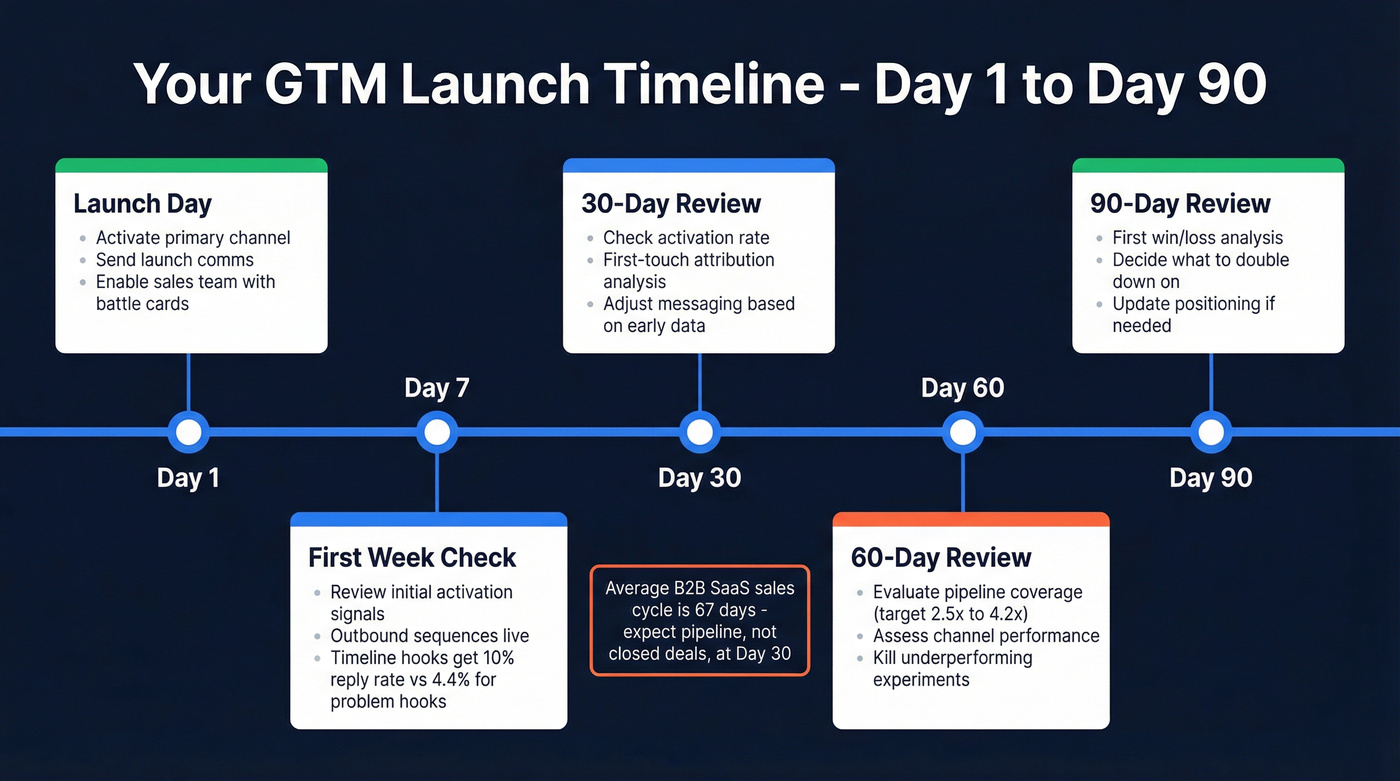
For outbound, timeline-based cold email hooks pull a 10.01% reply rate versus 4.39% for problem-based hooks. That's a 2.3x difference based on framing alone. Build that insight into your sequence templates before launch, not after your first campaign underperforms.
Measurement & Optimization
Here's where you calibrate against reality. The benchmarks that matter for a GTM plan aren't vanity metrics - they're unit economics. Target a CAC:LTV ratio of 3:1 to 5:1, CAC payback under 12 months, and win rates around 24% as a median baseline with 32% as top quartile. B2B SaaS sales cycles average around 67 days, so don't panic if deals aren't closing in week three.
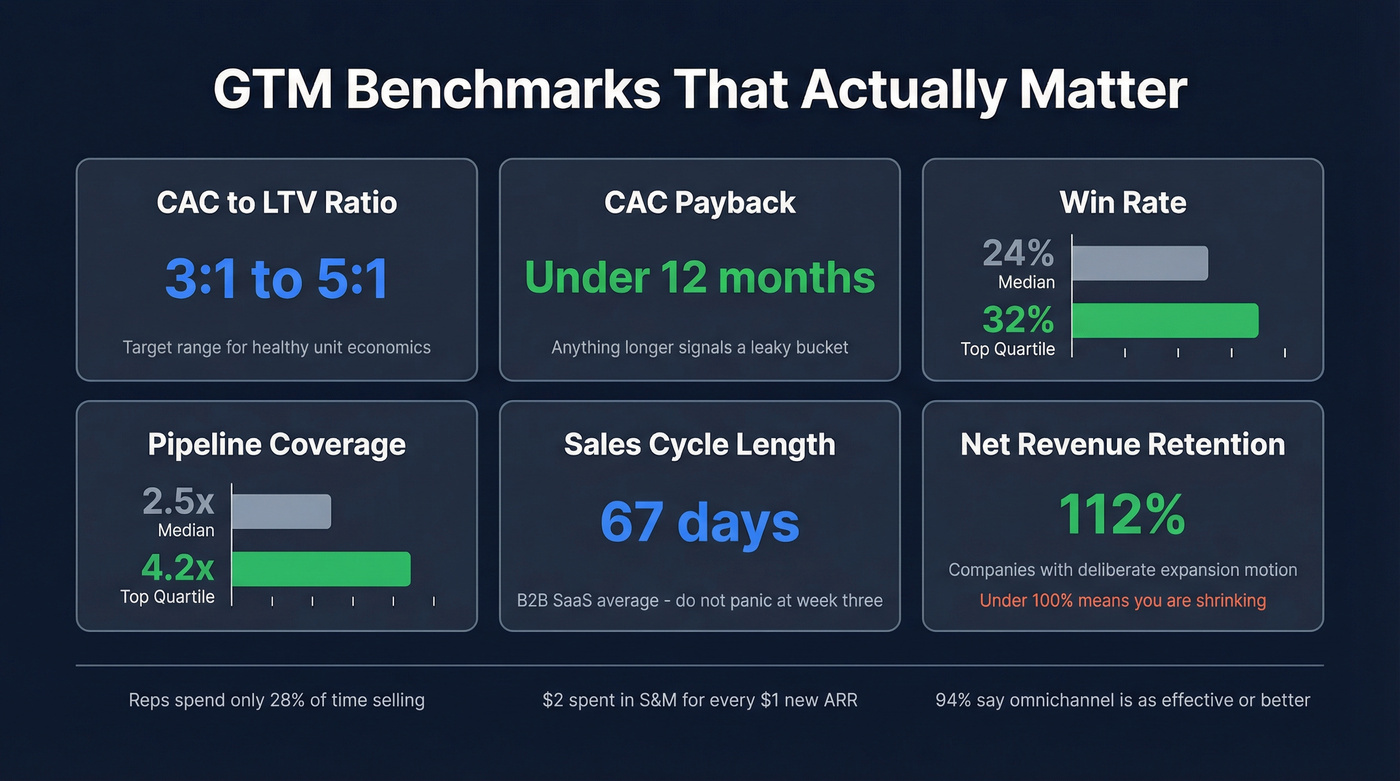
Build a 30/60/90-day review cadence into the template itself. At day 30, check activation rate and first-touch attribution. At day 60, evaluate pipeline coverage against the 4.2x top-quartile benchmark and the 2.5x median. At day 90, run your first win/loss analysis and decide what to double down on. In our experience, the templates that survive past launch week are the ones with a named owner for every section and a calendar invite for every review.
Think beyond the traditional funnel, too. The bowtie model treats activation, adoption, retention, and expansion as equal to acquisition - and companies that add a deliberate expansion motion can push NRR to ~112%. Phase 4 should track post-sale metrics with the same rigor as pipeline metrics.
PLG vs. Sales-Led Decision Tree
Stop debating this philosophically. It's an ACV calculation.
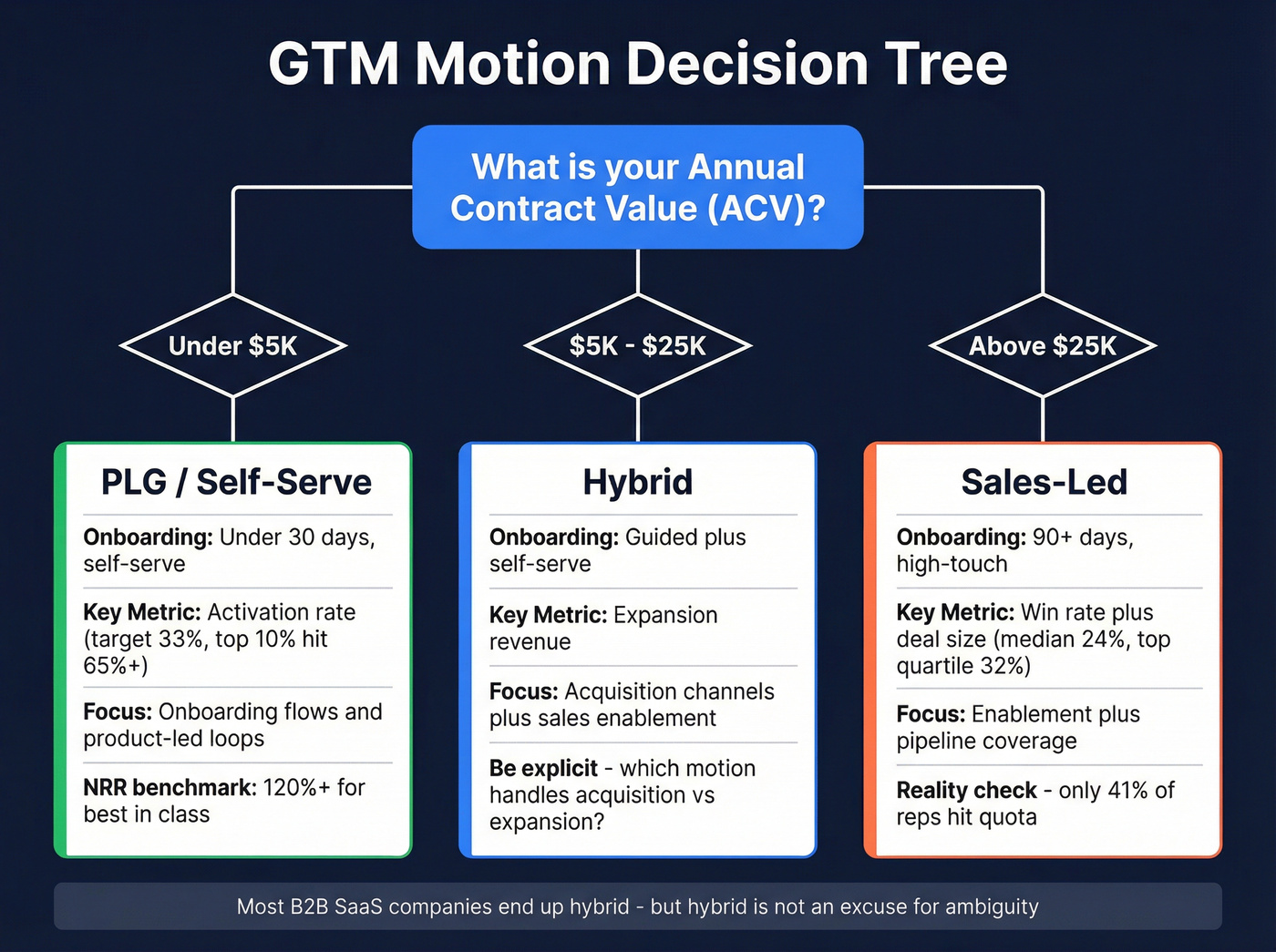
| Factor | PLG / Self-Serve | Hybrid | Sales-Led |
|---|---|---|---|
| ACV | Under $5K | $5K-$25K | Above $25K |
| Onboarding | Under 30 days, self-serve | Guided + self-serve | 90+ days, high-touch |
| Key Metric | Activation rate | Expansion revenue | Win rate + deal size |
| Template Focus | Onboarding flows | Acquisition + enablement | Enablement + pipeline |
PLG companies average a 33% activation rate, with the top 10% hitting 65%+. Best-in-class PLG companies maintain net revenue retention above 120%. If your product can't deliver value within 30 days without a human touching the account, PLG isn't your motion - regardless of what your board deck says.
On the sales-led side, the math is getting harder. Companies now spend $2 in sales and marketing for every $1 of new ARR, and that ratio is up 14% since 2024. Only 41% of SaaS reps hit quota. Your GTM plan needs to account for this reality - bake in realistic ramp times, quota expectations, and the enablement investment required to make sales-led work.
Here's the thing: most B2B SaaS companies end up hybrid, and that's the right call. But "hybrid" isn't an excuse for ambiguity. Be explicit about which motion handles acquisition and which handles expansion. If you can't draw that line on a whiteboard in 30 seconds, your team will default to whatever feels comfortable - and comfortable doesn't scale.

Your GTM execution phase needs a contact data source and verification method. Prospeo gives you both - 300M+ profiles with 98% email accuracy, 125M+ verified mobiles, and 30+ filters to match your exact ICP. No guessing, no bounced emails burning your domain on launch day.
Fill in that outbound workflow section with data that actually connects.
2026 GTM Benchmarks Worth Knowing
Calibrate your targets against these. The "Your Target" column is blank - fill it in before your next planning session.
| Metric | Top Quartile | Median | Your Target |
|---|---|---|---|
| ARR Growth | 93% | 50% | ___ |
| Pipeline Coverage | 4.2x | 2.5x | ___ |
| Win Rate | 32% | 24% | ___ |
| CAC Payback | 12-18 mo | 18-24 mo | ___ |
| PLG Activation | 65%+ | 33% | ___ |
| NRR | >120% | ~100% | ___ |
| Cold Email Reply | 10%+ | 5.8% | ___ |
Pipeline coverage at 4.2x for top quartile means you need four deals in play for every one you plan to close. If you're running at 2.5x, you're median - and one bad quarter away from missing the number. 70% of companies now report moderate to full AI adoption in GTM workflows, which is compressing response times and raising the bar for personalization.
Cold email reply rates declined from 6.8% in 2024 to 5.8% in 2025, and the downward trend hasn't reversed. Timeline-based hooks still outperform problem-based hooks by 2.3x, but the trend line is clear: volume alone won't save a lazy outbound motion. The problem starts upstream - with who you're targeting and whether your data is any good.
Five GTM Mistakes Your Plan Should Prevent
1. Misaligned market understanding. You built the ICP from your assumptions, not from customer conversations. The fix is structural: add an ICP validation worksheet that requires five customer interviews before the positioning section gets filled in. The consensus on r/ProductMarketing is telling - a common ask is "does anyone have a sample GTM strategy I can see?" That gap between template theory and execution reality is exactly what kills launches.
2. Cross-functional silos. Marketing wrote the messaging. Sales never saw it. Product shipped something different. Embed a RACI Matrix directly in the template. Every section gets an owner, a reviewer, and a sign-off date.
3. Features over outcomes. Your positioning reads like a spec sheet. Run a positioning audit before launch - for every feature listed, write the outcome it creates. If you can't, cut it from the messaging. "We use machine learning" means nothing. "We cut pipeline review time by 60%" means everything.
4. Inadequate sales enablement. Reps spend 72% of their time not selling, and only 41% hit quota. Include an enablement checklist in Phase 3 - battle cards, competitive briefs, demo scripts, objection docs. If it's not in the template, it won't get built.
5. Bad outbound data. This one kills GTM motions silently. 44% of reps give up after one touch, and 80% of deals take at least five. When half your emails bounce on the first sequence, reps lose confidence and stop following up entirely. Adding a verification step to your outbound workflow - using a tool like Prospeo that refreshes data every seven days - takes minutes per batch and saves weeks of wasted effort.
GTM Examples Worth Studying
Let's skip the Starbucks-China and Apple Lisa examples that every other GTM article recycles. Here are four companies with lessons that actually translate to B2B SaaS.
Brex didn't try to be a better corporate card for everyone. They created a category - corporate cards for startups - and built the entire GTM motion around a persona that incumbent banks ignored. The lesson: niche positioning beats broad targeting at launch. You can expand later.
Notion turned templates into a distribution channel. Their community-led growth strategy meant users were building and sharing GTM templates, onboarding docs, and wikis - each one a free acquisition channel. By the time Notion launched enterprise sales, the product had already infiltrated thousands of companies bottom-up. That's PLG at its purest.
Monzo used a waitlist with a visible queue position and referral mechanics to manufacture virality before the product was widely available. Scarcity and social proof work even in fintech, where trust is everything. If your product has a natural network effect, build the waitlist mechanic into Phase 3 of your template.
Gong built thought leadership from anonymized customer data - publishing insights from millions of sales calls that no competitor could replicate. Their content wasn't opinion; it was proprietary data. That's a GTM moat most companies overlook. If you have unique data, your content strategy should lead with it.
Where to Find Free GTM Templates
The format matters less than you think. What matters is whether your team will actually open it next Tuesday.
Notion has 21 free GTM templates on its marketplace, including a Maven-built strategy doc rated 4.9/5. If your team already lives in Notion, start there. The database and toggle features make it easy to build a living document that evolves past launch day.
Google Docs/Sheets is the most portable option. Everyone has access, sharing is frictionless, and you can build a simple Sheets-based KPI tracker alongside the strategy doc. For cross-functional teams where not everyone uses the same tools, this wins.
Tool-locked options like Asana or Smartsheet make sense only if your team already lives there. Don't adopt a new project management tool just for your GTM plan. Skip these if you're a small team that doesn't need the overhead.
Paid template libraries like Product Marketing Alliance and ShareBird are common places PMMs look for GTM decks and swipe files - useful as starting points, though you'll still customize heavily.
Here's the contrarian take: the best go-to-market strategy template is the one you'll actually update. A two-page Google Doc that gets revisited weekly beats a 30-slide deck that collects dust after the launch meeting. If your deal size is under $10K, you probably don't need a 40-page GTM plan - you need a one-page brief with an ICP doc, a positioning statement, and an outbound workflow you can launch this week.
A GTM strategy is only as good as its pipeline coverage. Teams using Prospeo book 26% more meetings than ZoomInfo users and 35% more than Apollo - at $0.01 per email. Layer buyer intent across 15,000 topics to reach accounts already in-market for your launch.
Stop planning pipeline. Start building it with verified contact data.
FAQ
How long does it take to build a GTM plan?
A lightweight plan for a single product launch takes one to two weeks. An enterprise-grade, cross-functional strategy with full competitive analysis and enablement materials takes three to six weeks. The difference is usually the number of stakeholders who need to sign off, not the complexity of the plan itself.
What's the difference between a GTM strategy and a marketing plan?
A GTM strategy is a cross-functional launch or market-entry plan spanning product, sales, marketing, and customer success. A marketing plan is an ongoing channel and campaign strategy. Your GTM strategy gets you into the market; your marketing plan keeps you there.
Do I need a different template for PLG vs. sales-led?
Same structure, different emphasis. PLG templates weight activation metrics and self-serve conversion rates. Sales-led templates weight pipeline stages, enablement materials, and win/loss analysis. The four-phase framework above accommodates either motion - you just fill in different KPIs.
What's the most important section?
ICP definition. Everything downstream - positioning, channel selection, pricing, enablement - depends on knowing exactly who you're selling to and why they'd care. Get the ICP wrong and the rest of the template is fiction.