

Grata vs ZoomInfo: Deal Sourcing vs Sales Intelligence in 2026
Your fund just closed a new vehicle and the partners want a sourcing tool. Someone says "just get ZoomInfo." Someone else - probably the associate who actually builds pipeline - says "we need Grata." They're both right, and they're both wrong, because Grata vs ZoomInfo isn't really a head-to-head comparison. These tools solve fundamentally different problems.
Grata carries a 4.8/5 on G2 across 79 reviews, with 94% of them five-star. ZoomInfo sits at 4.5/5 with 9,000+ reviews. Those ratings tell you something: Grata's users love it for a narrow use case, while ZoomInfo's users like it broadly but complain loudly about specifics.
30-Second Verdict
Grata wins if you're in PE, IB, or corp dev and need to discover and source private companies. It's purpose-built for dealmakers.
ZoomInfo wins if you're running outbound sales at scale and need broad contact coverage across industries and job titles.
Skip both if you just need verified emails and direct dials without a $15K+ annual contract. Prospeo delivers 98% email accuracy, 125M+ verified mobiles, and a 7-day data refresh cycle - starting free.
Quick Feature Comparison
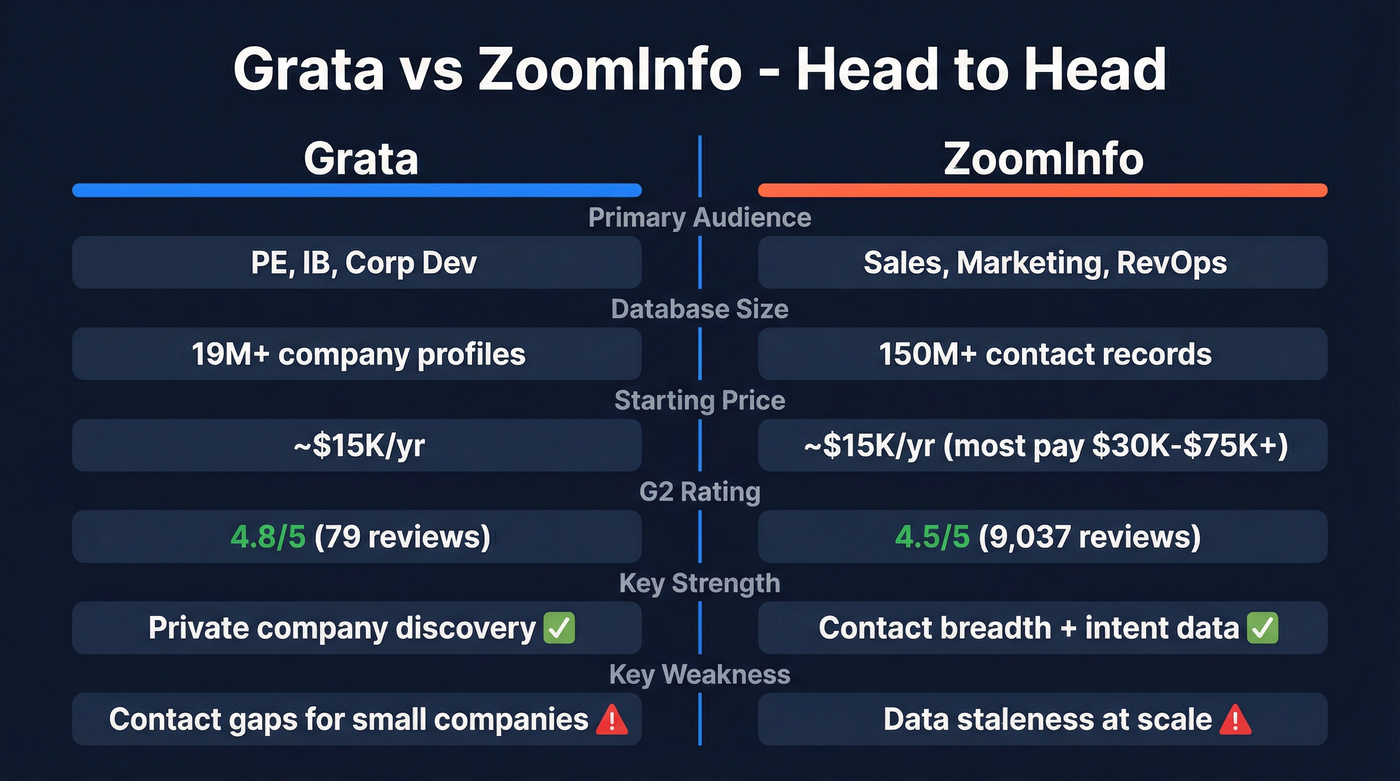
| Grata | ZoomInfo | |
|---|---|---|
| Primary audience | PE, IB, corp dev | Sales, marketing, RevOps |
| Database | 19M+ global company profiles | 150M+ contact records |
| Starting price | ~$15K/yr | ~$15K/yr (most pay $30K-$75K+) |
| G2 rating | 4.8/5 (79 reviews) | 4.5/5 (9,037 reviews) |
| Data refresh | Monthly/quarterly (varies by sector) | Updated daily (not every profile) |
| CRM integrations | Salesforce, HubSpot | Salesforce, HubSpot, and others |
| Key strength | Private company discovery | Contact breadth + intent |
| Key weakness | Contact gaps for small cos | Data staleness at scale |
What Grata Does Better
Grata isn't trying to be a sales intelligence platform. It's a deal-sourcing engine for private markets, and on G2, 28 of its 79 reviewers come from VC/PE with another 6 from investment banking. That's the core audience, and the product reflects it.

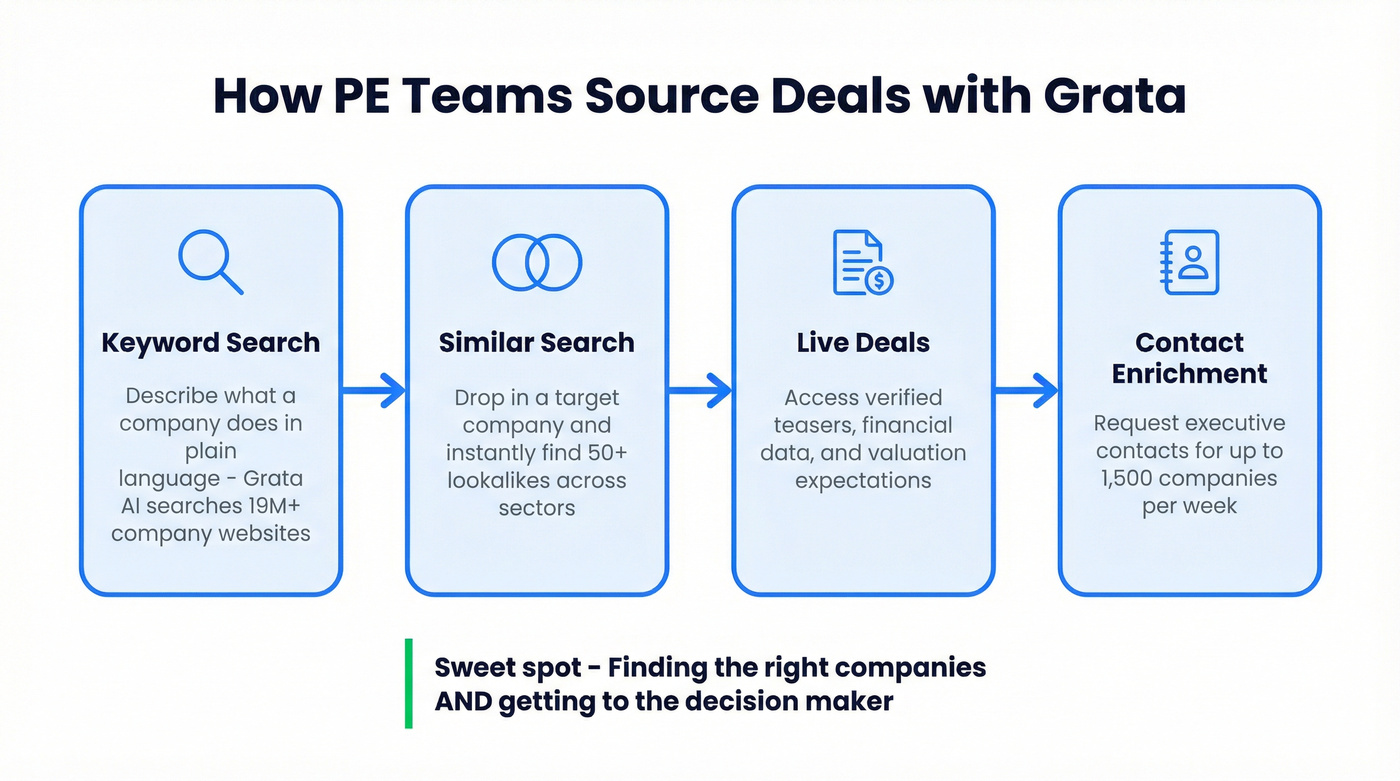
The core differentiator is keyword search across full company websites - not just industry codes or firmographic tags. You describe what a company does in plain language, and Grata's AI finds matches across its 19M+ global company profiles. Similar Search lets you drop in a target company and find lookalikes instantly, which is genuinely useful when a partner says "find me 50 more companies like this one" at 4 PM on a Friday.
Here's what PE teams actually care about:
- Conferences and events intelligence for event sourcing and list building
- Live Deals with verified teasers, financial data, and valuation expectations
- Contact Enrichment Program that lets you request executive contact searches for up to 1,500 companies per week
- 99% accuracy claim on company data - strong for firmographics, though individual contact coverage still has gaps at smaller companies
In a 2022 comparison, Grata found 7% more executive contact coverage than ZoomInfo on the same sample set. On Searchfunder, one practitioner noted they used Grata specifically for finding company owners and CEOs during their search fund process. That's the sweet spot: discovering the right companies and getting to the decision-maker, not blasting 10,000 SDR emails.

Grata leaves contact gaps at smaller companies. ZoomInfo's data goes stale before your sequence finishes. Neither solves the accuracy problem your pipeline actually depends on. Prospeo delivers 98% verified emails across 300M+ profiles on a 7-day refresh cycle - no $15K annual contract required.
Stop paying enterprise prices for contacts that bounce.
What ZoomInfo Does Better
ZoomInfo is a $1.25B-revenue machine built for sales teams. If your job is booking meetings rather than sourcing deals, ZoomInfo's scale is hard to beat.
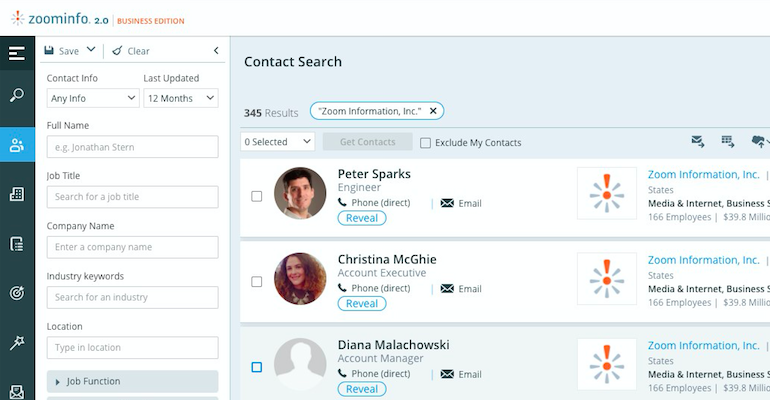
The database covers 150M+ contact records with job-title coverage well beyond C-suite. In 2025, ZoomInfo added 10.2M contacts through enhanced title classification and expanded international mobile coverage by 1.8M numbers across six European markets.
Where ZoomInfo separates from Grata:
- Buyer intent data that flags accounts actively researching your category
- Full sales engagement suite connecting prospecting to sequencing in one platform
- Workflow automation across integrations for RevOps teams managing complex tech stacks
The same Searchfunder thread mentioned ZoomInfo worked well for reaching IT decision makers via cold outreach. If you're an SDR team running volume outbound, Grata simply doesn't compete here - it wasn't designed to.
Pricing Breakdown
Neither tool publishes pricing transparently, which tells you something about how both companies want to control the negotiation.
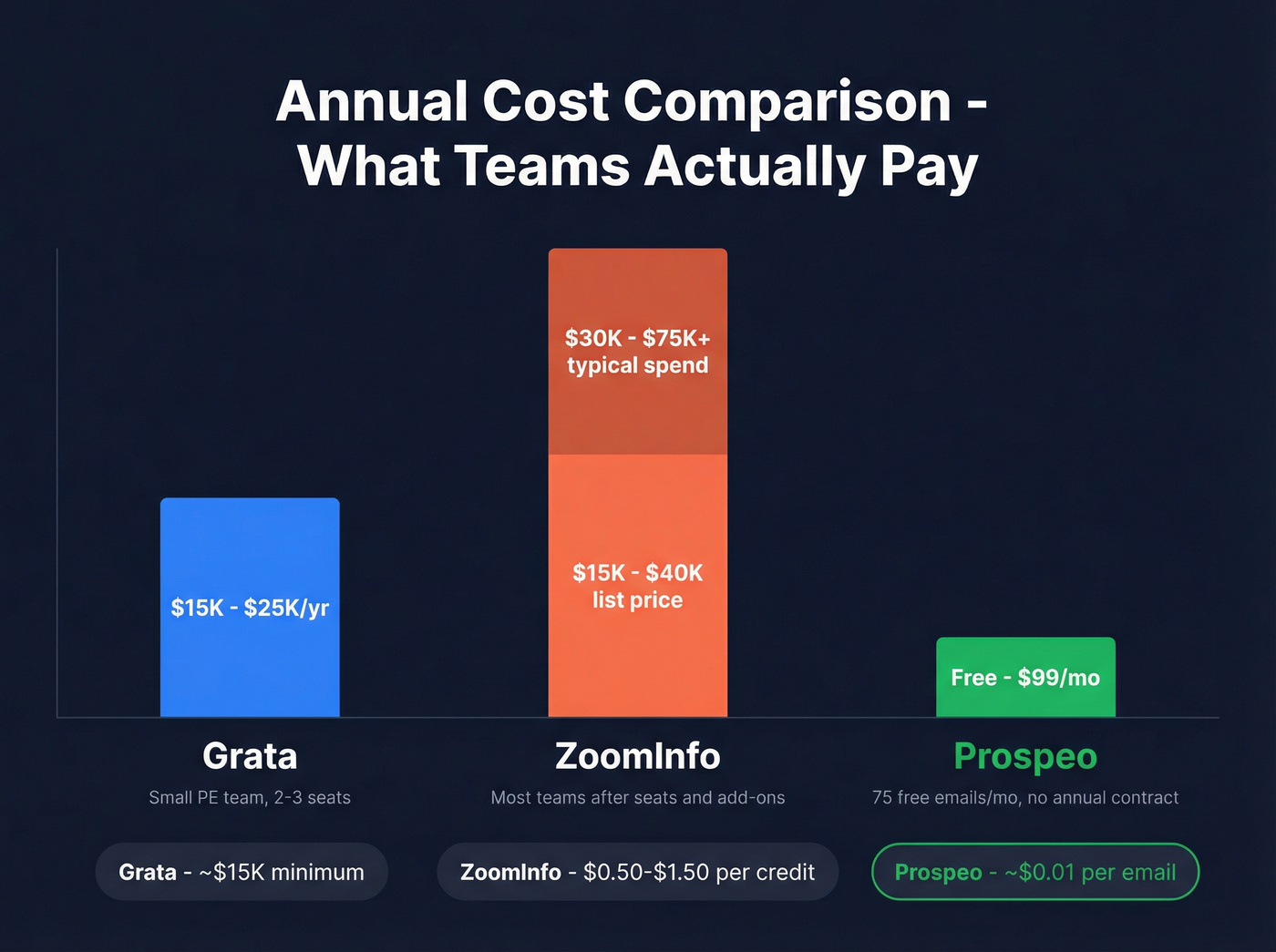
Grata starts at $15,000/year for the Basic plan. Pricing is annual and varies with seats, CRM integration tier, and add-ons like API or Data Warehouse access. A free trial is available. For a small PE team with 2-3 seats and basic CRM sync, expect $15K-$25K/year.
ZoomInfo is quote-based, but pricing benchmarks are widely documented. Common tier benchmarks run from $14,995/year (Professional+) up to $35,995/year (Elite+), and some pricing guides put Elite closer to $39,995+. Additional seats are often benchmarked at $2,500 each at list price. But list price is fiction for most buyers - Vendr benchmarks show what teams actually pay: $24,800-$44,200 for a 200-person company, $50,200-$113,800 for a 1,000-person org.
ZoomInfo is credit-based, and additional credits typically run $0.50-$1.50 per credit (lower at very high volumes). The Global Data add-on is commonly benchmarked at $9,995, and discounts of 30-65% are common with leverage. Watch the auto-renewal windows - typically 60 days - because missing them can lock you in for another year.
Here's the thing: if your average deal size is under $15K and your team has fewer than five reps, neither of these tools pencils out. You're paying enterprise prices for a fraction of the value.
Where Both Fall Short
Both tools have documented contact data problems, and we've heard this from our own users who've switched from each.
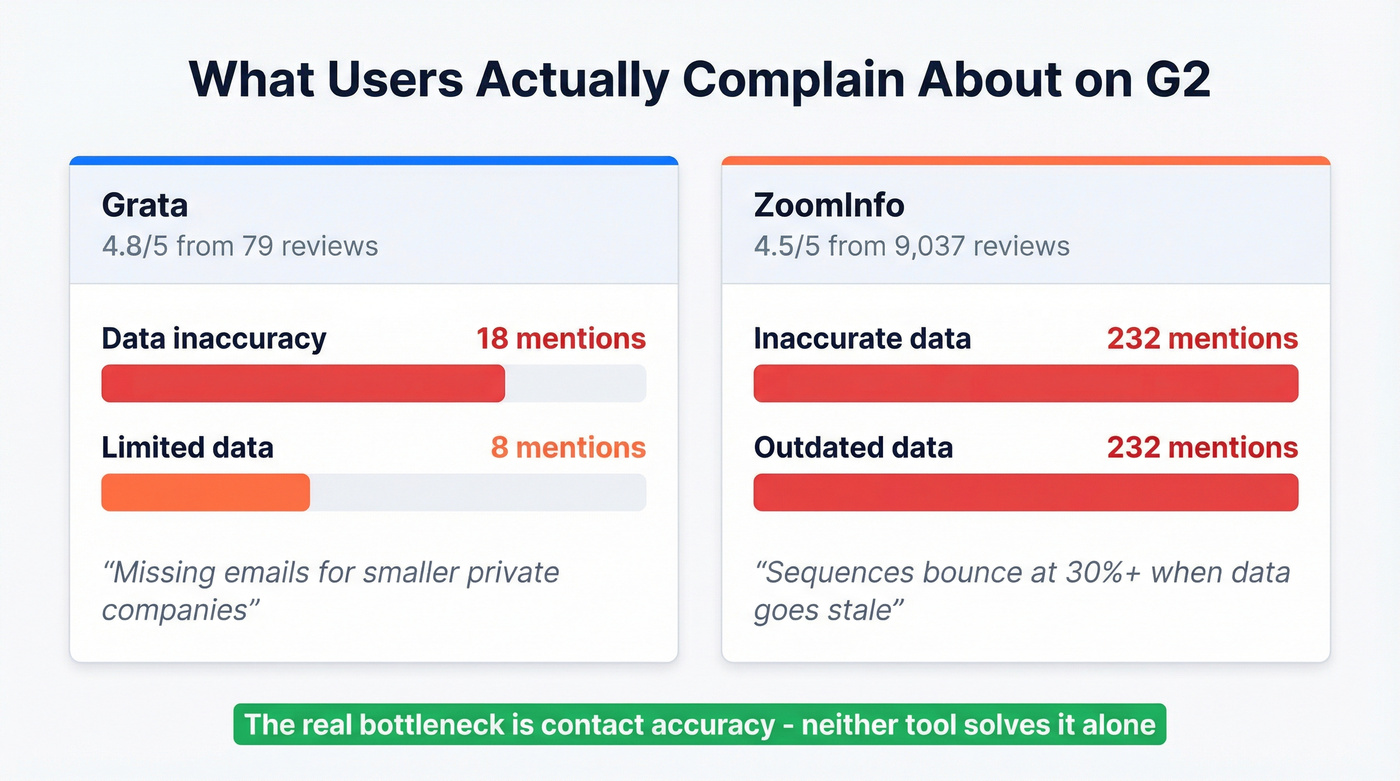
On G2, Grata's top cons cluster around data inaccuracy (18 mentions) and limited data (8 mentions) - reviewers flag missing emails for smaller private companies. ZoomInfo's issues are louder: inaccurate data and outdated data each appear in 232 reviews. At massive scale, staleness is inevitable, but that doesn't make it less painful when your sequences bounce at 30%+.
We've seen PE teams pair Grata with a dedicated verification layer to close the contact gap, and sales orgs run ZoomInfo exports through a second tool before loading sequences. If contact accuracy is the actual bottleneck - and let's be honest, it usually is - neither tool solves it alone. For more on this, see our guide to data enrichment and how teams operationalize lead enrichment.
PE teams pair Grata with a verification layer. Sales orgs scrub ZoomInfo exports before loading sequences. Both workflows exist because contact accuracy is the real bottleneck. Prospeo's 5-step verification, catch-all handling, and spam-trap removal mean your data works the first time - at $0.01 per email.
Skip the second tool. Start with data that's already verified.
Who Should Pick Which
Pick Grata if you're a PE analyst, investment banker, or corp dev professional building deal pipeline. You need private company discovery, similar-company search, conferences/events intelligence, and Live Deals. No other tool does this as well. If you also need deeper financial data, PitchBook is the other major player in this space, though at a significantly higher price point.
If your workflow is closer to outbound, it helps to map your sales prospecting techniques and define your ideal customer profile before you buy any database.
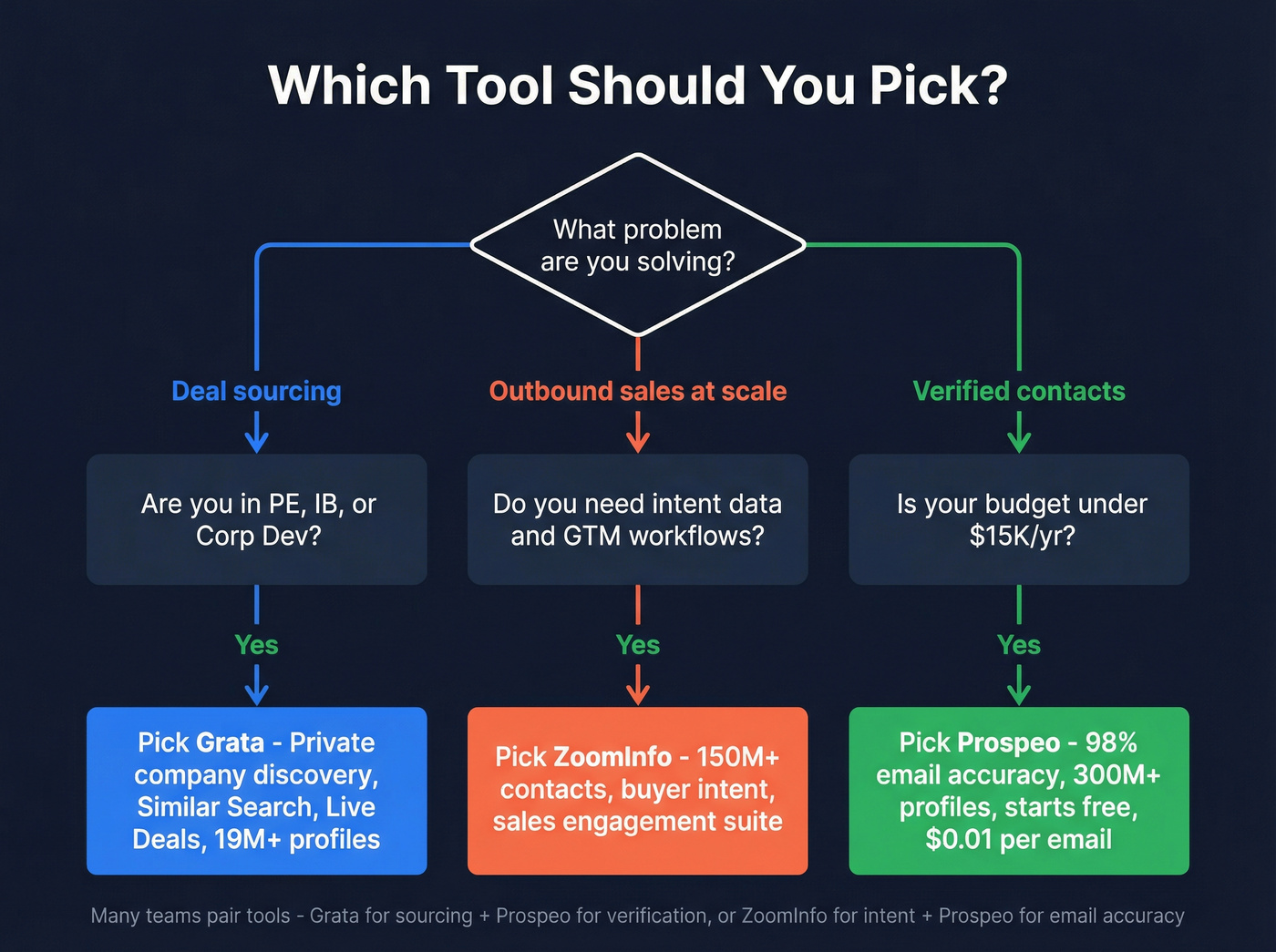
Pick ZoomInfo if you're running an SDR team, need buyer intent signals, or prospect across broad industries and job titles. The database depth and GTM workflow integration justify the cost for sales-led orgs doing real volume. If you're evaluating options, compare it against other sales prospecting databases and the broader category of SDR tools.
Pick Prospeo if you need verified emails and direct dials without a $15K+ annual commitment. At roughly $0.01 per email compared to ZoomInfo's $0.50-$1.50 per credit, the math isn't close. Founders, agencies, and outbound teams that care about deliverability over feature breadth get better data at a fraction of the cost. If bounces are your pain point, start with email bounce rate benchmarks and a proper email deliverability guide before scaling volume.
Many teams end up pairing tools - Grata for sourcing, a verification layer for contact data; ZoomInfo for intent, email verification before sequences go live. The best stack depends on your workflow, not on picking one platform to rule them all. When weighing Grata vs ZoomInfo, the real question isn't which is "better." It's which problem you're actually solving.
FAQ
Is Grata or ZoomInfo better for PE deal sourcing?
Grata wins decisively for private equity. It's purpose-built for PE, IB, and corp dev with private company discovery, similar-company search, and Live Deals across 19M+ global profiles. ZoomInfo is a sales intelligence platform - useful for outbound prospecting but not designed for deal sourcing workflows.
How much do Grata and ZoomInfo cost in 2026?
Grata starts at $15,000/year for the Basic plan. ZoomInfo benchmarks run from $14,995-$39,995+/year by tier, but most teams pay $30K-$75K+ after seats and add-ons. Both require annual contracts. Negotiate hard - ZoomInfo discounts of 30-65% are well-documented.
What's a cheaper alternative for verified contact data?
Prospeo offers 300M+ profiles with 98% email accuracy at roughly $0.01 per email - 90% cheaper than ZoomInfo per lead. A free tier includes 75 emails per month with no contract required. It won't replace Grata's deal-sourcing engine or ZoomInfo's intent data, but it handles verified emails and direct dials at a fraction of the cost.