

GTM Operations: What It Actually Is, What It Does, and How to Build It
A RevOps lead we know renamed her team "GTM Operations" last year. Same three people, same reporting line to the VP of Sales, same Salesforce dashboards. Six months later, marketing still couldn't get ops support for campaign attribution, and CS was building renewal tracking in Google Sheets. The rebrand changed nothing.
That's the gap between the label and the function - and with the average company now running 10.5 simultaneous GTM initiatives, it's a gap most teams can't afford.
The Short Version
Go-to-market operations is the execution layer that turns your GTM strategy into repeatable, measurable processes across sales, marketing, and CS. If your RevOps team reports to a CRO who's really a VP Sales with a nicer title, you don't have a unified ops function - you have a rebrand. Start with the data layer (enrichment + CRM hygiene), not the org chart.
What Go-to-Market Operations Actually Is
GTM Ops is the function responsible for making your go-to-market motion work as a system, not a collection of disconnected teams running disconnected playbooks. It owns the processes, data infrastructure, and tooling that connect demand generation to pipeline to revenue to expansion.
The stakes aren't abstract. Poor revenue process alignment costs organizations up to 10% of annual revenue. For a $50M company, that's $5M leaking through handoff gaps, misrouted leads, and dashboards nobody trusts.
Here's the thing: this isn't new work. It's been scattered across Sales Ops, Marketing Ops, and CS Ops for years. The shift is structural - unifying those functions under a single team with cross-functional authority. When companies centralize reporting under that kind of structure, the results are concrete: forecast accuracy improves roughly 35%, and MQL-to-opportunity conversion lifts 15%. Some frameworks break this into six components (motions, execution, foundation, unified data, signals, analytics), but the principle is the same: one team, one system, cross-functional scope.
RevOps vs GTM Ops vs Sales Ops
The confusion is real. On r/salesoperations and r/RevOps, practitioners consistently flag that the same work gets posted under five different titles - Sales Ops, Business Ops Analyst, CRM Specialist, Marketing Ops, Growth Analyst. Understanding the differences matters because the wrong label leads to the wrong reporting structure.
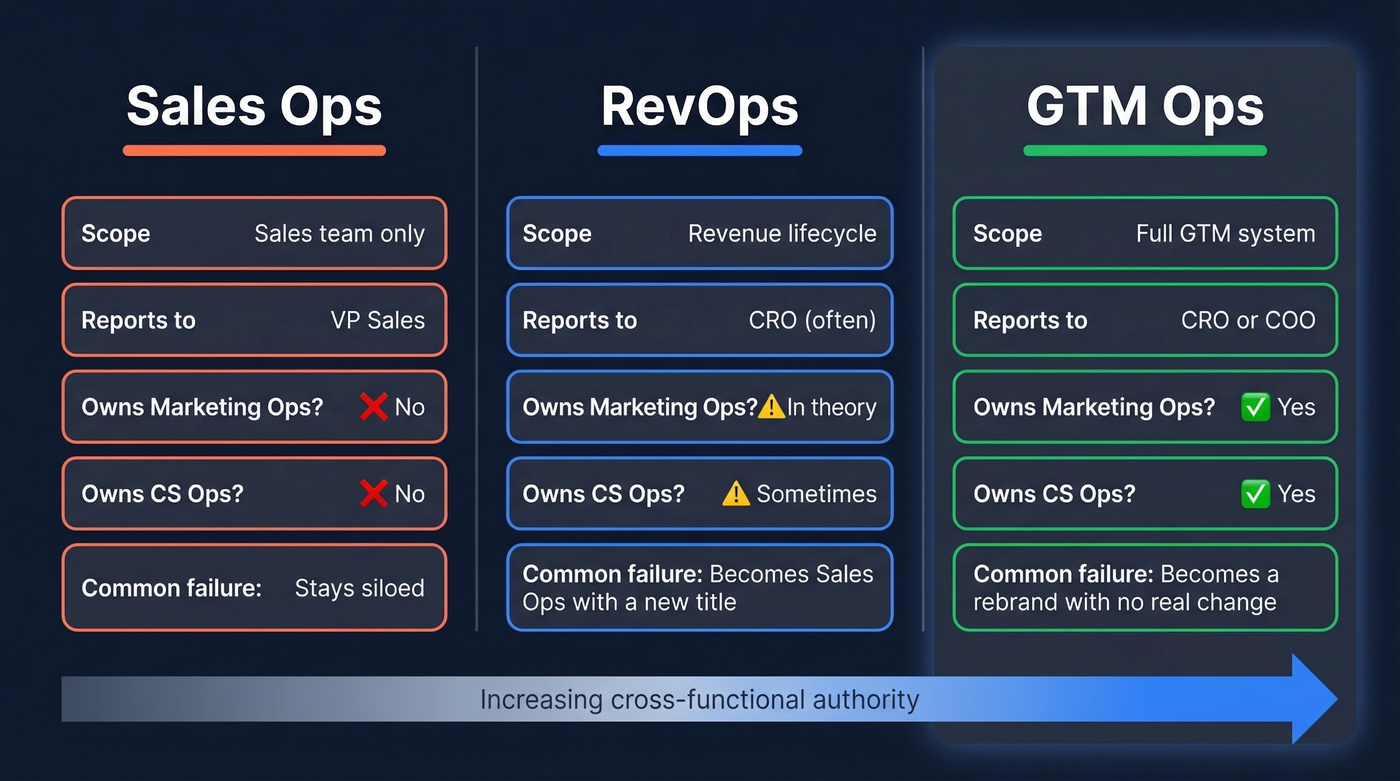
| Dimension | Sales Ops | RevOps | GTM Ops |
|---|---|---|---|
| Scope | Sales team only | Revenue lifecycle | Full GTM system |
| Reports to | VP Sales | CRO (often) | CRO or COO |
| Owns marketing ops? | No | In theory | Yes |
| Owns CS ops? | No | Sometimes | Yes |
| Common failure | Stays siloed | Becomes Sales Ops | Becomes a rebrand |
Andy Mowat put it well: "If you're just reporting to the Head of Sales, or just reporting to the Head of Marketing, you cannot drive deep change through the funnel." That's the structural test. RevOps defaults to Sales Ops when the CRO is effectively a VP Sales with a fancier title. A true go-to-market operations function reports to someone with genuine cross-functional authority - scope that includes demand gen, pipeline, customer expansion, and the data infrastructure underneath all of it.
Our take: most early-stage companies (seed to early Series A) don't need a separate ops function. They need one excellent ops generalist with cross-functional authority and a CRM that isn't on fire. The title matters far less than the reporting line.
Day-to-Day Responsibilities
The day-to-day breaks into four clusters, mapped to deliverables rather than job descriptions.
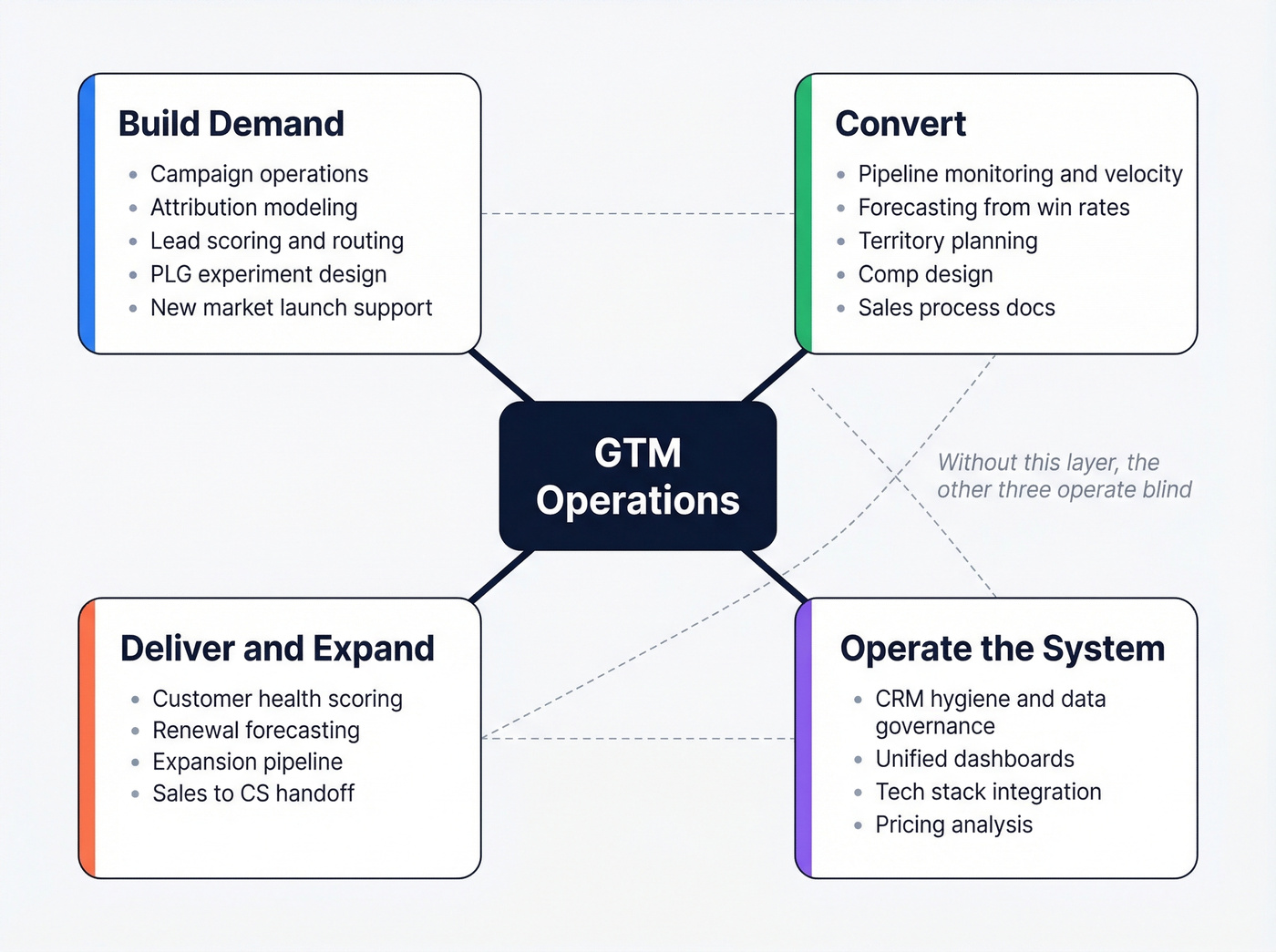
Build Demand
Campaign operations, attribution modeling, lead scoring and routing, PLG experiment design, and new market launch support.
Convert
Pipeline monitoring and velocity tracking, forecasting from win rates and rep capacity, territory planning, comp design, and sales process optimization. This is where most ops teams spend the bulk of their time, and it's also where the biggest visibility gaps hide - a forecast model that doesn't account for multithreaded deal ratios is lying to your leadership team every Monday morning.
Deliver & Expand
Customer health scoring, renewal forecasting, expansion pipeline tracking, and the handoff process between sales and CS.
Operate the System
CRM hygiene and data governance, unified dashboards, tech stack integration, and pricing analysis. This is the connective tissue. Without it, the other three clusters operate blind.
The operating principle underneath all of this is DRI ownership: one person responsible, one person accountable for every deliverable. Without it, teams lose up to 30% of their time just clarifying who owns what.
KPIs and Benchmarks
Most teams drown in metrics. Organize KPIs into three buckets: what you're producing, how you're distributing it, and whether it's converting.
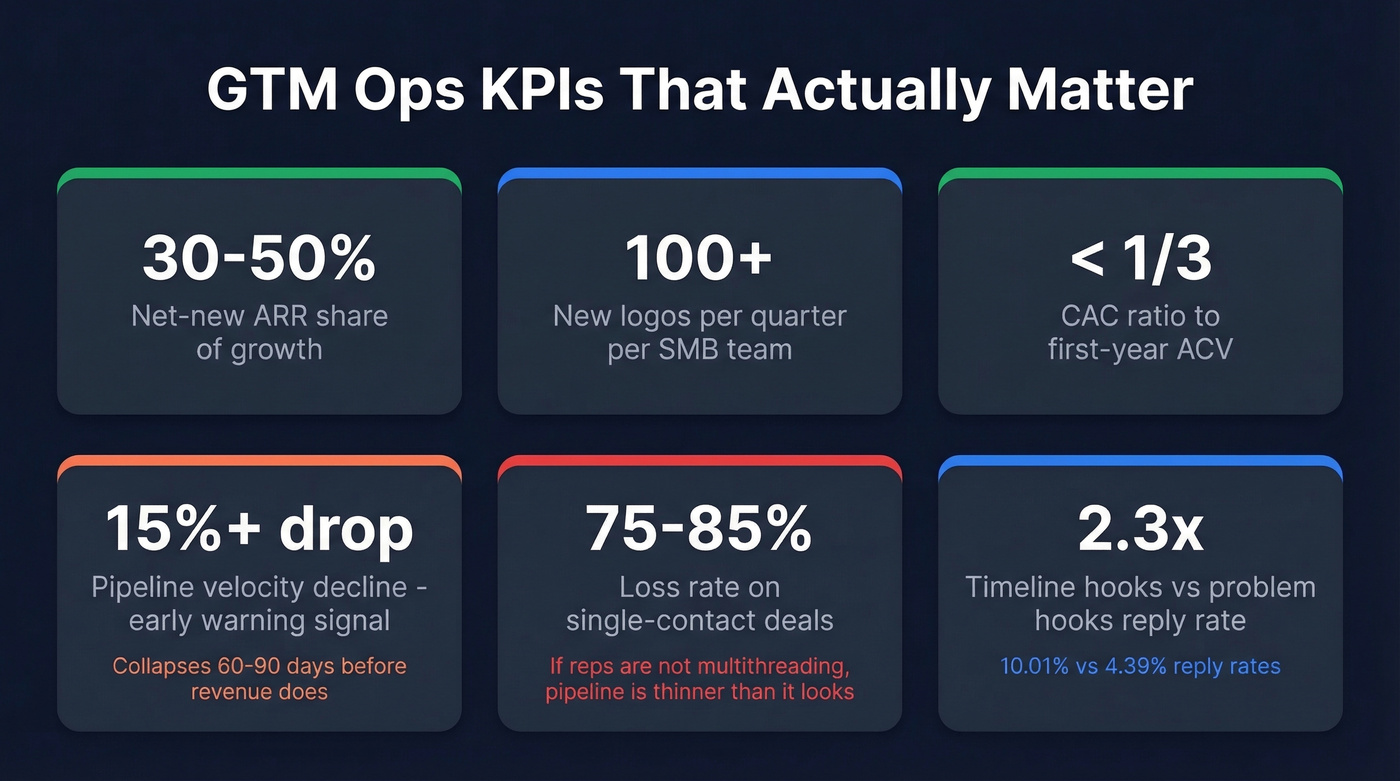
| Bucket | KPI | Benchmark |
|---|---|---|
| Production | Net-new ARR share | 30-50% of growth |
| Production | New logos/quarter (SMB) | 100+ per team |
| Distribution | CAC ratio | < 1/3 of first-year ACV |
| Distribution | PLG activation rate | 65%+ (top 10%) vs 33% avg |
| Conversion | Pipeline velocity trend | 15%+ drop = early warning |
| Conversion | Multithreaded deals | 1-contact deals lose 75-85% |
Two benchmarks deserve extra attention.
Pipeline velocity is a leading indicator. A 15%+ drop collapses 60-90 days before revenue does. If you're only watching bookings, you're seeing the crash in the rearview mirror.
Multithreading is the one most teams ignore. Deals with only one contact have a 75-85% loss rate in later stages. If your reps aren't multi-threading, your pipeline is thinner than it looks.
On outbound, recent benchmark data showed timeline-based hooks pulling a 10.01% reply rate versus 4.39% for problem hooks - a 2.3x difference. That's the kind of insight your ops team should surface weekly, not bury in a quarterly review deck.

Multithreading fails when your contact data is stale. Prospeo refreshes 300M+ profiles every 7 days - not the 6-week industry average - so your reps actually reach the 3-5 stakeholders needed to close. 98% email accuracy, 92% API match rate, $0.01/lead.
Stop building GTM processes on data that's already expired.
The GTM Ops Tech Stack
A typical mid-sized company runs more than 150 software tools. The answer isn't more tools - it's the right architecture. Think in five layers.
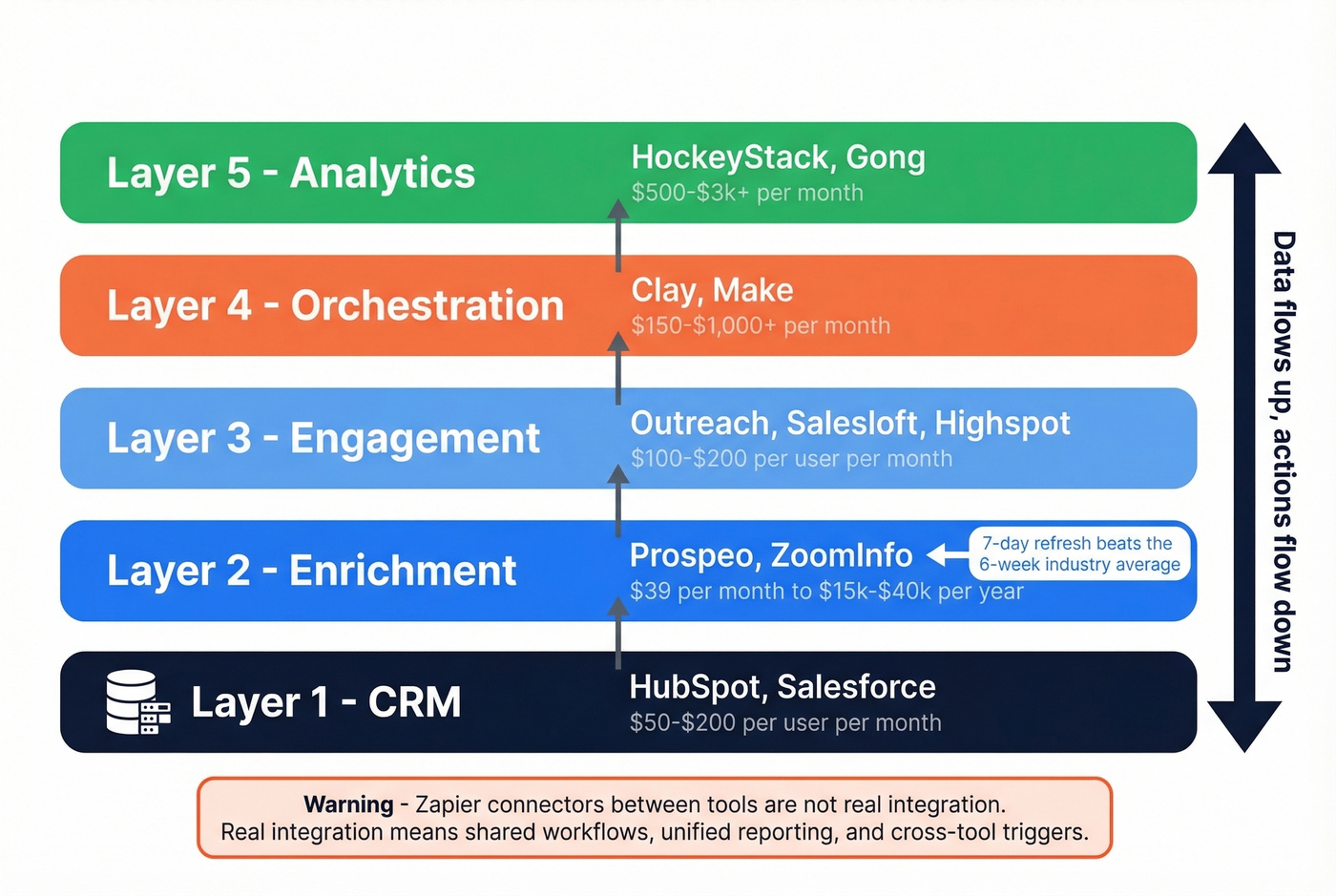
Layer 1: CRM. HubSpot or Salesforce ($50-$200/user/mo) as the system of record. Everything flows through here.
Layer 2: Enrichment. This is where most stacks quietly fail. The industry average refresh cycle for contact data is six weeks, and when your data is that stale, lead routing, scoring, deliverability, and dashboards all degrade fast. We've seen teams running outbound on six-week-old data wonder why bounce rates hit 30%+ - the answer is always the same. Prospeo covers 300M+ professional profiles with 98% email accuracy on a 7-day refresh cycle, at roughly $0.01 per lead. For ops teams building enrichment workflows, the API returns 50+ data points per contact at a 92% match rate.

Layer 3: Engagement. Outreach or Salesloft ($100-$200/user/mo) for sequences. Highspot or Seismic ($20-$60/user/mo) for enablement.
Layer 4: Orchestration. Clay ($150-$1,000+/mo) for workflow automation and multi-step enrichment.
Layer 5: Analytics. HockeyStack or your BI tool ($500-$3,000+/mo) for predictive analytics and attribution. Gong typically lands around $1,200-$2,500+/user/year depending on package and scale.
One warning: basic Zapier connectors between tools aren't real integration. Real integration means shared workflows, unified reporting, and cross-tool triggers. If your marketing attribution data can't flow into your sales forecasting model, you have a collection, not a stack.
| Layer | Example Tools | Price Range |
|---|---|---|
| CRM | HubSpot, Salesforce | $50-$200/user/mo |
| Enrichment | Prospeo, ZoomInfo | $39/mo - $15k-$40k/yr |
| Engagement | Outreach, Salesloft | $100-$200/user/mo |
| Orchestration | Clay, Make | $150-$1,000+/mo |
| Analytics | HockeyStack, Gong | $500-$3k+/mo |
Building by Company Stage
Don't overbuild. The biggest mistake early-stage companies make is scaling operations before product-market fit. You can't optimize a motion that doesn't exist yet.
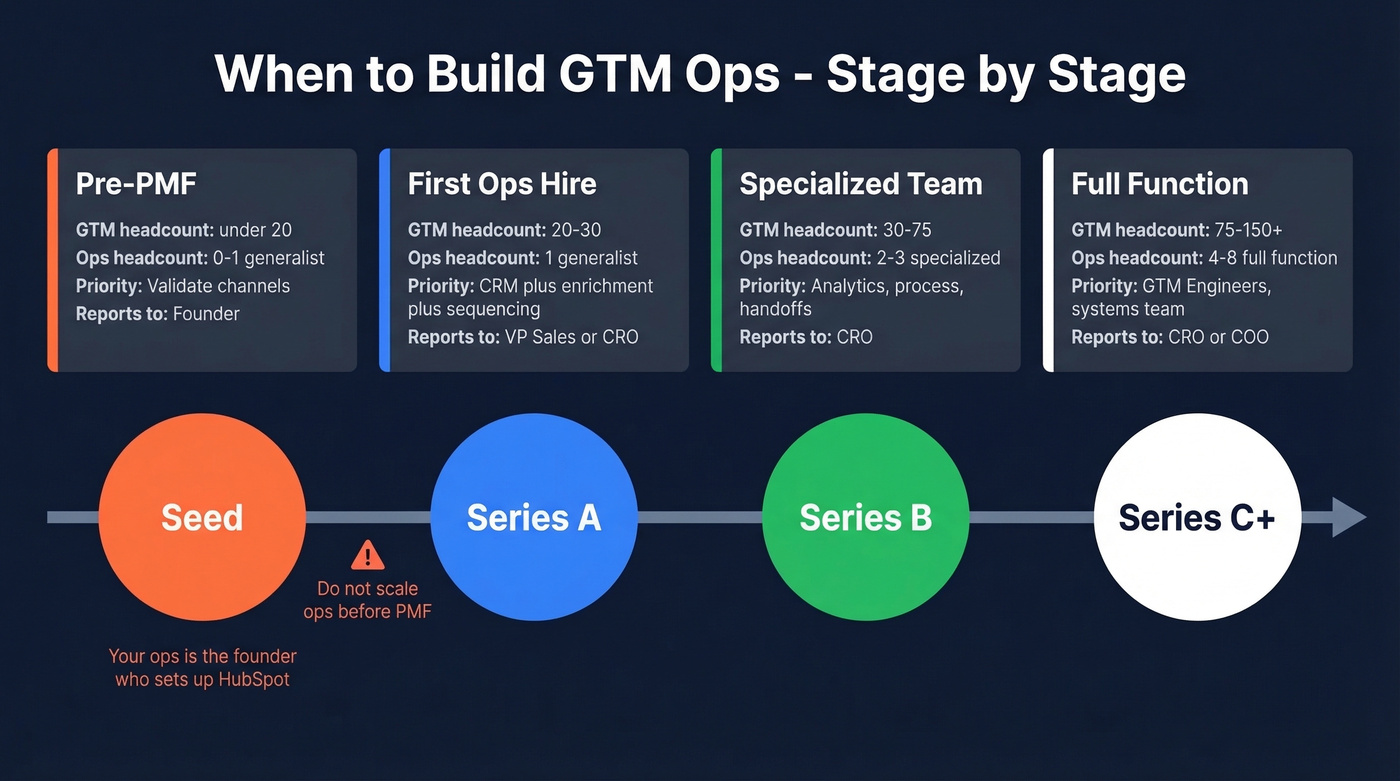
| Stage | GTM Headcount | Ops Headcount | Priorities | Reports to |
|---|---|---|---|---|
| Seed / Pre-PMF | <20 | 0-1 generalist | Validate channels | Founder |
| Series A | 20-30 | 1 generalist | CRM + enrichment + sequencing | VP Sales or CRO |
| Series B | 30-75 | 2-3 specialized | Analytics, process, handoffs | CRO |
| Series C+ | 75-150+ | 4-8 full function | GTM Engineers, systems team | CRO or COO |
At seed stage, your "ops" is the founder who sets up HubSpot and a data enrichment account. That's fine.
Series A is when you hire your first ops generalist. Bessemer recommends splitting into dedicated RevOps and Marketing Ops around 30-50 GTM headcount. By 75-150, you're adding specialized analytics, systems roles, and your first GTM Engineer. Skip this if you're pre-PMF and still iterating on ICP - you'll just be building infrastructure for a motion you're about to change.
Salaries in 2026
Titles are inconsistent, but comp bands are converging.
| Level | Base Range (US) | Notes |
|---|---|---|
| Associate / Analyst | $85k-$120k | Entry via ops, analytics, or AE pivot |
| Manager | $120k-$170k | First management layer |
| Director | $170k-$230k | Owns full function |
| VP | $220k-$320k | Reports to CRO/COO |
The career path is interesting. On Reddit, burnt-out AEs consistently describe wanting to move to "the systems side" - fixing processes, building dashboards, training reps. The typical hire is the AE who kept building dashboards instead of making calls, or the SDR manager who spent more time in Salesforce than on the phone. If that sounds like you, the function is growing fast and the comp reflects it.
Five Ways GTM Operations Fails
1. Rebrand without restructure. You renamed Sales Ops but didn't change reporting lines or scope. Marketing still can't get ops support. This is the most common failure we see, and it's the easiest to diagnose: ask your marketing team if they can get an ops ticket resolved in under a week.
2. Scaling ops before PMF. You hired three ops people and bought $80k in tooling before you had a repeatable sales motion. Now you're optimizing a process that doesn't work.
3. Data fragmentation. Your data lives across roughly 19 tools, and your enrichment provider refreshes every six weeks. Weekly-refresh enrichment exists for a reason - stale data corrupts everything downstream, from lead routing to forecasting.

4. No DRI ownership. Nobody knows who owns lead routing logic or the forecast model. Thirty percent of time burns on ownership clarification.
5. Measuring activity instead of outcomes. Tracking emails sent and calls made instead of pipeline velocity and multithreaded deal ratios hides conversion problems behind a wall of activity metrics. Let's be honest - if your weekly ops review is a spreadsheet of "calls made," you're not doing ops.
AI in Go-to-Market Ops
The real productivity gains are in automating CRM updates, note-taking, and pipeline management - teams see 25-30% increases in revenue-generating activity time. That's meaningful and proven.
The hype is AI SDRs. Only 2% of companies have successfully implemented them, despite 90% of go-to-market teams implementing AI tools or planning to soon. I haven't seen enough evidence to bet on the prediction that CROs will manage teams that are 50% AI agents.
Govern your workflows before you automate them. Automating a broken lead routing process with AI just creates broken lead routing faster.
The Future: GTM Engineers
The most interesting shift is the emergence of the GTM Engineer - a role that treats go-to-market workflows and data pipelines like production systems. PostHog runs marketing work in code repos. Vercel drives GTM from product signals. Clay has formalized the GTM Engineer role explicitly.
The pattern: treat your go-to-market system with the same rigor you'd treat your product codebase. As cloud marketplace GTM adds complexity - up to 120-day disbursement cycles, multi-entity billing - the need for engineering-minded ops people will only grow. This is an emerging org design pattern already showing up in hiring plans at growth-stage companies, and it's the clearest signal of where the function is headed.
GTM Ops owns the data infrastructure. If your enrichment layer returns bad emails, every downstream metric - pipeline velocity, CAC ratio, forecast accuracy - is compromised. Prospeo's enrichment API returns 50+ data points per contact at a 92% match rate, with 7-day refresh cycles baked in.
Build your GTM system on a data layer that actually holds up.
FAQ
What's the difference between GTM Ops and RevOps?
GTM operations aligns sales, marketing, and CS under one team with genuine cross-functional authority. RevOps often defaults to Sales Ops when it reports to a sales-focused CRO. The structural test is whether the team owns marketing ops and CS ops - not just the sales pipeline.
When should a company hire its first ops person?
Hire a cross-functional generalist at 15-20+ GTM headcount, when your CRM becomes a liability. This person should own CRM hygiene, unified dashboards, and handoff processes - and report to someone with authority beyond sales alone.
What tools does a GTM Ops team need?
At minimum: a CRM (HubSpot or Salesforce), a data enrichment tool with a weekly refresh cycle for verified contacts, a sequencing tool (Outreach or Salesloft), and a BI layer. Start with four integrated tools, not fifteen disconnected ones.
How much does a GTM Ops manager make in 2026?
$120k-$170k base in major US metros. Directors range $170k-$230k, VPs $220k-$320k. Titles vary widely - the same role appears as "Revenue Operations Manager" or "Business Operations Lead" across job boards.
Is GTM Ops just a fad?
The function is real. Cross-functional alignment and data infrastructure challenges aren't going away - companies losing 10% of revenue to process gaps need a structural fix. But the title is a fad if companies rebrand Sales Ops without changing reporting structures or scope.