

Healthcare B2B Lead Generation: What Actually Works in 2026
Selling into healthcare is a different animal. Your buyer isn't one person - it's a committee of 9 to 15 stakeholders, and the winning vendor was already on the shortlist before formal evaluation even started 95% of the time. If your healthcare B2B lead generation strategy isn't built around that reality, you're burning budget.
What You Need (Quick Version)
- Get on the Day One shortlist. 92% of B2B buyers start with at least one vendor in mind. Brand awareness and early relationship-building aren't optional - they're the whole game.
- Map the full buying committee. Not just the economic buyer. Enterprise health systems involve 12-15 stakeholders across clinical, IT, procurement, and compliance. Miss one blocker and your deal stalls for months.
- Fix your data first. Healthcare contact databases decay faster than any other vertical. Fragmented domains, M&A reshuffling, and non-standard titles mean generic data goes stale in weeks. Pair a vertical intelligence tool like Definitive Healthcare with a verified-contact layer like Prospeo - 98% email accuracy, 7-day refresh cycle - so you're not launching sequences into dead inboxes.
Why Healthcare Deals Take Longer
The average B2B buying cycle runs 10.1 months. Healthcare stretches that to 12 months or more, and enterprise B2B sales EHR implementations can push past two years. Even a $10K clinic sale can take 60-90 days.
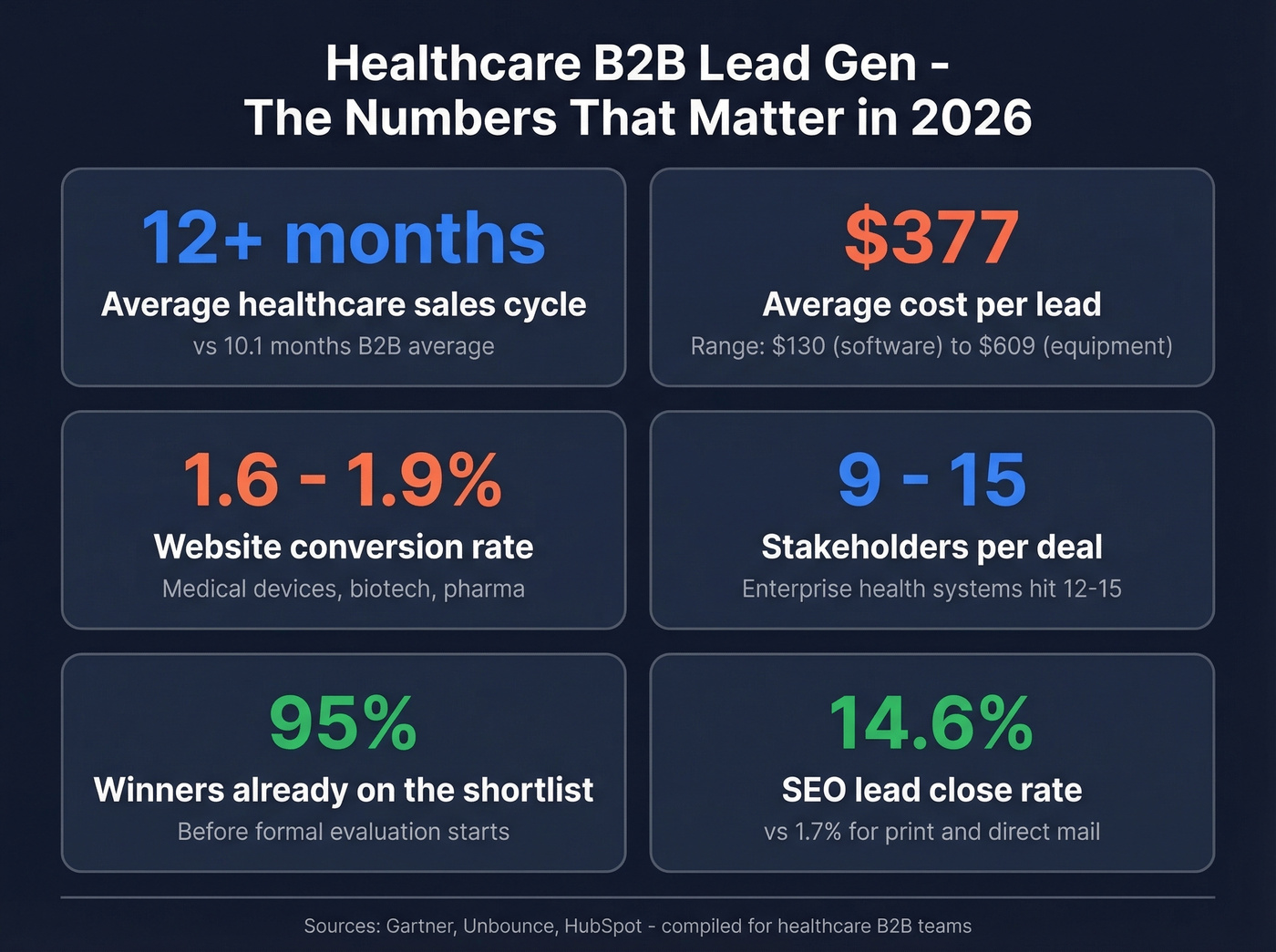
That alone changes everything about how you plan campaigns, set quotas, and measure ROI.
The overall B2B healthcare cost per lead averages $377, though subcategories range wildly - healthcare software sits around $130, while medical equipment hits $609. Website conversion rates are brutal too: recent benchmarks from Unbounce show medical device companies averaging just 1.6%, biotech 1.8%, pharma 1.9%. If you're benchmarking against SaaS numbers, recalibrate now.
Here's the other structural difference: 41% of buyers have a preferred vendor before formal evaluation begins. Your demand gen isn't just about generating leads - it's about being known and trusted before the buying window opens. And if you're selling a HealthTech category that doesn't have an established budget line yet, you're fighting for mindshare and budget creation simultaneously. That's a two-front war most teams underestimate.
If your average contract value is under $50K, you probably don't need the full enterprise healthcare data stack. A verified contact tool, a good sequencer, and deep Ideal Customer Profile research will outperform a $150K tech stack that nobody on your team fully uses.
The Healthcare Buying Committee
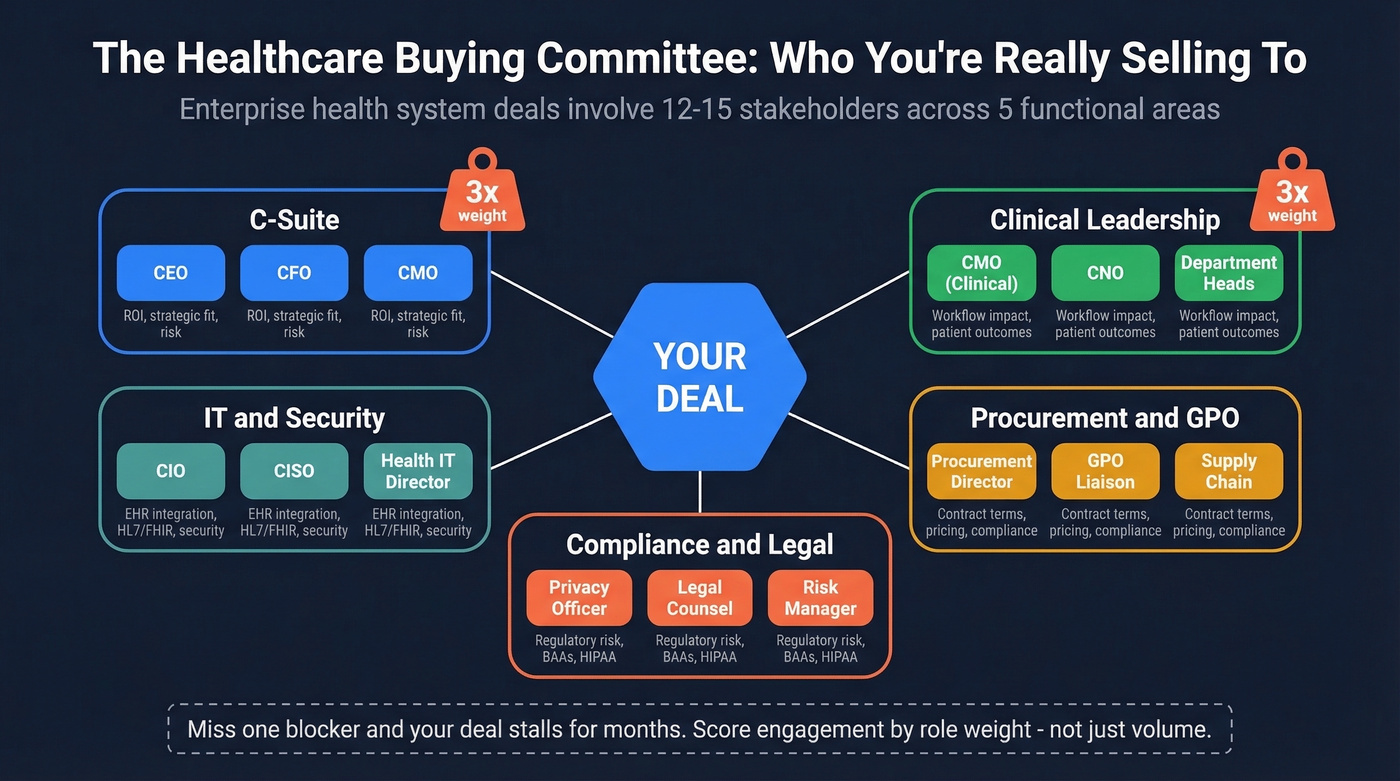
A typical healthcare software deal involves around 9 decision-makers. For enterprise health systems, that number climbs to 12-15. Here's who you're actually selling to:
| Role | What They Care About |
|---|---|
| C-Suite (CEO, CFO, CMO) | ROI, strategic fit, risk |
| Clinical Leadership | Workflow impact, outcomes |
| IT / Security | EHR integration, HL7/FHIR |
| Procurement / GPO | Contract terms, compliance |
| Compliance / Legal | Regulatory risk, BAAs |
Score healthcare leads by role weight - a CMO or CNO engagement is worth 3x a department manager's. Late-stage signals like pricing page visits or multi-stakeholder demo requests should trigger immediate sales follow-up.
GPO dynamics add another layer. Group Purchasing Organizations influence buying across entire facility networks, and getting onto a GPO contract can open dozens of hospitals at once. Qualify early whether your target accounts buy through GPOs.
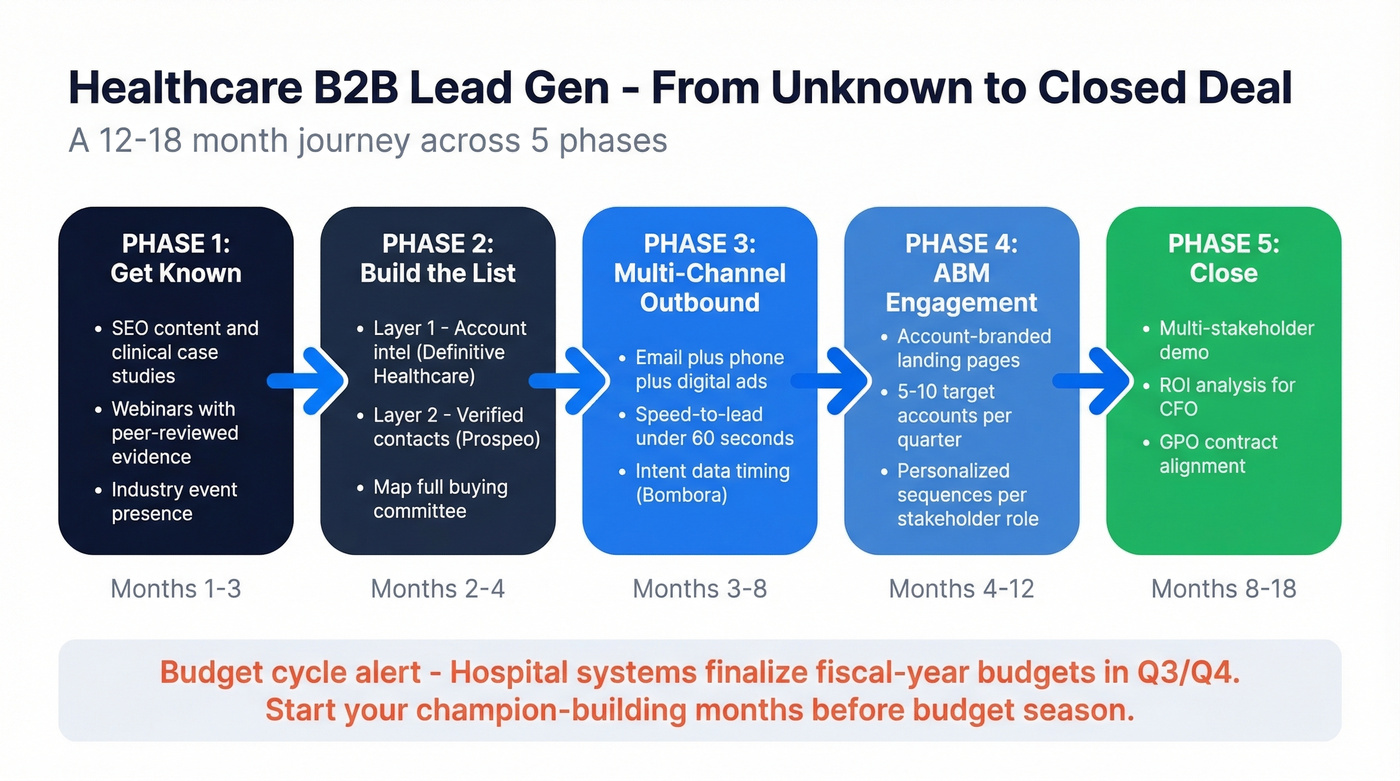
Hospital systems typically finalize fiscal-year budgets in Q3/Q4 for the following year. If you're pitching a capital expenditure in February, you've already missed the window. Your champion needs internal ammunition months before budget season opens.
Building a Prospect List That Works
Generic B2B databases fail in healthcare. Email domains are fragmented across facilities within the same health system. Titles aren't standardized - one hospital's "Director of Clinical Informatics" is another's "VP of Health IT." M&A activity constantly reshuffles org charts, making last quarter's data unreliable.
Look, healthcare is one of the toughest verticals for marketing, and bad data is the number one reason campaigns die on arrival.

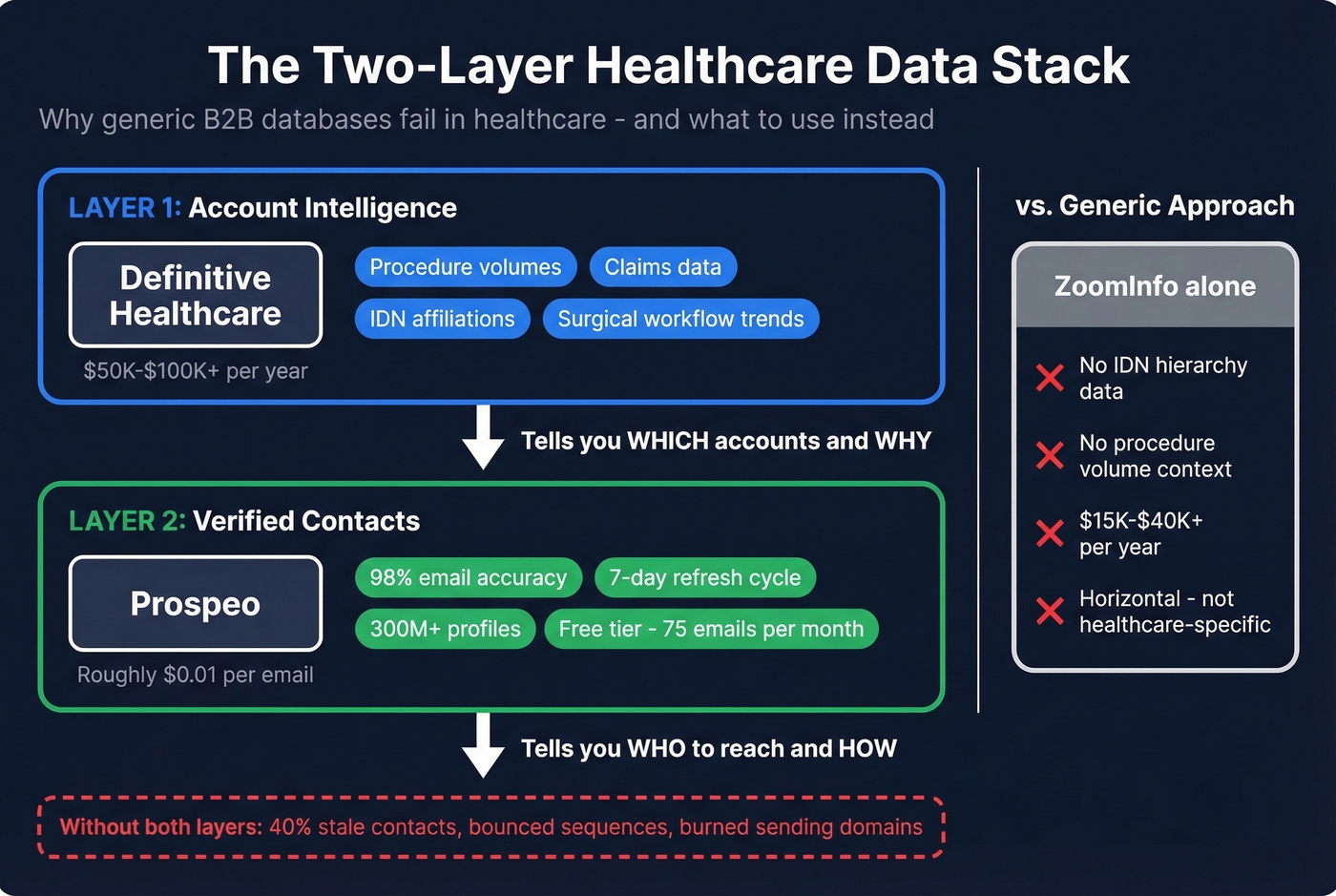
That's why the healthcare data stack needs two layers. Definitive Healthcare provides the account intelligence - procedure volumes, claims data, IDN affiliation hierarchies, surgical workflow trends. It tells you which accounts to target and why. But at $50K-$100K+ per year, it's a serious commitment.
For the contact layer - verified emails and direct dials - Prospeo solves the dead-data problem at a fraction of the cost. Its 7-day refresh cycle means you're not emailing people who changed roles six weeks ago. With 300M+ profiles, 98% email accuracy, and a free tier of 75 verified emails per month, you can test it against your healthcare ICP before committing budget. Paid plans run roughly $0.01 per email. Compare that to ZoomInfo, which typically costs $15K-$40K+ per year for a horizontal database that won't tell you which IDN affiliations matter.

Healthcare contact databases decay faster than any other vertical. Prospeo's 7-day refresh cycle, 98% email accuracy, and 300M+ profiles mean your outbound sequences actually reach the CMOs, IT directors, and procurement leads on your committee map - not inboxes that bounced six weeks ago. Start with 75 free verified emails per month.
Stop emailing ghosts. Build a healthcare prospect list that connects.
Strategies That Drive Results
ABM for Enterprise Health Systems
Account-based marketing is the natural fit for healthcare's concentrated buyer landscape. One 120-day ABM pilot produced 31 meetings, 17 qualified opportunities, and $2.7M closed over the following six months - with 300+ leads identified via intent data. Another agency built 3 landing page variants, 12 display ad versions, and custom email/voicemail scripts for just 10 target payors. That's the level of personalization enterprise healthcare ABM requires.
The playbook: pick 5-10 target accounts per quarter, build account-branded landing pages, and align sales and marketing on engagement signals. Platforms like Terminus and Demandbase run $30K-$100K+ per year, but for enterprise health system deals worth seven figures, the math works.
Content and SEO
SEO leads close at 14.6% versus 1.7% for print and direct mail. Inbound generates 3x more leads at 62% less cost. Those numbers hold even in a vertical where outbound dominates.
Healthcare buyers consume content differently. Webinars, whitepapers, and clinical case studies outperform generic blog posts by a wide margin. The content that converts isn't "5 Tips for Better Patient Outcomes" - it's detailed ROI analyses, implementation guides, and peer-reviewed evidence that a clinical champion can forward to their CFO with a note that says "we need to budget for this."
Multi-Channel Outbound
Email alone won't cut it. The combination of email, phone, and digital ads is what moves healthcare committees. The operational detail that matters most: speed-to-lead. Waiting even 30 minutes can tank conversion - aim for response times under 60 seconds using automation and routing.
Deliverability infrastructure matters just as much as message quality. Warm up dedicated sending domains before launching healthcare campaigns, rotate mailboxes to protect sender reputation, and monitor inbox placement rates weekly. We've watched teams burn through six figures in outbound spend before realizing their contact data was 40% stale and their primary domain was flagged. Don't be that team. Compliance guardrails are non-negotiable too - TCPA and DNC regulations apply to phone outreach, and healthcare buyers are particularly sensitive to vendors who cut corners.
If you want a tighter operational baseline, start with an email deliverability audit and track your email bounce rate weekly.
Intent Data for Timing
About 20% of your target accounts are in-market at any given time. Intent data platforms like Bombora track 15,000 topics to identify those accounts, letting you time outreach to actual buying signals instead of spraying sequences at cold lists.
Skip this approach if you're targeting fewer than 200 accounts total - the signal-to-noise ratio won't justify the spend.
HIPAA Compliance Essentials
HIPAA is triggered by protected health information (PHI). Standard B2B contact data isn't PHI by itself - but healthcare buyers still expect HIPAA-ready vendors and workflows, and your process can become HIPAA-relevant fast once you handle patient-related data.
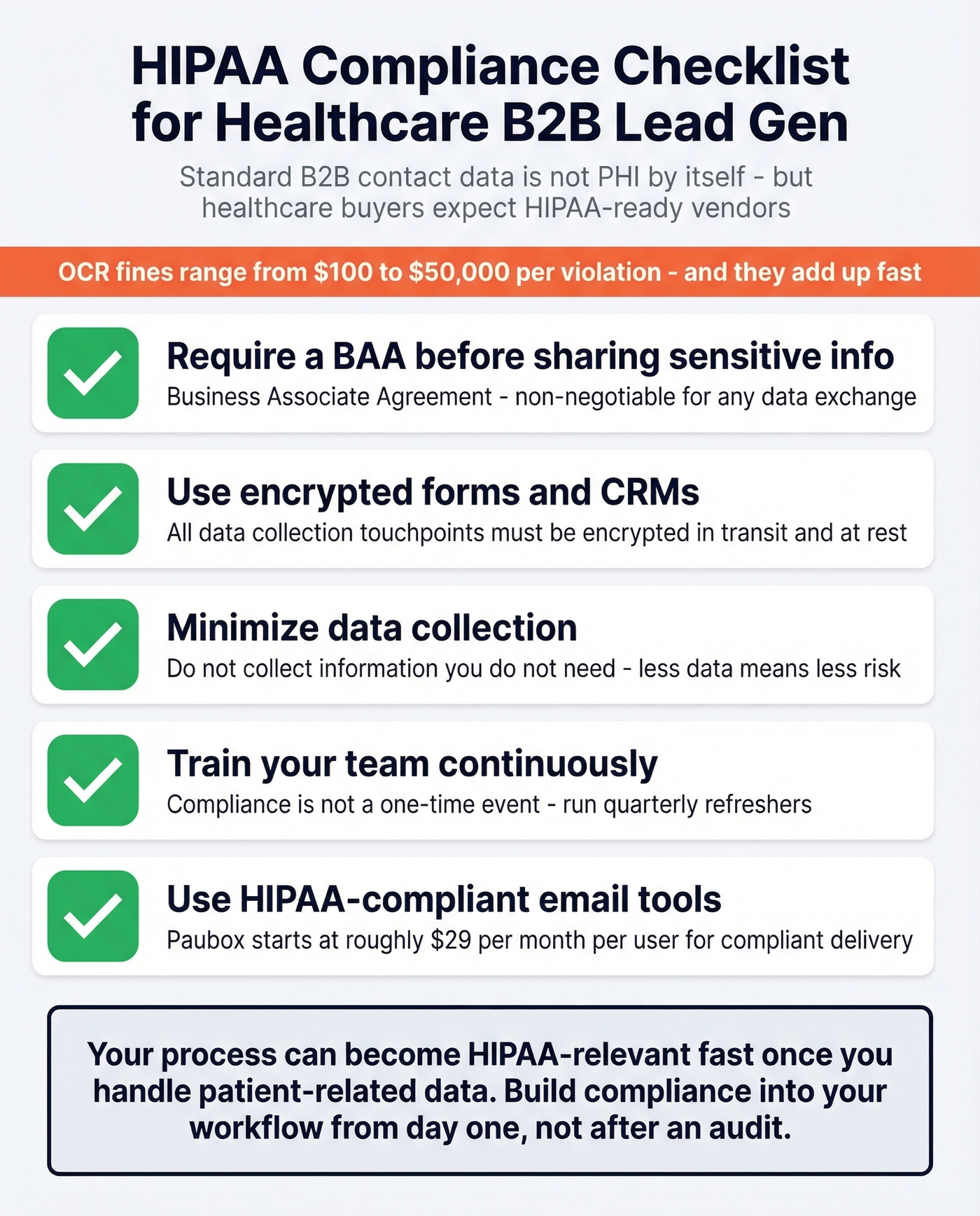
Require a Business Associate Agreement (BAA) before sharing any sensitive information. Use encrypted forms and CRMs for all data collection. Minimize what you ask for - don't collect information you don't need. Train your team continuously on compliance protocols. OCR fines range from $100 to $50,000 per violation, and they add up fast. For HIPAA-compliant email delivery, Paubox starts at ~$29/mo per user.
Benchmarks - What Good Looks Like
| Subcategory | Average CPL |
|---|---|
| Healthcare Software | $130 |
| Health & Wellness | $142 |
| ABA Therapy | $314 |
| Mental Health | $380 |
| B2B Healthcare Average | $377 |
| Medical Training | $472 |
| Medical Facility | $566 |
| Medical Equipment | $609 |
Website conversion rates for healthcare B2B hover between 1.6% and 1.9% for subcategories like medical devices and biotech. The broader industry-wide healthcare conversion rate runs around 6.8%, though that figure includes a wider definition of conversion events. If you're above 2% on website visitor-to-lead, you're outperforming most of the vertical.
Expect 3-6 months before you see initial qualified leads, and 12-18 months before meaningful revenue impact. In our experience, teams that set 90-day pipeline targets for healthcare campaigns end up abandoning strategies that would've worked by month six. Anyone promising faster results either doesn't understand the buying cycle or is measuring vanity metrics.
Tools for Healthcare Lead Gen
| Tool | Use Case | Price Range |
|---|---|---|
| Prospeo | Email finding + verification | Free (75/mo), ~$0.01/email |
| Definitive Healthcare | Account intelligence | $50K-$100K+/yr |
| ZoomInfo | B2B contact database | $15K-$40K+/yr |
| Apollo.io | Outbound sequencing + data | Free plan, from $49/mo |
| HubSpot / Salesforce | CRM + nurture workflows | Varies by edition |
| Bombora | Intent data signals | ~$25K-$50K/yr |
| Terminus / Demandbase | ABM platform | $30K-$100K+/yr |
| Paubox | HIPAA-compliant email | ~$29/mo per user |
For most teams entering healthcare B2B, the practical starting stack is a verified contact tool for outbound, Apollo or HubSpot for sequencing, and Definitive Healthcare when budget allows for deep account intelligence. Let's be honest - you don't need all of these on day one, and buying the full stack before you've validated your ICP is a great way to waste $200K.
If you're tightening your process, formalize lead scoring and review your lead generation metrics monthly.
Enterprise health system deals involve 12-15 stakeholders across clinical, IT, procurement, and compliance. Prospeo gives you verified emails and direct dials for every seat on the buying committee - at $0.01 per email instead of $15K+ per year for a bloated horizontal database. Layer 30+ filters including department headcount, job changes, and intent data across 15,000 topics to find in-market accounts.
Map the full buying committee with verified contact data for every stakeholder.
FAQ
How long does healthcare B2B lead generation take?
Expect 3-6 months for initial qualified leads and 12-18 months for meaningful revenue impact. The average healthcare sales cycle runs 6-12 months with 9-15 stakeholders involved, so pipeline velocity is structurally slower than general B2B. Teams that abandon campaigns before month six almost always quit too early.
Do I need HIPAA compliance for B2B outreach?
Standard B2B contact data isn't protected health information, so HIPAA doesn't technically apply to most outbound prospecting. That said, healthcare buyers expect HIPAA-ready vendors and BAAs in place before any sensitive data is shared - treat it as a practical requirement even for purely B2B campaigns.
What's the best database for healthcare contacts?
Definitive Healthcare is the gold standard for account intelligence at $50K-$100K+ per year. For verified emails and direct dials, Prospeo delivers 98% email accuracy with a 7-day refresh cycle at roughly $0.01 per email - critical in a vertical where contact data decays faster than any other industry.
What's a realistic cost per lead in healthcare B2B?
The overall B2B healthcare average is $377, but subcategories vary dramatically: healthcare software averages $130, while medical equipment runs $609. If your CPL is under $200 for software or under $400 for devices, you're performing well against industry benchmarks.