


Highspot vs Seismic: Does This Comparison Still Matter in 2026?
The Highspot vs Seismic comparison now has an expiration date. On February 12, 2026, the two companies announced a definitive agreement to merge. The combined entity will operate under the Seismic brand, led by Seismic CEO Rob Tarkoff, with Permira as controlling shareholder and Highspot CEO Robert Wahbe joining the Board of Directors. In a sales enablement market worth $5.23B in 2024 and projected to hit $12.78B by 2030, you're now evaluating products that are actively becoming one.
That rewrites the decision entirely. Here's what still matters, what you'll pay, and what to do while the deal plays out.
30-Second Verdict
- Pick Seismic if you're enterprise, need governance and compliance controls, and want to bet on the surviving brand. Negotiate hard before the deal closes.
- Pick Highspot if rep adoption is your top priority and you can live with uncertainty about long-term product direction post-integration.
- Skip both if you're mid-market, can't commit to a typical $70k-$180k+/year enablement contract, or refuse to sign a multi-year deal during merger limbo.
Features Compared Side by Side
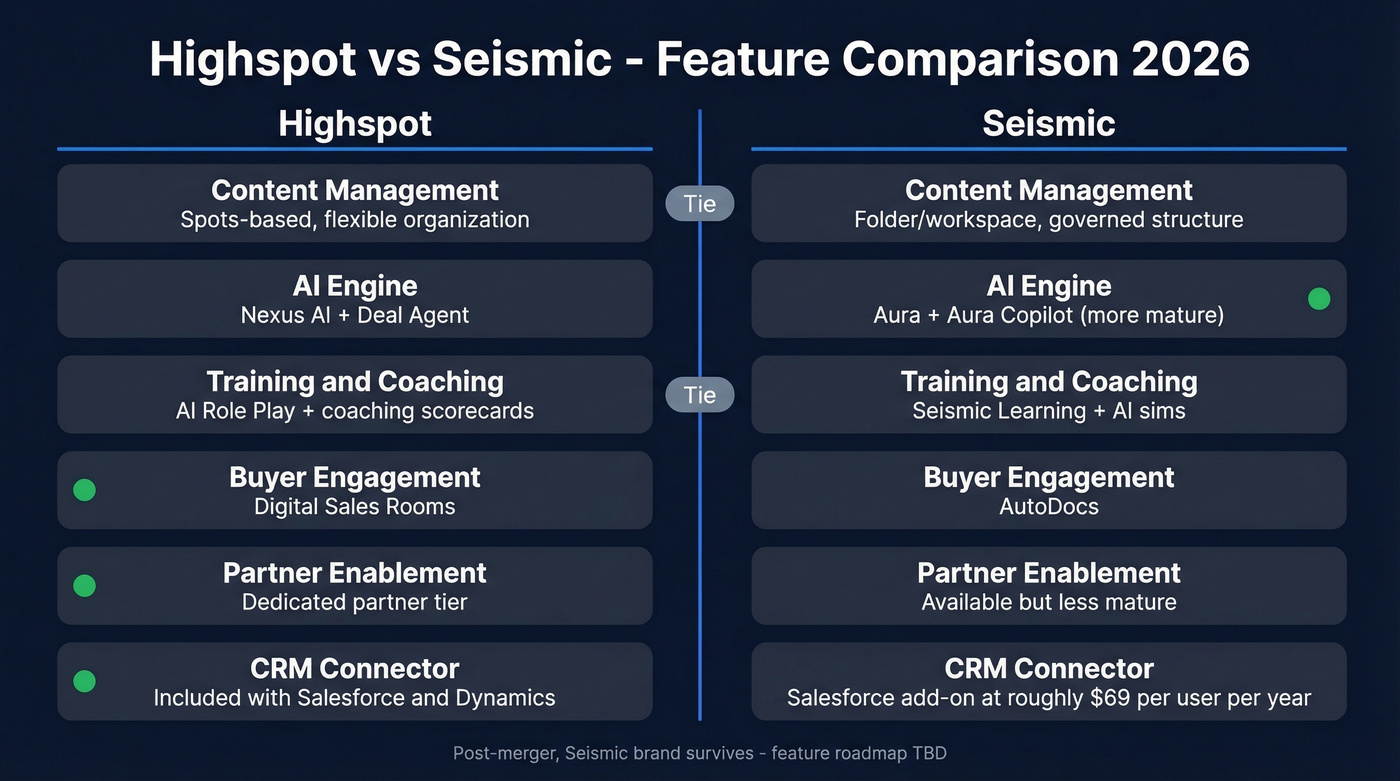
Both platforms earned a 4.7/5 on G2, and the feature overlap is substantial. Here's where they diverge:
| Capability | Highspot | Seismic | Edge |
|---|---|---|---|
| Content management | Spots-based, flexible | Folder/workspace, governed | Tie (different philosophies) |
| AI engine | Nexus AI + Deal Agent | Aura (including Aura Copilot) | Seismic (more mature) |
| Training/coaching | AI Role Play + coaching scorecards | Seismic Learning + AI sims | Tie |
| Buyer engagement | Digital Sales Rooms | AutoDocs | Highspot |
| Partner enablement | Dedicated partner tier | Available, less mature | Highspot |
| CRM connector cost | Included (Salesforce, Microsoft Dynamics) | Salesforce Connector is a ~$69/user/yr add-on | Highspot |
Highspot's Digital Sales Rooms and partner enablement stand out as genuine differentiators. Seismic's Aura is more mature for content customization - condensing documents into presentations, tagging and deduping training content - and its content governance model appeals to compliance-heavy industries like financial services and healthcare.
Here's the thing, though: the real question isn't which feature set is better today. It's which survives integration. A Reddit thread in r/SaaS framed the merger as "acquisition in practice," and that reads right to us. Seismic's name, CEO, and PE firm all carry forward. Wahbe takes a board seat, not an operational role. That tells you which stack is most likely to become the foundation.
If you're evaluating fresh and your deal sizes sit below $50k, you probably don't need either platform right now. The merger will produce a better, more integrated product in 18-24 months - but the next 18 months will be a feature freeze disguised as "strategic alignment." Wait if you can.
What You'll Actually Pay
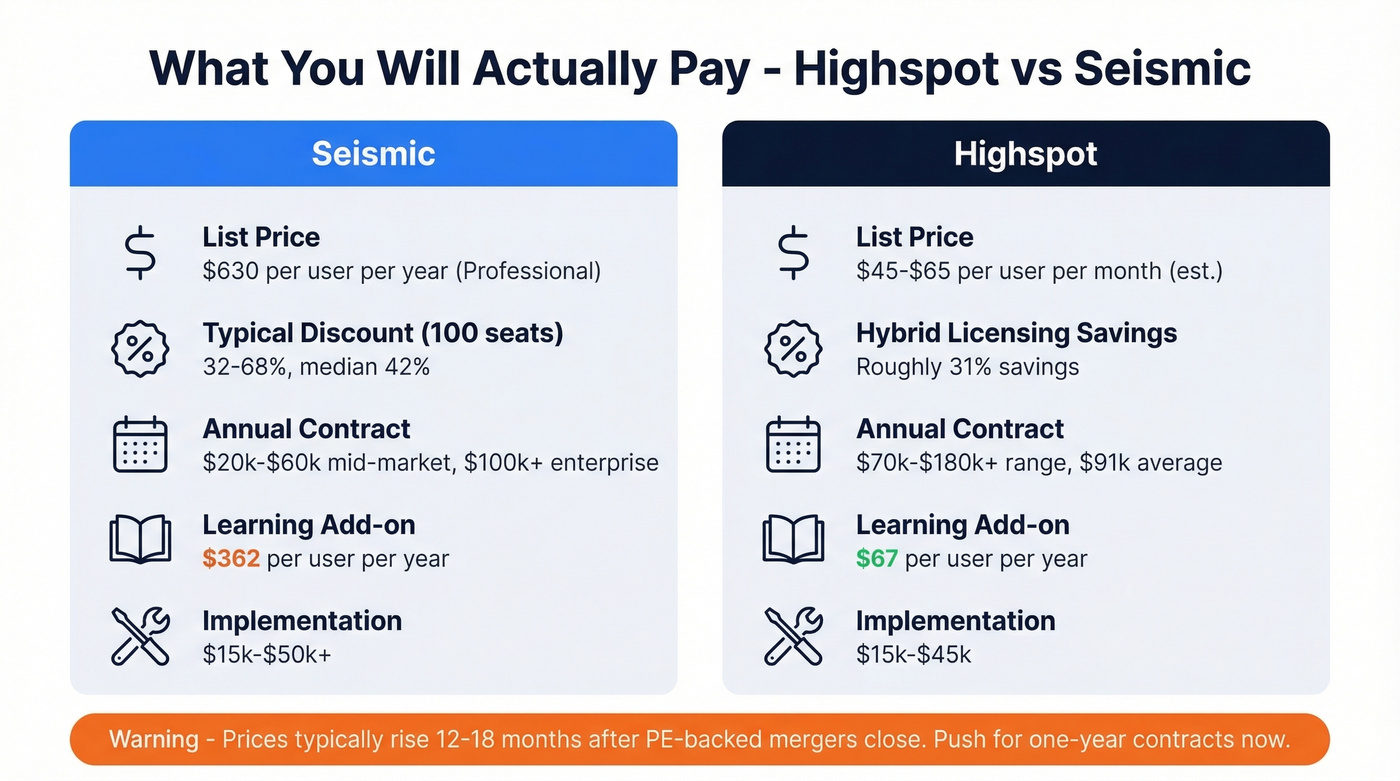
Neither platform publishes clean pricing. Here's what the numbers look like based on Vendr negotiation data and third-party benchmarks:
| Cost element | Seismic | Highspot |
|---|---|---|
| List price (per user/yr) | ~$630 (Professional), ~$494 (Enterprise Premier) | ~$45-$65/user/mo est. |
| Typical discount (100 seats) | 32-68%, median 42% | Hybrid licensing saves ~31% |
| Annual contract range | $20k-$60k (mid-market); $100k+ (enterprise) | $70k-$180k+ range; $91,460 avg |
| Learning add-on | $362/user/yr (list) | $67/user/yr (learning-only) |
| Implementation | $15k-$50k+ | $15k-$45k |
| Content migration | Included in impl. range | $8k-$25k |
Seismic's Aura Copilot pricing is all over the map - free pilot inclusions on some deals, $50+/user/month on others. The Salesforce Connector adds ~$69/user/year, which stings given that Highspot doesn't charge extra for CRM integrations.
We've tracked enablement pricing through multiple PE-backed mergers, and the pattern is consistent: prices rise 12-18 months after close. Reduced competition plus PE ownership plus consolidation costs equals upward pressure at renewal. If you're signing a contract right now, push hard for a one-year term. Three-year commitments during a merger are a gift to the vendor, not to you.

You're about to spend six figures on Highspot or Seismic - but none of that content lands if your reps are bouncing emails. Prospeo gives you 300M+ profiles with 98% email accuracy on a 7-day refresh cycle, so your enablement investment actually reaches real buyers.
Clean data first, enable second. Start free with 75 verified emails.
What Real Users Say
Seismic carries 1,682 G2 reviews. The top praise theme is ease of content search and sharing (65 mentions), followed by document filtering (25 mentions) and centralized, up-to-date materials (24 mentions). The flip side: poor search functionality shows up in 17 reviews, steep learning curve in 16, and navigation difficulty in 12. Power users love it. New reps struggle for weeks.
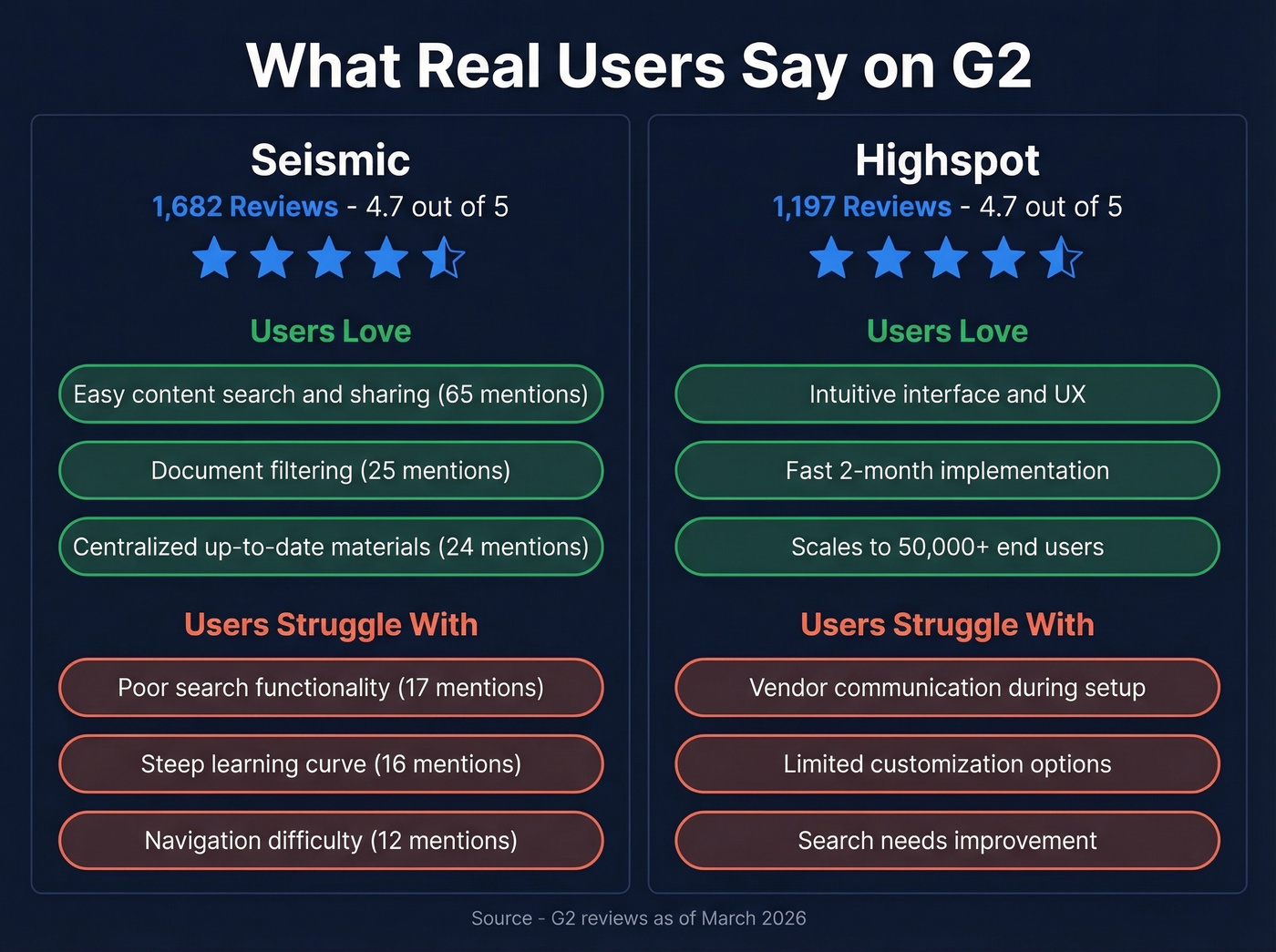
Highspot has 1,197 G2 reviews and consistently earns praise for its intuitive interface. G2 benchmarks show a 2-month implementation timeline and a 15-month ROI timeline. Complaints skew operational - vendor communication challenges during setup, limited customization options, and search improvements requested.
For context on Highspot's scale: the company raised $650M total at a $3.5B valuation in 2022, serves 40+ customers with 5,000 sales reps each, and its largest deployment exceeds 50,000 end users. That's a massive installed base Seismic now needs to migrate without breaking things, and we've seen how messy that gets - the Showpad/Bigtincan merger that completed in October 2025 still hasn't delivered a unified product experience.

The Problem Neither Platform Solves
Let's be honest: enablement platforms optimize what happens after a rep reaches a prospect. But if your contact data is stale, none of that content lands. We've watched teams pour six figures into Seismic or Highspot only to have reps bouncing emails at 30%+ rates because nobody invested in data quality upstream.
Prospeo keeps your prospect lists clean before your enablement stack kicks in - 300M+ professional profiles, 98% email accuracy, and a 7-day data refresh cycle. The free tier gives you 75 verified emails per month with no contract and no sales call.
If you're rebuilding your outbound motion during the merger window, start with sales prospecting techniques and a tight lead generation workflow so enablement content actually gets used.
The Verdict - What to Do Now
Enterprise (1,000+ employees, regulated, Microsoft stack): Seismic is the surviving brand. Commit there if you must, but negotiate a one-year contract, not three. You'll have more leverage after the merger closes and the product roadmap clarifies.
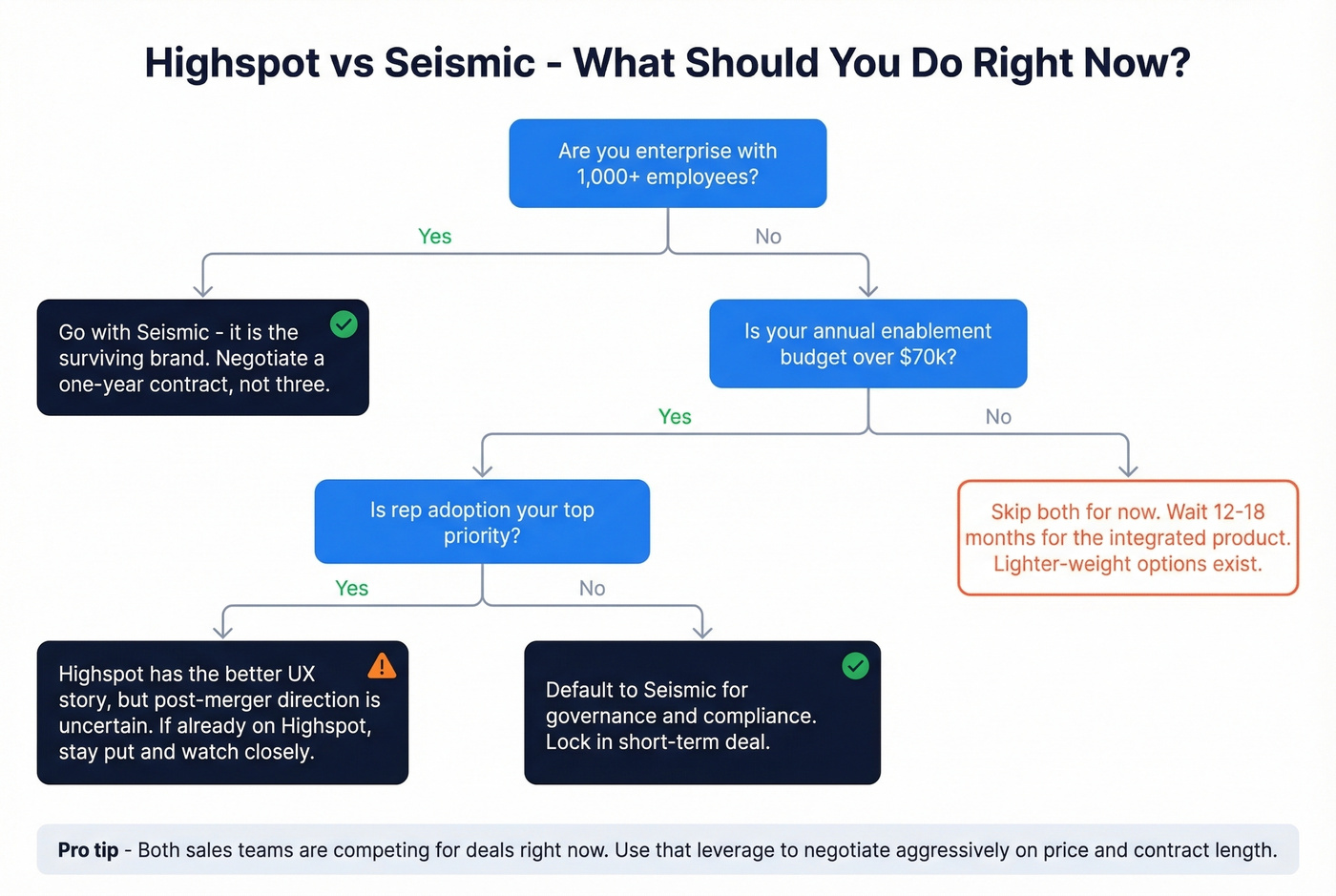
Mid-market prioritizing rep adoption: Highspot was the better UX story. Whether that UX survives integration is genuinely uncertain. If you're already on Highspot, stay put and watch. If you're evaluating fresh, that uncertainty is a real risk.
Mid-market that can't stomach $70k+/year: Look elsewhere. The enablement market is consolidating, but lighter-weight options exist for teams that don't need enterprise governance. Don't let a sales rep convince you that you need the Cadillac when a Honda gets you to work just fine.
If you're in this bucket, pair a lighter enablement tool with better outbound fundamentals: free lead generation tools, email deliverability, and email bounce rate monitoring.
Everyone: Lock in short-term contracts. The merger hasn't closed yet - it's still pending regulatory approval. Both platforms continue operating independently, but the 12-24 month integration window is when customers have the most negotiating power and the least product clarity. Use that asymmetry.
If you need a negotiation framework, set your walk away point and use a clear anchor before procurement gets involved.
While Highspot and Seismic sort out their merger, your reps still need to reach decision-makers. Prospeo delivers 98% accurate emails at $0.01 each - no contracts, no sales calls, no merger uncertainty. Teams using Prospeo book 26% more meetings than ZoomInfo users.
Stop waiting on the merger. Start reaching the right people today.
FAQ
Is this comparison still relevant after the merger announcement?
Yes, until the deal closes pending regulatory approval. Both platforms remain fully supported as independent products. Expect 12-24 months after close before meaningful product consolidation - enterprise software mergers of this scale rarely move faster.
Will pricing increase after the merger closes?
Almost certainly at renewal. Reduced competition, PE ownership via Permira, and consolidation costs all create upward pressure. Negotiate short-term contracts now while both sales teams still compete for deals and have incentive to discount aggressively.
Should I wait for the combined product before buying?
If your annual enablement budget is under $70k, yes - wait 12-18 months for the integrated platform. Larger enterprises with immediate needs should sign a one-year Seismic contract now and renegotiate once the roadmap solidifies post-close.