

Hot Call: The Complete Guide to Identifying, Preparing, and Closing High-Intent Leads
Your SDR's Slack just lit up. A VP of Marketing at a 200-person SaaS company requested a demo, visited the pricing page twice, and downloaded a case study - all in the last 90 minutes. That lead is on fire. The question is whether your team makes the hot call in the next five minutes or lets it cool for around 42 hours, which is a commonly cited average for B2B lead response time.
Leads contacted within 5 minutes are 21x more likely to qualify than those contacted after 30 minutes. RAIN Group's research across 488 buyers and $4.2B in purchases backs this up: top performers achieve 2.7x more conversions, largely because they respond faster and target better. The gap between intent and action is where deals die - and it's exactly what hot calling is designed to close.
Here's the short version: success comes down to three things, in order. Speed - contact within 5 minutes. Data quality - a verified phone number and email. Preparation - know the prospect's context before you dial. Below, we break down the scoring model, call framework, and scripts to execute all three. If you only do one thing after reading this, fix your lead response time.
What Is a Hot Call?
A hot call is a sales call to a prospect who's actively showing buying intent right now. They've requested a demo, asked about pricing, engaged with multiple pieces of content in a short window, or explicitly asked to be contacted. The key distinction: a hot lead isn't just aware of you - they're evaluating you.
Definition: A sales call made to a prospect who has demonstrated active buying intent through recent high-value actions - demo requests, pricing inquiries, multi-asset engagement, or direct outreach - and is likely within a 30-90 day purchase window.
Veloxy frames "hot calling" as a multichannel-first approach, using email, social, and content to warm a prospect before picking up the phone. That's a valid strategy, but it really describes the process of creating a hot lead, not the call itself. For this guide, we're focused on the operational definition: the prospect has shown intent, and you're calling while that intent is fresh. The distinction changes everything about how you prepare, what you say, and how fast you move.
Hot Call vs Cold Call: Key Differences
"Hot," "warm," and "cold" aren't really types of calls - they're descriptions of the prospect's readiness. CloudTalk maps them neatly to the funnel: cold is top-of-funnel, warm is mid-funnel, hot is bottom-of-funnel. The call technique changes because the prospect's mindset has changed.
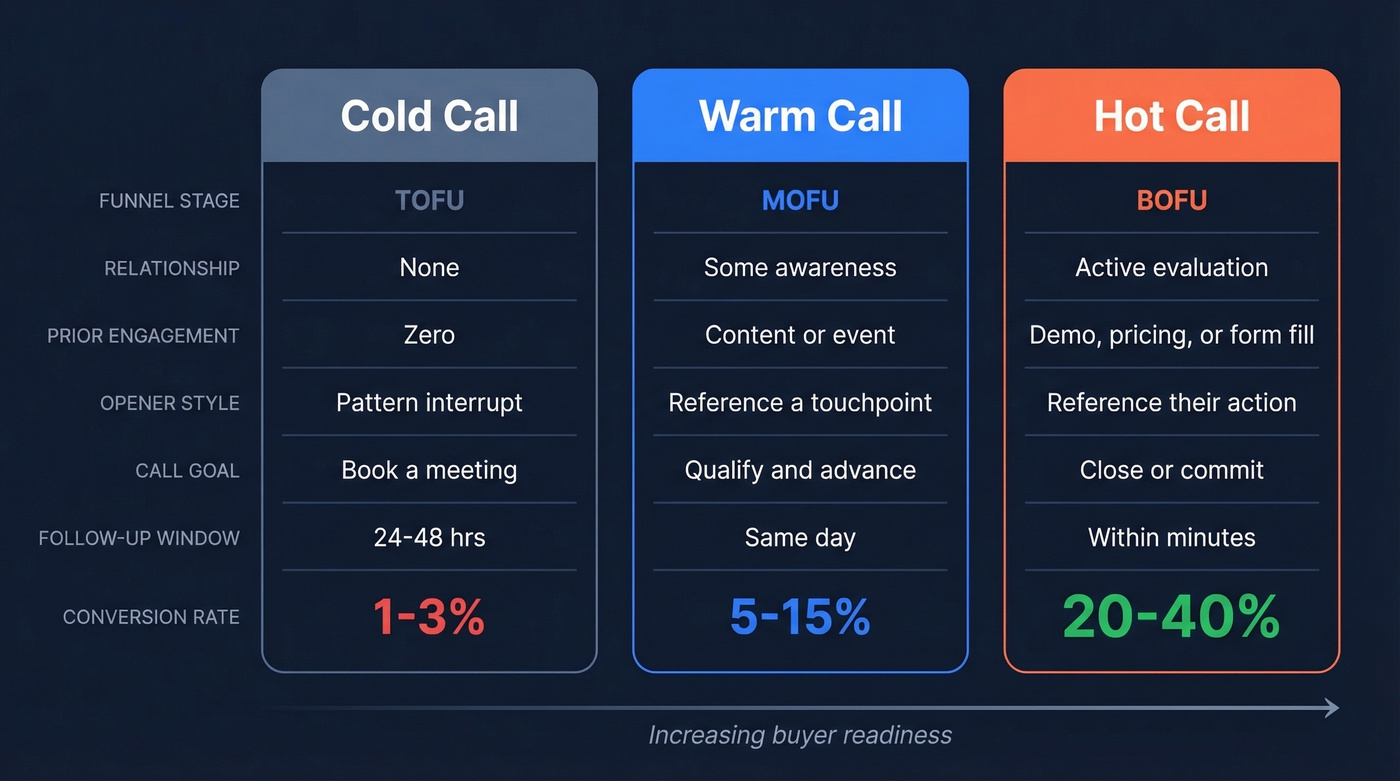
| Dimension | Cold Call | Warm Call | Hot Call |
|---|---|---|---|
| Funnel stage | TOFU | MOFU | BOFU |
| Relationship | None | Some awareness | Active evaluation |
| Prior engagement | Zero | Content/event | Demo/pricing/form |
| Opener style | Pattern interrupt | Reference touchpoint | Reference their action |
| Call goal | Book a meeting | Qualify + advance | Close or commit |
| Follow-up window | 24-48 hrs | Same day | Within minutes |
| Conversion rate | 1-3% | 5-15% | 20-40% |
CloudTalk's data shows it takes 18+ dials to connect on a cold call, and 48% of reps never follow up at all. Hot calling flips both of those problems - the prospect wants to talk, and the urgency forces follow-through.
The practical takeaway: hot calling isn't a "technique" you learn separately from cold or warm calling. It's the same fundamental skills - rapport, discovery, tailored pitch, next steps - executed with more urgency and better data. The difference is timing and context, not some secret script.
How to Identify Hot Leads
The 3 Types of Buying Signals
Not all intent signals carry equal weight. Boomerang's taxonomy breaks them into three practical categories for prioritizing your call queue.
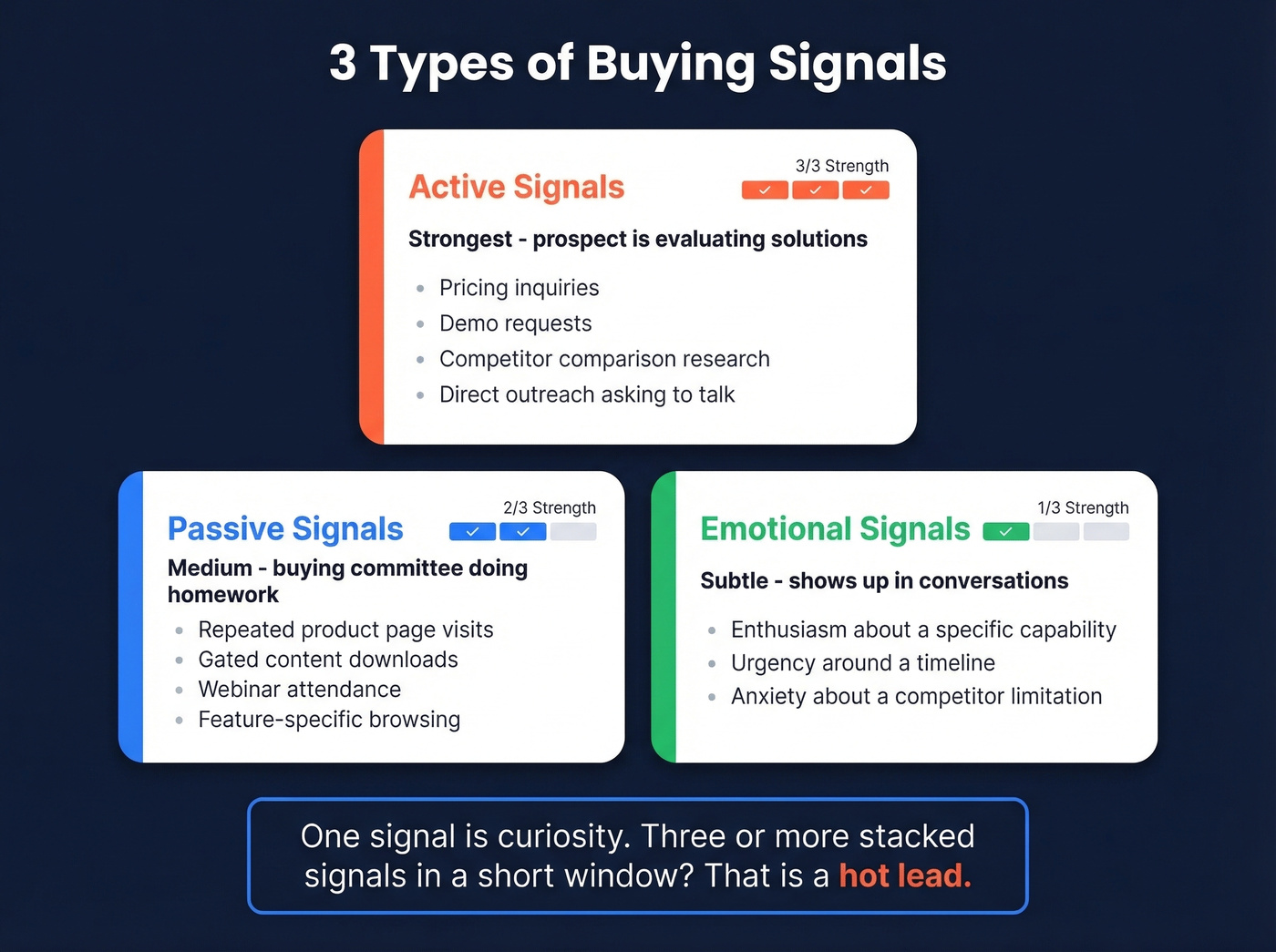
Active signals are the strongest: pricing inquiries, demo requests, competitor comparison research, and direct outreach. These prospects are evaluating solutions and want to talk.
Passive signals require interpretation: repeated product page visits, gated content downloads, webinar attendance, and feature-specific browsing. Individually they're noise. Stacked together, they're a buying committee doing homework.
Emotional signals show up in conversations: enthusiasm about a specific capability, urgency around a timeline, or anxiety about a competitor's limitations. Harder to track in a CRM but easy to hear on a call.
The 30-90 Day Window
Monday.com's framework defines hot leads as prospects ready to buy within 30-90 days. The signals that separate a marketing qualified lead from a sales qualified lead ready for immediate outreach are specific:
- Pricing and implementation questions together
- Rapid consumption of multiple assets in one session
- Buying committee involvement (CFO, IT, procurement)
- Explicit urgency: "We need this by Q3"
One signal is curiosity. Three or more stacked signals in a short window? That's a hot lead. And a quick reality check: not every inbound lead that looks warm is actually hot. A scoring model protects you from chasing tire-kickers.
A Simple Lead Scoring Model
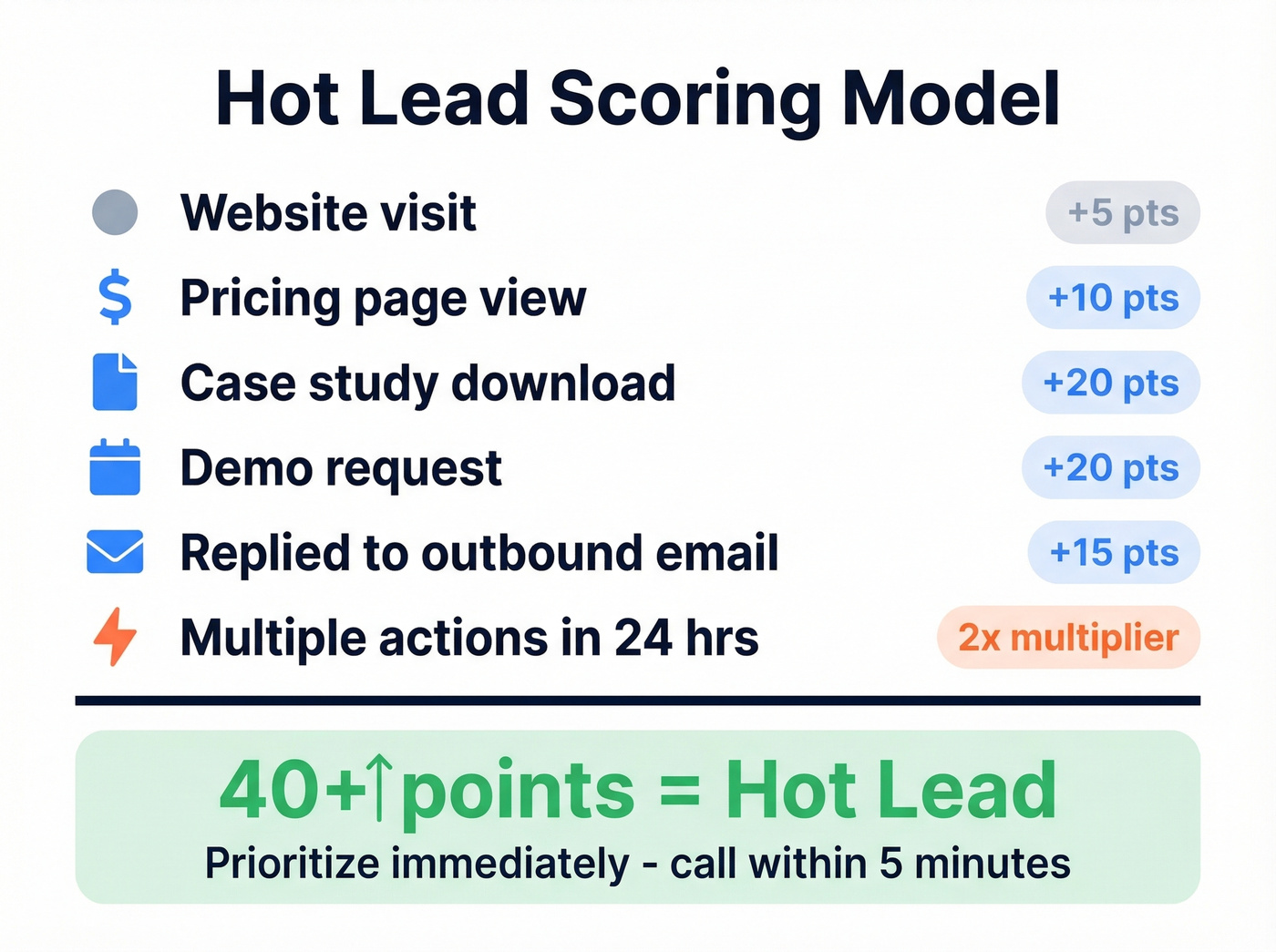
If you don't have a scoring model yet, start simple. Instantly's framework provides a clean starting point:
| Action | Points |
|---|---|
| Website visit | 5 |
| Pricing page view | 10 |
| Case study download | 20 |
| Demo request | 20 |
| Replied to outbound email | 15 |
| Multiple actions in 24 hrs | 2x multiplier |
Threshold: 40+ points = hot lead, prioritize immediately. Adjust the numbers to your sales cycle, but the principle holds - stack actions, weight for recency, and trigger an alert when the score crosses your threshold.
The 5-Minute Rule
Speed-to-lead is the single highest-leverage variable in hot calling. Leads contacted within 5 minutes are 21x more likely to qualify than those contacted after 30 minutes. Not 2x. Not 5x. Twenty-one times.
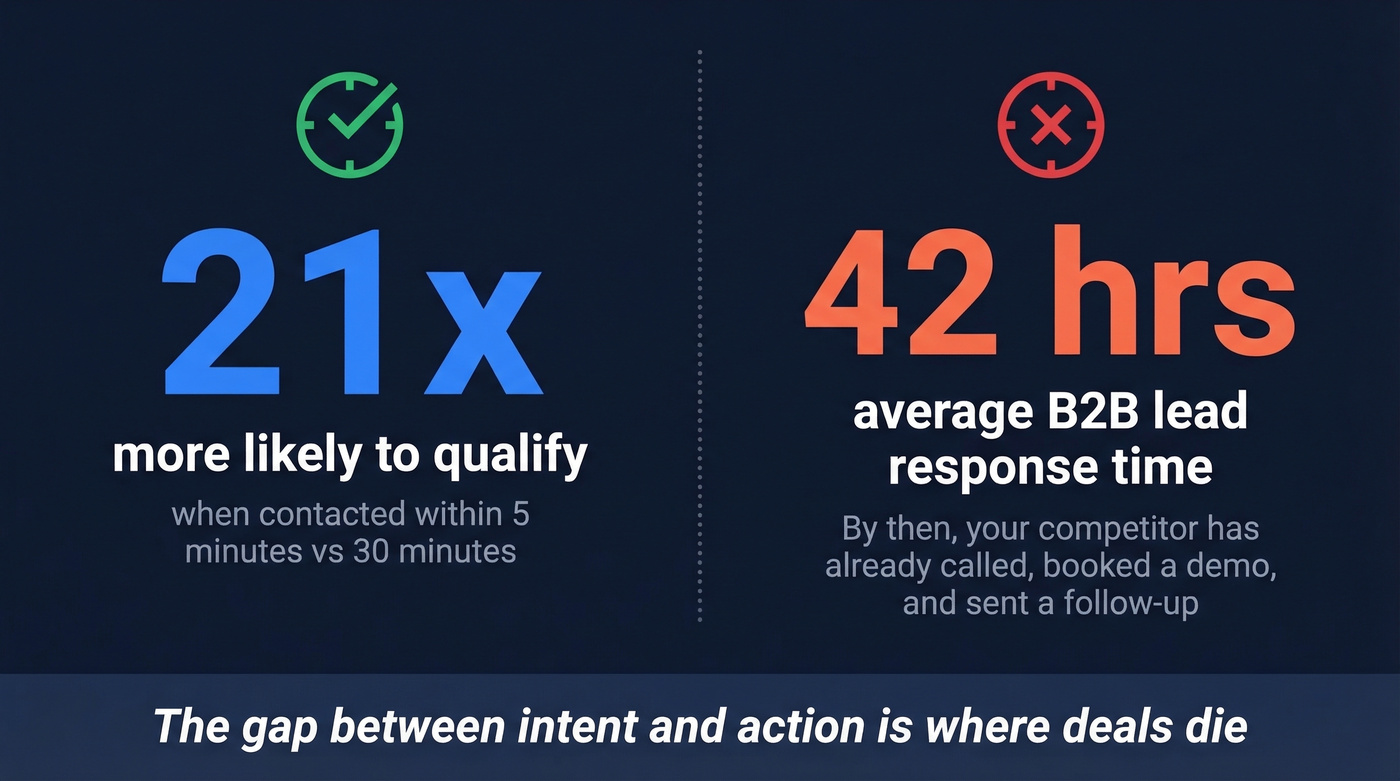
And yet the average B2B company takes around 42 hours to respond to an inbound lead. By then, your competitor has already called, booked a demo, and sent a follow-up email with a custom deck.
The 5-minute rule only works if you have a verified phone number when intent spikes. This is where most teams break down - the lead comes in hot, but the phone number in the CRM is stale or wrong. We've watched teams double their conversion just by fixing data hygiene. A verified mobile database with a weekly refresh cycle is the difference between reaching the person and leaving a voicemail at a disconnected number.
Here's the thing: if your average lead response time is over 30 minutes, fixing that one metric will do more for your pipeline than any new script, any new tool, or any new hire. Most teams don't have a closing problem. They have a speed problem.

The 5-minute rule only works if you have a real phone number. Prospeo's 125M+ verified mobile numbers refresh every 7 days - not every 6 weeks - so when intent spikes, you're dialing a number that actually connects. 30% pickup rate across all regions.
Stop losing hot leads to stale data. Dial verified numbers today.
How to Run One: The 4-Step Framework
This framework mirrors what a detailed r/sales breakdown of inbound calls recommends - and it's the same structure top-performing SDRs use in practice. Let's walk through each step.
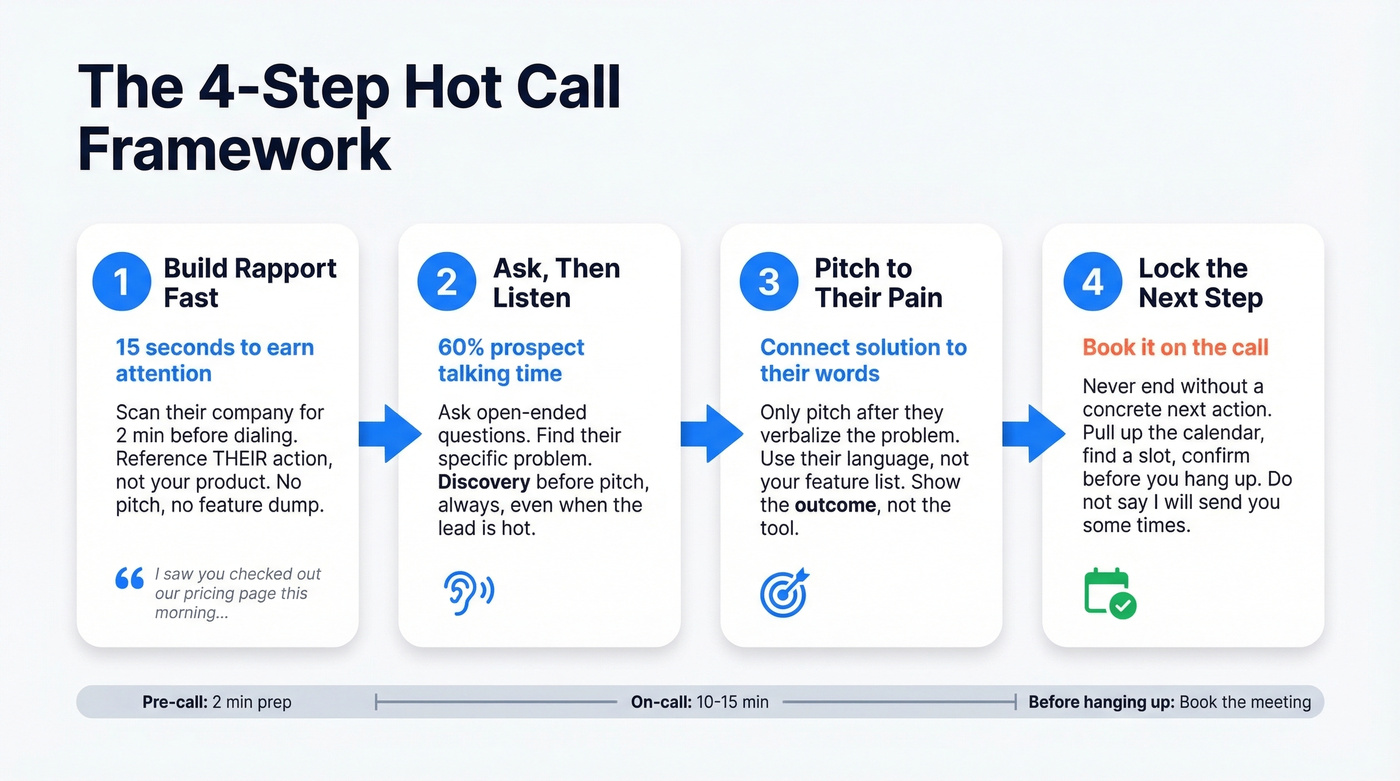
Build Rapport Fast
You've got maybe 15 seconds before the prospect decides if this call is worth their time. Spend 2 minutes before dialing to scan their company - recent funding, product launches, hiring patterns - and the prospect themselves.
Your opener should reference their action, not your product. "Hey Sarah, I saw you checked out our enterprise pricing page this morning - wanted to make sure I could answer any questions while it's top of mind." No pitch. No feature dump. Just relevance and a reason to keep talking.
Ask, Then Listen
The biggest mistake reps make on high-intent calls is assuming the prospect's interest means they're ready to hear a pitch. They're not. They have questions, concerns, and a specific problem they're trying to solve. Your job is to find out what that problem is.
Top performers let the prospect talk roughly 60% of the call. Ask open-ended questions - "What's driving the timeline on this?" or "What does your current setup look like?" - then shut up and take notes. Discovery before pitch. Always. Even when the lead is scorching hot.
Pitch to Their Pain
Only after the prospect has verbalized their problem should you connect your solution to it. "You mentioned your team's spending 6 hours a week on manual list building - here's how we'd cut that to 30 minutes." That's a pitch. "We have 300 million profiles and 30 search filters" is a feature list. The difference matters.
Lock the Next Step
Never end a hot call without a concrete next action. With about 5 minutes left, transition: "Can we get 30 minutes on the calendar Thursday to walk through a demo with your team?"
Book it while you're still on the phone. Don't say "I'll send you some times." Pull up the calendar, find a slot, and confirm it before you hang up. Every hour between the call and the booked meeting is an hour for the prospect to get distracted, reprioritize, or go dark.
Scripts That Actually Work
Inbound Demo Request
"Hi [Name], this is [Your Name] from [Company]. You requested a demo earlier today - I wanted to reach out while it's fresh. Is 3 minutes fair to make sure a full demo would actually be worth your time?"
[If yes]: "What specifically caught your eye? Was it [feature A] or more the [use case B] side?"
[Listen, then]: "Based on that, here's what I'd show you in the demo... Can we lock in 30 minutes on [day]?"
The 3-minute time-box, adapted from Zendesk's framework, works because it respects the prospect's time while creating a low-commitment opening. Most people say yes to 3 minutes. And 3 minutes of good discovery almost always turns into 10.
Pricing Page Visitor
This one's less about a rigid script and more about giving the prospect control. The "choose your own adventure" approach works well here.
Open with: "I noticed you were checking out our pricing - totally understand if you're just doing research, but I figured I'd save you some time." Then offer a choice: walk them through pricing for their team size, or send a comparison sheet they can share internally. Either way, follow up with: "What are you comparing us against?" That question opens real discovery without feeling pushy.
The worst version of this call? Launching into a pricing breakdown nobody asked for. Let them steer.
Referral Follow-Up
You open with the mutual connection's name - that's your permission slip. "Hi [Name], [Mutual Connection] suggested I reach out - they mentioned you're evaluating solutions for X." Then immediately hand control back: "I don't want to assume too much. Is that something you're actively working on right now?"
If they say yes, resist the urge to pitch. Instead: "What's the biggest challenge you're running into?" The referral name-drop is the strongest opener in sales. It establishes trust and gives you permission to ask direct questions. Don't waste it by launching into features - use it to open a real conversation.
5 Mistakes That Kill Deals
1. Pitching before discovery. The prospect showed intent, not a purchase order. They still have questions, objections, and a buying committee. Skip discovery and you'll pitch the wrong value prop to the wrong pain point.
2. Assuming urgency equals a closed deal. A hot lead is further along than a cold one, but "interested" and "ready to sign" are different things. We've seen reps rush proposals to hot leads and lose deals they would've won with one more discovery call. In our experience, the biggest gap isn't script quality - it's knowing when to slow down even when the lead feels urgent.
3. Talking more than 40% of the call. If you're doing most of the talking, you're not learning anything. Cognism's cold calling data reinforces what every sales manager knows: the best calls are prospect-led. High-intent calls are no exception.
4. Ending without a locked next step. "I'll send you an email" isn't a next step. "We're meeting Thursday at 2pm with your VP of Ops" is a next step. The difference in conversion is enormous.
5. Dialing stale data. Nothing kills momentum faster than a wrong number. Your lead scored 50 points, your CRM fired the alert, you called within 4 minutes - and the number's disconnected. Verify your contact data before every call block. Use a verification tool with a weekly refresh cycle. Skip this step and the rest of the framework falls apart.
The Tech Stack for Hot Calling
You don't need 10 tools. You need three categories covered, and you need them to talk to each other.
CRM with lead scoring. HubSpot handles basic scoring on its paid tiers. Salesforce starts around $25/user/month for Starter and scales up fast with editions and add-ons. The point is automated alerts when a lead crosses your hot threshold - if your reps are manually checking lead scores, you've already lost the speed game. (If you need a refresher on what counts as a CRM, see examples of a CRM.)
Intent data. Bombora is the enterprise standard for topic-level intent signals. Expect to pay $25K-$50K/year standalone, though it's increasingly bundled through data platforms. The goal is knowing which accounts are researching your category before they fill out a form. If you're building this motion, how to track sales triggers is the operational playbook.
Verified contact database. This is the piece most teams underinvest in. For hot calling specifically, you need verified mobiles that actually connect. Prospeo combines Bombora intent data tracking 15,000 topics with 125M+ verified mobile numbers that hit a 30% pickup rate - so you see the intent signal and get a working phone number without switching tools. The free tier gives you 75 emails and 100 Chrome extension credits per month, enough to test the workflow before committing. If you're comparing vendors, start with best B2B company data providers and best sales prospecting databases.
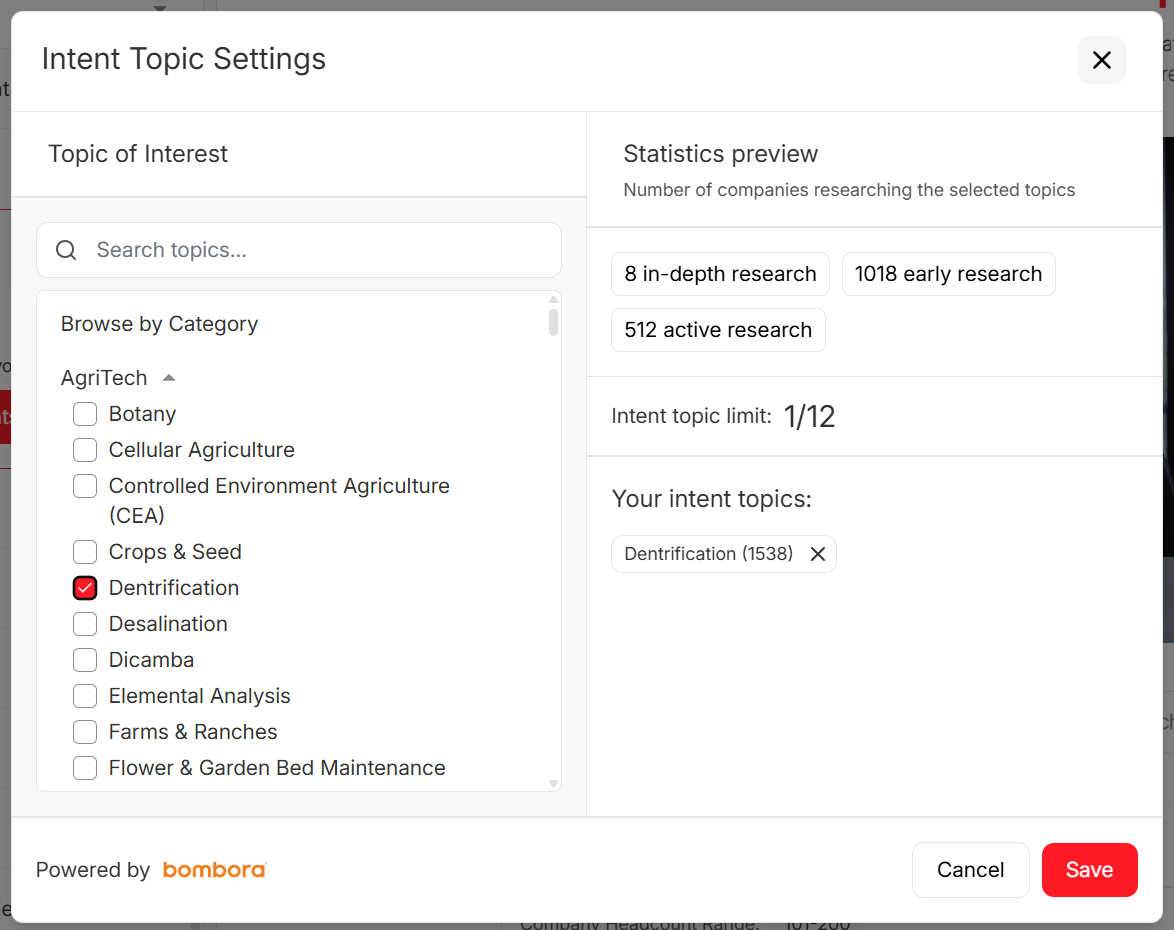
The stack doesn't need to be complicated. CRM for scoring and alerts, intent data for early warning, verified contacts for execution. Everything else is optimization.
Your lead scoring model flags a hot prospect at 40+ points. Now what? Prospeo layers Bombora intent data across 15,000 topics with 30+ filters - buyer intent, job changes, tech stack - so you know exactly who's in-market before you pick up the phone.
Identify hot leads before your competitors even see the signal.
FAQ
What's the difference between a hot call and a cold call?
A cold call targets someone with no prior relationship or expressed interest - you're interrupting their day hoping to earn attention. A hot call targets someone actively evaluating solutions who has requested a demo, visited pricing, or asked implementation questions. Cold calls create awareness at 1-3% conversion; hot calls convert existing demand at 20-40%.
What's a good conversion rate for hot calls?
Expect 20-40% conversion on well-executed hot calls, roughly 3-5x the rate of cold outreach. RAIN Group data shows top performers achieve 72% win rates on proposed deals versus 47% for average reps, and high-intent leads are where that performance gap compounds most.
How fast should I follow up with a hot lead?
Within 5 minutes. Leads contacted in under 5 minutes are 21x more likely to qualify than those contacted after 30 minutes. The average B2B company takes around 42 hours. Don't be average.
What tools do I need for effective hot calling?
Three things: a CRM with lead scoring alerts (HubSpot or Salesforce), intent data to catch buying signals early, and a verified contact database for accurate phone numbers. Prospeo bundles intent data and 125M+ verified mobiles with a 30% pickup rate, and its free tier lets you test the workflow without commitment.
What should I do if a hot lead doesn't answer?
Leave a voicemail under 30 seconds, follow up immediately with a personalized email, and try again within 24 hours. Hot intent decays fast - compress your cadence to 3-4 touches across phone, email, and social within 48 hours.