

How Digital Agencies Actually Get Clients (With Real Numbers)
You can build funnels for clients and still stare at an empty pipeline on Monday morning. We've seen it happen to talented agencies with great case studies - because "good work" isn't a distribution strategy. So how do digital agencies get clients when the work alone isn't enough?
In early 2025, one practitioner on r/agency broke down how they landed 10 clients in a single month: a mix of TikTok leads, referrals, and ruthless follow-up speed. That's not luck. It's a repeatable system.
Here's the thing: if your average deal size is under five figures annually, you don't need fancy "brand" tactics yet. You need volume, speed, and clean targeting.
What You Need (Quick Version)
If you want clients in the next 30 days, do these three things - no extra channels, no distractions:
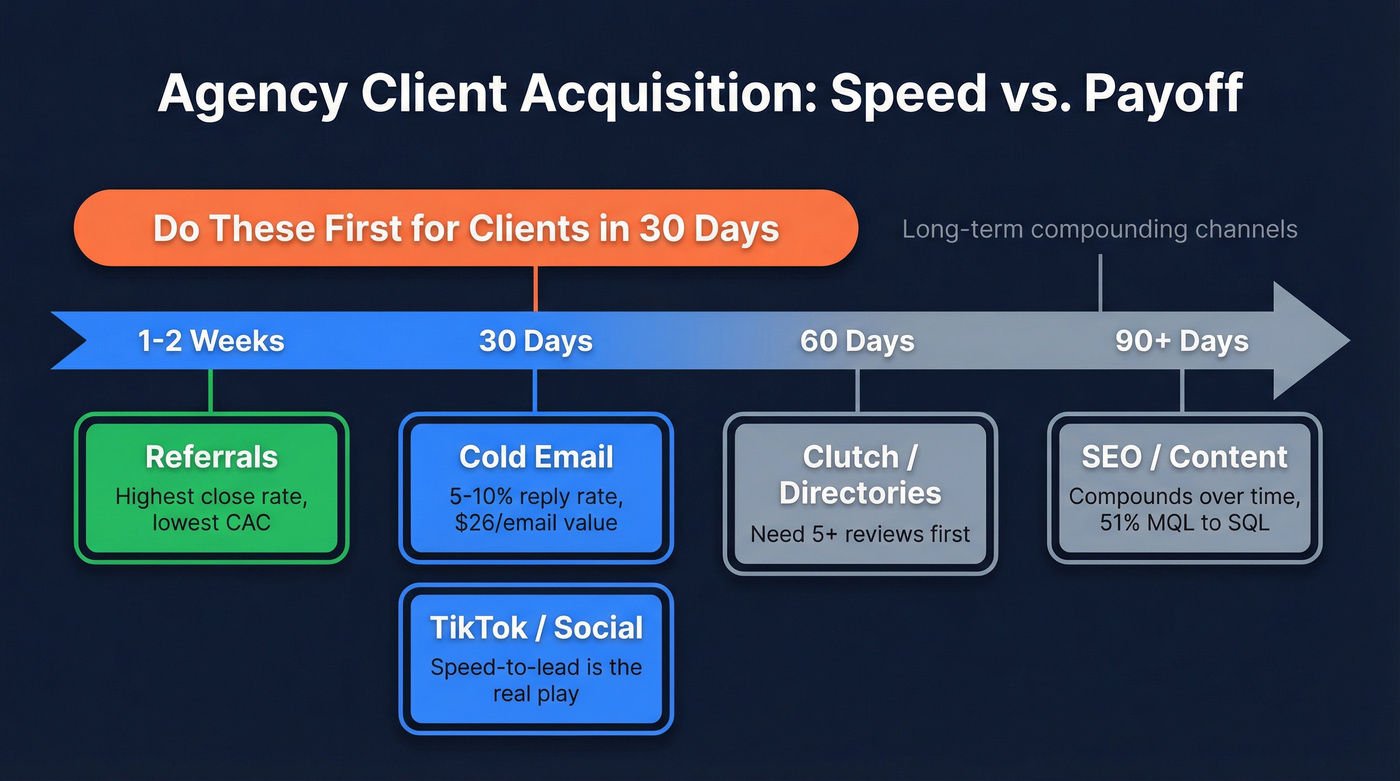
- Activate referrals with a structured ask and a simple incentive.
- Run a tight cold email campaign to 50-150 verified prospects.
- Post where your buyers already scroll (TikTok is underrated, but pick one platform and commit).
SEO, directories, webinars, partnerships - those can work, but they're usually a 90-day-plus payoff. The fastest agencies we know don't do more things. They do fewer things with more consistency.
Fix Your Offer First
Nothing works if your offer is "we do digital marketing." Productize it.
Keep it to two or three packages, each with a clear outcome and a fixed price. Proven price points that sell without endless discovery calls: a $495 single-scope project, a $795 audit-plus-implementation tier, and a $2,495 bundled package that solves a bigger problem. Buyers can understand these instantly, which means shorter sales cycles and fewer "let me think about it" replies.
Then tighten your ICP until it's almost uncomfortable. "Small businesses" isn't an ICP. "HVAC companies in Texas doing $2-10M revenue with no Google Ads program" is.
Referrals: Engineered, Not Hoped For
Referrals convert because trust is pre-loaded. DashThis reports that 75% of sales leaders say referrals convert at the highest rate, and agencies typically see meaningfully lower acquisition costs than paid channels.
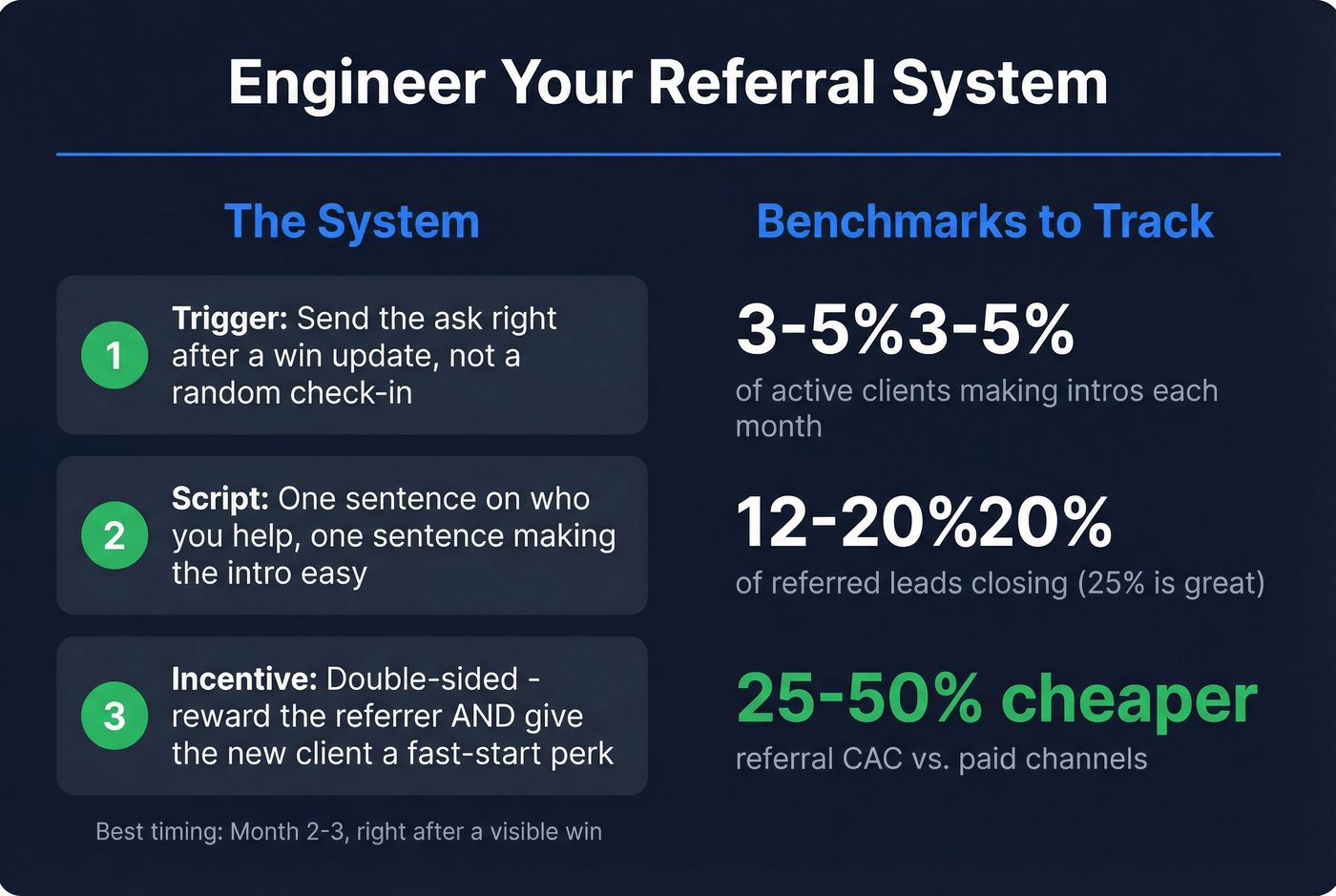
In our experience, the referral ask works best around month 2 or 3, right after you've delivered a visible win - a lead spike, a CPA drop, a conversion lift. Ask too early and it feels needy. Ask too late and the momentum is gone.
Here's the system that actually gets introductions:
- Trigger: send the ask right after a "win" update, not during a random check-in.
- Script: one sentence on who you can help, plus one sentence making the intro easy.
- Incentive: double-sided - give the referrer a discount or bonus, and give the new client a fast-start perk.
To know if it's working, watch three numbers. You want 3-5% of active clients making intros each month, 12-20% of referred leads closing (25% is a great stretch target), and referral CAC coming in 25-50% cheaper than your paid channel.
Cold Email: The Numbers and the Fix
Cold email still works in 2026, but only if you treat it like a deliverability game first and a copywriting game second.
Belkins analyzed [16.5 million cold emails](https://belkins.io/blog/cold-email-response-rates) and found the average reply rate was 5.8%. Their top performers were short - six to eight sentences - did best on Thursdays at 6.87% replies, and targeted one to two contacts per company, pulling about 7.8% replies versus 3.8% when blasting 10+ people at the same org.
Look, most agencies don't have a copy problem. They have a list problem.
We've watched agencies burn their primary domain in under a week because they uploaded a scraped list, hit send, and "hoped" the bounces wouldn't matter. They always matter. If your bounce rate creeps above roughly 2%, you're not just wasting sends - you're training inboxes to distrust you.

This is exactly where verified data earns its keep. Prospeo's 98% email accuracy and 7-day refresh cycle mean you're not sending to stale addresses that bounced three months ago. Stack Optimize used it to keep bounce rates under 3%, maintain 94%+ deliverability, and scale from $0 to $1M ARR with zero domain flags across client campaigns.
What Is One Cold Email Worth?
Most articles stop at "cold email works." Let's do the math that tells you how hard to push.
If you want to go deeper on sequencing and follow-ups, use these cold email follow-up templates and a simple B2B cold email sequence structure.
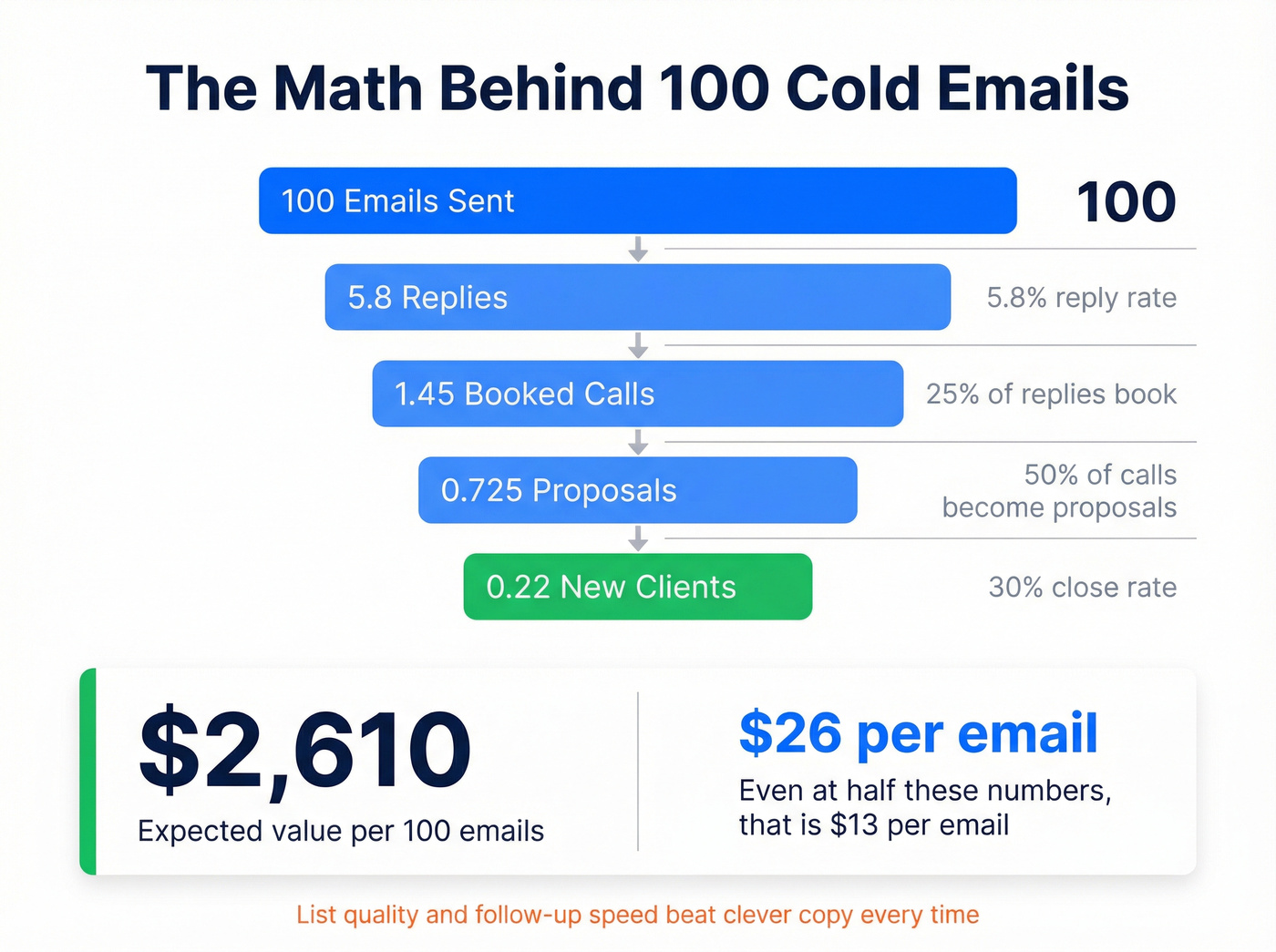
Use conservative benchmarks: a 5.8% reply rate, 25% of replies becoming booked calls, a 30% close rate from proposals, a $2,000 average monthly retainer, and 6-month average retention - giving you $12,000 in expected client value.
Now calculate expected value per 100 emails:
- 100 emails produce 5.8 replies
- 5.8 replies become about 1.45 booked calls
- If half of those calls become proposals, that's 0.725 proposals
- 0.725 proposals at a 30% close rate = 0.22 new clients
- 0.22 x $12,000 = $2,610 expected value per 100 emails
- That's roughly $26 per email in expected value
Even if your numbers are half as good, you're still looking at around $13 per email. That's why list quality and follow-up speed beat "clever" copy every time.

You just saw the math: every 100 cold emails can generate $2,610 in expected value - but only if those emails actually land. Prospeo delivers 98% email accuracy on a 7-day refresh cycle, so you're never sending to stale addresses. Stack Optimize used it to scale to $1M ARR with bounce rates under 3% and zero domain flags.
Stop burning your agency's domain on bad data.
Two Channels Agencies Underrate
TikTok (Yes, for B2B)
The r/agency case study wasn't about going viral. It was about speed-to-lead. They pulled multiple clients from TikTok lead forms, then replied to every inbound within 12 hours using a personalized Loom. That's the play: fast response plus a short video that proves you did five minutes of real research.
Agency owners on Reddit consistently circle back to the same point - the channel matters less than how fast you respond once someone raises their hand.
Google Business Profile
If you serve local businesses, your own GBP should be dialed in: services, photos, posts, and a steady drip of reviews. It's boring, and it works. One strong profile can quietly produce warm leads that skip the "prove you're real" stage entirely.
Clutch: A Reality Check
Clutch can work, but it's not a starter channel.
Use it if you already have 5+ verified reviews, you're in a category where buyers actively browse, and you can stomach $1,500-$6,000/month in sponsorship fees to win one to two qualified leads. Martal notes that 94% of B2B buyers use online reviews before engaging a vendor, so your profile matters.
Skip it if you're new, under-reviewed, or still shaky on closing. Paying for visibility before your sales process is tight is just expensive stress.
Content and SEO: Compounding, Not Immediate
Content is the channel that compounds, but it doesn't rescue a slow month. DashThis highlights an example where an agency achieved a 192% year-over-year increase in organic traffic by investing consistently in content, and Digital Bloom reports SEO-sourced leads convert MQL to SQL at 51% versus 26% for PPC.
If you're starting from zero, commit to one "money" page for your core service plus two supporting articles per month. That's enough to build momentum without turning your agency into a content factory. If you need a framework for what to publish and how to measure it, start with B2B content marketing.
Know Your Pipeline Numbers
If you don't know your conversion rates, you're guessing - and guessing feels like "marketing isn't working." Track funnel metrics and keep an eye on pipeline health so you can fix leaks before they become a slow month.
Here are realistic agency benchmarks:
| Stage | Conversion Rate |
|---|---|
| Lead to Booked Call | 10-30% |
| Booked Call to Proposal | 30-60% |
| Proposal to Close | 20-40% |
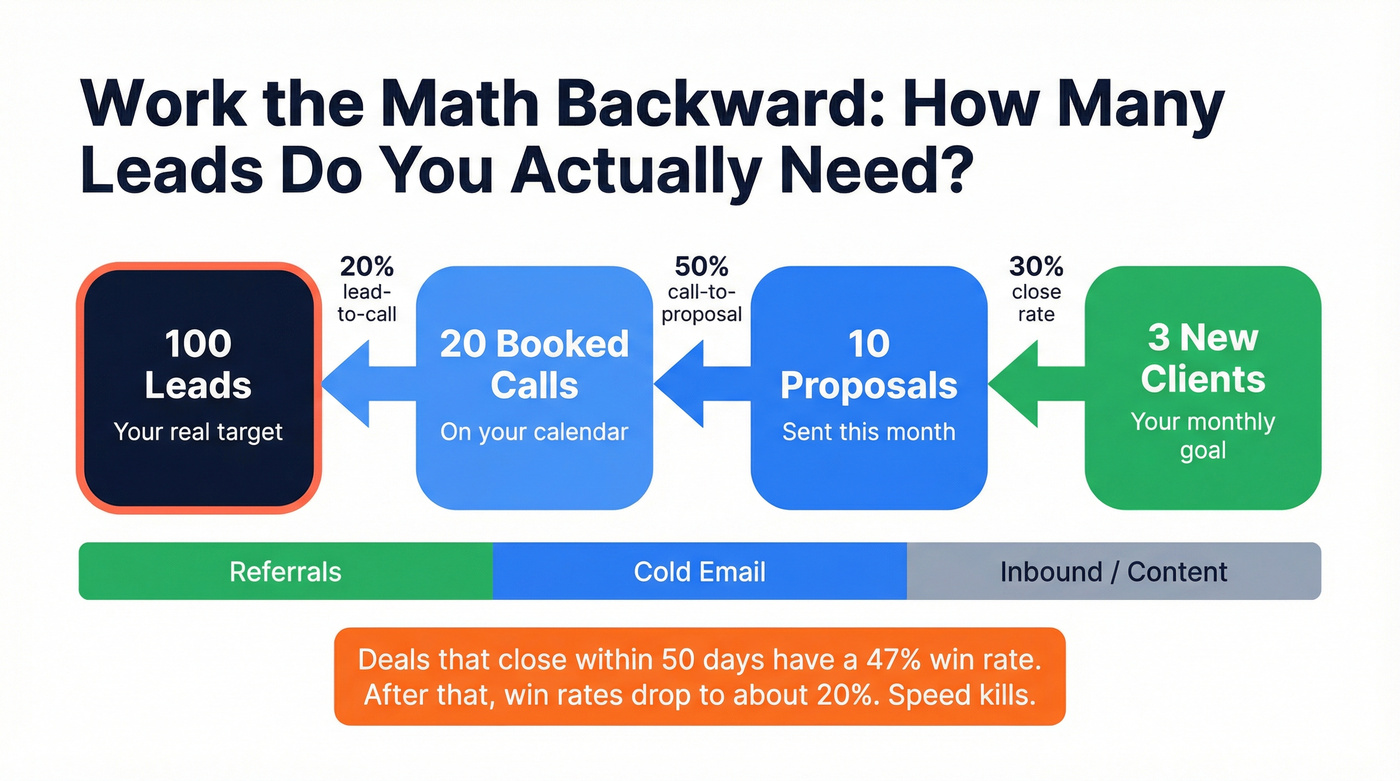
Speed matters as much as the percentages. Outreach found deals closed within 50 days show a 47% win rate; after that, win rates drop to roughly 20%. If a deal has been "thinking about it" for three months, it's usually dead. Move on.
Work the math backward. If you need 3 new clients this month and you close 30% of proposals, you need 10 proposals. If half your calls become proposals, you need 20 calls. If 20% of leads book calls, you need 100 leads. Now you have a real target, and you can decide whether those leads come from referrals, outbound, or inbound.
That backward math is the real answer to how digital agencies get clients consistently - they stop guessing and start engineering a pipeline with known inputs and outputs. If you want more ways to fill the top of funnel, borrow from these sales prospecting techniques and free lead generation tools.
Tightening your ICP to 'HVAC companies in Texas doing $2-10M revenue' is smart. Actually finding verified contacts at those companies is the hard part. Prospeo's 30+ search filters - revenue, headcount, technographics, intent data - let you build hyper-targeted prospect lists in minutes, not hours. At $0.01 per email, a 150-prospect campaign costs less than lunch.
Build agency prospect lists that convert, not bounce.
FAQ
How long does it take a new agency to land its first client?
Two to four weeks is realistic if you activate your network and ask for referrals immediately. Cold outreach usually needs 2-3 weeks of warm-up before replies become consistent, so run both channels from day one.
What's a realistic cold email reply rate for agencies?
Belkins' 16.5M-email benchmark puts the average at 5.8%. A well-targeted agency campaign should hit 5-10%, and 10-15% is excellent. List accuracy matters most - verified emails keep bounce rates under 3%, which protects your domain reputation and keeps you out of spam folders.
Is Clutch worth paying for as a small agency?
Not at the beginning. Get 5+ reviews and a reliable close process first. Once you can convert one to two qualified leads per month, sponsorships in the $1,500-$6,000/month range can deliver positive ROI.
What's the single fastest way for agencies to find new clients?
Structured referral asks after delivering a visible win. Referrals close at 2-3x the rate of cold leads and cost 25-50% less to acquire. Pair them with a 50-150 prospect cold email campaign for volume, and you cover both speed and scale.