

How Many Cold Calls Per Hour? Benchmarks, Math, and What Actually Matters
It's 2 PM. You've been dialing for three hours and talked to exactly two humans. One hung up. The other asked you to call back next quarter.
The answer to how many cold calls per hour you can make depends almost entirely on one variable most people ignore: your dialing method. Manual dialing gets you 8-25 dials per hour. A power or progressive dialer pushes that to 25-45. Parallel dialing on 3-10 lines? 60-150+. Cognism's 2026 cold calling report shows the industry average success rate climbed from 2.3% to 2.7% year-over-year, which tells us something important - cold calling isn't dying, it's just getting more efficient for reps who dial smarter.
Dials Per Hour by Dialing Method
Comparing a manual dialer's output to a parallel dialer's is like comparing a bicycle to a motorcycle. Stop doing it. Here's what each method actually produces:
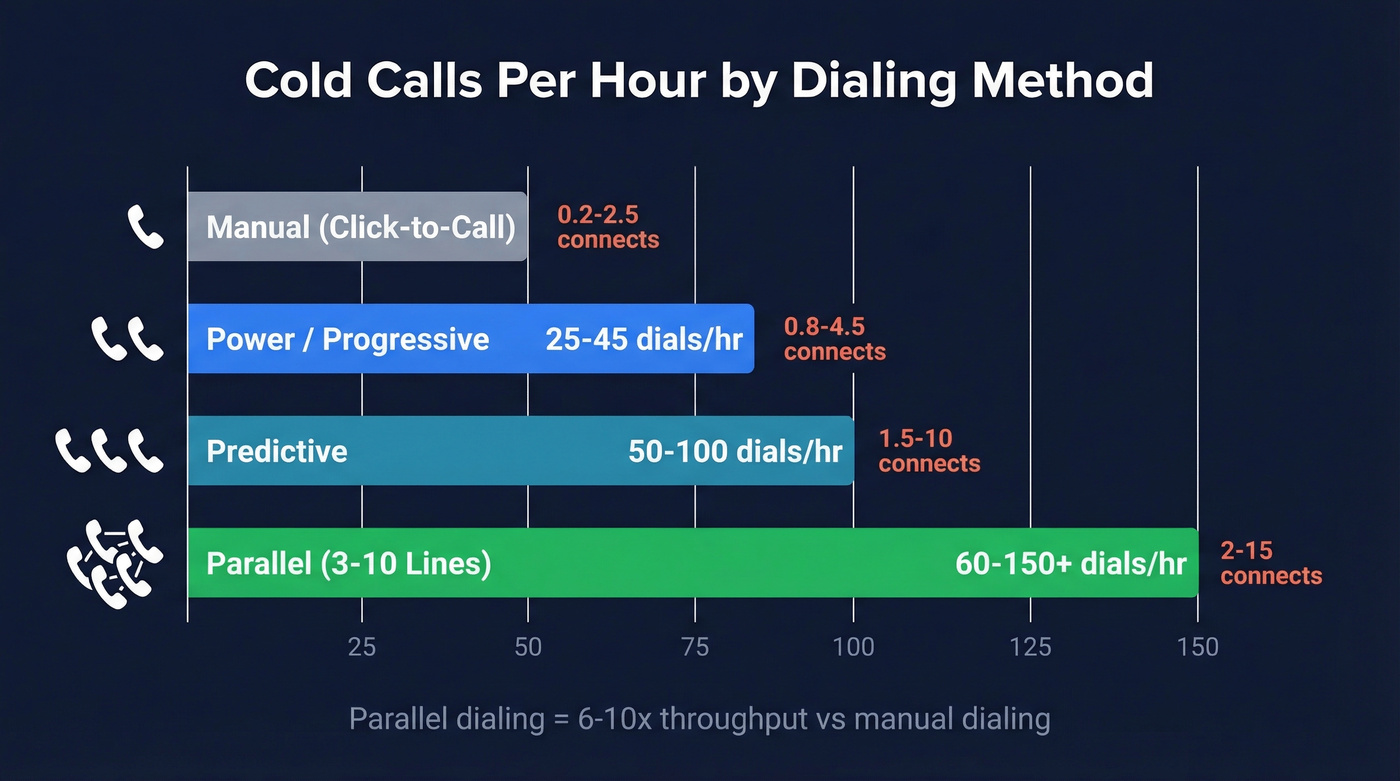
| Dialing Method | Dials/Hour | Est. Connects/Hour | Best For |
|---|---|---|---|
| Manual (click-to-call) | 8-25 | ~0.2-2.5 | Research-heavy calls |
| Power / Progressive | 25-45 | ~0.8-4.5 | Balanced volume + personalization |
| Parallel (3-10 lines) | 60-150+ | ~2-15 | High-volume SDR teams |
| Predictive | 50-100 | ~1.5-10 | Large call centers |
Parallel dialing is the biggest throughput jump - you're dialing 3-10 numbers simultaneously and connecting to the first live pickup. Teams running parallel dialers routinely hit 400-700 daily dials with 30-60 live connects. One SaaS SDR on r/sales reported hitting 180-200 dials per day without an auto-dialer, with a 5-8% connect rate and roughly 1 meeting per 200 calls.
Without automation, reps spend roughly 30% of their time actually selling. The rest goes to admin and call mechanics: dialing, logging, list work. That ratio is the real bottleneck, not effort or skill.
The Math Behind a Single Call
Here's what one cold call actually costs in time, using Klenty's model:
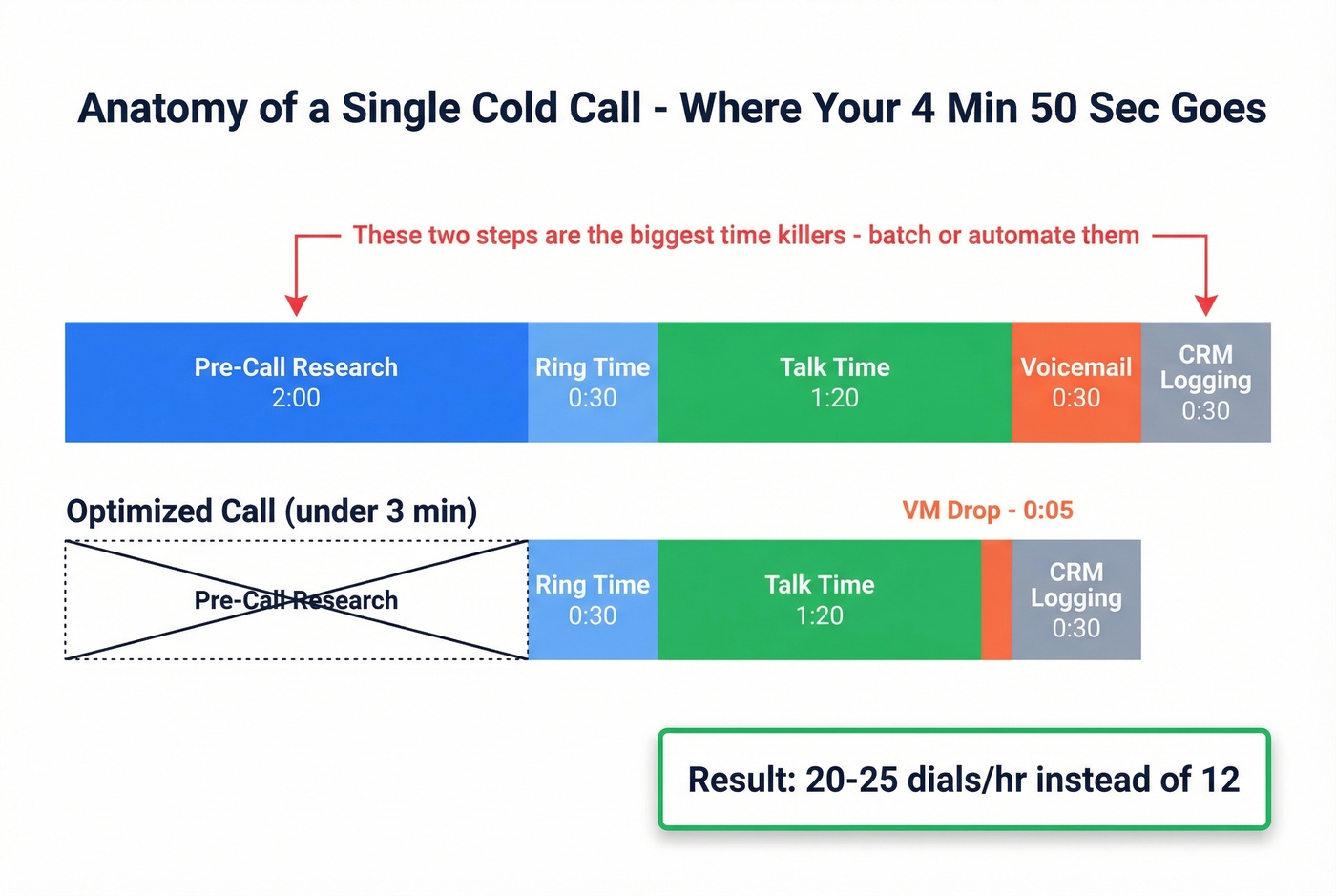
- Pre-call research: 2 minutes
- Ring time: 30 seconds
- Average talk time: 80-93 seconds
- Voicemail: 30 seconds
- CRM logging: 30 seconds
That's roughly 4 minutes 50 seconds per call - about 12 calls per hour. Since 80% of calls go to voicemail, most of those dials aren't even conversations.
Now remove pre-call research by batching it before your call block and use voicemail drops instead of recording live. You've cut each call to under 3 minutes, pushing throughput to 20-25 dials per hour on manual. Small workflow changes compound fast.

You just saw the math: pre-call research eats 2 minutes per dial. Prospeo's database gives you 50+ data points per contact - job title, tech stack, intent signals - so you can batch research in minutes, not hours. At $0.01 per email and 10 credits per verified mobile, cleaning up your workflow costs less than a single wasted calling hour.
Cut your pre-call research to zero and add 10+ dials per hour.
From Dials to Meetings
Dials per hour is a vanity metric. Connects per hour is what pays your rent.
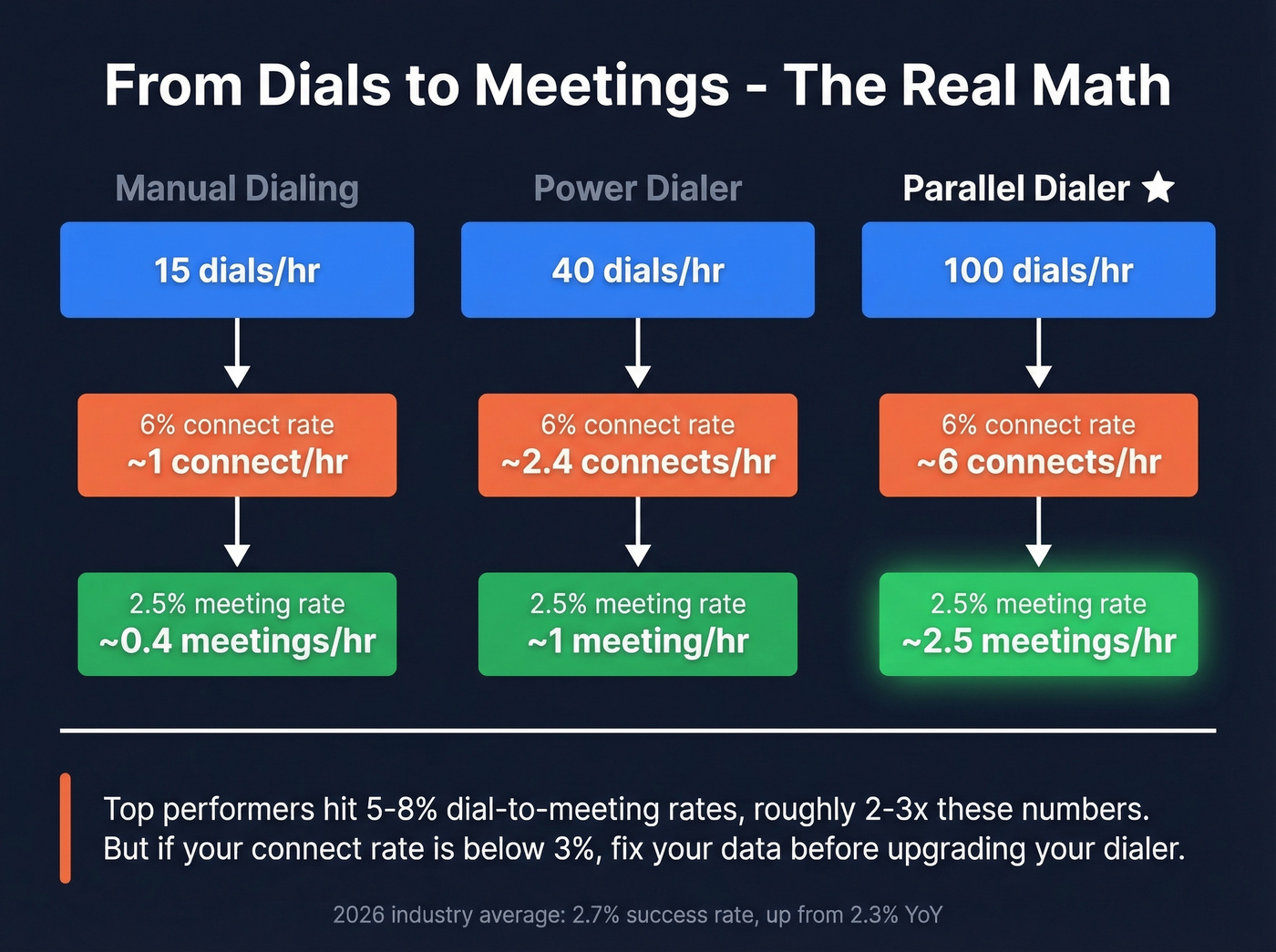
Let's run the math:
| Dials/Hour | Connect Rate | Connects/Hour | Meeting Rate | Meetings/Hour |
|---|---|---|---|---|
| 15 (manual) | 6% | ~1 | 2.5% | ~0.4 |
| 40 (power) | ~6% | ~2.4 | 2.5% | ~1 |
| 100 (parallel) | 6% | ~6 | 2.5% | ~2.5 |
Top-performing teams hit 5-8% dial-to-meeting rates, roughly 2-3x those numbers. These rates shift by industry, list quality, and who you're calling - the same team can see wildly different results across segments.
The latest 2026 data shows it now takes just 1.55 calls on average to reach a prospect who will eventually pick up, down from 2.9 in 2025. The diminishing returns curve is steep: by call 3, you've captured ~93% of total conversations.
Here's the thing: if your connect rate is below 3%, don't buy a better dialer - buy better data. A parallel dialer on a garbage list will underperform a click-to-call workflow on a verified list every single time. (If you're building a repeatable outbound motion, start with a cold calling system and then optimize throughput.)
What Kills Your Calls Per Hour
Bad numbers are the silent killer. If 17% of unanswered calls are due to incorrect contact data, you're burning minutes every hour on nothing. B2B contact data decays at about 22.5% per year - nearly a quarter of last year's list is already dead. Prospeo's 125M+ verified mobile numbers refresh every 7 days, not the 6-week industry average, and carry a 30% pickup rate that translates directly to more conversations per hour. (If you're fixing list quality at the source, data enrichment services can help close gaps fast.)
No voicemail drop strategy. Hitting voicemail on ~80% of dials is the single biggest time sink. Pre-record two or three versions and rotate them. (Pair this with sales follow-up templates so your post-call touchpoints stay consistent.)
Manual CRM logging. Typing notes into Salesforce between every call costs 30-60 seconds per dial. Auto-log dispositions and batch your notes at the end of each call block instead. If you're evaluating tooling, compare options in our guide to contact management software.
Treating every prospect identically. 84% of buyers say being treated like a person - not a number - is critical to engagement. We've seen SDRs booking 2x more meetings on 15 verified dials than teammates making 60 calls on unverified lists. Volume without accuracy is just noise. (For more ways to personalize at scale, see sales prospecting techniques.)
Quick Wins to Increase Dials Per Hour
- Pre-record voicemail drops - reclaim 30+ seconds on 80% of your dials
- Use verified direct dials - stop wasting time on switchboards and wrong numbers
- Time-block your calling - 10-11 AM and 4-5 PM are high-connect windows, and Thursday is the best day (more timing data in best time to send cold emails)
- Batch research before call blocks - never research and dial in the same session
- Cap attempts at 3 per prospect - 93% of conversations happen by call 3, so move on (if you need help handling pushback, use these cold call rejection scripts)
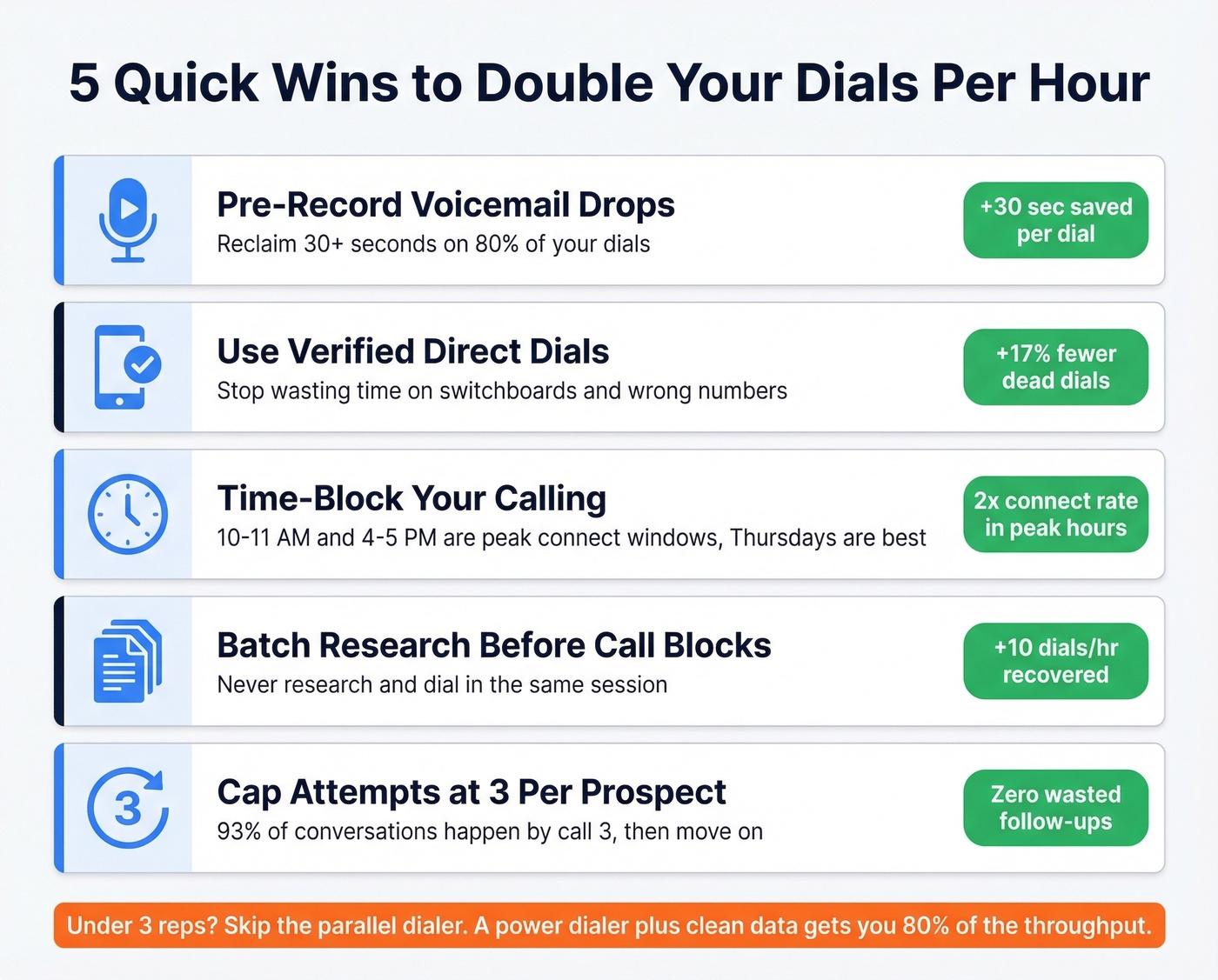
Skip the parallel dialer if your team is under 3 reps. The setup cost and learning curve aren't worth it at that scale. A power dialer paired with clean data will get you 80% of the throughput at a fraction of the complexity. (If you're shopping your stack, start with our ranked list of SDR tools.)
If 17% of your dials hit wrong numbers, you're losing 10+ minutes every hour to dead air. Prospeo's 125M+ verified mobile numbers refresh every 7 days - not the 6-week industry average - and carry a 30% pickup rate. That's the difference between 1 connect per hour and 6.
Every dial should reach a real person. Make your call blocks count.
FAQ
How many cold calls per day is normal?
Most SDRs manually dialing make 40-55 calls per day. With a power dialer, 100-150 is realistic. Parallel dialer teams hit 400-700. The range depends entirely on your dialing method and how much pre-call research you do per contact.
How long does it take to make 100 cold calls?
With manual dialing at roughly 12-15 calls per hour, expect 7-8 hours to hit 100 dials. A power dialer cuts that to about 2.5-4 hours, while parallel dialing can get you there in under an hour. The biggest time variable is voicemails, CRM logging, and pre-call research eating into every session.
What's a good cold call connect rate?
Industry benchmarks put B2B connect rates at 3-10%. Below 3%, your list quality is the problem - wrong numbers and outdated data drag the number down. Verified mobile numbers with a 7-day refresh cycle typically push connect rates toward the higher end of that range.
How many cold calls does it take to book a meeting?
On average, 40-45 dials per meeting booked, reflecting a 2.3-2.5% dial-to-meeting rate. Top-performing teams hit 5-8%, meaning roughly 12-20 dials per meeting. The 2026 industry average improved to 2.7%, so the trend is moving in the right direction for teams investing in better data and smarter workflows.