

How Recruiters Find Candidates: 7 Methods That Work in 2026
Every open role attracts roughly 74 applications. Sounds like plenty - until you realize that 69% of organizations still report difficulty filling positions, according to SHRM's Talent Trends report. The problem isn't volume. It's that the candidates who'd actually crush the role aren't applying.
Sourced hires are 5x more likely to be hired than inbound applicants, and that gap holds whether you're an internal recruiter building pipeline or an agency sourcer filling client reqs. So let's break down the seven methods that actually move the needle - with the search strings, benchmarks, and verification steps we've seen work across thousands of outreach campaigns.
The Quick Version
The three highest-ROI sourcing methods: outbound sourcing from professional profiles, ATS/CRM rediscovery, and employee referrals. Job boards generate 49% of applications but only 24.6% of hires. Stop defaulting to post-and-pray.
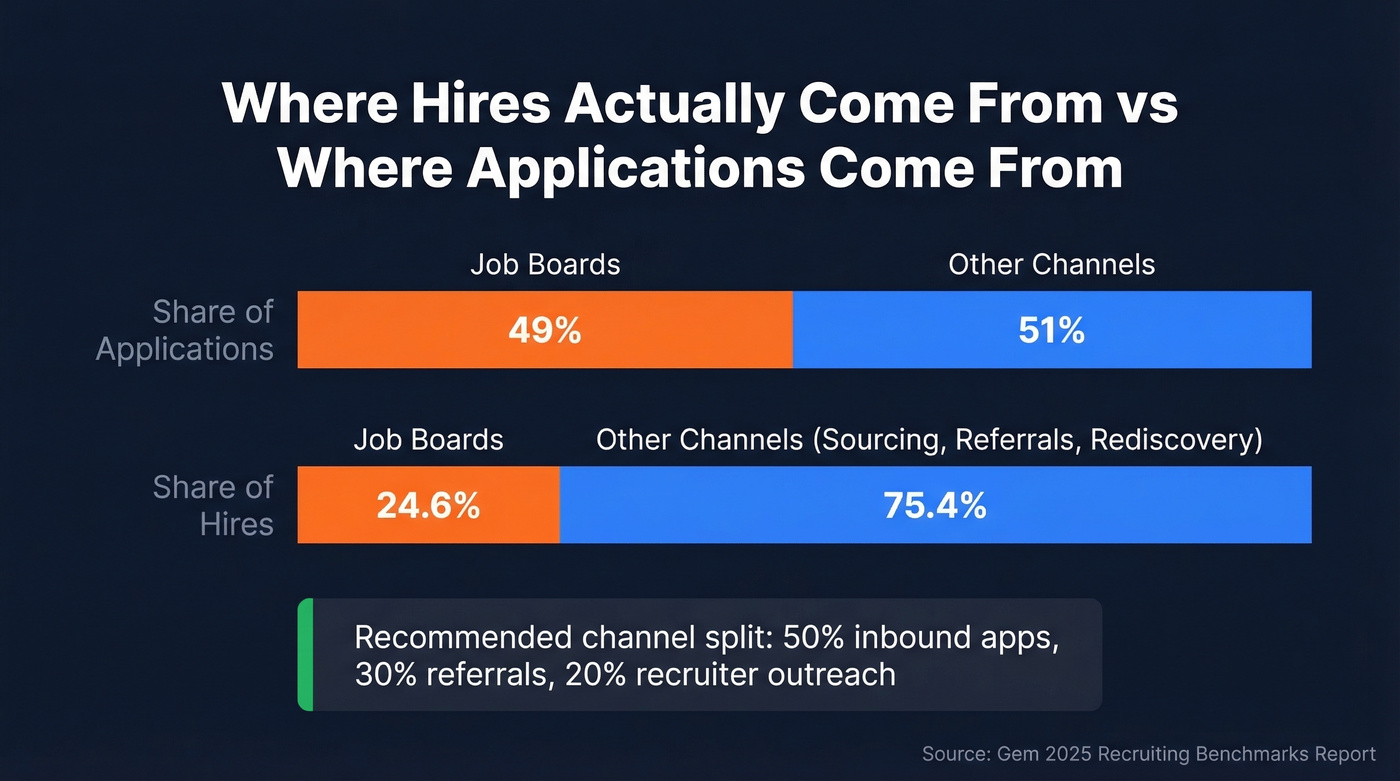
A reasonable channel split: 50% inbound applications, 30% employee referrals, 20% recruiter outreach.
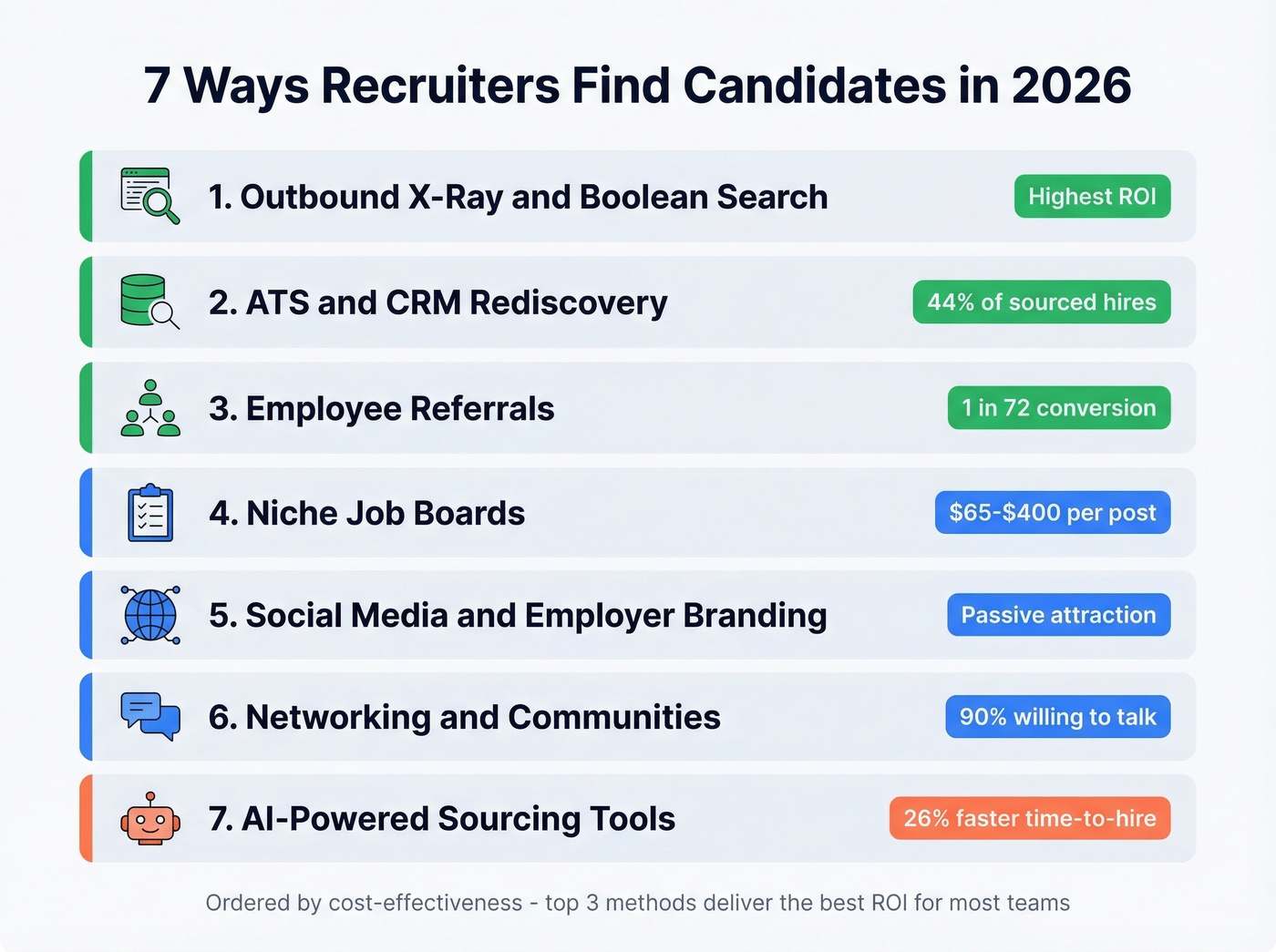
7 Sourcing Methods for 2026
1. Outbound Sourcing via X-Ray and Boolean Search
X-ray search uses Google operators to surface public profiles that platform search can't reach. Here are three templates you can copy right now:
- Design roles, remote:
site:linkedin.com/in ("UI/UX Designer" OR "Product Designer") AND "Remote" -"open to work" - Backend engineers, India:
site:linkedin.com/in ("Backend Developer" OR "Node.js Engineer") AND "India" -"open to work" - Product managers, SF:
site:linkedin.com/in ("Product Manager" OR "PM") AND "San Francisco" -"open to work"
Quick operator reference: AND narrows, OR broadens, - excludes in Google (use NOT on the platform's own search), and quotes force exact phrases. Be careful with exclusions - overusing them can shrink your pool by 30-40%.
This is the method that separates recruiters who fill roles in two weeks from those who wait two months. It's also the one that takes the most practice. If you can't write a solid Boolean string from scratch, start with the templates above and iterate from there.
2. ATS and CRM Database Mining
Your best candidates are likely already in your system.
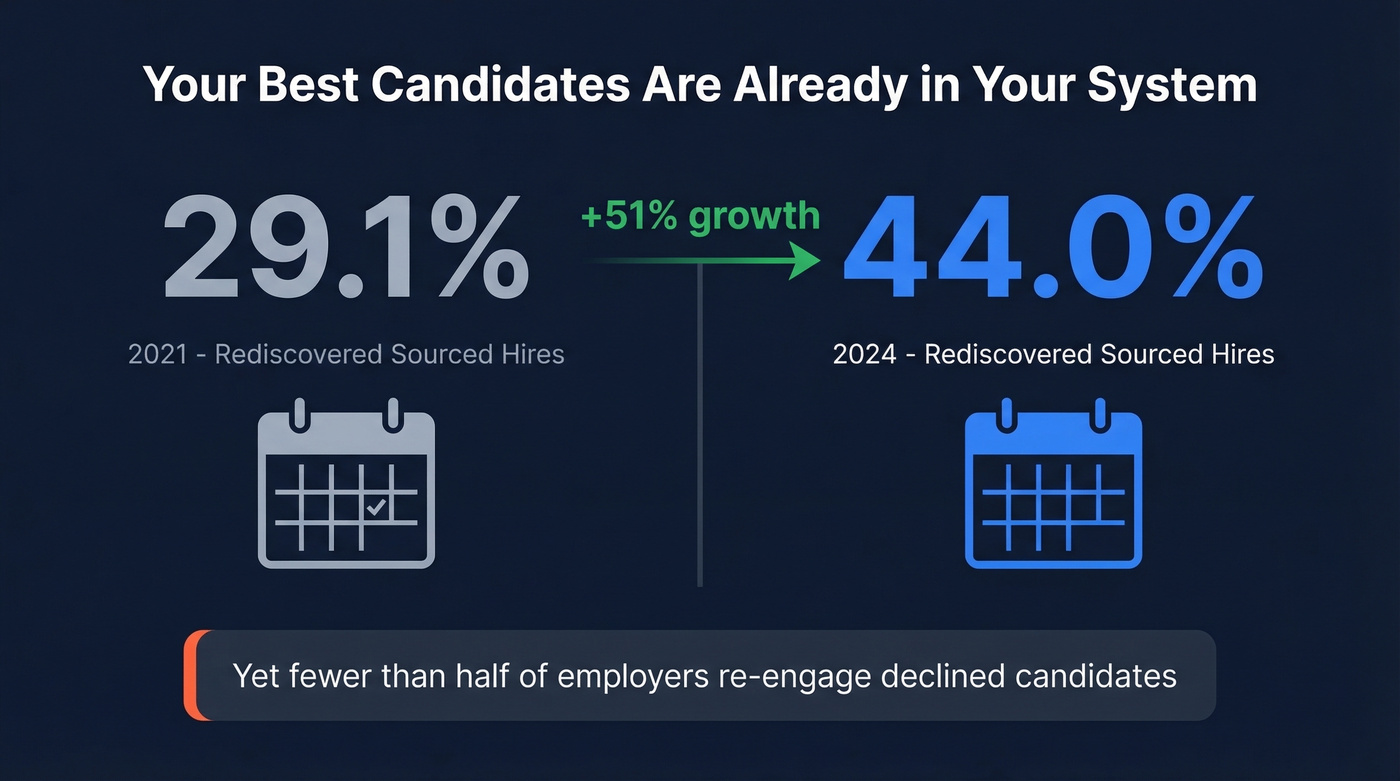
Rediscovered sourced hires jumped from 29.1% in 2021 to 44.0% in 2024 - nearly half of all sourced hires were people the company had already talked to. Yet fewer than half of employers re-engage declined candidates. Those "silver medalists" who finished second for a previous role are warm leads sitting in your ATS, and they already know your company. Run a quarterly rediscovery search before you ever post externally. It's free, it's fast, and the conversion rates are dramatically better than cold outreach.
If you're running multi-touch outreach after rediscovery, tighten your sequence management so warm leads don't go cold.
3. Job Boards - Niche vs. Mass-Market
Niche boards like Dribbble Jobs and We Work Remotely run $65-$400 per post. Indeed can cost $1,300+ for a single sponsored listing. If you're going to spend on boards, go niche - fewer applicants, much higher signal-to-noise ratio.
Always specify remote, hybrid, or on-site in the listing. Candidates filter on flexibility first. Skip this if your role is highly specialized (staff ML engineer, principal security architect) - those candidates aren't browsing job boards.
4. Employee Referrals
Referrals account for just 7% of hires in SmartRecruiters' US benchmark data. That's a missed opportunity.
They convert at rates closer to sourced candidates - 1 in 72 versus 1 in 152 for inbound applicants. A structured referral program with clear incentives and a dead-simple submission process is one of the cheapest sourcing channels you can build. The biggest mistake we see? Companies that have a referral program on paper but make it so clunky that nobody uses it. If submitting a referral takes more than 90 seconds, your program is broken.
5. Social Media and Employer Branding
Your career page and recruiter profiles either attract candidates passively or repel them. There's no neutral.
Optimize your career page for the roles you hire most frequently. For individual recruiter profiles, credibility details matter: a professional headline, a real photo, visible activity in your industry. Candidates check your profile before they reply to your message - and if it looks like a ghost town, they won't reply at all.
If you're driving candidates into outbound conversations, borrow a few email subject line examples to lift opens without sounding spammy.
6. Networking and Industry Communities
GitHub, Stack Overflow, Dribbble, and Behance aren't job boards - they're portfolios. Recruiters who spend time in these communities can evaluate work quality before ever sending a message.
Here's what makes this work: only 18% of employees report being extremely satisfied at work, and Lever's research found that 90% of workers are willing to talk even if they're not actively looking. Connecting with ideal candidates through niche communities - rather than cold outreach alone - is what separates top sourcers from the rest. But you have to actually participate, not just lurk and DM people.
To keep those conversations moving, use a simple connection email instead of a generic pitch.
7. AI-Powered Sourcing Tools
Organizations using AI in recruiting report 26% faster time-to-hire. A recruiter on r/RecruitmentAgencies reported an agentic outbound tool that cut time-to-hire nearly in half for some roles.
The hype needs a reality check, though. Practitioners have noted that tools like HireEZ sometimes return candidates who look great on paper but don't fit the role. AI is a force multiplier for skilled sourcers, not a replacement for search craft. If your Boolean fundamentals are weak, AI just scales your bad searches faster.
If you're adding automation, treat it like AI cold email outreach: guardrails first, scale second.

X-ray search finds the profiles. But profiles don't reply - verified emails do. Prospeo's Chrome extension pulls verified emails and direct dials from any professional profile in one click, with 98% accuracy and bounce rates under 4%.
Stop losing sourced candidates to bounced emails. Verify before you send.
The Step Most Recruiters Skip
Look - most sourcing failures aren't about finding candidates. They're about everything that happens after. You found 50 great profiles. Half the emails bounce. Your reply rate on the rest is 4%. That gap between "found" and "contacted" is where sourcing efforts go to die.
This is exactly where a verification layer pays for itself. We've seen teams cut bounce rates from 35% to under 4% overnight just by adding real-time email verification before hitting send. Prospeo's Chrome extension pulls verified emails and direct dials from any professional profile or company website in one click - which is particularly useful when you're working through a list of X-ray search results. The free tier gives you 75 verified emails per month plus 100 Chrome extension credits, and paid plans run about $0.01 per email.
If you're troubleshooting deliverability, start with email bounce rate basics before changing tools.

Sourcing Mistakes That Cost You Candidates
- Reactive hiring. Waiting until a seat is empty means you're already behind. The best teams build pipeline before the req opens.
- Over-relying on AI without manual search skills. If you can't write a Boolean string, you can't tell when the tool is returning garbage.
- Ghosting candidates. Interviews per hire are up 42% since 2021. Disappearing after a final round destroys your employer brand for years.
- Single-channel sourcing. One channel creates homogeneity risk. Diversify your channels to diversify your pipeline.
If your reply rates are stuck, audit your follow-up email reply rate and fix the bottleneck before adding more volume.
What a 2026 Recruiter Stack Looks Like
The typical high-performing stack has four layers: a sourcing channel (X-ray search, professional profile databases, community sourcing), an ATS/CRM for pipeline management and rediscovery, a sequencing tool for multi-touch outreach, and a verification layer to keep bounce rates low.
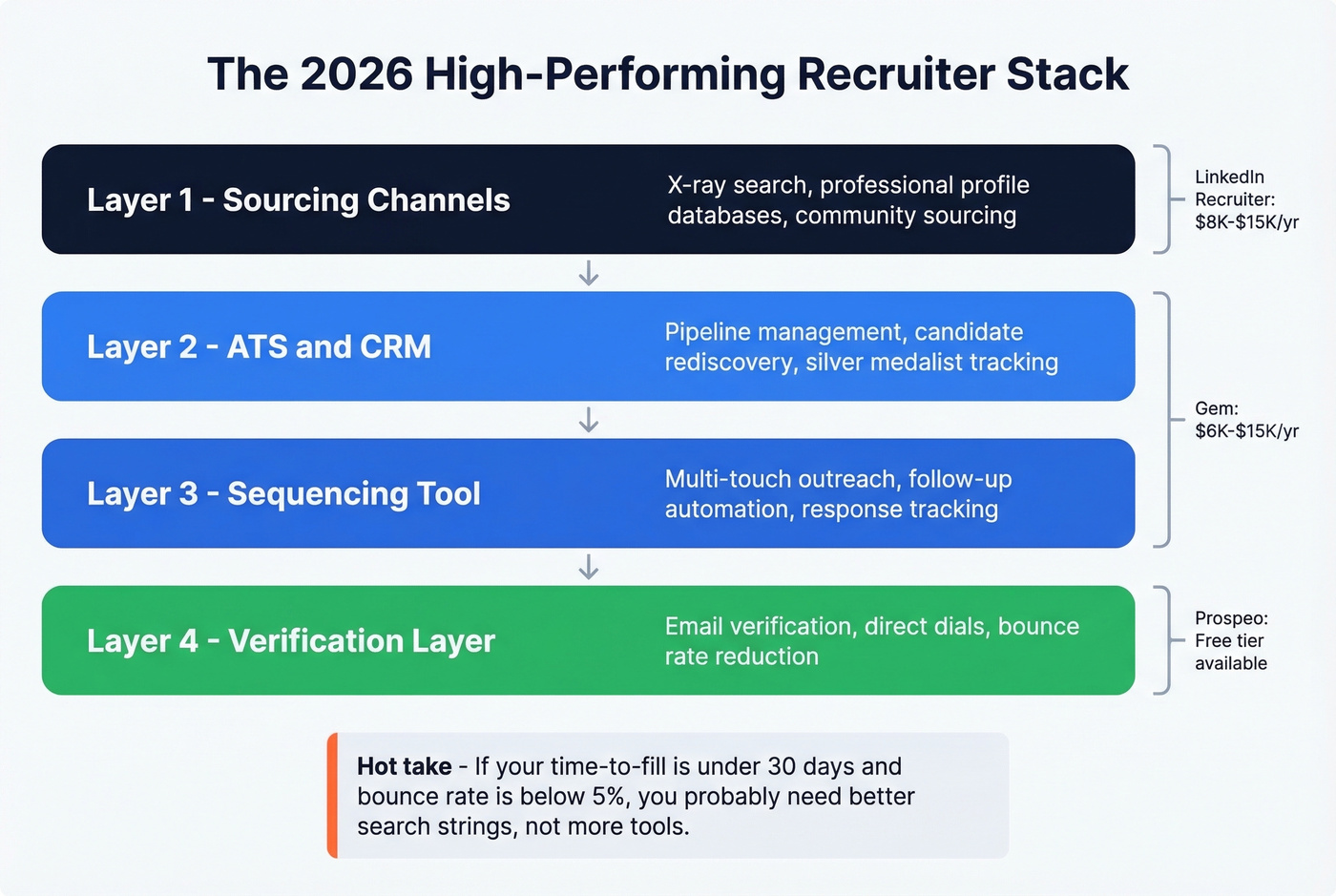
Directional pricing: LinkedIn Recruiter runs roughly $8,000-$15,000/year per seat, Gem typically costs $6,000-$15,000/year per seat for outreach and analytics, and Prospeo's free tier plus your existing ATS covers two of those four layers at zero cost. Build from there.
If you're evaluating the verification layer, compare options in our Bouncer alternatives guide.
Hot take: If your average time-to-fill is under 30 days and your bounce rate is already below 5%, you probably don't need a bigger stack. You need better search strings and a referral program. Most recruiting tool spend is a band-aid over weak sourcing fundamentals.
Recruiters who source 50 candidates shouldn't lose half to bad contact data. Prospeo gives you 75 free verified emails per month, 125M+ verified mobile numbers, and a 7-day data refresh cycle - so the candidate who changed jobs last week still gets your message.
Your sourcing is only as good as the contact data behind it.
FAQ
What's the difference between sourcing and recruiting?
Sourcing is the front end - finding and engaging potential candidates through search, outreach, and networking. Recruiting covers the full lifecycle from sourcing through screening, interviewing, and onboarding. Every recruiter sources, but dedicated sourcers focus exclusively on the top of the funnel.
How do recruiters find passive candidates?
Through X-ray search strings, Boolean queries on professional databases, ATS rediscovery of "silver medalist" candidates, and networking in communities like GitHub or Stack Overflow. 90% of workers are willing to talk even if they're not actively looking - the key is personalized outreach with verified contact data so your message actually lands.
What's the most cost-effective way to source candidates?
ATS rediscovery and employee referrals deliver the highest ROI by far. Rediscovered candidates now account for 44% of sourced hires, and referrals convert at 1 in 72 versus 1 in 152 for inbound applicants. Both channels cost almost nothing compared to job board sponsorships or recruiter seat licenses.