

How to Ask for an Appointment: Scripts & Templates (2026)
You've been staring at the blank email for twelve minutes. Or maybe you're holding your phone, rehearsing what to say to a receptionist who picks up in three rings. Whether it's a sales prospect, a dentist, or your boss's boss, figuring out how to ask for an appointment feels harder than it should - and threads on r/internetparents prove you're not the only one who wants a literal script.
Here's every script you need, for every channel and context.
4 Rules for Any Appointment Request
These work whether you're emailing a VP of Marketing or calling your dentist.
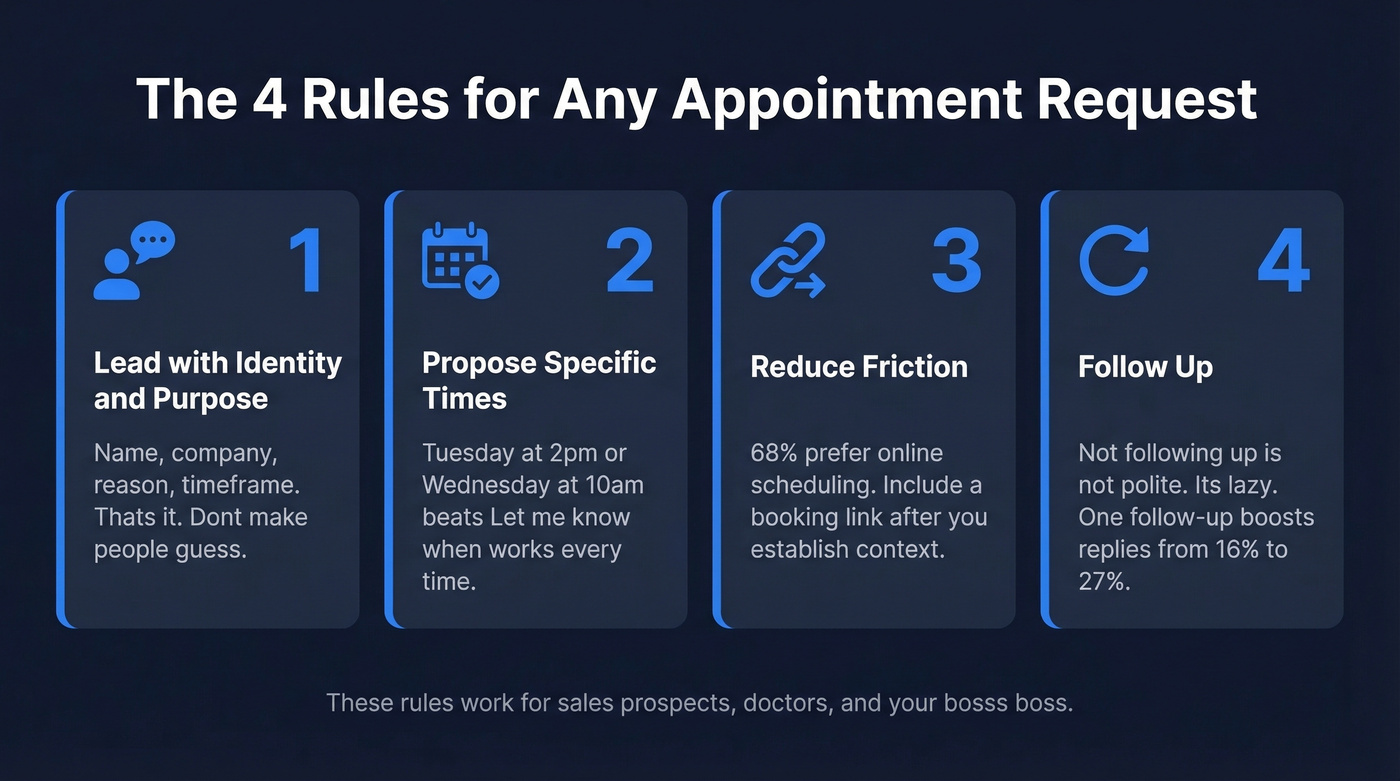
Lead with identity and purpose. Don't make people guess. "Hi, I'm Sarah from Acme - I'd love 20 minutes to walk through how we helped [similar company] cut onboarding time by 30%." That's a complete opener. Name, company, reason, timeframe. Done.
Propose specific times. "Are you free Tuesday at 2pm or Wednesday at 10am ET?" beats "Let me know when works" every single time. You're doing the cognitive work for them, and that alone increases your odds of getting a yes.
Reduce friction. 68% of people prefer online scheduling when it's available. Include a booking link - but only after you've established context. A naked Calendly link in a cold email is the equivalent of handing someone a contract before introducing yourself.
Follow up. Not following up isn't polite. It's lazy. More on this below.
How to Ask for an Appointment by Email
Email is the default channel for professional appointment requests, and it's where most people overthink things. Let's break it down.
Subject Lines That Get Opened
Your subject line is the gatekeeper. 47% of recipients decide to open based on the subject line alone. Data from 85M+ cold emails shows 1-4 words is the ideal length, and all-lowercase subject lines (except proper nouns) tend to outperform capitalized ones. Keep it under 33 characters so it displays fully on mobile.
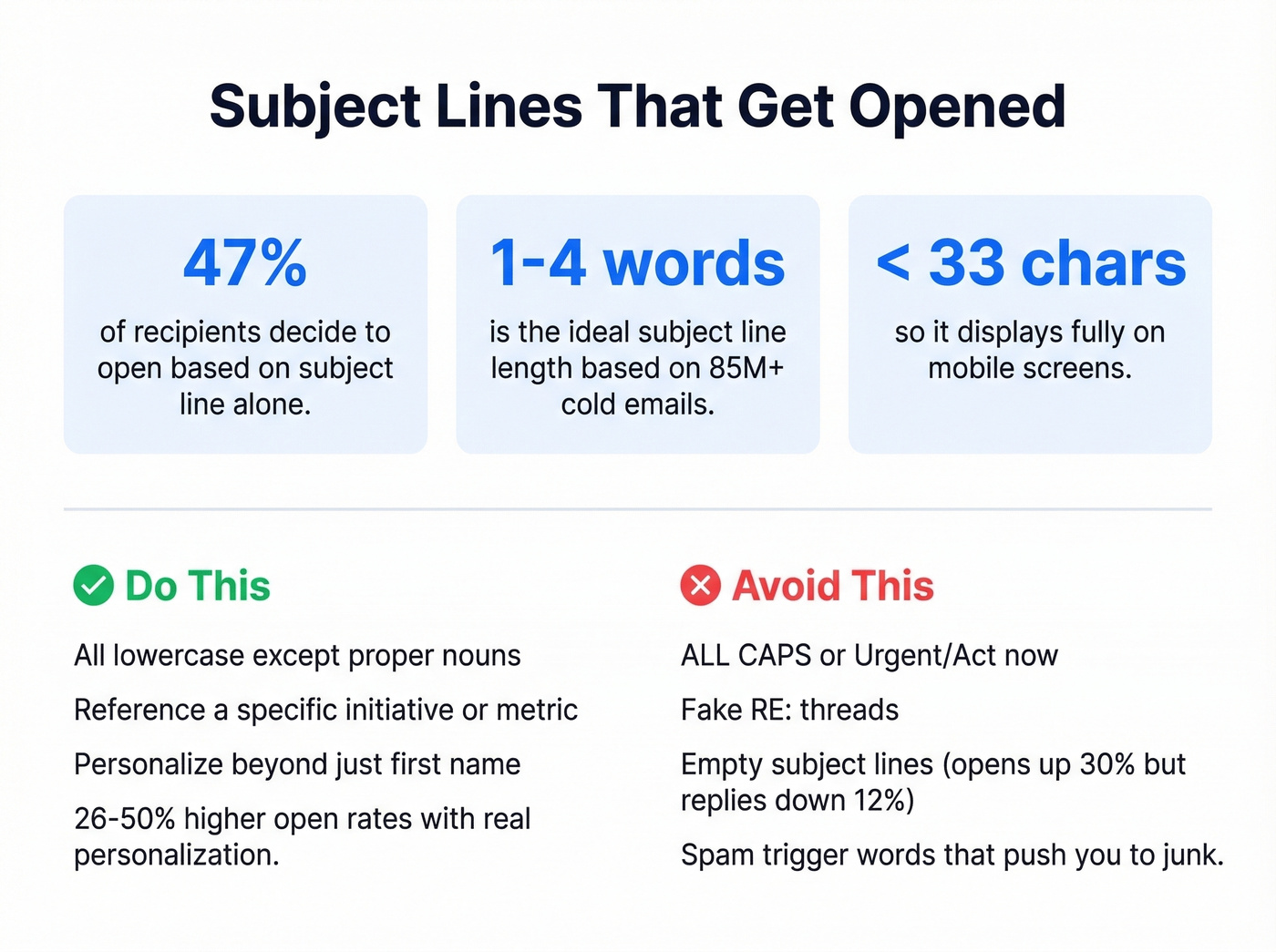
In 2026, inserting {{first_name}} doesn't count as personalization. Reference a specific initiative, metric, or event - personalized subject lines can deliver 26-50% higher open rates.
Avoid spam triggers: ALL CAPS, "Urgent/Act now," and fake "RE:" threads push you toward the junk folder. Empty subject lines boost opens by 30% but cut replies by 12%. Skip the gimmick.
Email Structure
Follow this framework: clear subject, purpose in the first sentence, 2-3 time options with time zone, expected duration, direct CTA. Keep the whole email between 50-120 words. Anything longer and you're writing a proposal, not requesting a meeting.
One counterintuitive tip: your first cold email should be plain text - no attachments, ideally no links, and no tracking pixels. Deliverability first, persuasion second. Save the case study PDF for the reply. If you want more examples of strong openers and CTAs, see email copy patterns that consistently convert.
Cold B2B Outreach Template
This one works when you have no prior relationship with the prospect:
Subject: quick question re: [company's initiative]
Hi [Name],
I'm [Your Name] with [Company]. We helped [similar company] [specific result] - and I think we could do something similar for [their company].
Would you have 20 minutes this week to explore that? I'm open Tuesday at 2pm or Thursday at 10am ET.
Either way, happy to share the case study.
[Your Name]
If you're building a full sequence (not just one email), use a proven B2B cold email sequence structure.
Formal / Senior Stakeholder Template
When you're scheduling time with someone senior, formality signals respect:
Subject: 15 min request - [topic]
Dear [Name],
I'm reaching out to request a brief meeting regarding [specific topic]. I believe 15 minutes would be sufficient to cover [what you'll discuss] and align on next steps.
Would any of the following work for your schedule?
- Tuesday, March 18 at 9:00am ET
- Wednesday, March 19 at 2:00pm ET
- Thursday, March 20 at 11:00am ET
I'm happy to adjust to your availability.
Best regards, [Your Name]
Internal Meeting Request
Subject: sync on [project] - 30 min
Hey [Name],
Can we block 30 minutes to align on [specific topic]? I want to make sure we're on the same page before [deadline/milestone].
How's Thursday at 3pm? I'll send a calendar invite.
Thanks, [Your Name]
Realistic Expectations for Cold Outreach
Here's the thing most "appointment setting" guides won't tell you: cold email is a volume game with thin margins. Expect 2-4% reply rates on well-written, well-targeted sequences. One practitioner running 400 emails per day across warmed-up secondary domains reported booking around 90-100 meetings per month - a strong result, but one that required verified lists, dedicated sending domains with proper SPF/DKIM/DMARC, and 2-3 weeks of inbox warmup before sending a single campaign email.
We've seen bounce rates destroy campaigns that had great copy. If you're doing B2B outreach at scale, verify your list first - Prospeo catches bad addresses before they wreck your deliverability, with 98% email accuracy and a free tier that doesn't require a credit card. (If you’re troubleshooting bounces, start with email bounce rate benchmarks and fixes.)
How to Ask by Phone
Use the phone when: you need a same-day appointment, you're calling a medical office, or the person hasn't responded to two emails.
Skip the phone when: you're cold-calling someone who has no idea who you are and email would give them context first.
Sales Cold Call Script
Keep it under 30 seconds before you ask for the meeting:
"Hi [Name], this is [Your Name] with [Company]. I'll be brief - we work with [type of company] on [specific problem], and I noticed [relevant observation about their business]. I'd love 15 minutes to show you what we've done for [similar company]. Would Thursday or Friday work for a quick call?"
State your name, give one reason they should care, propose times. Don't pitch the product - pitch the meeting. For a deeper system (openers, objections, and timing), see this cold calling system.
Doctor, Dentist, or Therapist Script
If you're nervous about calling a medical office, here's exactly what to say. Have your insurance card in front of you before you dial.
"Hi, I'd like to schedule an appointment. I'm a [new/existing] patient. My name is [full name], my date of birth is [DOB], and my insurance is [provider and member ID]. I'm looking for [a general checkup / a cleaning / an initial consultation]. What's your earliest availability?"
The receptionist will guide you from there - they'll ask about preferred days, confirm your insurance, and let you know about any paperwork. You don't need to explain your symptoms in detail on the phone.
Voicemail Script
Keep voicemails under 30 seconds. Speak slowly, especially when giving your phone number. Say your number twice - always.
"Hi, this is [Your Name] calling for [Name/Office]. I'm reaching out to [schedule an appointment / follow up on our conversation]. You can reach me at [phone number] - that's [repeat number]. I'm available [callback window, e.g., weekdays between 9 and 5 ET]. Thanks, and I look forward to hearing from you."
How to Ask via Message or In Person
Professional messages follow the same rules as email, just compressed. Keep messages under 150 words and lead with value, not your pitch. Value-first messaging generates 3x more responses than pitch-first approaches.
The CCQ method from SalesBread is a solid framework for personalizing connection messages: Compliment something specific about their work, Commonality to establish a shared experience, Question to make the actual ask. It works because you've earned the right to ask before you ask. If you want more ways to tailor outreach without sounding robotic, use a personalized outreach checklist.
Messaging Template
"Hi [Name] - loved your recent post on [topic]. I'm working on something similar at [Company] and think there's a natural overlap. Would you be open to a 15-minute call this week? Happy to work around your schedule."
In-Person Template
At a conference or networking event, keep it simple. Directness reads as confidence, not rudeness.
"I've really enjoyed this conversation. I'd love to continue it - can I grab 20 minutes on your calendar next week? Here's my card, or I can shoot you a message tonight while the context is fresh."
Then actually send that follow-up the same evening. 80% of positive responses come after the 2nd or 3rd touchpoint.

The best appointment request in the world won't book a meeting if it bounces. Prospeo verifies emails through a 5-step process - 98% accuracy, catch-all handling, spam-trap removal - so your perfectly crafted ask actually lands in the inbox.
Stop writing appointment emails to addresses that don't exist.
When to Use Which Channel
| Scenario | Best Channel | Why |
|---|---|---|
| Cold B2B outreach | Email first | Gives context, easy to forward |
| Medical appointment | Phone | Fastest, insurance verification |
| Warm lead follow-up | Email or message | Low friction, documented |
| Same-day urgency | Phone | Immediate response |
| Senior executive | Email (formal) | Respects their time, scannable |
| Networking follow-up | Message | Casual, contextual |
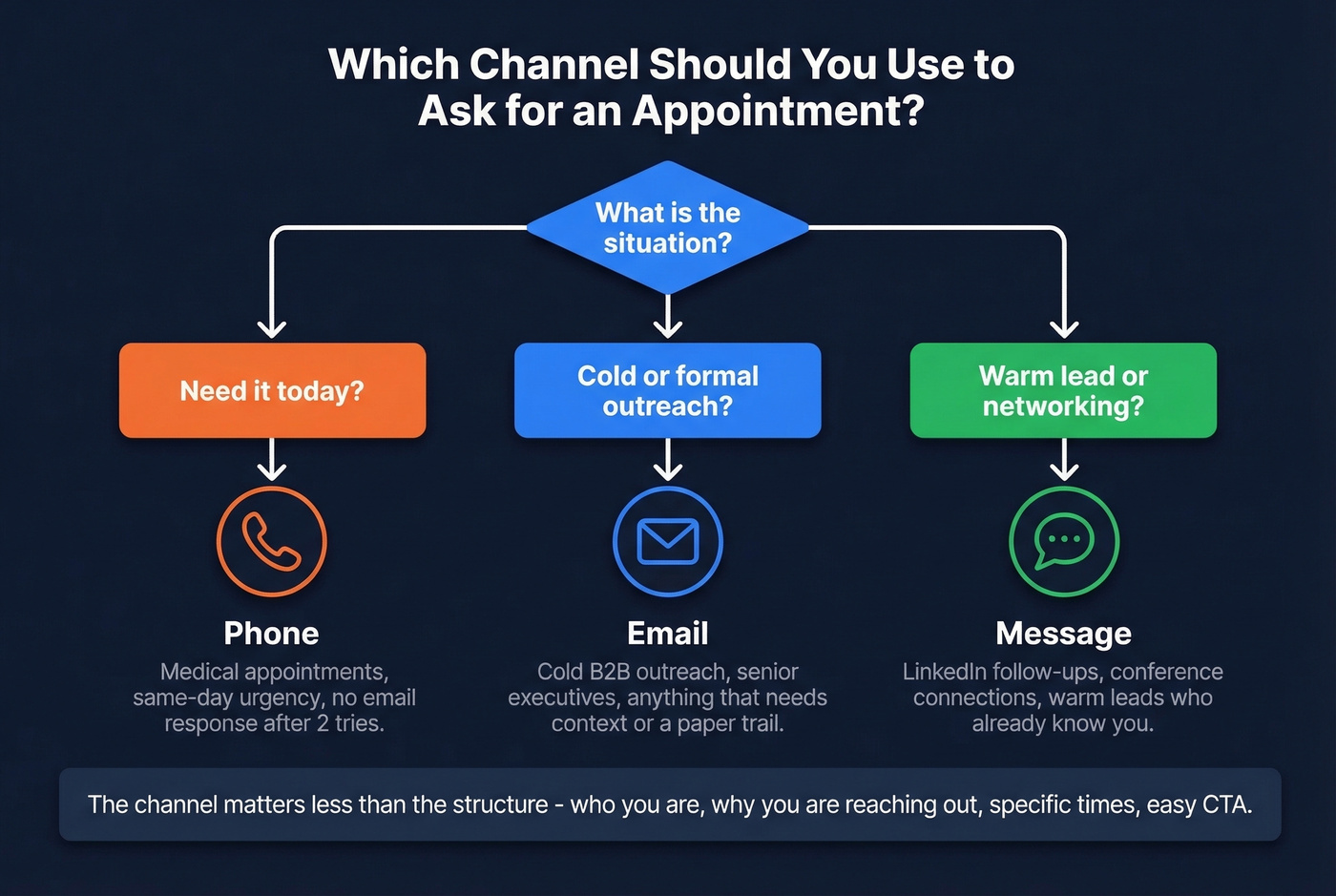
The channel matters less than the structure. A well-crafted phone call and a well-crafted email follow the same logic - who you are, why you're reaching out, specific times, easy CTA. (For more meeting-specific phrasing, see email wording to schedule a meeting.)
Follow-Up Templates That Actually Work
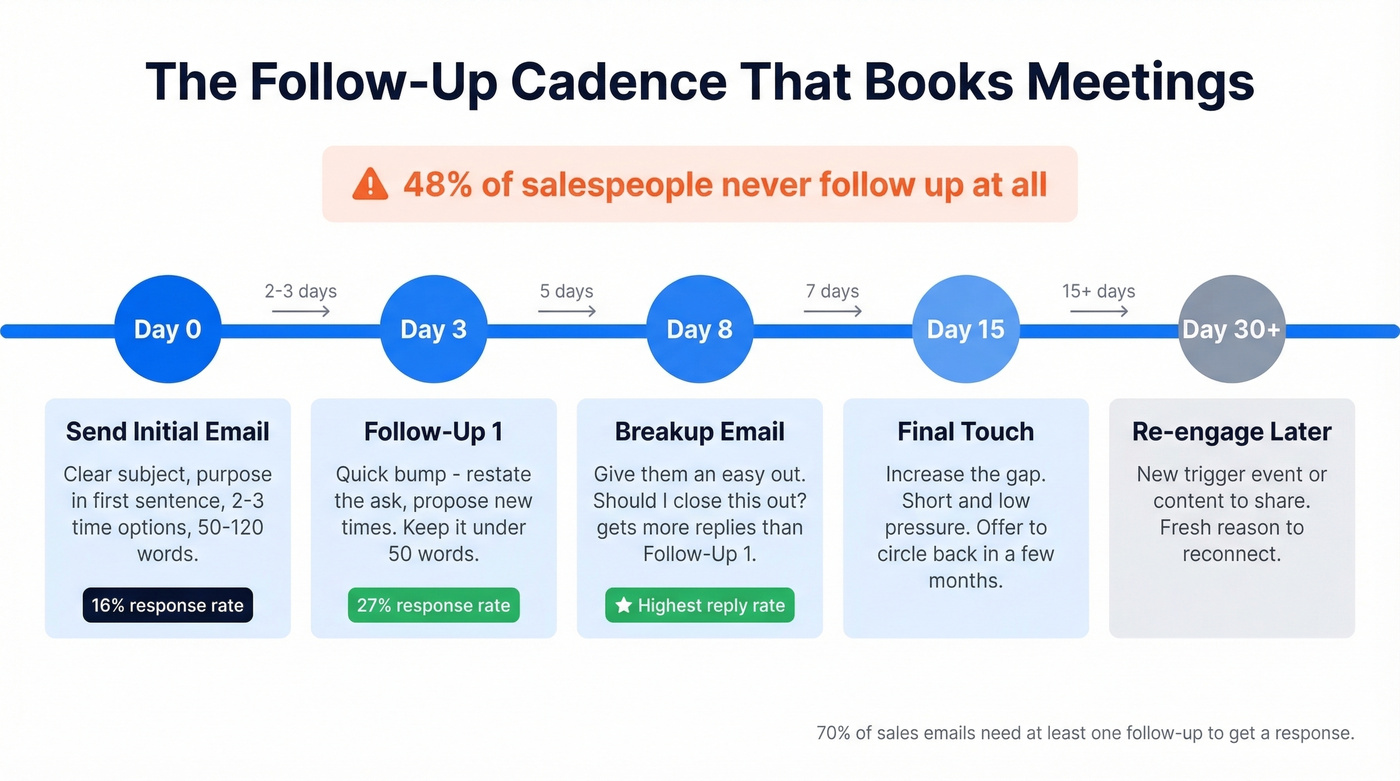
70% of sales emails need at least one follow-up to get a response. Without a follow-up, your response rate sits around 16%. Add just one and it jumps to 27%. Yet 48% of salespeople never follow up at all.
That stat still blows my mind.
The cadence: First follow-up after 2-3 days. Second after 5 days. Third after 7 days. Then increase the gaps. Keep each follow-up between 50-125 words. If you want more variations, pull from these sales follow-up templates.
Follow-up #1 (Day 3):
Subject: re: [original subject]
Hi [Name], just bumping this up - would [day] or [day] work for a quick 15-minute call? Happy to adjust.
Follow-up #2 / Breakup (Day 8):
Subject: should I close this out?
Hi [Name], I know things get busy. If the timing isn't right, no worries at all - just let me know and I'll circle back in a few months. Otherwise, I'm still happy to find 15 minutes this week.
In our experience, the breakup email gets more replies than the first follow-up. Something about giving people an easy out makes them more willing to engage.
Confirmation, Reminder, and Rescheduling
55% of people check email before starting their workday, so send reminders the evening before or first thing in the morning. Always include the full details: date, time, location or video link, duration, and cancellation policy if applicable.
Confirmation: "Thanks for booking, [Name]. You're confirmed for [date] at [time] [timezone]. We'll meet at [location/link]. See you then."
Day-before reminder: "Quick reminder - we're set for tomorrow at [time]. Here's the [link/address]. Let me know if anything changes."
Rescheduling: "Hi [Name], something came up and I need to move our [date] meeting. Would [alternative 1] or [alternative 2] work instead? Apologies for the shuffle."
Mistakes That Kill Your Chances
Vague subject lines. "Meeting?" tells the recipient nothing. "15 min - Q2 pipeline review" tells them everything. If you need inspiration, swipe from these email subject line examples.
No specific times proposed. "Let me know when you're free" puts the work on them. Propose 2-3 options instead.
Booking link before context. Dropping a Calendly link in a cold email without explaining who you are or why they should care is a fast way to get ignored. Earn the click first.
Not following up. One email isn't a campaign. It's a coin flip. (If you’re unsure about timing, use this guide on when should you follow up on an email.)
Sending to unverified email addresses. This one's specific to B2B outreach, but it's devastating. Keep hard bounces under 1% to protect your sender reputation. Send from a dedicated secondary domain, warm it up for at least two weeks, and run your list through Prospeo before every campaign.
Running 400 cold emails a day means nothing if your list is full of dead addresses. Prospeo's 143M+ verified emails refresh every 7 days - not every 6 weeks - so your appointment requests reach real people at real companies.
Book more meetings by starting with data that actually connects.
FAQ
How do you politely ask for an appointment?
State who you are, explain why you're reaching out, and propose 2-3 specific times. Keep the message under 120 words and make it easy to say yes with a clear call to action. Clarity is politeness - don't over-apologize or bury your ask in filler.
What should I say when calling a doctor's office?
Say: "Hi, I'd like to schedule an appointment. I'm a [new/existing] patient, my name is [X], my insurance is [Y], and I'm looking for [reason]." Have your insurance card ready before dialing - the receptionist will handle the rest.
How do you request a meeting without being pushy?
Propose specific times, give a clear reason for the meeting, and keep your message under 120 words. One follow-up after 3 days isn't pushy - 48% of salespeople never follow up at all. Persistence with respect is professional, not aggressive.
How many times should you follow up?
At minimum twice. Response rates jump from 16% to 27% with just one follow-up. Space them 3-7 days apart with increasing gaps. After three unanswered messages, send a brief breakup email and move on.
Why aren't my appointment request emails getting replies?
The most common culprit isn't bad copy - it's bad data. Bouncing emails tank your sender reputation, so even well-written messages land in spam. Verify addresses before sending, use 1-4 word subject lines, send plain text with no links on first touch, and always propose specific times.