

How to Ask for a Response in Email Without Being Annoying
You sent the proposal three days ago. You know they opened it. And now you're staring at a blank reply, cursor hovering over "Send" on a follow-up you've rewritten four times because it sounds too pushy, too desperate, or too passive-aggressive.
Here's the thing: knowing how to ask for a response in email without sounding desperate is a skill most people never learn - and it costs them deals, jobs, and relationships. The problem isn't politeness. It's that most follow-ups are vague, poorly timed, or structurally broken. What follows is a data-backed framework, copy-paste templates, and the specific phrases to avoid - all usable in five minutes.
The Five Rules (Quick Version)
If you read nothing else, follow these:
- Use the 3-part structure: brief context reminder, clear ask, easy out.
- Lead with the ask. Your first sentence should tell them exactly what you need.
- Wait 3-5 business days before your first follow-up. Not 24 hours. Not two weeks.
- Cap your sequence at 3 emails total. After that, you're hurting yourself more than helping.
- Verify the email address first. A follow-up that bounces is worse than no follow-up at all.
Do Follow-Ups Actually Work?
Yes - but with sharp diminishing returns.
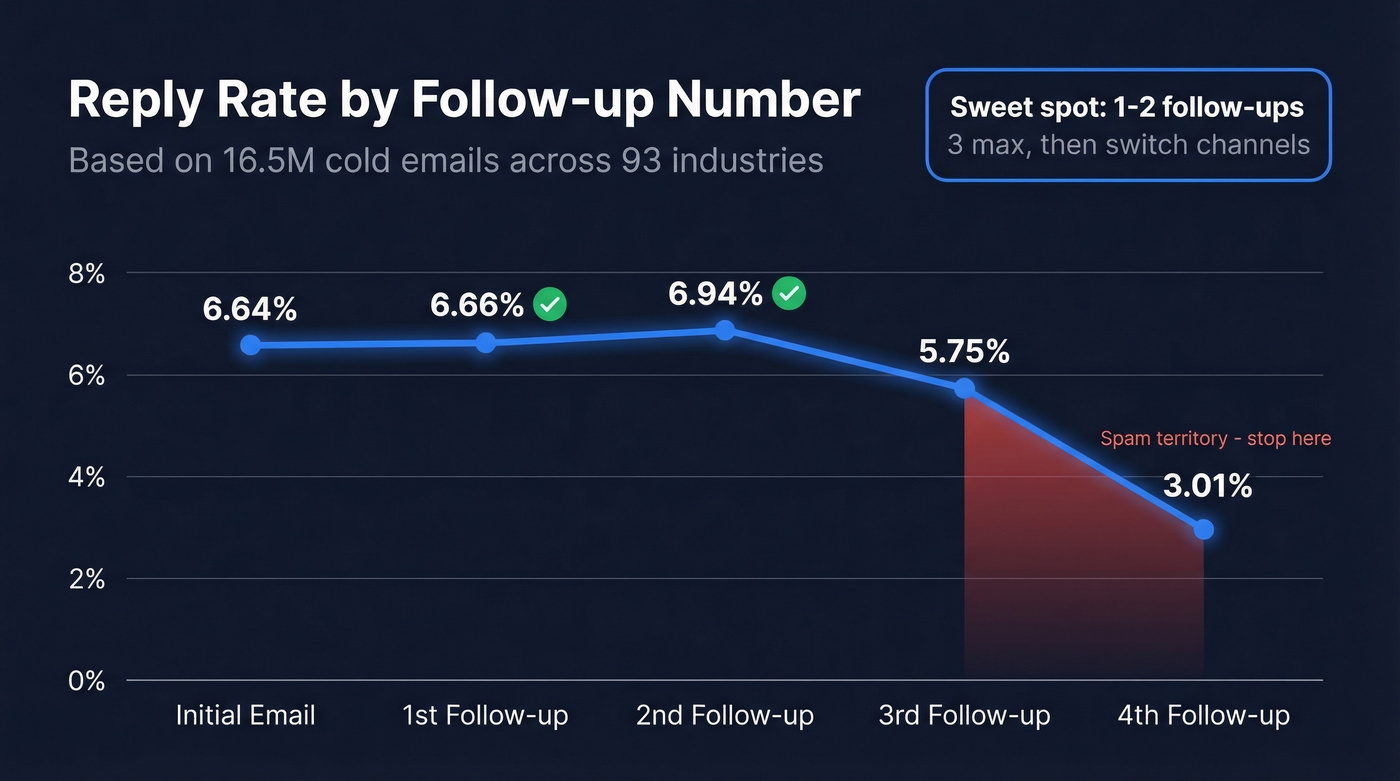
Belkins analyzed 16.5 million cold emails across 93 business domains (Jan-Dec 2024) and the data is clear. The highest reply rate - 8.4% - came from a single email with no follow-up at all. One follow-up held steady. Two follow-ups still performed. After that, reply rates collapse.
The founder reply curve tells the story: 6.64% on the initial email, holding at 6.66% after the first follow-up and 6.94% after the second, then declining to 5.75% after the third and cratering to 3.01% by the fourth. Meanwhile, sending 4+ emails in a sequence more than triples both unsubscribe rates and spam complaints. Company size matters too. Small businesses (2-50 employees) are more tolerant of follow-ups - reply rates actually bounce back on the second email. Enterprise contacts (1,000+ employees) are the opposite; persistence actively hurts.
Woodpecker's data reinforces the sweet spot: emails without a follow-up average a 16% response rate versus 27% with just one follow-up. That single follow-up nearly doubles your odds. The second one helps a little. Everything after that works against you.
Our hot take: if email isn't working after two follow-ups, switch channels entirely. Belkins' research shows a LinkedIn message paired with a profile visit hits an 11.87% reply rate - higher than any email-only sequence. Most people keep hammering the same inbox when they should be showing up somewhere else.
The takeaway: 1-2 follow-ups are smart. Three is the ceiling. Four is spam territory.
How to Structure Your Follow-Up
The best follow-ups share a structure you can learn in 30 seconds. Zapier's framework breaks it into three parts: a brief reminder of context, a clear ask, and an easy out. Whether you're following up after a proposal or a cold outreach, this structure applies.
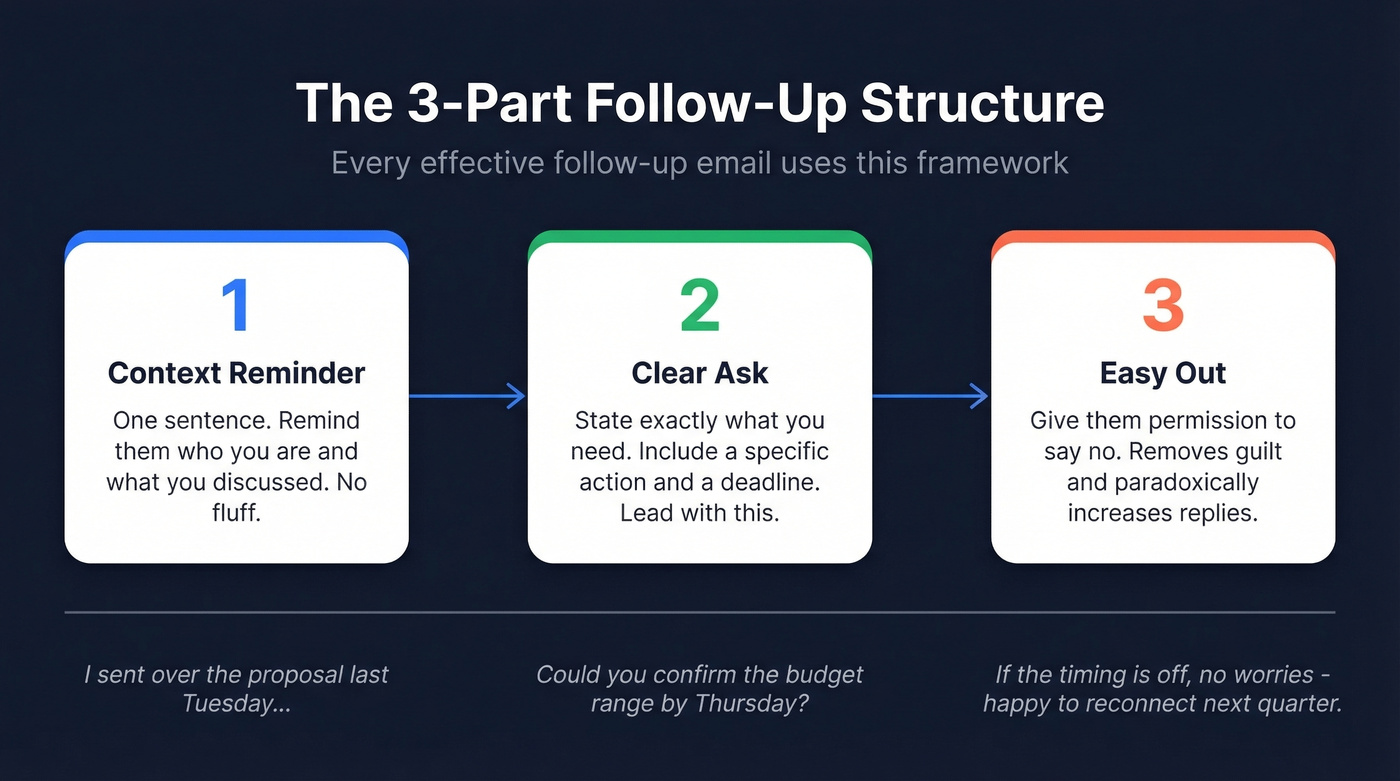
Lead with the ask. Your first sentence should state what you need - not "Hope you're doing well," but the actual request. Inbox previews are short. If your ask doesn't show up immediately, it might as well not exist.
Make the next step specific. "Let me know your thoughts" is vague enough to ignore. "Could you confirm the budget range by Thursday?" gives them a concrete action and a deadline. Personalized follow-ups hit ~18% response versus ~9% for generic templates - specificity isn't just polite, it's effective.
Keep it scannable. Bullets, bold key phrases, short paragraphs. A wall of text in a follow-up signals that replying will be work. Make it look easy to answer. Before you send, verify the address is still valid - a bounced follow-up damages your domain's sender reputation, which hurts deliverability on every future email you send. We use Prospeo's email verification for this; the 98% accuracy rate means you're not wasting follow-ups on dead addresses.
Give them an easy out. "If the timing isn't right, no worries - just let me know and I'll follow up next quarter" removes the guilt of saying no. Paradoxically, making it easy to decline makes people more likely to engage.
Subject Lines That Get Opened
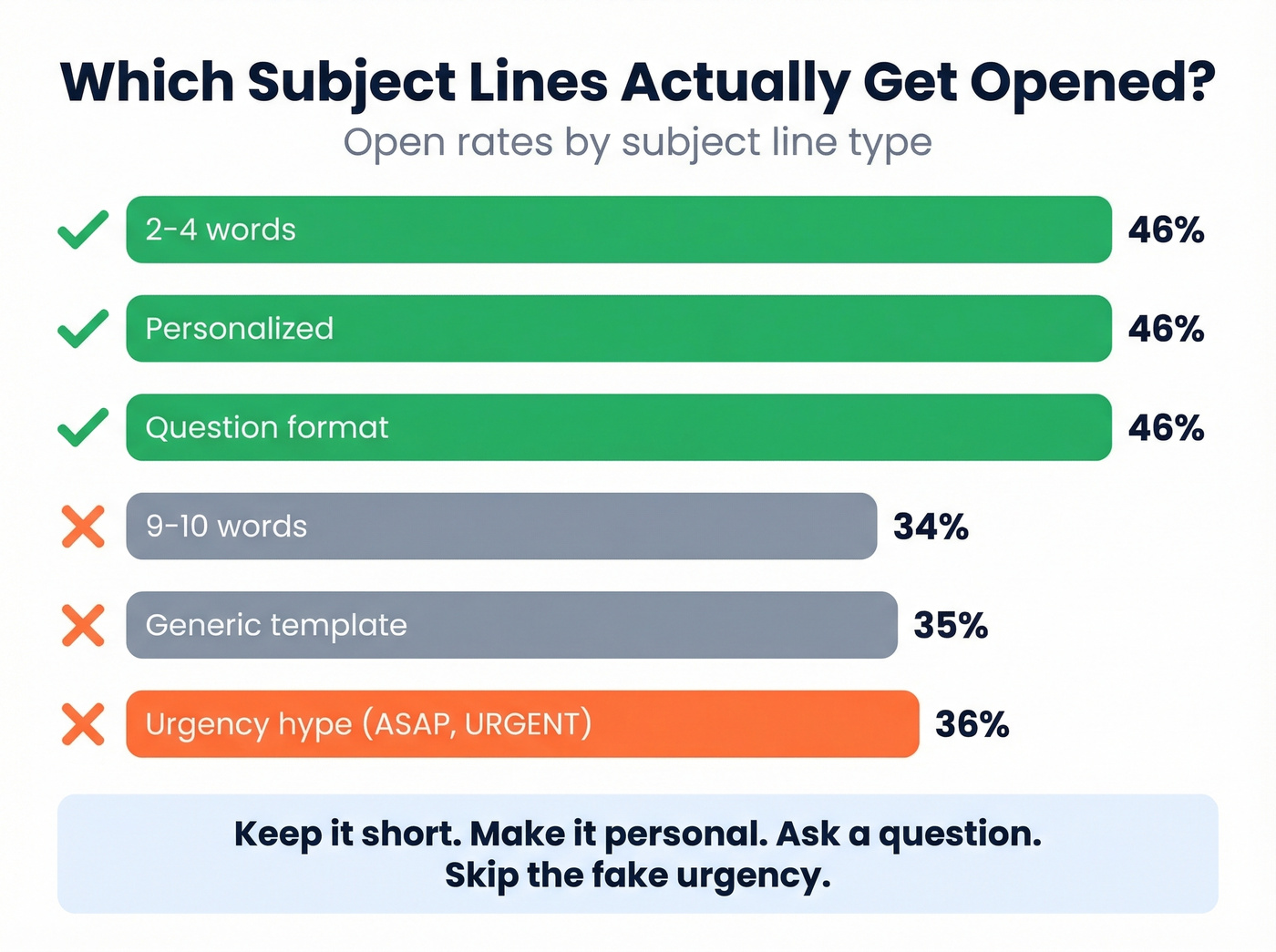
Your follow-up doesn't matter if it never gets opened. Subject line data based on email outreach benchmarks is surprisingly consistent:
| Subject Line Type | Open Rate |
|---|---|
| 2-4 words | ~46% |
| Personalized | ~46% |
| Question format | ~46% |
| 9-10 words | ~34% |
| Generic | ~35% |
| Urgency hype ("ASAP") | <36% |
Short beats long. Personal beats generic. Questions beat statements. And anything that screams urgency - "URGENT," "ASAP," "Time-sensitive" - actually performs worse than a calm, specific subject line.
A few that apply these rules:
- "Quick question on the proposal" - 4 words, question format
- "Next steps, [Name]?" - personalized, question, 3 words
- "Following up - budget timeline" - specific, 4 words
- "Still interested?" - 2 words, direct, question
If you want more options, pull from these email subject line examples and adapt them to your context.

Your follow-up copy is perfect - but it bounces. A single bounced email damages your domain reputation and tanks deliverability on every future email you send. Prospeo's 98% email accuracy and 7-day data refresh means the addresses you're following up on are real, current, and verified.
Stop wasting perfect follow-ups on dead inboxes.
Templates by Scenario
Every template below follows the 3-part structure: context reminder, clear ask, easy out. Copy, customize, send.
If you need more variations, these sales follow-up templates cover more tones and use cases.
Cold Email Follow-Up
Use this 3-5 business days after your initial cold email gets no reply.
Hi [Name], I reached out last [day] about [specific topic]. Wanted to see if a 15-minute call this week makes sense. If the timing's off, happy to reconnect next quarter.
Proposal Follow-Up
Use this 3-5 days after sending a proposal with no reply.
Hi [Name], following up on the proposal I sent on [date]. Any questions I can clarify, or adjustments to scope that would help move things forward? If you've gone a different direction, no hard feelings - just let me know.
Job Application Follow-Up
80% of hiring managers say thank-you notes influence their decisions, yet only 24-57% of candidates send them. That's a massive edge sitting on the table.
Hi [Name], thank you again for the conversation on [date]. I'm excited about the [role] and wanted to reiterate my interest. Is there anything else I can provide to help with next steps?
Invoice Follow-Up
Here's what most people get wrong with overdue payment emails: they apologize. Don't. You provided a service. State the facts.
Before: "So sorry to bother you, but I was just wondering if maybe you had a chance to look at the invoice I sent? No rush at all!"
After:
Hi [Name], invoice #[number] for [amount], sent on [date], is now [X] days past due. Could you confirm when we can expect payment? If there's an issue with the invoice, I'm happy to resend or adjust.
The "after" version works because it contains zero apologies and one clear question.
Networking Follow-Up
Hi [Name], great connecting at [event] on [day]. I'd love to continue our conversation about [topic]. Would a 20-minute chat next week work? If your schedule's packed, no rush.
The Breakup Email
Your final follow-up. Make it clear this is the last one - and mean it.
Hi [Name], I've reached out a couple of times about [topic] and haven't heard back - totally understand. I'll close the loop on my end, but if this becomes relevant down the road, I'm an email away.
This works because it removes all pressure, signals professionalism, and - counterintuitively - often triggers a reply. We've seen breakup emails pull responses weeks later from contacts who'd gone completely silent.
Ending a Sales Email with a Question
One of the most effective ways to prompt a reply is to close with a question instead of a statement. It shifts the dynamic - giving the recipient something to react to rather than just absorb.
The key is choosing the right type. Yes/no questions ("Does this sound interesting?") are easy to answer but easy to dismiss. An open-ended CTA like "What's your biggest challenge with [topic] right now?" invites a real conversation and tends to generate longer, more engaged replies. The tradeoff: open-ended CTAs produce fewer but higher-quality responses, while binary questions produce more replies at lower engagement depth.
Best closing questions by scenario:
- Cold outreach: "Would it make sense to explore this further?" - low commitment, easy to answer.
- Post-demo: "What would need to be true for this to work for your team?" - surfaces objections early.
- Re-engagement: "Is this still a priority for Q3, or should I check back later?" - gives a graceful exit.
Skip questions that feel like traps. "When should I pencil in our call?" assumes a commitment the recipient hasn't made, and it'll annoy them.
For more guidance on writing asks that convert, see these emails that get responses and email call to action best practices.
When to Send Your Follow-Up
Timing matters more than most people think.
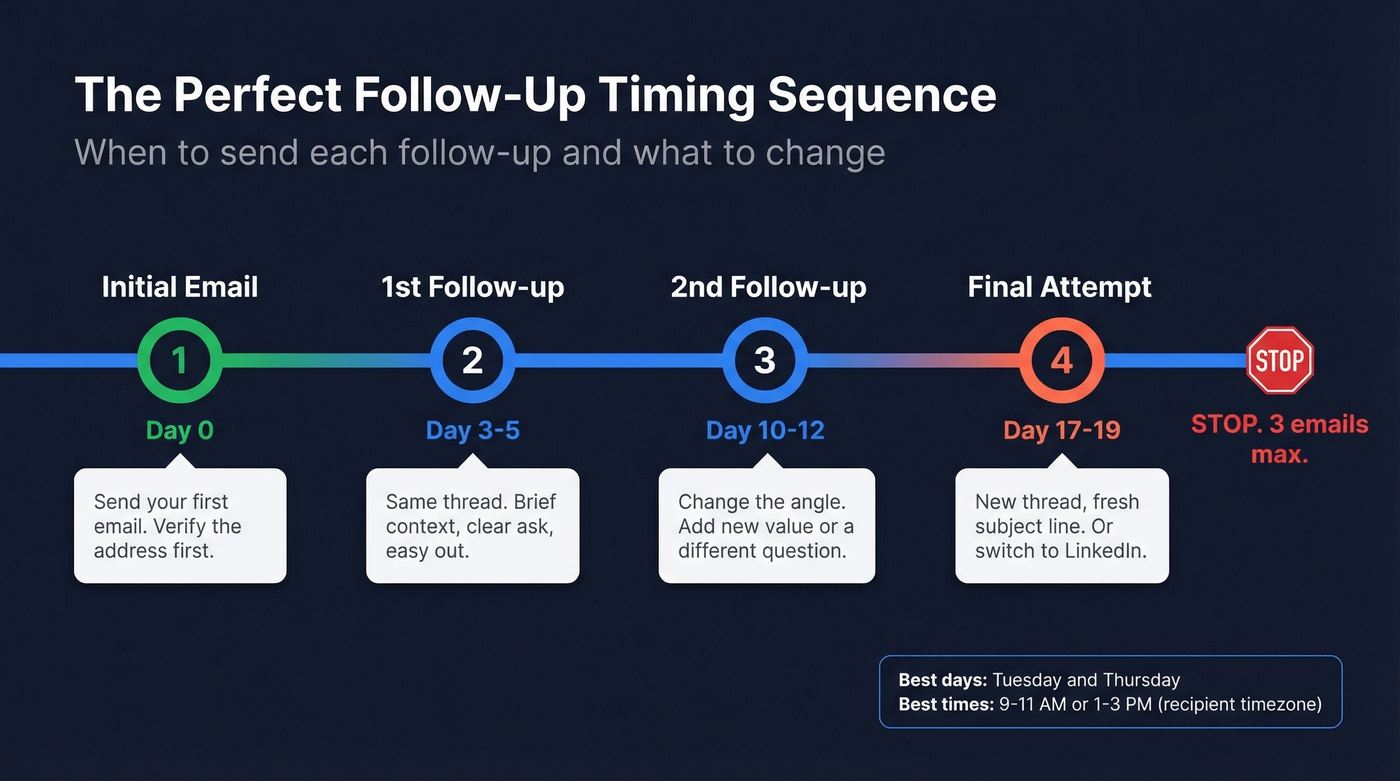
- First follow-up: 3-5 business days after the initial email.
- Second follow-up: 5-7 business days later. Change the angle - don't just repeat yourself.
- Third attempt: Switch to a new thread with a fresh subject line. The old thread is dead.
- After three total emails: Stop. You've made your case.
Best send days are Tuesday and Thursday. Best windows are 9-11 AM or 1-3 PM in the recipient's timezone - not yours. If you're emailing someone in London from San Francisco, schedule accordingly.
If you want a deeper timing breakdown, this guide on when you should follow up on an email goes further.
Phrases That Backfire
The reason people don't reply usually isn't your tone. It's that your email is too long, too vague, or arrived at the wrong time. But certain phrases do actively work against you. CNBC flagged the worst offenders - and we've seen every one of them kill reply rates in practice.
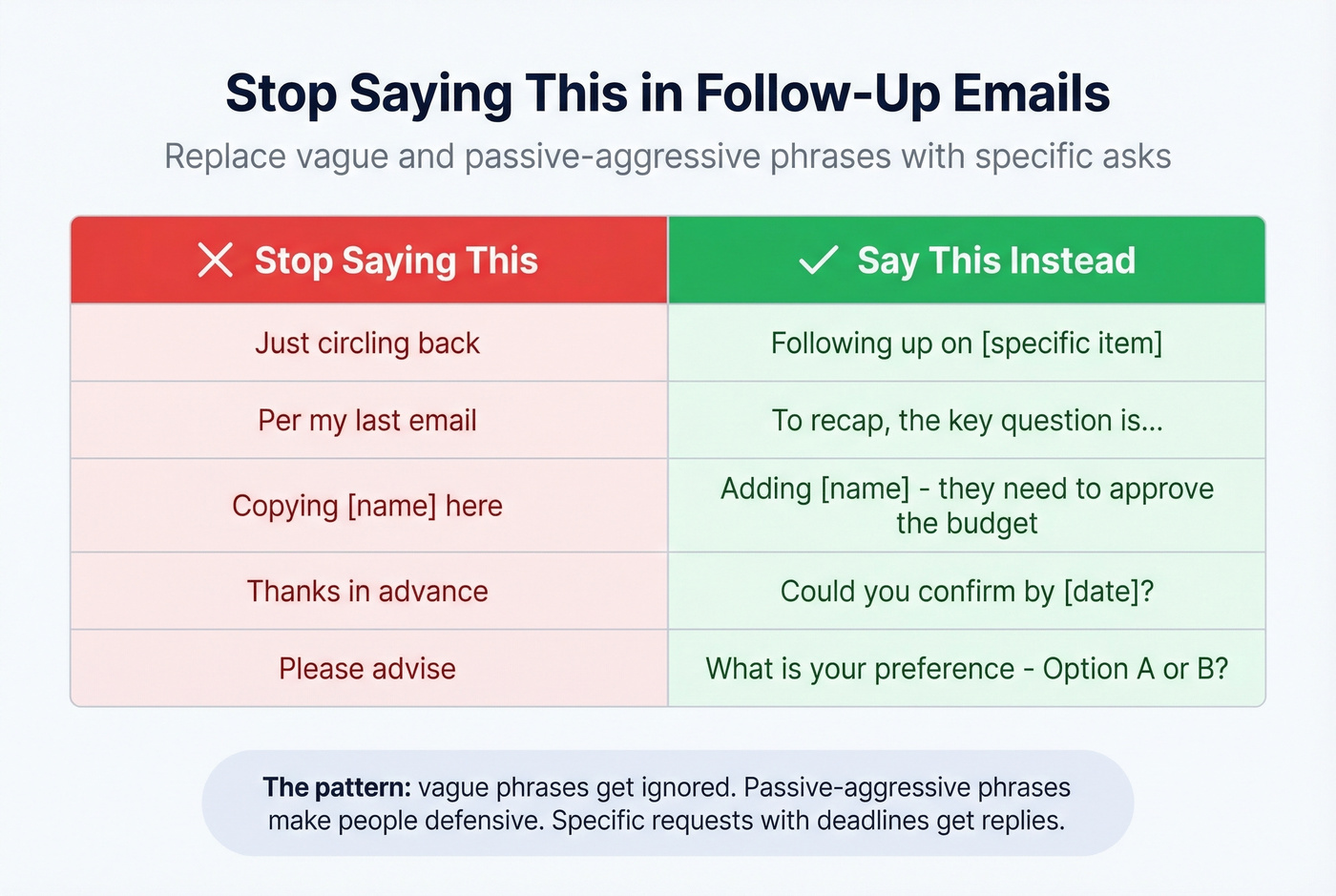
| Instead of... | Say... |
|---|---|
| "Just circling back" | "Following up on [specific item]" |
| "Per my last email" | "To recap, the key question is..." |
| "Copying [name] here" | "Adding [name] - they'll need to approve the budget" |
| "Thanks in advance" | "Would you be able to confirm by [date]?" |
| "Please advise" | "What's your preference - Option A or B?" |
The pattern is simple: vague phrases get ignored because they don't contain an action item. Passive-aggressive phrases get ignored because they make the recipient defensive. Replace both with a specific request and a deadline.
If you need alternatives to "checking in," this guide on how to say just checking in professionally has better options.
Following Up Across Cultures
If you're emailing internationally, default to these rules:
Start more formal than you think necessary. German recipients prefer direct, formal communication. Japanese business culture favors indirectness and higher formality. Mirror the recipient's tone in subsequent emails.
Avoid idioms and sarcasm. "Let's touch base" doesn't translate well. Be literal.
Specify time zones explicitly. "Thursday at 2 PM EST (7 PM GMT)" removes ambiguity. Use "March 15" instead of "3/15" - date format conventions vary by country and the numeric version creates confusion.
Be direct about the ask, indirect about pressure. State what you need clearly, but give generous timelines and easy outs. Norms for requesting a reply vary by culture, so when in doubt, err on the side of formality and patience.
You only get 1-2 follow-ups before replies crater. Don't waste them on wrong addresses or outdated contacts. Prospeo verifies emails through a 5-step process with catch-all handling and spam-trap removal - at $0.01 per email. 15,000+ companies trust it to protect their sender reputation.
Make every follow-up count - start with verified data.
FAQ
How many follow-up emails is too many?
Cap at three total emails. Belkins' 16.5 million-email study found that 4+ emails more than triple spam complaints while reply rates crater below 3%. Two follow-ups capture nearly all recoverable responses.
Should I reply to the same thread or start a new one?
Keep your first and second follow-ups in the same thread - it preserves context and makes it easy for the recipient to scan prior messages. On the third attempt, start a fresh thread with a new subject line. The old thread has been mentally filed as "ignore."
What if I'm not sure I have the right email address?
Verify before you follow up. A bounced follow-up damages your domain's sender reputation, which hurts deliverability on every future email. Tools like Prospeo can verify addresses in real time - the free tier gives you 75 verifications per month, enough to clean a small list before any outreach sequence.
Is it rude to set a deadline in a follow-up?
No. Specific deadlines like "by Friday EOD" actually increase response rates because they create clarity, not pressure. Vague requests like "when you get a chance" signal that your email isn't urgent, so it gets deprioritized indefinitely.
What's the best way to request a reply without being pushy?
Use the 3-part structure: remind them of context briefly, state your specific ask, and offer an easy out. Ending with a low-pressure question like "Does next week work better?" gives the recipient a simple path to respond without feeling cornered.