

How to Ask for Time for a Meeting - and Actually Get a Yes
The average cold email reply rate is 3.43%. That means 97 out of 100 meeting requests vanish into silence - no "no," no "let me check my schedule," just nothing. Knowing how to ask for time for a meeting is the gap between that 3.43% and the 10%+ that top performers hit.
The difference isn't what you're asking. It's how you ask.
What Every Meeting Request Needs
Every effective meeting request has five elements. Miss one and your acceptance rate drops.
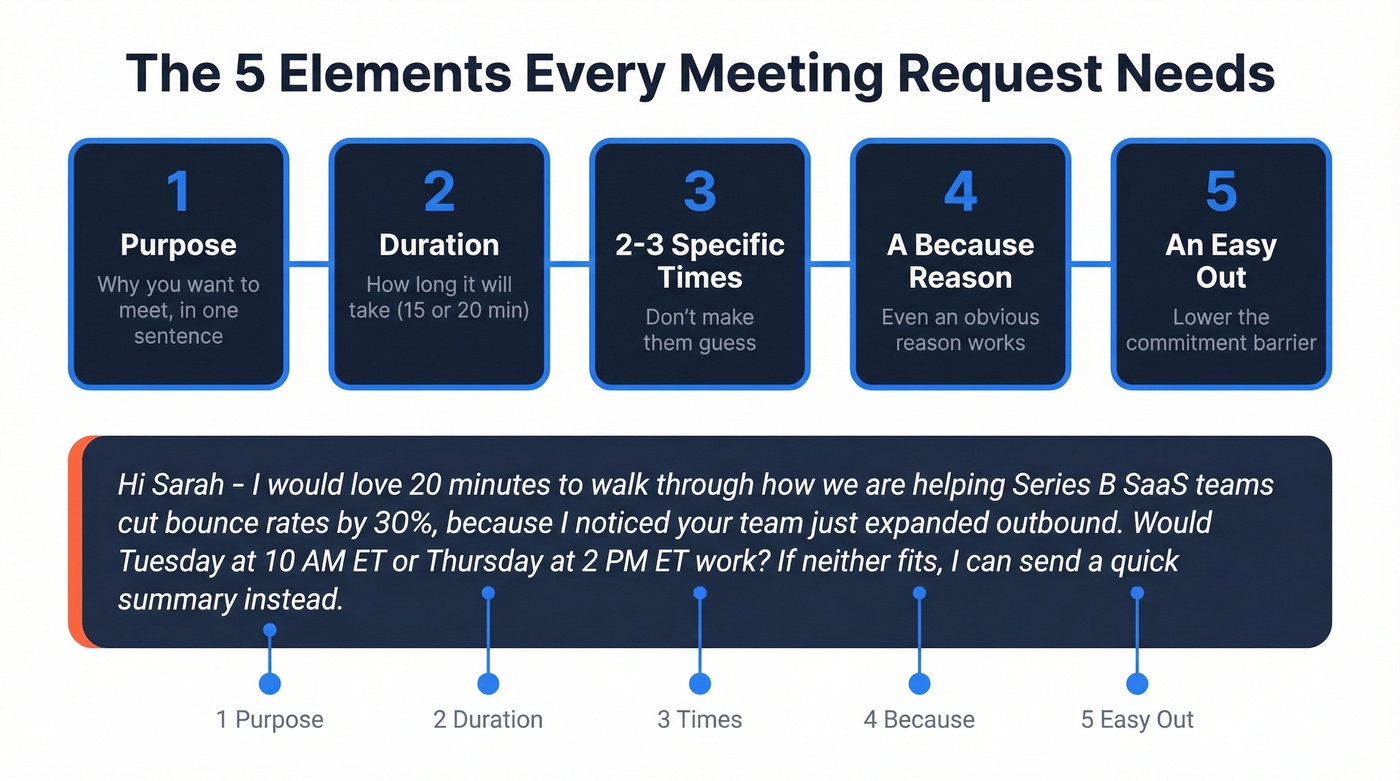
- Purpose - why you want to meet, in one sentence
- Duration - how long it'll take (15 min, 30 min)
- 2-3 specific times - don't make them guess
- A "because" reason - even an obvious one works
- An easy out - lower the commitment barrier
Put together, it sounds like this:
"Hi Sarah - I'd love 20 minutes to walk through how we're helping Series B SaaS teams cut bounce rates by 30%, because I noticed your team just expanded outbound. Would Tuesday at 10 AM ET or Thursday at 2 PM ET work? If neither fits, I can send a quick summary instead."
Follow-up matters more than the first ask. Only 2% of deals close on the first try.
The Psychology Behind "Yes"
There's a reason "because" appears in the formula above. Ellen Langer's copy machine study found that adding a reason to a request - any reason - dramatically changes compliance. With a real reason ("because I'm in a rush"), 94% of people said yes. Without one, only 60% complied. Here's the kicker: even a meaningless reason ("because I have to make some copies") hit 93%. The word "because" itself is a compliance trigger.
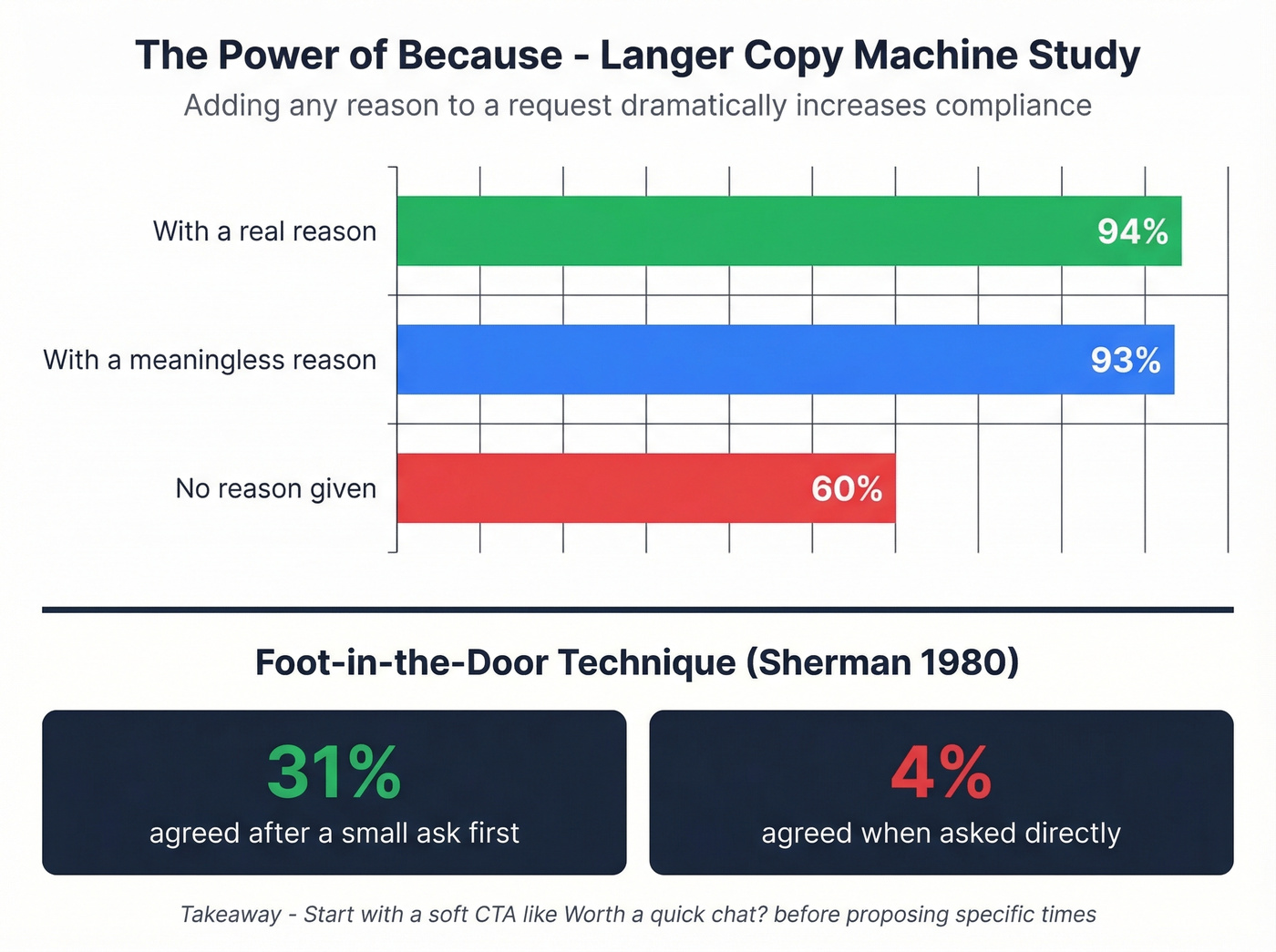
This maps directly to meeting requests. "Can we meet Tuesday?" is a bare ask. "Can we meet Tuesday because I want to share benchmarks from three companies in your space?" gives the recipient's brain a reason to say yes - even if the reason is lightweight.
There's a second principle at play: the foot-in-the-door technique. Sherman's 1980 study showed that when people agreed to a small hypothetical request first, 31% later agreed to a bigger real one - compared to just 4% when asked directly. For meeting requests, a soft CTA like "Worth a quick chat?" outperforms "Can we meet Tuesday at 2 PM?" The soft ask is the small commitment. Once they reply "sure," you propose specific times.
A practical way to apply this: open with a low-friction question like "Worth a quick chat?" or "Would it make sense to compare notes?" and only send times or a scheduling link after they engage.
The 5-Part Framework for Requesting Meeting Time
1. State the purpose in one sentence. "I'd like to discuss potential synergies" tells the recipient nothing. "I want to show you how three companies your size cut SDR ramp time by 40%" gives them a reason to care. Big difference.
2. Suggest a duration. "15 minutes" or "a quick 20-minute call" sets expectations. Leaving duration open makes the recipient imagine a 60-minute slog, and nobody wants that.
3. Offer 2-3 specific times. Open-ended "when works for you?" puts the cognitive load on the recipient, which means they'll deal with it later - which means never. Two or three concrete options make it easy to pick one. Krisp's scheduling guide highlights offering 2-3 suggested time slots as one of the highest-impact changes you can make.
4. Give a reason with "because." "Because I noticed your team just raised a Series B" or "because we're working with two companies in your space" - the bar is lower than you think.
5. Provide an easy alternative. "If a call doesn't make sense, I can send a 2-minute summary instead." Paradoxically, offering an out makes people more likely to take the meeting.
Let's be honest: if your average deal size is under $15k, you probably don't need a 30-minute discovery call. A 15-minute meeting with a tight agenda will close more deals than a bloated one that prospects dread accepting.
Meeting Request Templates by Scenario
Cold Outreach to a Prospect
Hi Marcus - we helped Acme Corp cut their bounce rate from 35% to under 4%. I'd love 15 minutes to share what worked, because the playbook maps directly to teams scaling outbound. Wednesday at 11 AM ET or Friday at 9 AM ET? Happy to send a breakdown instead.
This template only works if it reaches the right inbox. We've seen teams craft perfect meeting requests that bounce because the email address was six months stale. Prospeo finds and verifies professional emails with 98% accuracy, so your request actually arrives.
Warm Lead / Post-Interest Reply
Hey Priya - you mentioned data freshness is a pain point. I'd love 20 minutes to walk through the refresh workflow we built, because it solves the lag issue you described. Monday at 2 PM ET or Tuesday at 10 AM ET?
Internal - Getting Time with a VP
Here's a before/after to show how the framework transforms a vague ask:
Before: "Hi David - can we find time to chat about the partnership?"
After: "Hi David - I'd like 30 minutes with you and your VP of partnerships to align on the co-sell motion before Q3 pipeline reviews start, because two joint deals shifted stages this week. Thursday morning or Friday after standup?"
The "after" version states the purpose, names the duration, gives a reason, and offers time options. The "before" version does none of that.
Client Check-In
Hi Jennifer - I want to schedule a 25-minute quarterly review to flag two optimization opportunities we spotted, because there's a quick win that could save your team 3-4 hours per week. Next Tuesday at 1 PM ET or Wednesday at 3 PM ET?
Cross-Department Collaboration
Hey Alex - marketing's new lead scoring model goes live next month. I need 20 minutes with you and someone from ops to align on handoff criteria, because the current MQL definition is creating friction at the SDR stage. Thursday at 11 AM or Friday at 2 PM?
Reconnection After an Event
Hey Tom - we met at SaaStr last week (you asked about outbound deliverability for agency clients). I've got a case study that's directly relevant - worth 15 minutes Thursday at 10 AM PT or Friday at 1 PM PT? If timing's tight, happy to send it over email.
Verbal and Slack Requests
Not every meeting request happens over email. For Slack or in-person asks, use the "binary question" technique: narrow the options to two choices instead of leaving it open. "Can we grab 15 minutes Tuesday or Wednesday morning?" beats "When are you free this week?" The bounded choice reduces decision fatigue and gets a faster answer.
A Slack message version:
Hey - quick ask. Need 15 min to align on the handoff criteria before the scoring model goes live. Tuesday 11 AM or Wed 2 PM work?

You just spent time crafting the perfect meeting request - don't let it bounce. Teams using stale data see 35%+ bounce rates, which kills deliverability and domain reputation. Prospeo verifies emails with 98% accuracy on a 7-day refresh cycle, so your meeting ask reaches the right inbox every time.
Stop perfecting emails that never arrive. Fix the data first.
Subject Lines That Get Opened
Your meeting request is worthless if the email never gets opened. 33% of recipients decide whether to open based on the subject line alone, and 64% mark emails as spam without reading if the subject line feels off. Personalized subject lines boost open rates by 22%.
If you want more tested options, start with these subject line formulas.
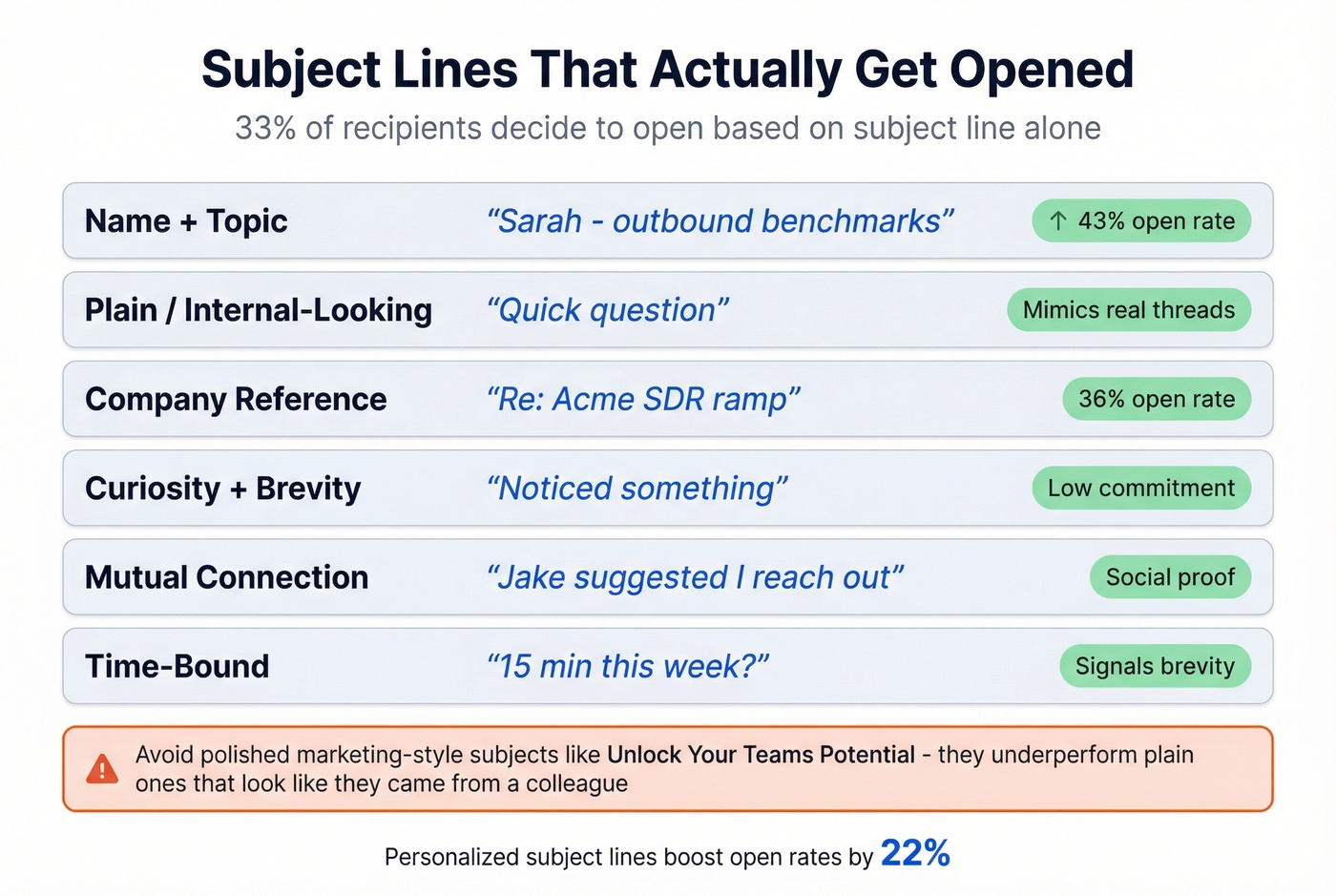
| Formula | Example | Why It Works |
|---|---|---|
| Name + topic | "Sarah - outbound benchmarks" | 43.41% open rate vs 16.67% |
| Plain / internal-looking | "Quick question" | Mimics real threads |
| Company reference | "Re: Acme's SDR ramp" | 35.65% open rate |
| Curiosity + brevity | "Noticed something" | Low-commitment open |
| Mutual connection | "Jake suggested I reach out" | Social proof trigger |
| Time-bound | "15 min this week?" | Signals low commitment |
Polished, marketing-style subject lines ("Unlock Your Team's Potential!") tend to underperform plain ones. The best subject lines look like they came from a colleague, not a newsletter.
Mistakes That Kill Acceptance Rates
1. Sending a calendar link before context. Yes, 68% of people prefer online scheduling. But that stat applies after they've decided to meet. Dropping a Calendly link in a cold email - before you've established why the meeting matters - creates friction. Save the link for the follow-up after they say yes.
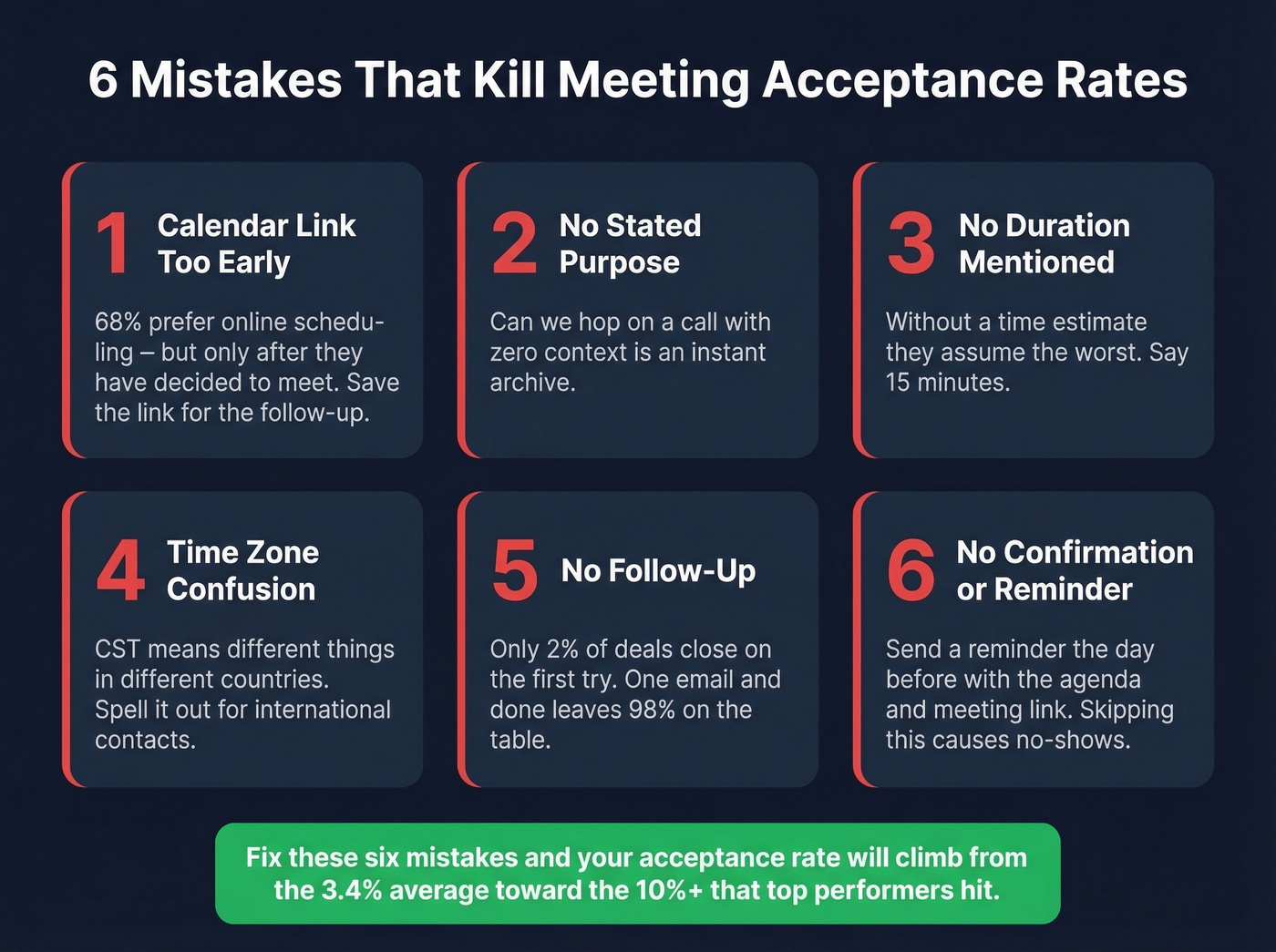
2. No stated purpose. "Can we hop on a call?" with zero context is an instant archive.
3. No duration mentioned. Without a time estimate, the recipient assumes the worst. "15 minutes" is almost always the right number for a first meeting.
4. Time zone confusion. "CST" means Central Standard Time in the US and China Standard Time in Asia. If your recipient is international, abbreviations create confusion. We'll cover how to fix this below.
5. No follow-up. Only 2% of deals close on the first try. One email and done means you're leaving 98% of potential outcomes on the table. If you need better language than "just following up," use these alternatives.
6. No confirmation or reminder. Once someone agrees to meet, send a reminder the day before with the agenda and meeting link. Skipping this step is how confirmed meetings turn into no-shows. A simple pre-meeting email prevents most no-shows.

There's a mistake that comes before all of these: sending to a dead email address. A perfectly crafted meeting request that bounces is worse than a mediocre one that arrives. If you're not verifying emails before sending, you're wasting every template in this article.
The Follow-Up Sequence
A first follow-up increases B2B response rates by 50%, with optimal timing at three days after the initial send. Only 2% of deals close on the first try, but that number climbs to 10% with four follow-ups.
If you want more copy-paste options, use these follow-up email templates and bump email templates.
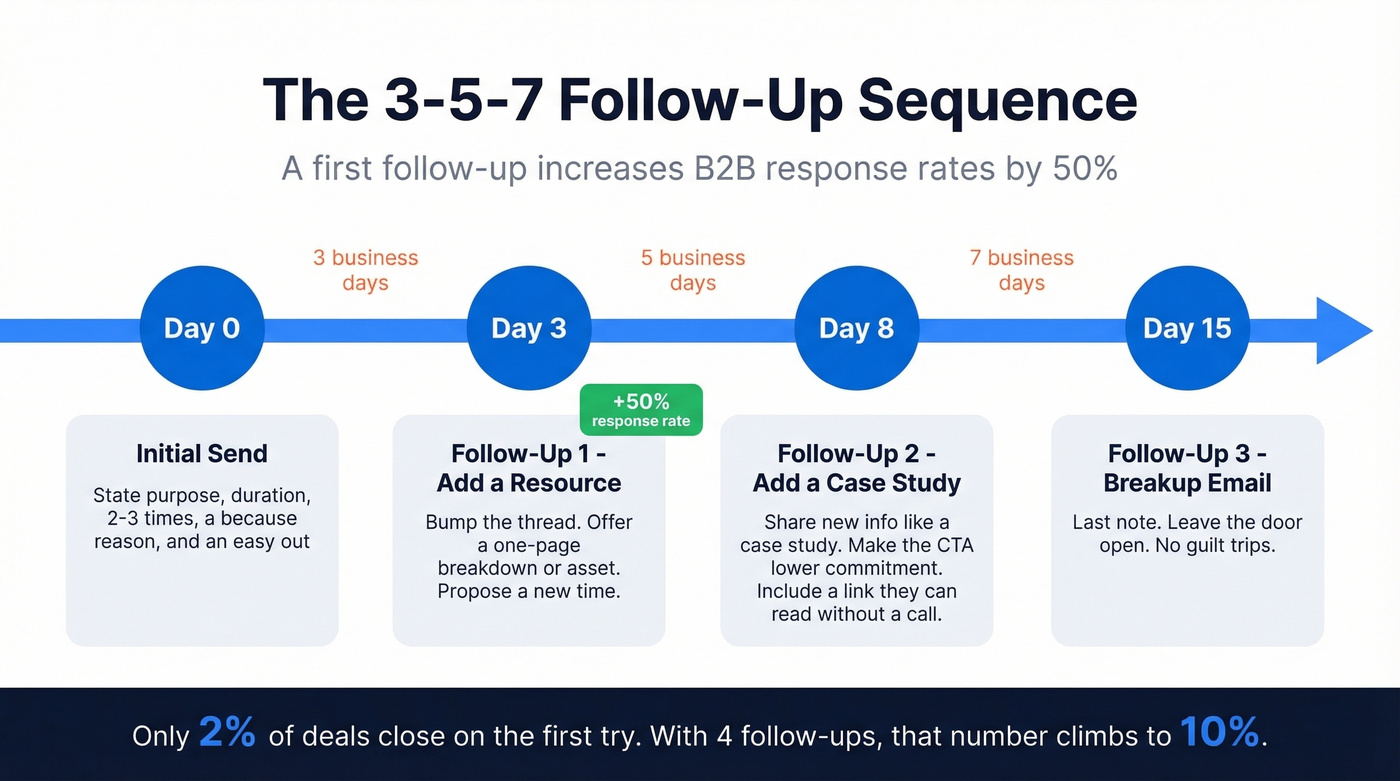
Use the 3-5-7 rule: follow up at 3 business days, then 5, then 7. Each follow-up must add value - "just checking in" is the fastest way to get marked as spam. If you keep getting silence, this check-in email after no response guide helps.
Follow-up #1 (Day 3):
Hi Marcus - wanted to bump this in case it got buried. I put together a one-page breakdown of the bounce rate reduction I mentioned - happy to send it if a call doesn't make sense. Thursday at 2 PM ET for 15 minutes?
Follow-up #2 (Day 8):
Hey Marcus - last note. We just published a case study with a team your size that cut SDR ramp from 10 weeks to 4. Worth a look even without a call: [link]. If you want to dig in, I've got 15 minutes open Tuesday or Wednesday.
Each follow-up introduces new information. The first adds a resource. The second adds a case study and makes the CTA lower-commitment. Never send the same ask twice with different words - that's not persistence, it's pestering.
Time Zones Without Confusion
Time zone abbreviations are a trap.
Abbreviations (EST, PST, CST): Familiar to US-based recipients, but ambiguous internationally. "CST" alone maps to three different time zones worldwide. They also ignore daylight saving shifts.
City names + UTC: Slightly longer to write, but zero confusion. This is the better default for any cross-border communication.
Use UTC as your anchor and list city times:
"Let's meet at 11:00 UTC (7 AM New York, 12 PM London, 6 PM Tokyo)"
time.is handles the conversion and generates a shareable link. It takes 10 seconds and eliminates the "wait, is that my time or yours?" back-and-forth.
Scheduling Tools Worth Using
Once someone says yes, don't lose the meeting to a five-email scheduling thread. Per Zapier's roundup:
| Tool | Free Tier | Paid From | Best For |
|---|---|---|---|
| Calendly | Yes | $12/user/mo | Safe default, most integrations |
| Cal.com | Yes (individuals) | $15/user/mo | Best free option, open-source |
| SavvyCal | Yes (limited) | $12/user/mo | Power users, overlay scheduling |
| zcal | No | $9.50/user/mo | Budget-friendly, clean UI |
| Sidekick | No | $5/user/mo | Cheapest paid option |
| lemcal | Yes (1 calendar) | $9/mo | Lemlist users |
Calendly is the safe default - everyone recognizes it, it integrates with everything, and the free tier handles basic scheduling. Cal.com is the best free option if you want more customization. SavvyCal is the power-user pick for teams that need overlay scheduling and routing logic.
The tool matters less than the timing. Send the scheduling link after someone agrees to meet, not as your opening move. In our experience, we've watched teams obsess over which scheduler to use while ignoring the fact that their meeting requests never get replies in the first place. Fix the ask first. Skip the scheduler comparison if you haven't nailed the five-part framework above.
If you want more examples, here are meeting request email templates and meeting request email examples.
The best meeting request template in the world won't help if you're emailing the wrong person. Prospeo's 300M+ profile database with 30+ filters - including job changes, buyer intent, and department headcount - lets you find the exact decision-maker worth requesting time from. At $0.01 per email, one booked meeting pays for thousands of lookups.
Find the right person before you ask for the meeting.
FAQ
How do you politely ask for a meeting time?
State your purpose in one sentence, suggest a duration (15-30 minutes), offer 2-3 specific time slots, include a "because" reason, and provide an easy alternative like a written summary. This five-part structure removes guesswork and makes it simple for the recipient to say yes.
How many times should you follow up?
Three to four times using the 3-5-7 rule (follow up at 3, 5, and 7 business days). Only 2% of deals close on the first touch, and each follow-up should introduce new value - a resource, a case study, or a lower-commitment CTA.
Should I send a calendar link in my first email?
Not for cold outreach. Dropping a scheduling link before establishing why the meeting matters creates friction. Use the first email to earn interest, then share your Calendly or Cal.com link once they've replied with intent.
What tools help ensure my meeting request actually arrives?
Email verification is the first step. If you're sending to stale addresses, nothing else matters. Pair a verification tool with a scheduler like Calendly or SavvyCal to eliminate back-and-forth once the recipient says yes.
How do I request a meeting on Slack or in person?
Use the binary question technique - offer two specific options instead of "when are you free?" Keep it to one sentence: purpose, duration, and two times. Example: "Need 15 min to align on handoff criteria - Tuesday 11 AM or Wednesday 2 PM work?"