

How to Be a Successful SDR: The Playbook Nobody Gave You
It's week three. You've made 200 calls, connected with six people, and two of them hung up before you finished your name. Your manager says "trust the process," but nobody's shown you what the process actually looks like with real numbers attached.
If you're wondering how to be a successful SDR, this is the playbook that should've been in your onboarding folder - the benchmarks, scripts, and uncomfortable truths that separate reps who get promoted from reps who burn out.
The Quick Version
If you're short on time, these five habits drive the most results:
- Time-block ruthlessly. Calls during golden hours from 8am to 3pm, research at end of day, Slack closed in between.
- Use permission-based openers. "Have you got 30 seconds for me to explain the nature of my call?" outperforms every clever hook.
- Personalize the first line. Generic intros get deleted. One sentence about their company, role, or a recent trigger event changes everything.
- Verify your data before you dial. A 40% bad-number rate kills your connect rate math. Pull verified contacts before call blocks so you don't waste golden hours on dead numbers.
- Qualify with discipline. Know whether you're running BANT or MEDDIC - and why - before your first discovery call.
What Nobody Tells You
SDR purgatory is real. The "12-18 months to AE" path that recruiters pitch during interviews depends on headcount, internal politics, and whether your company actually has AE openings. In tight markets, that timeline stretches well beyond expectations. Ask about the promotion path before you accept the offer - not after you've already started.
There's no golden pitch. Your performance depends on territory, timing, and product-market fit more than any script. The consensus on r/techsales is blunt: if over half your team misses quota, that's a company problem, not a you problem. Don't internalize systemic failures as personal ones.
Rejection is the default state. You'll hear "no" 95 times for every 5 yeses. The reps who last long enough to get promoted treat rejection as data, not as a verdict on their abilities. Log every activity in your CRM - your manager can't advocate for your promotion if they can't see your numbers.
Know Your Benchmarks
You can't improve what you don't measure. Here's what typical SDR benchmarks look like right now:
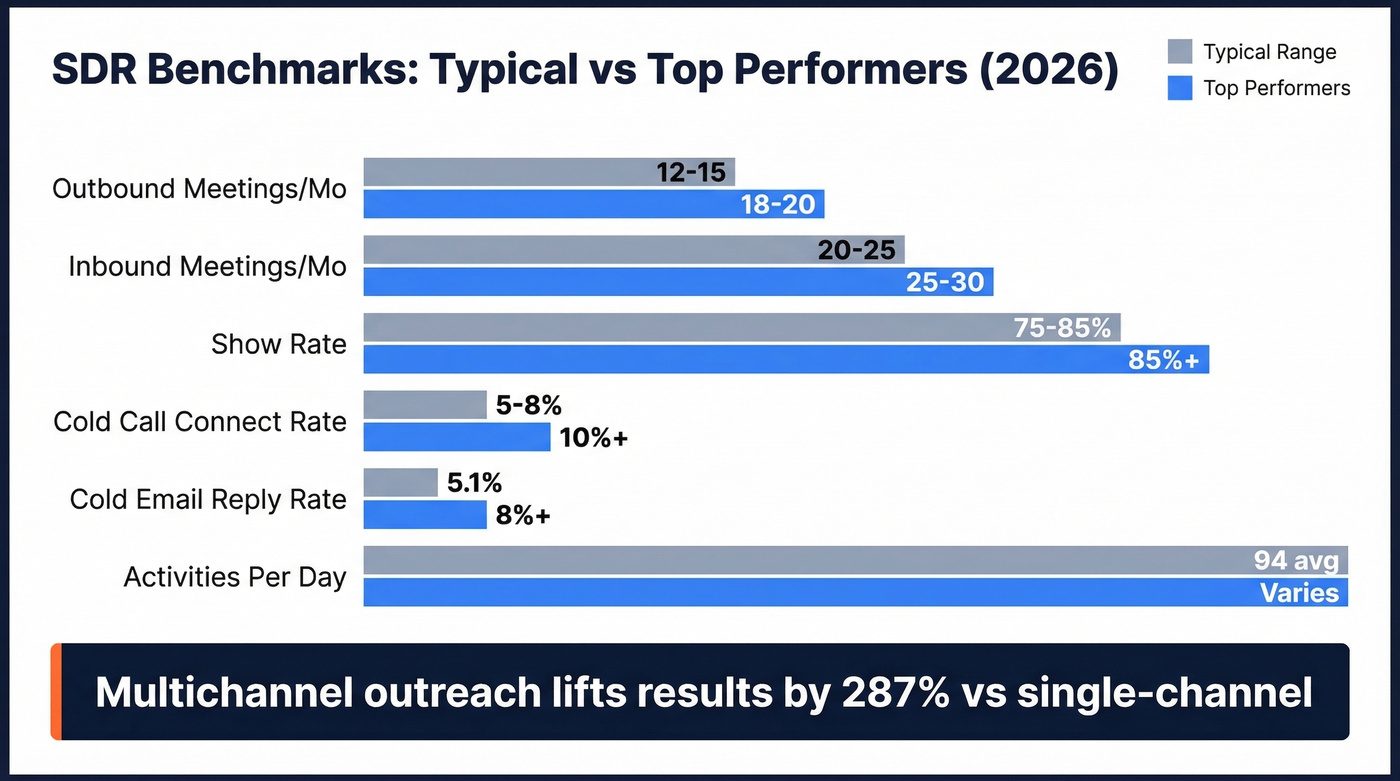
| Metric | Typical Range | Top Performers |
|---|---|---|
| Outbound meetings/mo | 12-15 | 18-20 |
| Inbound meetings/mo | 20-25 | 25-30 |
| Show rate | 75-85% | 85%+ |
| Cold call connect rate | 5-8% | 10%+ |
| Cold email reply rate | 5.1% | 8%+ |
| Activities/day | ~94 avg | Varies |
That ~94 activities/day breaks down to roughly 36 calls, 33 emails, 15 voicemails, and 7 social touches. The number that should shape your entire strategy: multichannel outreach lifts results by 287%](https://salesso.com/blog/outbound-sdr-statistics/) compared to single-channel. If you're only calling or only emailing, you're leaving pipeline on the table.
Structure Your Day for Peak Output
The 4-layer time-blocking system is the best daily framework we've seen for SDRs:
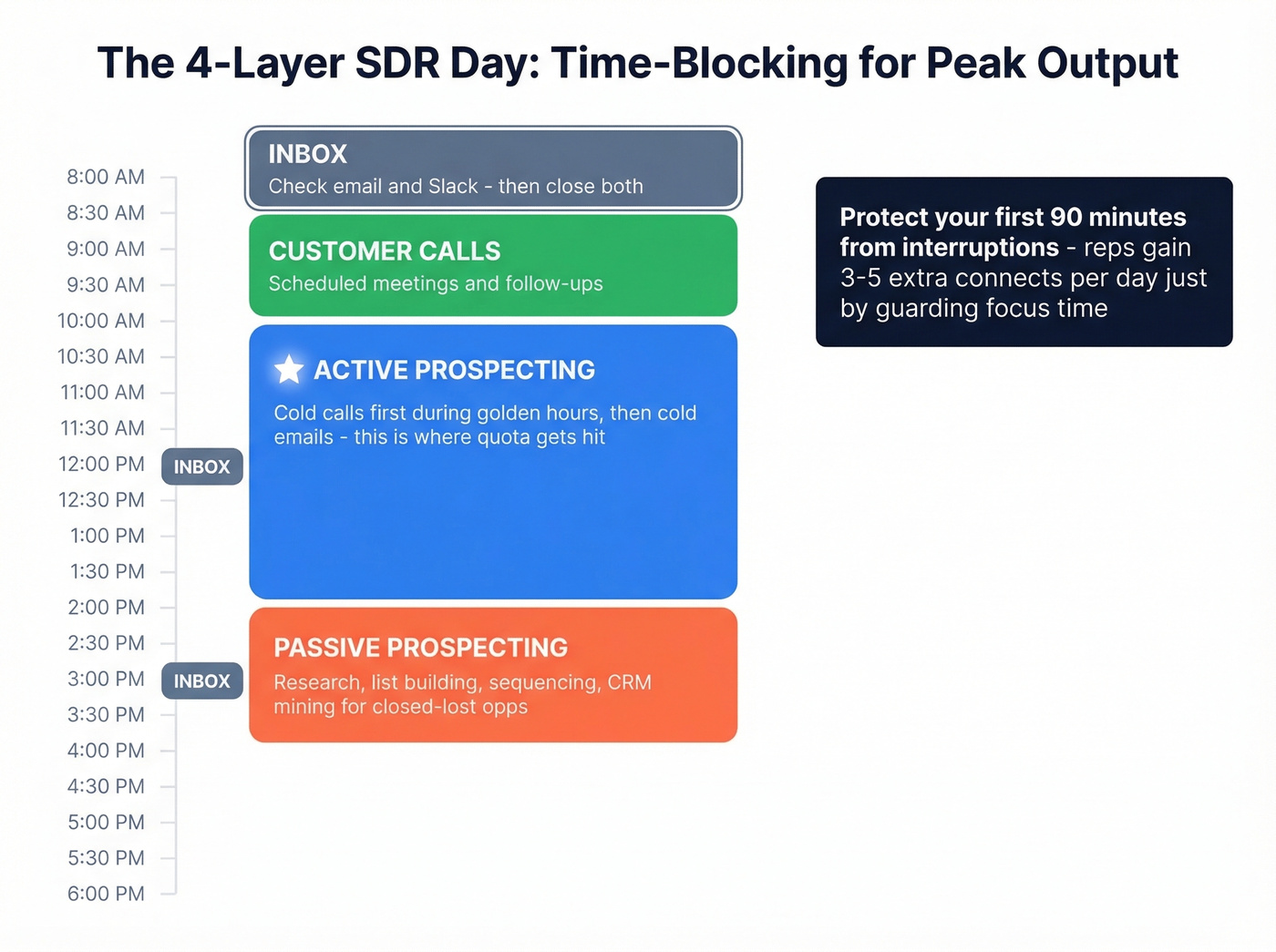
- Inbox - Check at 8:30am, noon, and 3pm only. Close Slack entirely between windows.
- Customer calls - Scheduled meetings and follow-ups during morning hours.
- Active prospecting - Cold calls first during golden hours, then cold emails. This is where quota gets hit.
- Passive prospecting - Research, list building, and sequencing batched at end of day.
Another common split that works: 2 hours follow-up, 2 hours new outreach, 1 hour learning.
Don't limit yourself to net-new lists, either. Mine your CRM for closed-lost opportunities from 6-12 months ago, search Salesforce notes for keywords like "timing" or "next quarter," and check job postings for companies actively hiring roles your product supports. These warm-adjacent leads convert significantly better than pure cold outreach, and most reps completely ignore them.
Here's the thing: the biggest productivity killer isn't lack of effort - it's context switching. Every time you check Slack mid-call-block, you lose momentum and burn time getting back into rhythm. We've seen reps add 3-5 extra connects per day just by protecting their first 90 minutes from interruptions. Guard your focus time like it's revenue, because it is.
Cold Call Scripts That Work
The Permission-Based Opener
This works because it gives the prospect control, which paradoxically keeps them on the line:
"Hi [Name], it's [Your Name] from [Company]. Have you got 30 seconds for me to explain the nature of my call?"
If they say they're busy:
"I completely understand. Give me two minutes, and if it isn't for you, I won't call again."
The Choose-Your-Own-Adventure Opener
This variant drives a micro-yes early by giving the prospect two paths, both of which keep the conversation going:
"Hi [Name], I'm calling about [pain area]. I can give you the 30-second version or the 2-minute version - which works better?"
The Gatekeeper Script
From Pipedrive's script library - build rapport before asking for the transfer:
"Hi, I was wondering if you could help me. I'd feel better if I knew your name first... [Name], great. What's the best way to reach [Decision Maker]?"
Voicemails
Keep it under 20 seconds. State your name, company, one clear reason to call back, and repeat your number twice. No pitch, no feature dump. Follow up every few days, and stop after a handful of ignored messages. Persistence works; harassment doesn't.

You just read that a 40% bad-number rate kills your connect rate math. Prospeo gives SDRs 98% verified emails and 125M+ direct dials with a 30% pickup rate - so every minute of your golden hours goes toward live conversations, not voicemail boxes and bounces.
Stop burning call blocks on dead data. Verify your list first.
Cold Email Templates
The Video Offer (34% Reply Rate)
A Reddit user on r/coldemail tested this with 150 emails to e-commerce brands - 51 replies, 31 booked calls, 8 paying clients, roughly EUR12K in revenue:
Subject: I recorded a video for you
Hi [Name],
I put together a quick strategy breakdown for [Company] - specifically around [specific pain point you noticed]. No pitch, just ideas.
Want me to send it over?
It works because of the curiosity gap plus zero ask in the first email. No links, no Calendly, no pitch. Just permission to share value.
The Pain-Insight-Ask Structure
Subject: [Specific trigger - e.g., "Saw the new VP Sales hire"]
Hi [Name],
[One personalized sentence about their situation]. Teams in [their space] typically struggle with [specific pain]. We helped [similar company] solve that by [brief insight].
Worth a 15-minute call this week?
Short intro, single CTA, personalized first line, value before the ask. Writing concise, relevant emails is one of the most underrated skills for any sales development representative.
Qualify Smarter
Use BANT when there's a single decision-maker, clear budget authority, and a straightforward buying process. It's fast and it works for transactional deals.
If you want a tighter discovery flow, keep a discovery questions cheat sheet open during calls.
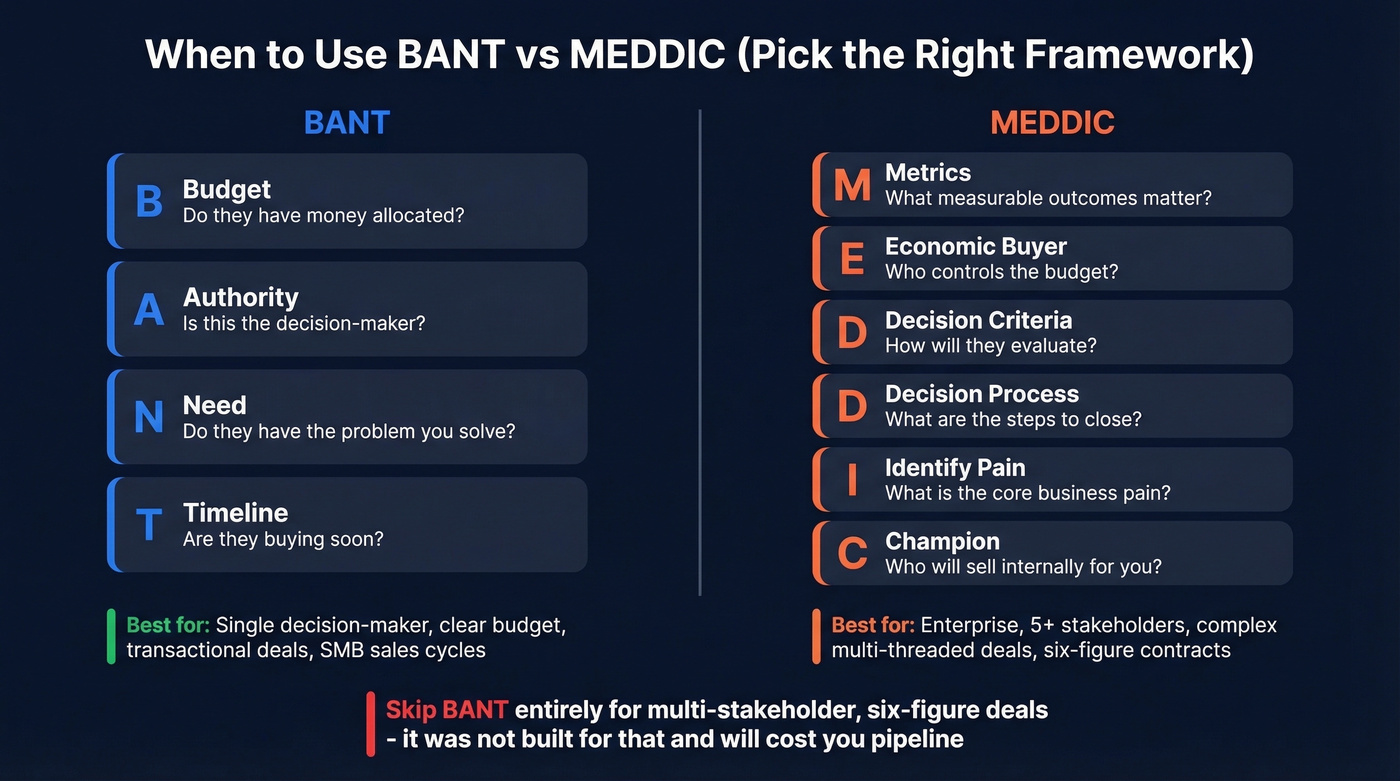
Use MEDDIC or MEDDPICC when you're selling into enterprise accounts with 5+ stakeholders in the buying committee. BANT assumes one person holds the budget and makes the call - that assumption falls apart in complex B2B.
If you're building a repeatable enterprise motion, use a MEDDIC sales qualification framework and standardize it across the team.
Let's be honest: skip BANT entirely once you're consistently selling multi-stakeholder, six-figure deals. It wasn't built for multi-threaded sales cycles, and using it there will cost you pipeline you didn't even know you lost.
Fix Your Data First
Most SDR performance problems aren't about skills or scripts. The surface problem is "reps aren't hitting quota," the underlying cause is "not enough pipeline," and the root cause is that 40% of your contact data is outdated or wrong. I've watched entire teams miss quota for a quarter before someone finally audited the data and found half the phone numbers were disconnected.
If you're evaluating vendors, start with a shortlist of data enrichment services and compare refresh cycles and verification methodology.

Prospeo fixes this at the source. Its database runs 98% email accuracy across 300M+ profiles, and verified mobile numbers hit a 30% pickup rate compared to the 12% industry average. Every record refreshes on a 7-day cycle, which matters because most providers take six weeks. Snyk cut their bounce rate from 35-40% to under 5% after switching, and GreyScout cut rep ramp time from 8-10 weeks to 4 weeks. There's a free tier to test it, no contracts, and credits run about $0.01 per email.
If you're troubleshooting bounces, use an email bounce rate checklist before you blame copy or targeting.
The best cold email in the world bounces if the address is wrong. Prospeo's 5-step verification and 7-day data refresh mean your sequences land in real inboxes - not spam traps. At $0.01 per email, even SDRs on starter budgets can prospect like enterprise teams.
Hit 8%+ reply rates when every email actually arrives.
Use AI Without Losing Your Edge
A fully-loaded SDR costs $75-100K/year. AI SDR platforms run $500-$2,000/month. The math looks obvious, but expect 40-60 hours of data cleanup before you can launch any AI tool effectively, and 3-6 months before you see real ROI.
If you're experimenting with automation, start with AI cold email outreach principles so you don't scale bad messaging.
Start with 100-200 test accounts, not your entire TAM. AI handles research and email drafting; you handle the judgment calls, objection handling, and relationship-building that actually close deals. Reps who use AI to prep better calls will outperform reps who let AI send generic sequences on autopilot. Every time.
Traits That Separate Top Performers
After watching hundreds of reps ramp, we've noticed the qualities that matter come down to a short list: coachability, resilience after rejection, genuine curiosity about the prospect's business, and the discipline to follow a process even when it feels repetitive. Top performers aren't flashy - they're consistent. The reps who hit quota month after month aren't the loudest on the floor; they're the ones who prep before every call, debrief after every loss, and never stop iterating on their approach.
If you struggle with hearing "no" all day, build a system for cold call rejection so it doesn't wreck your week.
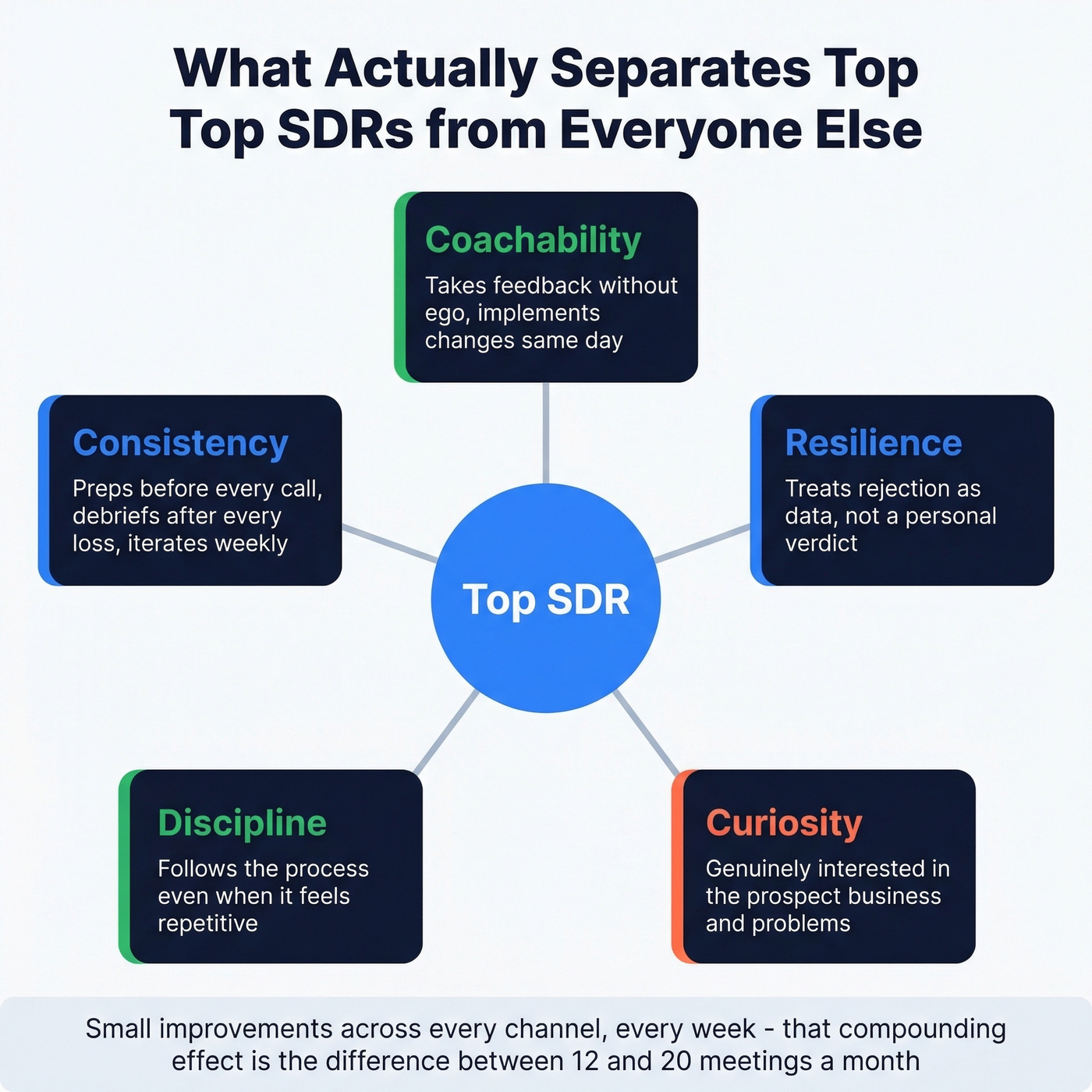
What makes a great SDR isn't a single talent. It's the willingness to stack small improvements across every channel, every week. That compounding effect is what separates a 12-meeting month from a 20-meeting month.
FAQ
How many meetings should an SDR book per month?
Outbound SDRs typically book 12-15 qualified meetings per month, with top performers hitting 18-20. Expect a 15-25% drop-off from booked to held, so track held meetings - that's the number your pipeline actually depends on.
How long does it take to get promoted from SDR to AE?
At healthy organizations, 12-24 months is standard. In tight markets with limited AE headcount, it stretches longer. If the promotion path isn't clear during interviews, that's a red flag - ask directly before accepting the offer.
What tools do top-performing SDRs use?
The core stack is a CRM like Salesforce or HubSpot, conversation intelligence like Gong, a verified data provider, and a sequencing tool like Outreach or Salesloft. The data provider matters most - accurate contact info means fewer bounces and more live conversations per hour.
What's the best advice for someone just starting the SDR role?
Focus on activity volume first, then optimize for quality. Track your numbers weekly to spot which channel - calls, emails, or social - converts best for your territory. Master one channel before layering on the next, and always personalize your first touch.