

How to Build a Company Profile That Actually Wins Business
A PPE business owner on Reddit shared a problem we see constantly: a 30-year-old company still handing prospects a profile from years ago. Faded logos, a mission statement nobody reads, zero mention of the certifications that actually win tenders. That profile isn't a sales tool - it's a liability.
A company profile is a brief document that gives an overview of your business and helps introduce you to potential clients, partners, or investors, typically as a shareable PDF. Some brands call their About page a "company profile," but in sales and procurement it usually means a standalone document you can email, attach to proposals, and hand out at trade shows. Let's walk through how to build one that actually earns meetings.
Three Types of Company Profiles
Decide who's reading your profile before you write a single word. A profile for a procurement team looks nothing like one for an angel investor.
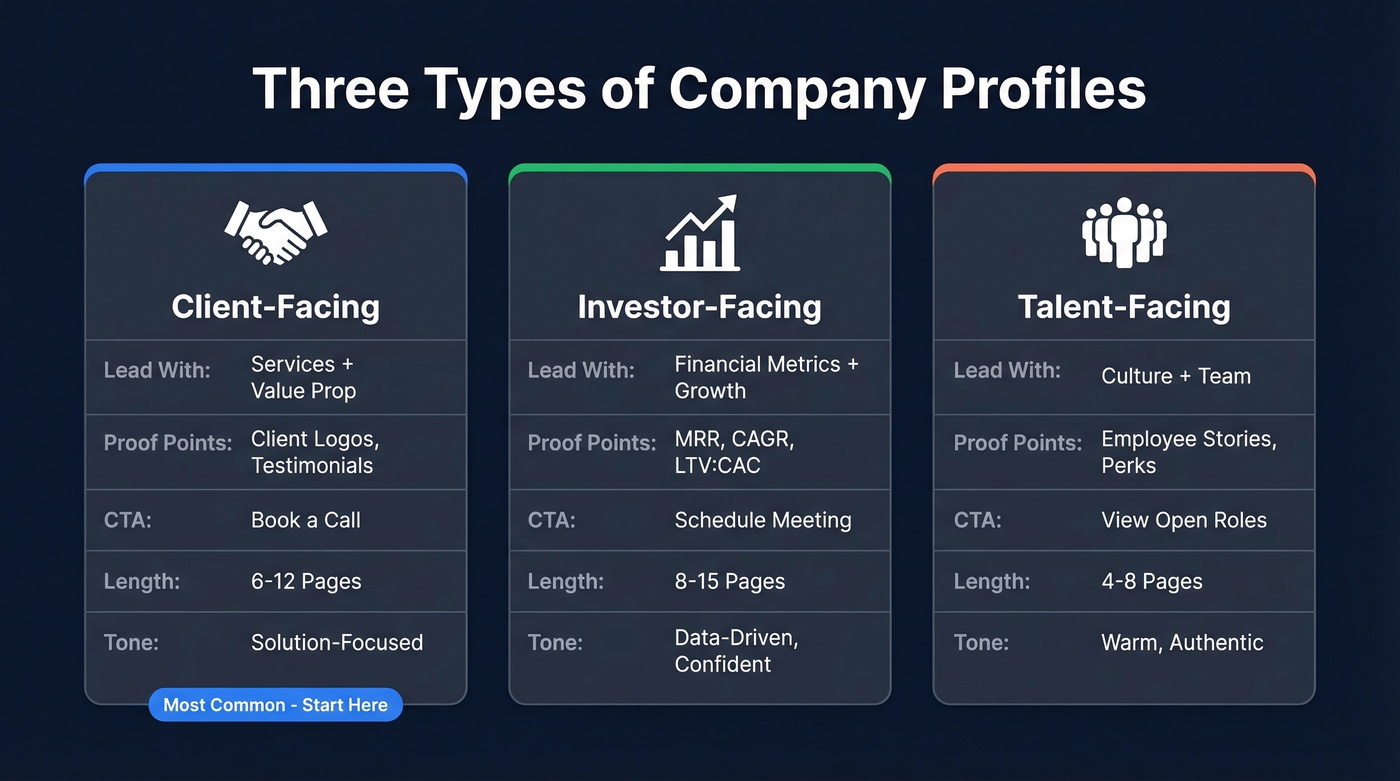
| Element | Client-Facing | Investor-Facing | Talent-Facing |
|---|---|---|---|
| Lead section | Services + value prop | Financial metrics + growth | Culture + team |
| Proof points | Client logos, testimonials | MRR, CAGR, LTV:CAC | Employee stories, perks |
| CTA | "Book a call" | "Schedule meeting" | "View open roles" |
| Ideal length | 6-12 pages | 8-15 pages | 4-8 pages |
| Tone | Solution-focused | Data-driven, confident | Warm, authentic |
The client-facing version is the most common in B2B. If you're only building one, start there.
What to Include in Your Profile
Every profile needs business details - name, founding year, legal structure, headquarters - followed by a mission statement kept to two sentences max. Then cover your products or services, the industries you serve, and your competitive advantage over the next vendor. Add leadership bios, social proof like client logos and testimonials, and any certifications or licenses that matter to your buyer. Close with contact info, a QR code, and a clear call to action.
Bizplanr's template, downloaded over 14,000 times, covers these same core sections and works as a solid structural starting point. TemplateLab also offers 37+ free templates in Word, PowerPoint, and PDF.
How Long Should It Be?
One-pager (~250 words): Best for cold outreach attachments or proposal appendixes. Logo, value prop, three proof points, CTA. That's it.
6-12 pages: The sweet spot for most B2B companies. That's roughly 1,500-3,000 words. A sharp 6-pager beats a bloated 20-pager every time - procurement teams don't have the patience for filler, and neither do you.
12-20 pages: Portfolio-heavy industries like architecture, construction, or design. A 16-page magazine-style layout on Behance shows what this looks like in practice.

Your company profile is only as good as the inbox it lands in. Prospeo gives you verified emails for the VPs, procurement leads, and founders at your target accounts - 98% accuracy, refreshed every 7 days, at $0.01 per email. Stop sending polished PDFs to dead addresses.
Build the profile. We'll find the people who need to read it.
7 Steps to Create Your Profile
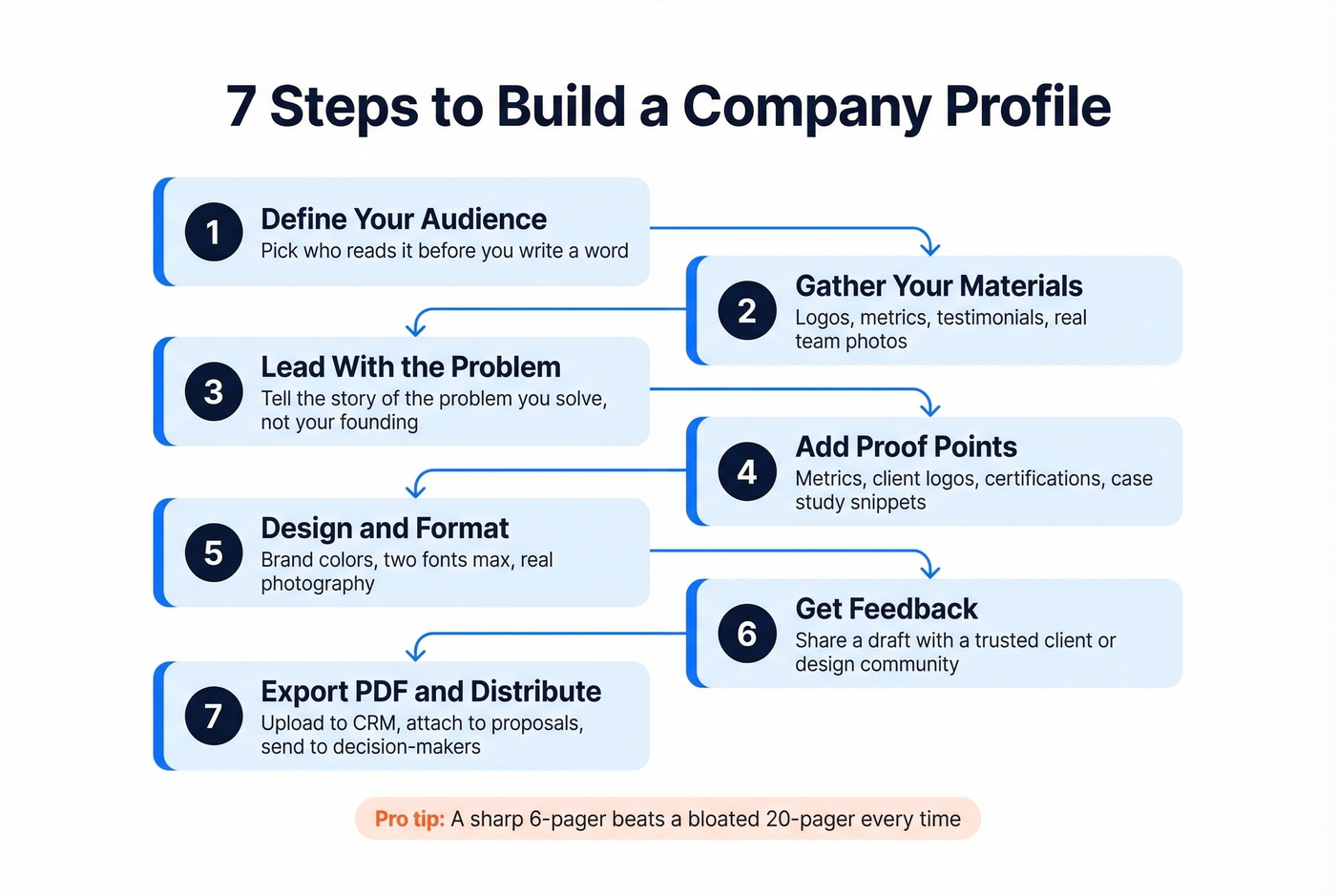
1. Define Your Audience and Purpose
A profile aimed at procurement managers needs certifications and org charts. One aimed at seed investors needs MRR and growth rates. Pick your audience first - everything else follows from that decision.
2. Gather Your Materials
Pull together brand assets: logo, brand colors, fonts. Then collect key metrics, client testimonials, certifications, and team headshots. Real photos over stock - always. Stock imagery screams "we didn't care enough to take a picture."
3. Lead With the Problem You Solve
Every guide says "tell your story." Here's the thing: tell the story of the problem you solve, not the story of your founding. Nobody cares about the garage unless it explains why your product is better.
4. Add Proof Points
Metrics, client logos, ISO certifications, awards, case study snippets. Proof builds trust faster than promises. If you've got numbers, lead with them - a "47% cost reduction for Client X" line does more work than three paragraphs of brand philosophy.
5. Design and Format
Stick to brand colors, two fonts max, and real photography. In one r/smallbusiness thread, a founder specifically struggled with PowerPoint slide design and image editing - even while using Canva. If that's you, start with a pre-built Canva template and customize from there. For print, export at 300ppi in CMYK.
6. Get Feedback
Share a draft with a trusted client or post it to a design community like Behance. The feedback loop catches blind spots you'll miss internally. We've seen profiles go through three rounds of internal review and still miss that the phone number was wrong.
7. Export as PDF and Distribute
PDF preserves formatting across devices and prints cleanly. Upload it to your CRM, attach it to proposals, and send it to the people who need to see it.
Investor Profiles - What to Add
Investors want financial performance front and center: historical revenue, profit margins, growth trajectories, and metrics like ROI and CAGR. At seed stage, investors expect $5k-$20k MRR with 10-20% month-over-month growth. Series A profiles should show $100k+ MRR, scalable acquisition channels, and a LTV:CAC ratio of 3:1 or better.
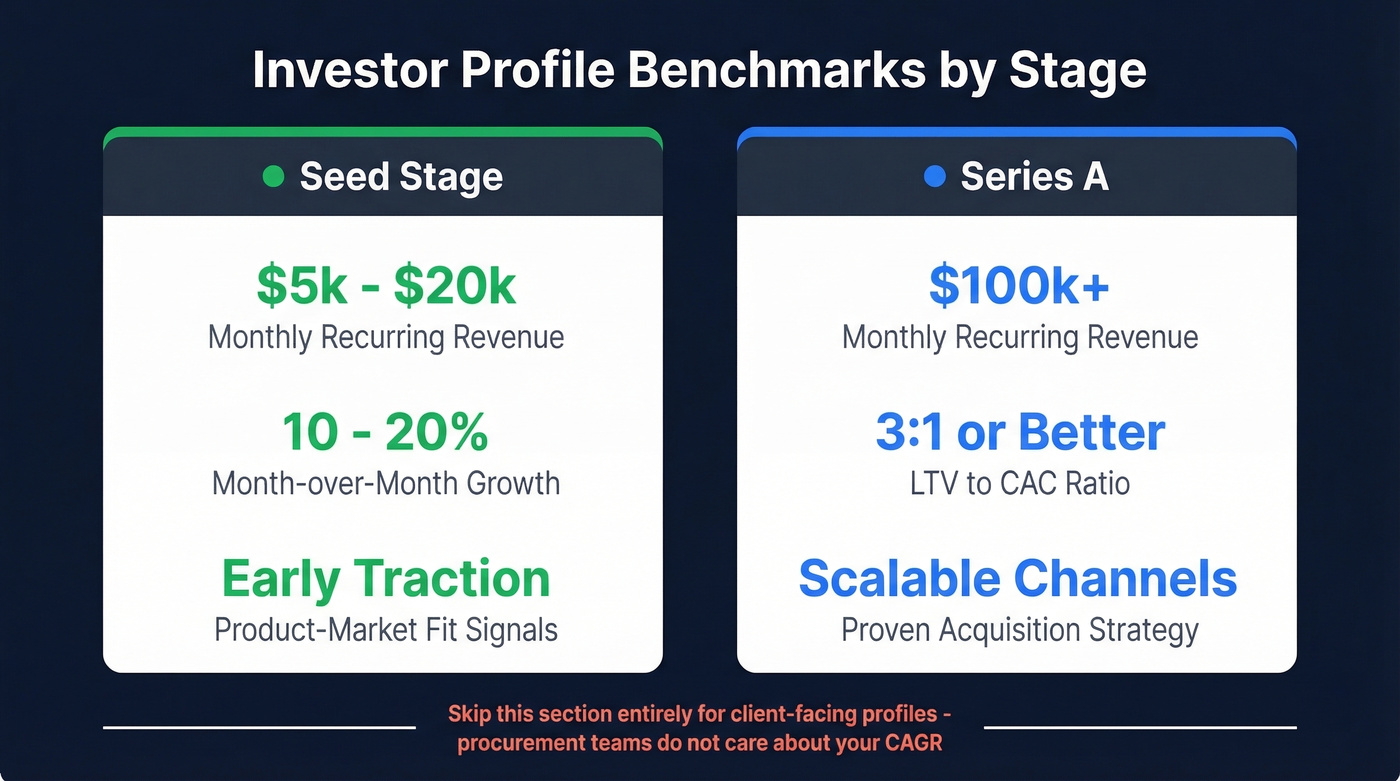
Lead with your executive summary and competitive edge, then let the numbers do the convincing. Skip this section entirely if you're building a client-facing profile - procurement teams don't care about your CAGR.
5 Mistakes That Kill Your Profile
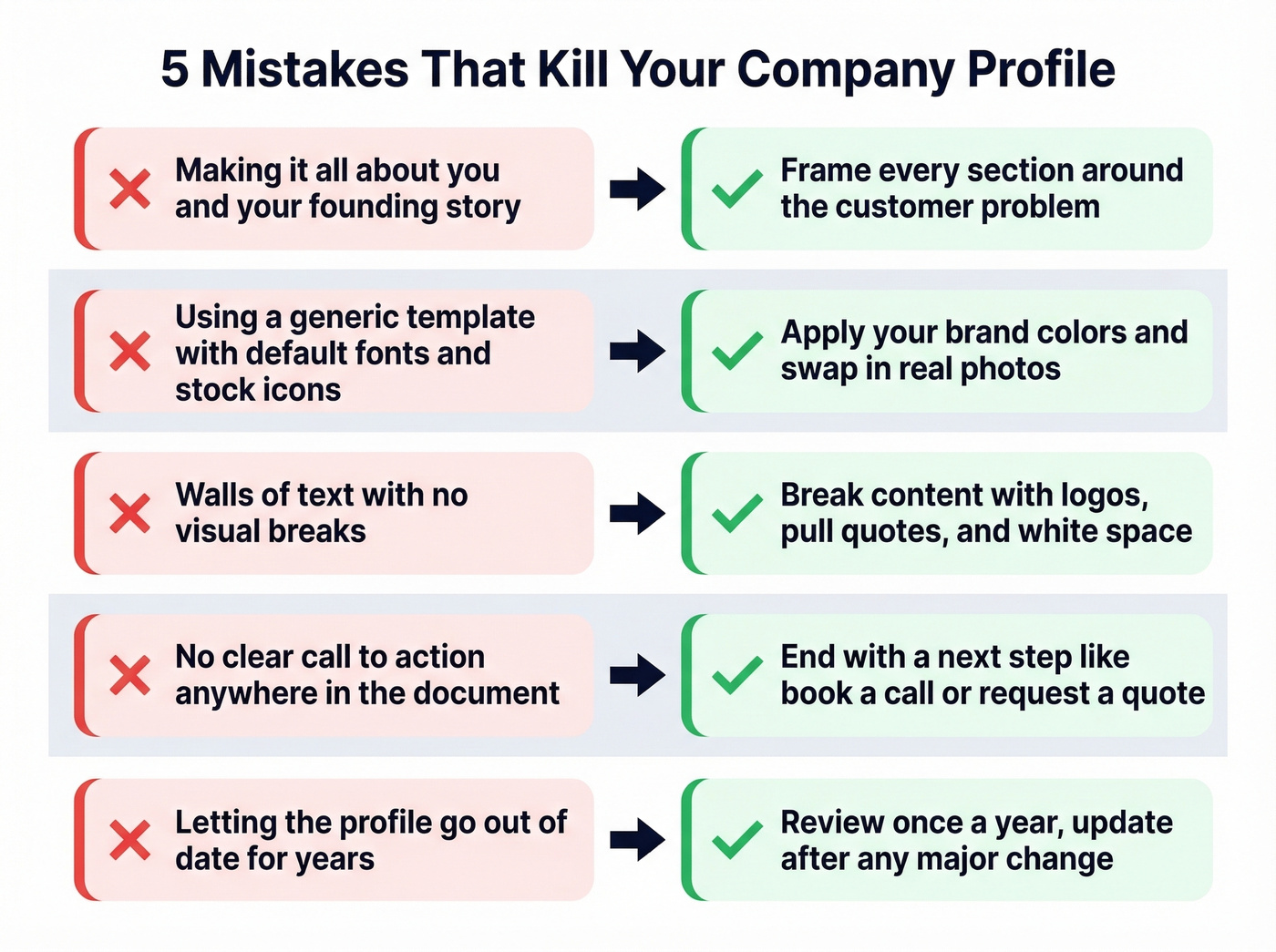
1. Making It All About You
Frame every section around the customer's problem. Your founding story is context, not the headline.
If you need a quick way to sharpen your positioning, start with a simple elevator pitch before you write the profile.
2. Using a Generic Template Without Customization
Default fonts and stock icons undermine confidence. Apply your brand colors and swap in real photos. A template is a starting point, not a finished product.
3. Forgetting Visual Flow
Walls of text get skimmed and forgotten. Break content with logos, pull quotes, highlighted stats, and white space. If a page has more than 300 words with no visual break, redesign it.
4. No Clear Call to Action
In our experience, profiles without a CTA get forwarded but never acted on. Every profile should end with a next step - book a consultation, visit your site, request a quote.
If you're sending the profile by email, make sure your email call to action is specific and easy to act on.
5. Letting It Go Out of Date
Review your profile at least once a year. Update immediately after leadership changes, new product launches, or major market shifts. An outdated profile signals a stale business, and that's the opposite of what you're going for.
Now Send It to the Right People
Look - most company profiles fail not because they're poorly designed, but because they never reach the right person. The bottleneck isn't the document. It's finding the decision-makers who need to see it.
You've built a sharp, proof-loaded PDF. Now you need verified email addresses for the VPs, procurement leads, and founders at your target accounts. With Prospeo, you can paste a company URL, pull verified contacts in seconds, and push them straight into your outreach tool - 98% email accuracy, 75 free verified emails per month, no contracts.
To improve reply rates once it’s sent, use proven sales follow-up templates and a consistent sales prospecting workflow.
You just spent hours crafting a company profile loaded with proof points and a killer CTA. Don't waste it by guessing email addresses. Prospeo's 300M+ database with 30+ filters lets you find the exact decision-makers at your target companies - by job title, department, industry, even buyer intent signals.
Send your profile to the right person the first time.
FAQ
What's the difference between a company profile and a pitch deck?
A company profile is a standalone PDF covering your business overview for multiple audiences - clients, partners, vendors. A pitch deck is investor-focused, designed for live presentations, and built in slides with a narrative arc toward a funding ask. You'll often need both, but they serve different purposes.
How often should I update my company profile?
Review it at least once a year, and update immediately after leadership changes, new product launches, or major client wins. Outdated revenue figures or old team photos erode credibility faster than having no profile at all.
How do I find the right contacts to send my profile to?
Use a B2B data tool to find verified emails for decision-makers at target companies. Filter by job title, industry, and company size to narrow your list, then attach your profile to personalized outreach rather than blasting it to a generic inbox.
Can I use a free template to build my company profile?
Yes. TemplateLab offers 37+ free templates in Word, PowerPoint, and PDF, and Canva has dozens of drag-and-drop options. Start with a template for structure, then customize with your brand colors, real photos, and actual proof points. The template gets you 60% of the way there - the last 40% is what separates forgettable from impressive.