

How to Calculate Email Bounce Rate - Formula, Benchmarks & Fixes
You just sent a 10,000-email campaign and 400 came back as bounces. Is that bad? Yes. You're heading toward dangerous territory, and most ESPs won't give you much of a grace period before they start throttling your sends.
Bounce rate = (Bounced emails / Emails sent) x 100. Under 2% is healthy. Between 2-5% is a warning. Above 5% means you've got a real problem. The single fastest fix? Verify your list before you hit send.
The Bounce Rate Formula
The math is simple:
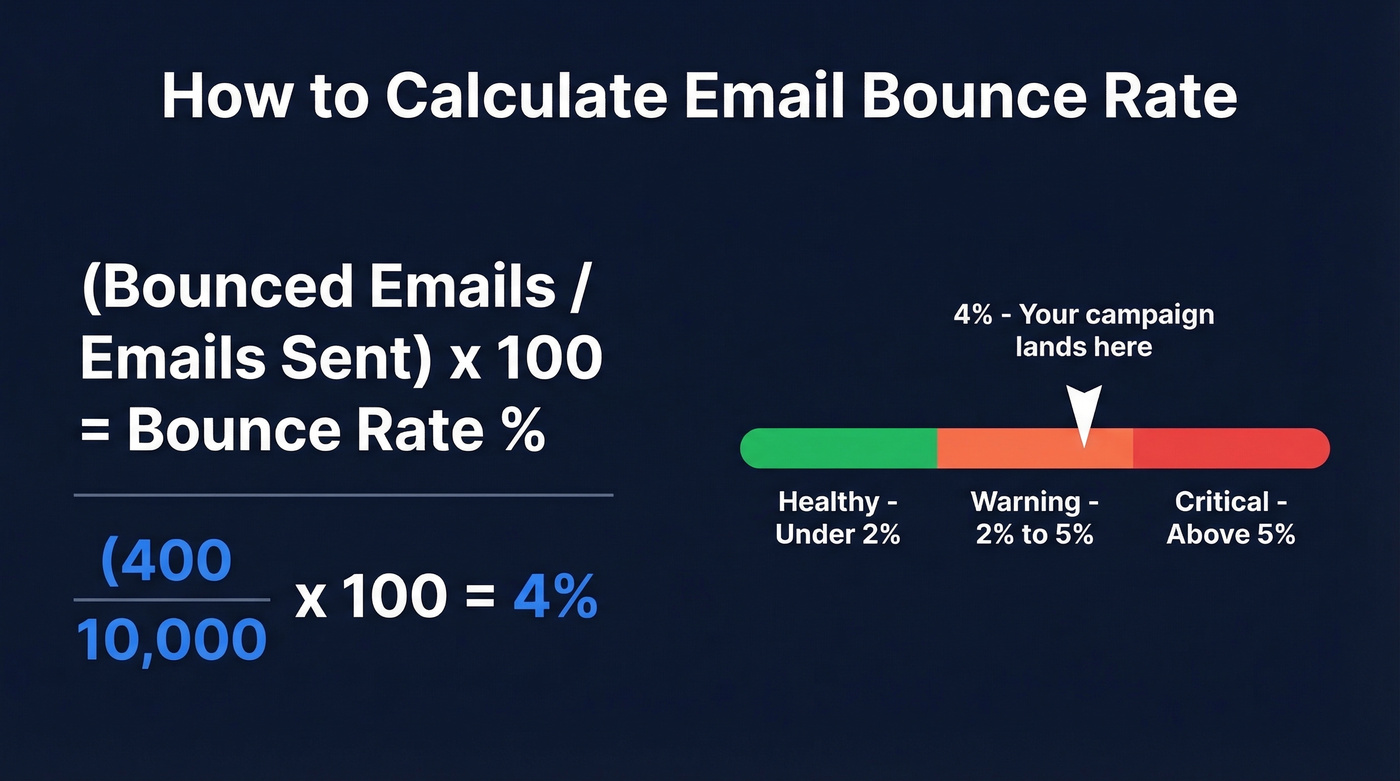
(Bounced emails / Emails sent) x 100 = Bounce rate %
Using that 10,000-email scenario: (400 / 10,000) x 100 = 4%. That puts you in the warning zone - not catastrophic, but your ESP is watching, and your sender reputation takes a hit with every send at that level.
You can apply this formula to any campaign, whether it's a weekly newsletter or a cold outreach sequence. Treat 2% as the ceiling, not the target. If you're consistently above it, something in your list hygiene process is broken.
Hard vs. Soft Bounces
Not all bounces are equal.
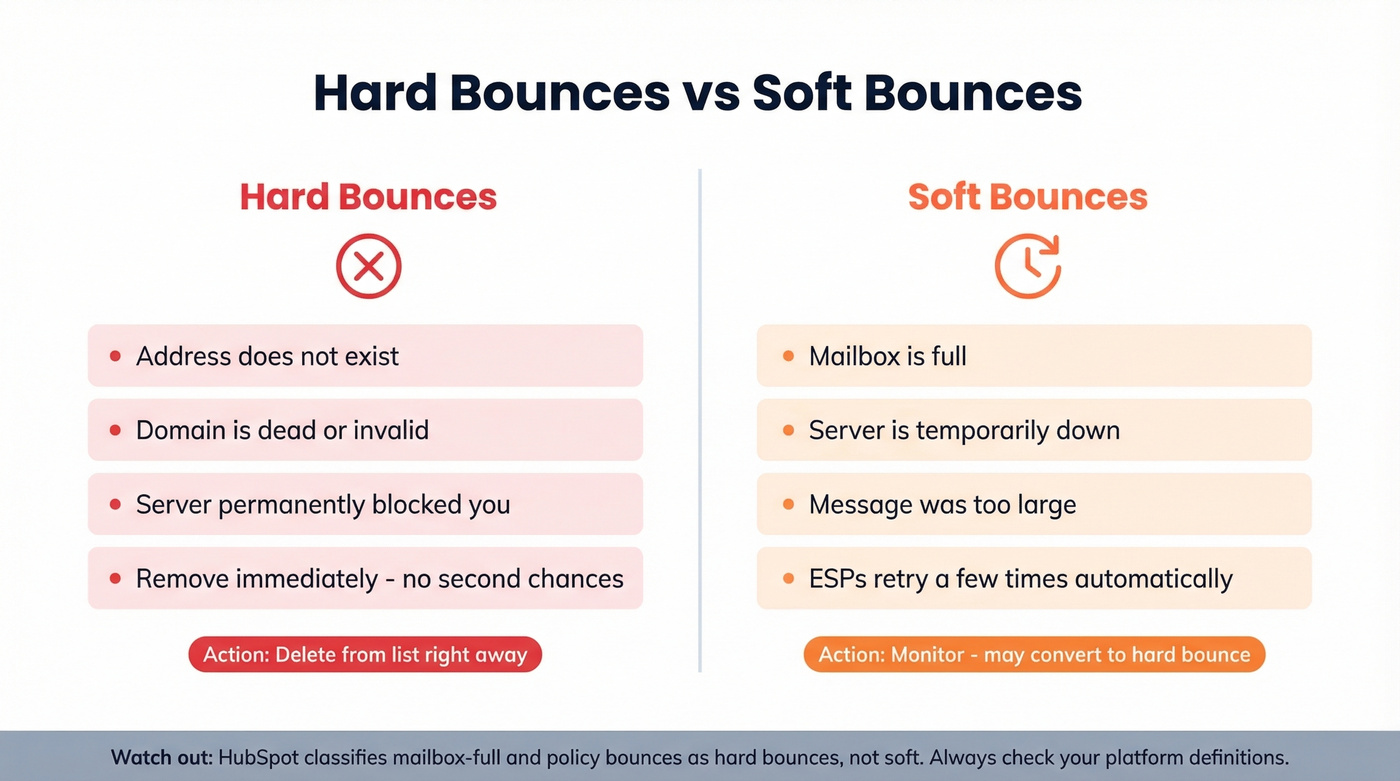
Hard bounces are permanent failures - the address doesn't exist, the domain is dead, or the server has explicitly blocked you. Remove these immediately. No second chances.
Soft bounces are temporary - a full mailbox, a downed server, an oversized message. Most ESPs retry soft bounces a few times before converting them to hard bounces and suppressing the address.
Here's the gotcha: HubSpot classifies mailbox-full, policy, and spam bounces as hard bounces, not soft. Your "hard bounce rate" in HubSpot can look inflated compared to the same list sent through other platforms. Before you panic, check how your specific platform defines each type. This distinction matters because the same list can produce wildly different numbers depending on the ESP you're using, and we've seen teams waste weeks troubleshooting a "problem" that was really just a classification difference.
Bounce Rate vs. Deliverability
These metrics sound similar but measure very different things. 88% of email senders can't correctly define delivery rate - don't be one of them.
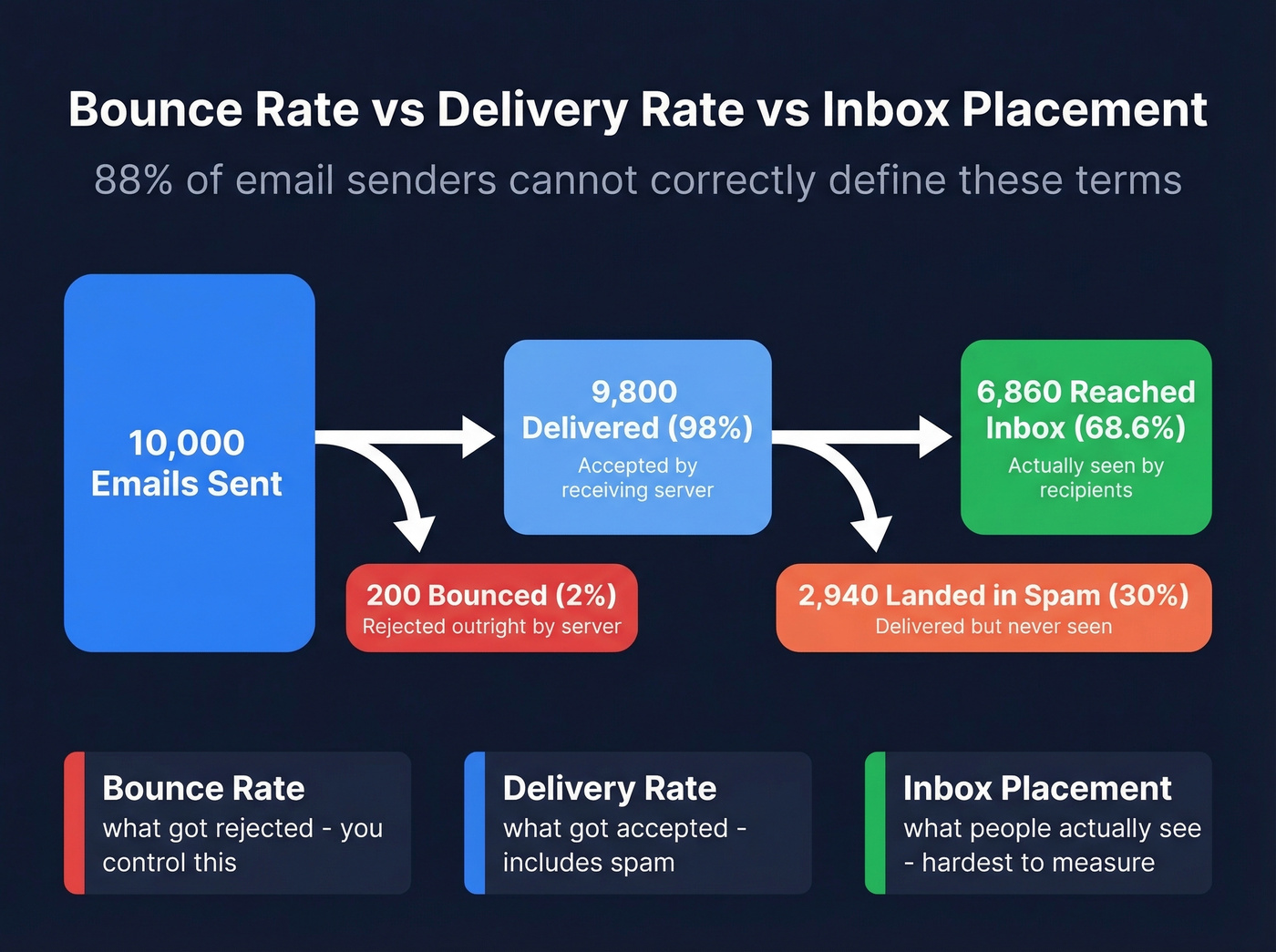
Bounce rate measures the percentage of emails rejected outright. Delivery rate measures the percentage accepted by the receiving server - but "accepted" includes emails dumped into spam. Inbox placement rate measures what actually lands in the primary inbox.
A 98% delivery rate sounds great until 30% of those "delivered" emails went straight to junk. Most ESPs don't report inbox placement at all. Bounce rate is the metric you can control directly, so that's where your energy belongs.

You just read that cold lists bounce at 18-22% without verification. Prospeo's 5-step verification - with catch-all handling, spam-trap removal, and honeypot filtering - delivers 98% email accuracy. That's how teams like Snyk dropped bounce rates from 35-40% to under 5% across 50 AEs.
Stop calculating bounce rates. Start eliminating them.
What's a Good Bounce Rate?
The standard framework: 2% or under is healthy, 2-5% is a warning, 5%+ is critical. But "good" depends heavily on what you're sending and who you're sending to.
Opt-in marketing benchmarks from ActiveCampaign's industry data:
| Industry | Avg. Bounce Rate |
|---|---|
| Beauty & Personal Care | 0.33% |
| Agriculture & Food Services | 0.50% |
| Business & Finance | 0.55% |
| Consulting | 0.79% |
| Creative Services & Agencies | 0.93% |
| Construction | 1.28% |
These numbers come from opt-in lists - people who signed up to hear from you. Benchmarks vary wildly by source and methodology. Brevo's latest benchmark report analyzed over 44 billion emails, and MailerLite's benchmark dataset covers 3.6M campaigns, but different datasets, definitions, and time windows produce very different "average" numbers. One compilation lists Constant Contact's legal services bounce rate at 16.27%, while Mailchimp's construction hard-bounce benchmark sits at 1.28%. The sample and methodology matter enormously.
Let's be honest: if you're doing cold outreach, these opt-in benchmarks are irrelevant. Cold lists commonly bounce at 18-22% without verification. That's not "normal" - it's just common. In our experience, any cold outreach team that makes verification non-negotiable can get below 5%.
What Happens When Bounces Spike
ESPs don't just track your bounce rate - they enforce it.
HubSpot suspends sending when hard bounces exceed 5%, spam reports top 0.1%, or unsubscribes pass 5%. Other platforms have similar thresholds, even if they're less transparent about them. High bounces trigger a deliverability spiral: your sender reputation drops, ISPs route your emails to spam, engagement tanks, and your reputation drops further. It compounds fast.
Only 23.6% of B2B marketers verify their email lists before campaigns. Three out of four teams are gambling with their domain reputation every time they hit send. That number is staggering when you consider how cheap and fast verification has become.
How to Reduce Your Bounce Rate
Most guides say "clean your list regularly." That's useless without specifics. Here's the actual playbook.
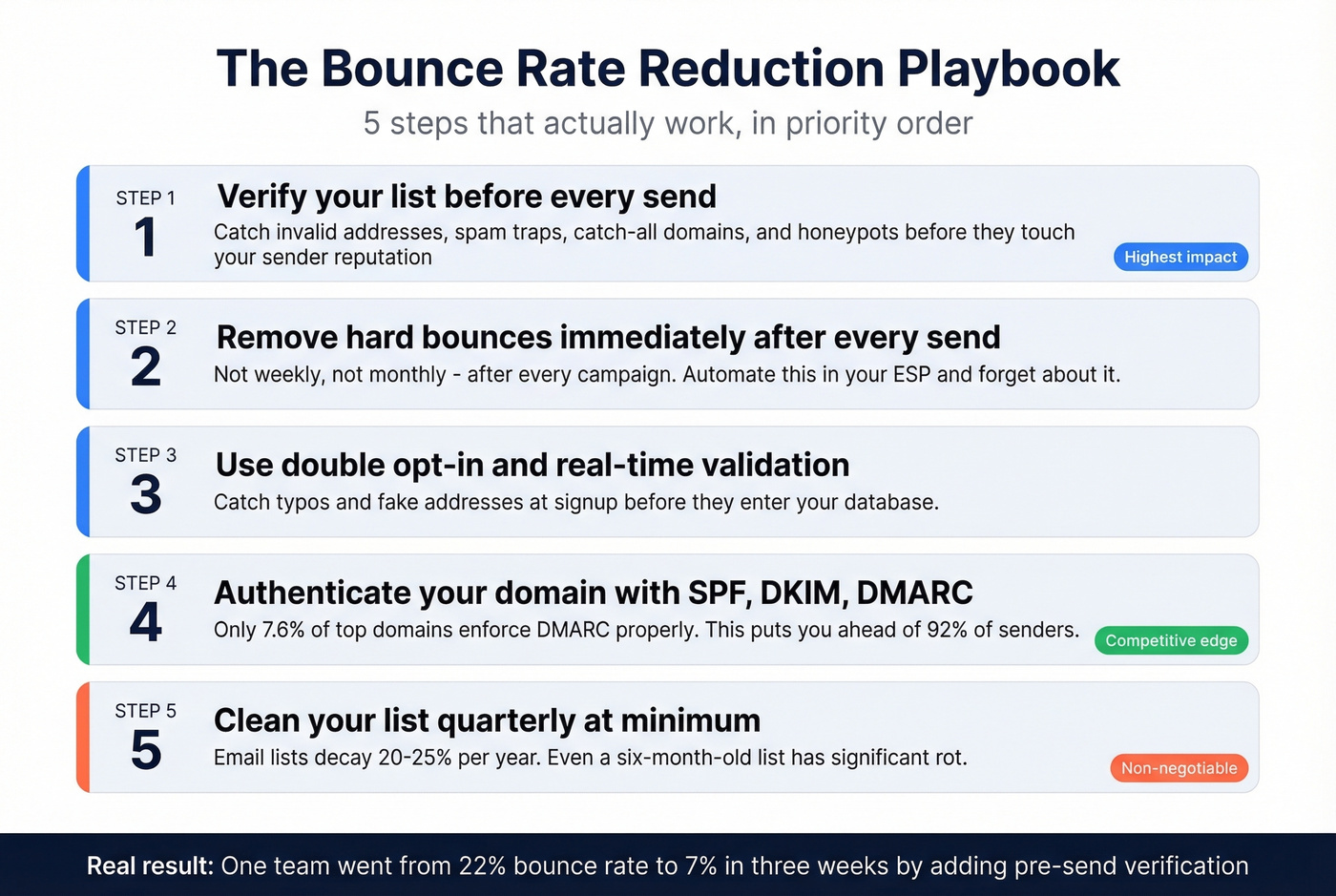
1. Verify your list before every send. This is the single highest-impact action you can take. Prospeo's 5-step verification catches invalid addresses, spam traps, catch-all domains, and honeypots before they ever touch your sender reputation. The free tier gives you 75 verifications per month to test it.
2. Remove hard bounces immediately after every send. Not weekly. Not monthly. After every campaign. Most ESPs let you automate this - set it up once and forget it.
3. Use double opt-in and real-time validation. Double opt-in cuts list size but dramatically improves quality. Pair it with real-time email validation at signup to catch typos and fake addresses before they enter your database.
4. Authenticate your domain. Set up SPF, DKIM, and DMARC. Only 7.6% of the top 10 million domains enforce DMARC with quarantine or reject policies. Getting this right puts you ahead of 92% of senders. (If you want to go deeper, start with DMARC alignment and then confirm DKIM is working.)
5. Clean quarterly - minimum. Email lists decay 20-25% per year. Job changes, company closures, abandoned inboxes - even a list from six months ago has significant rot. Skip this and you're building on a foundation that's crumbling underneath you.
We've seen this pattern play out repeatedly. One practitioner on r/salestechniques reported bounces at 22% sending 800-1,000 emails per week. After adding verification and improving lead sourcing, they dropped to 7% in three weeks - and their call connect rate jumped from 12% to 19%.
Here's the thing: if your deal sizes are under five figures and you're not verifying emails before every send, you're spending more on deliverability damage than you'd ever spend on a verification tool. The math doesn't work any other way. If you need a broader framework, use an email deliverability guide and keep an eye on email velocity as you scale.
Every bounced email chips away at your sender reputation. At $0.01 per verified email, Prospeo costs less than a single deliverability repair. Our 7-day data refresh cycle means the addresses you pull today won't be stale next week - unlike providers refreshing every 6 weeks.
Clean data is cheaper than domain recovery. Always.
FAQ
Is a 5% bounce rate bad?
Yes. 5% is the threshold where ESPs like HubSpot suspend sending privileges entirely. Aim for under 2% on opt-in lists and under 5% on cold outreach. Anything above that signals serious list quality issues that'll erode your sender reputation over time.
How often should I clean my email list?
Quarterly at minimum, and always before major campaigns. Lists decay 20-25% per year, so even a six-month-old list has significant rot. If you're sourcing contacts from a platform with a weekly data refresh cycle, you'll have less cleanup to do - but quarterly audits are still non-negotiable.
Do I need a bounce rate calculator?
No - the formula is simple enough for a spreadsheet. Divide bounced emails by emails sent, multiply by 100. Where you actually need a tool is for prevention: an email verification service will do far more for your bounce rate than any calculator ever could.
What's the fastest way to lower my bounce rate?
Run your entire list through an email verification tool before your next send. Most teams see a meaningful drop after a single pass - catching invalid addresses, spam traps, and honeypots that wreck deliverability. The Reddit example above shows what's possible: 22% down to 7% in three weeks, just by adding pre-send verification.