

How to Contact Large Companies for Business (2026)
Small companies that landed their first corporate contract saw [266.4% average revenue growth](https://business.tutsplus.com/tutorials/how-to-get-big-corporate-clients - cms-29049) within two years, according to a Center for an Urban Future survey. That's not a typo. Of the 33.3 million small businesses in the U.S. - 99.9% of all companies - most never attempt enterprise outreach, which means less competition for those who do.
If you've ever searched a Fortune 500 website and found nothing but media@company.com and a generic contact form, you know the frustration. The "Contact Us" page isn't built for new vendors. This playbook shows you how to get past that wall and reach the person who can actually sign a purchase order.
What You Need (Quick Version)
Enterprise buying committees average roughly 7 stakeholders per deal. You won't close anything by emailing one person.
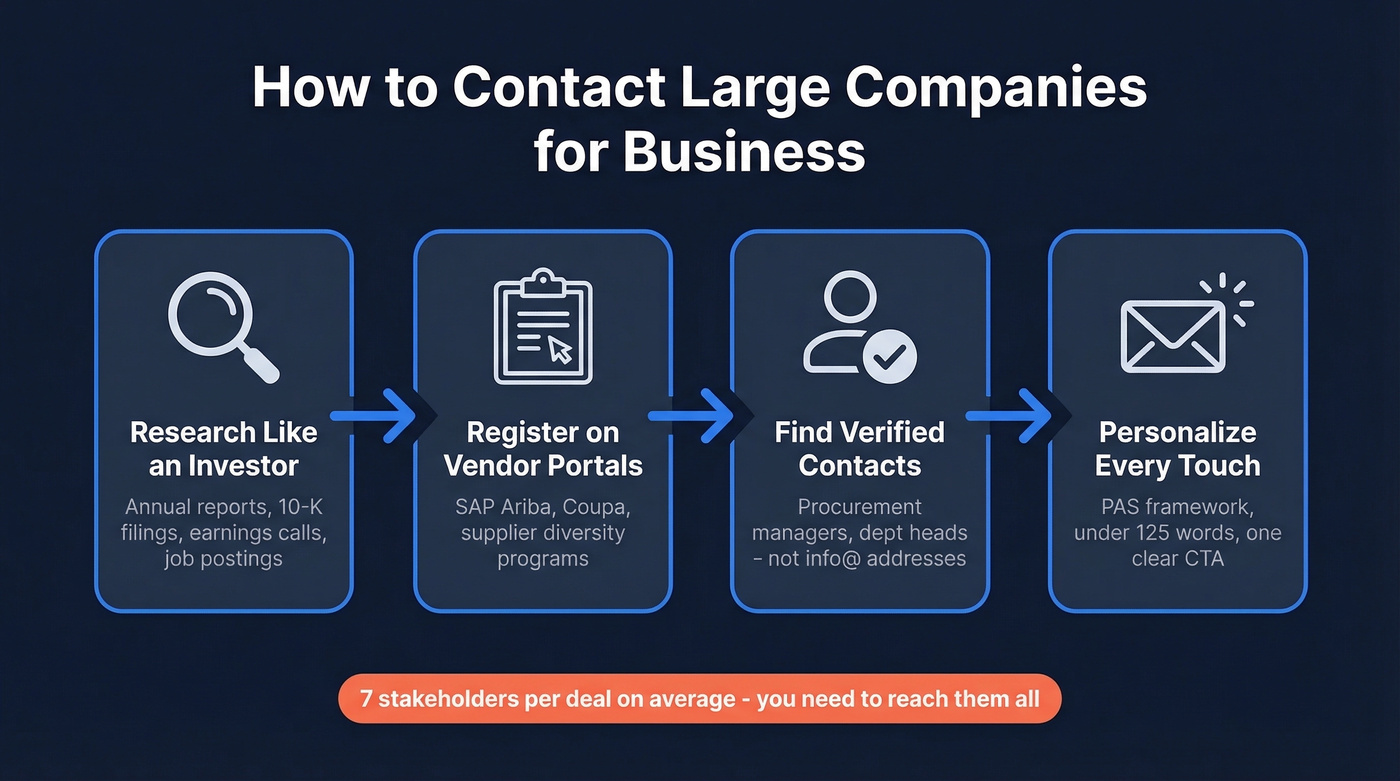
- Research like an investor - annual reports, 10-K filings, earnings calls
- Use vendor portals - most large companies have supplier registration systems
- Find verified contacts - get real emails and direct dials, not info@ addresses
- Personalize every touch - generic pitches die in enterprise inboxes
Each step below is something you can execute this week.
Research the Company Like an Investor
70% of enterprise prospects research vendors before ever taking a call. Your outreach needs to reflect that same level of preparation. Before you write a single email, dig into the company like you're evaluating a stock.
For public companies, start with their investor relations page. Annual reports and 10-K filings reveal current strategic initiatives, pain points management is discussing publicly, and which departments are growing. Look for supplier mentions - many companies name key vendors in their filings, which tells you who you're competing against.
For private companies, check press releases, job postings (hiring signals budget), and trade publications covering their industry. Industry conferences and trade shows are another high-value entry point - decision-makers are far more accessible in person than behind a corporate switchboard. The goal is to walk into outreach knowing something specific about their business that 95% of cold emailers won't bother to learn.
Use Vendor Portals as Your Front Door
Here's something most guides on contacting large companies skip entirely: enterprises have formal systems for finding new suppliers. A supplier registration portal is an online gateway where you submit your business info, certifications, and capabilities for procurement teams to evaluate.
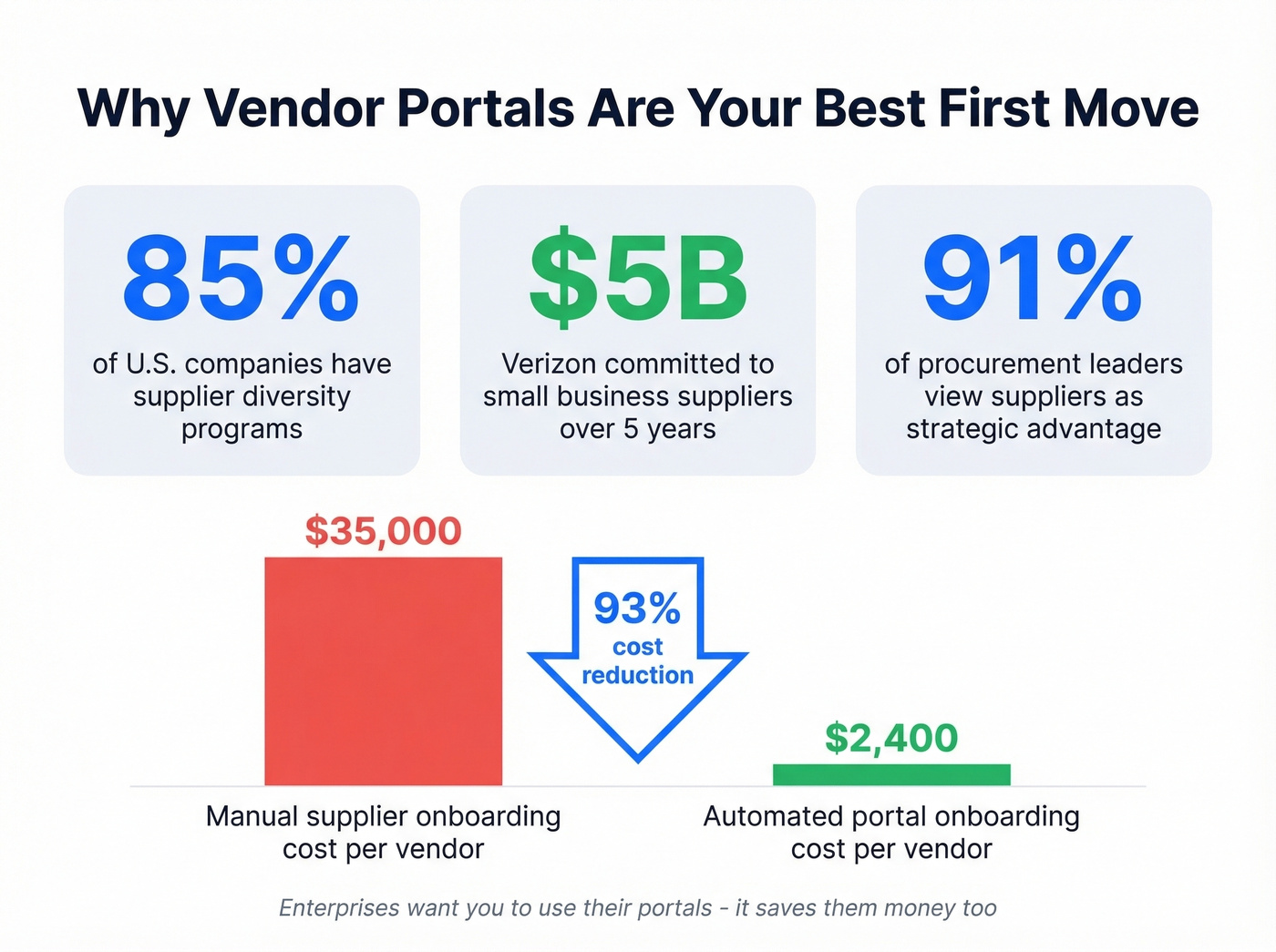
85% of U.S. companies have [supplier diversity programs](https://www.ism.ws/supply-chain/dei-in-procurement/), and many actively seek small and diverse vendors. Verizon [committed $5 billion over five years](https://www.verizon.com/about/news/verizon-announces-commitment-supporting-small-businesses) to their Small Business Supplier Accelerator - complete with mentorship, training, and modified insurance requirements. That's real budget earmarked for companies like yours. And 91% of procurement leaders now view suppliers as a strategic advantage, not just a cost center.
Why do procurement teams prefer portals? Because manual supplier onboarding can cost enterprises up to $35,000 per vendor - automated portals cut that to roughly $2,400. They want you to use the system.
Platforms like SAP Ariba and Coupa Supplier Portal are common places enterprises route supplier onboarding. Register, complete every field (incomplete profiles get filtered out), and upload relevant certifications. Use buyer-friendly keywords that match how procurement teams search, then follow up directly with the procurement department. Don't just register and wait.
Find the Right Decision-Makers
Vendor portals are the front door. Direct outreach to the right stakeholders is the side door. You need both.
With around 7 people involved in a typical enterprise purchase, targeting the CEO is almost always wrong. Start with procurement managers and department heads - the people who own the budget and feel the pain your product solves. The CEO's assistant can be a useful intel source, but your first outreach should go to the people who'll actually champion your solution internally.
Look, info@ and media@ addresses are black holes. Sending outreach to generic inboxes wastes your time and can damage your sender reputation if emails bounce. We've found that using a B2B database with company, job title, and department filters is the fastest way to build a real target list. Prospeo's database covers 300M+ professional profiles with 30+ search filters, 98%-accurate verified emails, and direct mobile numbers refreshed every 7 days - with a free tier of 75 emails per month, enough to build your first list without spending anything.


Enterprise buying committees have ~7 stakeholders. You need every one of them. Prospeo's 300M+ profile database with 30+ filters - job title, department, company size - lets you build a complete decision-maker list at any large company with 98%-accurate emails and verified direct dials. Free tier gets you 75 emails to start.
Build your first enterprise target list in minutes, not weeks.
Get Past the Gatekeeper
Even with direct contact info, you'll sometimes hit a gatekeeper - receptionists, executive assistants, or anyone screening calls for decision-makers. A few tactics that consistently work:
Email first, then call referencing it. "I'm following up on an email I sent Tuesday about X" sounds legitimate because it is.
Use the prospect's first name. "Is Sarah available?" signals familiarity. "Can I speak with the VP of Procurement?" signals cold call.
Don't pitch the gatekeeper. They can't buy from you. Be polite, be brief, ask to be connected.
Call outside business hours. Before 8:30 AM or after 5:30 PM, decision-makers often answer their own phones.
Use direct mobile numbers. This bypasses the switchboard entirely - it's the single most effective gatekeeper strategy. Verified mobile databases make this scalable; we've seen a 30% pickup rate on verified numbers across regions, which blows away switchboard connect rates. If you're building a repeatable calling motion, pair this with a documented cold calling system.
Write Outreach That Gets Replies
Cold outreach reply rates across channels average 7-15%. Highly personalized sequences push past 25%. The difference isn't magic - it's specificity.
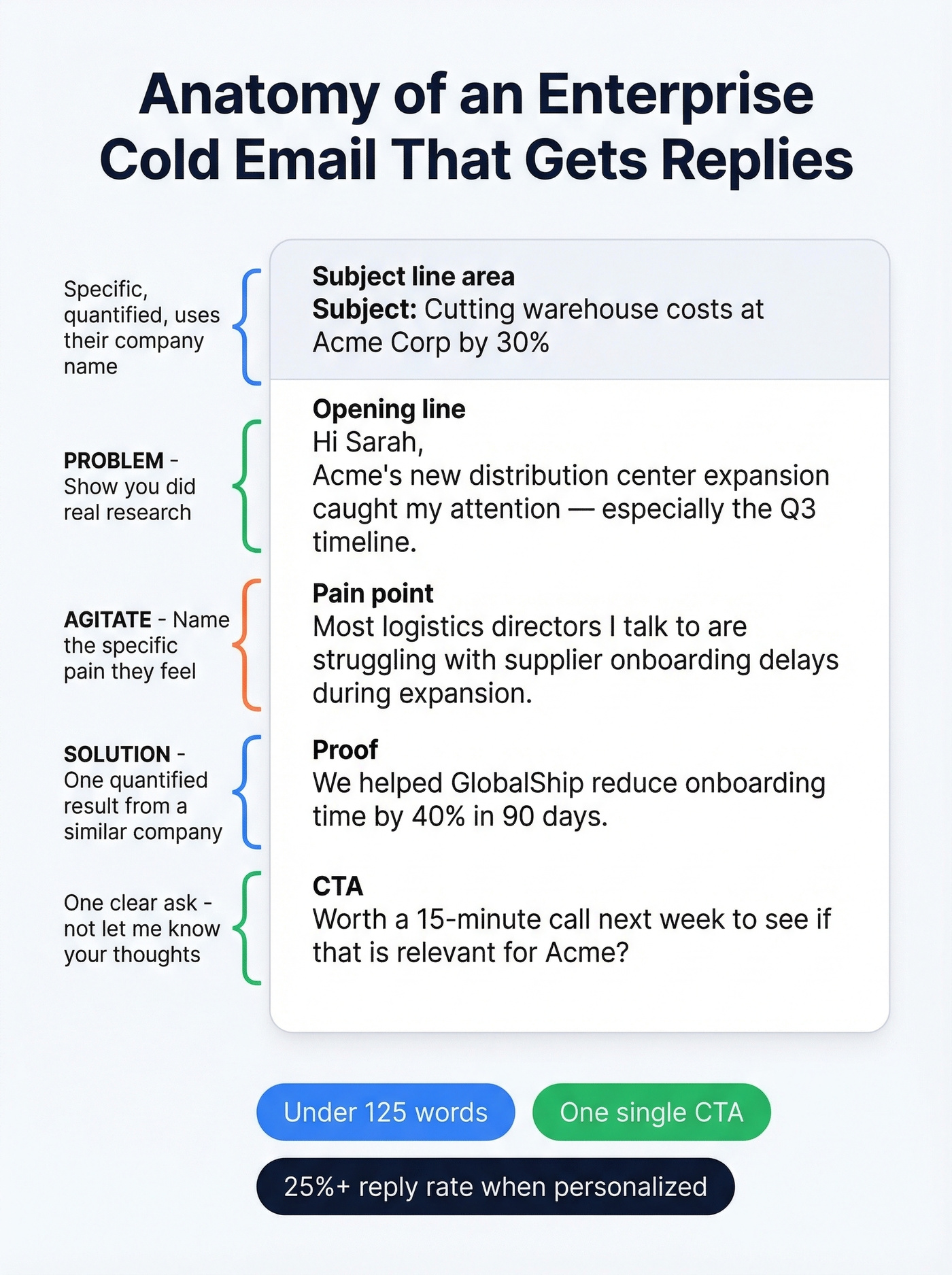
Use the PAS framework (Problem, Agitate, Solution) adapted for enterprise:
Subject: Cutting [specific cost] at [Company] by 30%
Hi [First Name],
[Company]'s [specific initiative from your research] caught my attention - especially the [specific detail]. Most [their role] I talk to are dealing with [specific problem].
We helped [similar company] reduce [metric] by [number] in [timeframe].
Worth a 15-minute call next week to see if that's relevant for [Company]?
Keep it under 125 words. One clear CTA - a 15-minute call, not "let me know your thoughts." Personalization boosts revenue 10-15% according to McKinsey research, and in cold email, it's the difference between a reply and the trash folder. For more structure, use a proven B2B cold email sequence and test variations from these cold email subject line examples.
Don't limit yourself to email, either. A connection request with a personalized note converts well for enterprise outreach, especially when you've already sent an email and can reference it. In our experience, three touches across two channels in the first week generates more replies than five emails in a row. Multi-channel always wins.
Follow Up Without Being Annoying
Enterprise sales cycles run 3-12 months. Your first email won't close a deal. Here's the cadence we've tested across dozens of enterprise campaigns:
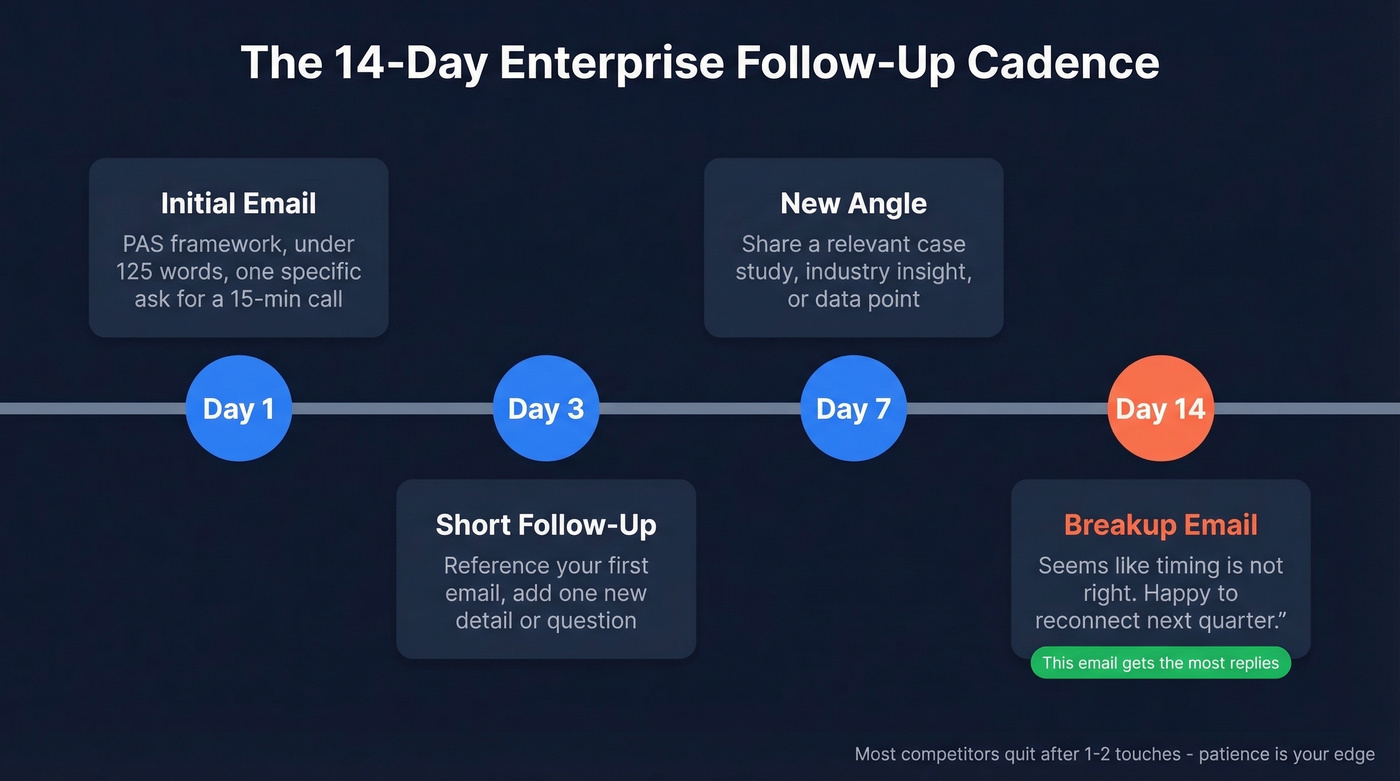
- Day 1: Initial email
- Day 3: Short follow-up referencing the first email
- Day 7: New angle - share a relevant case study or insight
- Day 14: Breakup email - "Seems like timing isn't right. Happy to reconnect next quarter."
The breakup email at Day 14 actually generates more replies than the initial outreach. Something about the finality makes people respond. Don't send five emails in a week. Patience is a genuine competitive advantage in enterprise sales - most of your competitors give up after one or two touches, and the consensus on r/sales backs this up: persistence without pestering is what separates closers from the rest. If you want copy you can plug in immediately, start with these sales follow-up templates and align timing with when you should follow up on an email.
Start Building Your Target List
Selling to large companies isn't harder than selling to small ones - it's just more structured. The real barrier isn't access to decision-makers; it's that most small businesses never bother with the structured approach. They send one email to info@bigcorp.com, hear nothing, and conclude that enterprise is "not for us."
That's wrong.
Now you know how to contact large companies for business the right way: research, register on vendor portals, find the right people, personalize your outreach, and follow up with discipline. Pick five target accounts this week, register on their vendor portals, and pull verified contacts for three decision-makers at each. That's your starting line. If you're going after named accounts, this pairs well with account-based selling best practices and a clear ideal customer profile.
Generic switchboards kill enterprise deals. Prospeo's 125M+ verified mobile numbers deliver a 30% pickup rate - bypassing every gatekeeper between you and the procurement leader who signs purchase orders. Data refreshes every 7 days so you're never calling a dead number.
Skip the switchboard. Call decision-makers directly.
Common Questions
How do I find the right person to contact at a large company?
Map the buying committee by department - target procurement managers and department heads, not the CEO. Use a B2B database to search by company, job title, and seniority, then verify emails before outreach. Aim for 3-5 contacts per target account so you're reaching multiple stakeholders in the buying committee simultaneously.
How long does it take to land an enterprise client?
Enterprise sales cycles typically run 3-12 months depending on deal size and procurement complexity. Deals under $50K close faster, often 60-90 days, when you register on vendor portals and run direct outreach simultaneously to compress the timeline.
What should I say in a cold email to a large company?
Lead with a specific problem you can solve - not a generic pitch. Keep it under 125 words, include one quantified result from a similar customer, and end with a single clear ask like a 15-minute call. Reference something specific from the company's annual report or recent initiatives to prove you've done your homework.
Are vendor portals worth registering for?
Yes. 85% of U.S. enterprises have supplier diversity programs with dedicated procurement budgets for small vendors. Verizon alone committed $5 billion over five years. Registration is free, takes 30-60 minutes, and puts you in the system procurement teams actively search when sourcing new suppliers. Skip this step and you're leaving the easiest entry point on the table.