

How to Create a Cold Call Script That Books Meetings
It's 9:15 AM. You've got 50 names on a list, a coffee going cold, and a quota that doesn't care about your feelings. Cold calling converts at roughly 4.82% per conversation, and 49% of organizations still rely on it as a primary or secondary channel. Knowing how to create a cold call script that actually works comes down to one good framework and the willingness to adapt - not 21 templates you'll never memorize.
What You Need (Quick Version)
The framework: Confirm -> Context -> Questions -> Handle -> Close. Your opener should take 30 seconds or less.
In a tracked Reddit A/B test, pattern-interrupt openers kept 30% of prospects on the line past 30 seconds, compared to 14% for a direct pitch. The step most reps skip entirely? Verifying contact data before dialing. If a third of your numbers are disconnected, your script never gets a fair shot.
Cold Calling Benchmarks Worth Knowing
Calibrate expectations before you write a single line. The success-rate, call-length, best-day, and attempts-to-reach numbers below come from WHAM (We Have A Meeting) data as cited in Cognism's report, while the talk/listen and question-count benchmarks come from Gong's analysis of 326K sales calls.
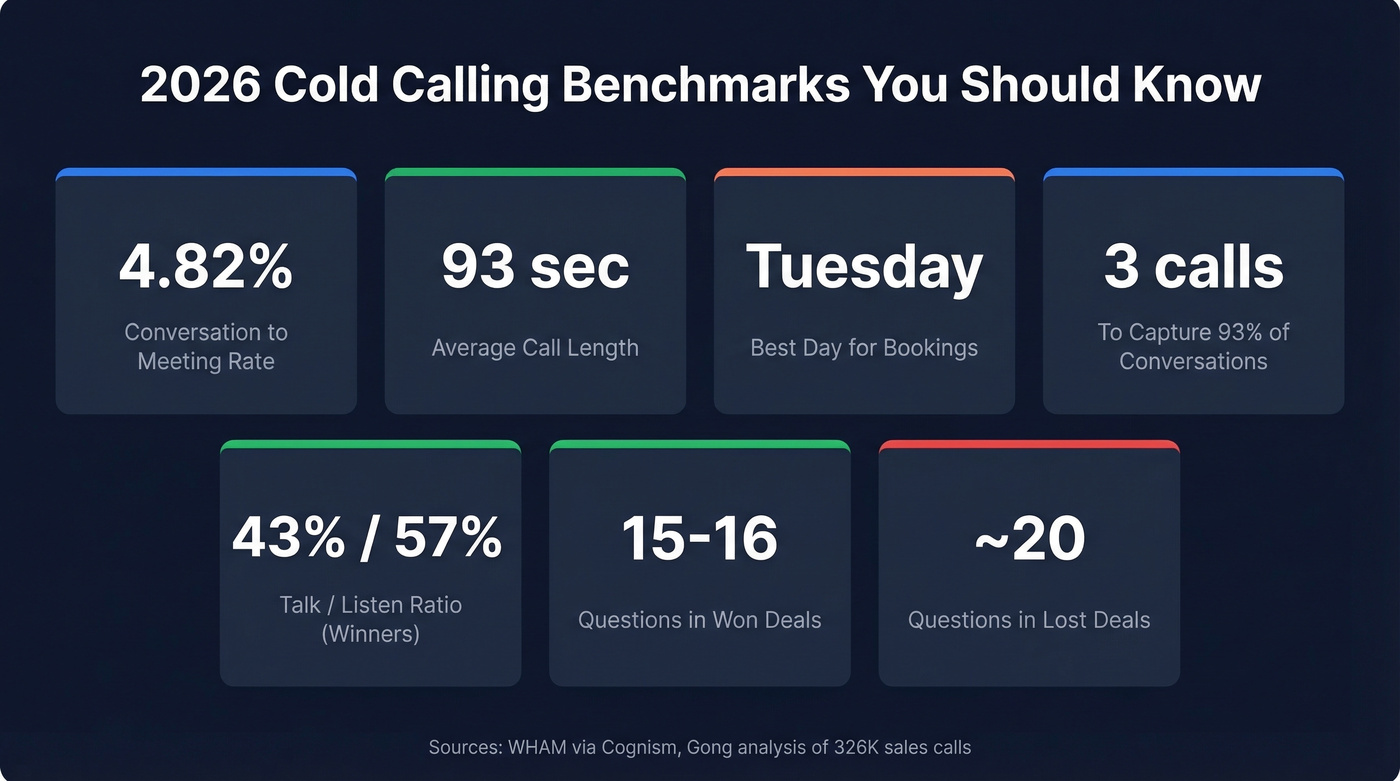
| Metric | Number |
|---|---|
| Success rate (conversation to meeting) | 4.82% |
| Avg call length | 93 seconds |
| Best day for bookings | Tuesday |
| Calls to capture 93% of conversations | 3 |
| Talk-to-listen target ratio | 43% / 57% |
| Questions in won deals | 15-16 |
| Questions in lost deals | ~20 |
The question count surprises people. More questions doesn't mean better discovery - it means you're interrogating, not conversing.
Before You Script - Fix Your Data
B2B contact data decays at 2.1% per month - that's 22.5% annually. Reps lose 27.3% of their selling time to bad data. Those 50 names on your list? If 15 numbers are disconnected, your energy craters by dial 20 and the script you spent an hour writing never gets heard.
We've seen teams double their connect rates just by cleaning lists first. Run your numbers through Prospeo's mobile finder before every call block - 125M+ verified mobile numbers, a 30% pickup rate, and a 7-day refresh cycle. The free tier gives you 75 verified emails per month plus 100 Chrome extension credits, no contract required.
Build Your Script in Five Steps
You don't need a novel. You need a skeleton that fits inside 30 seconds of talking time and leaves room for the prospect to speak. Aim for the 30-50-20 cadence: 30% introducing value, 50% asking questions, 20% confirming understanding.
If you're building this into a repeatable outbound motion, it helps to think in terms of a full cold calling system instead of a one-off script.
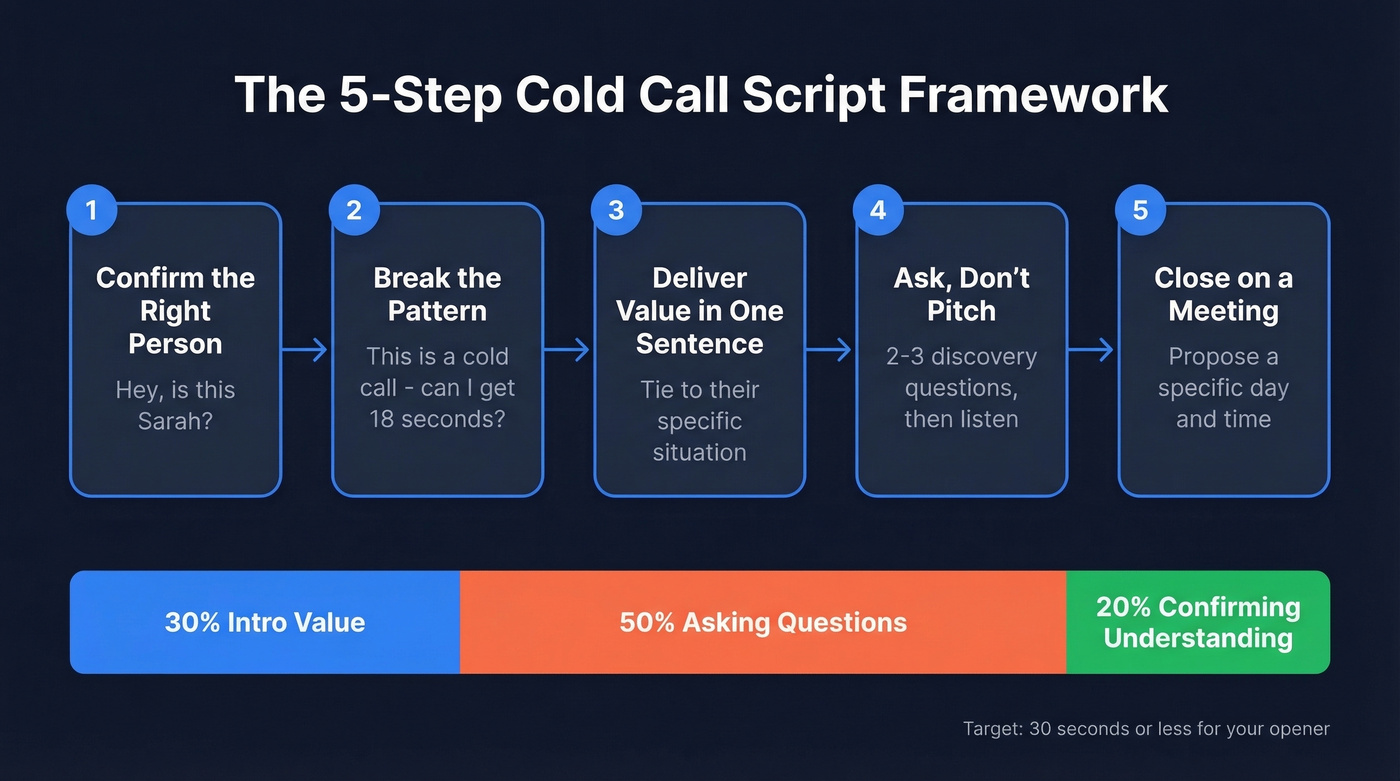
Step 1: Confirm the Right Person
"Hey, is this Sarah?" Simple, human, and it prevents the embarrassment of pitching the wrong person for 45 seconds. This resets the prospect's attention because they have to respond before anything else happens.
Step 2: Break the Pattern
Spend 5 minutes before each call finding 3 prospect-specific insights - a funding round, a job posting, a competitor move. Then open with honesty, not polish.
In one tracked opener test, "Hey Sarah, this is a cold call - can I get 18 seconds?" beat every other variant. We'll cover the A/B data shortly.
Step 3: Deliver Value in One Sentence
One sentence. Not a paragraph. Tie it to something specific you found in your prep: "We help Series B SaaS teams cut onboarding time by 37% - saw you just raised and figured timing might be right." If you can't say it in one breath, it's too long. Lead with the prospect's problem, not your product's feature list.
If you struggle to compress your value prop, borrow structure from these sample elevator pitches and adapt them for the phone.
Step 4: Ask, Don't Pitch
This is where Gong's 43/57 ratio matters most. Top performers talk 43% of the time and listen 57%. Have two or three discovery questions ready - not ten. "What's your biggest bottleneck with [process] right now?" Then shut up. The prospect's answer tells you whether to keep going or gracefully exit.
To sharpen this part, keep a short bank of discovery questions you can rotate by persona.
Step 5: Close on a Meeting
The goal isn't a sale. It's booking 20 minutes on the calendar. "Would it make sense to grab 20 minutes Thursday afternoon so I can show you how this works for [similar company]?" Propose a specific day and time - vague asks get forgotten.
If you want a tighter framework for the ask, use these steps to close a sale as a checklist for your meeting close.

You just built a five-step script designed to book meetings. Now make sure it actually gets heard. B2B contact data decays 2.1% per month - that's 1 in 5 numbers going dead every year. Prospeo's mobile finder gives you 125M+ verified direct dials on a 7-day refresh cycle, so every dial connects to a real person.
Stop wasting your best script on disconnected numbers.
Which Opener Actually Works?
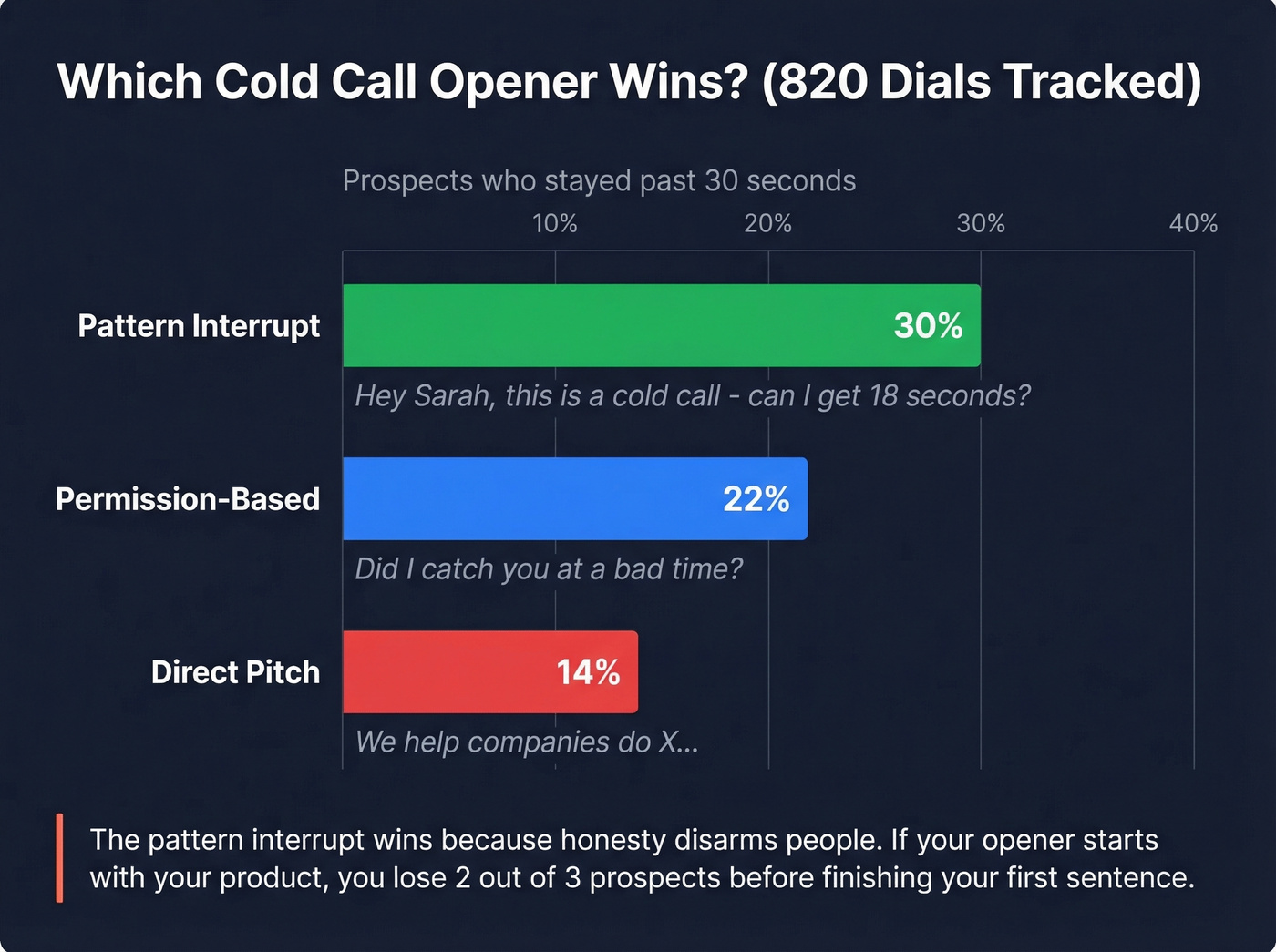
A practitioner on Reddit ran 820 dials with tracked results across three opener styles:
| Opener Style | Stayed Past 30 Sec |
|---|---|
| Pattern interrupt | 30% |
| Permission-based | 22% |
| Direct pitch | 14% |
The pattern interrupt that worked: "Hey [Name], this is [You] from [Company] - this is a cold call. Can I get 18 seconds to tell you why I'm calling?" The honesty disarms people. The permission-based variant - "Did I catch you at a bad time?" - still works well for VP and C-suite prospects, but in that tracked test, the pattern interrupt consistently beat it.
Here's the thing: if your current script opens with "We help companies do X," you're losing 2 out of 3 prospects before you finish your first sentence. Kill that opener today.
After a missed call, skip the voicemail. One practitioner tracked 310 voicemails and got a ~1% callback rate. A follow-up message sent within 5 minutes pulled a 14% response rate. The phone is step one of a multi-channel sequence, not the whole strategy. If you need copy for that follow-up, start with these sales follow-up templates.
Objection Handling Responses
The #1 frustration on r/sales is prospects saying "not interested" before you've said anything of substance. We've all been there - and the instinct to just accept it and move on is strong. Don't.
If this is a recurring issue, build a simple practice loop around cold call rejection so you can stay calm and consistent.
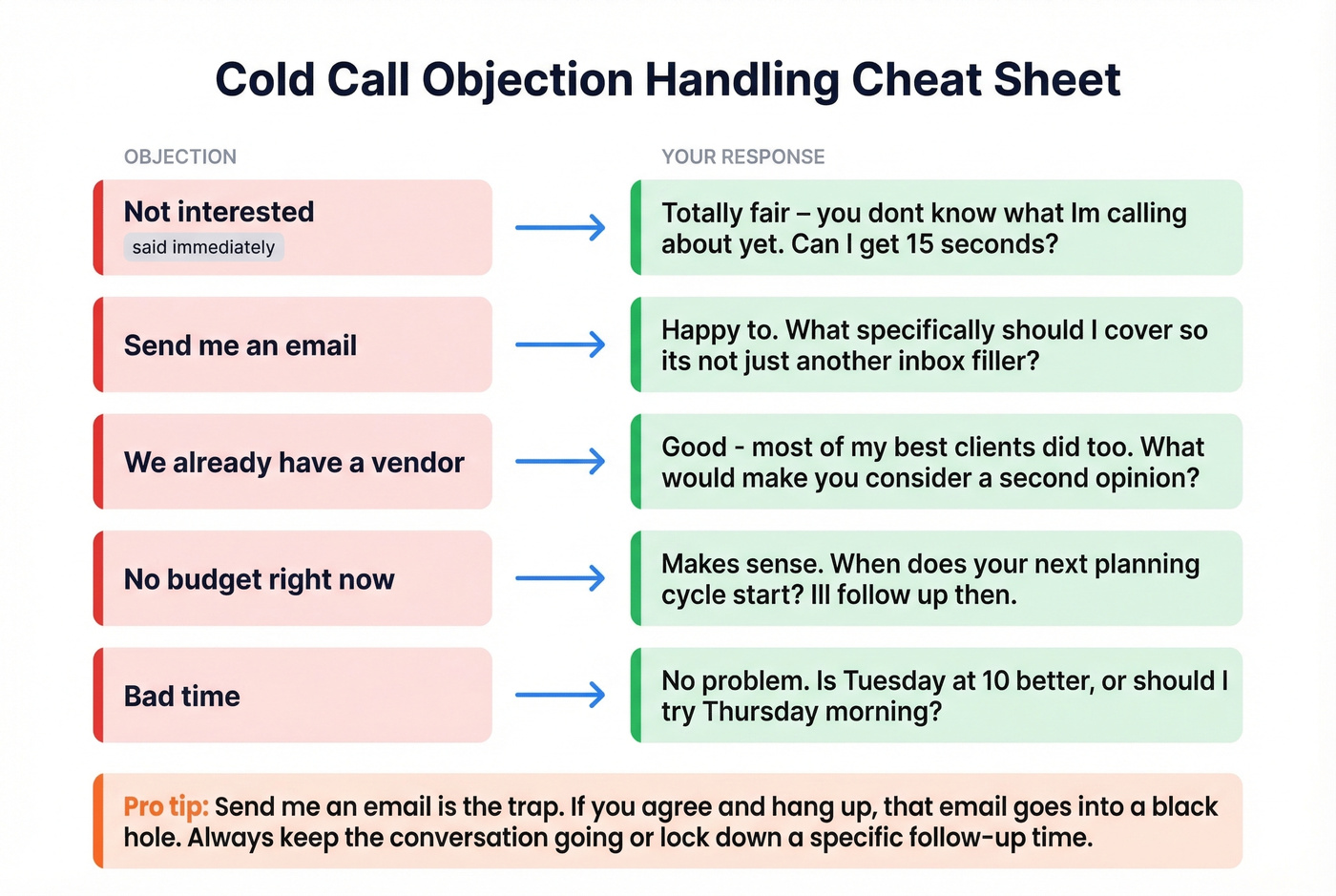
| Objection | Response |
|---|---|
| "Not interested" (immediate) | "Totally fair - you don't know what I'm calling about yet. Can I get 15 seconds?" |
| "Send me an email" | "Happy to. What specifically should I cover so it's not just another inbox filler?" |
| "We already have a vendor" | "Good - most of my best clients did too. What would make you consider a second opinion?" |
| "No budget right now" | "Makes sense. When does your next planning cycle start? I'll follow up then." |
| "Bad time" | "No problem. Is Tuesday at 10 better, or should I try Thursday morning?" |
The "send me an email" line is the trap. If you agree and hang up, that email goes into a black hole. Always keep the conversation going or lock down a specific follow-up time.
Delivery Tips That Matter
Your script is a skeleton, not a cage. 48% of B2B salespeople are afraid of cold calling - and the ones who sound afraid get hung up on.
Stand up while you dial. Your energy shifts immediately. Smile while you talk - prospects can hear it. Slow down - nervous reps talk fast, confident reps let silence breathe.
And record yourself for the first five calls each day. In our experience, reps who review their own recordings improve faster than reps who get coached by managers, because they catch verbal tics and pacing issues a manager would never notice in a 1:1. Writing the script is only half the battle - practicing delivery until it sounds conversational is the other half. If you're ramping a new team, pair this with a lightweight 30-60-90 day plan for sales reps.
Compliance Checklist for 2026
TCPA lawsuits are up ~95% year-over-year, and the June 2025 McLaughlin v. McKesson decision means FCC interpretations no longer bind district courts. This isn't optional reading.
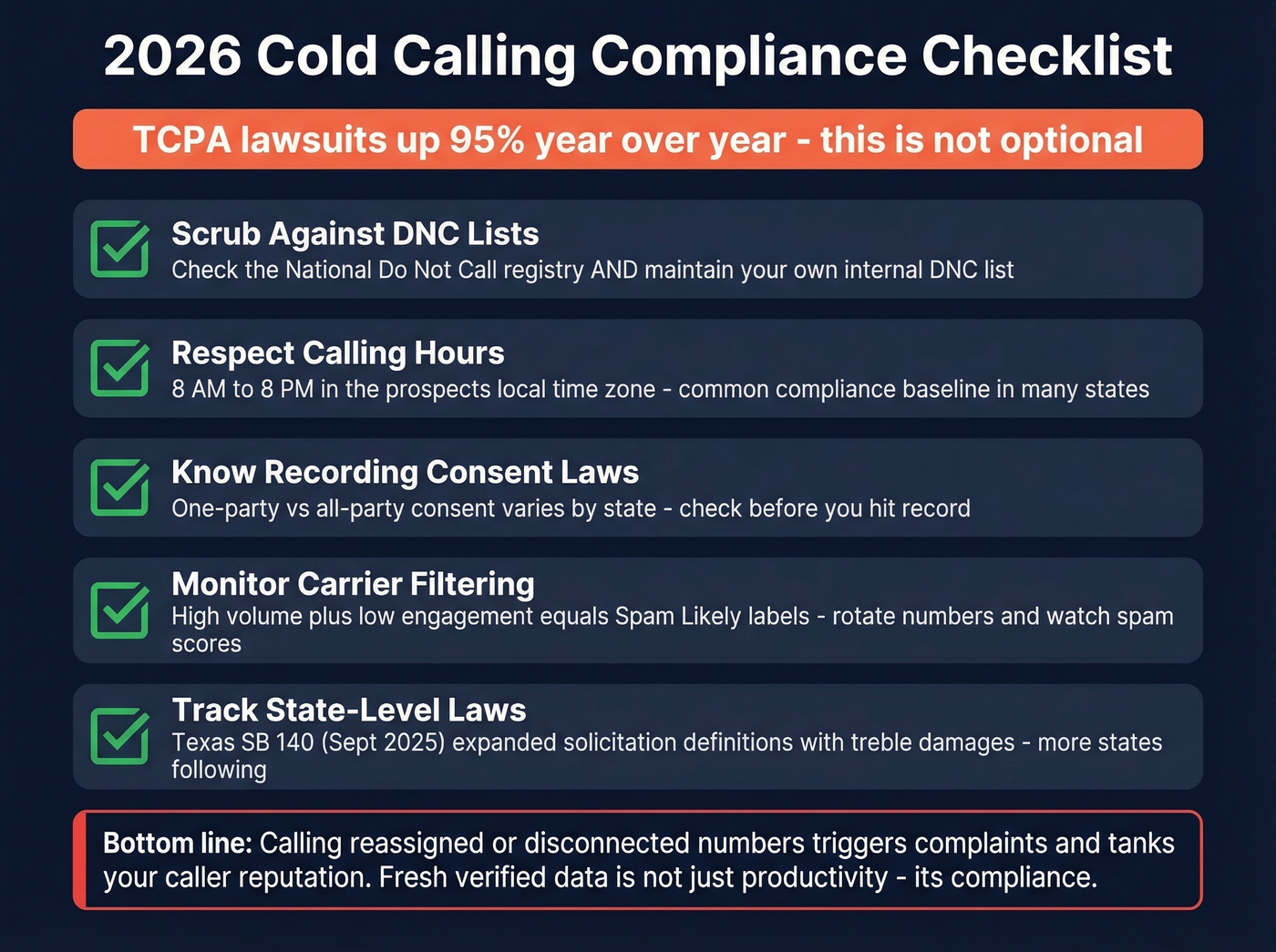
- Scrub against the National DNC and maintain your own internal DNC list.
- Calling hours: 8 AM-8 PM in the prospect's local time zone is a common compliance baseline in many states.
- Call recording consent: Know your one-party vs. all-party consent states before you hit record.
- Carrier filtering: High volume plus low engagement equals "Spam Likely" labels. Rotate numbers and monitor spam scores.
- State-level laws: Texas SB 140, effective September 2025, expanded solicitation definitions with treble damages. Other states are following.
Calling reassigned or disconnected numbers triggers complaints and tanks your caller reputation. Fresh, verified data isn't just a productivity play - it's a compliance requirement. If you're adding SMS to your sequence, read up on cold texting rules before you do.
The data is clear: pattern-interrupt openers keep 30% of prospects on the line, but only if you're calling the right person at the right number. Prospeo delivers 98% email accuracy and a 30% mobile pickup rate - meaning your carefully crafted script lands with real decision-makers, not voicemail boxes and wrong numbers.
Give every dial a fair shot - start with data that actually connects.
FAQ
How long should a cold call script be?
Your opener should take 30 seconds or less, and cold calls average about 93 seconds total. Write tight - aim for a half-page of bullet points, not a full-page monologue. Leave room for the prospect to talk at least 57% of the time.
What's the best day and time to cold call?
Tuesday is the best day for booking meetings. Tuesday through Thursday, 10:00-11:30 AM in the prospect's local time zone shows the highest connect rates - 19% versus 5% on Friday afternoons. Avoid Monday mornings and Friday after lunch.
How many dials does it take to book one meeting?
Expect roughly one meeting per 70-80 total dials, since not every dial connects. Three attempts capture 93% of possible conversations with a given prospect - don't give up after one try. Verified mobile numbers cut wasted dials significantly.
Do personalized scripts outperform generic ones?
Yes. Reps who spend five minutes researching a prospect before dialing consistently outperform those reading a one-size-fits-all script. Personalization doesn't mean rewriting your entire approach for every call - swap in one or two prospect-specific details like a recent funding round or a job posting that proves you did your homework.
What if I've never written a cold call script before?
Start with the five-step framework: confirm the contact, break the pattern, deliver one sentence of value, ask discovery questions, and close on a meeting. Write your lines word for word, then practice until you can deliver them without reading. After 50 dials, review what's working and cut everything that isn't.