

How to Drive Urgency in Sales Without Being Pushy
It's week eight. The deal was supposed to close in week four. Your champion's gone quiet, the CFO's "reviewing priorities," and your manager keeps asking for an update you don't have. That limbo is where pipeline goes to die.
Most urgency advice is written for e-commerce - countdown timers and "only 3 left!" banners. That doesn't translate when you're selling a complex B2B product to a six-person buying committee. If you're trying to figure out how to drive urgency in sales without resorting to fake deadlines, the answer starts with math, not manipulation.
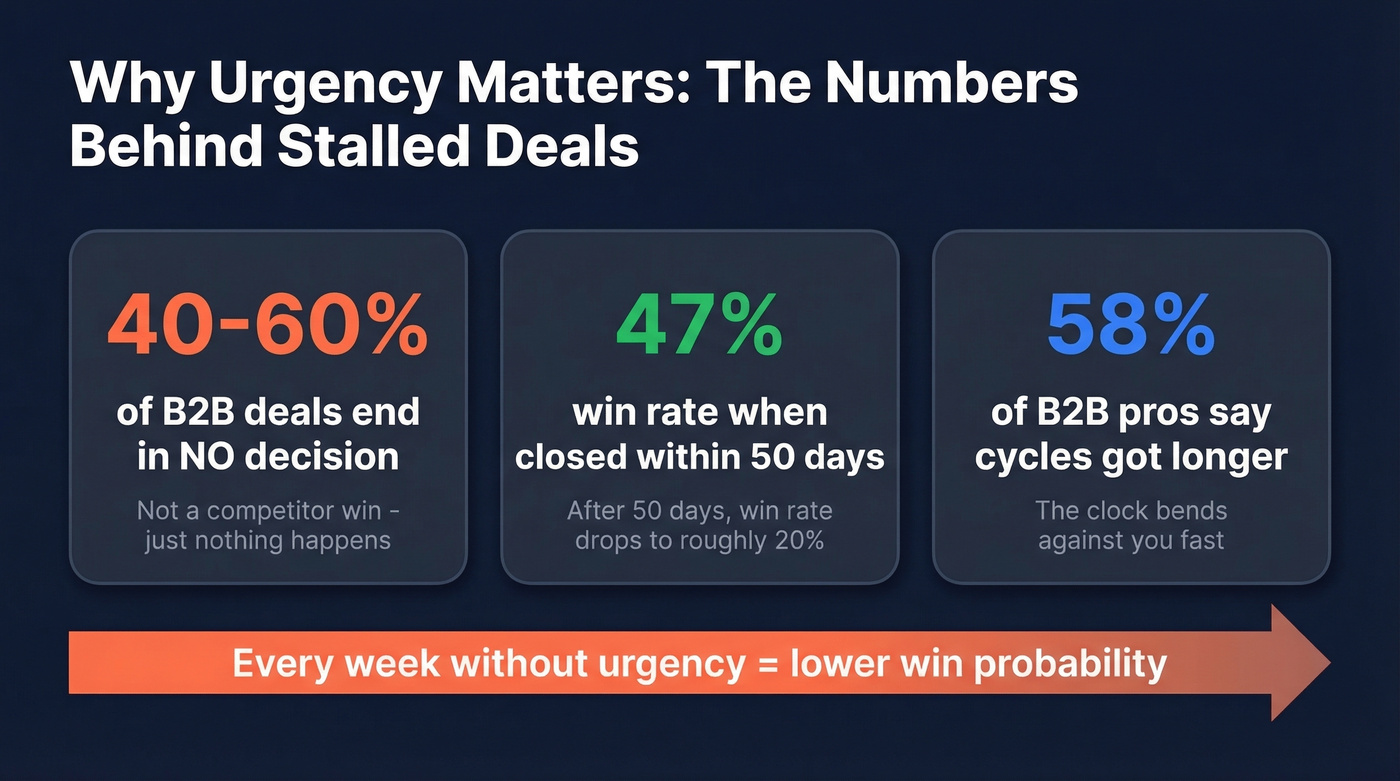
40-60% of B2B deals end in no decision. Not a competitor win - just nothing. Outreach data backs it up: deals closed within 50 days hit a 47% win rate, and after that window you're looking at roughly 20% or worse. Meanwhile, 58% of B2B professionals say their sales cycles got longer this year. The clock isn't a metaphor. It's a conversion curve, and it bends against you fast.
What Actually Works (Quick Version)
- You don't manufacture urgency - you uncover it by quantifying the cost of doing nothing. The r/sales crowd is right: if the buyer isn't feeling pain, no "limited-time offer" will fix that.
- If your deal doesn't have a compelling event, it's a wish, not a forecast.
- The #1 tactic: do the COI math live on the call. Everything else is secondary.

You just calculated that 15 SDRs waste $45K/week on manual list-building. Prospeo's database with 30+ filters - including buyer intent, job changes, and headcount growth - lets your team find verified decision-makers in minutes, not hours. 98% email accuracy means when the window opens, you connect.
Stop bleeding pipeline time. Start building lists that actually convert.
The Playbook for Creating Urgency in Sales
Quantify the Cost of Inaction (COI)
Your biggest competitor isn't the other vendor. It's the status quo. And the status quo wins every time the buyer can't articulate - in dollars - what doing nothing costs them.
If you want a tighter discovery flow for this, use a structured set of discovery questions to surface the numbers early.
Prospect theory tells us losses feel about 2x stronger than equivalent gains. Pitching ROI is fine, but quantifying what the buyer loses by waiting is far more motivating. Building a real sense of urgency starts here, with the buyer's own numbers, not your quota deadline.
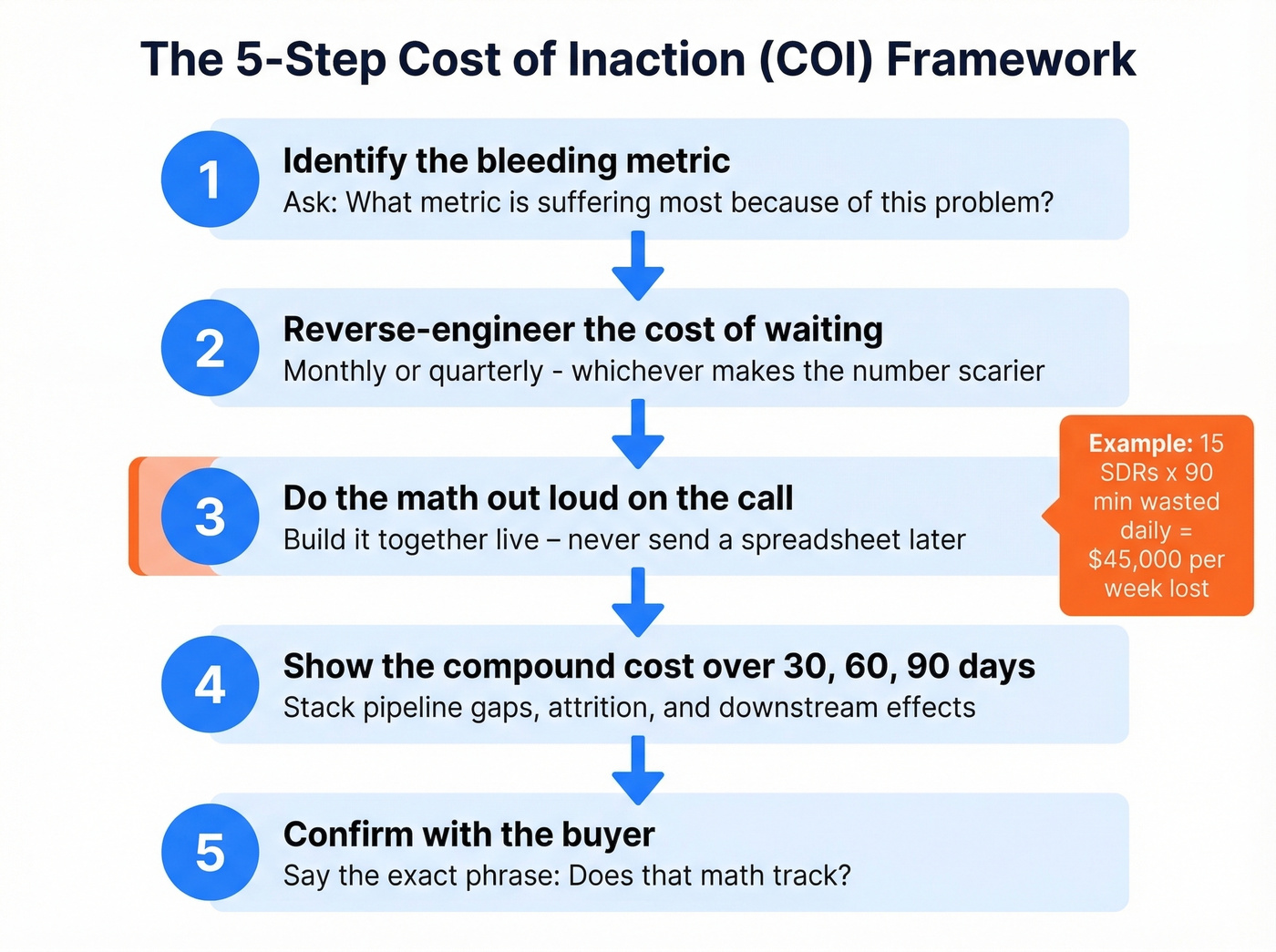
Here's the five-step framework we use:
- Identify the metric that's bleeding. Ask: "What metric is suffering most because of this problem?"
- Reverse-engineer the cost of waiting. Monthly or quarterly - whichever makes the number scarier.
- Do the math out loud on the call. Don't send a spreadsheet later. Build it together, live.
- Show the compound cost over 30, 60, and 90 days. Pipeline gaps, attrition, downstream effects - stack them.
- Confirm with the buyer. The exact phrase: "Does that math track?"
Let's make this concrete. Say you're selling to a team with 15 SDRs who each waste 90 minutes a day on manual list-building. That's 22.5 hours per day across the team - 112.5 hours per week. In a mid-market org paying loaded SDR costs, that works out to roughly $45,000/week walking out the door. You say that number out loud, pause, and ask if it tracks. Most buyers have never done this math themselves, and the silence after you say the number is where urgency is born.
In our experience, 75%+ of stalled calls never establish a quantified COI. That's the gap - not your pitch deck, not your demo flow. It's that nobody did the math.
Identify a Real Compelling Event
Use this if: The buyer has a time-bound business pressure - a migration deadline, a board review, a compliance date, a new product launch.
Skip this if: The only "event" you can name is your quarter-end or a pricing deadline you invented.
SalesHood analyzed 100,000 opportunities across 10 companies and found a 0.8 correlation between a customer-defined compelling event and faster cycle times plus more wins. But 85% of deals don't have an identified compelling event. With the average B2B buying committee now at 6.3 stakeholders, alignment around a shared deadline matters more than ever.
Here's the thing: if the compelling event takes more than 10 words to describe, it probably isn't one. "Board mandated cloud migration complete by Q3" - that's a compelling event. "They seemed really interested after the demo" - that's a feeling. Your month-end deadline, a "special pricing" expiration, or getting the deal done before an executive visit? Those are seller events. They create pressure, not urgency.
Add compelling event as a CRM field and review it in every pipeline call. If the field is blank, the deal isn't real.
Map Discovery to Urgency With MEDDIC
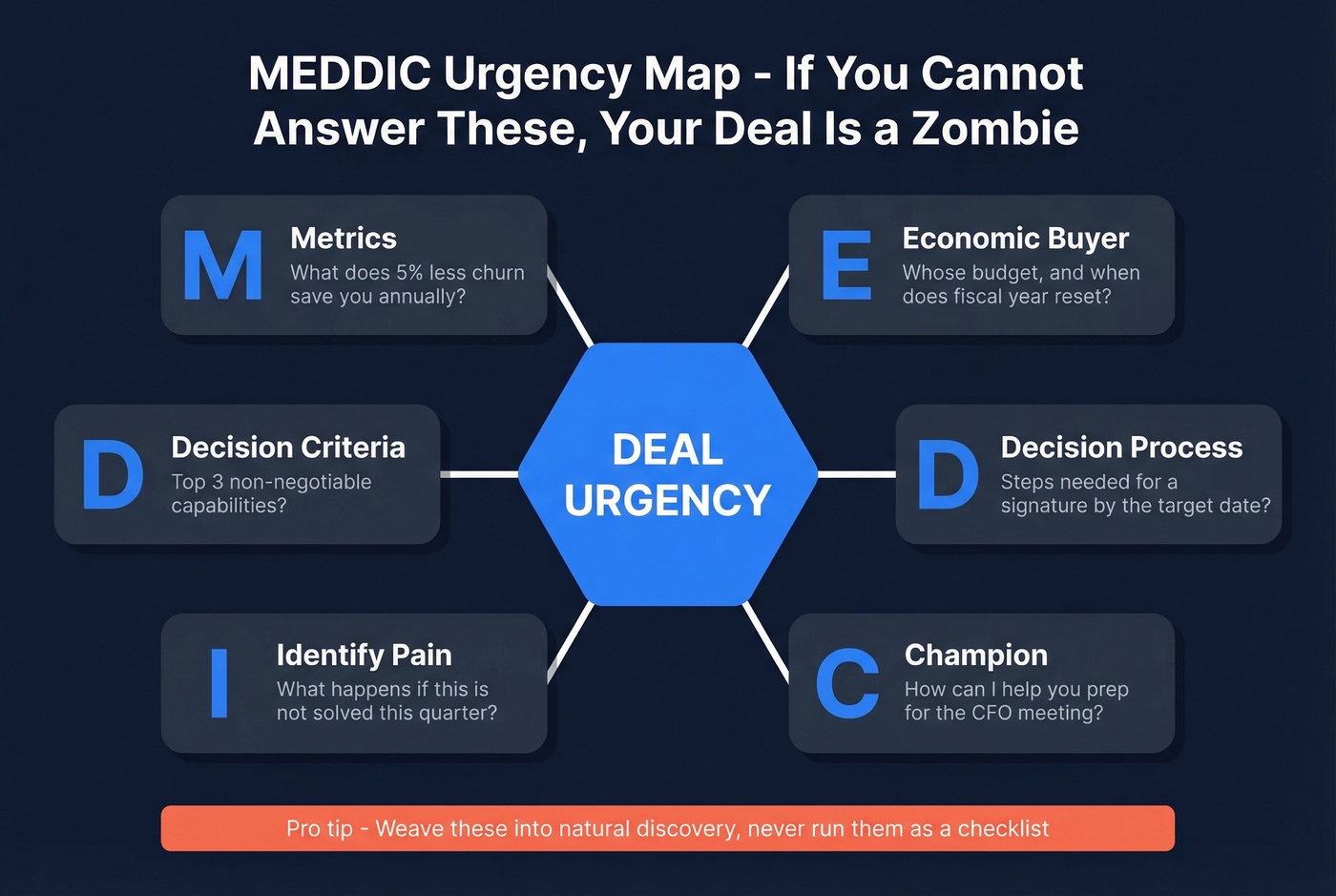
If you can't answer these six questions, you don't have urgency - you have a zombie deal.
| MEDDIC Letter | Urgency Question |
|---|---|
| Metrics | "What does 5% less churn save you annually?" |
| Economic Buyer | "Whose budget, and when does fiscal year reset?" |
| Decision Criteria | "Top 3 non-negotiable capabilities?" |
| Decision Process | "Steps needed for a signature by [date]?" |
| Identify Pain | "What happens if this isn't solved this quarter?" |
| Champion | "How can I help you prep for the CFO meeting?" |
Don't run through MEDDIC like a checklist on a call. Weave these questions into natural discovery. The goal is to surface whether urgency exists and, if it does, anchor it to specific business consequences. We've seen dozens of deal reviews where reps had strong champions and solid demos but couldn't answer the Metrics or Decision Process questions. Those deals stalled every single time.
If you want a deeper set of prompts, keep a bank of MEDDIC discovery questions ready for each stage.
The Pull-Away (Last Resort)
When a deal has stalled - repeated postponed demos, radio silence after a strong call - try the negative reverse sell. David Sandler developed this approach in 1967, and it still works because it aligns with the buyer's hesitation instead of pushing through it.
Something like: "It sounds like this might not be the right time. Should we close this out and revisit next quarter?"
It forces a clear yes or no. The endless "maybe" is what kills your forecast.
One caveat: this works best on decisive, competitive personalities. If your buyer is conflict-averse, a pull-away can give them the exit they were too polite to take. A thread on r/sales put it well - the pull-away isn't a trick, it's a filter for deals that were already dead.
What Kills Deal Urgency
Even when you've done the work - quantified COI, identified a compelling event, mapped MEDDIC - you can still blow it. The most common root cause isn't a missing tactic. It's that the buyer never connected the problem to a dollar figure in the first place.
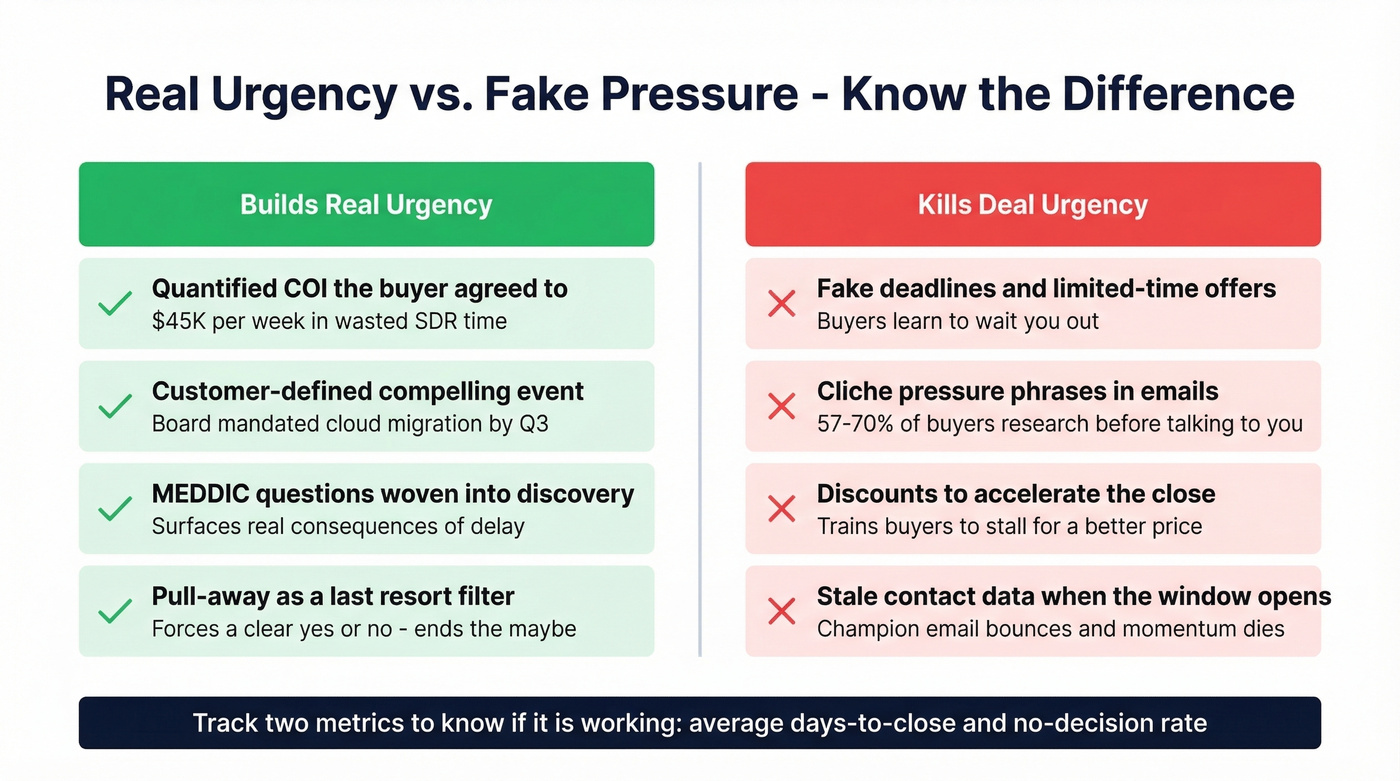
Fake deadlines. Constant limited-time offers numb buyers. They learn to wait you out, and eventually they stop responding altogether.
Cliche pressure phrases. 57-70% of B2B buyers research extensively before engaging a rep. They can smell manufactured pressure from the first email.
Discounts to accelerate. You're not creating urgency. You're training buyers to stall until you drop the price. Every discount you offer to "get the deal done this quarter" teaches the entire buying committee that your pricing is negotiable if they just wait.
Bad contact data when the window opens. This one's frustrating because it's so preventable. You've finally got the buyer ready to move, a new VP joins the committee, and your champion's email bounces. Momentum dies fast. Prospeo's 98% email accuracy and 7-day refresh cycle exists for exactly this scenario - when the window opens, you need to reach stakeholders immediately, not chase down updated contact info.
If most of your pipeline lacks a compelling event, that's not a pipeline. It's a wish list. Fix the inputs before you try to fix the urgency.
Track two metrics to know if your tactics are working: average days-to-close and no-decision rate. If both improve, your game is real. If you need a clean way to monitor this, start with pipeline health metrics.
Bad contact data kills deal urgency faster than any stalled committee. When your champion's email bounces mid-cycle, that compelling event you worked so hard to identify becomes irrelevant. Prospeo refreshes every 7 days - not the 6-week industry average - so your contacts are current when momentum peaks.
Don't let stale data destroy the urgency you built. Get contacts at $0.01 each.
FAQ
Can you create urgency if the buyer isn't in-market?
No - you can't manufacture urgency that doesn't exist. But you can uncover consequences the buyer hasn't quantified yet, and that reframes "someday" into "this quarter." The COI math framework above is your best tool for surfacing hidden pain.
What's the difference between urgency and pressure?
Urgency is buyer-recognized consequences of delay tied to their business reality. Pressure is seller-imposed arbitrary deadlines tied to your quota. One builds trust; the other destroys it. If the timeline isn't anchored to the buyer's world, it's pressure.
How do you maintain urgency after creating it?
Lock in next steps with specific dates on every call and keep the COI math visible in follow-up emails. Make sure your contact data stays current so you can loop in new decision-makers or re-engage a quiet champion without losing momentum.