

How to End a Cold Email That Actually Gets a Reply
You sent 200 cold emails last week. Four replies. Two were "please remove me from your list."
That math tracks - the 2026 cold email benchmark report puts the average reply rate at 3.43%, and 58% of all replies come from the first email in a sequence. Your closing carries disproportionate weight. But obsessing over templates misses the point. The real levers are CTA clarity, total email length, and whether the email even lands in the inbox.
The Quick Version
If you're short on time, here's the checklist:
- One clear CTA - a yes/no question, not a paragraph
- A gratitude-based sign-off ("Thanks" or "Cheers" - not "Best regards")
- Under 80 words total for the entire email
- A lightweight signature - name, title, company, no images
- Verified contact data so the email actually arrives
That's the whole framework. Everything below explains the why and the how.
Four Components of a Strong Email Closing
Your email's ending has four distinct parts, and conflating them leads to bloated closings that bury the ask. The closing line is the last sentence of your body - where you restate relevance or bridge to the ask. The CTA is the specific action you're requesting: a reply, a meeting, a yes/no answer. The sign-off is the farewell word or phrase ("Thanks," "Cheers," "Best"). And the signature is your name, title, and company info below the sign-off.
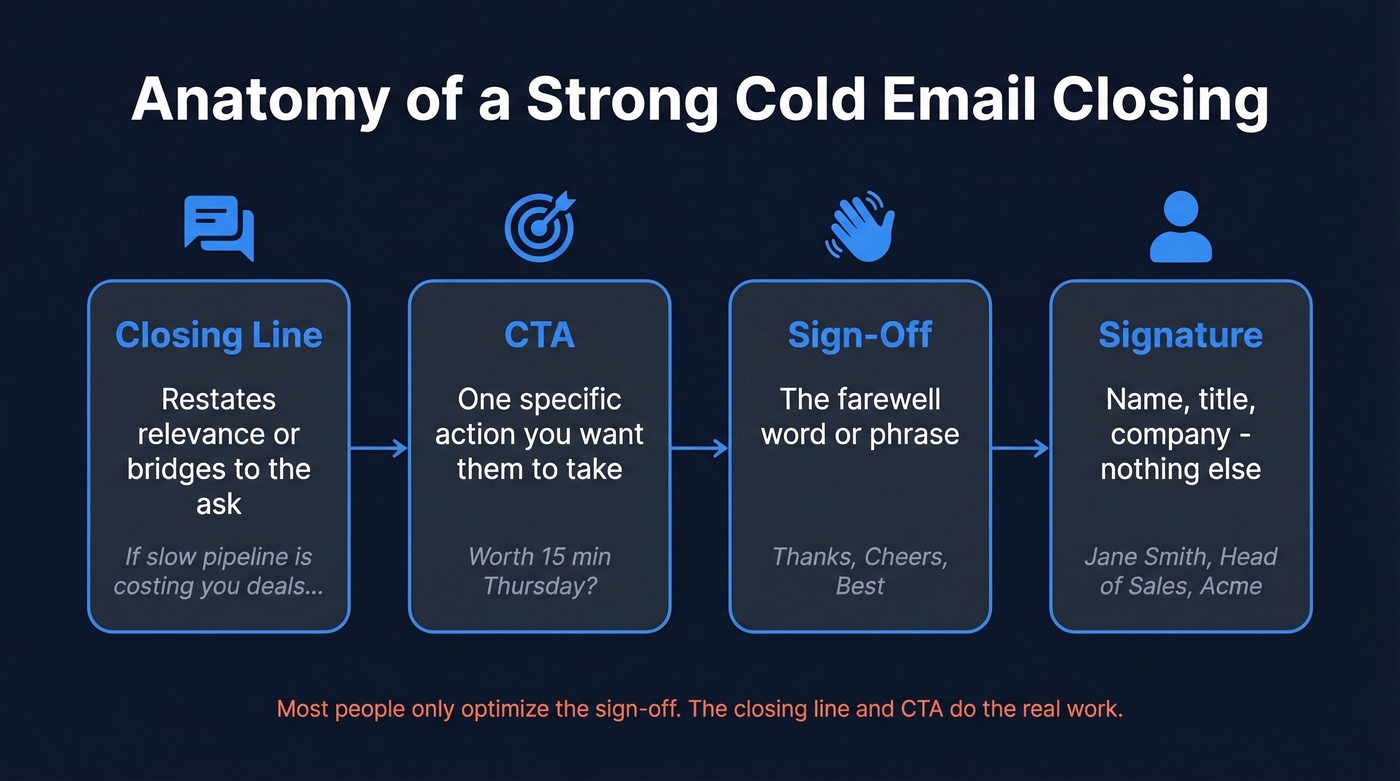
Most people only think about the sign-off. The closing line and CTA do the actual work.
Six Closing Tactics That Drive Replies
Use a Single, Clear CTA
The 2026 benchmark guidance is consistent: the best-performing cold email campaigns use one CTA. Not two. Not "let me know if you're interested or if there's someone else I should reach out to." One question. One action.
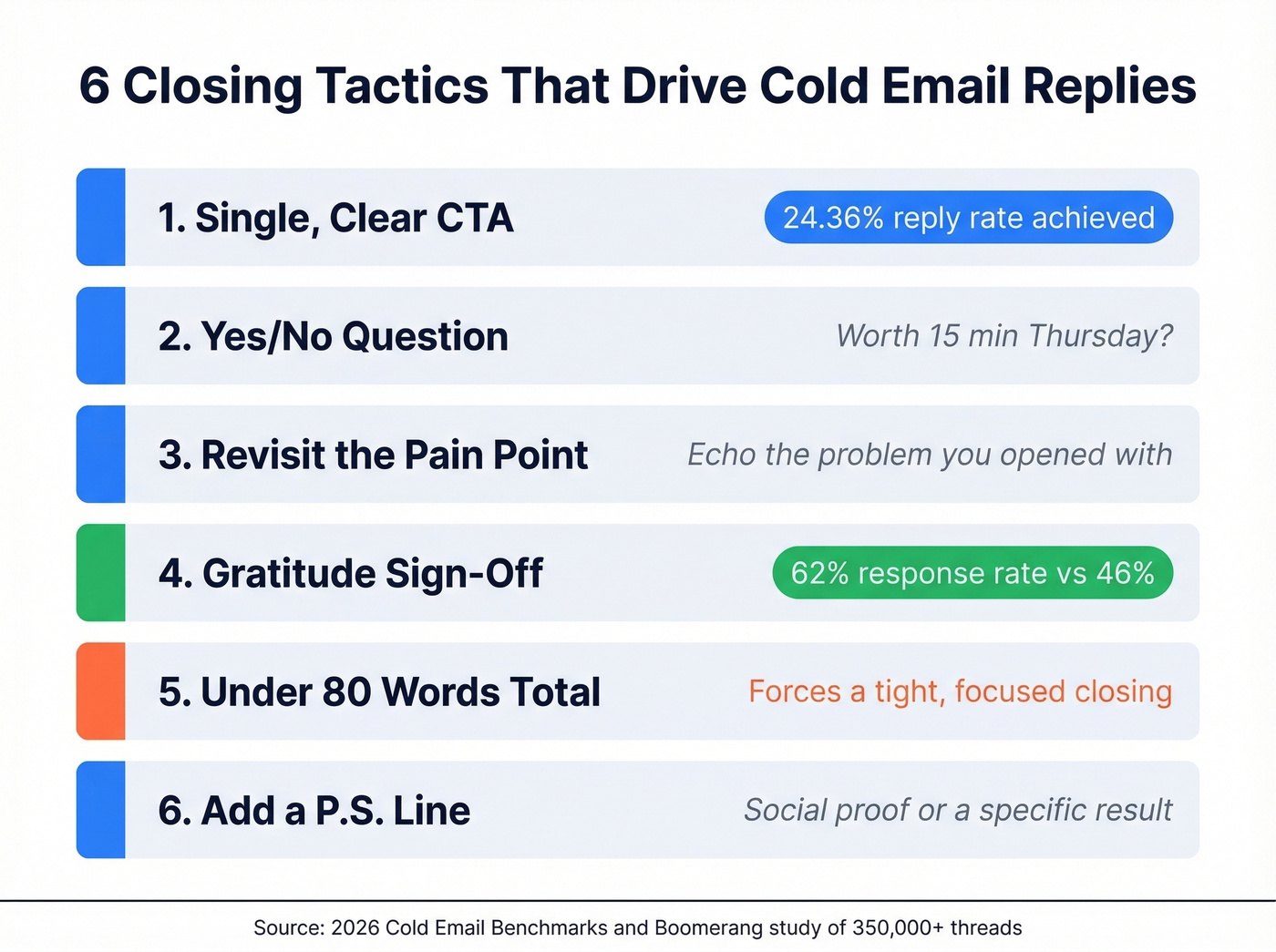
A practitioner on r/coldemail documented their iteration from 3.44% to 24.36% reply rate across three campaigns. The biggest change? Replacing soft CTAs like "let me know if you're interested" with clear, assumptive asks. We've seen the same pattern in our own outbound - "let me know if you're interested" is the worst CTA in cold email. Kill it.
Ask a Low-Friction Yes/No Question
"Worth a 15-minute call Thursday?" beats "I'd love to schedule a meeting at your earliest convenience to discuss how we might be able to help." The first takes two seconds to answer. The second takes two seconds to delete.
Example: "Does improving [specific metric] matter this quarter?"
Revisit the Pain Point
Your closing line should echo the problem you opened with. If your email starts with pipeline velocity, end with pipeline velocity - not a generic pleasantry.
Example: "If slow pipeline is costing you deals, happy to show what changed for [similar company]."
Use a Gratitude-Based Sign-Off
More on this in the data table below, but the short version: "Thanks" outperforms "Best regards" by 10+ percentage points in response rate. It's warmer, shorter, and signals you value the reader's time.
Keep the Entire Email Under 80 Words
This isn't just a closing tactic - it's a structural constraint that forces better closings. The 2026 benchmarks show the best-performing campaigns stay under 80 words total. When your whole email is 80 words, your closing can't ramble. It has to be tight.
Add an Optional P.S. Line
A P.S. line draws the eye. Use it for one piece of social proof or a specific result - not another link. Benchmark data shows that follow-ups written to feel like replies outperform formal follow-ups by about 30%, and a well-placed P.S. creates that same conversational feel in your first touch.
Example: "P.S. We helped [company] cut bounce rates from 35% to under 4% last quarter."

A perfect CTA can't get replies if your email bounces. Prospeo's 98% verified email accuracy and 7-day data refresh mean your cold emails actually reach real inboxes - not spam folders or dead addresses.
Stop crafting closings for emails that never arrive.
Bad to Better: Closing Line Rewrites
This is the section you'll actually bookmark. Every weak closing follows the same pattern: vague intent, no specific ask, easy to ignore.
| Bad Closing | Better Closing | Why It Works |
|---|---|---|
| "Let me know if you'd like to discuss further." | "Worth 15 minutes Thursday to see if this fits?" | Specific day, yes/no answer, low commitment |
| "I'd love to connect and learn more about your needs." | "Are you still scaling the SDR team this quarter?" | Shows research, asks about their priority |
| "Please don't hesitate to reach out if you have questions." | "Does cutting ramp time from 8 weeks to 4 matter right now?" | Pain-specific, implies a concrete result |
| "Looking forward to hearing from you soon." | "Can I send a 2-minute walkthrough?" | Ultra-low friction, gives them control |
The pattern: replace open-ended invitations with closed-ended questions tied to a specific outcome. Every "better" version can be answered in under five seconds. Let's be honest - ending your cold email with a tight, specific question is the single highest-leverage skill in outbound, and most people never bother to practice it.
Best Sign-Offs by Response Rate
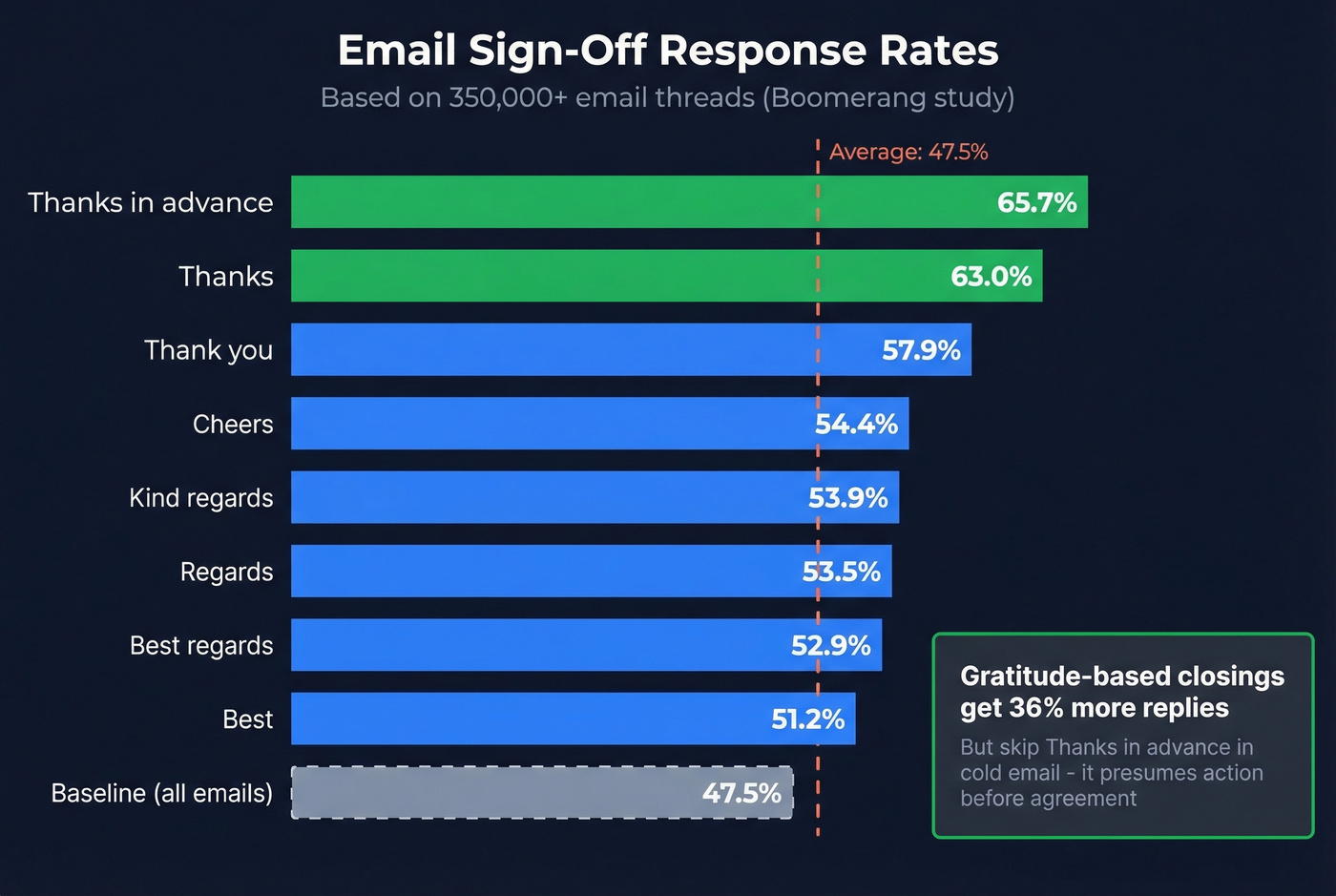
Boomerang analyzed over 350,000 email threads (2017 study - still the largest dataset on sign-off performance) and measured response rates by sign-off:
| Sign-Off | Response Rate |
|---|---|
| Thanks in advance | 65.7% |
| Thanks | 63.0% |
| Thank you | 57.9% |
| Cheers | 54.4% |
| Kind regards | 53.9% |
| Regards | 53.5% |
| Best regards | 52.9% |
| Best | 51.2% |
| Baseline (all emails) | 47.5% |
Emails with any thankful closing hit a 62% response rate versus 46% for non-thankful closings - a 36% relative lift. These numbers come from general business email, not cold outreach specifically, so expect lower absolute rates in cold campaigns. But the relative ranking holds: gratitude-based closings consistently outperform formal ones. Default to "Thanks" or "Thanks, [First Name]."
Here's the thing about "Thanks in advance" topping the chart: I'd avoid it in cold email. It presumes the recipient will do something for you before they've agreed to anything. In warm threads between colleagues, that presumption is fine. In a cold first touch, it reads as entitled. Stick with "Thanks" - all the gratitude signal, none of the presumption.
Signatures, Links, and Deliverability
Your perfectly crafted closing line can't get a reply if the email lands in spam - or bounces entirely.
Stop including calendar links in your first cold email. You haven't earned the meeting yet. That extra link hurts performance, and it signals presumption. Save it for after they reply.
Plain text usually beats HTML for cold email. Your fancy signature with the company logo and three social icons is getting flagged as marketing mail. For your first touch, keep it to name, title, and company. That's it. Make sure SPF, DKIM, and DMARC records are configured - without them, nothing else here matters.
Beyond authentication, a few more deliverability rules that directly affect your closing and signature:
- Don't track opens. Tracking pixels are increasingly flagged by spam filters and can tank inbox placement. (If you want the technical why, see tracking pixels.)
- Minimize links. One link maximum in the body. Zero in the signature for cold first touches.
- Rotate signatures at scale. If you're sending hundreds of emails daily, vary signature elements - alternate between "John Smith" and "John S.," swap title phrasing between "Head of Sales" and "Sales Lead" - to reduce pattern-based spam detection.
- Verify your list before sending. None of this matters if you're emailing invalid addresses. We've seen bounce rates tank sender reputation in as few as two campaigns. Run your list through an email verification tool like Prospeo before you worry about your closing - it verifies emails in real time with 98% accuracy and catches spam traps and honeypots that other tools miss. (More: email bounce rate, email deliverability, and how to improve sender reputation.)

Five Closing Mistakes That Kill Replies
- Multiple CTAs. Every additional ask dilutes the first one. Pick one action and commit. (Related: email call to action.)
- Vague, passive closings. "Let me know your thoughts" gives the prospect nothing specific to respond to.
- Too many links. Multiple links in a cold email is a spam signal that hurts deliverability.
- Generic sign-offs. "Best regards" from a stranger reads like a form letter because it is one.
- Missing unsubscribe option. CAN-SPAM requires a clear opt-out mechanism, and including one also supports compliance expectations in GDPR contexts.
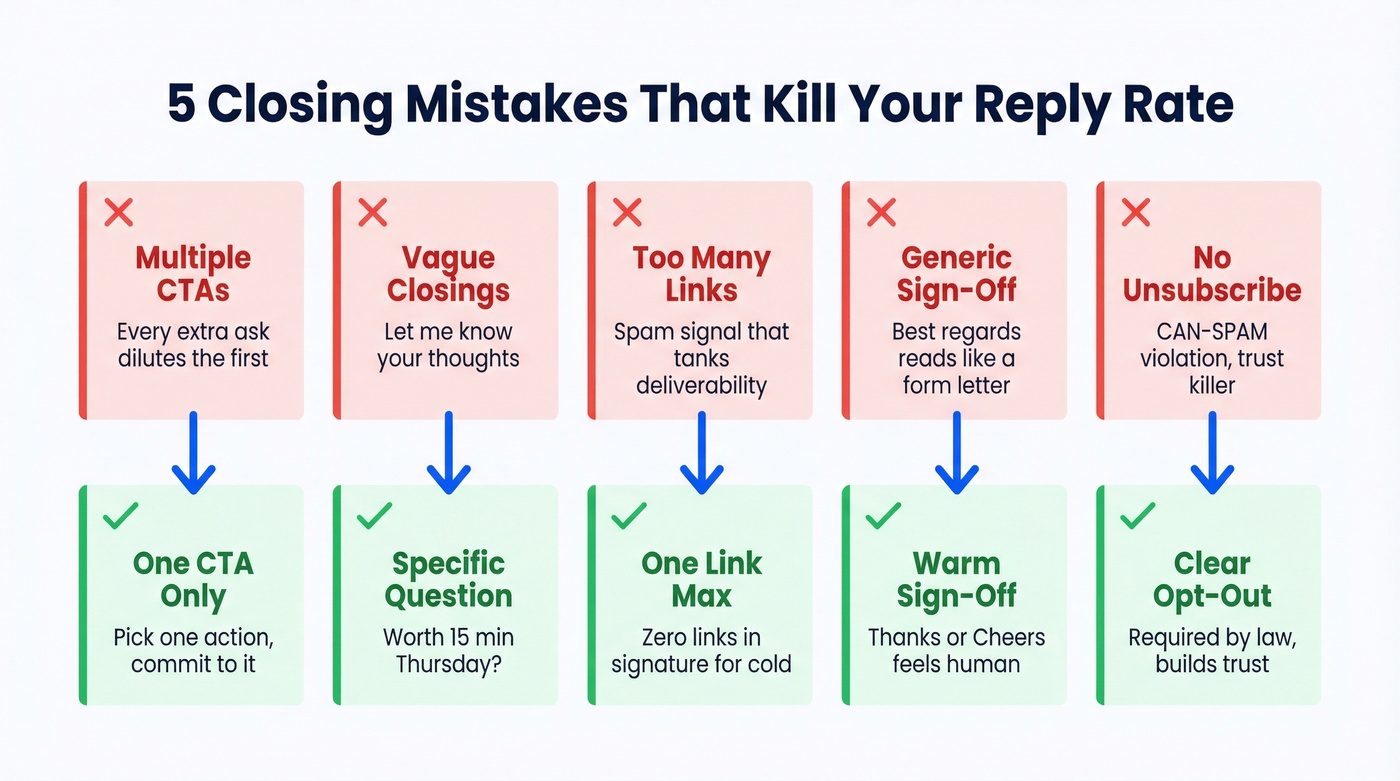
Skip the mistake-avoidance mindset if you've already nailed the fundamentals above. For teams still seeing sub-3% reply rates, though, audit your last 50 sends against this list before changing anything else. If you're running sequences, pair this with proven cold email follow-up templates.
FAQ
Should I include a calendar link in a cold email?
No - not in the first email. Adding a scheduling link introduces an extra URL that can hurt deliverability, and it presumes a meeting before the prospect has expressed interest. Share your calendar link after they reply and agree to a conversation.
How many CTAs should a cold email have?
One. Always one. The 2026 benchmark data shows the best-performing campaigns use a single, clear CTA - typically a yes/no question that takes under five seconds to answer.
What's a realistic cold email reply rate in 2026?
The average is 3.43%. Above 5.5% puts you in the top quartile. Closing optimization won't turn a 2% campaign into a 20% one, but it's the difference between 3.4% and 5.5%+.
How do I make sure my cold emails actually reach the inbox?
Authenticate your domain (SPF, DKIM, DMARC), send plain-text emails, minimize links, and verify every address before sending. Bad data is the fastest way to burn a domain - one client we spoke with went from a 35% bounce rate to under 4% just by running their list through proper verification before hitting send.
Meritt cut their bounce rate from 35% to under 4% with Prospeo and tripled pipeline to $300K/week. Every closing tactic in this guide works better when you're reaching verified contacts at $0.01 per email.
Send fewer emails, get more replies - starting today.