

How to End a Sales Pitch: 7 Closes That Work in 2026
You just nailed the demo. The prospect was nodding, asking smart questions, even laughing at your jokes. Then you hit the last slide and say, "So... what do you think?" Dead silence - two days later, the email comes: "We need to think about it."
Knowing how to end a sales pitch is the difference between a deal that closes and one that ghosts you. 36% of sales pros say closing is the hardest part of the job, and it's not because they lack product knowledge. It's because they don't have a system for the last two minutes.
The Short Version
The close isn't a magic line. It's a 4-step sequence: recap value, confirm alignment, make a specific ask, go silent. If you only learn three closes, make them the summary close, the assumptive close, and the takeaway close. They cover 90% of scenarios.
The biggest mistake reps make is saving the close for the final 30 seconds - you should be using trial closes throughout the entire conversation. And here's the uncomfortable truth: if you're pitching the wrong person, no technique will save you. A sales presentation can only close a sale when you're talking to someone with the authority to say yes.
Why Closing Is Harder Now
B2B deals don't close the way they did five years ago. The average purchase now requires final approval from 6 to 10 decision-makers, and strategic enterprise deals average 17 contacts. That's not a buying process - it's a committee negotiation.
77% of B2B buyers say their last purchase was "extremely complex or difficult" according to a Gartner survey. The core issue isn't product evaluation - it's internal consensus. Your champion loved the demo, but procurement wants a different payment structure, legal has questions about data handling, and the CFO hasn't seen the deck yet. Your close can't just convince one person. It has to arm your champion with the language and materials to sell internally, which changes everything about how you wrap up the conversation.
The Anatomy of a Strong Close
The goal of most closes isn't "buy now." It's advancing to the next concrete step. Every effective closing follows the same four-step structure:
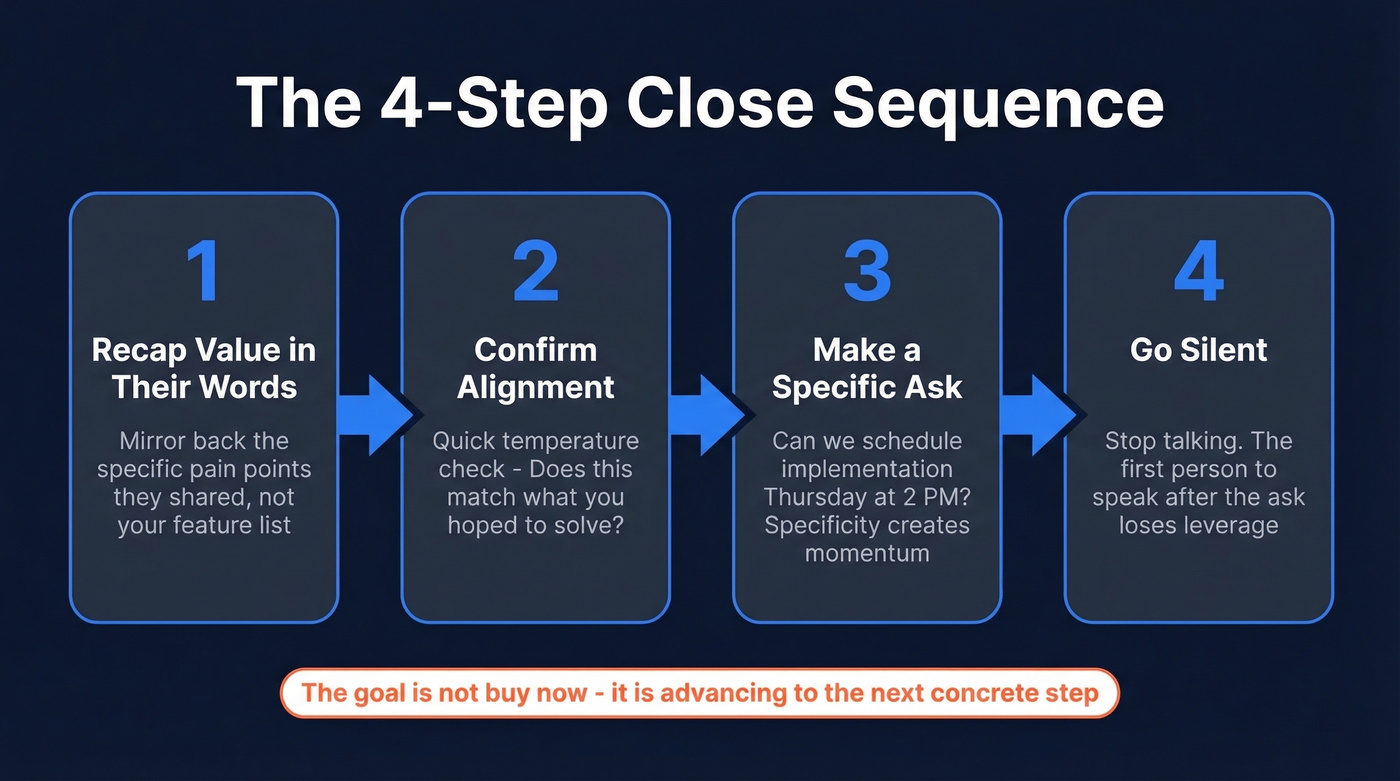
Recap value in their words. Don't list features. Mirror back the specific pain points they shared. "You mentioned your team's spending 6 hours a week on manual list building..."
Confirm alignment. A quick temperature check before the ask. "Does this match what you were hoping to solve?" This surfaces objections before you go for commitment.
Make a specific ask. "Can we schedule a 30-minute implementation call Thursday at 2 PM?" Specificity creates momentum. "What do you think?" doesn't.
Go silent. After the ask, stop talking. The first person to speak after the ask usually loses leverage.

Your close only works if you're talking to someone who can say yes. Prospeo gives you direct access to 300M+ verified contacts with 30+ filters - including seniority, department, and buyer intent - so you pitch decision-makers, not gatekeepers.
Stop perfecting your close on people who can't sign the deal.
7 Ways to End a Sales Pitch
1. Summary Close
Script: "We've covered [pain point], [solution], and [ROI]. Based on what you've shared, the [plan] fits. I'll send the proposal today - can we walk through it Friday at 10?"
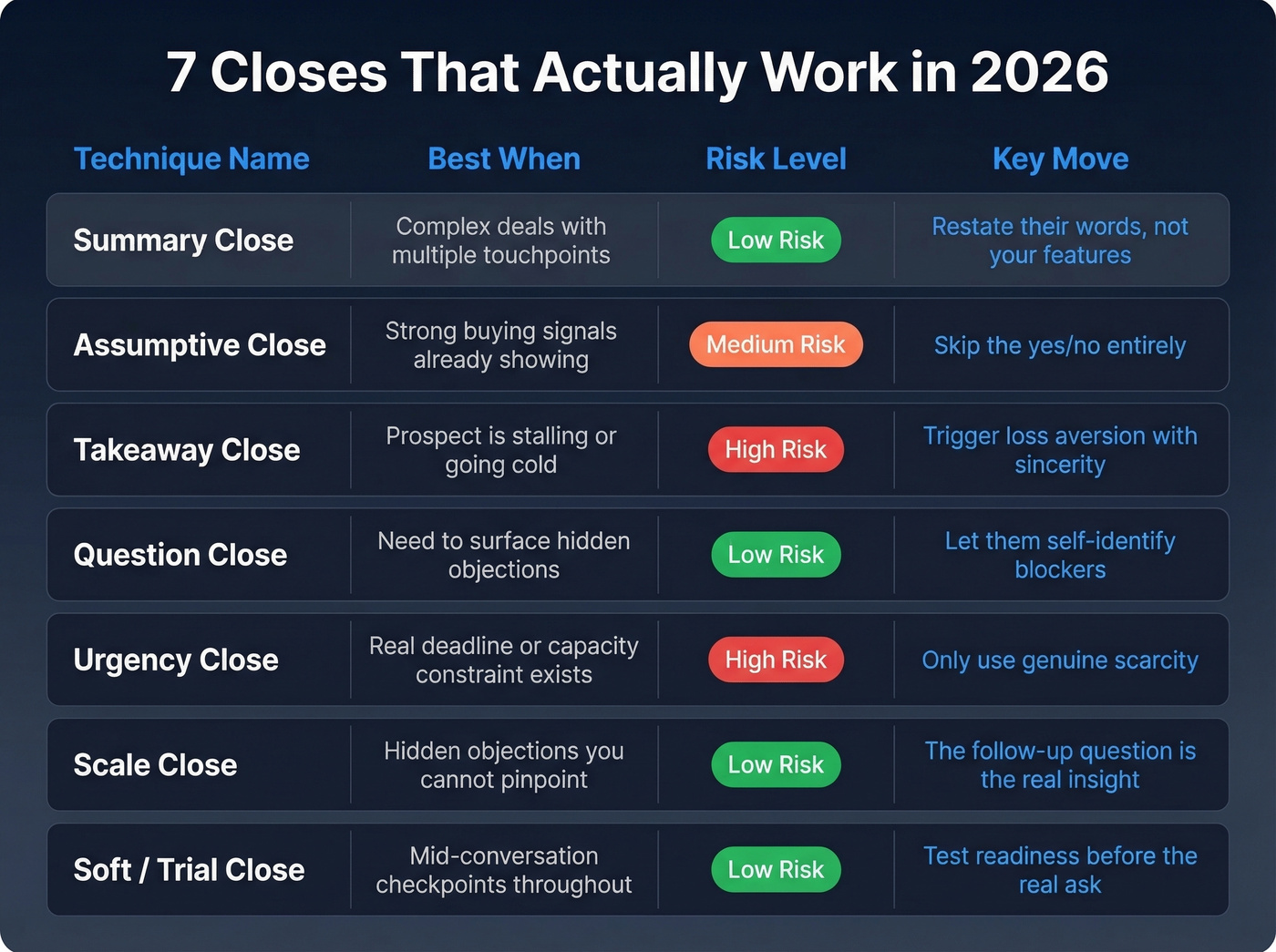
Use this on complex deals with multiple touchpoints where details blur between calls. Re-anchor around their priorities, not your features. One warning: it sounds robotic if you list product capabilities. Restate their words and their problems.
2. Assumptive Close
Script: "Should we start with the 50-seat plan or the 100?"
This works when you're seeing strong buying signals - the prospect's asking about onboarding timelines, integration requirements, or pricing tiers. They've mentally moved past "if." The assumptive close skips the yes/no entirely, which is why it's one of the most effective techniques in a rep's toolkit.
But only do this after you've confirmed alignment on the problem, the outcome, and the path forward. Without that groundwork, you'll sound presumptuous - the exact thing most reps are trying to avoid.
3. Takeaway Close
Script: "Honestly, based on what you've described, this might not be the right fit for your team right now."
Pull this out when the prospect is stalling. The takeaway triggers loss aversion - suddenly the thing they were lukewarm about becomes the thing they might lose. On r/sales, practitioners explicitly recommend the "maybe we're not a fit" approach and describe it as producing "more closures than I can count."
Deliver it with genuine sincerity. If it sounds like manipulation, you'll lose trust permanently.
4. Question Close
Script: "Is there anything else you'd need to see before moving forward?"
This lets the prospect self-identify remaining objections without a yes/no confrontation. It's a reliable way to close without cornering the buyer. The risk? It opens a can of worms if your discovery was weak. If they surface three new concerns, you're back to square one.
5. Urgency Close
Script: "Our implementation team has two onboarding slots left this quarter. Want me to hold one?"
Only use this when a real deadline or capacity constraint exists. Genuine scarcity gives the prospect a reason to act now.
Here's the thing: fake urgency destroys trust instantly. Customers are 23% more likely to spend with brands they trust - one fake deadline erases that advantage. We've seen reps lose six-figure deals over a single dishonest constraint. Don't be that rep.
6. Scale Close
Script: "On a scale of 1 to 10, how close are you to moving forward? What would make it a 10?"
You need to surface hidden objections without forcing a binary yes/no. The follow-up question is where the real insight lives. Pair it with genuine curiosity, not a checklist tone - otherwise it feels clinical and the prospect shuts down.
7. Soft / Trial Close
Script: "Does this align with what you were hoping to solve?"
Don't save closing for the end. Trial closes throughout the call test readiness and surface resistance early. Use these as mid-conversation checkpoints - after the demo, after the pricing discussion, after the objection handling. If you overuse them, though, you start asking for permission instead of leading.
What Top Closers Do Differently
Gong's analysis of 1.8M opportunities tells a clear story about multi-threading: closed-won deals have 2x as many buyer contacts as closed-lost. On deals over $50K, multi-threading boosts win rates by 130%. Selling teams for closed-won deals are 67% larger than for lost deals.
If you're selling into larger accounts, account-based selling is the operating model that makes multi-threading repeatable.
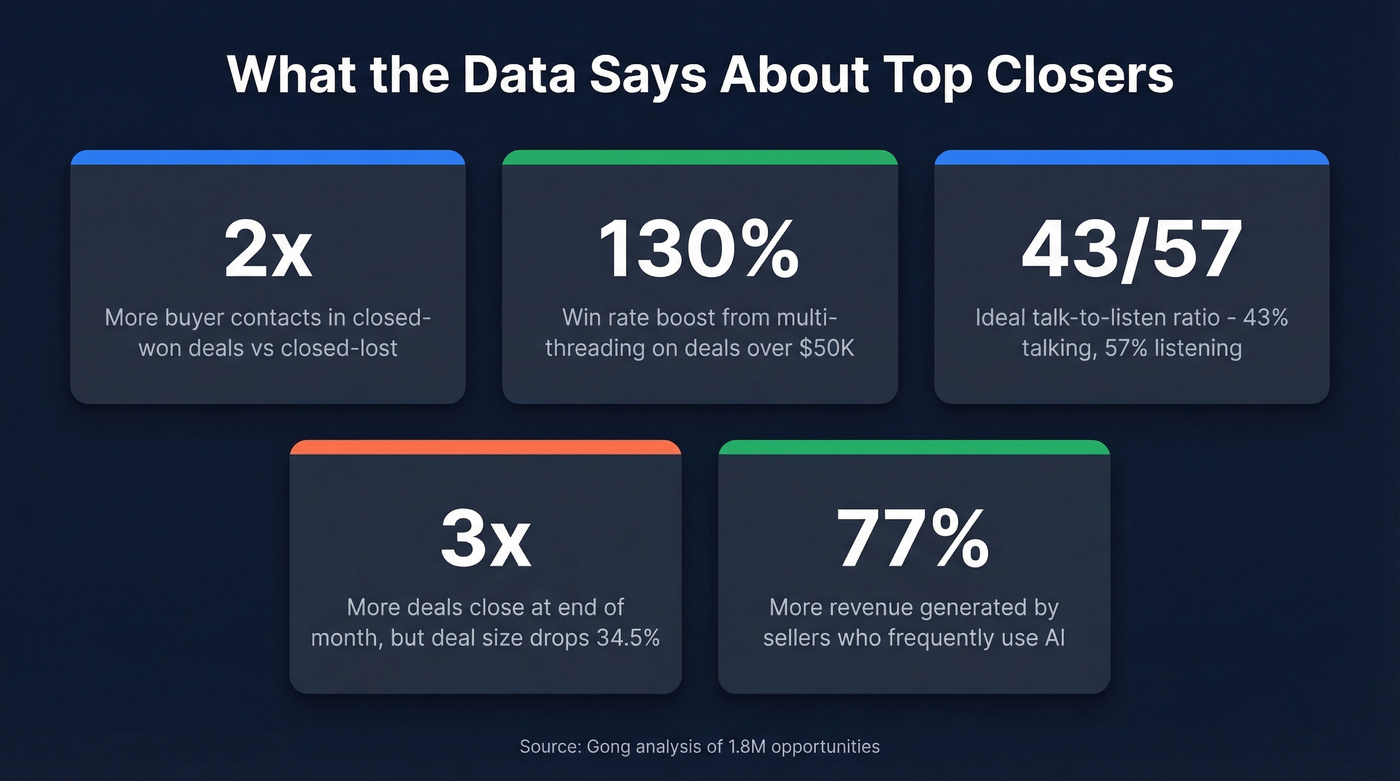
Talk-to-listen ratio matters, but consistency matters more. The sweet spot is 43% talk, 57% listen. Low performers' talk time swings wildly, hitting 64% when they lose - they start monologuing when they feel the deal slipping, which is exactly the wrong instinct. When the buyer signals commitment, stop selling and start closing.
Here's a stat that should change your end-of-quarter behavior: salespeople close three times as many deals at the end of the month, but deal size drops 34.5%. If you're discounting to hit quota, you're training buyers to wait you out.
One more data point worth internalizing: sellers who frequently use AI generate 77% more revenue. AI-assisted prep before the close - researching stakeholders, prepping objection responses, personalizing the recap - is becoming table stakes in 2026. If you're building this into your workflow, a 30-60-90 day plan helps you operationalize it without overwhelming your week. Industry benchmarks vary more than most reps realize, too. Computer software deals close at 22%, finance at 19%, and business/industrial at 27%. If you're in software and comparing yourself to a 40% target, your expectations are off.
5 Mistakes That Kill Your Close
Talking too much. Low performers hit 64% talk time in lost deals. When you feel the urge to fill silence with more features, stop. The prospect needs space to process and commit. In our experience, the reps who lose the biggest deals aren't the ones who said the wrong thing - they're the ones who couldn't stop talking.
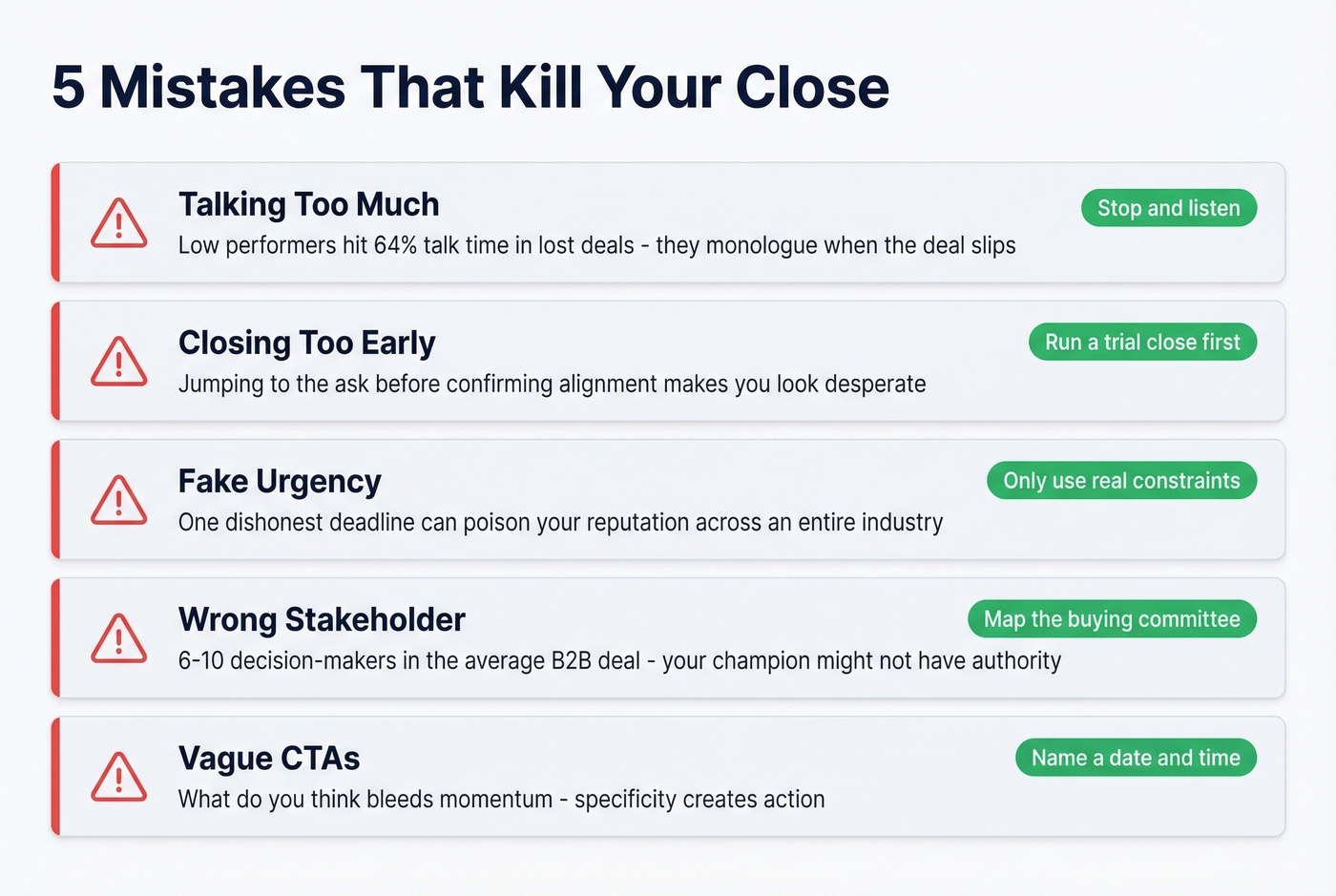
Closing too early. Jumping to the ask before confirming alignment makes you look desperate. Always run at least one trial close before the real one.
Fake urgency. "This price is only good until Friday" when it's the same price next month? Buyers talk to each other. One dishonest constraint can poison your reputation across an entire industry. Skip this if you can't point to a genuine, verifiable deadline.
Pitching the wrong stakeholder. With 6-10 decision-makers in the average B2B deal, this is a structural problem, not a technique problem. Your champion might love you but lack the authority to sign. Identify the economic buyer early - tools like Prospeo's 30+ search filters make it straightforward to map out the full buying committee before you ever open your slide deck. (If you want a more formal way to do this, use a MEDDPICC economic buyer lens.)
Vague CTAs. "What do you think?" bleeds momentum. "Let's get a 30-minute implementation call on the calendar for next Tuesday" doesn't.
Post-Meeting Follow-Up
The meeting ended well. Now what?
Most reps send a follow-up email and wait. That's not enough. Leaving a voicemail boosts email reply rates from 2.73% to 5.87%. Cold calling nearly doubles email reply rates - 3.44% vs 1.81% for email alone. Multi-channel follow-up isn't optional; it's the difference between a deal that advances and one that ghosts you.
If you need a starting point, keep a set of sales follow-up templates ready so you can send the recap within 10 minutes.
For enterprise deals, build a mutual action plan before you leave the call. Lay out every step between now and signature - legal review, security questionnaire, executive briefing - with dates and owners attached. Ending a sales pitch doesn't stop when you close your screen share; it ends when every stakeholder has what they need to say yes. This is also where a digital sales room can keep stakeholders aligned between meetings.
Let's be honest: your follow-up only works if it reaches the right person. We've found that the biggest post-demo failure isn't bad messaging - it's that the voicemail went to a gatekeeper instead of the decision-maker who wasn't on the call. Having verified direct dials and emails for every stakeholder on the buying committee before you pitch changes the math entirely. If you're still building your outbound motion, start with proven sales prospecting techniques so you're not relying on luck.
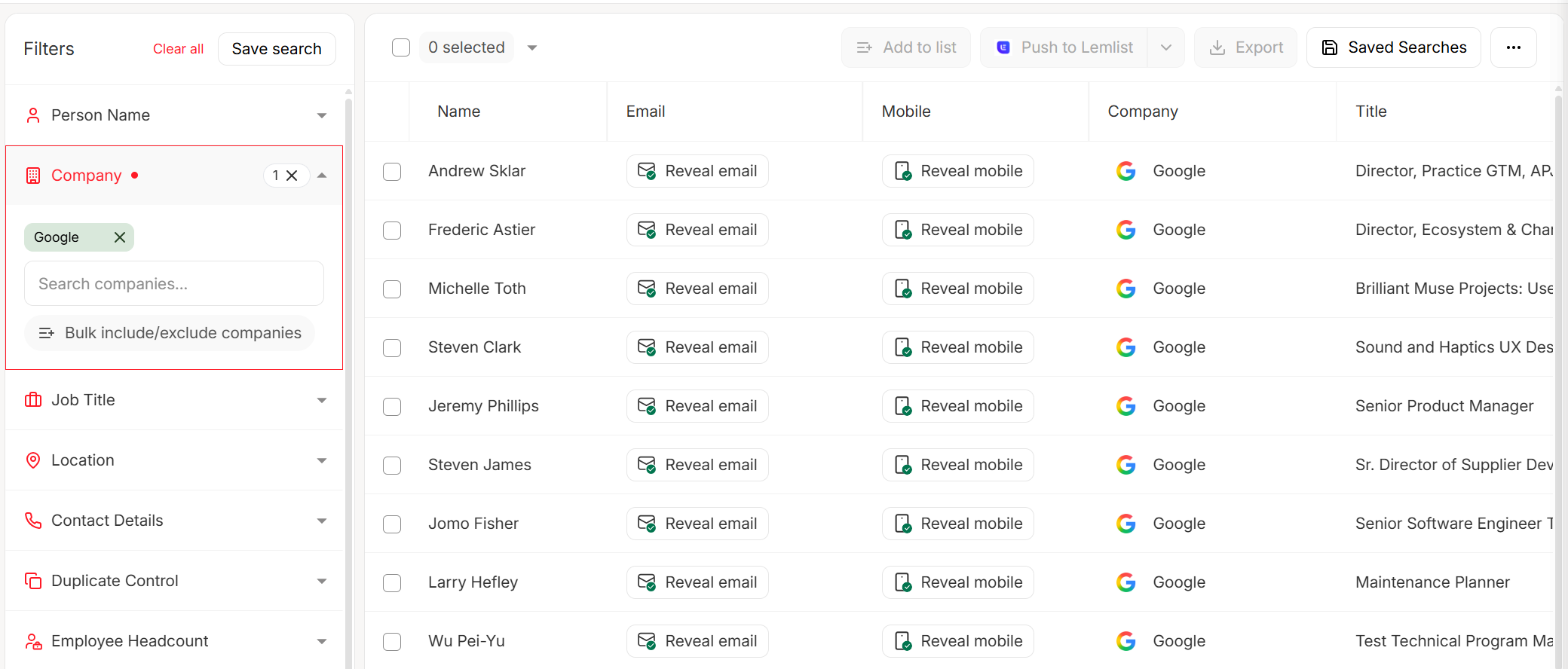
Deals with 6-10 stakeholders need multi-threading, not better one-liners. Prospeo maps entire buying committees with verified emails (98% accuracy) and 125M+ direct dials - so your champion isn't the only person who's heard your pitch.
Arm yourself with every stakeholder's contact before the next call.
FAQ
How do I end a sales pitch without sounding pushy?
Use the summary close or question close - both let the prospect lead. Recap value in their words, then ask a specific next-step question instead of a yes/no demand. Silence after the ask signals confidence, not pressure. For example: "Based on what you've shared about [their pain point], I'd recommend [plan]. Can we schedule implementation for next week?"
What's the best closing line for B2B sales?
There's no single magic phrase - match the technique to buyer signals. If they're asking about pricing and onboarding, use the assumptive close. If they're stalling, try the takeaway. The summary close works in almost every scenario as a safe default. The key is reading readiness, not memorizing scripts.
How do I handle "let me think about it"?
Ask what specifically they need to think about - this surfaces the real objection. If they can't articulate it, the issue is usually an unsurfaced stakeholder or budget concern. Multi-thread early so "let me run it by my boss" never catches you off guard. You should already have that person's contact info before the first meeting.
How do I end a sales conversation professionally?
Summarize what you discussed, confirm the next step with a specific date, and thank them for their time. Even when the deal isn't closing today, a clear wrap-up shapes whether there's a next conversation. If the deal is dead, say so directly - honesty preserves the relationship for future opportunities.