

How to Find Newly Registered Businesses (And Actually Contact Them)
You sell office furniture in Phoenix. Every new LLC filed this quarter is a potential buyer - they're leasing space, buying desks, setting up conference rooms. The problem? Finding those businesses is only half the battle. The US Census Bureau tracks over 5 million new business applications annually, but a registration filing gives you a business name, an address, and maybe a registered agent. It doesn't give you an email or a phone number. And without those, a list of new filings is just a PDF you'll never use.
Three Paths, Depending on Your Budget
- Free route: Your state's Secretary of State website for raw filings. Some states offer daily or weekly bulk feeds.
- Local discovery: Google Maps monitoring for newly appearing businesses in your target area.
- The step most people skip: Run your list through an email finder - registries don't include emails, and guessing them destroys your deliverability.
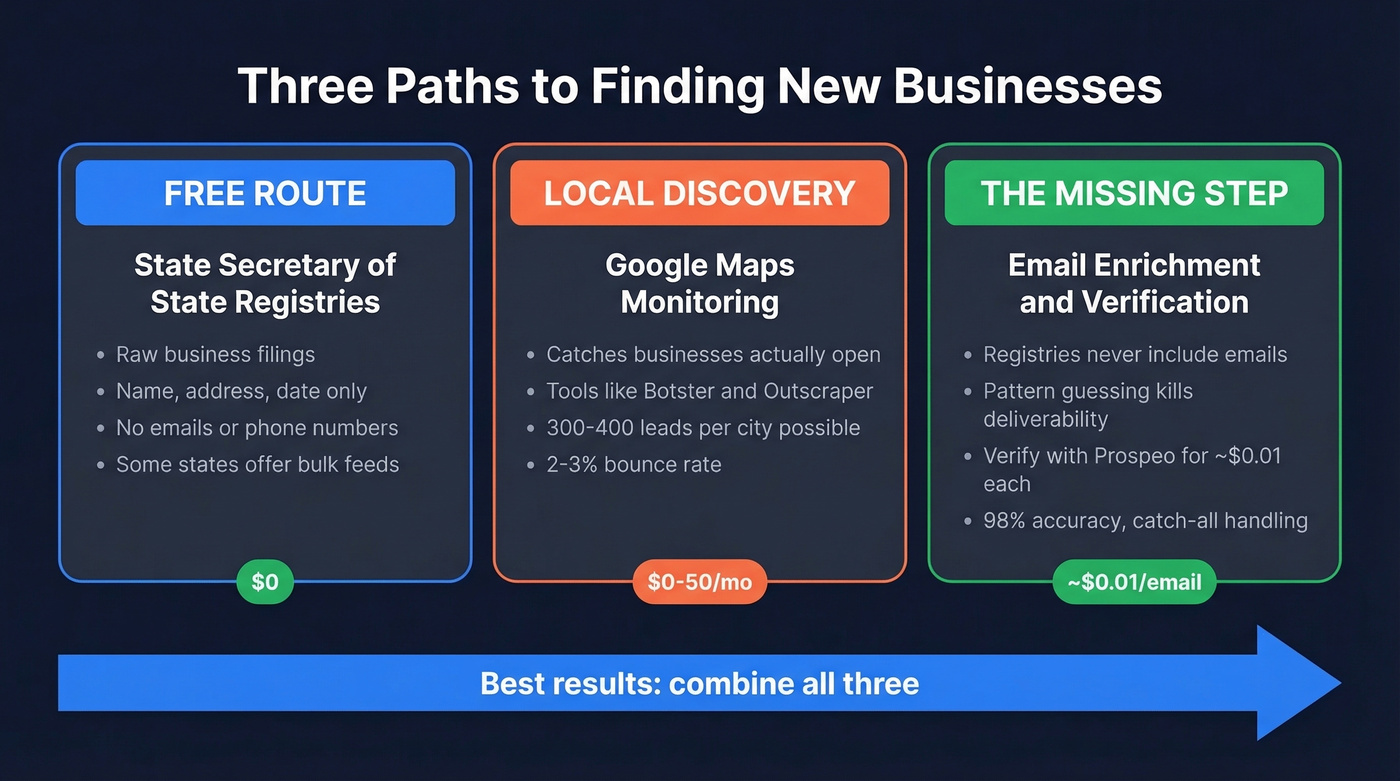
Let's break each one down.
State Secretary of State Registries
Every state maintains a public registry of business filings. That's the good news. The bad news is most SOS websites are stuck in the 1990s - no date filters, no bulk export, and search interfaces that feel like they were designed for Internet Explorer 6.
A few states actually get this right. West Virginia's SOS offers a bulk data service with a "New Companies" file generated daily and a weekly version every Monday. Minnesota's Secretary of State sells an active-business dataset for $30, and you can order it on a weekly basis to catch new filings as they come in.
Most states aren't this generous. You'll get a search portal where you can look up businesses one at a time, with no way to filter by formation date or export in bulk. It's 2026. West Virginia figured out daily bulk feeds. Why hasn't yours?
Google Maps Monitoring
Here's a distinction most people miss: "newly listed on Google Maps" and "newly registered" aren't the same thing. A business can register months before it shows up on Maps - or never appear at all. But for local prospecting, Maps listings are often more useful than filings because they signal a business that's actually open and operating.
Tools like Botster let you run scheduled searches for a keyword and location and turn on "Deliver new items only" so you only see newly appearing listings since your last run. Outscraper supports filtering results by a date range for when companies were added, and you can subscribe to ongoing updates tailored to specific locations and industries. You can even pair this with Google Alerts - set alerts for industry keywords in your target metro, and you'll catch new businesses showing up in local press or directories before they appear in state filings.
In one head-to-head test of local lead sources on r/coldemail, Google Maps scraping with direct website email extraction produced 300-400 leads per city with 2-3% bounce. That's a number worth paying attention to.

State registries give you business names and addresses. They don't give you emails. Prospeo's Email Finder takes a list of domains from new filings and returns verified email addresses - 98% accuracy, catch-all handling, spam-trap removal. Teams using verified data over pattern-guessing see bounce rates drop from 12-14% to under 4%.
Stop guessing emails for new businesses. Verify them for $0.01 each.
Other Discovery Sources
OpenCorporates aggregates registry data from jurisdictions worldwide, and company records include an incorporation_date field. Use it if you're prospecting across multiple states or countries and want a single API. Free for open data projects, paid for commercial use. It's registry data only, though - no emails or phone numbers.
Crunchbase tracks newly funded companies, founding dates, and key personnel. Starter runs $29/mo per user, Pro $49/mo per user billed annually. Great if your ICP is funded startups and you want to identify warm intro paths through shared investors. Skip it if you're targeting the landscaping company that just filed an LLC in Scottsdale.
Pro tip: Most public libraries give you free access to Reference Solutions (formerly ReferenceUSA), which includes business contact data. The catch is a 250-record export cap per download - fine for targeted research, painful for bulk prospecting.
Why Enrichment Is the Step Everyone Skips
Here's the thing: state registries almost never include email addresses. You can download every new filing in West Virginia, but you'll have business names, addresses, and registered agents - not the founder's inbox.
If you're building outreach lists from raw filings, treat this as a lead enrichment problem, not a scraping problem.
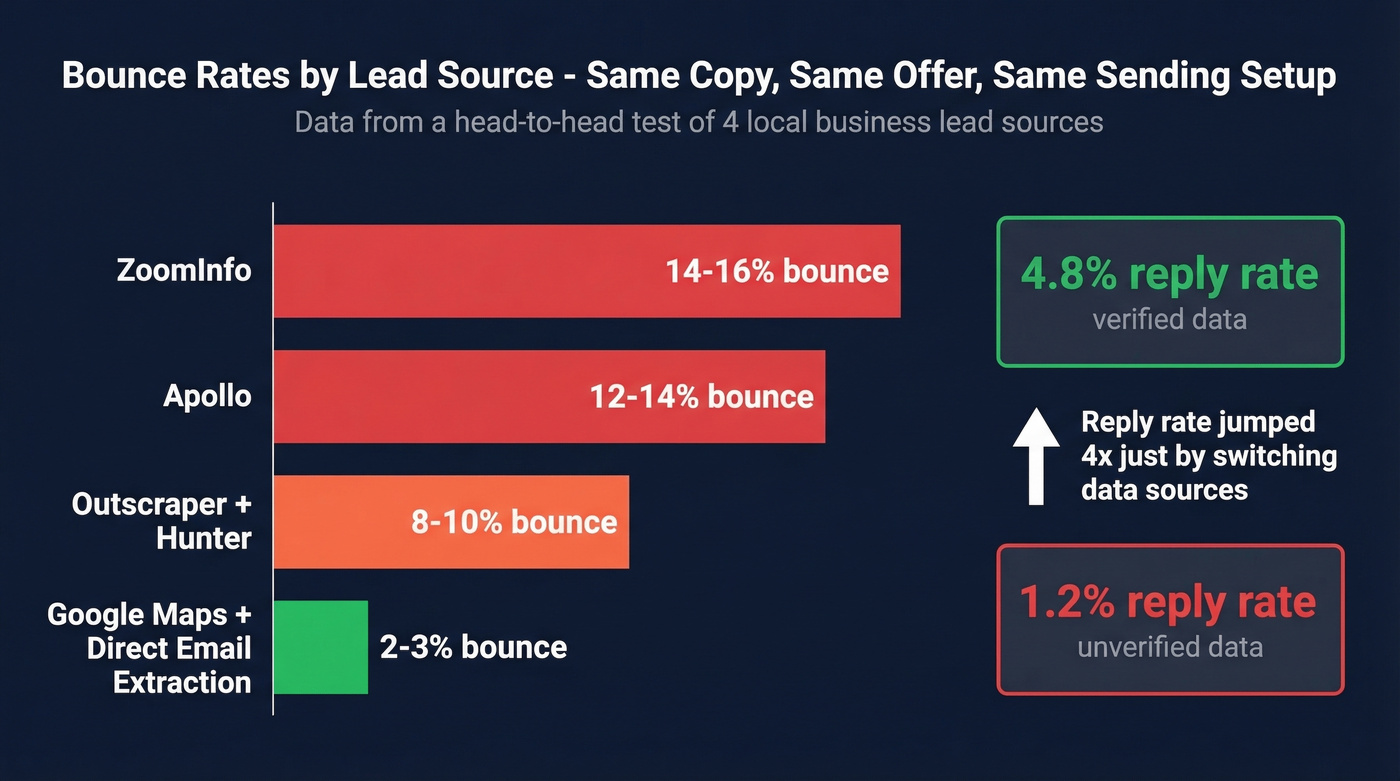
Most people try to solve this with pattern guessing or enterprise databases. Both fail for newly registered businesses. In that same Reddit test of four local lead sources, Apollo bounced at 12-14%, ZoomInfo at 14-16%, and an Outscraper + Hunter combo at 8-10%. Google Maps scraping with direct website email extraction? 2-3% bounce. Same copy, same offer, same sending setup - reply rates jumped from 1.2% to 4.8% just by switching data sources.
We've seen teams burn through their sender reputation in a week by pattern-guessing emails for local SMBs. The owner of a three-person roofing company isn't using firstname.lastname@company.com. He's using mike@roofingpros.com or info@mikesfencing.net, and no pattern-matching algorithm is going to figure that out.
If you want to keep bounces low, start with email bounce rate benchmarks and work backward to your data sources.

Once you have your list of new registrations, run the domains through Prospeo's Email Finder. Upload a CSV of domains, get verified email addresses back - 98% accuracy, real-time verification, catch-all handling included. The free tier gives you 75 emails per month, and it's roughly $0.01 per email after that. For a list of 500 new filings, that's about $5 to get verified contacts instead of guessing and tanking your domain.
Most paid "new business lead lists" are scraped from the same public registries you can access for free, marked up 10-50x, and delivered with unverified contact data. The registry data is public record. In our experience, the only part worth paying for is verification - and that doesn't need to cost $15K a year.
If you're comparing tools, it helps to separate data enrichment services from pure prospecting databases.
Most 'new business lead lists' resell public registry data at 10-50x markup with unverified contacts. The registry data is free. The only part worth paying for is verification. Prospeo gives you 75 free verified emails per month, then roughly $0.01 each - that's $5 to verify 500 new filings instead of $15K/year for an enterprise database that bounces at 14%.
Turn your free registry list into a verified outreach list in minutes.
Cost Comparison
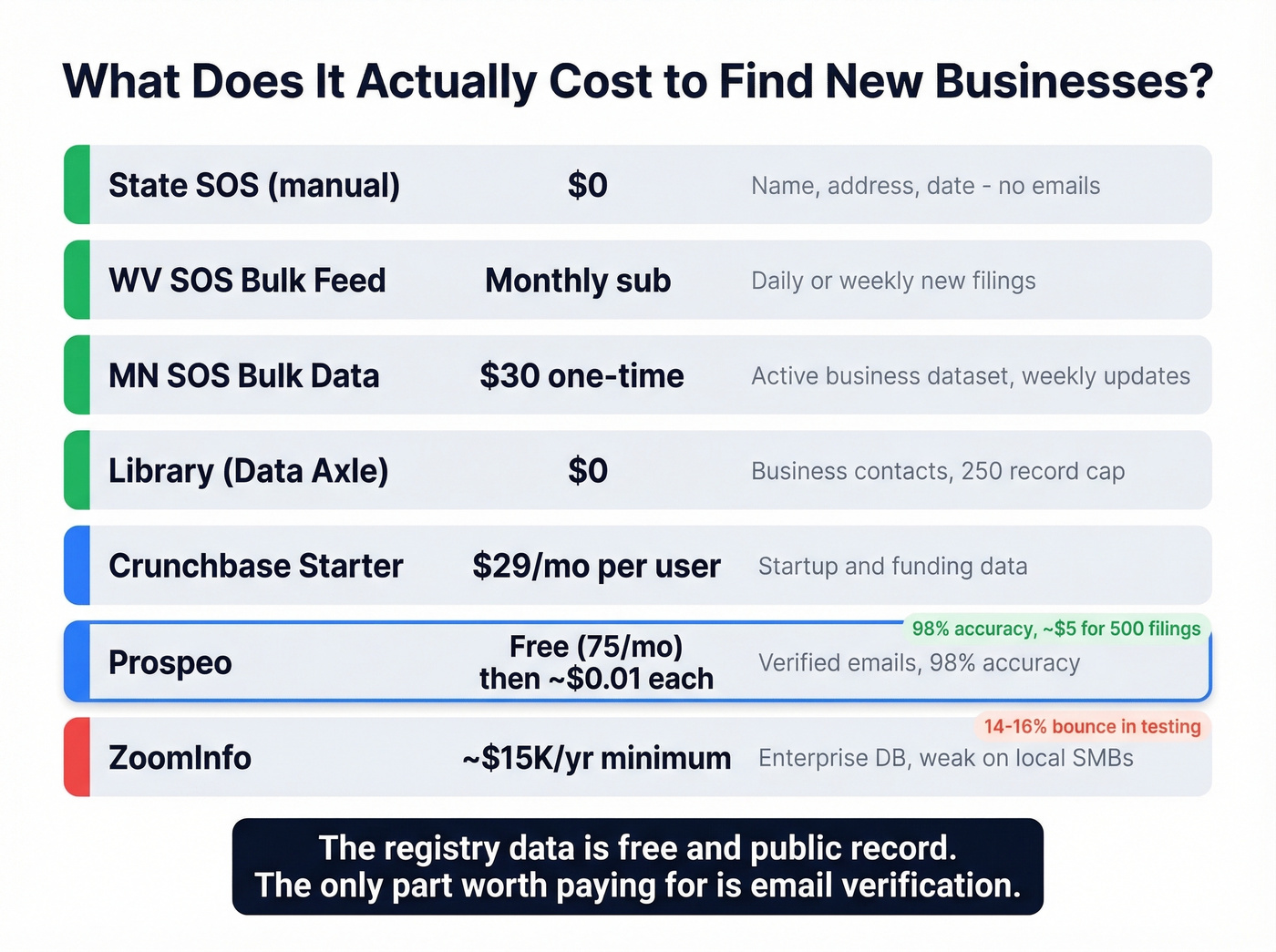
| Method / Tool | Cost | What You Get |
|---|---|---|
| State SOS (manual) | Free | Name, address, date - no emails |
| WV SOS bulk feed | Monthly subscription | Daily/weekly new filings |
| MN SOS bulk data | $30 one-time | Active business dataset; weekly updates available |
| Data Axle via library | Free | Business contacts; 250-record cap |
| Crunchbase Starter | $29/mo per user | Startup and funding data |
| Prospeo | Free (75 emails/mo) | Verified emails, 98% accuracy, ~$0.01/email |
| ZoomInfo | ~$14,995/yr minimum | Enterprise DB; weak on local SMBs |
If you're turning these leads into outbound, pair the list with proven sales prospecting techniques and a simple sales follow-up system.
FAQ
Are newly registered business lists free?
Yes - every state's Secretary of State maintains a public registry you can search at no cost. Bulk downloads vary: West Virginia offers daily feeds to subscribers, Minnesota charges $30 for a data file. The registrations themselves are always public record.
How do I get email addresses for new businesses?
State registries don't include emails. Pull the business names and domains from the registry, then run them through an email finder like Prospeo (75 free credits/month, 98% accuracy) to get verified contacts before outreach.
How often are state registries updated?
West Virginia publishes new filings daily. Minnesota offers weekly updates. Most other states refresh their online portals within a few business days of filing but don't offer structured bulk feeds - you'll need to scrape or check manually.
What's the best free way to find new businesses in my area?
Combine two sources: your state's SOS portal for official filings and Google Maps monitoring via Botster or Outscraper for businesses that are actually open. Maps catches operating businesses that won't appear in filings for weeks, while the registry catches entities that haven't set up a web presence yet.