

How to Generate Business Leads: The Practitioner's Playbook for 2026
A RevOps lead we work with ran a 3-tool bake-off last quarter. The "best" database created 4,000 duplicate contacts in Salesforce in five days. The cheapest one had better phone connect rates. The lesson wasn't about which tool won - it was that knowing how to generate business leads lives and dies on execution details, not tactics lists.
This is the playbook for getting those details right.
What You Need (Quick Version)
Three things separate teams generating pipeline from teams burning budget:
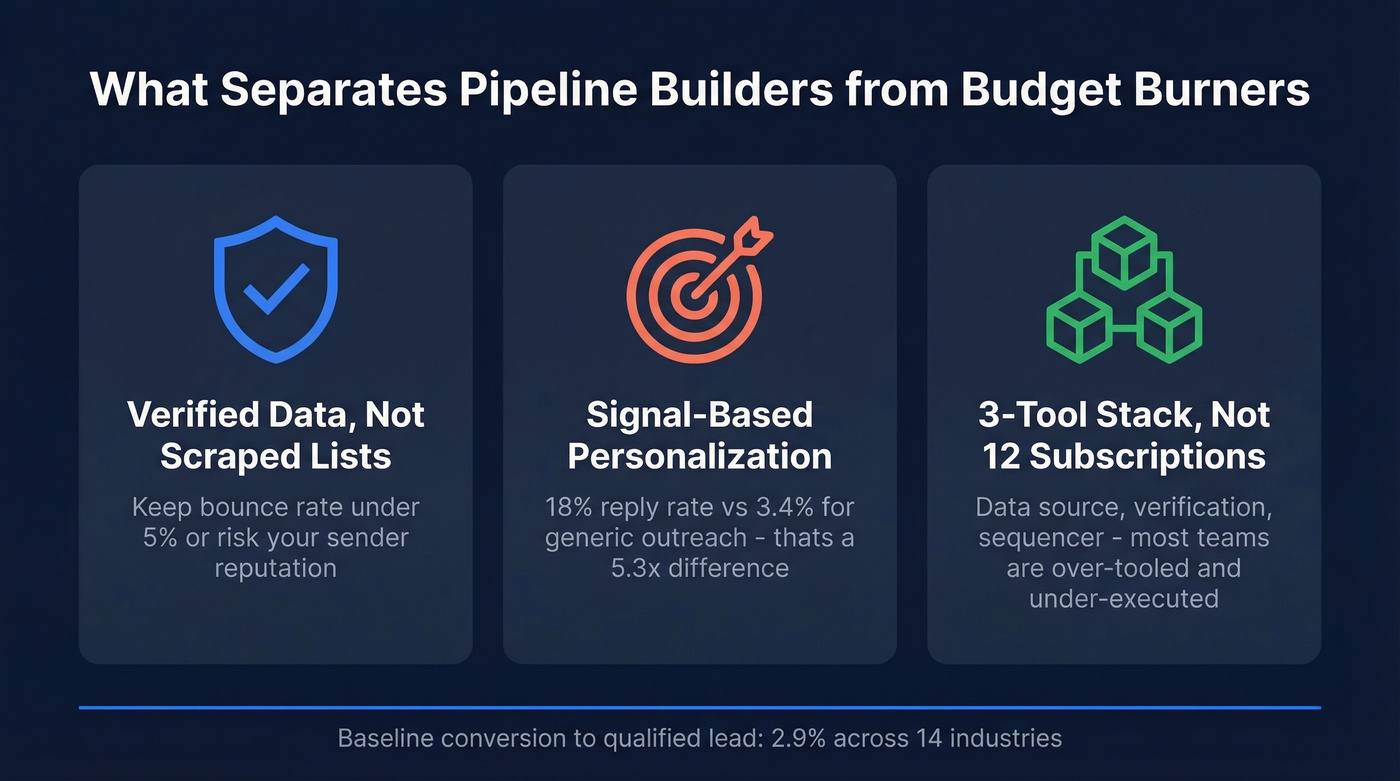
- Verified data, not scraped lists. If your bounce rate is above 5%, you're putting your sender reputation at risk with every campaign.
- Signal-based personalization, not "Hi {FirstName}" templates. Generic outreach pulls a 3.4% reply rate. Signal-based personalization hits 18%. That's a 5.3x difference from the same effort.
- A 3-tool stack, not 12 subscriptions. Data source, verification, sequencer. Most teams are over-tooled and under-executed.
The average conversion rate to a qualified lead is 2.9% across 14 industries and 100M+ datapoints. That's the baseline. Everything below is about beating it.
Why Lead Gen Is Harder Now
The playbook that worked in 2023 doesn't work in 2026. In a r/b2bmarketing thread, one poster described the current reality perfectly: cold emails pulling ~2% reply rates, connection requests ignored, ads expensive with low conversion - and asked for a buying-signal-based workflow that actually produces meetings.
Here's the thing: cold email isn't dead and inbound didn't stop working. The bar moved. Google and Microsoft's authentication mandates made SPF/DKIM/DMARC table stakes, inbox providers got smarter about filtering, and every buyer's inbox is more crowded than it was two years ago. The teams still producing consistent pipeline aren't doing anything exotic. They're executing the fundamentals with better data and sharper targeting.
Strategies to Generate Business Leads in 2026
Inbound: SEO, Content, and Lead Magnets
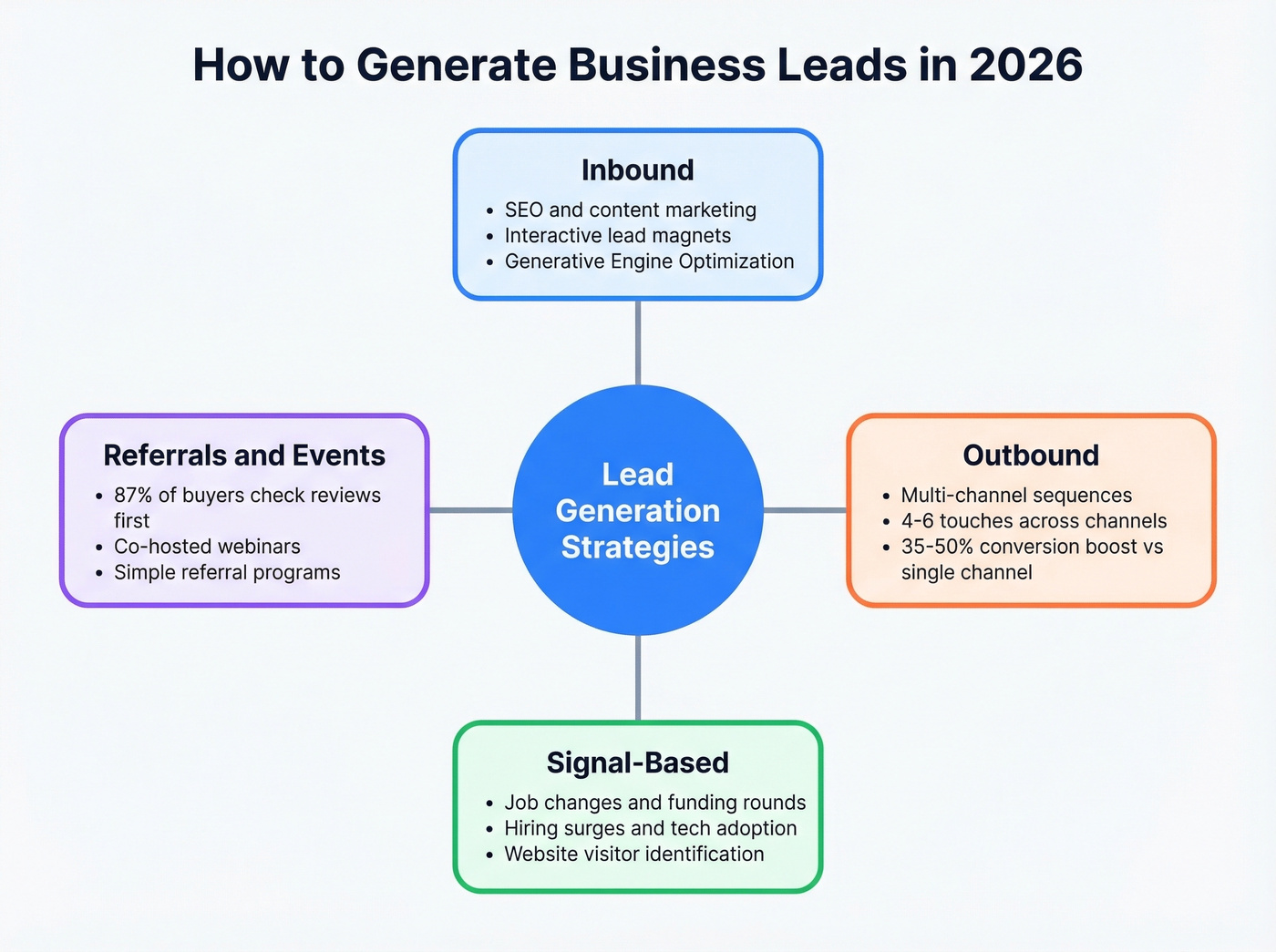
Content marketing is an accumulating asset. The first six months feel like shouting into a void, but by month twelve, organic traffic becomes your cheapest lead source. 81% of marketers say interactive content grabs attention more effectively than static assets - think ROI calculators, assessment tools, and benchmark quizzes rather than generic ebooks.
Specificity is what makes the difference. A lead magnet titled "The Complete Guide to Sales" converts terribly. One titled "Cold Email Deliverability Checklist for Outbound Teams" converts because it solves a problem the reader has right now. Match the magnet to the pain, not to a broad topic.
One 2026 consideration worth your attention: Generative Engine Optimization. As AI-assisted search tools like ChatGPT, Perplexity, and Google's AI Overviews reshape how buyers find solutions, structuring your content for AI citation - clear definitions, data-rich answers, authoritative sourcing - is becoming as important as traditional SEO.
Outbound: Cold Email and Multi-Channel Sequences
Single-channel outbound is a losing game. Multi-channel outreach - email plus calls plus social - boosts conversions 35-50% compared to email alone. That's not marginal. It's the difference between a pipeline and a spreadsheet of ignored messages.
70% of senders stop after one email, but 42% of replies come on follow-ups. Most reps quit right before the conversation starts. Build sequences with 4-6 touches across channels, and you'll outperform the majority of outbound teams by default.
Signal-Based Outreach
This is the biggest gap in most lead gen programs. Instead of blasting your entire TAM, you target the slice that's actively in-market. Job changes, funding rounds, hiring surges, technology adoption - these are buying signals that tell you someone has budget, authority, and a reason to talk.
Signal-based personalization templates hit ~18% average response rates versus 3.4% for generic outreach. That's not a rounding error. It's a fundamentally different approach. You layer buyer intent with job role and company growth signals to build lists of people who are actually ready to buy, rather than spraying thousands of contacts and hoping a few stick.
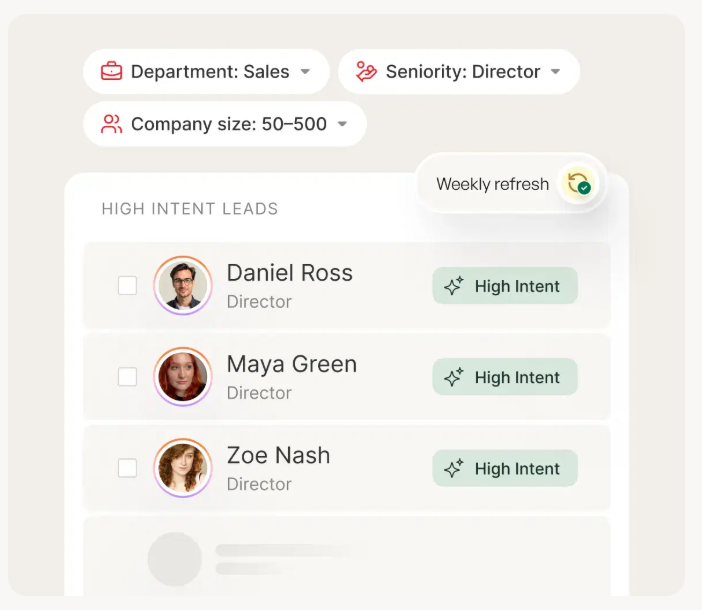
Don't overlook your own website traffic, either. Company-level visitor identification tools like Leadfeeder and RB2B reveal which accounts are researching your solution before they ever fill out a form. Pairing website intent with outbound targeting is one of the highest-ROI plays available right now.
Referrals, Partnerships, and Events
For SMBs especially, referrals remain the highest-conversion channel. 87% of B2B decision makers look for honest reviews before purchasing, which means your existing customers' word carries more weight than any ad. Build a simple referral program with one clear ask, one simple next step, and consistent follow-up - even an informal version will generate warmer leads than any cold channel.
Webinars work for B2B because they combine education with lead capture. Co-host with a complementary vendor and you double your audience without doubling your effort. Treat events as pipeline generators, not brand awareness exercises - have a clear next step for every attendee.
Cold Email Execution Deep-Dive
Let's get into the mechanics, because this is where most guides go vague and most teams go wrong.
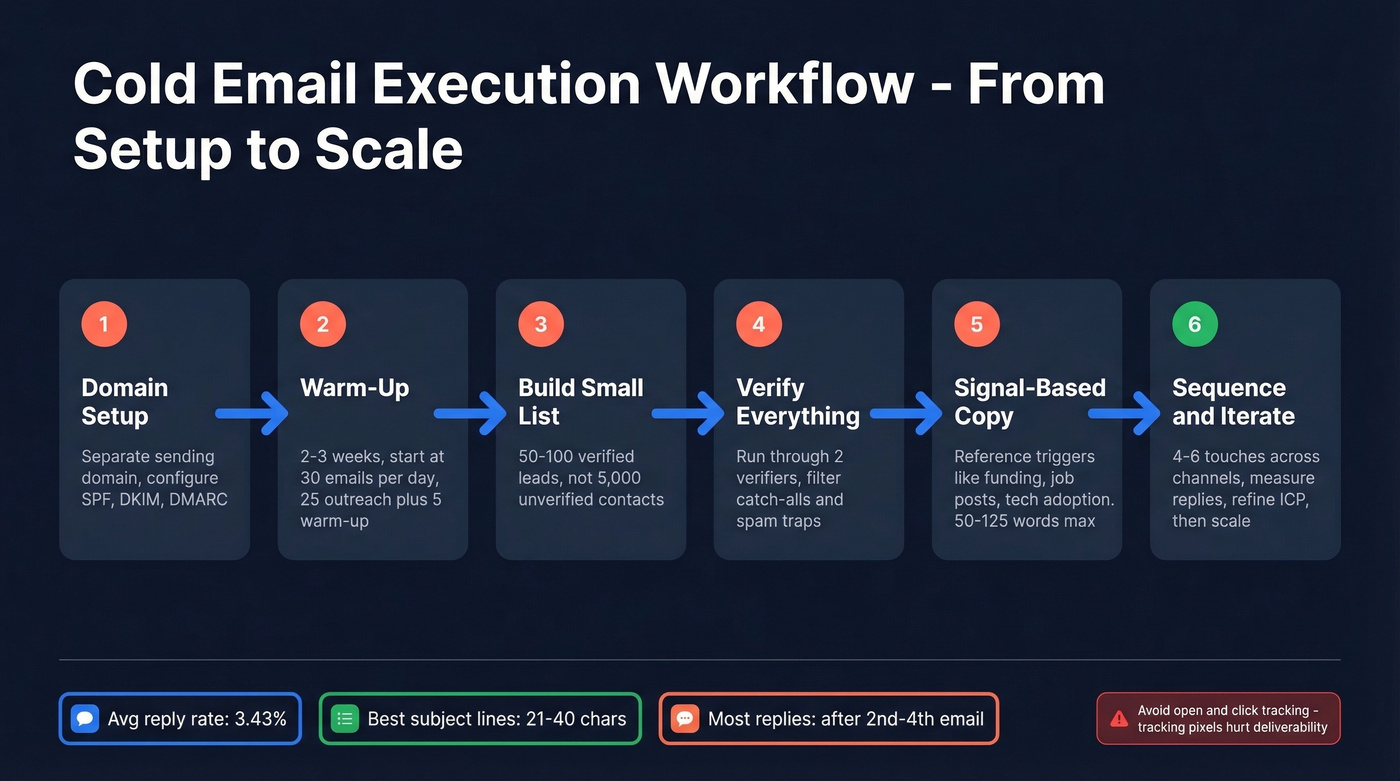
Deliverability infrastructure comes first. Don't send from your main domain. Set up a separate sending domain, configure SPF/DKIM/DMARC, and warm it up for 2-3 weeks before sending a single outreach email. Start at about 30 emails per day - 25 outreach plus 5 warm-up - and scale slowly from there. (If you need a deeper checklist, see our email deliverability guide.)
One warning straight from the r/sales trenches: avoid open and click tracking. Tracking pixels hurt deliverability because inbox providers flag them. It feels counterintuitive to fly blind on opens, but your reply rate is the metric that matters, and you'll get more replies with better deliverability.
Personalization has tiers. Basic personalization - first name, company name - doesn't move the needle anymore. Business-context personalization does. Reference a specific trigger: a recent funding round, a job posting that signals a pain point, a technology they just adopted. We've seen teams triple their reply rates just by switching from generic templates to trigger-based messaging. Well-targeted campaigns with this level of relevance regularly reach 15-30% reply rates. (For more examples, use these cold email follow-up templates.)
Aim for these benchmarks:
- Average cold email reply rate: 3.43%
- Average open rate: 27.7% (top performers hit 45%+)
- Best-performing subject lines: 21-40 characters
- Optimal email length: 50-125 words
- Most replies arrive after the 2nd-4th email
Start with 50-100 leads and iterate. Don't build a 5,000-person list on day one. Test your messaging, measure replies, refine your ICP targeting, then scale what works.

You just read that bounce rates above 5% torch your sender reputation. Prospeo's 5-step email verification delivers 98% accuracy - teams using it cut bounce rates from 35%+ to under 4% and tripled pipeline output.
Fix your data before you fix your messaging.
The Step Everyone Skips: Data Verification
You didn't write a bad email. You sent it to a bad list.
The practitioner workflow on r/sales is clear: export, clean, verify. And use at least two verifiers. Apollo's contact data is user-populated, not independently verified - and if you send unverified exports, bounce rates get ugly fast.
Before you sequence a single email, verify your list. Run every contact through a process that handles catch-all domains, removes spam traps, and filters honeypots. The free tier at Prospeo gives you 75 emails per month, enough to test whether better data actually improves your reply rates. It will. (If you're comparing tools, start with our email verification breakdown.)
Benchmarks: What Good Looks Like
Numbers without context are useless. Here's what the data says about lead gen performance in 2026.
| Metric | Benchmark | Source |
|---|---|---|
| Avg. conversion rate | 2.9% | Ruler Analytics (100M+ datapoints) |
| Avg. form rate | 1.7% | Ruler Analytics |
| Avg. call rate | 1.2% | Ruler Analytics |
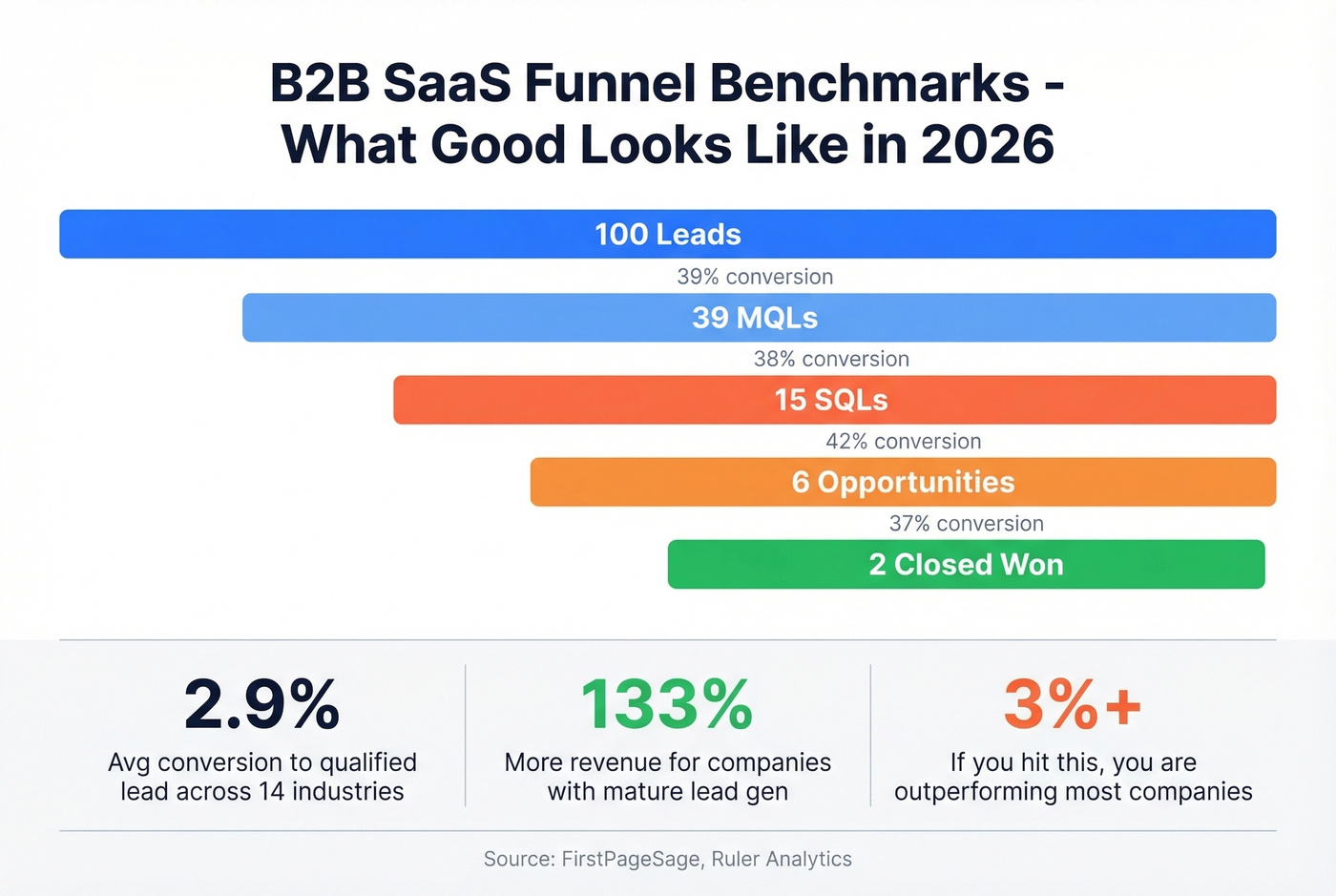
For B2B SaaS specifically, FirstPageSage's funnel benchmarks break down the full journey: Lead to MQL at 39%, MQL to SQL at 38%, SQL to Opportunity at 42%, SQL to Closed Won at 37%. That means roughly 10 out of every 100 leads become customers. Companies with mature lead gen processes generate 133% more revenue - the snowball effect of getting this right is massive.
If you're above 3% conversion to qualified lead, you're outperforming most companies. Below 2%? The problem is almost certainly data quality or targeting, not your messaging. (Compare against the average B2B lead conversion rate benchmarks.)
Real talk: If your average deal size is under $15K, you probably don't need a $30K/year data platform. A tight list of 200 verified contacts with signal-based personalization will outperform a 10,000-contact spray-and-pray campaign from an enterprise database every single time. Spend on accuracy, not volume.
Mistakes That Kill Your Pipeline
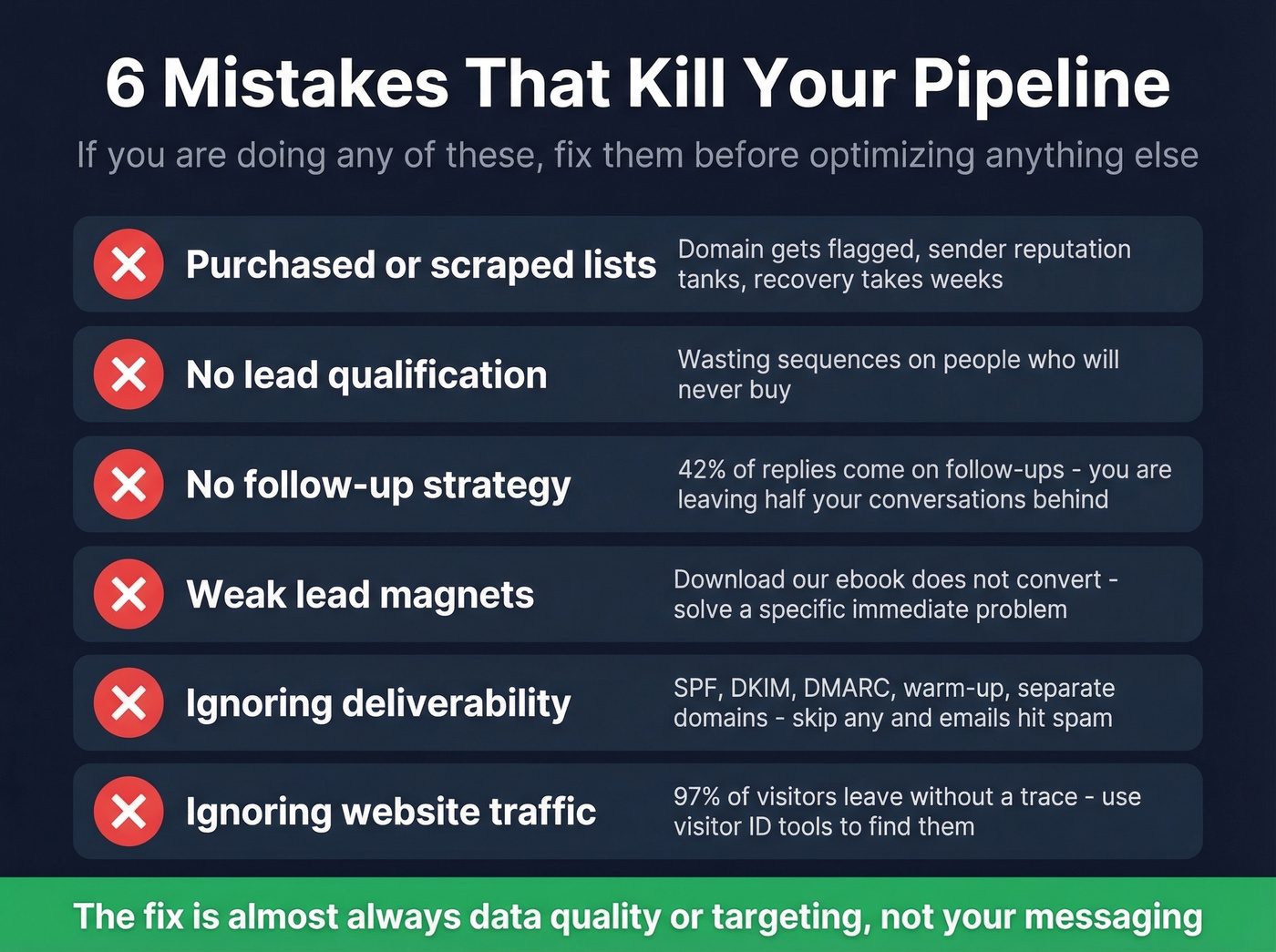
- Relying on purchased or scraped lists. Your domain gets flagged, your sender reputation tanks, and recovery takes weeks. Build or verify your own lists. (If you're tempted, read is it illegal to buy email lists.)
- No lead qualification. Sending to anyone with a pulse wastes sequences on people who'll never buy. Define your ICP tightly and filter ruthlessly. (A simple lead scoring model fixes this fast.)
- No follow-up strategy. 42% of replies come on follow-ups. If you're sending one email and moving on, you're leaving nearly half your potential conversations on the table.
- Weak lead magnets. "Download our ebook" doesn't convert. Solve a specific, immediate problem.
- Ignoring deliverability. SPF/DKIM/DMARC, warm-up, separate sending domains - skip any of these and your emails land in spam. Your brilliant copy doesn't matter if nobody sees it.
- Ignoring anonymous website traffic. Most sites convert around 2-3% of visitors into qualified leads. The other 97% leave without a trace. Company-level visitor identification tools turn that invisible traffic into targetable accounts.
The Right Tool Stack
You need three categories: data + verification, email sequencing, and a CRM. Everything else is optional until you've maxed out those three. (If you're building your stack from scratch, start with these outbound lead generation tools.)
| Category | Tool | Starting Price | Key Strength |
|---|---|---|---|
| Data + Verification | Apollo.io | Free; ~$49-99/mo/user | Large DB, user-contributed |
| Data + Verification | ZoomInfo | ~$15-40K/year | Enterprise-grade, high cost |
| Sequencing | Instantly | ~$30-97/mo | High-volume cold email |
| Sequencing | Lemlist | ~$32-129/mo/user | Multi-channel built in |
| CRM | HubSpot | Free; paid from ~$20/mo/seat | Best free CRM for SMBs |
| CRM | Salesforce | ~$25-300+/user/mo | Enterprise workflows |
| Enrichment | Clay | Free; ~$149-800/mo | Custom data pipelines |
| Automation | Zapier | Free; $19.99/mo | Connects everything |
Skip tools that hide pricing behind a "talk to sales" gate unless you're genuinely enterprise-scale. Self-serve platforms with transparent pricing and no annual contracts exist now - and at ~$0.01 per verified email, they often deliver higher accuracy than the incumbents at a fraction of the cost. For teams under 20 reps, that's the smarter bet.

Signal-based outreach hits 18% reply rates, but only if you can actually find the right contacts at the right time. Prospeo layers buyer intent across 15,000 topics with job change, funding, and hiring signals - all refreshed every 7 days, not 6 weeks.
Target in-market buyers at $0.01 per verified email.
FAQ
What's the difference between B2B and B2C lead generation?
B2B targets decision-makers at companies with longer sales cycles and higher deal values, typically $5K-$500K+. B2C targets individual consumers at higher volume with shorter cycles. The tools overlap, but B2B requires account-level research, multi-threading across buying committees, and email verification that B2C doesn't.
How can I generate leads for free?
Start with content marketing, SEO, referrals, and networking - these cost time, not money. For outbound, free tiers on tools like Prospeo (75 verified emails/month) and HubSpot CRM let you test cold email without spending a dollar. Build a list of 50 ICP contacts, verify them, and iterate on messaging before you invest in paid tools.
How long before lead gen efforts produce results?
Outbound can produce meetings within one to two weeks if your data and messaging are solid. Inbound through SEO typically takes three to six months to build momentum. Most B2B sales take 1-3 months to close after first contact, so plan your pipeline expectations accordingly.
What's a good lead conversion rate?
Across 14 industries, the average is 2.9%. Consistently above 3% means you're outperforming most companies. Below 2% usually signals a data quality or targeting problem - fix your list before rewriting your copy.
How do I find new leads on a tight budget?
Referrals and cold email to a tight, verified list of 50-100 ICP contacts. Start small, measure what works, and scale the winning channel. Avoid spreading budget across five channels simultaneously - that's how you burn cash without learning anything.