

How to Get Clients for Your Staffing Agency: The Data-Backed Playbook
It's Monday morning. You've got two conversations in your CRM - one's gone cold, the other's "still deciding." Meanwhile, the agency down the street just signed three new MSAs this quarter. The difference isn't hustle. It's systems.
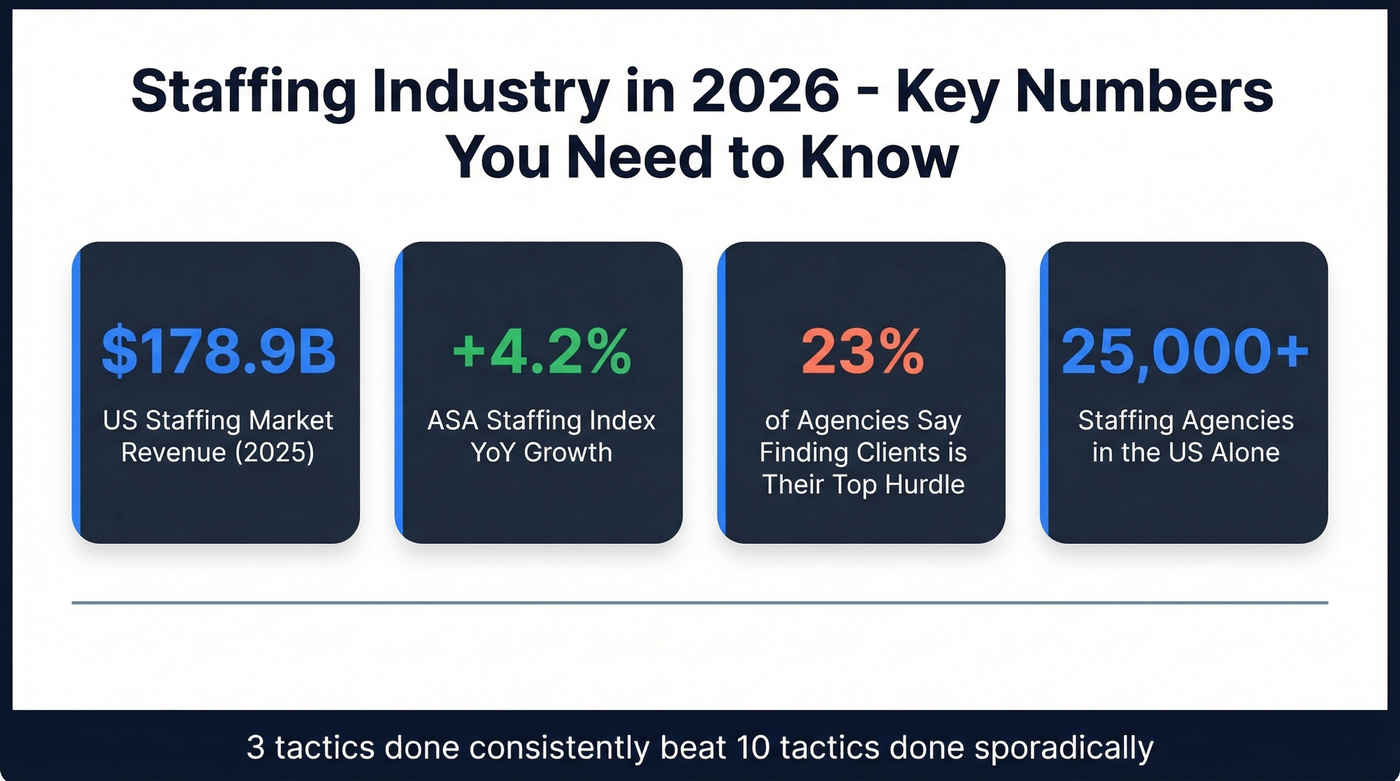
Figuring out how to get clients for a staffing agency has never been more competitive - or more systematizable. The US staffing market generated $178.9B in 2025, with 2% growth forecast for 2026 and the ASA Staffing Index running 4.2% above last year. There's money on the table. But 23% of staffing agencies say finding new clients is their biggest hurdle - up 7 percentage points year-over-year. Three tactics executed consistently with clean data beat ten tactics done sporadically. Let's build the system.
The Short Version
If you take nothing else from this article, do these three things:
- Pick a niche with measurable demand. Finance & accounting and education are two of the highest-opportunity staffing sectors heading into 2026.
- Launch a formal referral program. 86% of fast-growth agencies have one. If you don't, you're leaving your easiest revenue channel on the table.
That's the skeleton. Now let's put muscle on it.
Define Your Niche and ICP
There are over 25,000 staffing agencies in the US alone. If you're pitching "we do staffing" to everyone, you're competing on price against all of them. You'll lose.
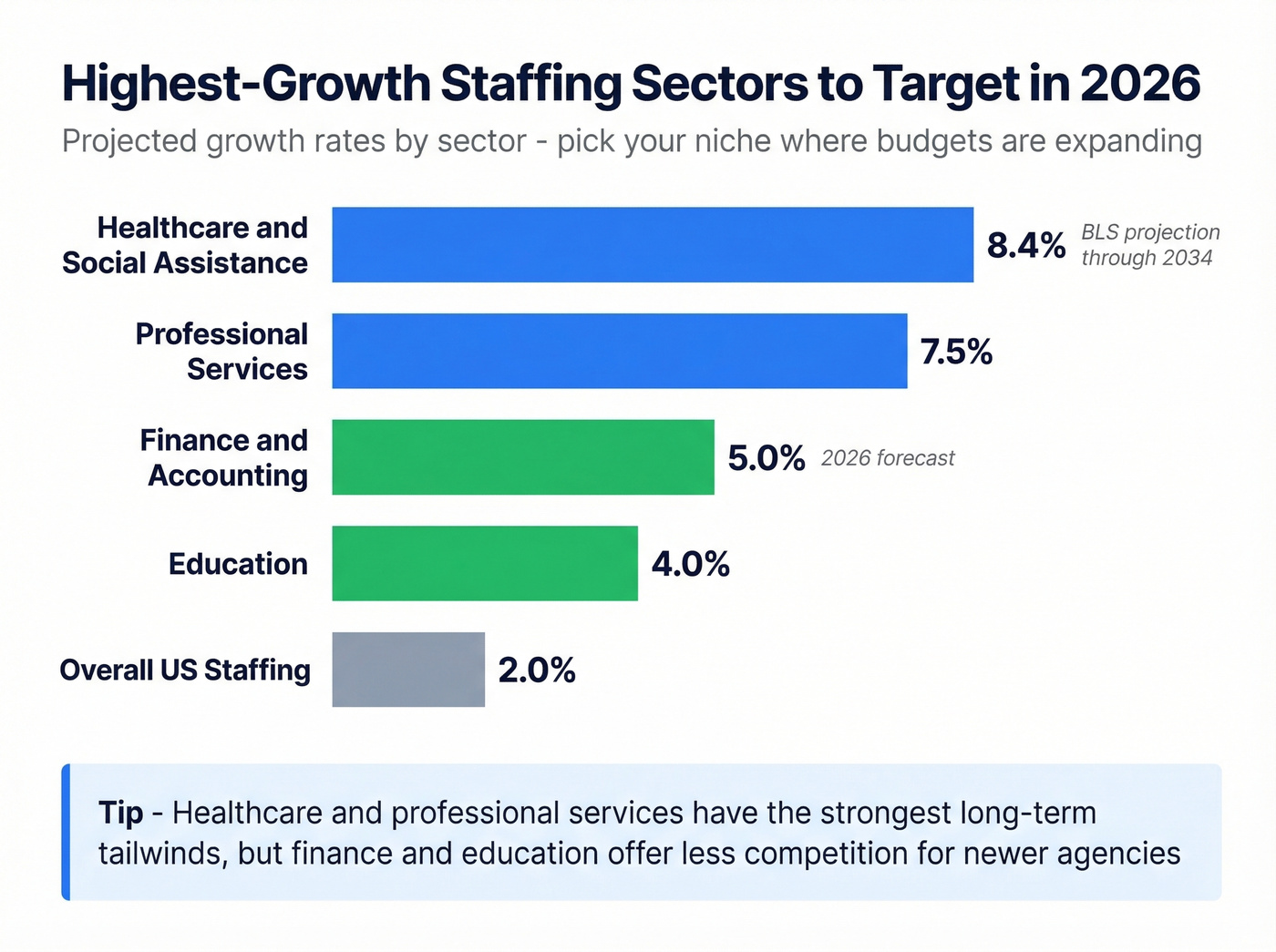
The BLS projects healthcare and social assistance growing 8.4% through 2034, with professional services at 7.5% over the same period - driven by AI and cybersecurity demand. For US staffing specifically, finance & accounting is forecast at 5% growth in 2026 and education at 4%. These aren't guesses. They're where hiring budgets are expanding. Your ICP worksheet should cover these dimensions:
- Company size - headcount range where you deliver best (50-500? 500-5,000?)
- Hiring volume - minimum annual hires that make the relationship profitable
- Budget signals - funded, growing, or replacing an underperforming agency
- Decision process - who signs the MSA? HR VP? Procurement? Hiring manager?
- Sector - your vertical specialty
- Geography - where you can actually service requisitions
- Agency attitude - do they already use agencies, or do you need to educate them?
Get specific. "Mid-market healthcare companies in the Southeast with 200+ employees and active agency relationships" is an ICP. "Companies that hire people" isn't.
Spotting Companies That Buy Staffing
Once you've defined your ICP, you need to find companies that already buy what you sell. Here's the signal taxonomy that actually works.
Job board signals. Scan major boards for listings that use language like "our client," "recruiting on behalf of," or obscured company names. These companies are already paying agencies. Compare multiple similar listings - repeated agency branding across roles and locations indicates an ongoing relationship you can compete for.
Career page fine print. Look for phrases like "preferred recruitment partners," "approved suppliers," or "unsolicited CVs from agencies will not be accepted." That last one actually tells you they receive enough agency outreach to need a policy - which means they use agencies.
Social behavior patterns. Watch for companies with talent acquisition or resourcing job titles popping up, posts thanking recruitment partners, or seasonal hiring spikes that signal agency dependency. These are soft signals, but they compound when layered with the harder ones above.
Competitor intelligence. Check rival agencies' websites for client logos, case studies, and sector pages. Phrases like "high-volume hiring across multiple sites" indicate embedded relationships. Those clients are your prospects.
Hiring triggers. New job postings, fresh funding rounds, leadership changes, and high-turnover roles all signal that a company needs talent fast. These are your outreach triggers - not cold pitches, but timely conversations.
Once you've identified target companies, you need verified contact data for the actual decision-makers. This is where most agencies waste time - manually searching, guessing email formats, bouncing messages. Prospeo's B2B database lets you filter 300M+ profiles by headcount growth, live job posting signals, and buyer intent, pull verified emails with 98% accuracy refreshed every 7 days, and start your sequence the same day.
Seven Tactics to Win Staffing Clients
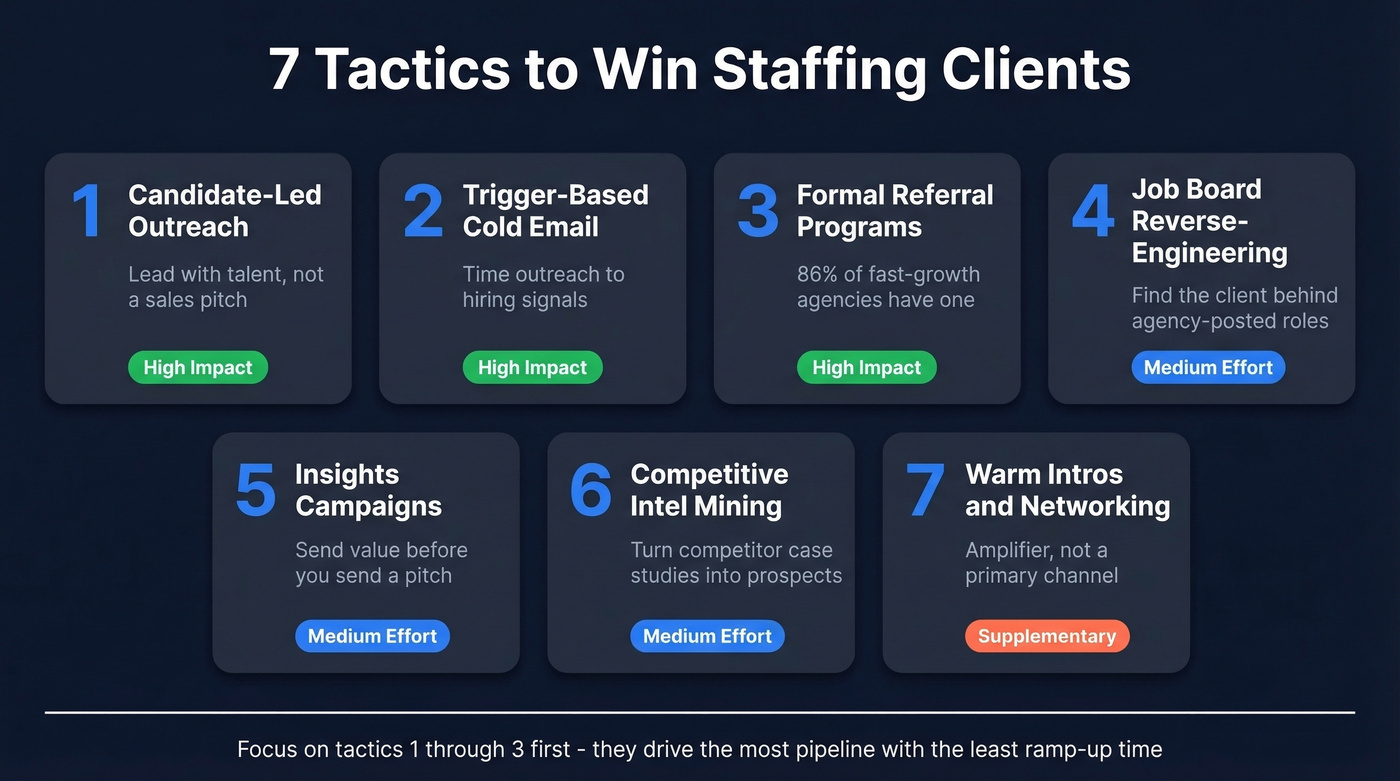
1. Candidate-Led Outreach
Use this if you've got strong candidates in your pipeline and want to open doors without a cold pitch. Lead with a "talent letter" - three real candidates with anonymized profiles, sent to a hiring manager who needs that exact skill set. The framing is "we have talent you can't easily find," not "can we work with you?" We've tested both talent letters and generic cold intros across dozens of agency campaigns. Talent letters open more doors, period.
You can also flip references into client conversations - every candidate's reference is a hiring manager at another company. During candidate intake, ask where they've been placed before and by which agencies. Every answer gives you a company that buys staffing services and an agency you're competing against.
Skip this if you don't have a candidate bench worth showcasing yet. Build your talent pool first.
2. Trigger-Based Cold Email
The best staffing cold emails aren't cold at all. They're timed to a hiring signal - a new job posting, a funding round, a leadership change. "I noticed you're hiring three DevOps engineers this month" is a conversation starter. "We're a staffing agency, let's chat" is noise.
3. Formal Referral Programs
86% of fast-growth agencies have formal referral programs, compared to just 60% of no-growth agencies. 71% of fast-growth firms rate referrals "extremely important." The data is unambiguous.
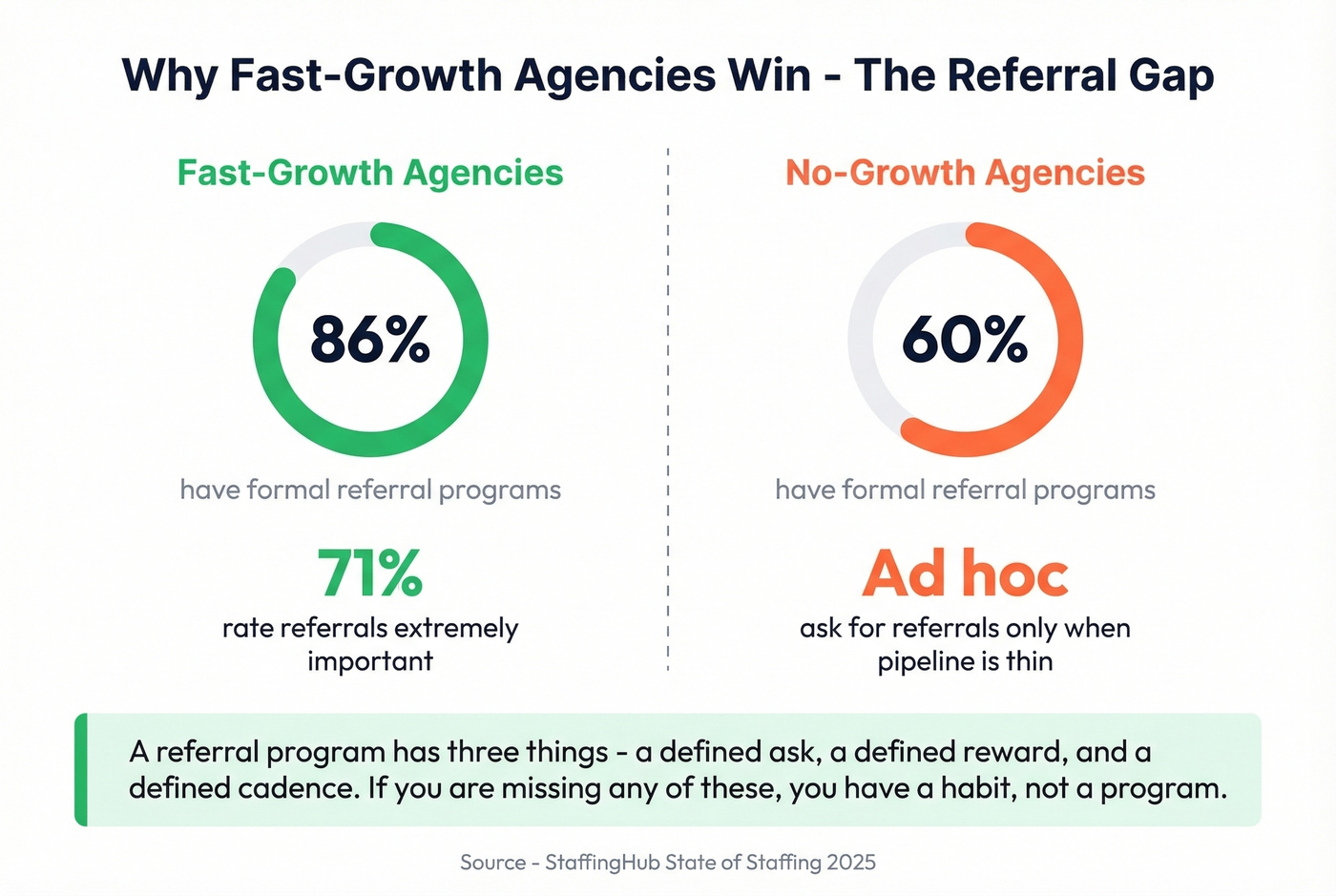
The common mistake is treating referrals as informal. "Hey, know anyone who's hiring?" isn't a program. A program has a defined ask, a defined reward, and a defined cadence. Ask after every successful placement, not once a quarter when pipeline is thin. Don't limit referral asks to happy clients either - prospects who said no due to timing or budget still know other hiring managers.
4. Job Board Reverse-Engineering
Find the end client behind agency-posted roles. When you see "recruiting on behalf of a leading financial services firm in Chicago," cross-reference the job description, location, and requirements against company career pages. Multiple similar listings from different agencies often point to the same client - one that's clearly open to agency partnerships.
5. Insights Campaigns
Send value before you send a pitch. Pull salary benchmarking data for a prospect's sector, package it in a clean one-page PDF, and email it with zero ask. Next week, send executive moves at their competitors. The week after, a market outlook snippet. By the time you pitch, you're a known quantity - a market expert, not another agency begging for a meeting.
One agency consultant on r/Recruitment described this as their highest-converting BD play. Another in the same thread tested ads with a £200 budget - 39 paid clicks, 6,000 impressions - and called the results mostly meaningless. Paid social is a brand play for staffing, not a client acquisition channel.
6. Competitive Intelligence Mining
Your competitors' websites are prospecting goldmines. Quick checklist:
- Client logos on homepage or "about" page
- Case studies naming industries, company sizes, and outcomes
- Testimonials with named companies or titles
- Sector pages listing specific verticals served
- Press releases announcing new partnerships
If a competitor's case study says "reduced time-to-fill by 40% for a 500-person manufacturing company in Ohio," you now know that company uses agencies and cares about speed. Build your pitch accordingly.
7. Warm Intros and Networking
Here's the thing: networking is supplementary, not primary. Conferences and warm intros are amplifiers for a system that already works. They aren't the system itself. We've seen agencies spend 20 hours a month at events and come back with business cards that never convert. That's a hobby, not a strategy. Use networking to accelerate deals already in motion - not to replace the outbound engine you should've built months ago.
Cold Email Templates for Staffing Sales
Templates are starting points, not scripts. Customize every one with a hiring signal, a candidate angle, or a market insight. Keep every email body under 150 words and use the AIDA structure: Attention, Interest, Desire, Action.
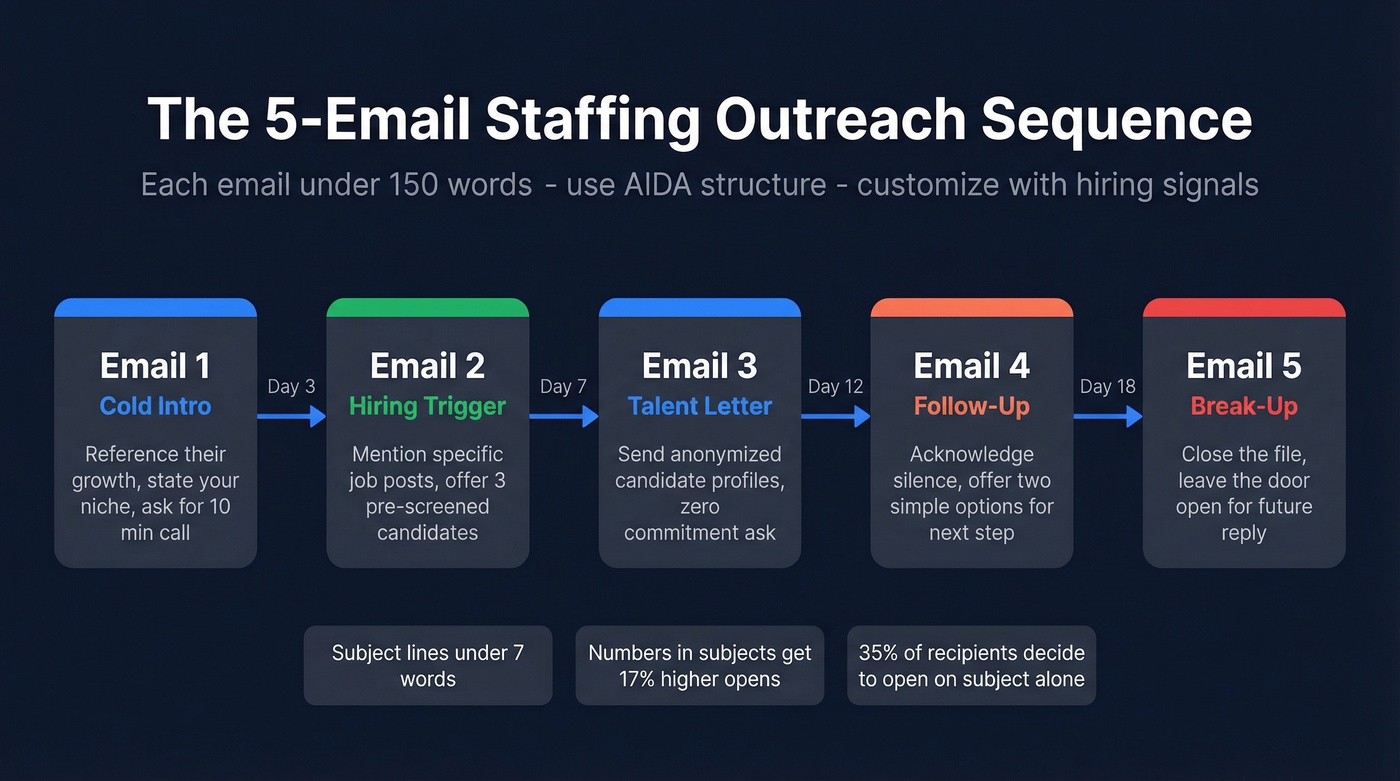
Subject line rules: keep them under 7 words, include numbers when possible - they get 17% higher open rates - and remember that 35% of recipients decide to open based on the subject line alone.
Template 1 - Cold Intro
Subject: Quick question about [Company]'s hiring
Hi [First Name],
[Company] keeps coming up in our [niche] research - looks like you're growing the team. We specialize in [niche] across [region] and typically cut time-to-fill by [X]% for similar companies.
Worth a 10-minute call to see if there's a fit?
Template 2 - Hiring Trigger
Subject: 3 [role type] candidates for [Company]
Hi [First Name],
I saw [Company] posted [X roles] this month on [job board]. We specialize in [niche] and currently have three pre-screened candidates with [specific skill/experience].
Would it make sense to share their profiles? Takes 2 minutes to review.
Template 3 - Talent Letter
Subject: [Niche] talent brief - [Month] 2026
Hi [First Name],
We work with [niche] professionals across [region]. This month, three standout candidates hit our desk - [brief anonymized descriptions].
If any of these profiles match an open or upcoming need, I'll send full details. No commitment needed.
Template 4 - No-Response Follow-Up
Subject: Quick question, [First Name]
Hi [First Name],
I reached out last week about [niche] talent for [Company]. Totally understand if the timing's off.
Two options: (1) a 10-minute call this week, or (2) I'll check back next quarter. Which works better?
Template 5 - Break-Up Email
Subject: Should I close your file?
Hi [First Name],
I've reached out a few times about [niche] staffing for [Company]. No response tells me this isn't a priority right now - totally fair.
I'll close your file for now. If hiring needs change, reply to this thread and I'll pick it right back up.
Bonus: "We Already Have a Vendor" Response
Hi [First Name],
Totally get it - most of our clients started as someone else's. We're not looking to replace your current partner. But when overflow hits or a niche role stalls, having a backup agency already vetted saves weeks.
Happy to stay on your radar. Mind if I check in next quarter?
Your cadence should run 8-12 touchpoints over 3-4 weeks, mixing email, phone, and social touches. It takes 3-8 call attempts just to reach a prospect. Most agencies give up after two. Don't be most agencies.

You just learned how to spot companies that buy staffing services. Now you need verified emails for the decision-makers. Prospeo's database lets you filter by headcount growth, live job postings, and buyer intent - then pull 98% accurate emails refreshed every 7 days. At $0.01 per email, one signed MSA pays for years of prospecting.
Stop guessing email formats. Start booking MSA conversations today.
Build a Pipeline, Not a Prayer List
If you're not tracking conversion rates at every stage, you don't have a pipeline - you have a prayer list. Here are the stages that matter:
Contacted -> Replied -> Meeting Booked -> Proposal Sent -> MSA Signed -> First Req -> First Fill
And here's what realistic conversion looks like:
| Metric | Average Team | Top Team |
|---|---|---|
| Reply rate | <10% | 10-15% |
| Meeting booked | 2-3% | 6-10% |
| Call attempts to reach | 5-8 | 3-5 |
| Touchpoints per deal | 12+ | 8-12 |
The gap between average and top isn't talent - it's targeting and follow-through. Top teams send fewer, better emails to more qualified prospects. They follow up more consistently. They use verified data so they're not wasting touches on dead addresses. We've tested both single-channel and multi-channel sequences, and the difference is stark: multi-channel converts 2-3x better.
Hot take: if your average client is worth under $40K annually, you probably don't need a $30K ZoomInfo contract. You need 50 verified emails, a good sequence, and the discipline to follow up 12 times.
The Tech Stack Without the Enterprise Price Tag
You don't need $30K/year tools to run effective BD. Here's what a lean staffing business development stack actually costs:
| Category | Tools | ~Monthly Cost |
|---|---|---|
| B2B data + verification | Prospeo | Free-$39/mo |
| ATS/CRM | Bullhorn, Recruiterflow | $50-150/user/mo |
| Email sequencing | Smartlead, Instantly, Lemlist | $30-100/mo |
| Enterprise data | ZoomInfo | $1,250-3,300/mo |
Total stack cost if you're smart about it: $100-300/month. That's less than one placement fee. At roughly $0.01 per verified email versus ZoomInfo's ~$1 per lead, the cost difference is 100x - and the data refreshes weekly instead of every 4-6 weeks. Native integrations with Salesforce, HubSpot, Smartlead, Instantly, and Lemlist mean contacts flow straight into your sequences without manual exports.
Five Mistakes That Kill Your Pipeline
No niche. Trying to serve everyone means you compete on price against 25,000+ agencies. Specialize or get commoditized.
Sending outreach from unverified lists. If your list is six months old, you're burning your domain and don't even know it. Verify every email before you send. (If you need a process, start with an email bounce rate baseline.)
No follow-up cadence. Most agencies give up after one or two touches. It takes 8-12 touchpoints to book a meeting. Build the cadence and stick to it. Use proven sales follow-up templates so reps don't improvise.
Selling before leading with value. "We're a great staffing agency" is a pitch. "Here are three candidates who match your open DevOps roles" is value. Lead with insight, not ego.
Ignoring existing clients. Expanding an existing account costs less and closes faster than winning a new logo. If you're not actively mining your current clients for new departments, locations, and hiring managers, you're leaving revenue on the table.
What Fast-Growth Agencies Do Differently
Fast-growth agencies - defined as 21%+ revenue growth - aren't just working harder. They're investing differently. 62% plan new software purchases this year, compared to 37% of the broader industry. AI adoption has hit 61%, up from 48% in 2024, and the use cases are practical: 70% of fast-growth firms use AI for candidate qualification versus 51% overall, and 60% use it for candidate-client matching. Compliance automation runs at 57% versus 37% for the rest of the industry.
Meanwhile, 27% of agencies reported revenue contraction in 2024. The gap between winners and losers is widening, and the dividing line is technology adoption and systematic BD - not headcount or years in business.
Real talk: if you're still running BD off spreadsheets and gut feel, you're on the wrong side of that gap. Start by tightening your sales prospecting techniques and tracking funnel metrics weekly.
Fast-growth staffing agencies run systems, not spray-and-pray. Prospeo gives you the trigger signals - funding rounds, job postings, headcount growth - layered with 30+ filters so your talent letters and cold emails land with the right VP of HR, not a dead inbox. 15,000+ companies already use it to build pipeline.
Build your staffing client list in minutes, not weeks.
Staffing Client Acquisition FAQ
How long does it take to land your first staffing client?
Plan for 3-6 months from first outreach to signed MSA and first fill. The sales cycle involves building trust, proving candidate quality, and navigating procurement. Most agencies don't profit until year three - front-load your pipeline building so you're not scrambling later.
What's the best channel for staffing business development?
Candidate-led outreach and trigger-based cold email consistently outperform cold calling alone. Multi-channel sequences combining email, phone, and social touches convert 2-3x better than single-channel efforts. Tie every touch to a hiring signal, not a generic pitch.
How many touchpoints does it take to book a meeting?
Plan for 8-12 touchpoints over 3-4 weeks. It takes 3-8 call attempts just to reach a prospect. Top teams book meetings at a 6-10% rate with tight targeting, while average teams sit at 2-3%. Persistence paired with relevance is the formula.
Do I need expensive tools to find staffing clients?
No. A complete BD stack runs $100-300/month. Free tiers on tools like Prospeo give you enough verified contacts to test your first outreach sequence on real hiring managers before you spend a dollar. Scale your tools after your first five placements, not before.
Should I specialize in one industry or stay generalist?
Specialize. Healthcare, finance & accounting, and education are high-opportunity niches heading into 2026. Generalist agencies compete on price against 25,000+ firms - that's a race to the bottom you won't win.