

How to Handle Objections in Sales: 20+ Examples That Actually Work
A RevOps lead we know ran a call audit last quarter. Out of 200 recorded cold calls, reps faced the same five objections over and over - and fumbled them differently every time. No shared playbook, no consistent framework, just 200 reps improvising against predictable resistance.
Here's what makes that expensive: 96% of prospects research your company before they ever talk to a rep, and 71% prefer doing that research independently. They're informed, skeptical, and short on patience. Deals that close within 50 days hit a 47% win rate; drag past that window and it drops to 20%. Every botched objection extends the cycle. Every extended cycle kills your odds.
You don't need 50 scripts. You need 5.
The Only 5 Objections That Matter
Gong analyzed 300M+ cold calls and found that just five objections account for 74% of everything reps hear. They fall into three categories:
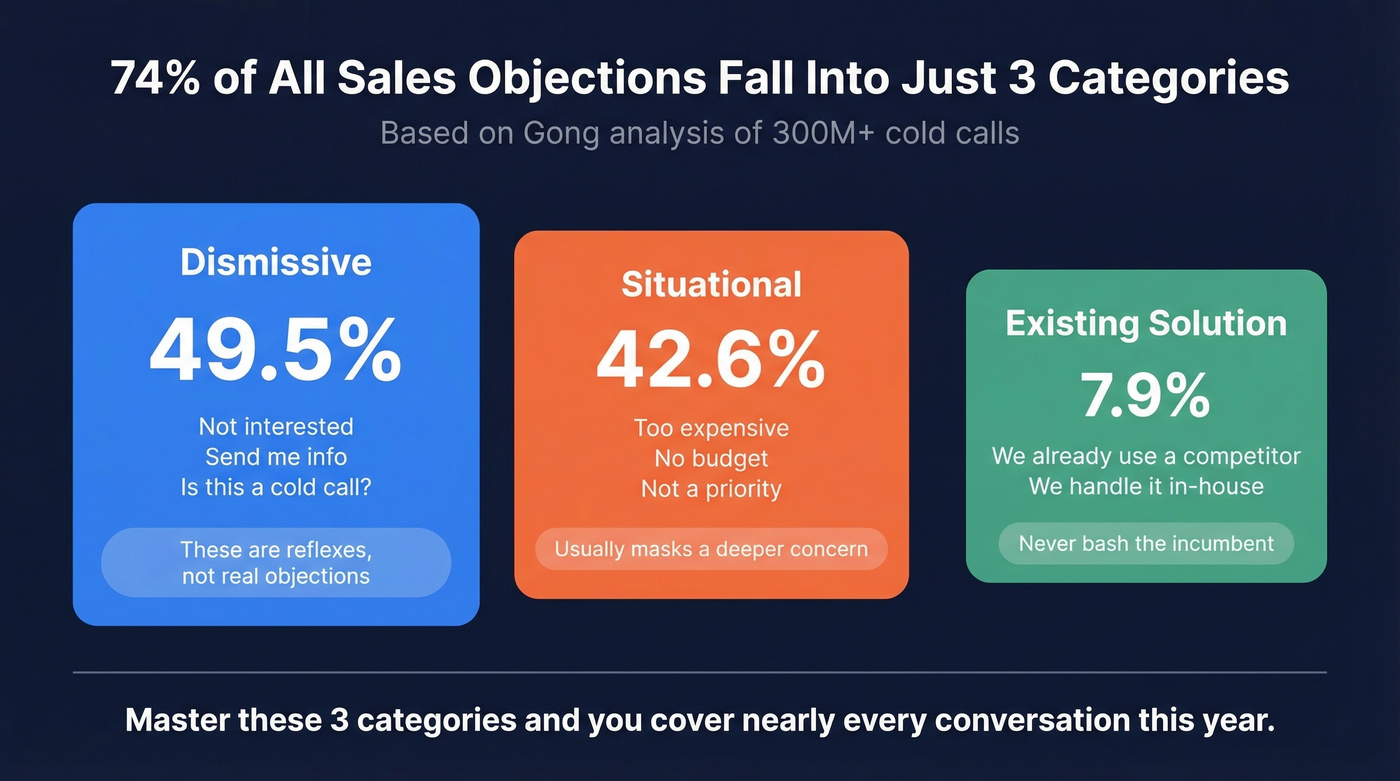
- Dismissive objections (49.5%) - "Not interested," "Send me info," "Is this a cold call?" These aren't real objections. They're reflexes.
- Situational objections (42.6%) - "Too expensive," "No budget," "Not a priority." These sound specific but usually mask a deeper concern.
- Existing solution objections (7.9%) - "We already use [competitor]," "We handle it in-house." Never bash the incumbent. Surface a gap instead.
Master these three categories and you've covered nearly every conversation you'll have this year.
20+ Objection Examples With Responses
Dismissive Objections (49.5%)
These sting because they feel personal. They're not. A dismissive objection is a prospect's autopilot response - they've said "not interested" to the last six callers and you're number seven. The goal isn't to overcome the objection in a single sentence. It's to interrupt the pattern long enough to have a real conversation.
Objections are proof the prospect is still engaged. Silence is the dead end.
"Not interested."
Pure reflex. They decided before you finished your first sentence.
"That's completely fair - most people say that before they know why I'm calling. Can I ask you one quick question before I let you go?"
You're not fighting the objection. You're giving them permission to say no, which paradoxically keeps them on the line. One behavioral study on charitable giving found that adding "you're free to accept or refuse" language increased donations by 400% - the same principle lowers reactance on cold calls.
"Just send me some info."
The polite brush-off. They want you off the phone without confrontation.
"Happy to - but so I don't waste your time with a generic PDF, what's the one thing that would actually make you open it?"
If they give you a real answer, you've just uncovered a pain point. If they can't answer, they'll often admit they were just trying to end the call - and now you're in a real conversation.
"Is this a cold call?"
"100%. I figured being honest about that beats pretending we met at a conference. I'm calling because [specific trigger - hiring, funding round, tech stack change]. Does that land at all?"
The disarmingly blunt approach outperforms polished openers on cold calls. Prospects don't trust smooth. They trust direct.
"Now's not a good time."
"Totally get it. When's better - later today or tomorrow morning? I only need 90 seconds."
Don't accept the vague brush-off. Pin down a specific callback window. If they won't commit to a time, they're not busy - they're uninterested. Treat it like "not interested" and pivot to a pattern interrupt.
"We're not looking at anything new right now."
"That makes sense - most of the companies I talk to aren't actively looking. They just want to know what's changed in the space since they last evaluated. Would a 2-minute overview be worth it?"
This reframes the conversation from "buying" to "learning," which is a much smaller commitment.
"Can you call me back next quarter?"
"Absolutely. Before I do - what's happening next quarter that makes the timing better? I want to make sure I bring the right info when I call back."
Most reps just say "sure" and set a reminder. That's a mistake. Qualifying the callback gives you intel for the follow-up and tests whether "next quarter" is real or just another way to say "never."
"How did you get my number?"
"Your info's in our database - I'm reaching out because [specific reason tied to their role or company]. Does that context help?"
Don't get flustered. Acknowledge it directly, then pivot to relevance. The faster you get to "why you specifically," the faster the defensiveness fades.
Situational Objections (42.6%)
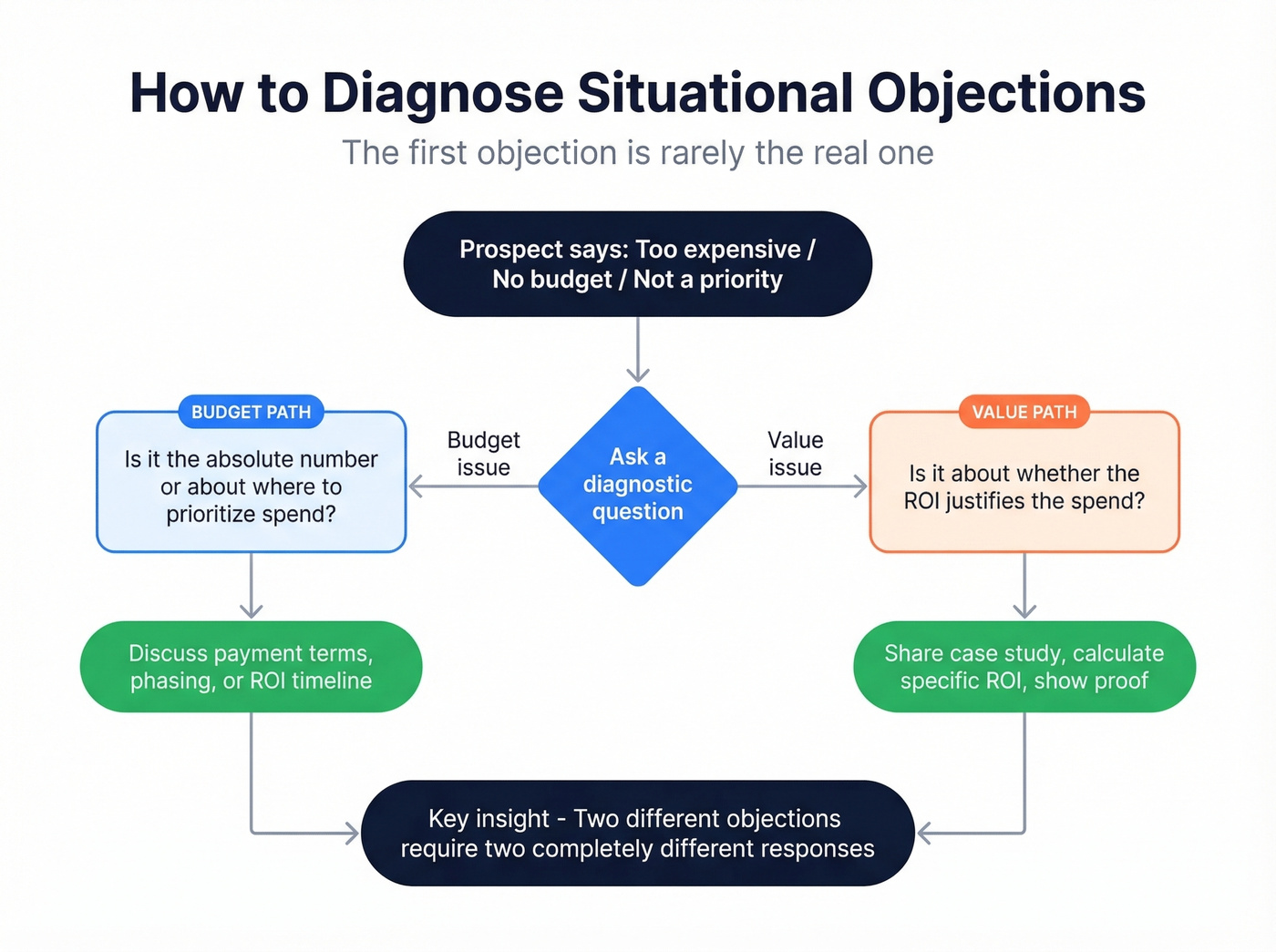
Situational objections feel more legitimate because they reference real constraints - budget, timing, priorities. But research shows the first objection is rarely the real one. "It's too expensive" might actually mean "I'm not sure this is durable enough to justify the cost." Your job is to diagnose, not defend.
"Too expensive."
"When you say too expensive - are we talking about the absolute number, or is it more about whether the ROI justifies the spend?"
This diagnostic question splits the objection into two very different conversations. If it's the absolute number, you're in a budget discussion. If it's ROI, you're in a value discussion. Those require completely different responses, and asking the question buys you time to figure out which one you're actually having.
"We don't have the budget."
"When you mention budget, are we talking zero flexibility, or is this about where to prioritize spend?"
Most reps hear "no budget" and retreat. But budget objections are often priority objections in disguise. If the prospect says "it's about prioritization," you've just been invited to make your case.
"Not a priority right now."
"Totally get it - what would need to change for this to become a priority? Is it a specific quarter, a trigger event, or something else?"
You're not pushing back. You're mapping their buying timeline. If they say "after Q3 planning," you've got a concrete follow-up date. If they can't articulate what would change, the real objection is something else entirely.
"I need to talk to my boss / get internal buy-in."
"Makes total sense. What do you think their biggest concern will be? I can put together a one-pager that addresses it directly - saves you from having to sell it internally."
Two things happen here: you surface the real decision-maker's likely objection, and you position yourself as an ally rather than an outsider. You're helping them win an internal conversation, not pressuring them to close.
"We just signed a new contract with someone else."
"Got it - how long is the term? Even if the timing's off now, it's worth having a comparison point ready for when renewal comes up. Most teams start evaluating 90 days before."
You're not asking them to break a contract. You're planting a seed for the renewal conversation and giving yourself a legitimate reason to follow up.
"Your competitor offered us a better deal."
"I'd be surprised if they didn't - we're not the cheapest option. The question is whether the gap in price is worth the gap in [specific differentiator: accuracy, support, integration]. What matters most to your team?"
Never compete on price alone. Redirect to value. If they insist it's purely about cost, this might not be your deal - and that's fine.
Existing Solution Objections (7.9%)
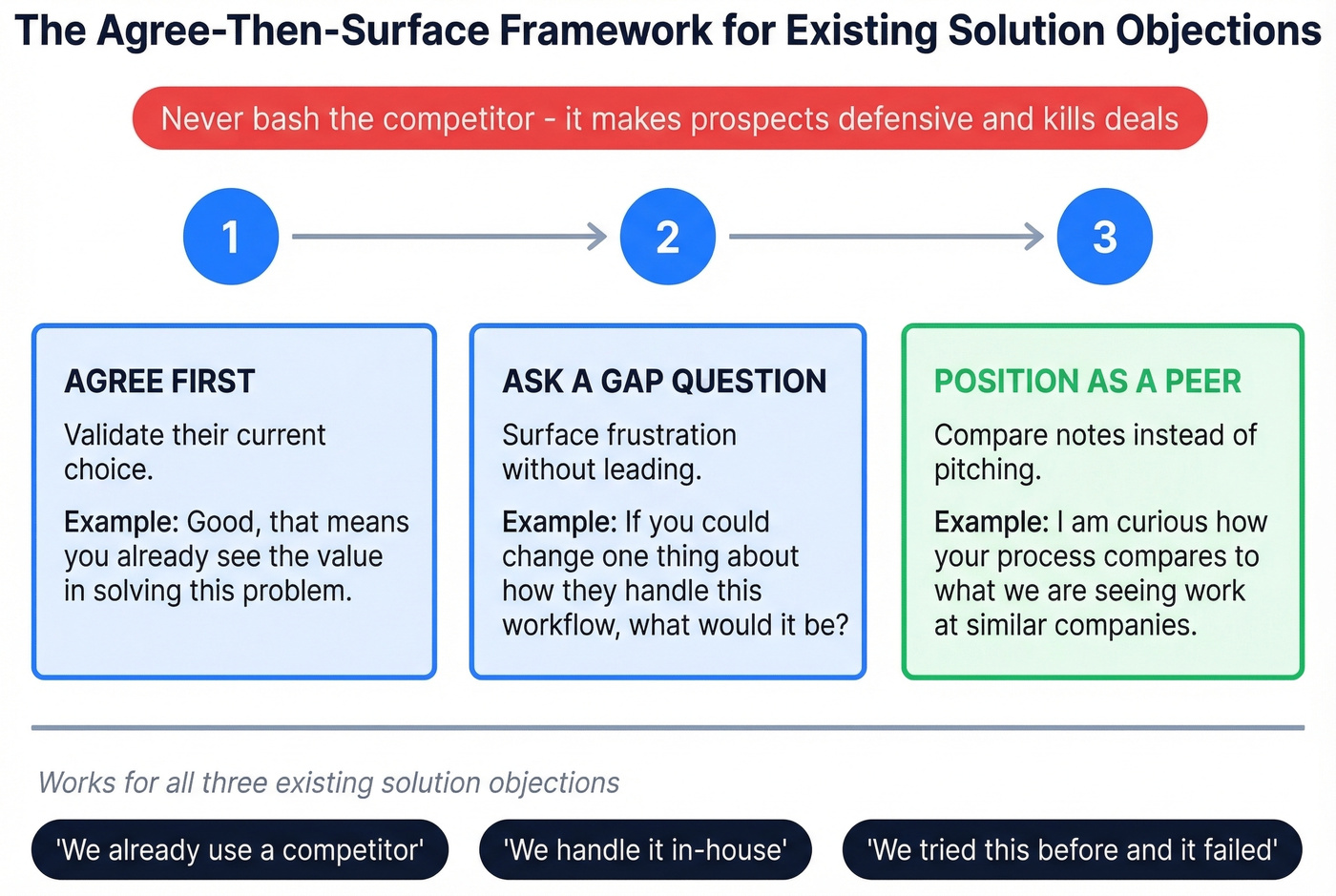
The rarest but trickiest category. The prospect has a tool or process they've invested in - emotionally and financially. Gong's data is clear: reps who criticize the prospect's current solution make them defensive and kill the deal. Never bash the competitor.
"We already use [competitor]."
"Good - that means you already see the value in solving this problem. Out of curiosity, if you could change one thing about how [competitor] handles [specific workflow], what would it be?"
You agree first, then ask a question that surfaces a gap. Most people have at least one frustration with their current tool. Once they articulate it, you've got an opening.
"We handle it in-house."
"That's impressive - most teams outsource this. What does your internal process look like? I'm curious how it compares to what we're seeing work at [similar company]."
This positions you as a peer, not a salesperson. You're comparing notes, not pitching.
"We're locked into a contract."
"Totally understand - when does it come up for renewal? In the meantime, would it be worth a quick look so you have a comparison point when that conversation happens?"
You're not asking them to switch today. You're asking them to look. That's a much smaller ask, and it keeps the door open.
"We tried something like this before and it didn't work."
"That's actually really helpful to know. What went wrong? I'd rather understand what failed than pretend it didn't happen - and I can tell you specifically how our approach is different."
Past failure creates the strongest resistance because it's rooted in experience, not assumption. Acknowledge it head-on. If you can diagnose why the previous solution failed and draw a clear line to how yours avoids the same pitfall, you've turned their worst objection into your best selling point.
"I've never heard of your company."
"Fair - we're not a household name yet. We work with [2-3 recognizable customers or a specific result]. Would it help if I sent over a case study from a company in your space?"
Social proof does the heavy lifting here. Don't defend your brand awareness - redirect to results.
What Top Reps Do Differently
Gong analyzed 67,149 sales calls and found something counterintuitive: the best objection handlers aren't smooth talkers. They're the ones who shut up longest.
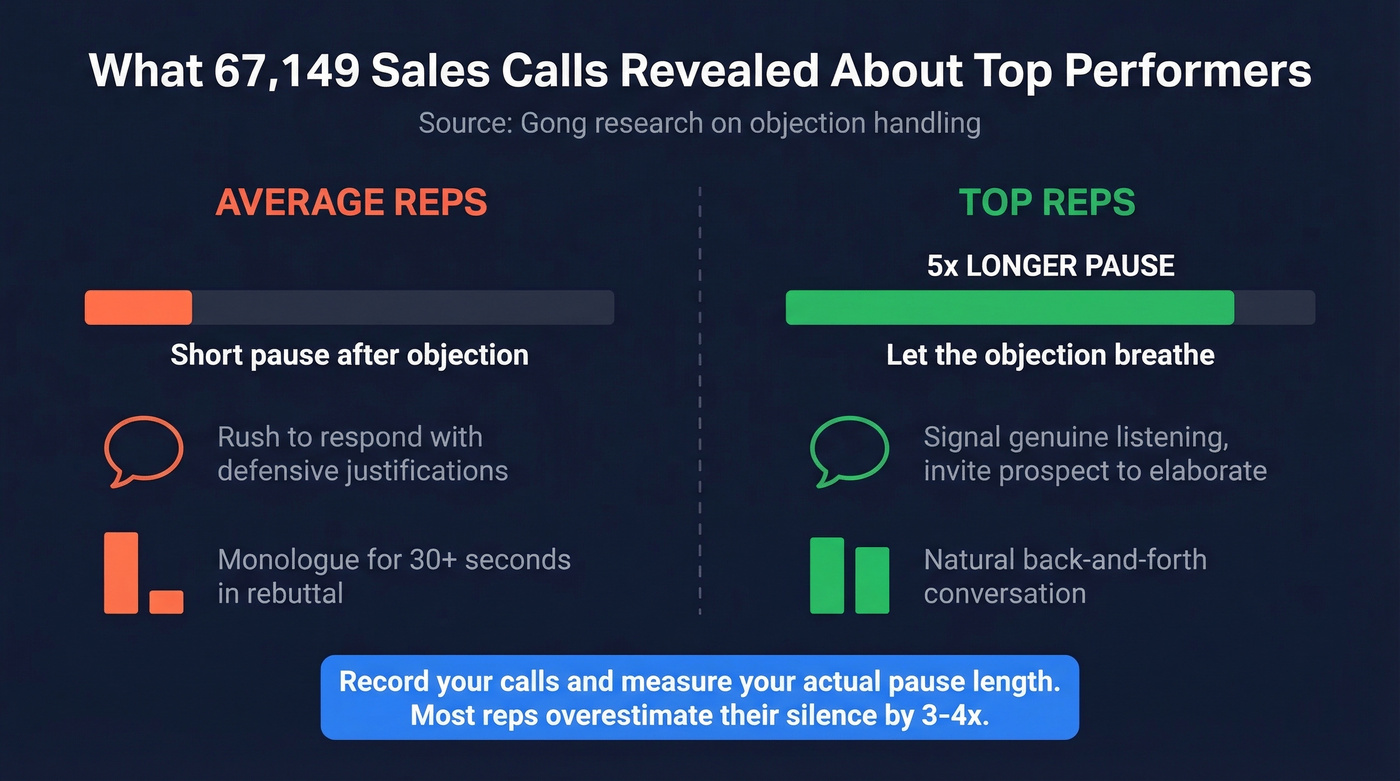
Top-performing reps pause 5x longer after hearing an objection than their average-performing peers. While most reps rush to respond - filling the silence with defensive justifications - the best reps let the objection breathe. That pause signals you're actually listening, and it gives the prospect space to elaborate on what they really mean.
The other pattern: conversational balance. Healthy calls feature natural back-and-forth between speakers, not a rep monologuing through a rebuttal. If you're talking for 30 seconds straight after an objection, you've already lost.
Here's the thing: record your calls and review how long you actually pause after objections. Most reps overestimate their silence by 3-4x. The data will humble you - and then it'll make you better.

Every fumbled objection extends your sales cycle - and deals past 50 days drop to a 20% win rate. The fastest way to recover? Stop wasting reps' time on bad numbers. Prospeo gives you 125M+ verified mobiles with a 30% pickup rate, so your team spends less time chasing dead leads and more time practicing these frameworks on real decision-makers.
Reach the right prospect on the first dial, not the fifth.
6 Objection-Handling Mistakes That Kill Deals
Research on objection-handling failures identifies six anti-patterns that consistently tank deals. Most reps are guilty of at least three.
Believing the first objection is real. "Too expensive" is almost never about price alone. It's durability, ROI uncertainty, or fear of switching costs. Take the first objection at face value and you'll solve the wrong problem.
Rushing to address without understanding. The moment a prospect says "no budget," most reps launch into ROI justification. Slow down. Ask a diagnostic question first.
Arguing or getting defensive. The second you push back on a prospect's concern, you've turned a conversation into a debate. Debates have winners and losers. Sales conversations have buyers and sellers.
Offering discounts too soon. If you're discounting every time someone says "too expensive," you're negotiating against yourself. Discounts before diagnosis devalue your product and signal that your original price was inflated - which raises trust issues that are harder to fix than the pricing objection itself.
Answering too quickly. Related to the 5x pause data: jumping in with a response before the prospect finishes signals that you've heard this before and have a canned answer. Even if you do, the prospect shouldn't feel that.
Ignoring the emotional layer. Objections aren't purely rational. Fear of change, internal politics, past bad experiences with similar tools - these drive resistance as much as budget or timing. Acknowledge the feeling before addressing the logic.
When to Walk Away
Sometimes the best objection handling is recognizing when to stop. If a prospect cycles through the same objections three times, or if every response generates a new, unrelated pushback, the deal is fundamentally misaligned. Continuing to "handle" objections at that point isn't persistence - it's desperation, and the prospect can feel it.
The confident move: "It sounds like the timing isn't right. I'll follow up in six months - if anything changes before then, you've got my number." Walking away preserves the relationship and, counterintuitively, often brings the prospect back later.
4 Proven Objection-Handling Frameworks
| Framework | Best For | Complexity | When to Use |
|---|---|---|---|
| Agree - Incentivize - Test Drive | Cold calls, general | Low | Default for most situations |
| Feel-Felt-Found | Warm leads, relationship sales | Low | Mid-funnel, rapport-heavy |
| LAER | Enterprise, multi-stakeholder | High | Complex deals, procurement |
| 4 Ps (Pause-Probe-Provide-Prove) | Discovery, demos | Medium | When you need evidence |
If you only learn one, make it Agree - Incentivize - Test Drive. It works across the widest range of scenarios: agree with the objection, incentivize continued conversation by surfacing curiosity, then sell a look - not the product.
LAER (Listen-Acknowledge-Explore-Respond) is the enterprise workhorse. When you're dealing with a CFO who cares about ROI risk and a CTO who cares about integration security in the same deal, LAER's structured exploration phase helps you map each stakeholder's real concern before responding. 81% of revenue leaders say deals are more complex than they were two years ago - LAER fits that complexity.
Feel-Felt-Found works in warm conversations but sounds rehearsed on a cold call without heavy customization. If you catch yourself saying "I understand how you feel, others have felt the same way, and what they found was..." word-for-word, you've already lost the prospect's trust. Skip this one for outbound.
Responses by Sales Stage
Different stages surface different objection types. Matching your framework to the stage matters more than memorizing scripts.
Cold call - Dismissive objections dominate. Use the disarmingly blunt approach. Your only goal is earning 30 more seconds of conversation, not closing the deal. If you're rebuilding your outbound motion, start with these sales prospecting techniques.
Discovery - Situational objections surface here. "No budget," "not a priority," "not the right time." This is where diagnostic questions earn their keep. Don't pitch - probe.
Demo - Existing solution objections peak during demos because the prospect is actively comparing you to what they have. Sell the test drive. Don't ask them to commit; ask them to evaluate. Use a simple product demo checklist so you don’t miss the proof points.
Negotiation and procurement - Stakeholder-specific objections multiply. The CFO wants ROI proof. The CTO wants integration specs. Legal wants compliance guarantees. Procurement wants better terms. LAER is the right framework here because each stakeholder needs a different exploration path. A Sellible analysis of enterprise objections maps these stakeholder concerns in detail - worth bookmarking if you sell into organizations with formal buying committees. If you need to set a hard boundary, define your walk away point before the call.
The Objection You Can Prevent Before the Call
Every framework above assumes you're talking to the right person at a working number. That assumption fails more often than most teams admit.
We've watched this pattern play out dozens of times: a rep dials 20 numbers, 7 are disconnected, 4 go to voicemail for people who left the company months ago, and by the time they reach a live prospect on call #8, they sound defeated. That defeated tone triggers dismissive objections that have nothing to do with the pitch and everything to do with the rep's energy.
Bad contact data is the hidden objection generator. Meritt, an outbound agency, ran a 35% email bounce rate before switching to Prospeo. Bounces dropped under 4% and their connect rate tripled. That's the difference between reps who sound fresh and reps who sound like they've been rejected all morning. If you’re cleaning lists at scale, start with data enrichment services and track your email bounce rate.
Fix the data upstream and you'll hear fewer reflexive brush-offs. Not because the script changed, but because the rep showed up confident instead of frustrated.

Your reps hear "How did you get my number?" on every cold call. With Prospeo's 98% email accuracy and 7-day data refresh, you're reaching out with current, verified contact data - so you can pivot from defensiveness to relevance in seconds. 15,000+ companies trust Prospeo to power confident outbound.
Stop improvising against predictable objections with outdated data.
FAQ
What's the best framework for handling sales objections?
Agree - Incentivize - Test Drive works for most situations because it's simple and adapts to any objection type. For enterprise deals with multiple stakeholders, switch to LAER (Listen-Acknowledge-Explore-Respond) - its structured exploration phase handles competing concerns from different buyers.
How many objections do reps actually face?
Just 5 objections account for 74% of all resistance reps encounter, based on Gong's analysis of 300M+ cold calls. Master "not interested," "send me info," "too expensive," "no budget," and "we already use someone" - and you've covered three-quarters of every conversation.
How do you overcome objections on cold calls?
Dismissive objections ("not interested," "send me info") dominate cold calls - use disarmingly blunt transparency instead of a polished pitch. Give the prospect permission to say no, which paradoxically keeps them on the line. And verify your contact data before dialing so your energy stays high through the entire call block.
What are the most common sales objections in 2026?
The five most common based on 300M+ analyzed calls: "Not interested" and "Send me info" (dismissive, 49.5%), "Too expensive" and "No budget" (situational, 42.6%), and "We already use someone" (existing solution, 7.9%). Dismissive objections alone account for nearly half - meaning pattern interruption matters more than product knowledge.
Is there a repeatable process for overcoming objections?
Yes. Every effective response follows three steps: pause to signal you're listening, ask a diagnostic question to uncover the real concern, then respond to the actual objection rather than the surface-level one. Top reps pause 5x longer than average performers after hearing an objection, per Gong's analysis of 67,149 calls.