

How to Handle Rejection in Sales: Math, Scripts, and Science
It's 2:30 PM on a Tuesday. You've made 47 dials, had six conversations, and every single one ended with some version of "not interested." Your CRM looks like a graveyard of dispositioned leads. The motivational poster on the wall says "Every no gets you closer to a yes," and you want to throw your headset at it.
You're not alone. More than 70% of sales professionals report struggling with their mental health, and rejection is a major driver. The average cold call converts to a meeting just 4.82% of the time. That means for every 100 conversations, roughly 95 end in some form of "no."
Here's the thing: learning how to handle rejection in sales isn't about developing thick skin. It's a math problem, a skills problem, and sometimes a data problem. You need better numbers, better scripts, and better data - not another affirmation.
The Three Things That Actually Help
Calculate your personal rejection math. The funnel benchmarks below turn rejection from an emotional event into a predictable ratio. Once it's a number, it stops being personal.
Learn five objection responses cold. Scripts are below. Memorize them so you never freeze after a "no." Freezing is what makes rejection sting - not the word itself.
Fix your data. Some of what feels like "rejection" is actually bounced emails and disconnected numbers. Your outreach never arrived. That's a solvable problem, and we'll get into it.
Why Sales Rejection Hurts More Than It Should
"Just smile and dial" is advice from people who haven't made 100 cold calls in a day since 2008. Rejection genuinely hurts, and there's psychology behind it.
Research published in Frontiers in Psychology links rejection to social pain and negative affect, showing it can threaten four core psychological needs simultaneously: belonging, control, self-esteem, and meaningful existence. No wonder a bad afternoon on the phones can wreck your entire week.
Three cognitive biases make it worse:
Negativity bias means a single harsh "no" at 10 AM overshadows five productive conversations that afternoon. One rude prospect feels louder than three who booked demos.
Loss aversion means losing a deal you thought was close hurts roughly twice as much as winning a similar deal feels good. That pipeline deal that ghosted you after three meetings? It stings disproportionately because your brain treats lost opportunities as more significant than gained ones. We've seen reps spiral for days over a single lost deal worth less than their average close - the math doesn't justify the pain, but the brain doesn't care about math.
The ostrich effect is the sneakiest one. After a string of rejections, reps start avoiding the phone altogether - checking email, updating CRM notes, doing anything that isn't another dial. It feels productive. It isn't.
Understanding these mechanisms doesn't make rejection painless. But it does make it predictable. And predictable things are manageable.
Current Rejection Benchmarks
Let's turn feelings into numbers.
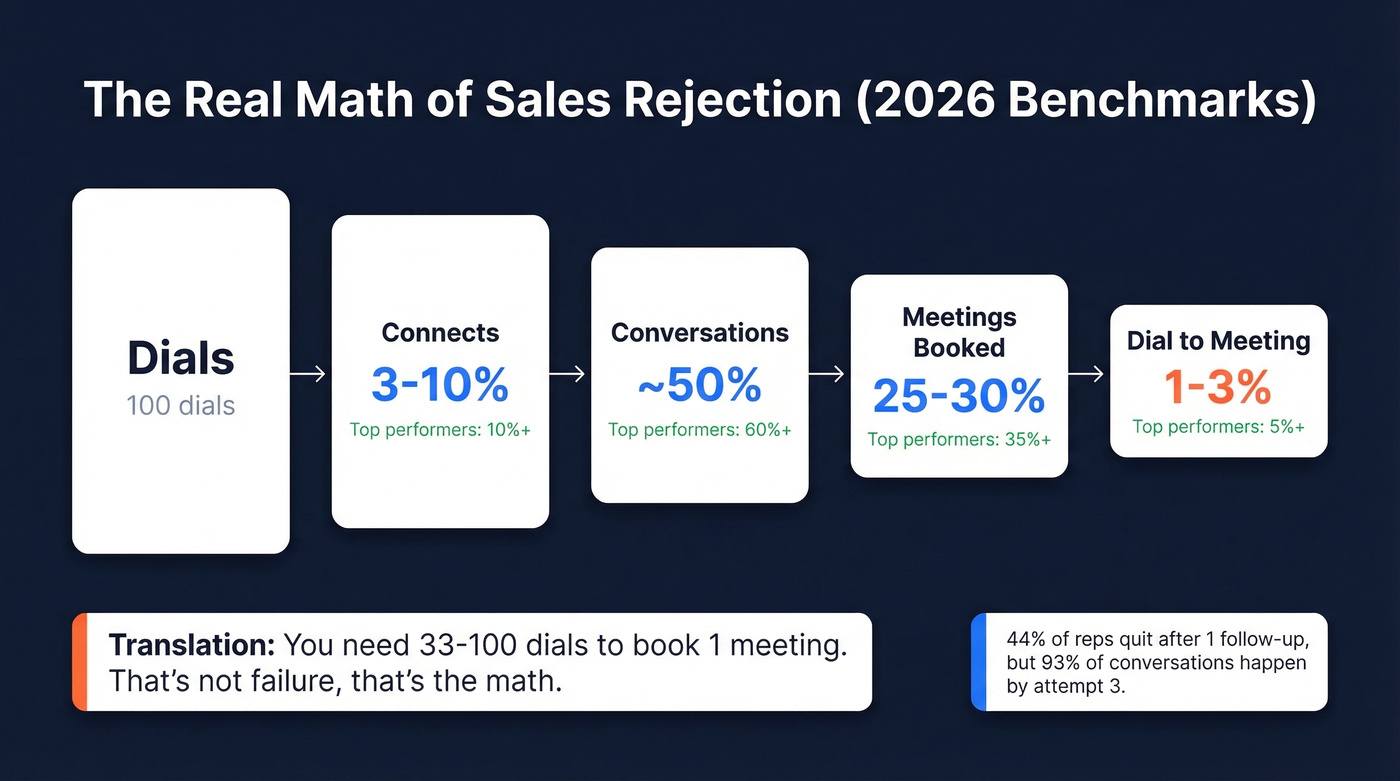
| Stage | Average Rate | Top Performers |
|---|---|---|
| Dial to Connect | 3-10% | 10%+ |
| Connect to Conversation | ~50% | 60%+ |
| Conversation to Meeting | 25-30% | 35%+ |
| Dial to Meeting | 1-3% | 5%+ |
| Attempts to Reach | ~8 calls | 3-5 calls |
Benchmarks from SalesHive. Call-length and call-attempt distribution data from the Cognism/WHAM 2026 report.
At a 1-3% dial-to-meeting rate, you need 33-100 dials to book a single meeting. That's not failure - that's the math of the channel. The average cold call lasts just 93 seconds, so you have less than two minutes to make your case.
Here's where it gets interesting: 93% of total conversations happen by the third call attempt. Five attempts capture 98.6%. Yet 44% of reps quit after a single follow-up. Nearly half the sales force is abandoning prospects right before the math starts working in their favor.
And prospects want to hear from you. 57% of C-level and VP buyers prefer phone contact, and 82% of C-level buyers accepted meetings after a series of contacts that started with a cold call. The phone works. You just have to survive the first 95 "no"s to get to the 5 "yes"s.
Not All "No"s Are Real Rejection
Before you work on your mindset, categorize what's actually happening when you hear "no." Dealing with rejection in sales starts with understanding which "no"s actually count.

True Rejection
The prospect evaluated your offer and declined. They understood the value prop, it wasn't right for them, and they said no. This is the only type that should prompt genuine reflection. A prospect who says no today might still refer you tomorrow - but only if you handled it with grace.
Objections (Solvable Concerns)
"We don't have budget right now" isn't a no - it's a "convince me." Objections are information dressed up as rejection. When you hear one, your job is to ask one more question, not to hang up. (If you want more talk tracks, see our sales tips guide.)
Gatekeeping
You never reached the decision-maker. An assistant screened you out, or you got routed to voicemail purgatory. This isn't personal - it's an access problem. Tightening your sales prospecting techniques can reduce how often you hit this wall.
Timing Mismatch
Right person, right company, wrong moment. They're mid-implementation on a competitor, or their budget cycle resets in Q3. A timing mismatch only becomes a lost deal if you stop calling. This is where a consistent cold calling system pays off.
Bad Data
This is the category most sales rejection tips ignore entirely. You dialed a disconnected number. Your email bounced. The prospect left the company six months ago. You weren't rejected - your outreach never arrived. Email non-responses fall here too: an email that lands in spam or hits an invalid address isn't a "no," it's noise. (Related: email bounce rate benchmarks and fixes.)
In our experience, this category is bigger than most teams realize. We've seen outbound programs where 30-35% of "rejections" were actually bounced emails and dead phone numbers - contacts that never received the outreach in the first place. Tools like Prospeo verify emails and phone numbers in real time, which cuts that phantom rejection rate dramatically. If you're evaluating vendors, start with these data enrichment services.


You just read that 30-35% of "rejections" are actually bounced emails and dead numbers - outreach that never arrived. Prospeo verifies emails and phone numbers in real time with 98% accuracy, so every dial and every send reaches a real person. Stop counting phantom rejections as real losses.
Replace bad data with verified contacts for $0.01 per email.
What to Say When They Say No
The math helps. But when you're on the phone and someone hits you with "I'm not interested," you need words, not statistics. Here are eight scenarios with plug-and-play responses.
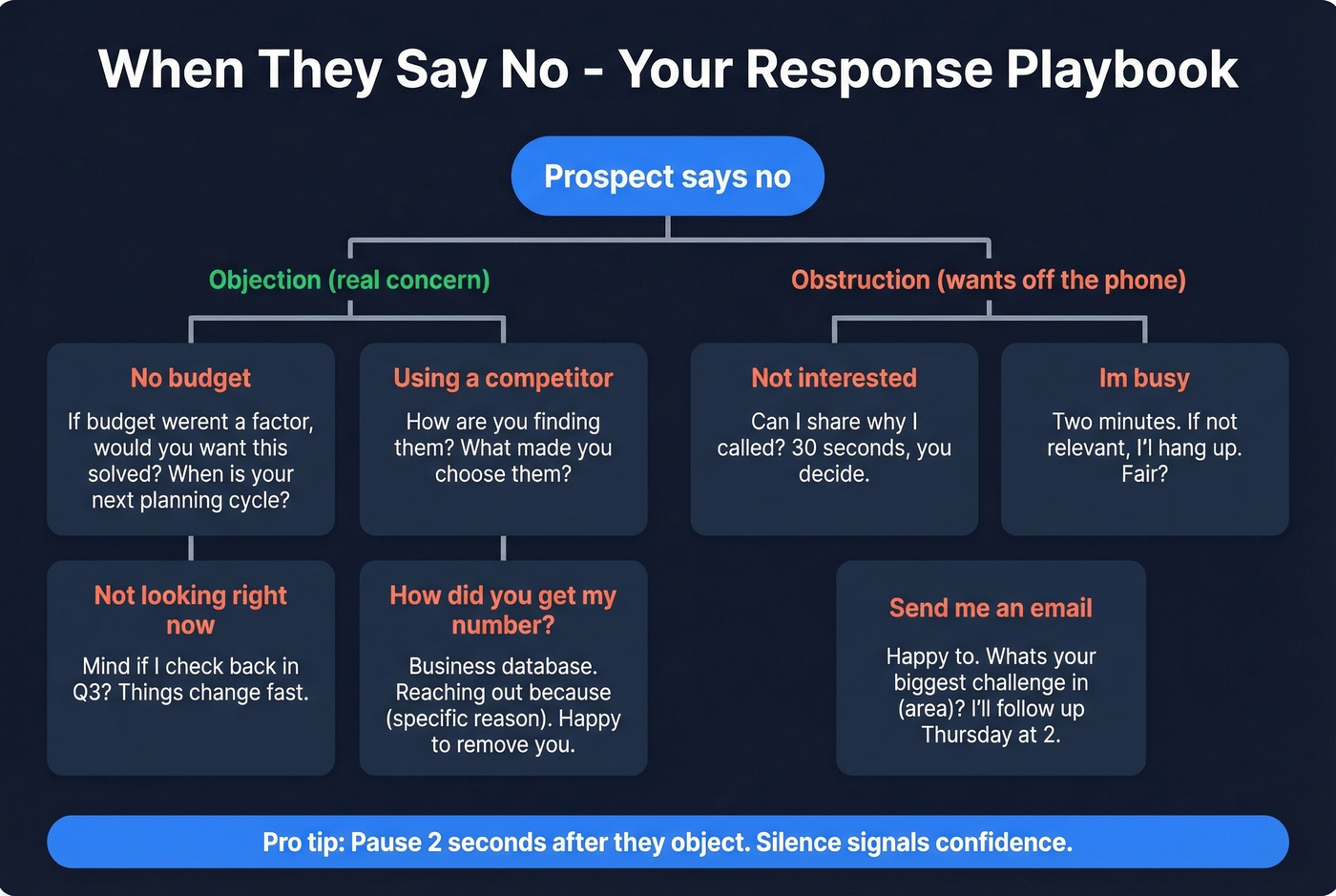
One important distinction first: objections are real concerns ("we don't have budget"). Obstructions are excuses to get off the phone ("I'm busy"). Both require different energy.
"I'm not interested." "You don't have to be interested right now. Can I quickly share why I'm calling, and you decide if it's relevant? 30 seconds." Permission-based and low-pressure. It keeps the door cracked.
"We're already using [competitor]." "That's great - how are you finding them? What made you choose them originally?" Curiosity beats defensiveness. You're learning what they value, which tells you exactly how to position your differentiator.
"I'm busy." "Totally understand. I'll take two minutes - if it's not relevant, just say so and I'll hang up. Fair?" Give them an explicit opt-out. Most people won't use it.
"Send me an email." "Happy to. So I send you something useful - what's the biggest challenge your team's dealing with in [area]? I'll follow up Thursday at 2." Pin down a specific follow-up date. "Send me an email" without a callback date is a polite dismissal. (You can also borrow a few sales follow-up templates.)
"We don't have budget." "Makes sense. Quick question: if budget weren't a factor, is this the kind of problem you'd want solved? ... When does your next planning cycle start?" Separate the money objection from the value objection.
"Call me back later." "Absolutely. When's good - next week, or next quarter? I'll put it in my calendar right now." Vague "later" is a brush-off. A specific date is a commitment.
"We're not looking right now." "Totally fair. Mind if I check back in [timeframe]? Things change fast, and I'd rather be the first call you think of when they do." Timing mismatch, not rejection. Get permission and set a reminder.
"How did you get my number?" "Your information is in our business database - same way most B2B outreach works. I'm reaching out because [specific reason]. If you'd prefer I remove your info, happy to do that." Transparent, no defensiveness. Pivot to value immediately.
Delivery matters as much as the words. Slow down after the prospect objects - a two-second pause signals confidence. Match their energy level. If they sound rushed, be concise. If they sound curious, expand.
What NOT to Do After a "No"
Three mistakes that turn a recoverable "no" into a burned bridge:
Don't argue. The moment you push back with "but you haven't even heard the full pitch," you've lost. Arguing with prospective customers destroys trust. You can ask questions. You can't debate.
Don't talk more. The instinct after rejection is to fill the silence with more features, more benefits, more words. Resist it. When someone says no, the best next move is a question, not a monologue.
Don't guilt-trip or badmouth competitors. "I can't believe you're staying with [competitor]" is a career-limiting move. If the prospect chose a competitor, respect the decision and keep the relationship warm for renewal season. A graceful exit preserves referral potential - the prospect who said no to you might recommend you to a colleague next quarter.
Building Long-Term Resilience
Handling individual rejections is a skill. Building long-term resilience is a system. Overcoming rejection in sales requires repeatable habits, not one-time pep talks. (If you want a deeper system, see resilience in sales.)
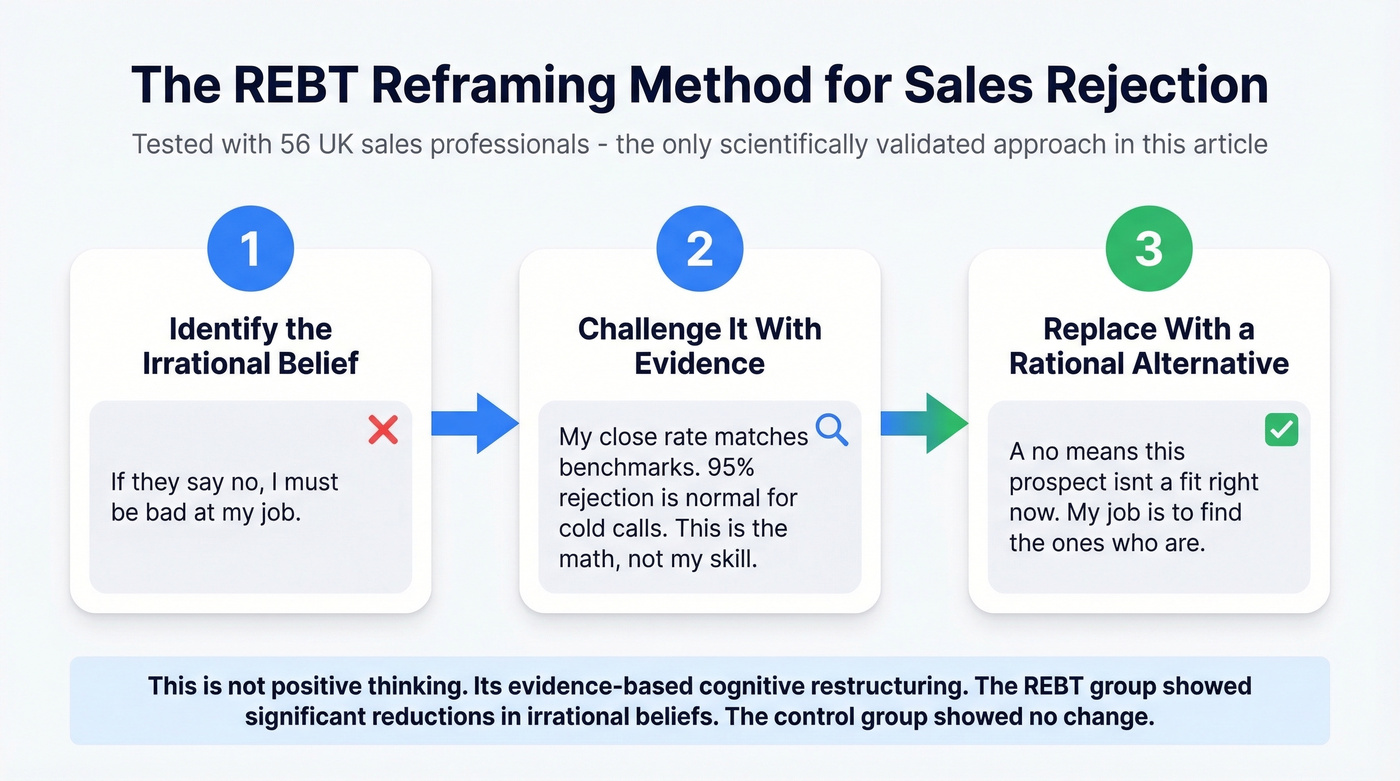
Reframing With the REBT Method
This is the only scientifically validated approach in this article, so pay attention. A 2024 study tested Rational Emotive Behaviour Therapy with 56 UK sales professionals using a pre-test/post-test experimental design with a control group. The REBT group showed significant reductions in irrational beliefs and emotional reactivity. The control group showed no change.
The practical translation: identify your irrational belief ("If they say no, I'm bad at my job"), challenge it with evidence (your close rate is in line with benchmarks - 95% rejection is normal), and replace it with a rational alternative ("A no means this prospect isn't a fit right now. My job is to find the ones who are."). This isn't positive thinking. It's evidence-based cognitive restructuring, and it's the most effective framework for reframing rejection that actually has research behind it.
The Rejection Quota
Instead of setting a daily close target, set a daily rejection target. Need 15 rejections before lunch. When each "no" becomes progress toward your quota, the emotional charge flips. You stop dreading the phone and start chasing the number.
Rejection Reps
Jia Jiang spent 100 days deliberately seeking rejection to desensitize himself. Adapt this for sales: spend 15 minutes each morning making asks you expect to fail. Request the VP meeting you'd normally skip. Ask for a referral from a prospect who said no last month. The goal isn't to win - it's to make rejection boring.
Activity Metrics Over Outcomes
Track dials, conversations, and follow-ups - not just meetings booked. Shift your scoreboard to things you control. When your daily metric is "50 dials and 8 conversations," a bad day means you didn't pick up the phone enough, not that you're a bad salesperson.
One habit that works: record every "no thanks" in a spreadsheet as a data point, not an emotional event. Over time, the pattern becomes clear - your numbers are your numbers, and rejection is just the cost of doing business. (If you want a cleaner framework, use sales activities examples as your baseline.)
Let's be honest about something, though. If your deal size is under $10k and your team spends more time recovering from rejection than actually dialing, the problem isn't mental toughness. It's almost always bad data or bad targeting. Fix the inputs before you try to fix the humans.
For Sales Managers: Coaching Through Rejection
Research in Industrial Marketing Management identifies emotional labor and customer injustice as key drivers of burnout and mental health struggles in sales teams. If you manage reps, here's what actually helps:
Run rejection debriefs, not blame sessions. After a lost deal, ask "what did we learn?" not "what did you do wrong?" The distinction sounds small. It isn't.
Recognize cumulative strain. One rejection is fine. Fifty in a week is a different animal. Check in with reps who've had rough stretches - and skip the "just keep pushing" speech. They know. They need someone to acknowledge the grind, not remind them of it.
Normalize the math. Post funnel benchmarks on a shared dashboard. When everyone sees that 95% rejection is the baseline, individual reps stop internalizing it. (You can also map this to a full AIDA sales funnel view.)
Model vulnerability. The fastest way to build a psychologically safe sales floor is for the manager to admit they got hung up on three times before lunch. The consensus on r/sales is that teams with transparent leadership handle rejection far better than teams where managers pretend they never lose.
FAQ
How many rejections does the average salesperson face per day?
At a 4.82% cold call success rate, 100 conversations yield roughly 95 rejections. For SDRs making 50-80 dials per day with 3-10% connect rates, expect 2-8 conversations and 1-7 rejections daily - plus dozens of non-connects that feel like rejection but aren't.
Is sales rejection bad for your mental health?
Yes. More than 70% of sales professionals report struggling with mental health, and rejection is a major driver. Emotional labor - performing enthusiasm while absorbing constant "no"s - compounds over time. Acknowledge it rather than suppressing it.
What's the best response to "I'm not interested"?
A permission-based redirect: "You don't have to be interested right now. Can I share why I'm calling, and you decide if it's relevant?" It reframes the conversation from a yes/no gate to a relevance check - and buys you 30 more seconds.
Can bad contact data cause unnecessary rejection?
Absolutely. Bounced emails and disconnected numbers aren't rejection - they're wasted effort that feels like it. Verifying contact data before outreach eliminates phantom rejections and improves real connect rates. When every dial reaches an actual human, your pipeline math starts working.
The math says you need 33-100 dials per meeting. But that ratio assumes every number is live and every email lands. With 125M+ verified mobiles (30% pickup rate) and 143M+ verified emails, Prospeo shrinks the denominator so your real conversion rate finally reflects your actual skill.
Fix your data and watch your dial-to-meeting rate climb.