

How to Identify Buying Signals and Actually Act on Them
A RevOps lead we know ran a signal pilot last quarter. Marketing dumped 200 "high-intent" accounts into Salesforce. Sales called 30 of them - 8 emails bounced, 12 hit disconnected numbers, 6 had no clue why anyone was calling. The other 4 were worth talking to. That's not a signal program. That's a lottery.
Most guides on how to identify buying signals list 15 examples and stop there. This one gives you the scoring model, routing rules, and response SLAs that turn detected intent into booked meetings. Stacked signals - two to three on the same account - convert at 5-10x the rate of cold outreach. And 85% of B2B purchases go to a vendor already on the buyer's day-one shortlist. If you're not detecting signals early, you're not on that list.
Three Things to Internalize First
- Single signals are noise. A content download isn't a buying signal. Two pricing page visits plus a second stakeholder from the same account engaging your case studies in the same week - that's a buying signal.
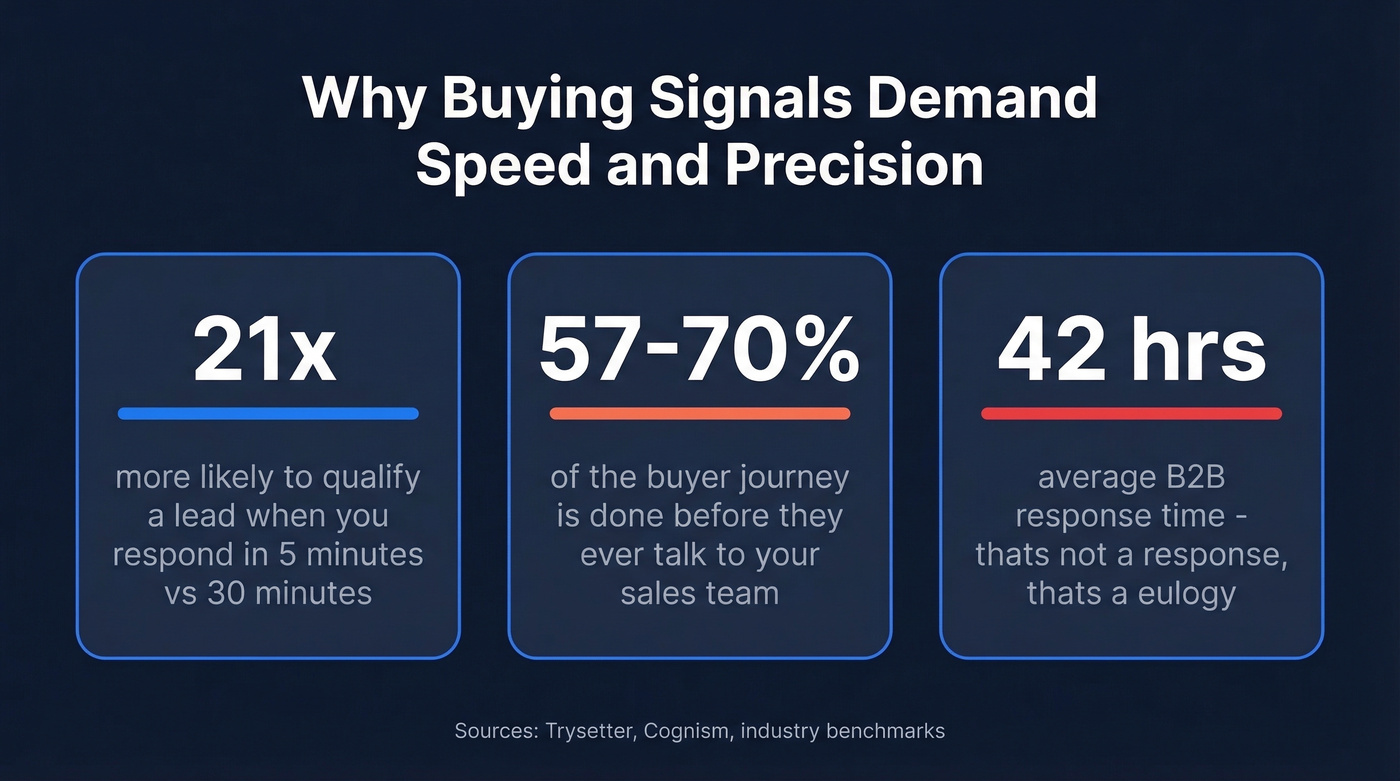
- Speed kills (in a good way). Responding within 5 minutes makes you 21x more likely to qualify the lead than waiting 30 minutes. The average B2B team takes 42 hours to respond.
- Your signal system is only as good as your contact data. A detected signal that leads to a bounced email is a wasted signal. Full stop.
What Are Buying Signals?
Buying signals are observable actions or behaviors indicating a prospect is moving toward a purchase decision. They fall into three categories: verbal (asking about pricing on a call, requesting references), nonverbal (body language in meetings, tone shifts), and digital (pricing page visits, content downloads, intent data surges).
Here's the thing: buyers are 57-70% through their research before they ever talk to sales. By the time someone fills out a demo form, the decision is nearly made. The real opportunity is uncovering these indicators earlier - when the buyer is still forming their shortlist and you can actually influence the outcome.
Signals That Deserve Action vs. Nurture
Not all signals carry equal weight. A blog visit and a demo request aren't in the same universe. Recognizing which signals deserve immediate action versus a nurture sequence is the difference between a productive SDR team and a burned-out one.
Here's how we rank them, with concrete point values you can plug into your scoring model today:
| Signal | Strength | Score | What to Do |
|---|---|---|---|
| Demo/trial request | High | +25-30 | Route to AE in 5 min |
| RFP submission | High | +30 | AE + SE assigned same day |
| Direct pricing inquiry | High | +20-25 | SDR call within 5 min |
| Multi-stakeholder engagement | High | +20 | Flag as active deal |
| Repeat pricing page visits | Medium | +15-20 | SDR outreach within 1 hr |
| Case study/comparison views | Medium | +10-15 | Nurture + SDR alert |
| Email reply or meeting accept | Medium | +10 | SDR follow-up same day |
| Competitor G2 review engagement | Medium | +10 | Send battlecard email |
| Champion job change | Quiet | +15 | Warm outreach within 48 hrs |
| Fresh funding/hiring spree | Quiet | +10 | Account research + outreach |
| Repeat profile views from same person | Quiet | +8 | Flag for personalized follow-up |
| Late-night content views | Quiet | +5 | Flag for morning follow-up |
| New stakeholder added to thread | Quiet | +10 | Multi-thread the deal |
High-Strength Signals
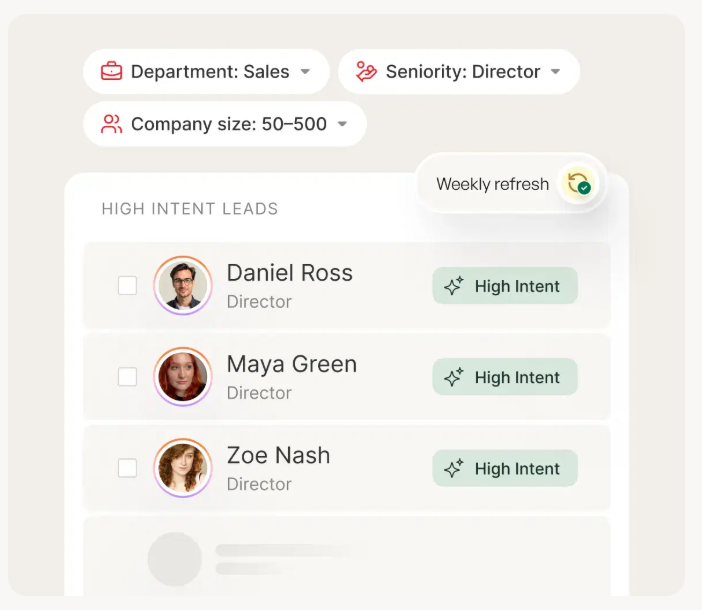
A demo request, a pricing inquiry, or an RFP submission means someone has already decided they need a solution and is actively evaluating vendors. On average, only three vendors get a demo when a purchase decision is being made. If you're getting the request, you're already on the shortlist.
Multiple stakeholders from the same account engaging simultaneously is the strongest compound signal we've seen. When the VP of Engineering and the Director of IT are both reading your case studies in the same week, that's a buying committee forming - not a coincidence.
Medium-Strength Signals
Repeat pricing page visits are the most underrated signal in this tier. Someone checking your pricing page three times in a week is doing internal homework - probably building a business case or comparing you against a competitor. Two to three visits in a 7-day window should trigger SDR outreach within an hour.
Case study and comparison page views tell you the buyer is in evaluation mode. Competitor G2 review engagement - someone from a target account reading G2 reviews of your competitors - is a signal most teams miss entirely.
Quiet Signals That Outperform Inbound
A practitioner on r/salestechniques put it well: the quieter indicators often convert better than the loud ones. Champion job changes are the classic example. When your internal champion moves to a new company, they're evaluating tooling in their first 90-120 days. That's a warm introduction disguised as a job change alert.
Repeat profile views from the same person signal sustained interest that hasn't yet turned into a form fill. Fresh funding rounds and hiring sprees signal budget and growth. Late-night content views - someone reading your technical docs at 10 PM - mean they're preparing a recommendation for their boss.
One signal Highspot's research highlights that most teams misread: silence after high engagement. If an account was heavily engaged and suddenly goes quiet, that's often internal debate - not disinterest. Don't abandon the deal. Multi-thread it.
Detecting Signals in the Dark Funnel
70% of the B2B buying journey happens anonymously. No form fills, no demo requests, no identifiable activity in your CRM. This is the dark funnel, and it's where most of your future pipeline is hiding.
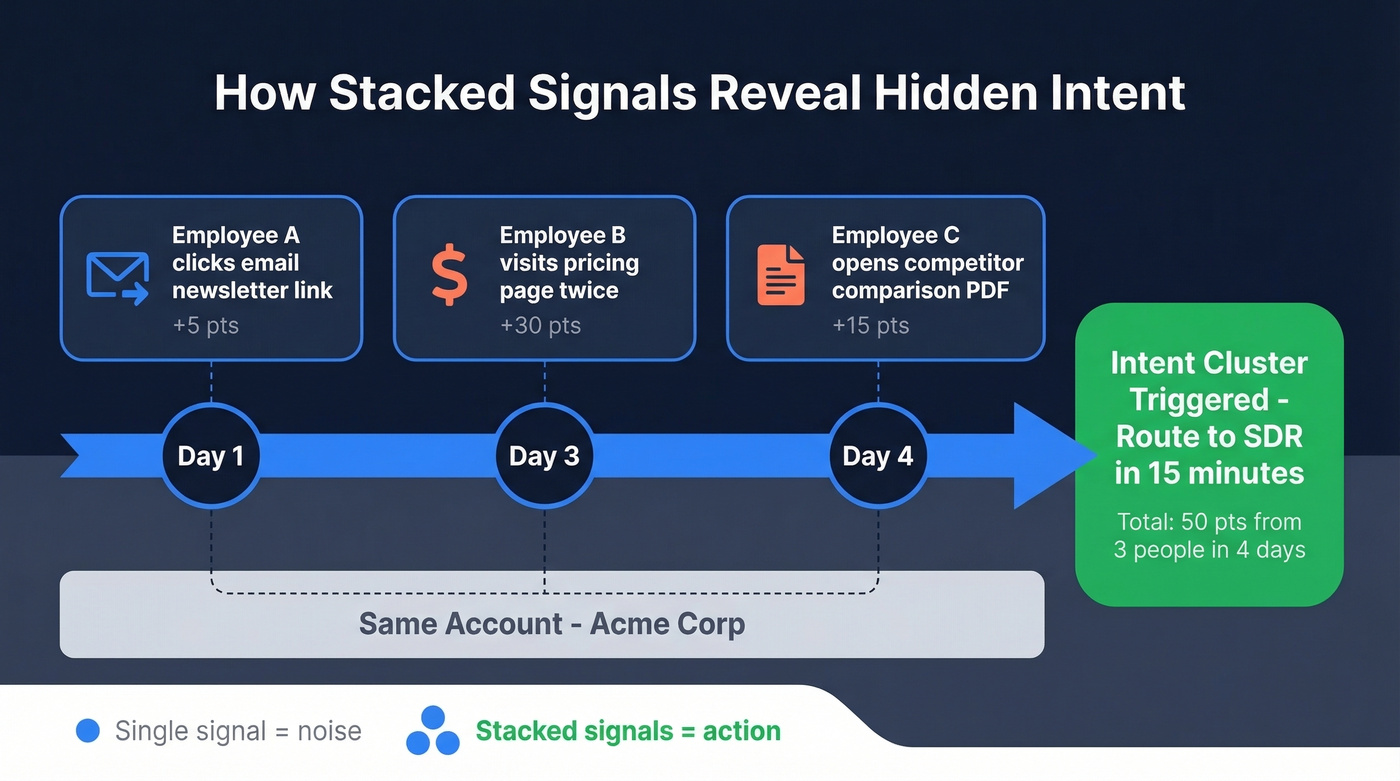
The key is shifting from contact-level to account-level identification. You can't always identify the individual, but you can identify the company. When multiple people from the same organization visit your pricing page, read your case studies, and engage with your comparison content in a short window, that's an intent cluster.

Let's break this down with a practical cross-channel stacking example:
- Day 1: Someone from Acme Corp clicks a link in your email newsletter
- Day 3: A different Acme Corp employee visits your pricing page twice
- Day 4: A third Acme contact opens your competitor comparison PDF
Any single one of those is noise. All three together within a week? Route to an SDR within 15 minutes. You don't need more signals. You need fewer, better ones - and convergence across people, pages, and time windows.
Your dark funnel detection checklist:
- Deploy account-level website identification using tools like Clearbit Reveal or RB2B
- Track cross-channel behavior patterns from email engagement through site visits to content consumption
- Define your intent cluster thresholds - minimum two signals from the same account in seven days
- Automate the routing so no human bottleneck sits between signal detection and SDR assignment

Your signal system just flagged a high-intent account. Now what? If 8 out of 30 emails bounce like that RevOps lead's pilot, every signal you detected was wasted. Prospeo delivers 98% email accuracy and 125M+ verified mobiles so your reps actually connect with the buyers showing intent - not voicemail boxes and bounce notifications.
Buying signals without verified contact data is just expensive noise.
Building Your Signal Scoring Model
Single-signal triggers are the biggest waste of SDR time in B2B sales. A content download is not a buying signal. Build stacked-signal thresholds or watch your SDRs burn out chasing students and consultants.
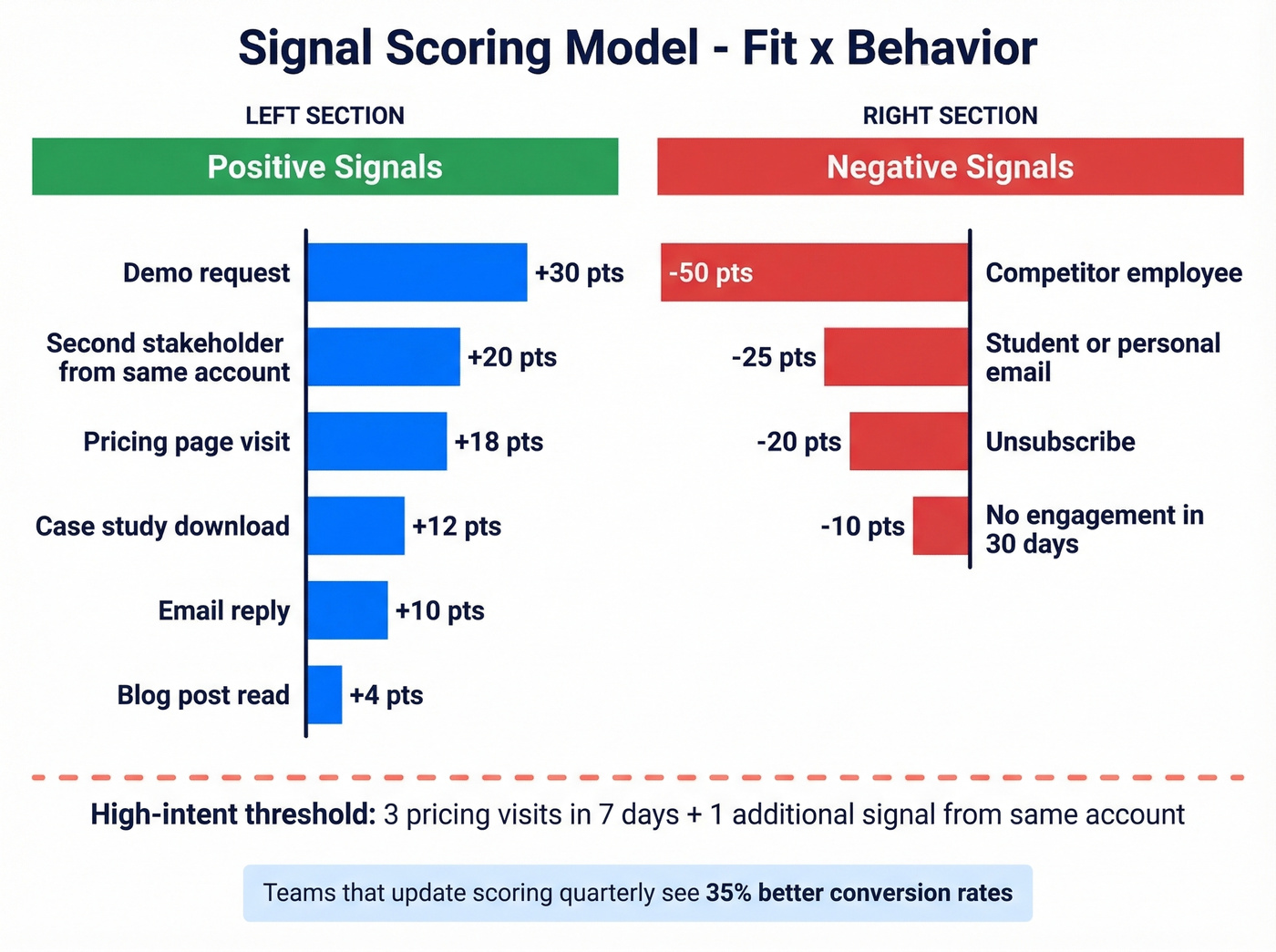
Your scoring model needs two axes: fit (does this account match your ICP?) and behavior (are they showing purchase intent?). A perfect-fit account with no behavioral signals gets nurtured. A high-behavior account with poor fit gets deprioritized. You need both.
Here's a model you can implement this week.
Behavioral scoring:
- Pricing/comparison page visit: +15-20 points per visit
- Blog post read: +3-5 points
- Demo request: +25-30 points
- Case study download: +10-15 points
- Email reply: +10 points
- Second stakeholder from same account: +20 points (this is the multiplier)
Negative scoring - equally important, and in our experience, the step most teams skip. Without it, you end up routing competitor employees and students to your SDRs.
- Unsubscribe: -20 points
- No engagement in 30 days: -10 points
- Student/personal email domain: -25 points
- Competitor employee: -50 points
Your high-intent threshold: 3 pricing visits in 7 days plus a second signal from the same account. Hit that, and the lead routes to an SDR within 15 minutes. Anything below stays in nurture.
Here's the uncomfortable truth about most signal programs: 82% of teams have adopted ABM, but under 25% rate their measurement practices as fair. They detect intent but never measure whether the response actually worked. Teams that update their lead scoring quarterly see a 35% boost in conversion rates. Calibrate or decay.
77% of B2B buyers won't talk to sales until they've done their own research. Your scoring model needs to detect that research phase, not just the hand-raise. And the payoff is real: teams using signal-based selling see 47% better conversion rates, 43% larger deal sizes, and 38% more closed deals. Backlinko's analysis of 12 million outreach emails found only 8.5% get a reply. Signal-based outreach can reach 18%. Same team, fewer emails, more replies.
The 5-Minute Response Playbook
The average B2B team takes 42 hours to respond to a lead. That's not a response - it's a eulogy.
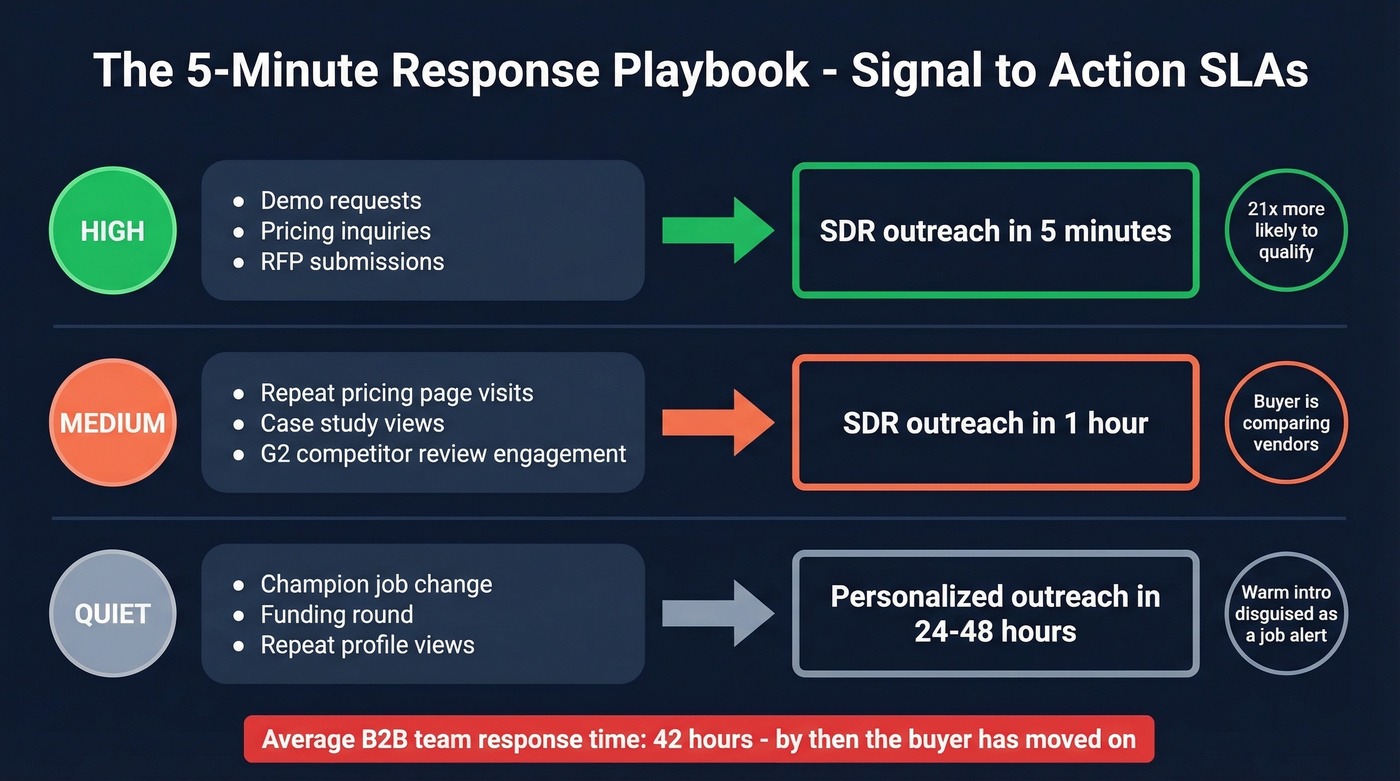
Do this:
- High-strength signals (demo requests, pricing inquiries, RFPs): SDR outreach within 5 minutes. Responding within 5 minutes makes you 21x more likely to qualify the lead versus waiting 30 minutes.
- Medium-strength signals (repeat page visits, case study engagement): SDR outreach within 1 hour. Companies responding within 1 hour are 7x more likely to qualify.
- Quiet signals (job changes, funding, hiring): Researched outreach within 24-48 hours. These need context, not speed.
Skip this if your team can't commit to SLAs:
- Routing all signals to the same queue with the same priority
- Waiting for "enough data" before reaching out - 78% of buyers purchase from the first responder
- Manual signal review by a manager before SDR assignment
The operational architecture: ingest signals into a single source of truth like your CRM or data warehouse, normalize them with standardized metadata including source, timestamp, account ID, and signal weight, score against your model, and route via automated Slack or CRM alerts. Tools like Zapier, Make, or Hightouch handle the plumbing. The hard part isn't the technology - it's getting your team to actually respond in 5 minutes.
If you want the end-to-end system, start with this blueprint on how to automate sales signals without creating a routing mess.
Hot take: if your average deal size is under $10k, you probably don't need enterprise intent data at all. First-party signals done well - your own website analytics, email engagement, and CRM activity - will get you 80% of the value. Save the $35k 6sense contract for when you've proven the playbook works with free data first.
What Intent Data Tools Cost
Intent data providers that won't publish pricing and require $25k+ annual contracts aren't built for the 50-person company trying to build pipeline. Here's what this actually costs:
| Tool | Starting Price | Contract |
|---|---|---|
| Prospeo | Credit-based, starts free | No contract |
| ZoomInfo Intent | $7,200-$36,000/yr | Annual |
| G2 Buyer Intent | $10,000-$87,000+/yr | Annual add-on |
| Bombora | ~$25,000/yr | Annual |
| 6sense | ~$35,000/yr | Annual |
| Demandbase | ~$40,000/yr | Annual |
Budget 15-25% above the license cost for implementation, integration, and ongoing optimization. A $35k 6sense contract becomes $40-45k all-in by the time you've connected it to your CRM and trained the team. We've seen teams blow $40k on enterprise intent tools before their first-party signals were even set up. Don't be that team.
Start with first-party signals and affordable intent data layers before committing to enterprise contracts.
The Data Quality Problem Nobody Talks About
Let's be honest - your marketing team dumped 200 intent leads into Salesforce. Sales called 30. Eight emails bounced, 12 hit disconnected numbers, 6 had no idea why you were calling. The other 4 were worth talking to.
The problem isn't your signal detection. It's your contact data. The industry average data refresh cycle is 6 weeks. In that time, people change jobs, get promoted, switch email addresses, and update phone numbers. Your signals identified the right account. But if you can't reach the decision-maker, the signal is worthless.
If you're seeing bounces, fix the root cause with data enrichment and a verified contact database before you scale outreach.
When Snyk rolled out Prospeo across 50 AEs, their bounce rate dropped from 35-40% to under 5%, and AE-sourced pipeline jumped 180%. That's what happens when your signal-triggered outreach actually lands - 98% email accuracy, a 7-day data refresh cycle, and 125M+ verified mobile numbers with a 30% pickup rate.
Knowing how to identify buying signals is only half the equation. Detect the signal, verify the contact, reach the person. Skip any step and the whole chain breaks.
If you need more ways to turn signals into meetings, pull a few plays from these pipeline generation ideas and tighten execution with B2B sales best practices.
Stacked signals convert 5-10x better than cold outreach - but only if you reach the right person within minutes. Prospeo tracks intent across 15,000 Bombora topics, layers it with job changes, funding rounds, and hiring surges, then gives you direct dials with a 30% pickup rate. One platform: detect the signal, find the buyer, make the call.
Stop detecting intent you can't act on. Stack signals and verified contacts in one workflow.
FAQ
What's the difference between buying signals and intent data?
Buying signals are observable actions - pricing page visits, demo requests, job changes - from any source. Intent data is a specific category of third-party signal tracking anonymous research behavior across the web. Intent data is one source of buying signals, not a synonym. Your first-party website and CRM signals qualify too.
How many stacked signals should trigger outreach?
Two stacked signals on the same account within a 7-day window. Single signals produce too many false positives. Teams routing stacked signals convert at 5-10x the rate of cold outreach. Weight multi-stakeholder engagement from the same account highest.
What tools do I need to start tracking buying signals?
Start with your existing CRM and website analytics - they're free. Add account-level visitor identification, build a lead scoring model, and layer in verified contact data so you can actually reach the people your signals surface. Add third-party intent data only after the foundation works.
How fast should I respond to a high-intent signal?
Within 5 minutes for high-strength signals like demo requests and pricing inquiries. Within 1 hour for medium-strength signals like repeat page visits. Responding in under 5 minutes makes you 21x more likely to qualify the lead, and 78% of buyers purchase from the first vendor to respond.