

How to Improve Sales Skills (Drills, Frameworks, and Benchmarks That Actually Work)
You sent 500 cold emails last month. 180 bounced. The rest landed in inboxes belonging to people who'd already defined their requirements before you ever showed up. That's not a skills problem - it's a system problem.
72% of sales leaders agree that training fails because it's one-size-fits-all, disconnected from how reps actually sell. And 62% cite outdated training content as the single biggest barrier to improvement. So if you're trying to figure out how to improve sales skills this quarter, the answer isn't another workshop. It's a practice system tied to real calls, real data, and real repetition.
Focus on three things: discovery questioning (SPIN), objection handling, and prospecting with verified data. Pair them with one 10-minute drill per day and one call review per week. This article includes a ready-to-use weekly drill schedule you can start Monday. Everything else is a force multiplier on those three.
Why Selling Changed in 2026
The buyer you're selling to in 2026 isn't the buyer from 2022. They've already done the work before you get a chance to pitch.
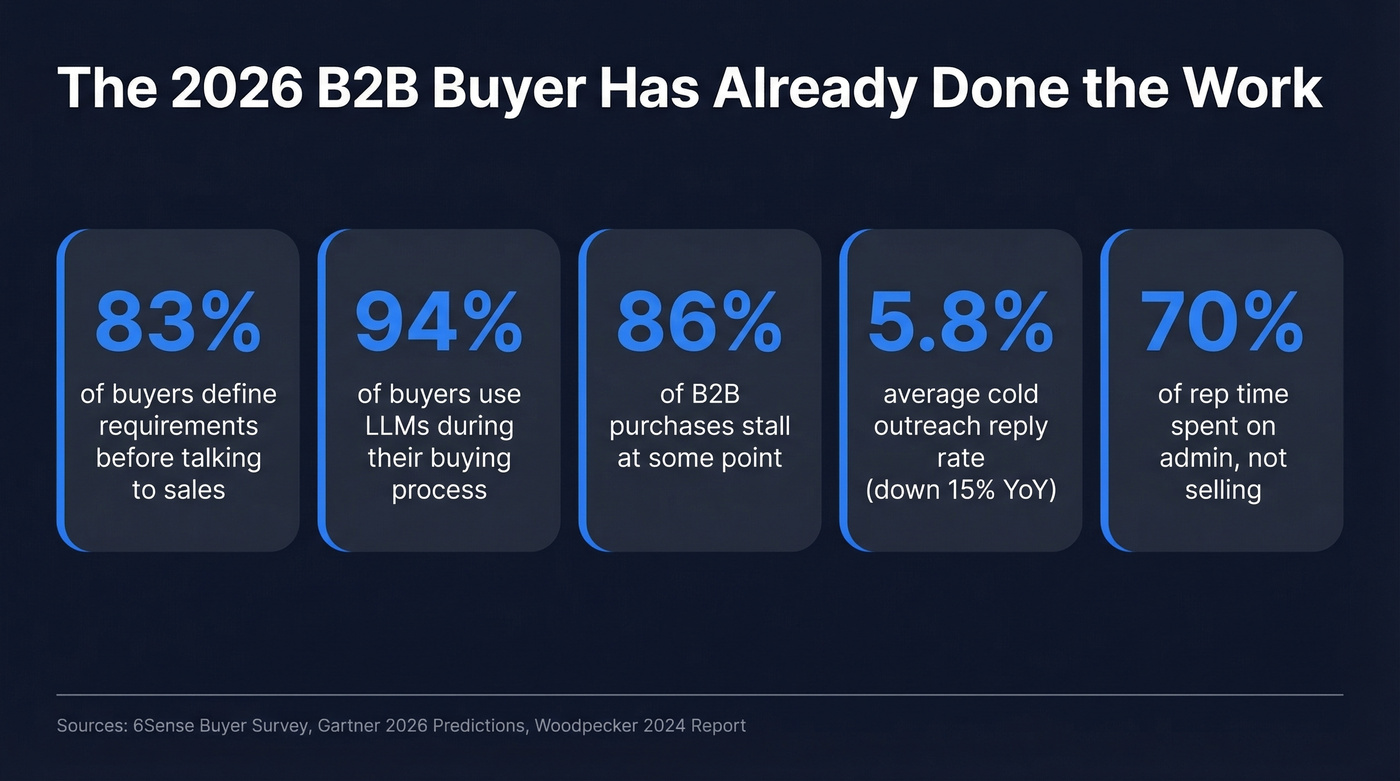
6Sense's buyer survey shows buyers define requirements 83% of the time before speaking with sales. Meanwhile, 94% of buyers use LLMs during their buying process, 86% of B2B purchases stall at some point, and the average B2B sales cycle has compressed from 11.3 to 10.1 months. Gartner predicts 65% of B2B sales orgs will shift from intuition-based to data-driven decision-making by the end of 2026. The direction is clear.
Cold outreach is getting harder too. Reply rates dropped 15% year-over-year - from 6.8% in 2023 to 5.8% in 2024. Only 5% of senders do true 1-to-1 personalization, yet personalized outreach drives 2-3x better results. Reps spend 70-72% of their week on admin and non-selling tasks, leaving barely 30% of their time for actual selling.
Here's the thing: the skills that worked when buyers needed you for information don't work when they've already asked ChatGPT, read three G2 reviews, and talked to a peer before your SDR hits send. One poster on r/sales earning $200k/yr selling conversational AI put it bluntly - success came down to "trial and error and PMF," not memorizing scripts. You need sharper discovery, better data, and a practice system that stacks.
The ROI of Skill Development
Sales training delivers a 353% ROI - roughly $4.53 back for every $1 invested. Structured onboarding alone cuts ramp time by up to 34% and boosts new-hire retention by 50%. For organizations focused on ramping new hires, that onboarding stat alone justifies the investment.
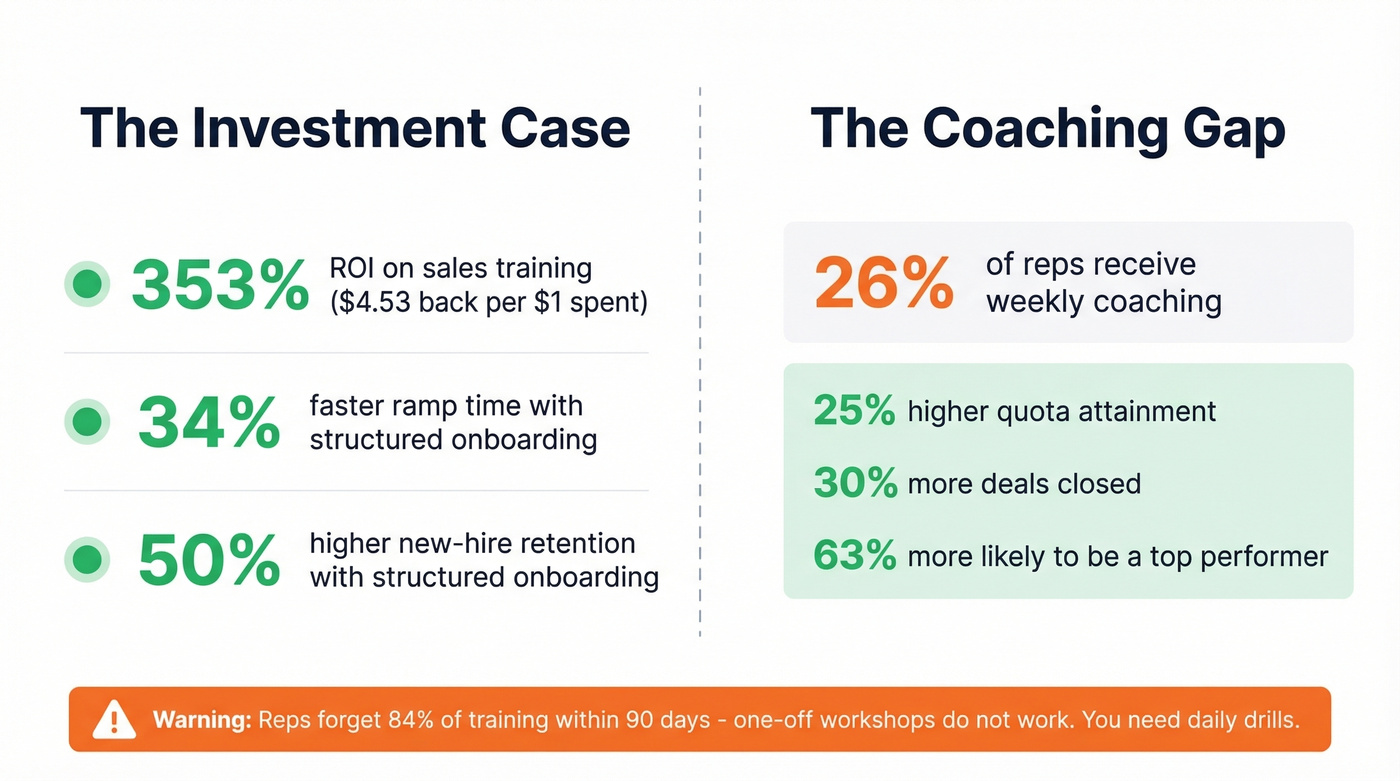
The coaching gap is where most orgs leak value. Only 26% of reps receive weekly coaching, but those who do hit 25% higher quota attainment and close 30% more deals. A seller is 63% more likely to be a top performer when they have an effective manager and a regular coaching cadence.
The catch? Salespeople forget 84% of new training within 90 days. One-off workshops don't move numbers. You need a drill-based system - short, repeated, tied to real calls. The rest of this article gives you exactly that.
The 8 Skills That Move Revenue
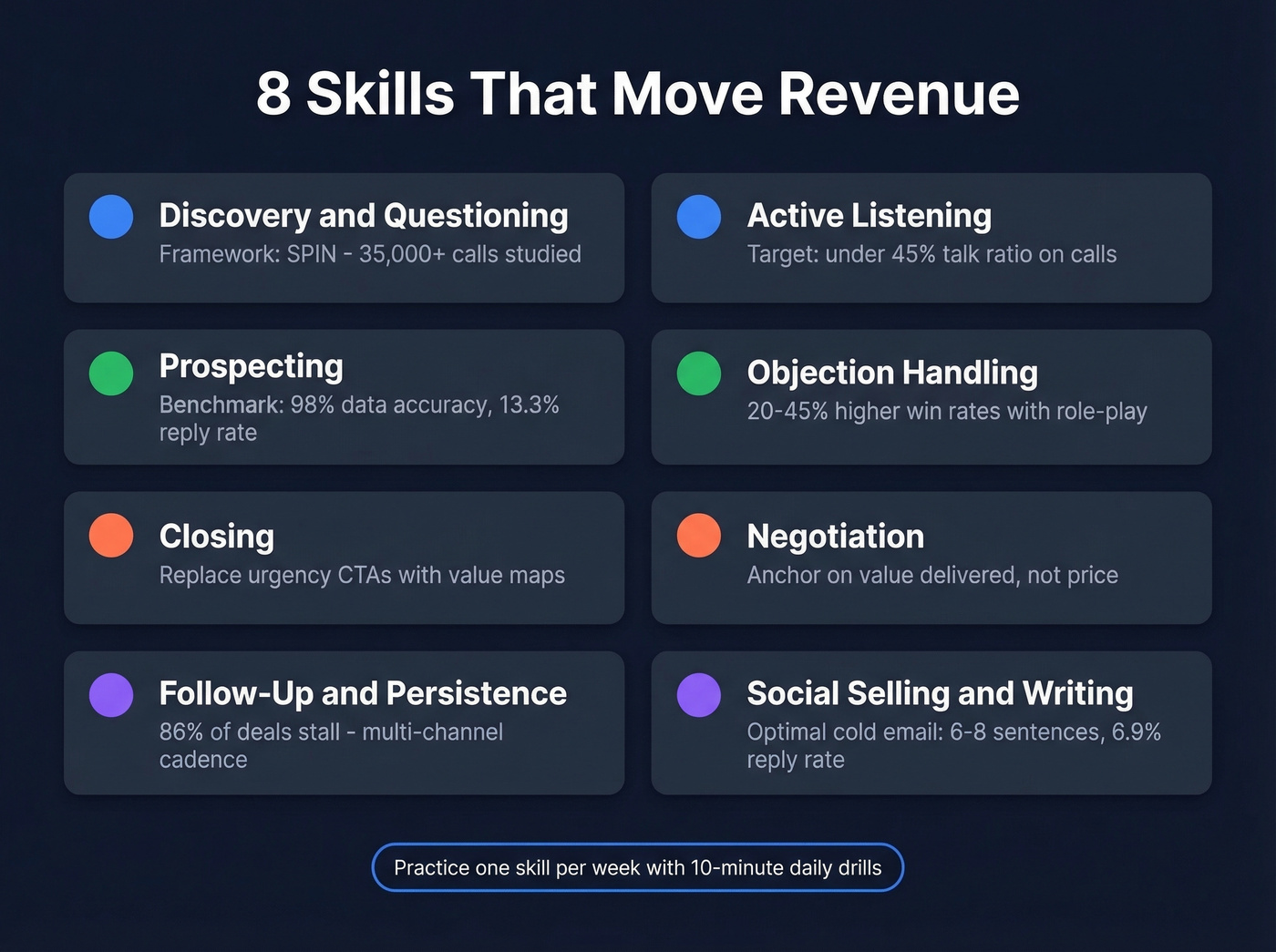
You don't need 19 skills. You need these eight, practiced deliberately, with benchmarks to know when you're improving.
Discovery and Questioning
SPIN Selling was built from studying 35,000+ sales calls across 20+ countries. Decades later, the core insight still holds: most reps overuse Situation and Problem questions while underusing Implication questions - the ones that make buyers feel the cost of inaction.
Grab a colleague, set a timer for two minutes, and run a discovery call where you can only ask questions. No pitching, no product mentions, no "what if I told you." It's uncomfortable the first time. By the fifth session, your discovery calls will sound completely different. This is one of the best ways to practice without needing a live prospect.
Active Listening
Top-performing reps listen roughly 57% of the call. The target talk ratio for most sellers should be under 45%.
Pull your last three recorded calls and score your own talk ratio. If you're above 55%, you're talking too much. Most reps are shocked by the number the first time they check.
Prospecting
Prospecting skill starts with data accuracy. If 35% of your emails bounce, no amount of copywriting saves you. We've seen teams burn entire domains because they trusted a database that hadn't been refreshed in months.
Prospeo gives you 98% email accuracy across 143M+ verified emails and 125M+ verified mobiles, with data refreshed every 7 days. The free tier includes 75 emails plus 100 Chrome extension credits per month - enough to test whether better data changes your reply rates before you commit a dollar. If you want more ideas beyond list quality, start with these sales prospecting techniques.
Voicemail doubles email reply rate. Top-quartile prospectors hit 13.3% reply rates versus the 5.4% average. The difference isn't magic - it's multi-channel persistence with clean data underneath. Try building a 25-contact list with verified data and writing a personalized first line for each one. Time yourself. This is the rep equivalent of batting practice.
Objection Handling
Reps who role-play before live calls see 20-45% higher win rates than those who don't. That's a massive range, and the variance comes down to how realistic the practice is.
The Objection Handling Gauntlet works like this: ten minutes, a partner, rapid-fire objections with no breaks. "We're happy with our current vendor." "Your price is too high." "We need to think about it." "Send me an email." Respond to each in under 30 seconds. It builds the muscle memory that makes live objections feel routine instead of panic-inducing.
Closing
Bryan Vasquez, Head of Sales at LinkBuilder.io, increased his team's win rate by 20% over two quarters by replacing urgency CTAs with data-backed proposals and tailored value maps. Fake scarcity doesn't work in B2B anymore. Buyers see through it instantly.
Replace "limited time offer" with a one-page value map showing the prospect's specific pain, the cost of inaction, and your measurable impact. Let the math close the deal. If you want a tighter structure for this stage, use these steps to close a sale.
Negotiation
Anchoring on value delivered beats anchoring on price every time. When a buyer says "your competitor is cheaper," the wrong response is a discount. The right response is a case study showing 3x ROI.
Practice this with a One-Slide Pitch Battle: one slide, two minutes, defend your price to a skeptical colleague. If you want to go deeper on the tactic itself, see anchor in negotiation.
Follow-Up and Persistence
86% of B2B purchases stall. Most reps give up after two touches. Build a multi-channel cadence - email, call, and video - spacing touches 3-5 days apart. Each touch should add new value, not just "checking in." If you need copy you can deploy immediately, use these sales follow-up templates.
Social Selling and Written Communication
The optimal cold email length for a 6.9% reply rate is 6-8 sentences. Lead with an insight or trigger event, not your product. Reference something specific - a recent funding round, a job posting, a tech stack signal. For more examples you can swipe, see these cold email subject line examples.
Social selling amplifies this. Commenting thoughtfully on a prospect's posts, sharing relevant insights in their feed, and engaging with their content before you ever send a cold email warms the relationship. The reps who do this consistently report that prospects reply to outreach with "Oh, I've seen your stuff" - and that changes the entire dynamic.
Write the first line of your email last. Draft the body, then go back and replace the opener with something that proves you did research. That single line is the difference between "delete" and "reply."

You can drill discovery questions and role-play objections all week - but if your prospecting list is full of dead emails, none of it converts. Prospeo delivers 98% email accuracy across 143M+ verified addresses, refreshed every 7 days. Teams using Prospeo book 26% more meetings than ZoomInfo users and 35% more than Apollo.
Fix your data before you fix your pitch. 75 free emails to start.
Your Weekly Drill Routine
The practice loop is simple: Assess, Drill, Apply, Review, Score, Repeat. One skill per week, one 10-minute drill per day, one call review session weekly. Companies with structured drills see up to 17% higher revenue growth versus those without. This routine turns theory into repetition - the only thing that actually sticks. If you want more options to rotate in, here are additional sales activities examples.
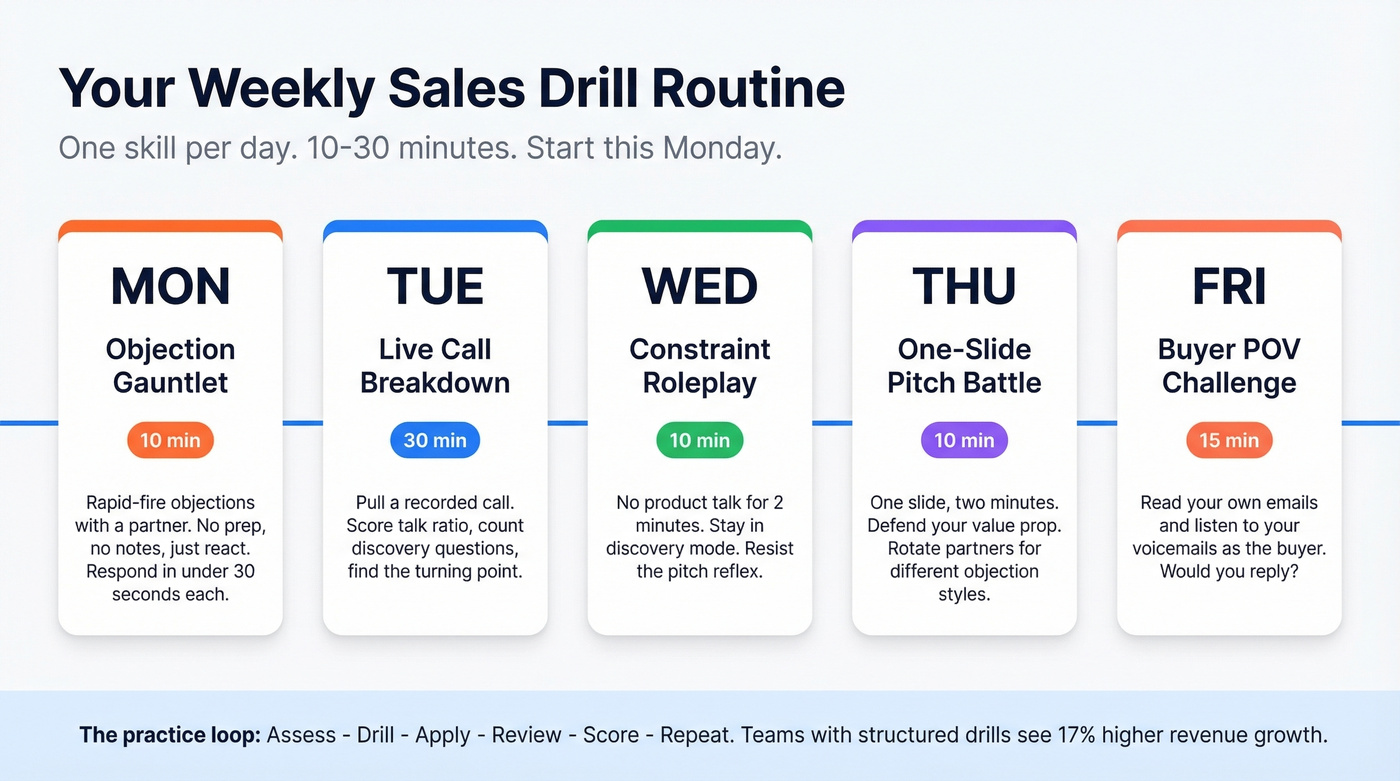
Here's a five-drill weekly rotation:
Monday - Objection Handling Gauntlet (10 min). Rapid-fire with a partner. No prep, no notes, just react.
Tuesday - Live Call Breakdown (30 min). Film-room style. Pull a recorded call, score talk ratio, count discovery questions, identify the moment you lost or won momentum.
Wednesday - Constraint Roleplay (10 min). "No product talk for 2 minutes." Forces you to stay in discovery mode and resist the pitch reflex.
Thursday - One-Slide Pitch Battle (10 min). One slide, two minutes, defend your value prop. Rotate partners so you face different objection styles.
Friday - Buyer POV Challenge (15 min). Respond to your own outreach as if you're the buyer persona. Read your emails, listen to your voicemails. Would you reply?
In our experience, the Friday Buyer POV drill is the one reps resist most - and the one that changes behavior fastest. Something shifts when you hear your own voicemail through the buyer's ears.
Organizations using AI sales coaching tools see 20-25% improvement in rep proficiency when layered on top of peer practice. 43% of revenue enablement leaders now use AI-powered role play for coaching, and it's worth exploring as a supplement to the live drills above. These tools are especially effective for reps who can't always find a practice partner. If you're building a stack, start with a shortlist of SDR tools.
Top-quartile prospectors hit 13.3% reply rates because they combine sharp personalization with clean data. Prospeo's 30+ search filters - buyer intent, technographics, job changes, funding signals - let you build hyper-targeted lists where every contact is verified. That's how you turn drill-sharpened skills into booked meetings.
Better skills deserve better data. Build your first verified list in minutes.
Frameworks Worth Learning
Not every framework fits every seller. Here's how the big four compare:
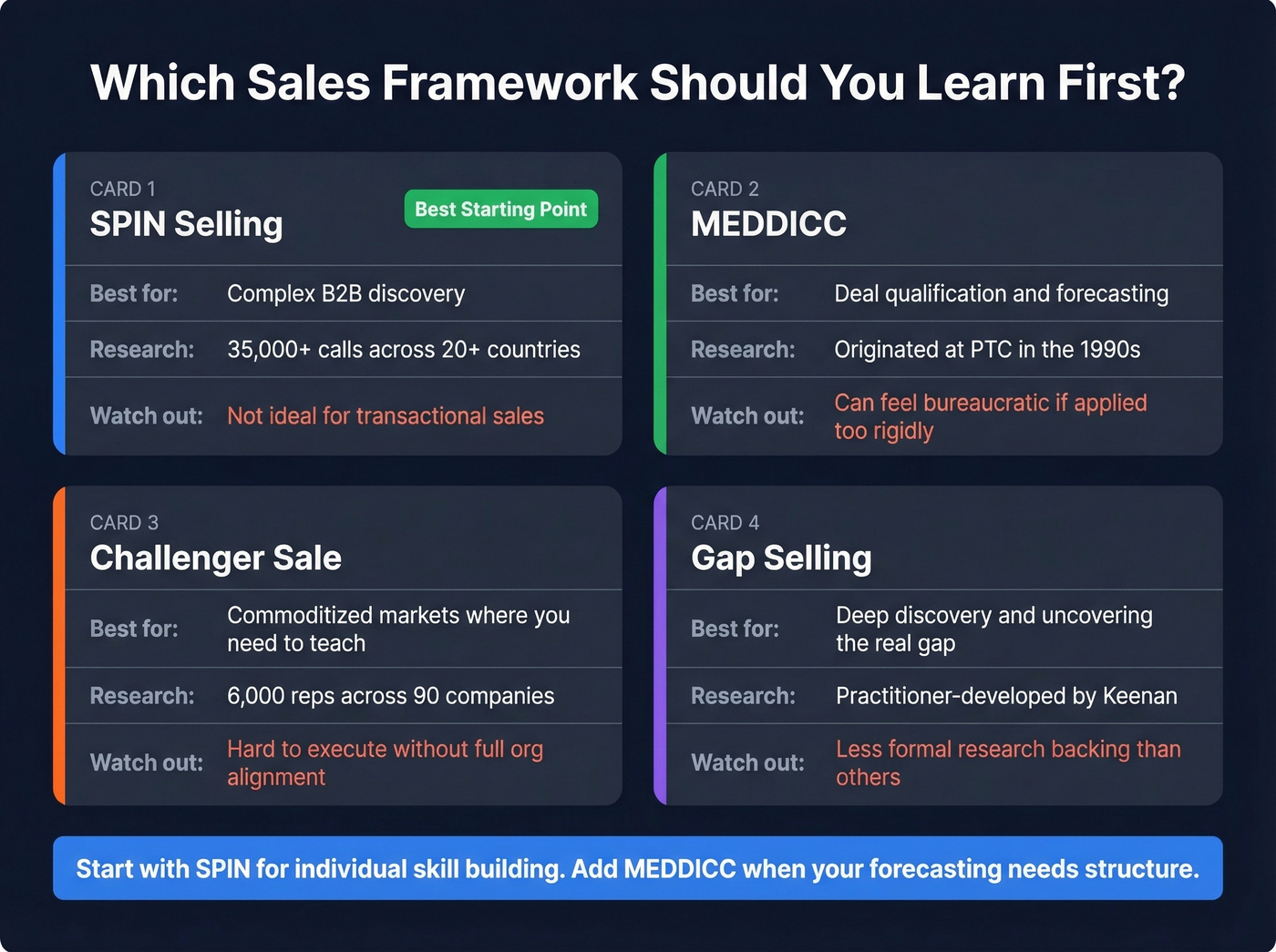
| Framework | Best For | Research Base | Watch Out For |
|---|---|---|---|
| SPIN Selling | Complex B2B discovery | 35,000+ calls, 20+ countries | Not for transactional sales |
| MEDDICC | Deal qualification | Originated at PTC, 1990s | Bureaucratic if too rigid |
| Challenger Sale | Commoditized markets | 6,000 reps, 90 companies | Hard without org alignment |
| Gap Selling | Discovery depth | Practitioner-developed | Less research-backed |
SPIN is the safest starting point for any individual contributor looking to build a strong foundation. The research base is enormous, and the framework scales from smaller deals to seven-figure enterprise cycles. MEDDICC is essential if your forecasting is unreliable - it forces qualification rigor that most teams lack. If you want prompts you can use on calls, start with these discovery questions.
A popular r/sales thread is clear on this: Challenger Sale is hard to implement without whole-org alignment. If you're an IC without executive buy-in for the methodology, skip it and focus on SPIN or Gap Selling instead.
Let's be honest - most reps don't need a new framework. They need to practice the one they already know. I've watched teams cycle through SPIN, then Challenger, then MEDDICC in 18 months, mastering none of them. Pick one. Run it for two full quarters before you evaluate.
Mistakes That Kill Deals
Talking too much. 73% of sellers rate themselves strong in risk detection and communication. Only 44% of their managers agree. Check your talk ratio before you assume you're a good listener.
Not qualifying. BANT is the minimum. If you can't identify Budget, Authority, Need, and Timeline within two calls, you're running a demo for someone who'll never buy.
Over-emphasizing price over value. When you lead with discounts, you train buyers to negotiate harder. Lead with ROI metrics and case studies instead.
Failing to prep for objections. Only 18% of buyers think salespeople are well-prepared. Spend 5 minutes before every call listing the three most likely objections and your response to each.
Bad contact data. Before you blame your pitch, check your data. We've seen reps agonize over subject lines when the real problem was a 35% bounce rate torching their domain reputation. Tools like Prospeo verify emails in real-time and include catch-all domain verification - protecting your sender reputation from the kind of bounce-rate damage that takes months to recover from. If you're troubleshooting deliverability, start with email bounce rate benchmarks and fixes.
Eliminating these bad habits often delivers faster results than layering on new techniques. Sometimes the quickest path to better performance is subtraction, not addition.
How to Measure Progress
Only 25% of sales organizations measure leading-indicator selling behaviors. The rest only track lagging KPIs and wonder why training doesn't stick.
Track both weekly:
Lagging indicators - outcomes like quota attainment, average deal size, sales cycle length, and win rate. These tell you if you're improving, but they move slowly.
Leading indicators - behaviors like discovery questions asked per call, executive meetings booked, follow-up cadence adherence, and talk ratio. These tell you if you're practicing the right things. They move fast and predict where your lagging indicators will be in 60 days. If you want a clean set of definitions and targets, use these funnel metrics.
We've found that teams tracking talk ratio weekly see the fastest improvement - it's the one metric that makes reps self-correct without being told. When you can see the numbers moving, the feedback loop tightens and behavior changes on its own.
Best Books by Role
If you only read three books: Fanatical Prospecting for pipeline, Gap Selling for discovery, and The JOLT Effect for handling indecision. That stack covers the full funnel and overlaps with the most-recommended titles on r/sales.
SDR add: New Sales. Simplified. - the best book on outbound prospecting mechanics.
AE add: SPIN Selling - still the gold standard for consultative discovery, even though it's from 1987.
Manager add: The Qualified Sales Leader - excellent on coaching and qualification frameworks. Skip the last third where it crams in MEDDICC content that feels like page inflation. The coaching chapters are where the real value lives.
FAQ
How long does it take to see results?
With daily 10-minute drills and weekly call reviews, most reps see measurable improvement in talk ratio and discovery quality within 4-6 weeks. Consistency matters most - 84% of training is forgotten within 90 days without reinforcement.
What's the single most important selling skill?
Discovery questioning. If you can uncover the real problem and its business impact - SPIN's Implication questions are the gold standard - closing, negotiation, and objection handling all get dramatically easier.
What should new reps focus on first?
Start with one framework (SPIN), one book (Fanatical Prospecting), and the weekly drill routine above. New reps who follow a structured practice system ramp 34% faster than those who rely on shadowing alone. Pair drills with real call reviews to accelerate pattern recognition.
Do I need expensive tools to get better?
No. Role-play with a colleague, review your own calls, and read SPIN Selling. The one early investment worth making is verified prospect data - a free tier from a tool like Prospeo (75 emails + 100 Chrome extension credits/month) ensures you're not wasting practice reps on bounced emails and dead contacts.
How do I go from good to great once the basics are solid?
Layer in deal qualification frameworks like MEDDICC and start tracking leading indicators weekly. The jump from good to great comes from measuring behaviors - not just outcomes - and coaching yourself against those metrics. Top performers review at least one recorded call per week, every week.