

How to Increase Sales in Your Logistics Business: A Data-Backed Playbook
You sent the lowest quote. You still lost. A rep on r/logistics put it perfectly: "Karen in purchasing will only go with Bob from ShipABC." Two months of competitive pricing, and the deal still goes to the incumbent because logistics buyers stick with people they've trusted for years. If you're trying to figure out how to increase sales in your logistics business without racing to the bottom on rates, you're asking the right question - but playing the wrong game if price is your only lever.
Here's what actually moves the needle.
The Short Version
- Stop competing on price. The cheapest carrier costs your customer more in the long run. Sell reliability.
- Build a disciplined 5-touch follow-up cadence. Over 80% of sales happen after at least five touches. Most reps quit after two.
Sell Reliability, Not Price
A 13-year logistics vet on r/sales shared a before-and-after that should be taped to every freight sales desk. When he assumed every shipper wanted the cheapest option, roughly 30 out of 100 shipments per month had issues - late deliveries, damages, broken promises. After shifting to higher-quality carriers with about a 10% increase in freight budget, he moved an average of 500 shipments per month with just 2-3 issues.
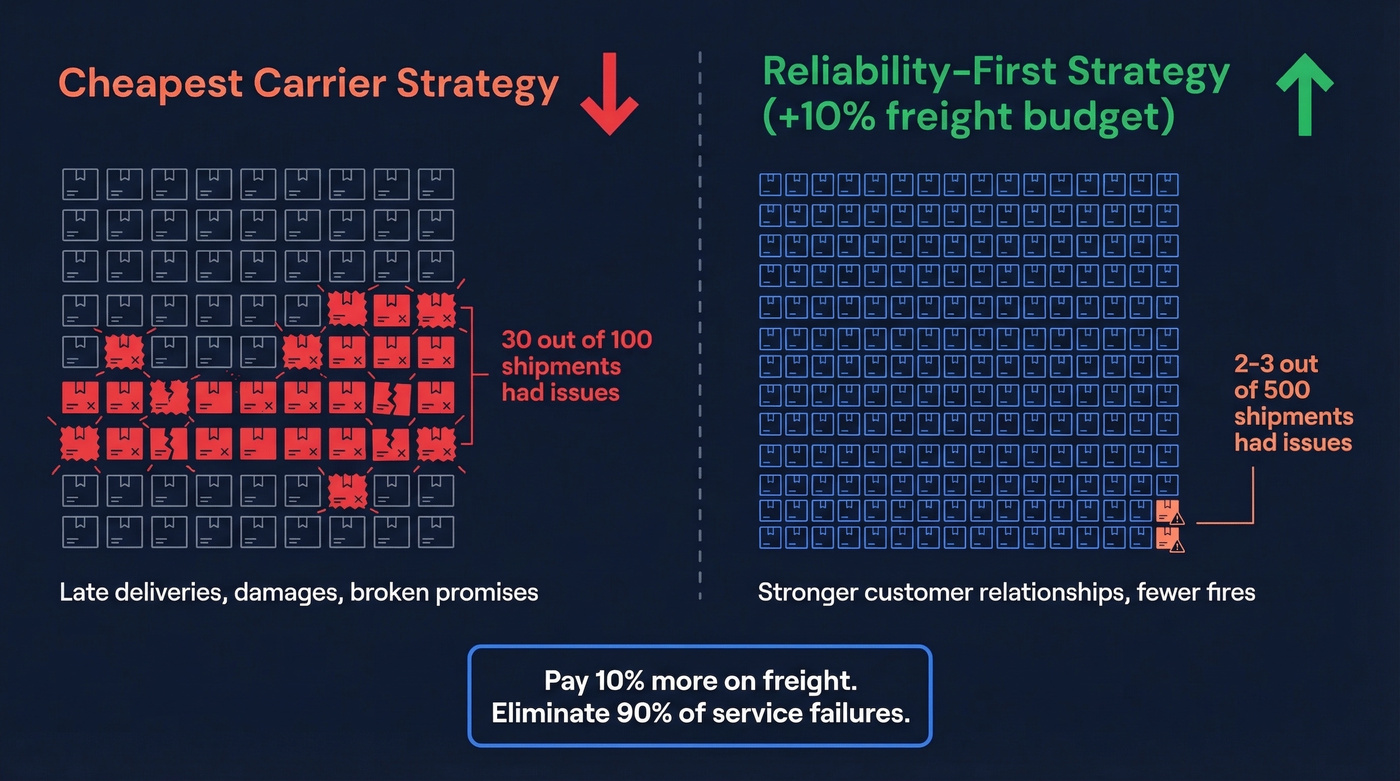
That's the pitch. Not "we're cheaper." It's "we'll cost you 10% more on freight and save you from the 30% of shipments that blow up your customer relationships."
The 2026 market makes this argument even stronger. Q1 ground parcel rates per package are 38.9% above the January 2018 baseline and up 5.4% year-over-year. With tariff uncertainty and service volatility still rattling supply chains, shippers care about schedule reliability more than shaving a few points off a rate. Lead with that in every conversation.
Under $50K in annual contract value, competing on price usually isn't worth it. The margins are too thin to absorb even one service failure, and reliability is the only sustainable differentiator for small and mid-size brokerages.
Build a Prospect List That Works
Contact data goes stale fast - the U.S. Department of Labor projects up to a 40% turnover rate in corporate America, which means the VP of Logistics you emailed in January might already be at a different company. Your reps are spending a big chunk of their week on manual research instead of selling.
Start with a tight ICP. One ABM case study for a trucking company used these criteria: shippers moving 10+ truckloads per month, consistent shipping patterns, multi-location operations, and specific verticals like furniture, FMCG, manufacturing, and automotive parts - focused on Midwest and Southeast freight corridors. That kind of specificity turns vague prospecting into a targetable list you can actually work.
For the data itself, Prospeo's B2B database handles the stale-data problem well. It covers 300M+ professional profiles with 98% email accuracy and 125M+ verified mobile numbers, with records refreshed on a 7-day cycle versus the 6-week industry average. You can filter by industry, headcount, location, and 30+ other criteria to build a logistics-specific list. The free tier gives you 75 emails plus 100 Chrome extension credits per month to test before committing a dollar.


Your prospect list decays every week. With 40% annual turnover in corporate roles, the shipping manager you're chasing may already be gone. Prospeo refreshes 300M+ profiles every 7 days - not every 6 weeks - so your reps dial real decision-makers, not dead leads. Filter by industry, headcount, and location to build a logistics-specific list in minutes.
Stop wasting touches on stale contacts. Start with data that connects.
The Cold Outreach Playbook
Cold Calling Benchmarks
Logistics cold calling converts at 1.77% - roughly 1 sale per 56 calls. Sounds brutal. But training changes the math dramatically: without any training, reps convert at 1.10%, needing about 91 calls per sale. Weekly training bumps that to 3.54%, cutting the calls needed to 28. Daily coaching pushes conversion to 9.03%, which means just 11 calls per sale. The investment in training pays for itself faster than almost any tool purchase.
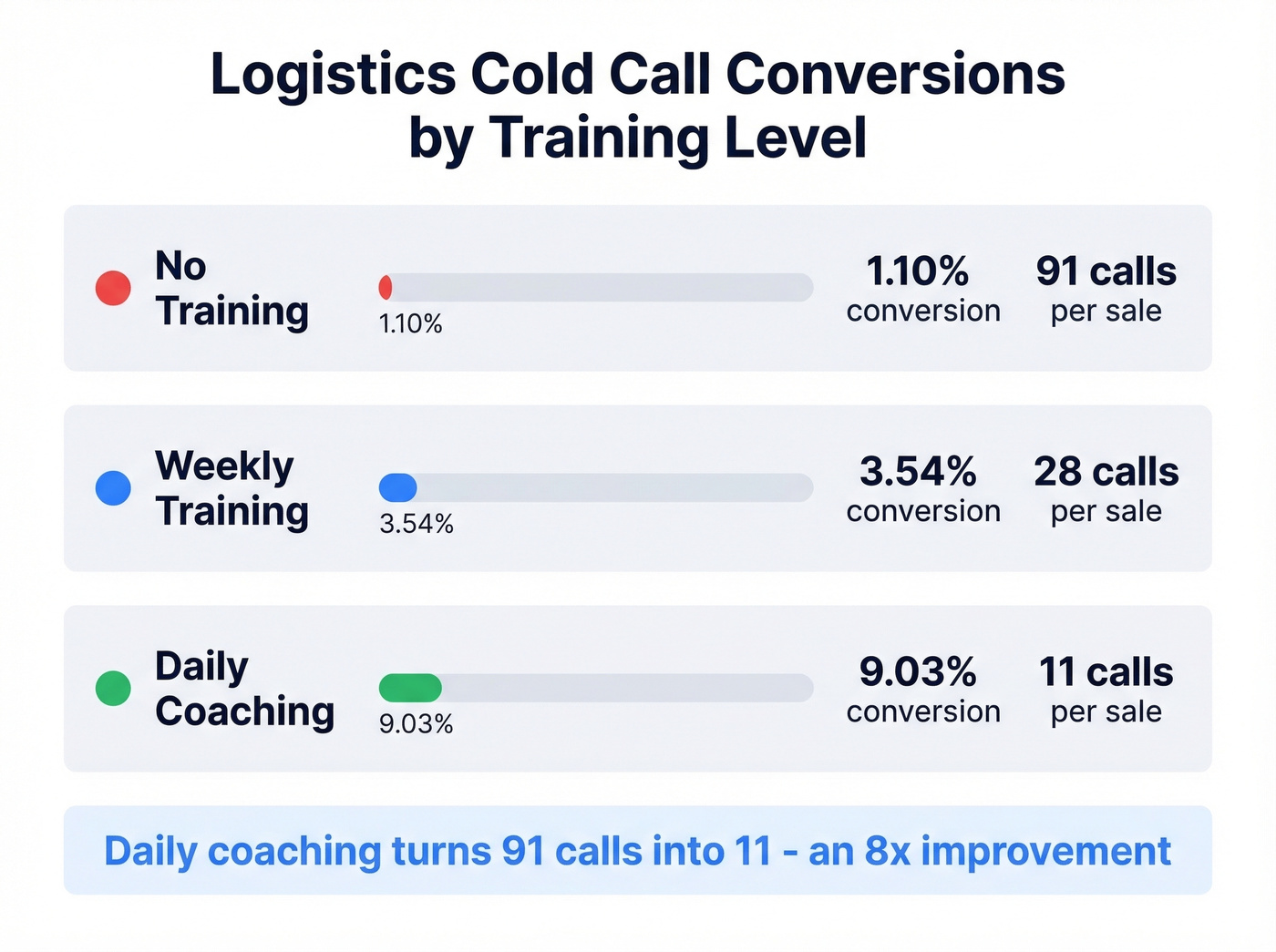
80% of your cold calls go to voicemail. A good script can increase callbacks up to 22%. Friday afternoons are the best time to connect; Monday mornings are the worst.
We've seen 2-3x better connect rates when reps verify contact data before dialing instead of working off old spreadsheets - it's one of those changes that seems obvious but almost nobody does consistently. If you need a repeatable system, start with a documented cold calling system and bake it into onboarding.
The 5-Touch Follow-Up Sequence
Only 2% of cold calls lead to a meaningful conversation. That's fine - because the close doesn't happen on the first touch. It happens on the third through seventh. Here's the FreightWaves-recommended cadence adapted for 2026:
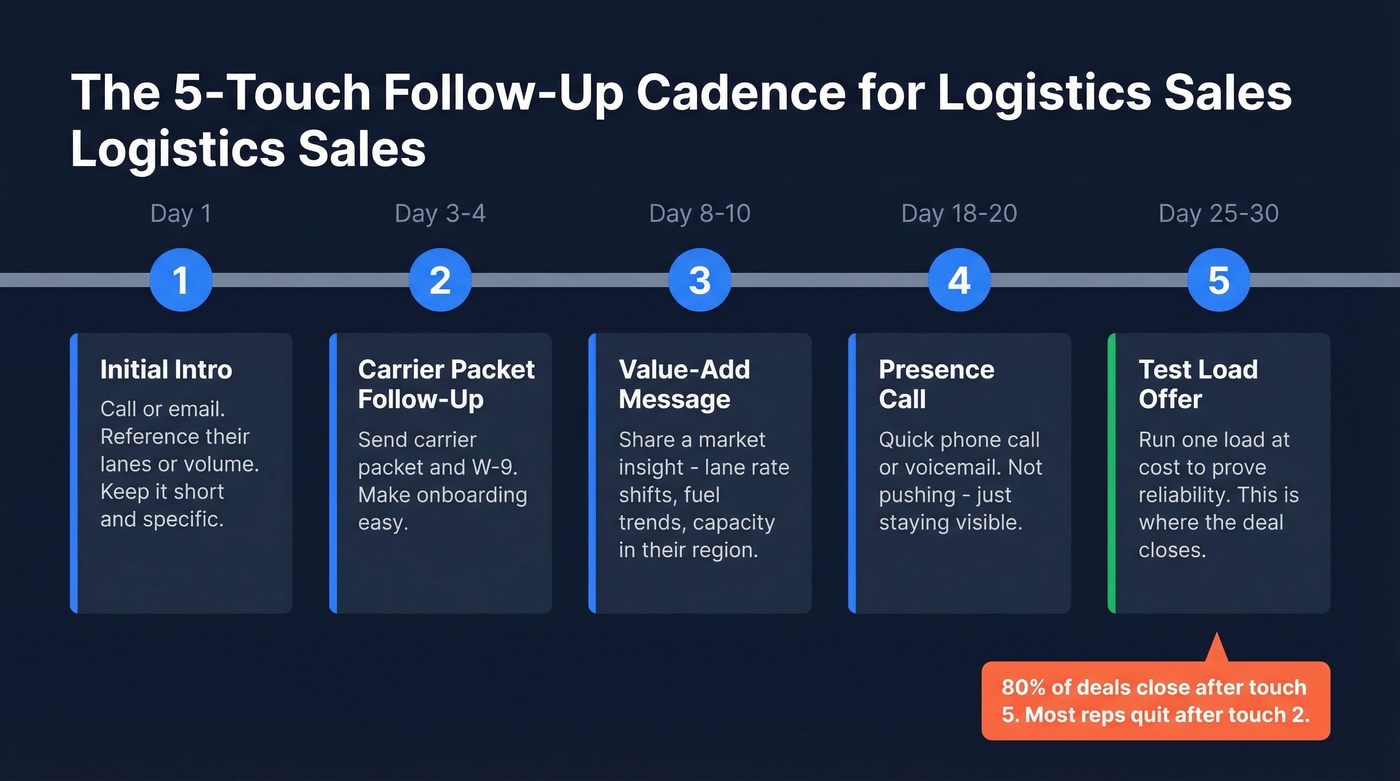
- Initial intro - call or email. Short, specific, reference their lanes or volume.
- 2-3 business days later - follow-up email with your carrier packet and W-9. Make it easy to onboard you.
- 5-7 business days later - value-add message. Share a market insight: lane rate shifts, fuel surcharge trends, capacity availability in their region.
- Around 10 days later - phone call or voicemail. Short "presence" script. You're not pushing, you're staying visible.
- Test load offer - run one load at cost or small margin to prove reliability. This is where the 10%-more-for-90%-fewer-issues pitch lands.
Let's be honest: most reps give up after touch two. The ones who follow through to touch five are closing 80% of the deals. If you want plug-and-play copy, keep a set of sales follow-up templates ready for each touch.
Use ABM to Land Enterprise Shippers
For enterprise accounts, spray-and-pray prospecting doesn't work. One logistics company built a list of 120 target accounts - 10+ truckloads/month, consistent patterns, multi-location, key verticals - and generated 23% higher pipeline within 90 days. 87% of marketers who measure ROI say ABM outperforms every other marketing investment.
Enterprise buyers want partners who understand their business, not vendors blasting generic rate sheets. KPMG's 2026 supply chain outlook confirms it - the focus has shifted from pure cost savings to total value delivery. Generalist positioning is a death sentence in a consolidating market. Pick 2-3 verticals and own them.
Build your target list by role and persona. Align sales and marketing on the same 50-120 accounts. Create content that speaks to their specific pain - lane density, seasonal capacity, compliance requirements - then work the 5-touch cadence on each account. In our experience, the companies that commit to this approach see results within one quarter, not one year. If you want to tighten execution, borrow from account-based selling best practices and a clear ideal customer profile.
Pick a CRM and Actually Use It
The best CRM is the one your reps will actually log activity in. Here's what makes sense for logistics teams at different stages:
| CRM | Free Tier | Starter Price | Mid-Tier | Best For |
|---|---|---|---|---|
| HubSpot | Yes (1K contacts) | $15/user/mo | $800/mo (5 users) | Teams under 10 reps |
| Pipedrive | No | $14/user/mo | $49/user/mo | Small teams wanting simplicity |
| Zoho CRM | Yes (3 users) | $14/user/mo | $40/user/mo | Budget-conscious teams |
| Salesforce | No | $25/user/mo | $165/user/mo | 20+ reps with dedicated RevOps |
Under 10 reps? Start with HubSpot's free tier or Pipedrive at $14/mo. Salesforce is overkill until you have 20+ reps and a dedicated RevOps person to configure it. We've seen too many logistics teams buy Salesforce because it sounds impressive, then watch reps ignore it because the setup is overwhelming. Skip it until you've genuinely outgrown the simpler options. If you're still evaluating, compare a few examples of a CRM and prioritize adoption over features.
Mistakes That Kill Logistics Revenue
Stop obsessing over lead generation. Your real problem is follow-up.
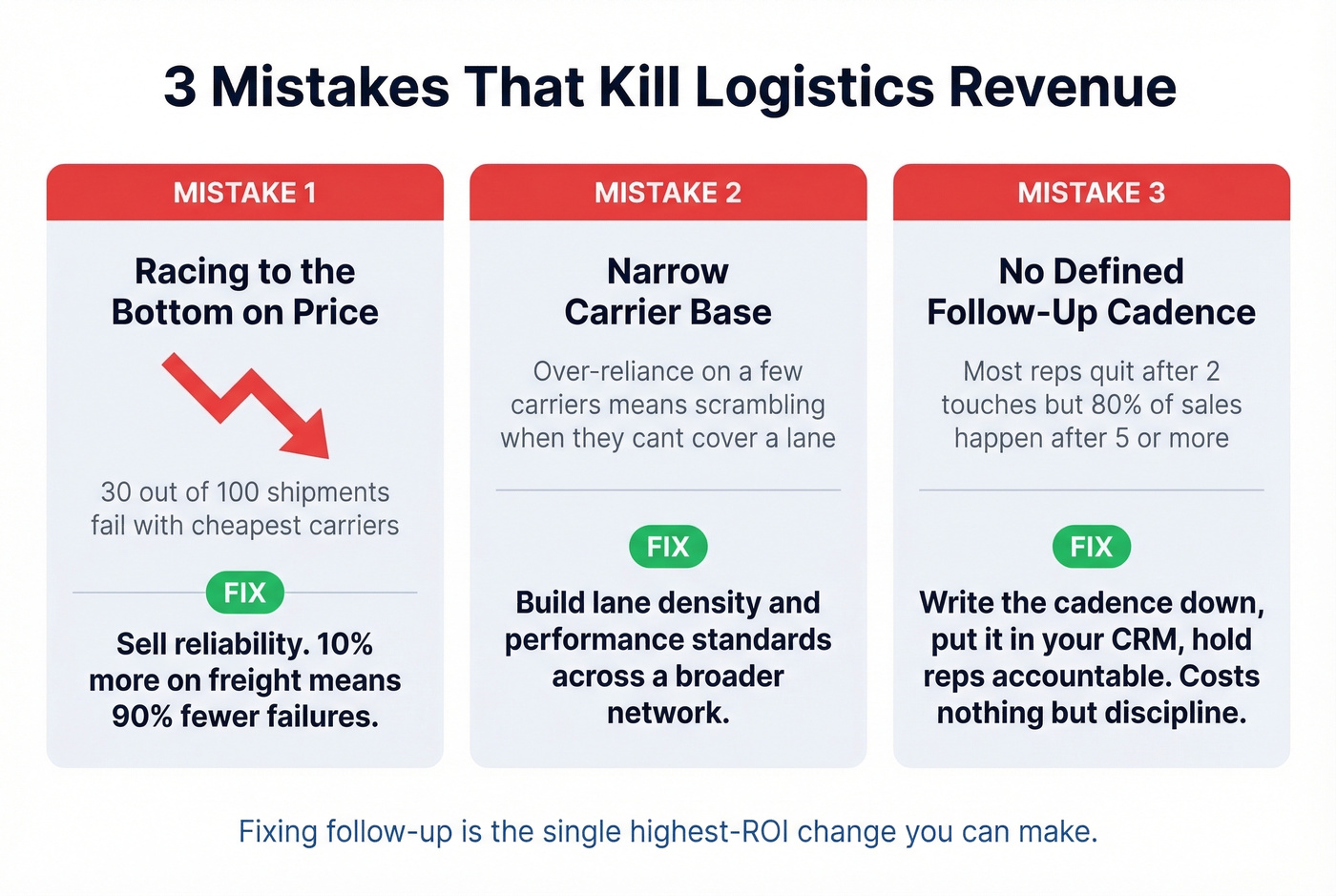
Racing to the bottom on price. You'll win the load and lose the account when something goes wrong. The 30-out-of-100 failure rate from the cheapest carriers isn't a hypothetical - it's what practitioners report over and over again.
Narrow carrier base. Over-reliance on a handful of carriers increases risk. When your go-to carrier can't cover a lane, you're scrambling. Build lane density and performance standards across a broader network.
No defined follow-up cadence. Most reps give up after 2 touches. 80% of sales happen after 5+. Write the cadence down, put it in your CRM, and hold reps accountable to it. This is the single highest-ROI change you can make, and it costs nothing but discipline. If you need a framework to operationalize it, use sequence management and track sales activities consistently.
Cold calling in logistics converts at 1.77% - but only if you're reaching real people. Reps using verified mobile numbers see 2-3x better connect rates. Prospeo gives you 125M+ verified mobiles with a 30% pickup rate, at $0.01 per email and no annual contracts.
Turn 56 calls per sale into 28 with data that actually picks up.
FAQ
How many cold calls does it take to close a logistics sale?
About 56 calls per sale at the 1.77% industry average. Weekly sales training cuts that to roughly 28 calls; daily coaching drops it to around 11. The investment in training pays for itself faster than almost any tool purchase.
What's the best CRM for a small logistics team?
HubSpot's free tier or Pipedrive at $14/user/month. Both are simple enough that reps will actually log activity instead of treating the CRM like a chore. Salesforce makes sense once you hit 20+ reps and have someone dedicated to managing it.
How do I find verified contact data for shippers?
Use a B2B data platform with a fast refresh cycle. Prospeo covers 300M+ profiles at 98% email accuracy with data refreshed every 7 days, so you're not calling people who left six months ago. The free tier includes 75 emails per month to test before committing budget.
What's the fastest way to grow freight brokerage revenue?
Fix your follow-up cadence before you do anything else. Most logistics reps quit after two touches, but 80% of deals close after five or more. A disciplined 5-touch sequence with verified contact data will move the needle faster than any pricing strategy or marketing campaign.