

How to Negotiate Over the Phone: Scripts + Checklist (2026)
A recruiter calls with a number. A dealer wants an answer today. Your SaaS vendor just sent a renewal 22% higher than last year. Here's the thing: knowing how to negotiate over the phone comes down to three things - preparation, scripts, and follow-through. The phone is your best weapon, but only if you know what to say before you pick it up.
Why the Phone Beats Email
Email feels safe. That's exactly why it doesn't work for negotiation. Research from Roghanizad and Bohns found that in-person requests succeeded about 70% of the time while email requests rarely received even a single response out of ten attempts. The phone sits between those extremes - real-time dialogue, vocal cues, and social pressure that makes stonewalling harder.
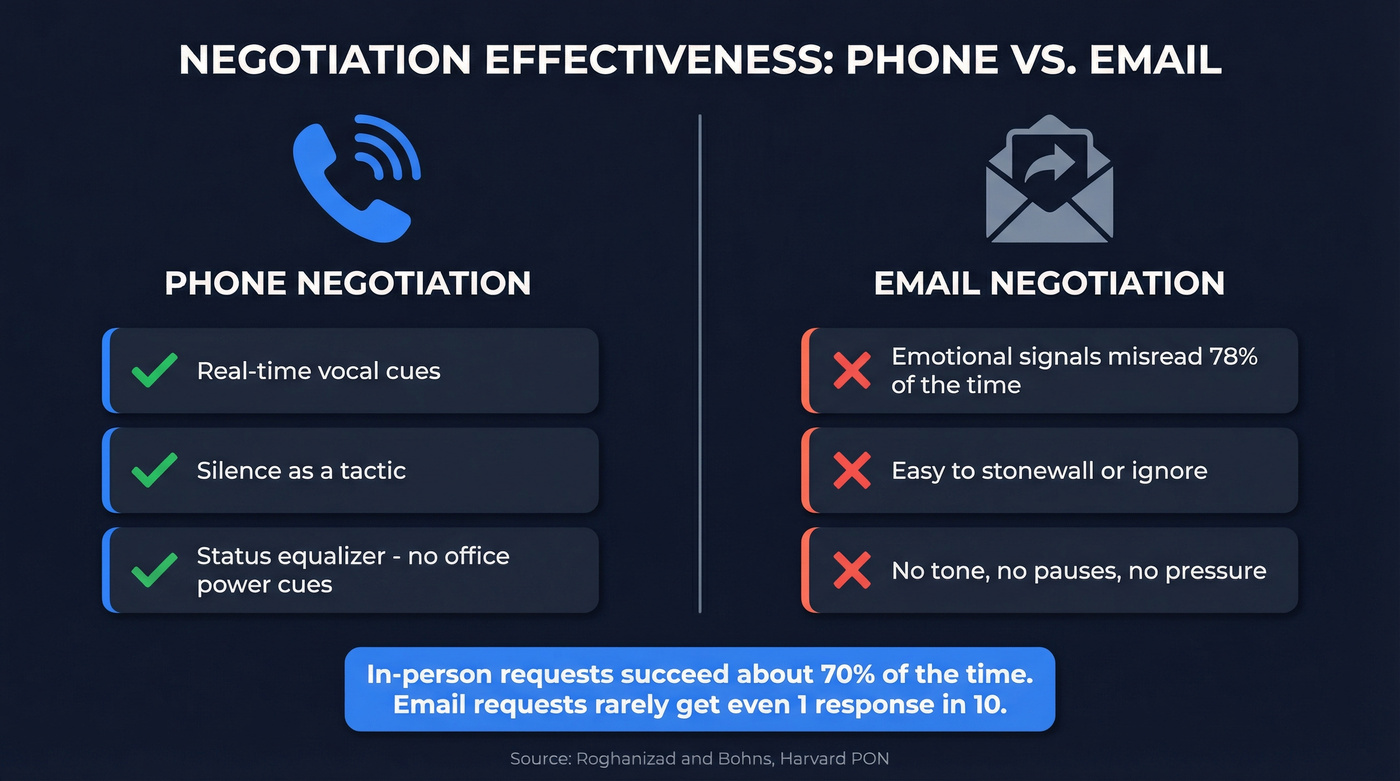
There's a deeper problem with email, though. In experiments by Laubert and Parlamis, trained coders agreed on the emotions expressed in email transcripts only about 22% of the time. Four out of five emotional signals get lost or misread. Some negotiators prefer email for the "poker face" effect, but that cuts both ways - you can't read their reactions either. On the phone, you hear hesitation, enthusiasm, and frustration in real time, and your tone of voice carries more persuasive weight than the words themselves.
There's also a status dynamic most people miss. Karrass points out that phone calls strip away office cues - the corner office, the expensive suit, the power seating arrangement. The phone is an equalizer. That works in your favor when you're negotiating up.
What You Need Before Dialing
Stop reading 20-tip listicles. You need three things:
- A number. Your target and your walk-away. Without both before the call, you're not negotiating - you're improvising. (If you want a deeper framework, set a clear walk-away before you dial.)
- A script. Exact sentences for your scenario, not bullet points. If you want more options, borrow proven talk tracks.
- A follow-up email. Verbal agreements evaporate. Lock everything in writing within 24 hours using battle-tested sales follow-up templates.
Everything below is the detail behind those three items.
Step-by-Step Phone Negotiation Framework
Prep
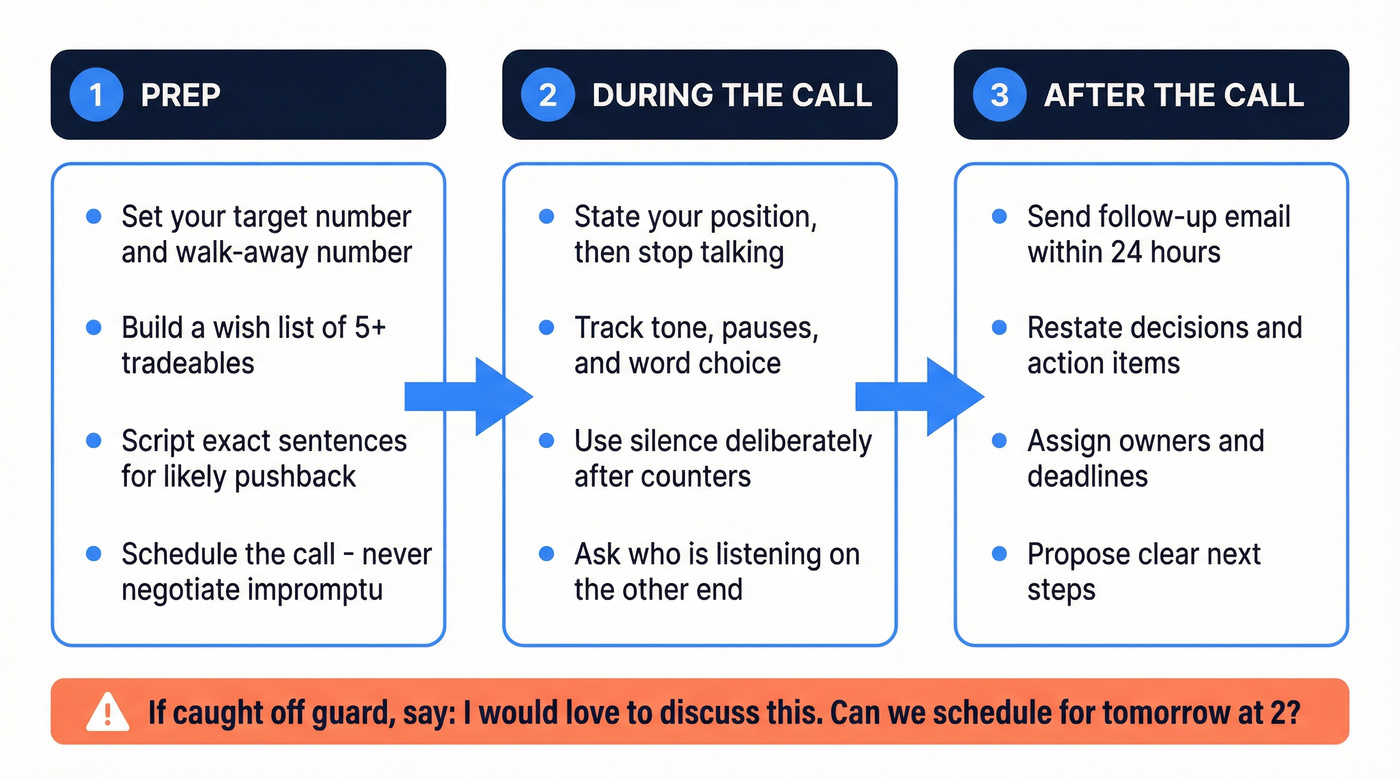
Karrass frames phone negotiation as fast and convenient but risky without preparation. Never negotiate impromptu. If someone catches you off guard, say: "I'd love to discuss this. Can we schedule for tomorrow at 2?" That one sentence buys you time to research, build your wish list, and rehearse your scripts. The callback works best when you give a specific time - "Can we talk at 2 PM tomorrow?" beats a vague "I'll call you back."
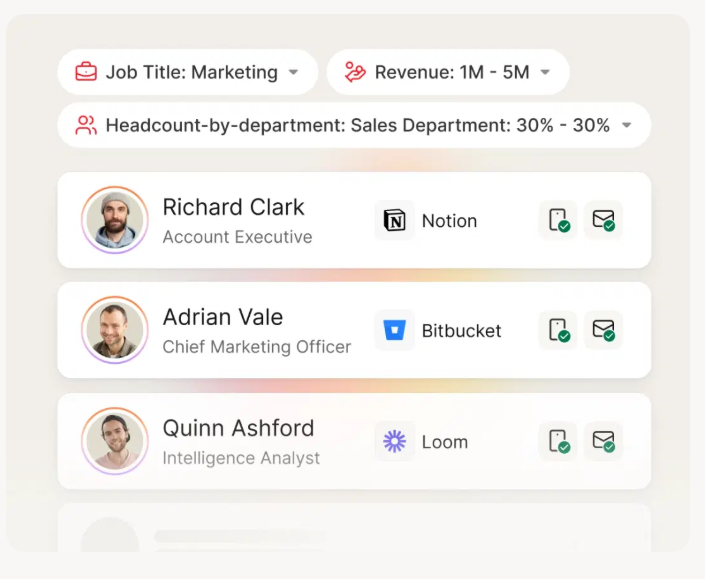
Before the call, know who you're talking to and whether they can actually make the decision. In B2B contexts, tools like Prospeo let you find verified emails and direct mobile numbers for decision-makers so you're not wasting a negotiation on someone who has to "check with their manager." (This is also a core part of modern sales prospecting techniques.)
Build a wish list of tradeables - payment terms, contract length, scope adjustments, implementation support. The longer your list, the more room you have to trade instead of just conceding on price.
During the Call
Take notes on everything - not just what they say, but how they say it. Mitel's guidance is to track tone, word choice, and reactions. A pause after your counter-offer tells you something. A quick "let me check" tells you something different. UvA research found that vocal qualities - not just words but how your voice sounds - measurably affect rapport and deal outcomes. Speak slowly and at a lower pitch when making your key points.
If you're on a call with multiple people on the other side, ask who's listening. Scotwork flags undisclosed silent participants as a major trust-destroyer. If discovered later, it poisons the entire relationship.
State your position, then stop talking. Silence is the most underused tactic on the phone. Whoever speaks first after a silence usually gives ground. (If you want the underlying mechanism, it’s the same logic as anchoring plus pressure.)
After the Call
Send a follow-up email within 24 hours. Restate what was agreed, list action items with owners and deadlines, and propose next steps. A phone deal without a written follow-up isn't a deal. It's a conversation. If you need a structure, use a sales meeting follow-up email format.
Scripts for Three Scenarios
Salary Negotiation
When they ask "What are you looking for?" - don't answer directly:
"I'd love to discuss comp, but I want to make sure I understand the full picture first - the role scope, the team, the growth path. Can we schedule a call for Thursday so I can give you a thoughtful answer?"
That buys you time. Pull comp data from Levels.fyi, Glassdoor, and Team Blind. When you give a number, anchor with a range where your target is the bottom. If you want $145k, say "I'm targeting $145-160k based on market data for this role and level." Then stop talking.
If they counter below your range, ask what flexibility exists on signing bonus, equity, or review timing.
Common mistake: Accepting the first number because you're relieved they offered at all. The first number is always the start, not the finish.
Car Deal Over the Phone
Dealers don't love negotiating by phone because it removes their home-field advantage. That's exactly why you should do it.
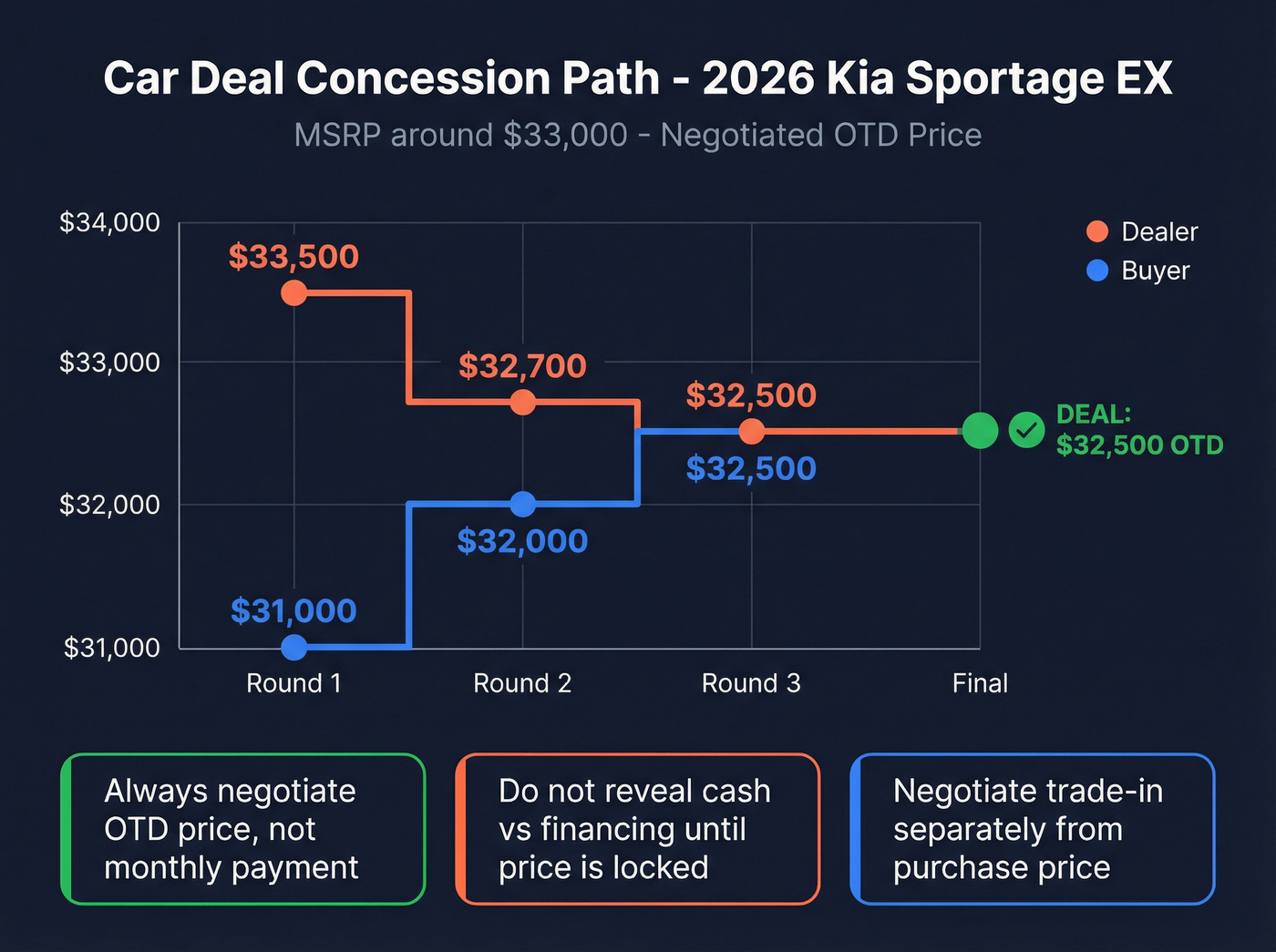
Research the vehicle's MSRP and comparable listings on Edmunds, TrueCar, CarGurus, or CarEdge before you call. Get a trade-in benchmark from Carvana or CarMax - and negotiate the trade-in separately from the purchase price. Then call the internet sales department, not the floor. (If you work with dealerships, a dedicated auto sales CRM can make these handoffs cleaner.)
Always negotiate the out-the-door (OTD) price, never the monthly payment. Monthly payment negotiation is how dealers hide margin in term length and add-ons. Don't reveal whether you're paying cash or financing until after you've locked the OTD number - that information changes their math and costs you money.
On fees: doc fees, registration, and taxes are legit. Everything else - "dealer prep," "market adjustment," "protection packages" - should be questioned or removed.
Let's walk through a real example. On a 2026 Kia Sportage EX with an MSRP around $33k, a buyer started at $31k OTD and settled at $32.5k OTD after a few rounds. The concession path went $33.5k to $32k to $32.7k to $32.5k. That's anchor-and-move in practice.
If the dealer pressures you for an answer right now, that's a signal - not a deadline. Thank them, hang up, and call the next dealer. The consensus on Reddit's car-buying communities is clear: pre-negotiating by phone before you ever set foot in the dealership is the single biggest power move a buyer can make.
Vendor or SaaS Renewal
When your vendor sends a renewal with a price increase, your instinct is to argue the number. Better approach: expand the conversation.
"If price is fixed, what can you move on? Payment terms, contract length, scope, SLA commitments, implementation fees?"
Most vendors have flexibility on at least two of those dimensions even when "price is approved by finance." Offer to extend the contract term in exchange for holding the current rate. Offer to pay quarterly instead of monthly if they'll waive the increase. (If you’re managing renewals at scale, track your renewal rate so you know what “good” looks like.)
In our experience, the biggest mistake in vendor negotiations is talking too much. State your counter, then wait. The vendor fills the silence with options you'd never have thought to ask for.

The article says it best: never waste a negotiation on someone who has to 'check with their manager.' Prospeo gives you verified mobile numbers and emails for actual decision-makers - 125M+ direct dials with a 30% pickup rate across all regions.
Stop negotiating with gatekeepers. Dial the person who signs the check.
Tactics That Actually Work
Use silence deliberately. Communication expert Meredith Harrigan puts it well: most people fill silences because they're uncomfortable, leading to concessions they regret. If you need a bridge, say: "I'm pausing because I want to be thoughtful about this." Then stay quiet.
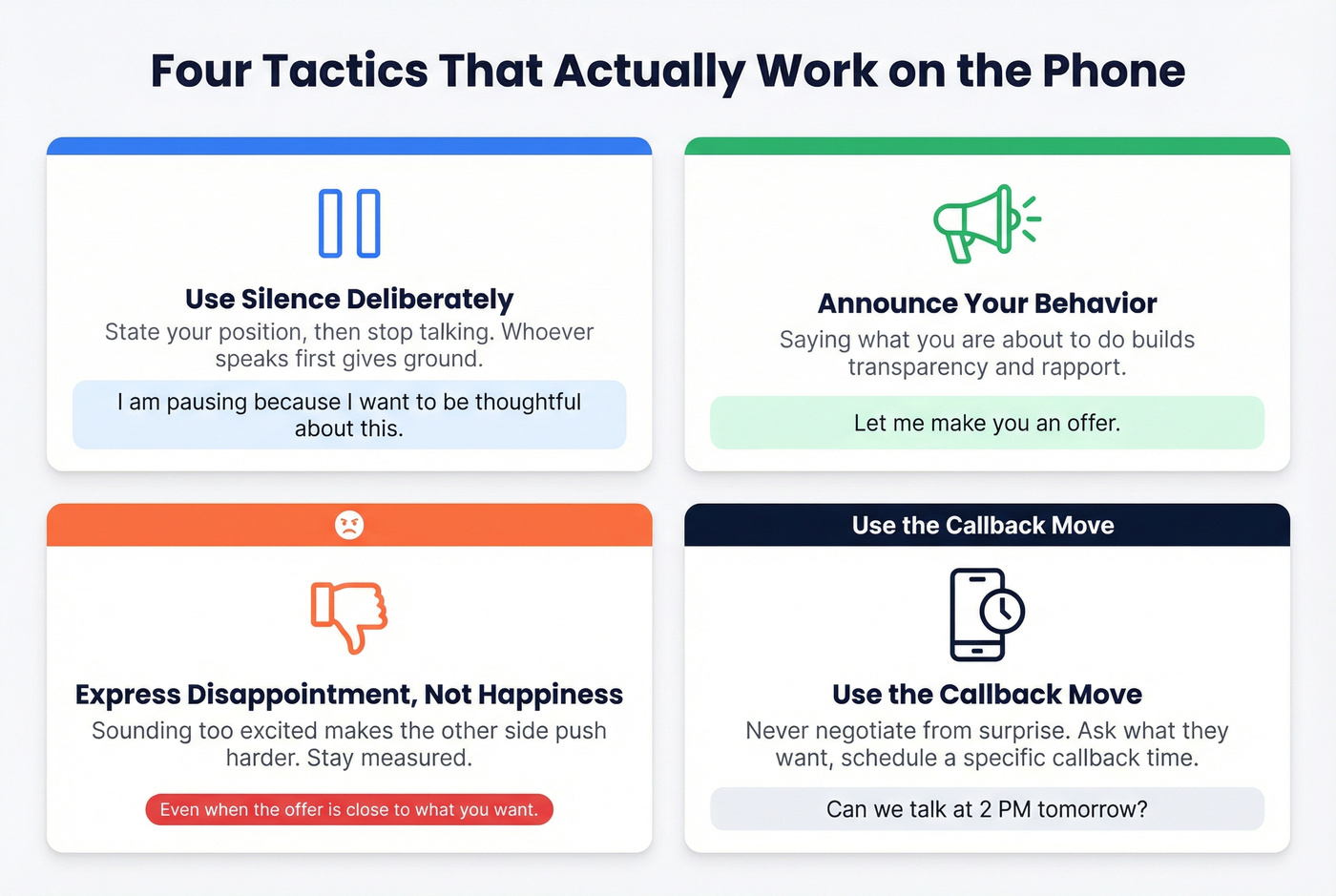
Announce your behavior. UvA research found that behavior announcements - "Let me make you an offer" or "Let me ask you a question" - increase perceived transparency and build rapport. It sounds small. It works.
Express disappointment, not happiness. The same research found that expressing disappointment secures better deals, while expressing happiness encourages the other side to push harder. Keep your tone measured, even when the offer is close to what you want. We've seen reps blow a great deal by sounding too excited too early - the other side immediately recalibrated.
Use the callback move. If you're caught unprepared, ask what they want, then say you'll call back at a specific time. Use that gap to build your wish list and prepare your trades. Never negotiate from surprise.
Mastering Tone of Voice
Your vocal delivery shapes the outcome as much as your arguments do. A calm, steady pace signals confidence; a rushed or high-pitched delivery signals anxiety and invites the other side to push harder.
Before any negotiation call, do a 60-second warm-up: breathe deeply, hum to relax your vocal cords, and rehearse your opening line out loud. Recording yourself during practice runs is the fastest way to catch habits - upspeak, filler words, nervous laughter - that undermine your position. I once listened back to a mock negotiation I'd recorded and counted eleven "ums" in two minutes. Brutal, but it fixed the problem overnight.
Your Pre-Call Checklist
- ☐ Research your counterpart (role, authority level, likely constraints)
- ☐ Set your target number and your walk-away number
- ☐ Build a wish list of 5+ tradeables
- ☐ Prepare 2-3 scripts for likely pushback scenarios
- ☐ Schedule the call (never negotiate impromptu)
- ☐ Have pen and notepad ready
- ☐ Plan your follow-up email timing (within 24 hours)
Skip the checklist at your own risk. We've watched experienced salespeople blow winnable deals because they picked up the phone without knowing their walk-away number. Preparation isn't optional - it's the whole game. (If you want a broader system, map this into your sales activities.)
The Follow-Up Email Template
Send this within 24 hours. The goal is to turn a verbal conversation into a written record.
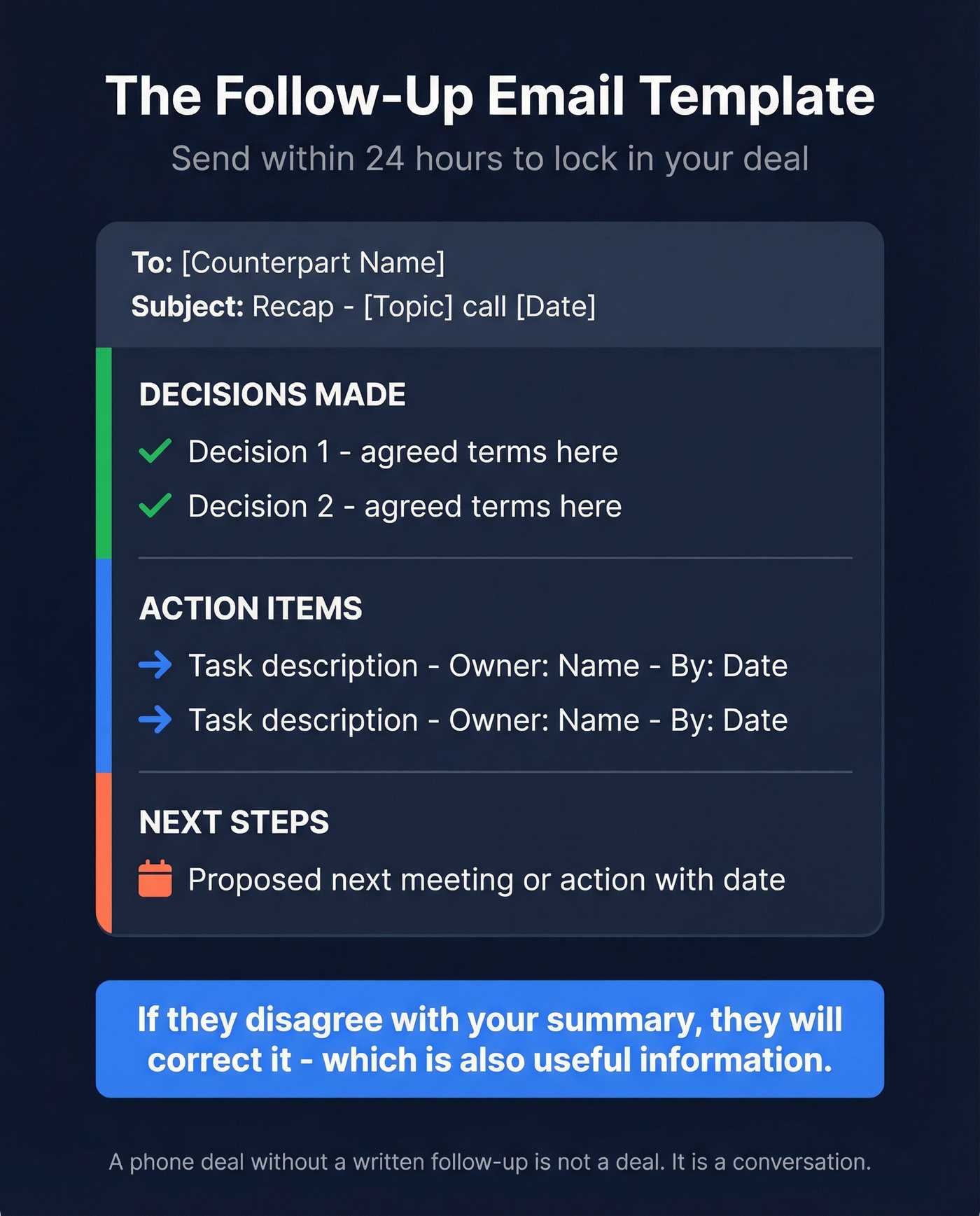
Subject: Recap - [Topic] call [Date]
Hi [Name],
Thanks for the call today. Here's my understanding of what we discussed:
Decisions made:
- [Decision 1]
- [Decision 2]
Action items:
- [Item] - Owner: [Name] - By: [Date]
- [Item] - Owner: [Name] - By: [Date]
Next steps: [Proposed next action or meeting]
Let me know if I've missed anything. Otherwise, I'll proceed on the above.
The structure matters more than the wording. Decisions, action items with owners and deadlines, and a clear next step. If they disagree with your summary, they'll correct it - which is also useful information.
Can You Record the Call?
As of 2026, 38 states plus D.C. follow one-party consent rules, meaning you can legally record a call you're on without telling the other person. Several states require all-party consent: California, Connecticut, Florida, Illinois, Maryland, Massachusetts, Montana, New Hampshire, and Pennsylvania - plus South Carolina for certain private conversations.
For multi-state calls, follow the stricter standard. The safest default: just disclose. Open with "This call may be recorded for quality and training purposes" and move on. Three seconds eliminates the legal question entirely.
Preparation wins phone negotiations. Prospeo's 30+ search filters - job title, seniority, department, company size - let you identify and reach the right contact before you ever pick up the phone. 98% email accuracy means your follow-up lands too.
Research your counterpart in minutes, not hours. Start free today.
FAQ
What's the biggest mistake when negotiating by phone?
Talking too much after stating your position. The person who speaks first after a silence usually concedes ground. Practice sitting with five seconds of dead air - it feels uncomfortable, but that discomfort is where better deals get made.
Should I negotiate salary over the phone or email?
Phone, almost always. Email requests are easy to ignore and strip out vocal cues that build rapport. Use the call for the actual negotiation, then send a follow-up email within 24 hours to lock the agreement in writing.
Does anchoring really work on the phone?
Yes. Research consistently shows that the first number stated in a negotiation disproportionately influences the final outcome. Anchor slightly above your target - if you want $145k, open with a $145-160k range - then let silence do the work.
How do I handle "I need to check with my manager"?
Ask upfront who has authority to make the decision. If they can't commit on the call, ask for a specific callback time and confirm what they'll bring back. Don't renegotiate the same points twice - reference your follow-up email as the baseline for the next conversation.