

How to Obtain Email Addresses for Businesses - The Data-Backed Playbook
You send 200 cold emails on Monday. By Wednesday, 47 have bounced, your domain reputation is flagged, and the remaining 153 land in spam. That's not a hypothetical - it's what happens when you skip verification on a list you scraped together from three different sources. The average professional sends and receives 120+ business emails per day, and the inboxes you're trying to reach are ruthless about filtering out senders with poor reputations.
Knowing how to obtain email addresses for businesses isn't the hard part anymore. Finding accurate ones that don't torch your deliverability - that's the actual skill.
What You Need (Quick Version)
You don't need seven methods. You need two good ones and a verification step.
- Learn two Google operator strings for manual backup. These cover edge cases where tools miss - small businesses, niche industries, recently launched companies.
- Never send without verifying. Your target is under 5% bounce rate. Anything above that and you're actively damaging your sender reputation.
Mistakes That Kill Outreach First
Buying bulk lists without checking data accuracy is the fastest way to burn a domain. A verified list of 500 contacts outperforms an unverified list of 5,000 every single time. Purchased lists are full of stale addresses, spam traps, and people who've changed jobs twice since the list was compiled. Skip this entirely.
If you want the legal angle before you even start, read Is It Illegal to Buy Email Lists?.
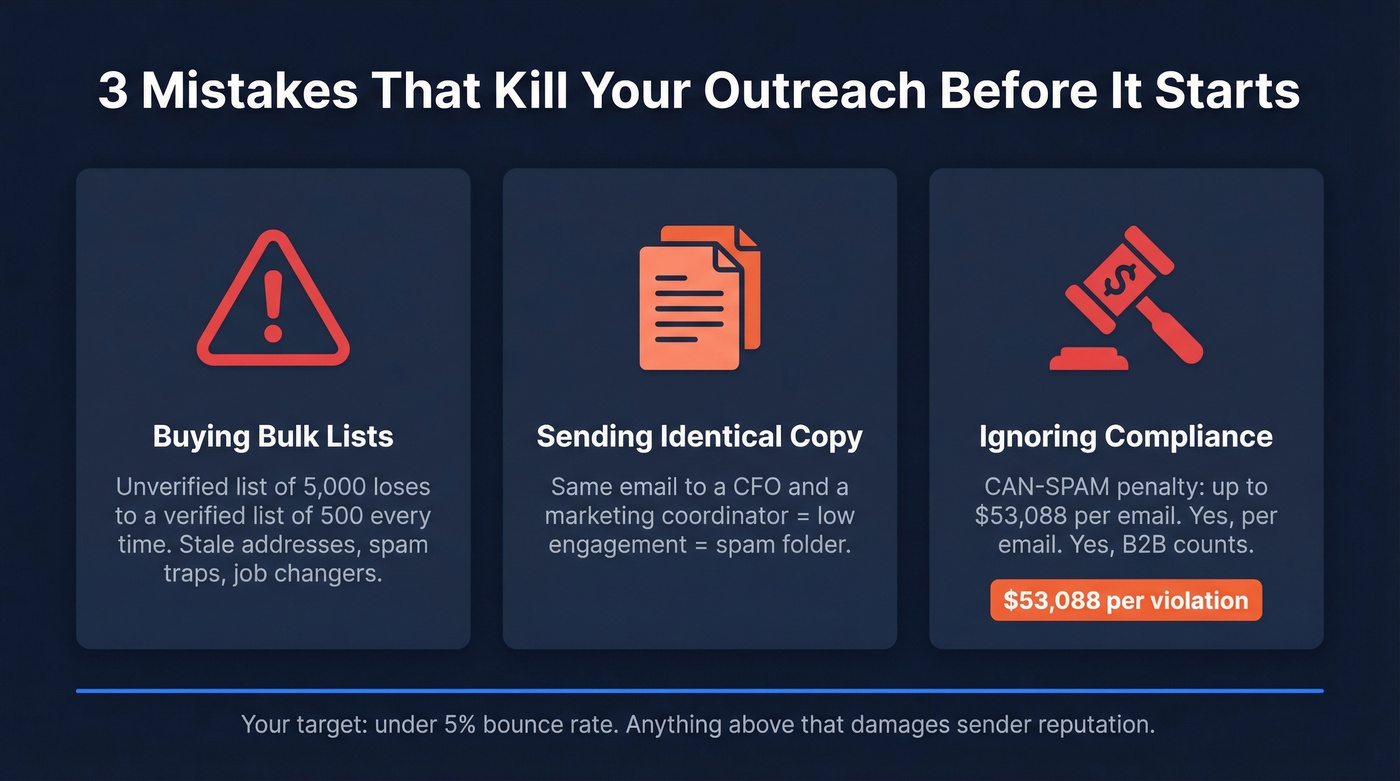
Sending identical copy to every contact is the second killer. Even if you've got the right addresses, blasting the same email to a CFO and a marketing coordinator guarantees low engagement. Low engagement signals to inbox providers that you're spam. Segment by role, industry, or company size at minimum. If you need copy help, use these cold email subject lines as a starting point.
Ignoring compliance regulations is the third. CAN-SPAM penalties run up to $53,088 per email in violation - not per campaign, per email. And CAN-SPAM explicitly covers B2B. There's no business-to-business exception. We'll cover the full checklist later, but the short version: include an opt-out link, a physical address, and honor unsubscribes within 10 business days.

7 Methods to Find Business Emails
Company Websites and Press Releases
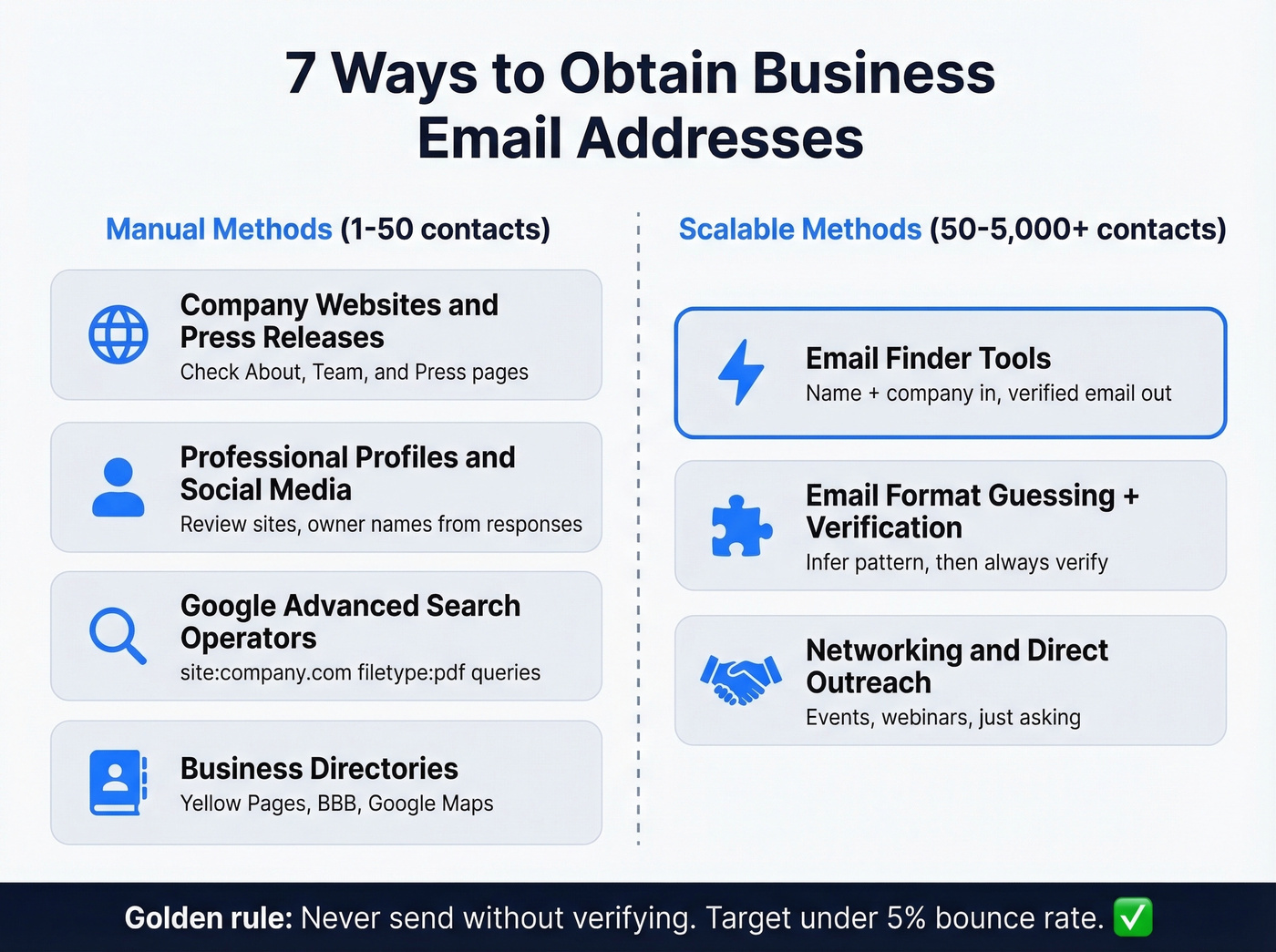
Start with the obvious. Check About, Contact, and Team pages - many companies list department or individual emails directly. Press releases are underrated: media contacts are almost always real, monitored inboxes. We've pulled dozens of valid contacts from press pages that tools completely missed, especially for mid-market companies that don't show up well in B2B databases.
Professional Profiles and Social Media
Review sites like Yelp and BBB are goldmines for local businesses, especially in hospitality and services. Owner and manager names show up in review responses, and from there you can run a name plus company through any email finder. Browse in private mode so you don't tip off the prospect before you're ready to reach out.
Google Advanced Search Operators
This is where manual research gets powerful. Two strings worth bookmarking:
Find emails in company documents:
site:company.com filetype:pdf "@company.com"
Filter out aggregator noise:
"@company.com" -site:zoominfo.com -site:apollo.io -site:linkedin.com
The pattern discovery workflow is simple. Find one or two real emails from a company, identify the format - first.last@, flast@, or first@ - then generate likely addresses for other employees. Always verify before sending; guessing formats without verification is how you rack up bounces. (If you want the full operator list, see Google Advanced Search Operators.)
Business Directories
Yellow Pages, BBB, Bing Places, and Angie's List still work for local and SMB businesses, especially those without websites. Google Maps listings often surface owner names and sometimes direct contact info. For businesses that exist primarily offline, directories are often your only starting point.
Email Finder Tools
Manual methods work for five or ten contacts. They don't work for five hundred.
If you need to source business email addresses at scale, email finder tools let you input a name and company or domain and get back a verified address in seconds. The accuracy gap between tools is massive - in a 5,000-contact benchmark, verified rates ranged from 16.9% to 77.5% across providers on the same dataset. We break down the options below. If you're building lists end-to-end, this lead generation workflow will help you avoid leaky steps.
Email Format Guessing
Most companies use predictable patterns: first.last@company.com, flast@company.com, or first@company.com. If you can find one or two real emails from a company via Google operators or their website, you can infer the pattern and generate likely addresses for other employees. But this is a starting point, not an endpoint. Run guessed addresses through a verification tool before sending.
Networking and Direct Outreach
Events, webinars, and trade shows remain the highest-quality source for business contact information - because the person gives it to you directly. For high-value targets where tools and Google operators come up empty, sometimes the best approach is simply asking. A brief message on a professional platform requesting their preferred email for a follow-up works more often than you'd expect.
If you need a tighter outbound system around this, use these sales prospecting techniques to structure your daily activity.

You just read that bounce rates above 5% damage your sender reputation. Prospeo's 5-step verification catches spam traps, honeypots, and catch-all domains before you hit send - delivering 98% email accuracy across 300M+ profiles.
Get 75 verified business emails free and see the difference yourself.
Email Finder Tools Compared
| Tool | Starting Price | Free Tier | Accuracy / Benchmark | Best For |
|---|---|---|---|---|
| Hunter | $24/mo | 25 searches/mo | 37.6% verified rate* | Verify-first workflow |
| Snov.io | $39/mo | 50 credits | 20.1% verified rate* | EU/international lists |
| Apollo | ~$49/mo/user | Yes | Not independently benchmarked | High-volume, low-budget |
| Findymail | $49/mo | No | 39.9% real enrichment** | Second-source enrichment |
| Voila Norbert | $39/mo | 50 searches | 36.0% verified rate* | Budget mid-range |
| Kaspr | $49/mo | 5 credits | N/A | One-by-one Chrome prospecting |
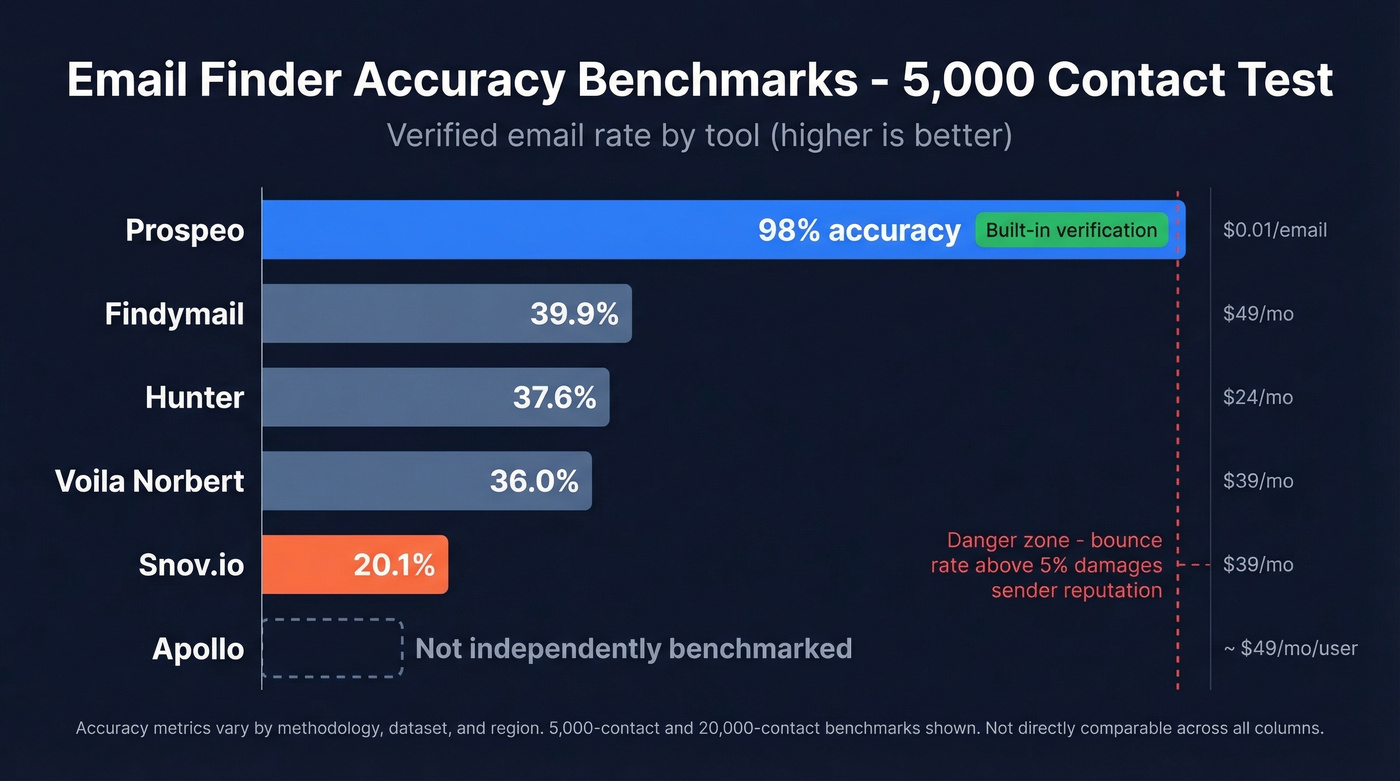
*5,000-contact benchmark · **20,000-contact benchmark. Accuracy metrics vary by methodology, dataset, and region - these numbers aren't directly comparable across columns.
Prospeo
Prospeo covers 300M+ professional profiles with 98% email accuracy, and the key differentiator is that verification is built into the finding process - a proprietary 5-step verification that handles catch-all domains, removes spam traps, and filters honeypots before you ever see the result. You're not paying for an email and then paying again to verify it somewhere else.
Pricing sits at roughly $0.01 per email, with a free tier of 75 verified emails per month. No annual contracts, no sales calls required. The 7-day data refresh cycle is a meaningful gap versus the 6-week industry average - you're not working with contacts who changed jobs last month.
In our experience, the real proof shows up in customer results. Meritt reported bounce rates dropping from 35% to under 4% after switching, with pipeline growing 3x. Stack Optimize maintains 94%+ deliverability and under 3% bounce across all clients with zero domain flags. When your email finder eliminates the need for a separate verification tool, the workflow gets dramatically simpler.
Hunter
Hunter's Chrome extension has 600,000+ users and a 4.7 rating from 12,000+ reviews - that's genuine social proof, and it's earned. The extension makes domain-level email discovery fast and frictionless. It starts at $24/mo, with a free plan offering 25 searches/month.
The tradeoff is database size. Practitioners on Reddit often note that Hunter's database is smaller than competitors'. It works better as a verification layer than a primary source. If you're finding emails through other methods and need to confirm them, Hunter is solid. If you need it to be your only tool, you'll hit coverage gaps. If you're comparing options, see our list of Hunter alternatives.

Snov.io
Use this if you're prospecting internationally and need affordable credits with built-in automation. Snov.io starts free with 50 credits, paid plans from $39/mo, and it handles email finding, verification, and drip campaigns in one platform. The international coverage - particularly in Europe and emerging markets - is where it earns its reputation.
Skip this if you need high verified rates on US-heavy lists. A 5,000-contact benchmark showed a 20.1% verified rate. Real-world results vary by dataset, but that's a notable gap versus top performers.
Apollo
Here's the thing about Apollo: the Reddit consensus is blunt. One practitioner targeting 500-1,000 emails per day described it as having a "big database but data feels bad sometimes... lots of bounces on older contacts." That tracks with what we've seen. Apollo's database covers 250M+ contacts with a free tier and paid plans from ~$49/mo per user - the sheer volume is impressive, and the platform bundles prospecting, engagement, and analytics.
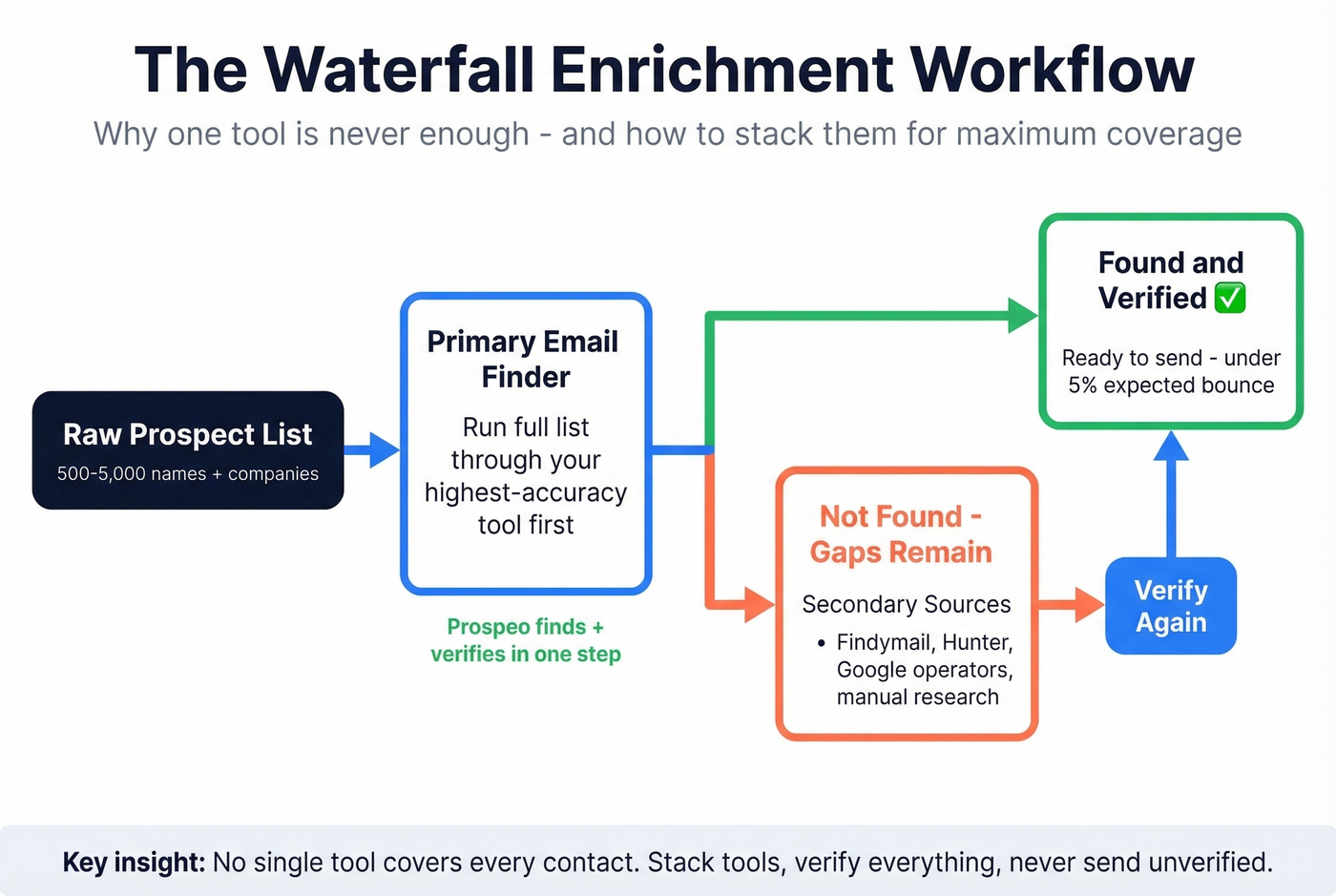
But big database doesn't equal accurate database. Per-seat pricing also gets expensive fast when you're scaling a team. If you're sending high volume and accuracy is non-negotiable, Apollo alone won't cut it. Consider using it as a top-of-funnel source and running results through a waterfall enrichment workflow with a dedicated verification tool. For a deeper comparison, see Coresignal vs Apollo.io.
Budget and Niche Finders
Findymail at $49/mo for 1,000 credits showed strong results in a 20,000-contact benchmark - 39.9% real enrichment rate with only a 1.1% hard bounce rate. Worth testing as a second source alongside your primary finder for high-volume campaigns.
Voila Norbert at $39/mo for 1,000 searches, with 50 free searches, is a solid mid-range option. Nothing flashy, but reliable enough for teams that don't need enterprise-scale coverage.
Kaspr takes a Chrome-extension-first approach. The Starter plan runs $49/mo for 60 direct email credits, scaling to $79/mo for 2,400 credits on the Business tier. Best for reps who prospect one-by-one from professional profiles rather than running bulk searches.
Manual methods break at scale. Prospeo finds and verifies business emails in one step for ~$0.01 each - no separate verification tool needed. Data refreshes every 7 days, so you're not emailing people who left the company last month.
Meritt cut their bounce rate from 35% to under 4%. Your list is next.
What Accuracy Benchmarks Show
Two independent benchmarks give us real data on email finder accuracy - and the results are humbling for most tools.
The Dropcontact benchmark tested 15 email finders on 20,000 real contacts split roughly between US and Europe, then performed 100% live email sending to measure actual hard bounces - not simulated pings. Top performers hit 40-55% real enrichment rates. The worst had error rates above 15%. Findymail landed at 39.9% real enrichment with 6.2% overall error. Dropcontact topped their own benchmark at 54.9% real enrichment and 1.9% error.
Always run your own bake-off on a sample of your actual target list before committing to any tool. We do this with every new provider we evaluate, and the results rarely match the marketing pages. If you want to improve match rates, add data enrichment before you run a finder.
Verify Before You Send
If your email finder doesn't include verification, you need a standalone verification tool. The mechanics are straightforward: syntax check, then DNS/domain check, then SMTP mailbox check. The whole process takes milliseconds per address. For a deeper breakdown, see our email deliverability guide.
| Tool | Claimed Accuracy | Price per 1,000 | Free Trial |
|---|---|---|---|
| Bouncer | 99.5% | $7 | 1,000 credits |
| NeverBounce | 99.9% | $8 | 1,000 credits |
| Xverify | 98% | $9.20 | None |
| BriteVerify | 97% | $10 | None |
| ZeroBounce | 96-98% | $7.50 (2K minimum) | 100 credits |
Your target is under 5% bounce rate. Above that, inbox providers start throttling your sending domain, and recovery takes weeks. I'd recommend Bouncer at $7/1,000 for the best value-to-accuracy ratio if you need a standalone verifier.
CAN-SPAM and GDPR Compliance
CAN-SPAM covers all commercial email in the US - and there's no B2B exception. Here's the FTC's compliance checklist, condensed:
- No false or misleading header info. Your "From," "To," and "Reply-To" must be accurate.
- No deceptive subject lines. The subject must reflect the content.
- Disclose it's an ad. Clear and conspicuous.
- Include a valid physical postal address. Street address, PO box, or registered private mailbox.
- Include a clear opt-out method. Must be easy to use and functional for 30 days after sending.
- Honor opt-outs within 10 business days. No exceptions, no fees, no extra info required.
- You're responsible for third parties. If an agency sends on your behalf, you're still liable.
Penalties run up to $53,088 per violating email. For a 1,000-email campaign with compliance issues, the math gets terrifying fast.
For EU contacts, GDPR applies. The most common legal basis for B2B cold email is "legitimate interest," but you need to document your reasoning, offer easy opt-out, and be prepared to delete data on request. When in doubt, consult a privacy attorney before targeting EU prospects at scale.
FAQ
Is it legal to cold email businesses?
Yes, under CAN-SPAM in the US and GDPR legitimate interest in the EU - but you must include opt-out links, a physical address, and honor unsubscribes within 10 business days. Penalties reach $53,088 per violating email, so compliance isn't optional.
What's a good bounce rate for cold email?
Under 5% is the threshold. Anything above that signals bad data to inbox providers and triggers throttling that takes weeks to recover from. Verify every address before sending - tools like Bouncer or Prospeo's built-in verification handle this automatically.
How do I find emails for small businesses without websites?
Use Google Maps, BBB, Yellow Pages, and Yelp to find owner names and business details. Then run the name and company through an email finder tool - Prospeo's 75 free monthly credits or Hunter's 25 free searches are solid starting points for low-volume lookups.
Should I buy a business email list?
Almost never. Purchased lists carry high bounce rates, stale data, and compliance risks. Building a verified list from scratch using email finder tools and Google operators produces dramatically better deliverability and engagement.
What's the most accurate email finder tool in 2026?
Prospeo leads with 98% verified email accuracy and a 7-day data refresh cycle. Independent benchmarks show most tools range from 20-55% enrichment rates, so always run a test batch against your actual target list before committing budget.