

How to Overcome Objections in Sales: What 67,000 Calls Reveal
It's 2pm on a Thursday. The demo went great - prospect was nodding, asking questions, even laughing at your joke about their competitor's UI. Then the follow-up call happens. "We're going to hold off for now." That deal dies in your pipeline, and you never really understand why.
Here's the uncomfortable math: 69% of reps fell short of quota last year. Only 2% of sales close on the first meeting, 60% of buyers say no at least four times before saying yes, and 40-60% of deals you "lose" aren't lost to a competitor - they're lost to no decision at all. The objection isn't the enemy. How you respond to it is.
What Actually Moves the Needle
Most objection-handling advice boils down to "listen and empathize." That's table stakes. What actually separates closers from quota-missers - backed by 67,149 recorded sales calls - comes down to three behaviors:
- Pause longer than feels comfortable. Top reps increase their pause length after objections. Average reps pounce.
- Ask a diagnostic question instead of answering. Clarify before you solve.
- Confirm the stated objection is even the real one. Most first objections are smoke screens.
What 67,000 Sales Calls Reveal
Gong Labs analyzed 67,149 sales meetings from a database of 5 million recorded calls, using machine learning to isolate the behaviors that separate top performers from everyone else during objection moments. The findings aren't intuitive.
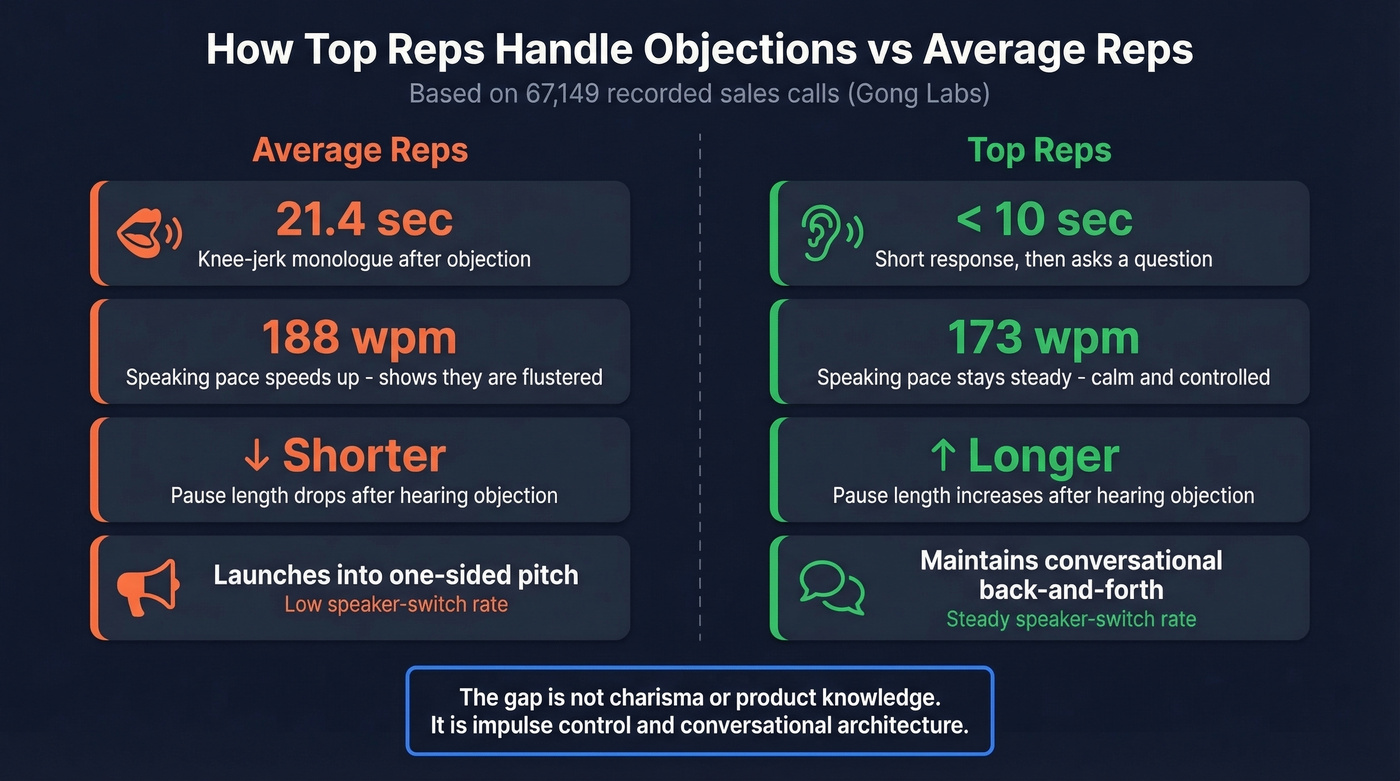
Average reps respond to an objection with a 21.45-second knee-jerk monologue. They speed up from a normal 173 words per minute to 188 wpm - a subtle but measurable tell that they're flustered. Their pause length actually drops after an objection. They pounce.
Top reps do the opposite. Their pause length increases. Their speaker-switch rate stays steadier, meaning they maintain conversational back-and-forth instead of launching into a one-sided pitch. And they close the loop with a simple question: "Does that make sense?"
The gap isn't charisma or product knowledge. It's impulse control and conversational architecture. The best reps treat an objection as a diagnostic moment, not a debate to win.
Five Mistakes Killing Your Deals
1. Treating the first objection as the real one. Many objections are smoke screens. "Price is too high" often masks concerns about implementation risk or internal politics. If you discount immediately, you've solved the wrong problem and left money on the table. Ask one follow-up question before responding to the surface objection.
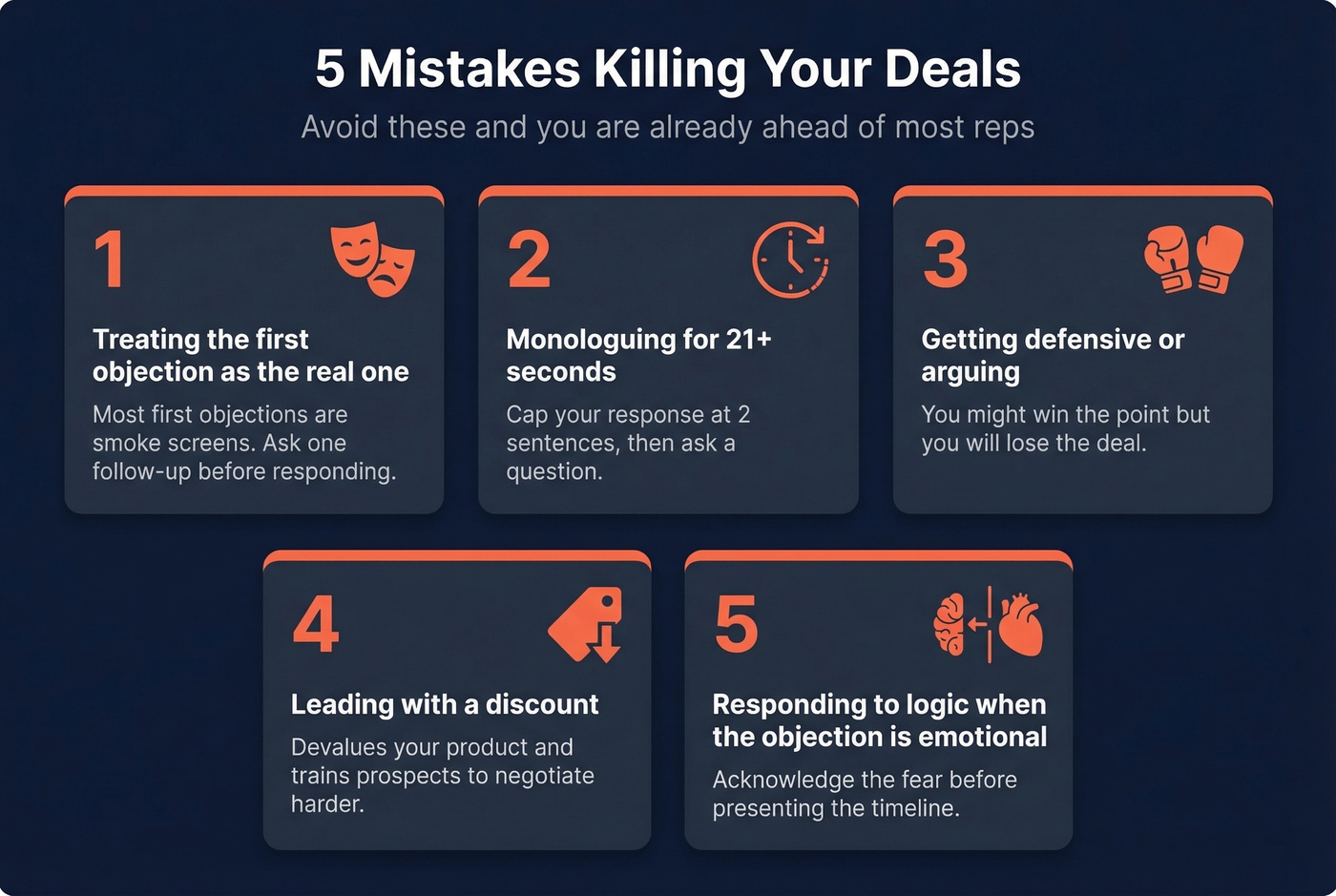
2. Monologuing for 21+ seconds. That stat isn't a coincidence. When you launch into a feature dump after an objection, you're signaling that you're defending, not listening. Cap your initial response at two sentences, then ask a question.
3. Getting defensive or arguing. The moment you argue, you've turned a conversation into a confrontation. Even if you "win" the point, you lose the deal. "That's a fair concern" costs you nothing.
4. Leading with a discount. Jumping to price concessions devalues your product and trains the prospect to negotiate harder. Lead with ROI and unique value first. Discounts are a last resort.
5. Responding to logic when the objection is emotional. A prospect who says "the timing isn't right" is often afraid of making the wrong decision or dealing with internal change management. Answering with a logical timeline doesn't address the fear. Acknowledge the emotion before presenting the logic.
A 7-Step Objection Handling Framework
This sequence - adapted from the Gong research and Chris Voss's negotiation principles - works across deal sizes and industries. You don't need to memorize it perfectly. You need to internalize the rhythm.
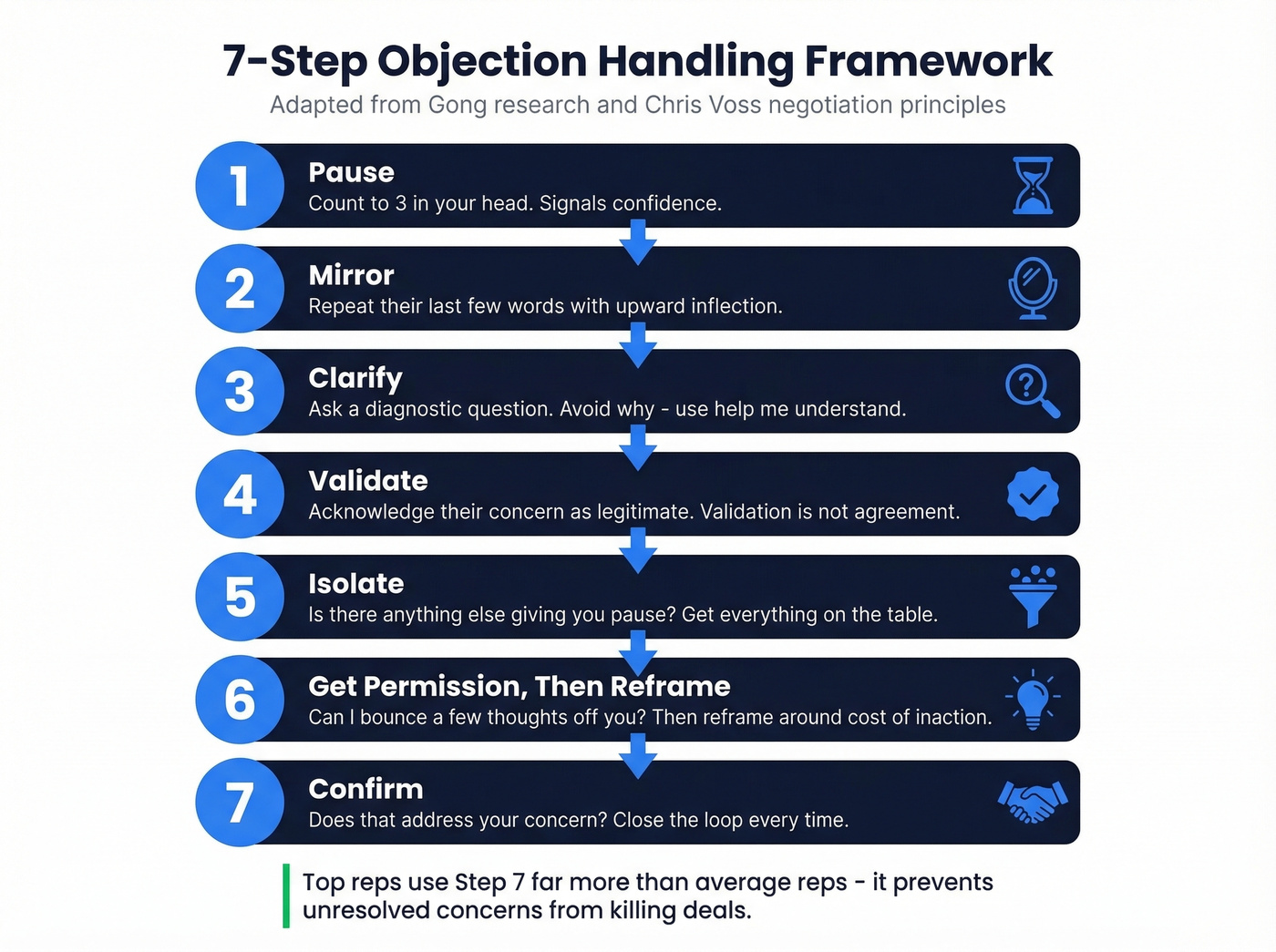
Step 1: Pause. Count to three in your head. This feels agonizing. Do it anyway. The pause signals confidence and gives you time to think instead of react.
Step 2: Mirror. Repeat the last few words of their objection with a slight upward inflection. "Not in the budget right now?" This prompts the prospect to elaborate without you asking a direct question.
Step 3: Clarify. Ask a diagnostic question - but avoid "why," which can feel confrontational. Use: "Can you help me understand what's driving that concern?" This surfaces the real objection behind the stated one.
Step 4: Validate. Acknowledge their concern as legitimate. "That makes total sense given where you are in the fiscal year." Validation isn't agreement - it's respect.
Step 5: Isolate. Ask: "Is there anything else beyond [stated concern] that's giving you pause?" Get everything on the table before you solve anything.
Step 6: Get permission, then reframe. Try: "Can I bounce a few thoughts off of you?" Once they say yes, present your response - reframe the objection in terms of cost of inaction, risk of delay, or an angle they haven't considered. This is where your product knowledge earns its keep.
Step 7: Confirm. Close the loop: "Does that address your concern, or is there still something we should talk through?" The research shows top reps use this question far more than average reps. It prevents unresolved concerns from festering into deal-killers.

The best objection-handling framework won't help if your call never reaches a decision-maker. Prospeo gives you 125M+ verified mobile numbers with a 30% pickup rate - so you actually get the conversation where your skills matter.
Stop practicing scripts on voicemail. Start reaching real buyers.
Scripts for Common Sales Objections
"We Don't Have the Money"
"I hear you - budgets are locked. But we're talking about 300+ hours lost by next fiscal. Is there usually a process for surfacing that kind of operational risk to leadership now, or should we map out the cost together so you're ready when it comes up?"
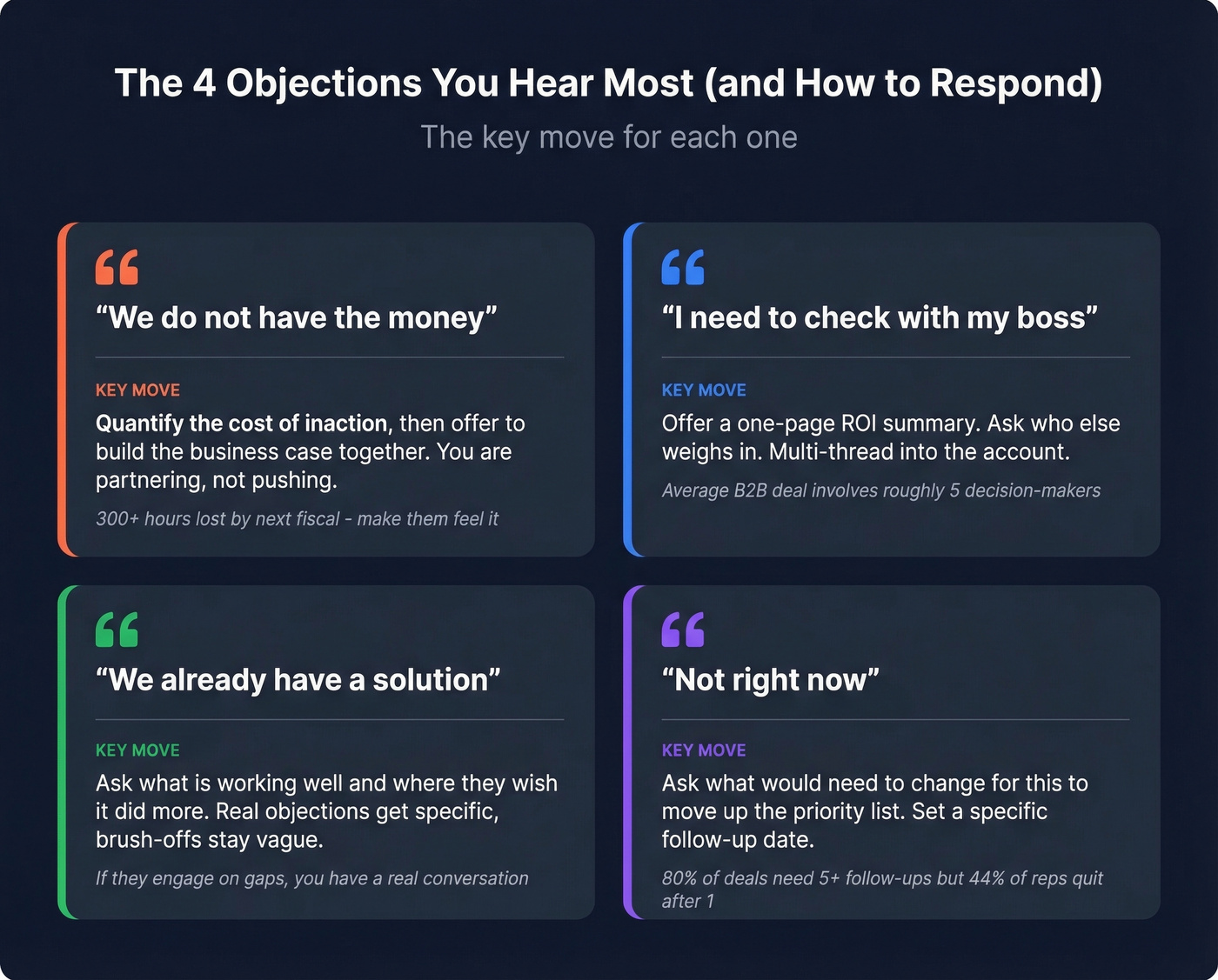
The key move: quantify what inaction costs them, then offer to build the business case together. You're not pushing - you're partnering. This approach, shared by a rep on r/sales, beats jumping straight to a discount every time.
"I Need to Check With My Boss"
The average B2B deal involves roughly 5 decision-makers. Enterprise deals can involve 10-17. So this objection is almost always legitimate.
"Totally understand. Would it help if I put together a one-page summary with the ROI numbers we discussed? And who else will weigh in - I'm happy to jump on a brief call with the broader group."
This makes your champion's life easier and gives you a reason to multi-thread into the account. We've seen reps rescue stalled deals just by getting 15 minutes with the CFO who was never part of the original conversation.
"We Already Have a Solution"
Test whether this is a real objection or a brush-off with one question: "What's working well with your current setup, and where do you wish it did more?"
Real objections get specific ("integration with Salesforce is painful"). Brush-offs stay vague ("we're just not interested"). If they engage, you've opened a conversation about gaps. If they don't, move on - no framework saves a dead lead.
"Not Right Now"
35-50% of sales go to the vendor that responds first. "Not right now" doesn't mean "never."
Skip the rebuttal. Ask this instead: "What would need to change for this to move up the priority list?" Then set a specific follow-up date. 80% of deals require at least five follow-ups, but 44% of reps quit after one. Persistence isn't pushy - it's math.
Choosing the Right Framework
You'll find a bunch of named objection-handling frameworks in sales enablement content, plus proprietary acronyms that vendors use to differentiate their training. Most are repackaged versions of the same core principles. You don't need all of them. You need one that fits your sales motion, drilled until it's muscle memory. If you're standardizing your process across the funnel, it helps to map this into your sales process optimization work.
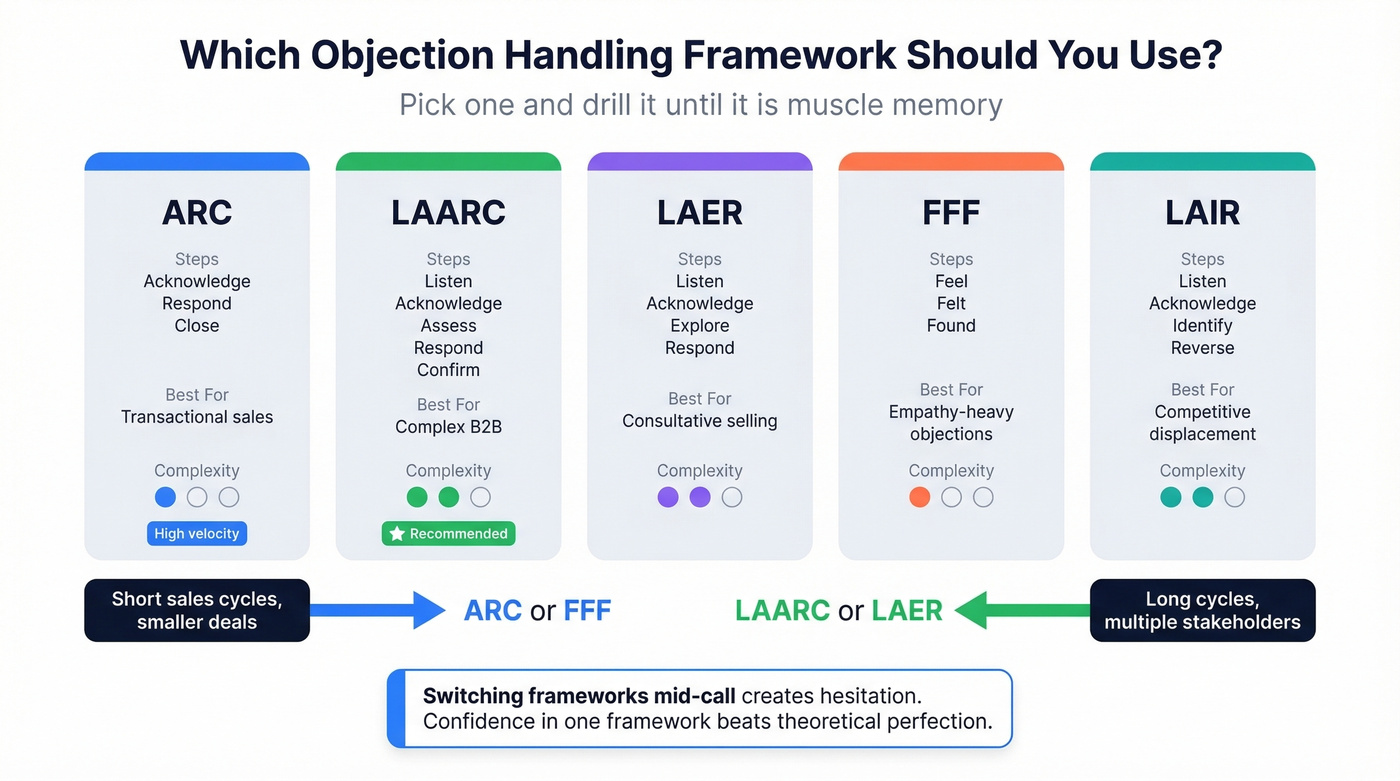
| Framework | Steps | Best For | Complexity |
|---|---|---|---|
| ARC | Acknowledge, Respond, Close | Transactional sales | Low |
| LAARC | Listen, Acknowledge, Assess, Respond, Confirm | Complex B2B | Medium |
| LAER | Listen, Acknowledge, Explore, Respond | Consultative selling | Medium |
| FFF | Feel, Felt, Found | Empathy-heavy objections | Low |
| LAIR | Listen, Acknowledge, Identify, Reverse | Competitive displacement | Medium |
Our recommendation: LAARC for complex B2B deals where multiple stakeholders and longer cycles are the norm. ARC for transactional or high-velocity sales where you need speed. Pick one and drill it. Switching between frameworks mid-call creates hesitation, which is worse than using a "suboptimal" framework confidently. The question isn't which framework is theoretically best - it's which one you can execute consistently enough that the steps become automatic.
How to Practice
Reading about overcoming sales objections doesn't make you better at it. Practice does. 43% of enablement leaders already use AI-powered roleplay to coach their teams, and sellers who regularly practice achieve 20-45% higher win rates. If you're building a repeatable routine, borrow a few ideas from sales training tips and track progress like a sales performance management program.
| Tool | Price | Best For |
|---|---|---|
| Yoodli | Free-$8/user/mo | Solo practice, budget teams |
| Second Nature | ~$30-40/user/mo | Team coaching, structured programs |
| Hyperbound | ~$150-250/user/mo | Enterprise enablement |
Yoodli is the obvious starting point if you're a solo rep or running a lean team - it's free to start and gives you AI-powered feedback on pacing, filler words, and response quality. Second Nature is better for managers running structured programs across a team. Hyperbound is enterprise-grade and priced accordingly.
Here's the thing: if your average deal size is under $15k, you probably don't need a $200/seat roleplay tool. Record your real calls, review them weekly with a peer, and use Yoodli for solo reps. The reps who improve fastest aren't the ones with the fanciest tools - they're the ones who actually review their calls.
The Root Cause Nobody Talks About
Let's be honest about a pattern we see constantly: teams invest in objection-handling training, buy roleplay tools, run weekly practice sessions - and close rates barely move. The problem isn't the framework. It's who they're talking to.
If your bounce rate runs 10-35%, you never reach the conversation where objection handling matters. Bad data means your reps spend hours preparing for calls that go to voicemail, wrong numbers, or people who left the company six months ago. When you're reaching someone who fits your ICP and is showing buying signals, the objections you hear are real ones - and real objections are the ones your framework can actually solve. Tools like Prospeo, with 98% email accuracy and a 7-day data refresh cycle, exist specifically to eliminate that upstream problem so your training investment pays off downstream. If you want to tighten the top of funnel, start with sales prospecting techniques and a clean lead generation workflow, then reduce waste with data enrichment services and better email deliverability.

69% of reps miss quota, and bad contact data is a silent killer. Prospeo's 98% email accuracy and 7-day data refresh mean fewer bounces, more live conversations, and more chances to handle objections instead of chasing dead leads.
Every bounced email is an objection you never got to overcome.
FAQ
What's the difference between an objection and a brush-off?
An objection reflects genuine uncertainty - the prospect has concerns but is still engaged. A brush-off is an excuse to exit. Test with one follow-up: real objections get specific ("we're worried about Salesforce integration"), while brush-offs stay vague ("we're just not interested").
How many follow-ups after an objection?
80% of deals require at least five follow-ups, but 44% of reps quit after one. Space each touchpoint with new value - a case study, a cost-of-delay calculation, or a relevant industry insight. Repetition without fresh information is spam.
What's the best objection-handling framework?
LAARC for complex B2B sales with multiple stakeholders and longer cycles. ARC for transactional or high-velocity sales where speed matters. Pick one and drill it until it's muscle memory - switching frameworks mid-call creates hesitation that costs you deals.
Can AI tools help me practice?
Yes - 43% of enablement leaders already use AI roleplay for coaching. Yoodli (free to $8/user/mo) is the best entry point for solo practice. Second Nature suits team-wide programs with structured scenarios and manager dashboards.
How do I handle objections in emails vs. calls?
Same framework, different pacing. On calls, pause and mirror - real-time back-and-forth lets you diagnose quickly. In email, ask one diagnostic question per message instead of stacking rebuttals. Keep responses short, end with a single question. None of this matters if your email bounces, which is why verified contact data matters as much as your messaging.