

How to Predict Sales - Without Getting Burned at Quarter Close
Four in five sales and finance leaders missed a quarterly forecast in the past year. Over half missed it twice or more. And here's the part that stings: teams paying for Salesforce and Gong are still submitting forecasts in Excel because they don't trust their own pipeline data.
If you want to learn how to predict sales reliably, the problem isn't effort or tooling. It's method, measurement, and - more than anything - data quality. Every forecasting method downstream fails when the contacts in your CRM are six months stale.
Pick a Forecasting Method That Matches Your Data
The biggest mistake is picking a method that requires data you don't have. A startup with eight months of CRM history shouldn't be running regression models.
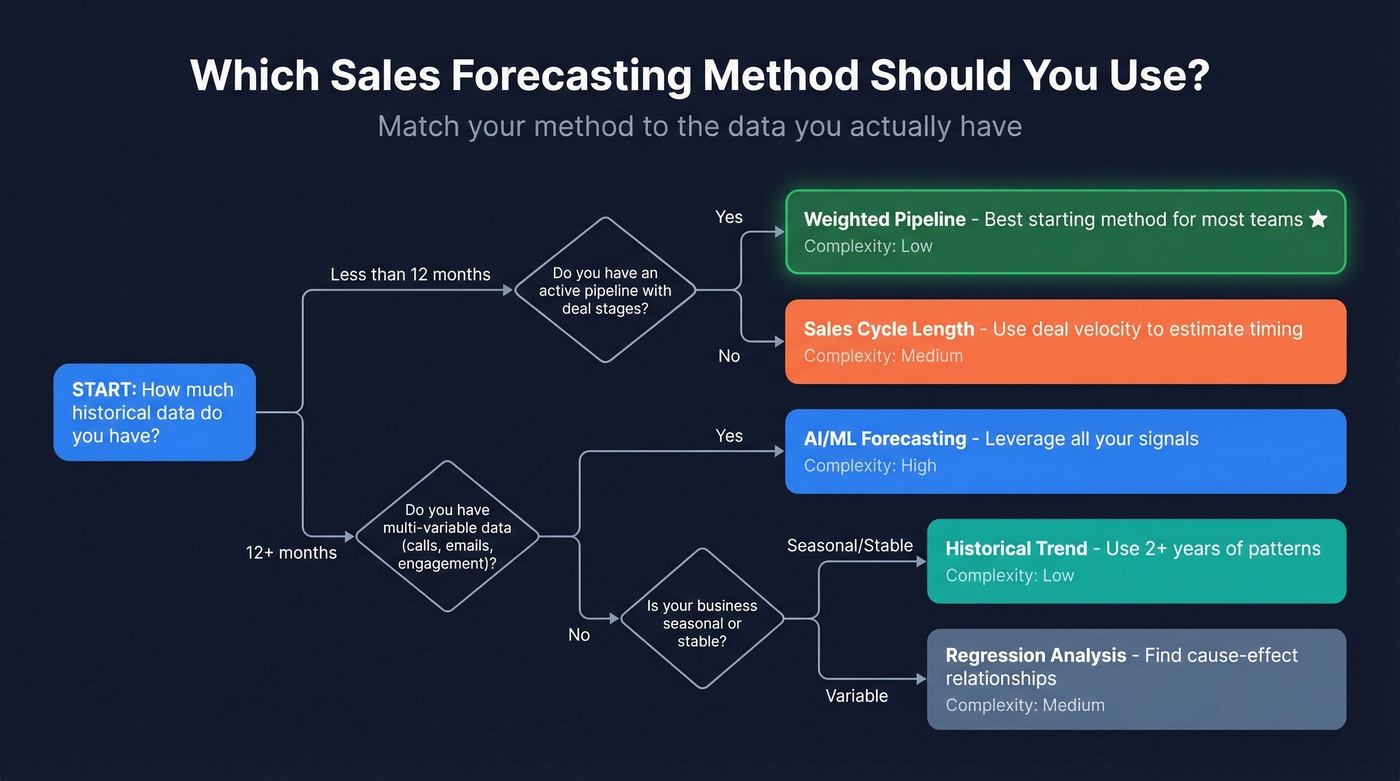
| Method | Best For | Data Needed | Complexity |
|---|---|---|---|
| Historical trend | Stable, seasonal businesses | 2+ years of sales data | Low |
| Weighted pipeline | Teams with active deals | Current pipeline + close probabilities | Low-Medium |
| Opportunity stage | Longer B2B sales cycles | CRM stage data | Medium |
| Sales cycle length | Timeline-focused forecasts | Deal velocity history | Low |
| Regression | Cause-effect analysis | Multi-variable historical data | Medium-High |
| AI/ML | Mature orgs with rich data | CRM + calls + emails + engagement | High |
Weighted pipeline is the only method worth starting with for most teams. Everything else requires data you probably don't have yet. We've seen this play out on r/SalesOperations - ops analysts with irregular cycles and limited history default to weighted pipeline because nothing else is reliable. Start there, layer in historical methods as your data matures (and tighten your CRM forecasting rules as you go). Smartsheet's free templates give you a solid starting spreadsheet if you're not ready for a dedicated tool.
Measure Forecast Accuracy
Most teams track whether they "hit the number." That's a pass/fail grade with no diagnostic value. You need these KPIs:
- Forecast Error - actual minus forecast, raw number
- MAE - average magnitude of errors across periods
- MAPE - percentage-based, comparable across quarters
- Forecast Bias - are you systematically over- or under-forecasting?
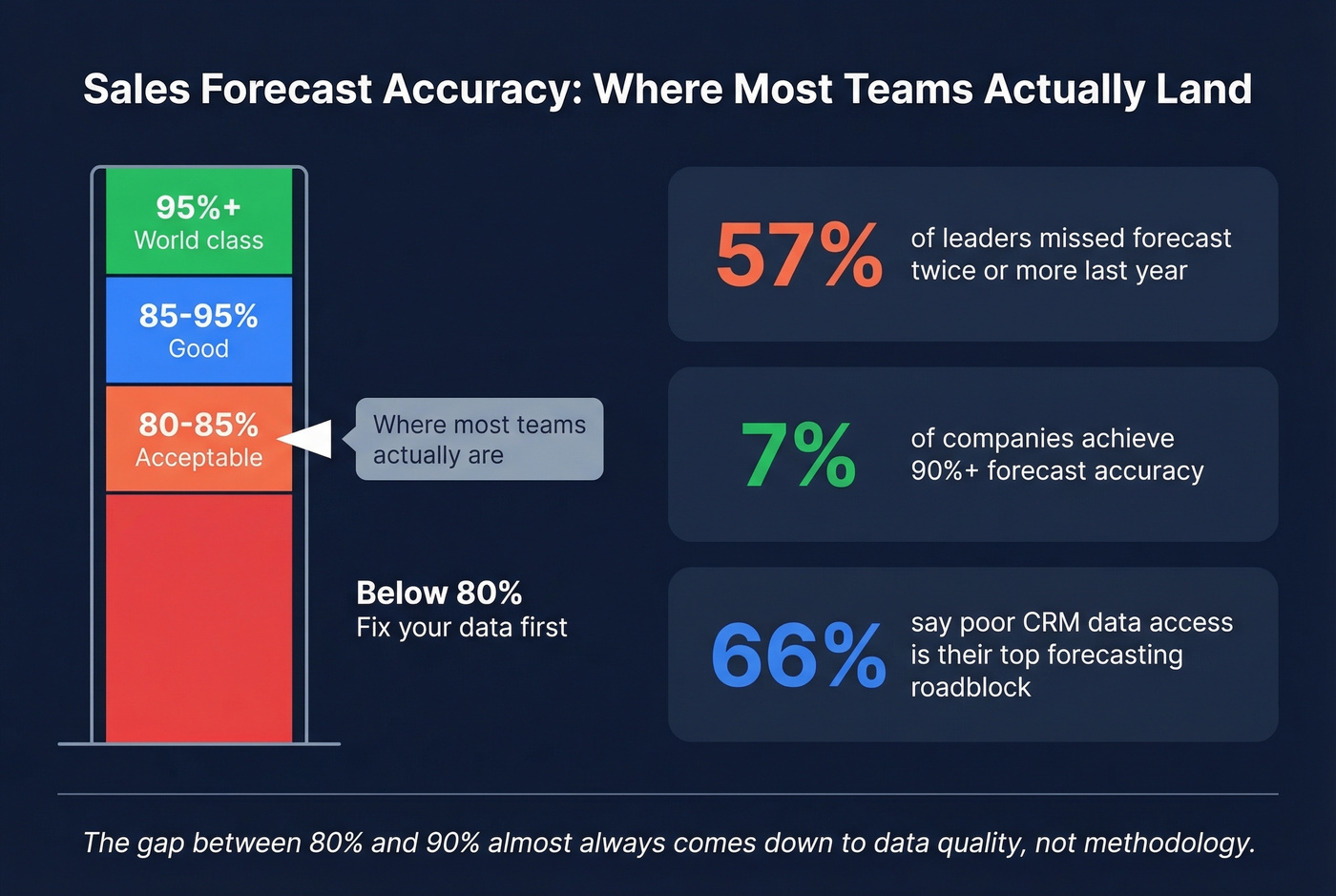
Here's where to aim, per Fullcast's benchmarks:
| Accuracy Band | Rating |
|---|---|
| 80-85% | Acceptable |
| 85-95% | Good |
| 95%+ | World-class |
The reality is sobering. Only 15% of companies forecast within 5% of actual revenue, only 7% hit 90%+ accuracy, and just 43% of leaders land within 10%. If you're in the 85% range, you're already ahead of most.
If your forecast accuracy is below 80%, stop tweaking your model and start fixing your data. The gap between 80% and 90% almost always comes down to data quality, not methodology (especially if your sales pipeline metrics are inconsistent across teams).

Every forecasting method in this article breaks down when your CRM contacts are stale. Prospeo refreshes records every 7 days - not the 6-week industry average - so your weighted pipeline reflects real opportunities, not phantom revenue from people who changed jobs last quarter. 98% email accuracy. 83% enrichment match rate. Native Salesforce and HubSpot sync.
Cut forecast error by fixing the data underneath it.
Mistakes That Kill Your Forecast
Let's be honest - most forecast misses aren't mysterious. They come from the same handful of problems, repeated quarter after quarter.
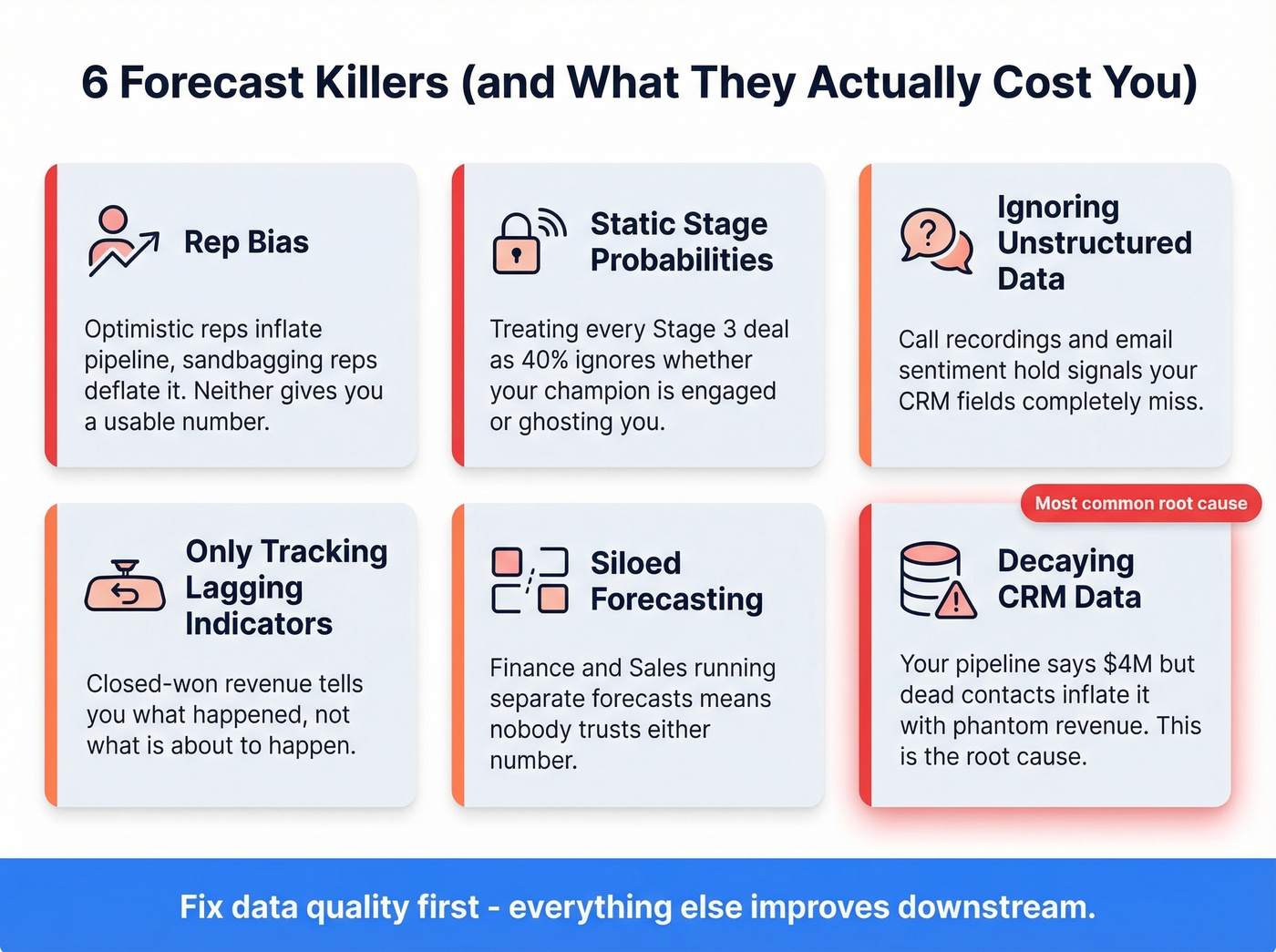
Rep bias. Optimistic reps inflate. Sandbagging reps deflate. Neither is useful without a systematic correction layer.
Static stage probabilities. Treating every Stage 3 deal as 40% ignores deal quality entirely. A $200K deal with an executive champion and a $200K deal where your contact ghosted two weeks ago aren't the same opportunity, but your CRM scores them identically.
Ignoring unstructured data. Call recordings and email sentiment contain signals your CRM fields miss. Only tracking lagging indicators. Closed-won revenue tells you what happened, not what's about to happen.
Siloed forecasting. If Finance and Sales aren't aligned on definitions, you're running two forecasts and trusting neither. No post-mortem. Teams that don't analyze why they won or lost specific deals repeat the same errors endlessly (a lightweight win-loss analysis fixes this fast).
Decaying CRM data. Your pipeline says $4M, but how many of those contacts have changed jobs? Every bad record inflates your forecast with phantom revenue. None of the six methods above work if the underlying data is rotting (see common CRM limitations that cause this).
Sales Forecasting Tools in 2026
The tool matters less than the data going into it. But you still need to pick one.
| Tool | Starting Price | Best For |
|---|---|---|
| Google Sheets / Excel | Free | Early-stage, under $1M ARR |
| Zoho CRM (Zia) | Free (3 users), from $14/user/mo | SMBs wanting AI on a budget |
| HubSpot Sales Hub | Free (2 users), from $15/user/mo | Mid-market HubSpot shops |
| Pipedrive | $14/user/mo | Small teams, simple pipelines |
| Salesforce Einstein | $50-220/user/mo | Enterprise Salesforce orgs |
| Clari | Not public | Revenue operations teams |
| Gong | ~$250/user/mo (bundled) | Call intelligence + forecast |
Skip Clari and Gong unless you're running 20+ reps. At those price points, you need deal volume to justify the spend. For teams under 20 reps, Zoho or HubSpot's built-in forecasting gets you 80% of the value at a fraction of the cost (and a consistent sales forecast meeting cadence matters more than the vendor).
One pattern we've noticed: a RevOps team on r/salestechniques reported dropping forecast error from roughly 15% to 5% after layering call scoring into their process. The tool mattered, but the data quality mattered more. That's always the pattern.
Fix Your Data Before You Forecast
This is where most forecasting guides stop - they cover methods and tools but skip the foundation. 66% of leaders say systems that can't access historical CRM and performance data are their top forecasting roadblock. And 97% agree that better data would make accurate forecasts easier.

Your pipeline says 200 opportunities worth $4M. But how many of those contacts have changed jobs? How many emails will bounce? How many titles are six months stale?
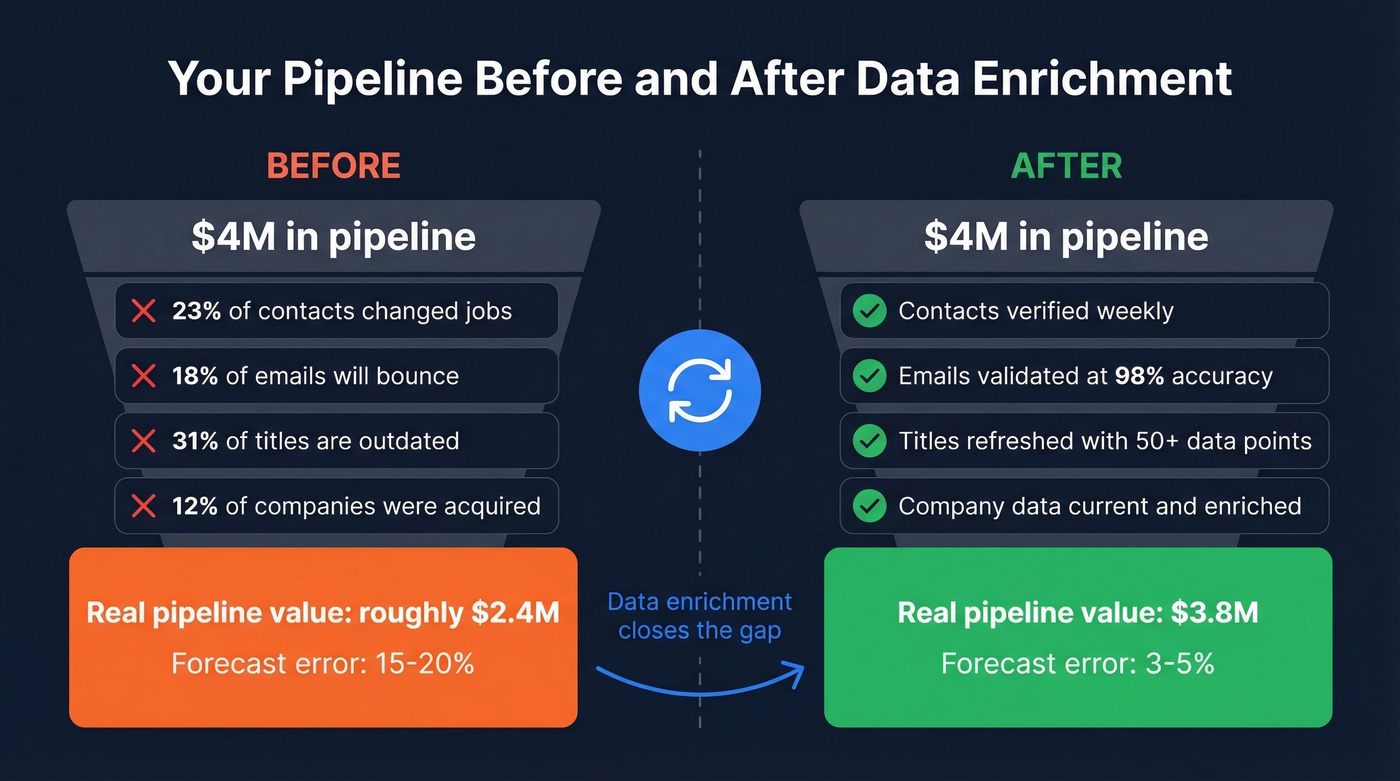
In our experience, teams cut forecast error by double digits just by cleaning their CRM data - before touching a single model or tool. We worked with one team that shaved 12 points off their MAPE in a single quarter by running enrichment across their pipeline and removing dead contacts. No new forecasting software. No AI model. Just accurate data (the same logic behind a proper sales pipeline audit).
This is where Prospeo fits - not as a forecasting tool, but as the data quality layer underneath every method. It refreshes records on a 7-day cycle versus the 6-week industry average, with 98% email accuracy and an 83% enrichment match rate. Native integrations with Salesforce and HubSpot mean your pipeline reflects reality instead of last quarter's org chart.
Here's the thing: most teams don't have a forecasting problem. They have a data hygiene problem dressed up as a forecasting problem. Fix the data first. Then pick your method. That's the real answer to how to predict sales with any confidence (and it’s also how you avoid quarter close surprises).
Teams shave double digits off forecast error just by cleaning dead contacts from their pipeline - before touching a single model. Prospeo's CRM enrichment returns 50+ data points per contact at a 92% match rate, so your $4M pipeline number actually means $4M. At $0.01 per email, it costs less than one missed forecast.
Stop forecasting on top of rotting data.
FAQ
How often should I update my sales forecast?
Weekly at minimum. Teams that refresh forecasts continuously outperform those running static quarterly reviews by 15-20% in accuracy. Pair weekly updates with a monthly deep-dive to catch structural pipeline shifts before they blindside you at quarter close.
Can I forecast sales without historical data?
Yes. Weighted pipeline forecasting works with just your current deals and estimated close probabilities - assign a win rate to each stage and multiply by deal value. Most early-stage teams start here and layer in historical trend analysis after 12-18 months of CRM data.
Why does my forecast keep missing even with a CRM?
Usually stale data. If contacts have changed jobs or emails bounce, your pipeline inflates with phantom revenue. Regular data enrichment - refreshing records weekly instead of quarterly - closes this gap faster than any model change.
What forecast accuracy should I aim for?
Target 85-95%, which puts you in the "good" tier per industry benchmarks. Only 7% of companies hit 90%+, so reaching 85% already puts you ahead of most peers. Below 80%, focus on data quality before model refinement.