

How to Refuse a Discount Request Politely
If you're running a 40% profit margin and you hand over a 10% discount, you need to sell 33% more volume just to break even. That math alone should make you pause the next time someone asks for "a little something off the price." And they will ask - 91% of Americans check for discounts before buying anything online, so the requests aren't slowing down. Knowing how to refuse a discount request politely is the difference between protecting your margins and slowly training every customer to haggle.
The 3-Step Framework for Declining Discount Requests
Here's the model: Acknowledge the request, Explain one clear reason, then Offer an alternative. One reason is enough. Two sounds like justification, three sounds like excuses.
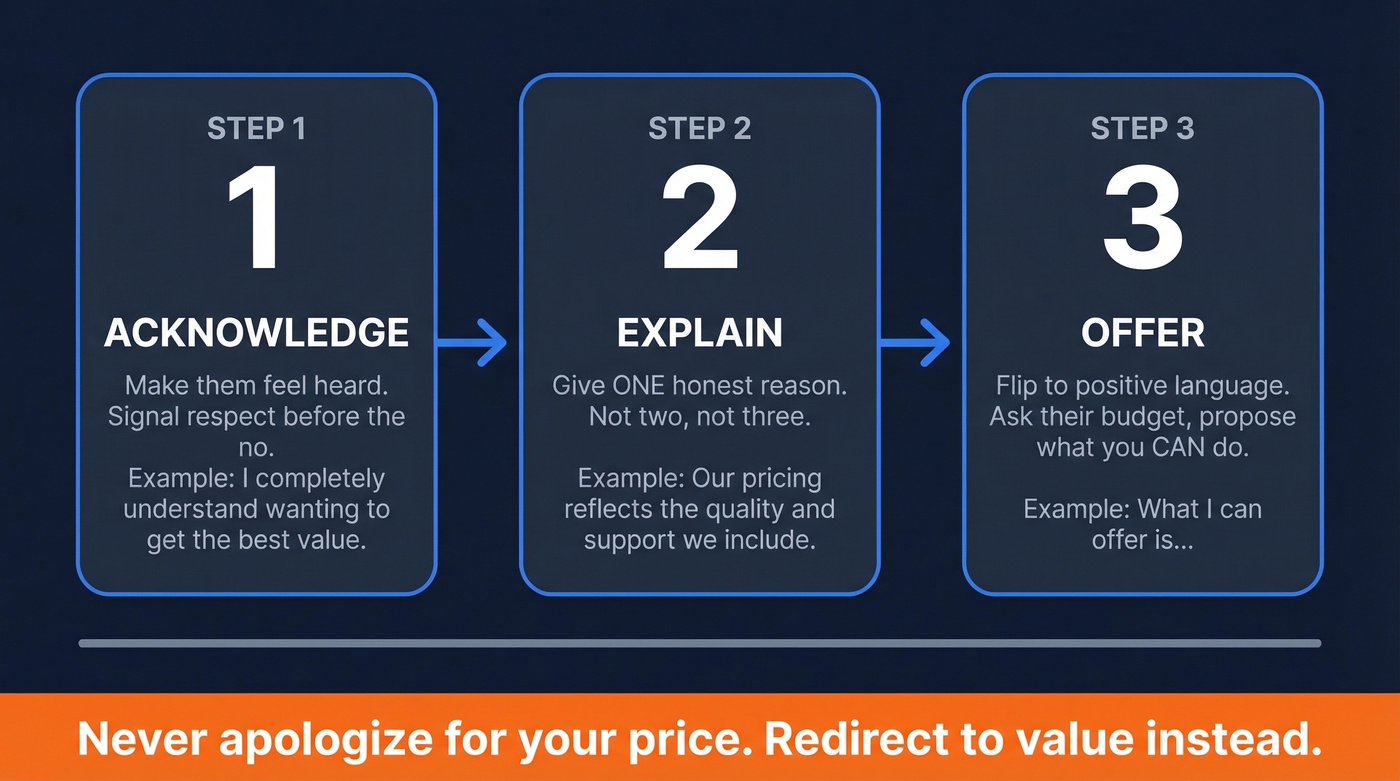
The scripts below give you copy-paste language for four common scenarios, but if you remember nothing else from this article: never apologize for your price. Redirect to value instead.
Acknowledge. Make the other person feel heard. "I completely understand wanting to get the best value" works in almost every context. This isn't agreement - it's signaling respect before you deliver the no.
Explain. Give one honest reason. Not three. "Our pricing reflects the quality and support we include" is plenty. Stop there.
Offer. This is where most people drop the ball. Instead of ending on a no, flip to positive language. "We can't do that" becomes "What I can offer is..." Ask their budget, then propose what you can do within it. Now they're the one deciding whether to say no.
Scripts to Politely Decline a Discount Request
Email to a Client
"Thanks for reaching out about pricing - I appreciate you being upfront. I don't have discounts available right now - what's your budget? I'd love to find a [payment plan / smaller package / bonus add-on] that works for you."
Short, warm, and redirects without caving.
B2B Prospect Pushing on Price
Start with a diagnostic question: "Is price a major barrier to your final decision, or is there additional value we could provide that would make this worth the investment?" This separates real budget constraints from reflexive negotiation. Learning how to add value in sales and how to negotiate without discounting starts with understanding which category the objection falls into.
If it's genuinely about budget, offer month-to-month billing at a 10-20% premium over annual - they get flexibility, you protect your effective rate. Or go quid pro quo: "I can offer X% off if you commit to a case study and a 12-month term." Never discount without getting something back.
Handling Price Pushback on Sales Calls
Keep it in the 30-90 second range. In real-time conversations, lead with the alternative before delivering the no - it softens the blow.
"What I can do is [alternative]. Our rates are set to reflect the results we deliver, so I can't flex on the base price. Does that help?"
Silence after the offer is fine. Don't fill the gap with more justification.
The Repeat Requester
This one's tricky because the relationship matters. Acknowledge the history: "We really value working with you, and your loyalty means a lot." Then skip the discount topic entirely and redirect to structured value.
"We've built a volume pricing tier for long-term partners - let me walk you through what that looks like."
If you don't have a formal program, build one. Ad-hoc discounts for loyal customers train everyone to ask. That's a pattern you can't undo easily.
Why This Works: The Psychology
The first number in any negotiation shapes everything after it. When you state your price confidently and don't flinch, that number becomes the anchor. Holding firm signals the number was set deliberately, not arbitrarily.
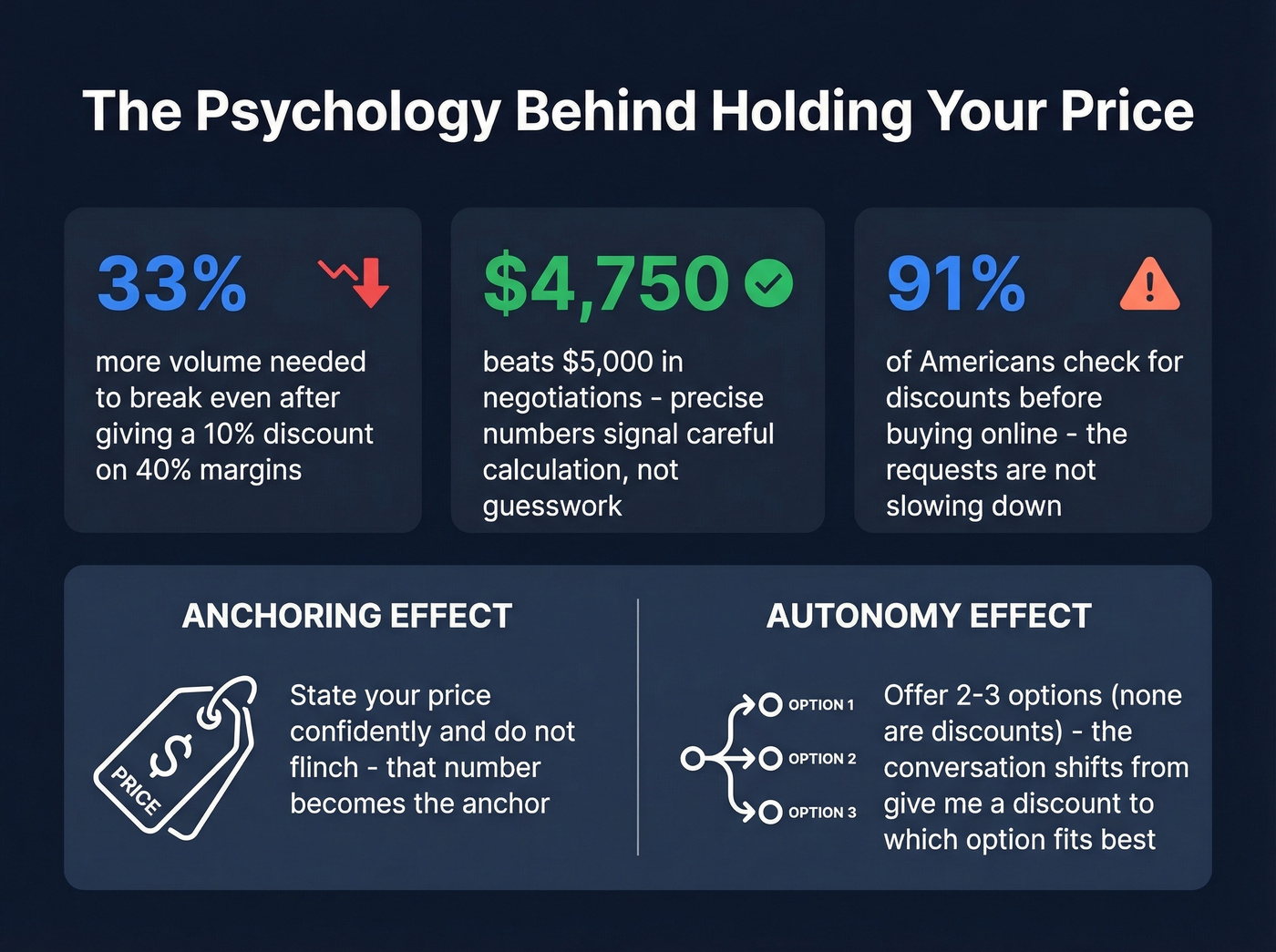
Here's a detail most people miss: precise numbers outperform round ones. Research cited by Harvard's Program on Negotiation found that "$4,750" holds better than "$5,000" because precision signals careful calculation. Offering a range - "$4,500-$5,200 depending on scope" - can help you claim more value while signaling flexibility.
The autonomy angle matters too. Customers escalate when they feel they've lost control. Offering options - even options that don't include a discount - gives them back a sense of agency and reduces friction dramatically. The moment you present two or three alternatives, the conversation shifts from "give me a discount" to "which option fits best." We've seen this play out dozens of times in our own sales conversations, and the difference in tone is immediate.

Discount requests often mean you're talking to the wrong buyers. Prospeo's 30+ search filters - buyer intent, funding stage, headcount growth - help you target companies that match your ICP and can afford your price. 15,000+ companies use Prospeo to fill their pipeline with prospects who close at full rate.
Stop negotiating price. Start reaching buyers who already have the budget.
Five Mistakes That Kill a Polite Refusal
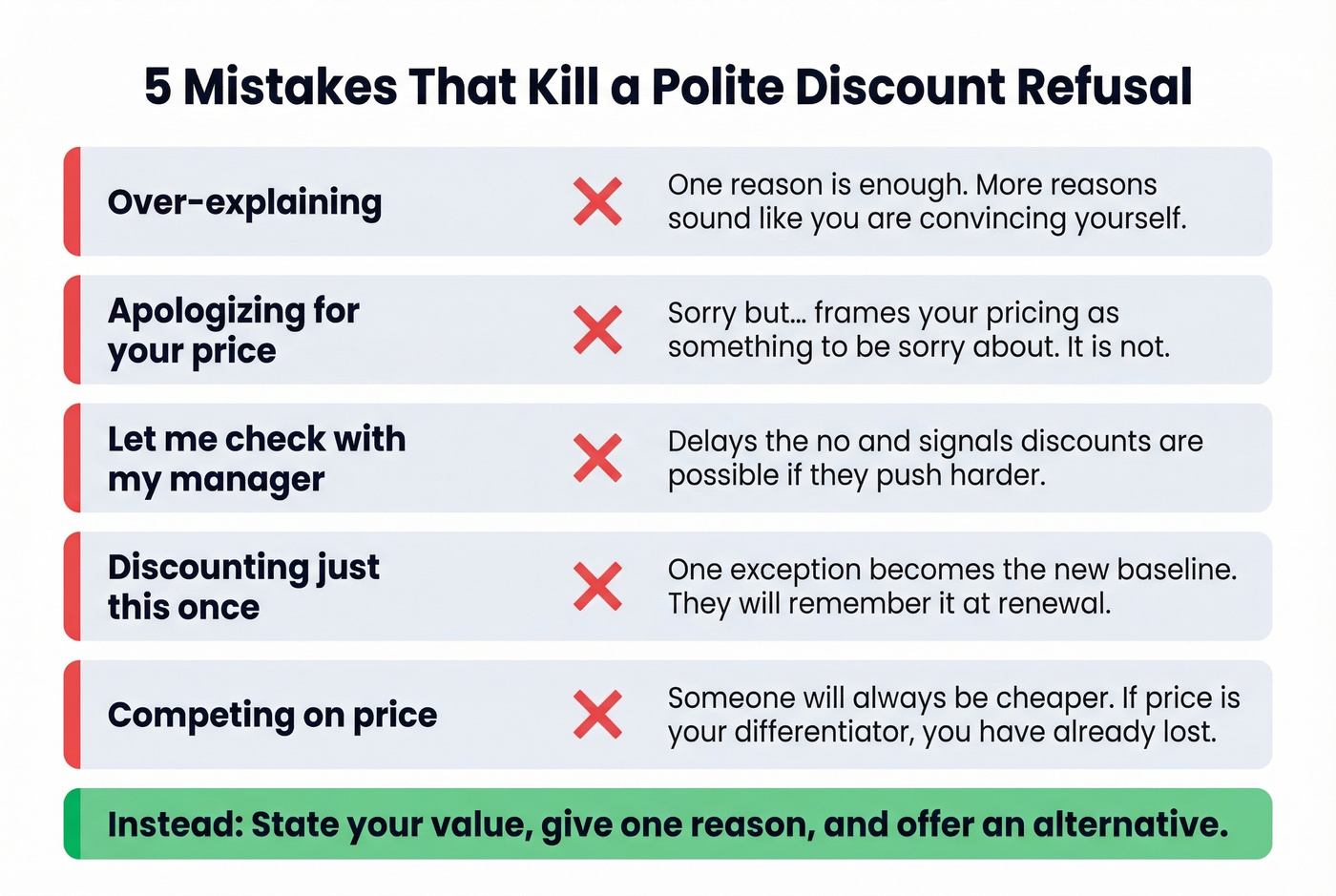
- Over-explaining. One reason. Not a paragraph. The more reasons you give, the more it sounds like you're convincing yourself.
- Apologizing for your price. "Sorry, but..." frames your pricing as something to be sorry about. It isn't.
- Defaulting to "let me check with my manager." This delays the no and signals that discounts are possible if they push harder. The consensus on r/sales is pretty clear: this move trains prospects to escalate every time.
- Giving discounts "just this once." There's no such thing. One exception becomes the new baseline - they'll remember it at renewal, on the next invoice, and on the next project.
- Competing on price instead of value. There will always be someone cheaper. If price is your differentiator, you've already lost.
How to Avoid Discounting in Sales
Not every discount request deserves a no. Longer contracts, more seats, bigger orders - a discount here is just smart pricing. Discounting the entry point works too, but only if you have a documented plan to bring them to full price within 90 days.
If you're building that plan, it helps to map it to your sales process optimization and track the downstream impact on renewal rate.
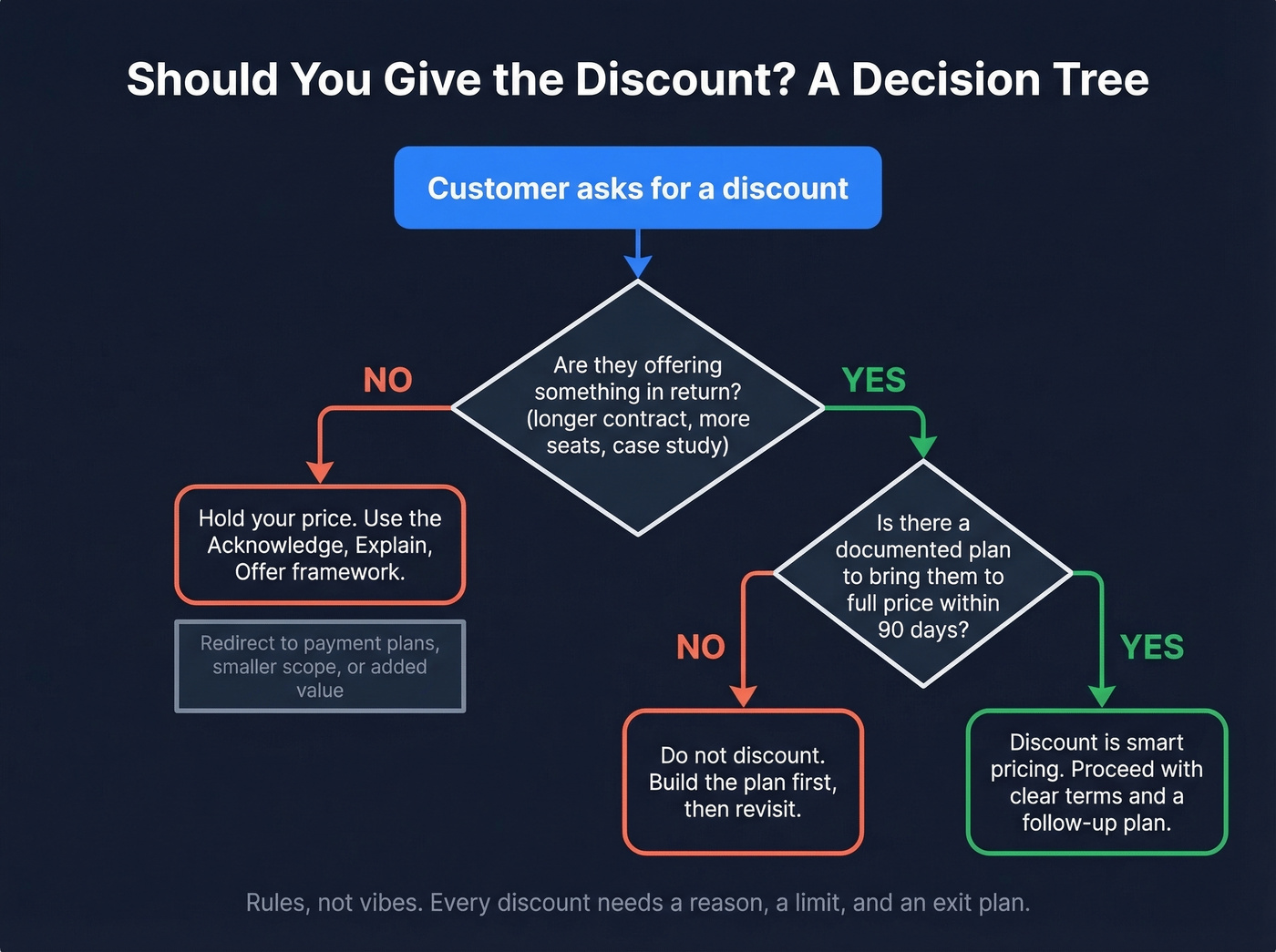
The key is having rules, not vibes. One dental practice adopted a "three strikes" cancellation policy - clear expectations made enforcement easy and actually improved patient behavior. Build your discount policy the same way: data-backed, with a follow-up plan to retain or upsell to full price.
Let's be honest: most businesses don't have a discounting problem. They have a B2B brand positioning problem. If every sales conversation starts with "can you do it cheaper," the issue isn't the customer. It's that your value isn't landing before the price conversation begins.
Stop the Ask Before It Starts
Start value discussions early in the sales cycle, before pricing comes up. Use precise numbers in proposals. Stack testimonials and social proof so your price feels justified before anyone questions it. The best way to handle discount discussions is to prevent them from happening in the first place.
If you're constantly fielding discount requests, you might be reaching the wrong buyers entirely. Better prospecting data means better-fit prospects who can actually afford what you sell. In our experience, when teams use Prospeo's 30+ search filters - buyer intent, funding stage, headcount growth - they're targeting companies that match their ideal customer profile before they ever get on a call. That alone cuts the "can you do it cheaper?" conversations in half.
Skip this approach if your product genuinely serves price-sensitive SMBs. In that case, tiered pricing and a clear free-to-paid path will serve you better than trying to eliminate discount conversations altogether. If you need more ways to fill pipeline without racing to the bottom, use proven sales prospecting techniques and tighten your lead scoring.
The best way to hold your price is to never get on a call with someone who can't pay it. Prospeo gives you 300M+ profiles with intent data across 15,000 topics so you reach in-market buyers before they ask for a discount. At $0.01 per email with 98% accuracy, better targeting costs less than one concession.
Better data means fewer discount conversations and more full-price deals.
FAQ
How do I say no to a discount without losing the customer?
Use the Acknowledge, Explain, Offer framework. Give one clear reason, then redirect to an alternative - a payment plan, smaller scope, or added value. Most customers respect clarity and a genuine alternative far more than a wishy-washy maybe.
What if a customer threatens a bad review after I refuse?
Stay calm, document the interaction, and don't cave. A business that discounts under threat trains every customer to threaten. Respond professionally, restate the value you provide, and move on. One bad review from a price-shopper won't sink you - but a reputation for folding under pressure will cost you far more over time.
How do I prevent discount requests in B2B sales?
Target better-fit prospects who match your ICP from the start. Pair that with strong value positioning early in the sales cycle, and most discount conversations never happen. When prospects already understand what they're getting and why it's worth the price, the negotiation shifts from "how much less" to "how do we get started."