

How to Send a Follow-Up Email That Actually Gets a Reply
You wrote the perfect email on Tuesday. Clear value prop, sharp subject line, sent at 10:14 AM. Crickets. You send a follow-up Thursday. Nothing. You check your deliverability dashboard - all three emails landed in spam because your SPF record was misconfigured. The copy was never the problem.
Here's the thing most follow-up guides skip entirely: knowing how to send a follow-up email is only half the battle. The other half is making sure it actually arrives. Belkins analyzed 16.5M cold emails across 93 business domains, and the highest reply rate - 8.4% - came from a single email, not a marathon sequence. Meanwhile, roughly 17% of cold emails never reach the inbox at all. If your follow-ups aren't landing replies, fix your infrastructure before you rewrite a single word.
What You Need Before Writing
Before you write a single follow-up, internalize these four rules:
- Add new value each time. A "just checking in" email is a wasted touch. Bring a data point, a resource, or a new angle.
- Wait 2-3 business days. Next-day follow-ups reduce replies by 11%. Patience pays.
- Cap at 2-3 follow-ups. Once you hit 4+ emails in a sequence, unsubscribe and spam complaints more than triple.
- Verify addresses before you send. Catch bad addresses, spam traps, and catch-all domains before they bounce and wreck your sender reputation. This is step zero.
How to Write a Follow-Up Email
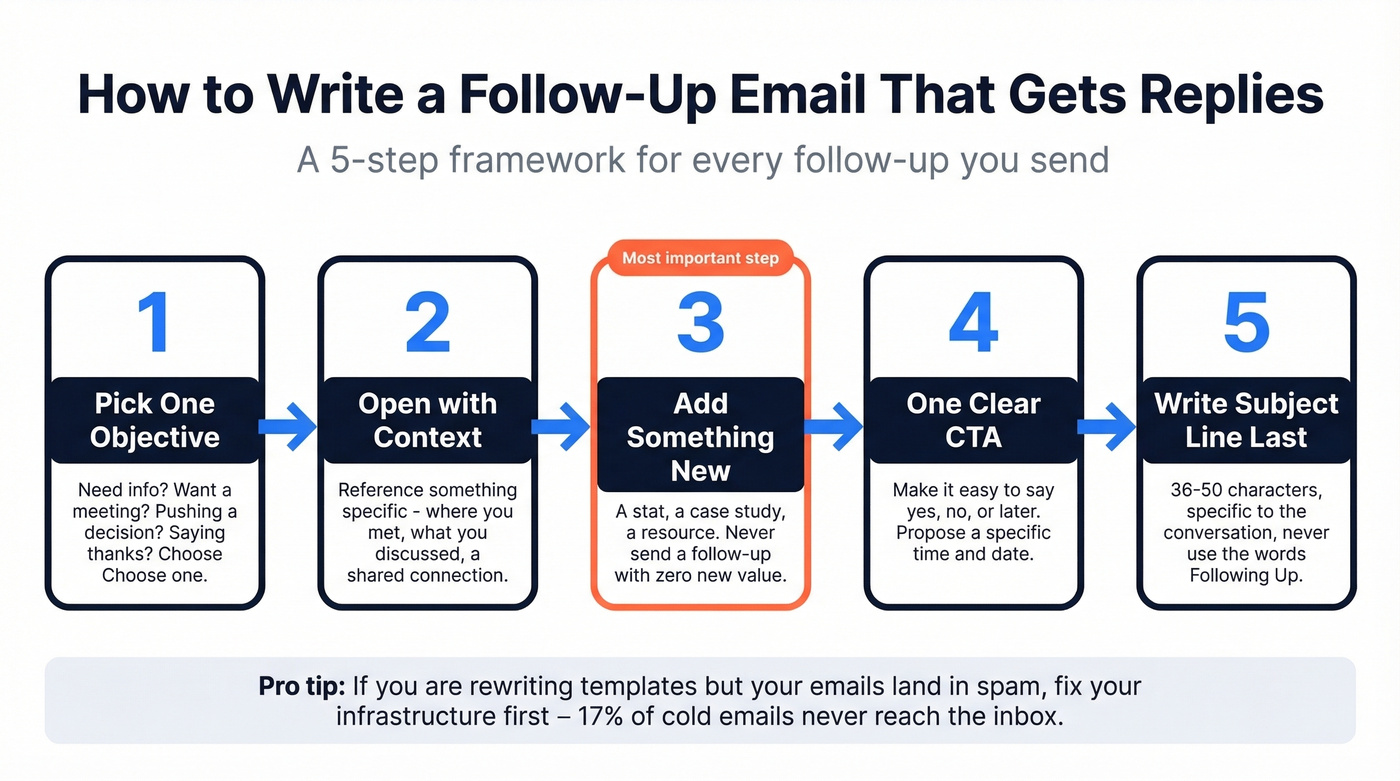
The HubSpot framework nails the structure: define your objective, open with context, state your purpose, then craft the subject line. Here's what actually works at each step.
Define Your Objective
Every follow-up falls into one of four buckets: you need information, you want a meeting, you're pushing for a decision, or you're saying thank you. Pick one before you type a word. Trying to accomplish all four in a single email is how you end up with a 200-word mess that gets skimmed and archived.
Open with Context
Your recipient gets dozens of emails a day. Remind them who you are and why you're writing in the first sentence - not with "per my last email," but with a specific reference. "We spoke at the SaaS Connect event about your outbound ramp" beats "I wanted to follow up on our conversation" every time.
Add Something New
This is where most follow-ups die.
Bad: "Just bumping this to the top of your inbox." Good: "We added 10-15 warm leads per week for a similar team in January - happy to share the playbook."
The first says nothing. The second gives the reader a reason to care. Every follow-up needs at least one piece of new information, whether that's a case study, a relevant stat, or a fresh angle on their problem.
One Clear CTA
Make it easy to reply yes, no, or later. "Does Thursday at 2 PM work for a 15-minute call?" is a CTA. "Let me know your thoughts" is not.
Write the Subject Line Last
Subject lines between 36-50 characters perform best. Be specific to the conversation - "Quick question about your Q3 pipeline goal" beats "Following Up." And never use the words "following up" as your subject line. Between 69-70% of recipients decide to mark an email as spam based on the subject line alone, so that generic opener is actively working against you.
When to Send a Follow-Up Email
Timing isn't everything, but it's not nothing. Tuesday through Thursday, 9-11 AM in the recipient's local time zone is the sweet spot. We've also tested early sends between 6-9 AM - they can catch top-of-inbox placement before the morning flood, and the open rates surprised us.
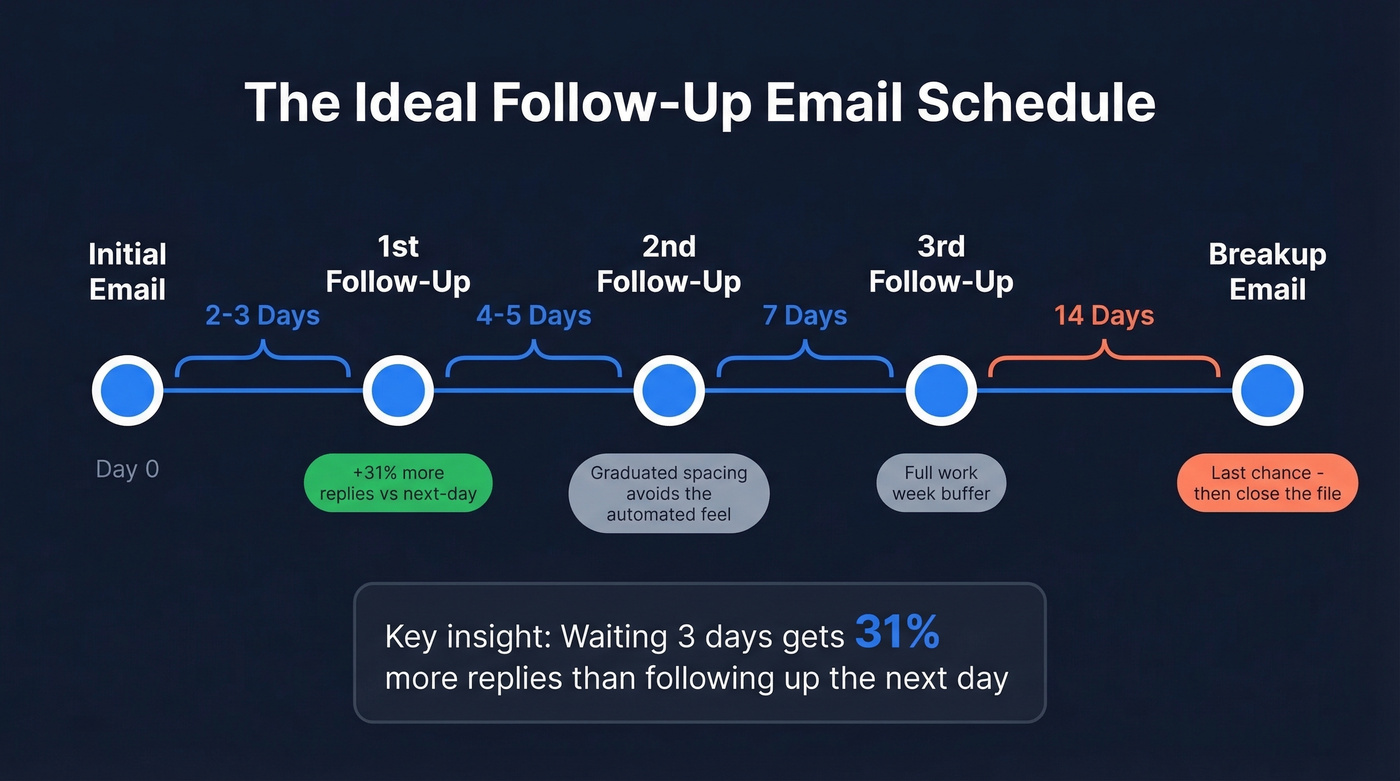
The bigger insight is spacing. Static intervals - every two days like clockwork - look automated and feel automated. Graduated spacing works better because it mimics how a real human would follow up: eager at first, then increasingly patient.
| Follow-Up # | Wait Time | Why |
|---|---|---|
| 1st | 2-3 days | Next-day follow-ups reduce replies by 11% |
| 2nd | 4-5 days | Graduated spacing avoids the "automated" feel |
| 3rd | 7 days | Gives them a full work week |
| Final (breakup) | 14 days | Last chance before closing the file |
Waiting three days results in a 31% increase in replies compared to next-day follow-ups. That's a massive lift for doing literally nothing.

You just read that 17% of cold emails never reach the inbox. Bad email addresses are the #1 reason follow-ups fail silently. Prospeo's 5-step verification catches spam traps, catch-all domains, and dead addresses before they torch your sender reputation - at 98% accuracy and $0.01 per email.
Fix your deliverability before you rewrite another follow-up.
How Many Follow-Ups Should You Send?
You don't need seven follow-ups. You need two or three good ones.
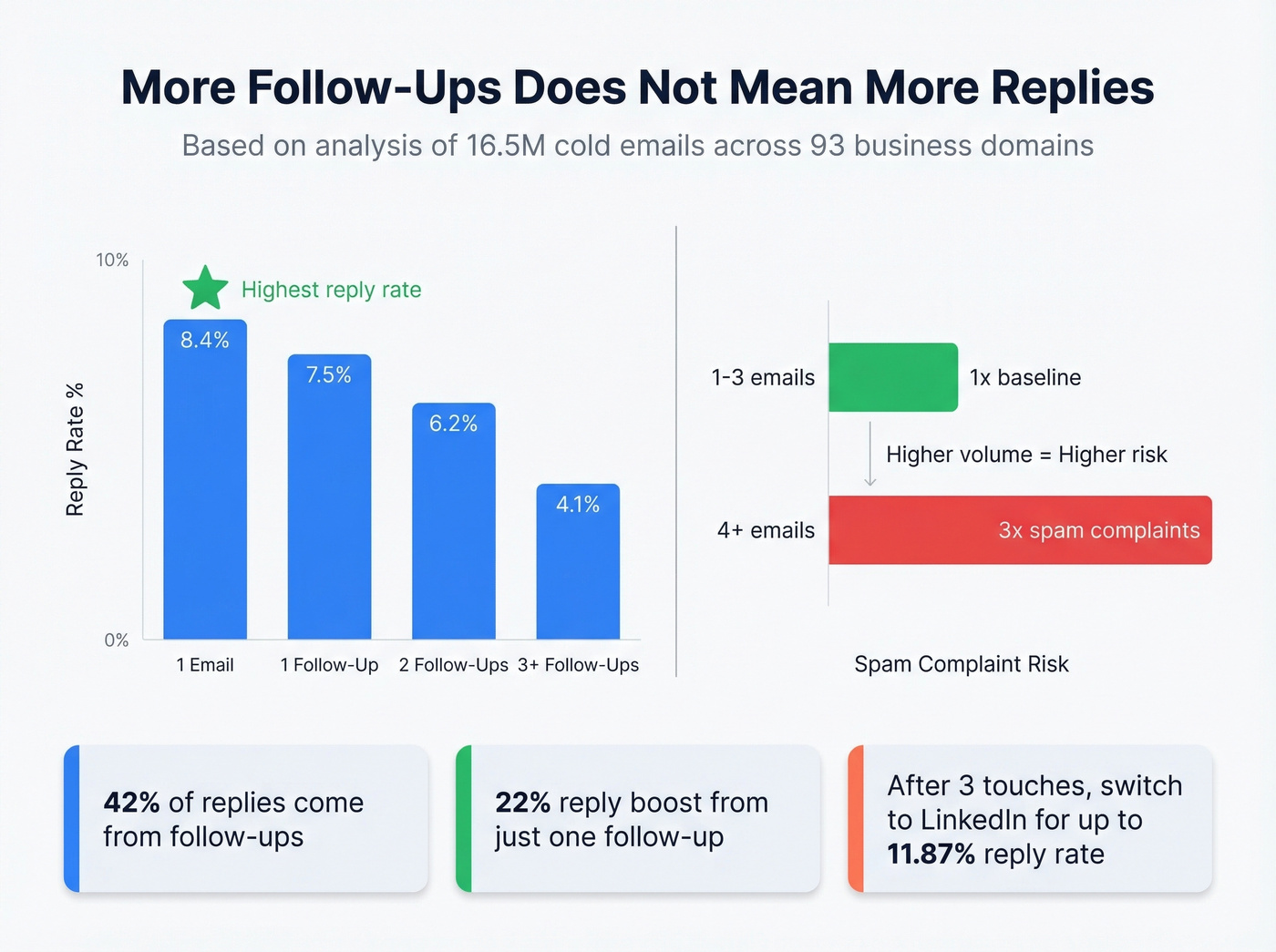
The "80% of sales require 5+ follow-ups" stat gets thrown around constantly, but the 16.5M-email dataset tells a different story. Sending 4+ emails in a sequence more than triples unsubscribe and spam complaint rates. Sending even one follow-up can increase reply rate by 22%. And 42% of all campaign replies come from follow-ups, meaning 58% come from the first email alone. Diminishing returns kick in fast.
Let's be honest: if email isn't working after 2-3 touches, stop emailing. Switch channels. LinkedIn nurturing actions drive reply rates up to 11.87% - nearly 50% higher than the best email-only sequences. The best follow-up is sometimes not an email at all.
The right number depends on context:
- Sales/cold outreach: 2-3 follow-ups + a breakup email
- Job interview: 1 follow-up within 24 hours + 1 check-in at the one-week mark
- Post-meeting recap: 1 email, same day or next morning
- Networking/event: 1 follow-up, 1-2 days after
- Unpaid invoice: 1 reminder + 1 escalation
SMB prospects with 2-50 employees are slightly more tolerant - reply rates start at 9.2%, drop to 8% after the first follow-up, then tick up to 8.4% on the second. Founders drop from 6.64% to 3.01% by the fourth email. Know your audience.
Follow-Up Email Templates by Scenario
Below are eight templates for every common situation. Adapt the structure to your voice - the framework matters more than the exact wording. If you want more plug-and-play options, start with these follow-up templates.
After No Response (Cold Outreach)
Subject: Quick data point on [their company's challenge]
Hi [Name], I shared a note last week about [specific topic]. Since then, I pulled some numbers - teams in [their industry] using [your approach] are seeing [specific result]. Worth a 15-minute look? I can share the full breakdown Thursday or Friday.
Send 2-3 days after your initial email. Lead with the new data point, not the fact that they didn't reply.
After a Meeting
Subject: Recap & next steps from [meeting topic]
Hi [Name], great conversation today. Here's what we landed on: [Decision 1], [Decision 2]. Action items: [Person A] will [task] by [date]; [Person B] will [task] by [date]. Let me know if I missed anything.
Send same day or next morning. The "who does what by when" structure keeps momentum and eliminates ambiguity - skip it and watch your deal stall for two weeks.
After a Job Interview
Subject: Thanks for the conversation, [Name]
Hi [Name], I enjoyed learning about [specific project discussed]. The [role] aligns well with my experience in [relevant skill] - especially [specific aspect they mentioned]. Looking forward to next steps.
Send within 24 hours. Reference something specific from the conversation to stand out from generic thank-you notes.
After Sending a Proposal
Frame each follow-up around a different objection your buyer might have - trust, urgency, cost, need, or desire. For proposals, the objection is usually urgency or cost. Address it head-on:
Subject: Any questions on the [project name] proposal?
Hi [Name], wanted to check if you've had a chance to review the proposal from [date]. Happy to walk through the pricing breakdown or adjust the scope if [specific section] doesn't fit. Would a 10-minute call this week help?
After a Networking Event
Subject: Good meeting you at [event name]
Hi [Name], we chatted at [event] about [specific topic]. I mentioned [resource/idea] - here's the link: [link]. Would love to continue the conversation over coffee next week. What works for you?
Send 1-2 days after. Always remind them where you met and what you discussed - they met dozens of people that day.
After a Demo or Sales Call
Subject: [Their company] + [your company] - next steps
Hi [Name], thanks for the time today. Based on what you shared about [their pain point], here's how we'd approach it: [1-sentence solution summary]. I've attached [relevant resource]. Want to loop in [their stakeholder] for a follow-up next week?
Send same day. Tie your solution directly to the problem they described, not your generic pitch deck.
The Breakup Email
In our experience, the breakup email gets more replies than the second or third follow-up. The "permission to close" framing removes pressure and triggers a response - we've seen reply rates jump 2-3x on these compared to standard follow-ups.
Subject: Should I close the file?
Hi [Name], I've reached out a few times and haven't heard back - totally understand if the timing isn't right. Should I close this out, or is it worth reconnecting in [timeframe]? Either way, no hard feelings.
Send 14 days after your last follow-up.
After an Unpaid Invoice
Subject: Invoice #[number] - quick reminder
Hi [Name], heads-up that invoice #[number] for [amount] was due on [date]. I've attached a copy. Can you confirm this is in the queue? If there's an issue with the amount or terms, happy to sort it out.
Send 3-5 days past due. Keep it matter-of-fact, not passive-aggressive. Escalate to their AP department on the second reminder.
Five Mistakes That Kill Reply Rates
The Empty Bump
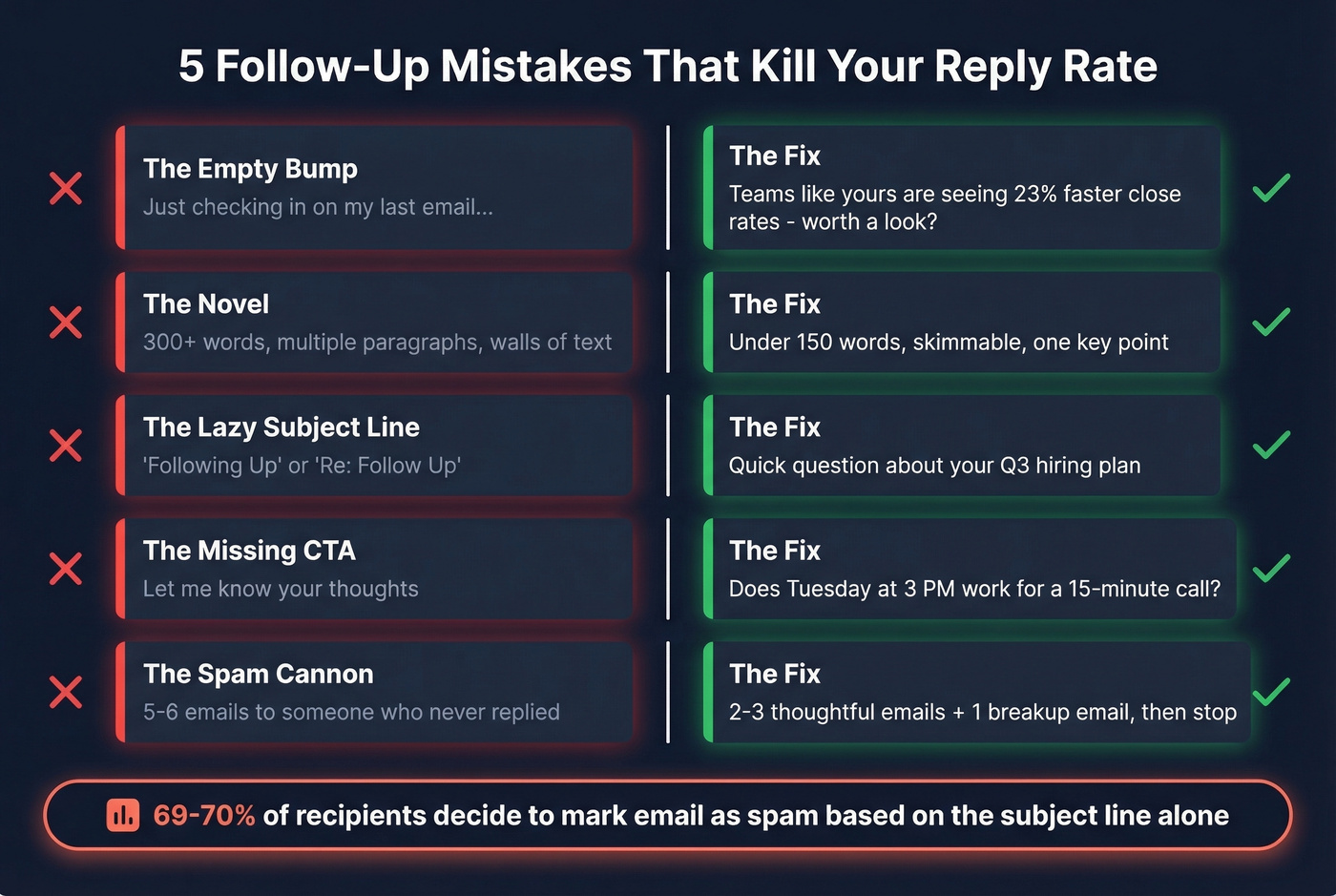
"Just checking in" is one of the worst phrases in professional email. "Touching base," "circling back," and "wanted to follow up" are close behind. These phrases signal you have nothing new to say. Every follow-up must contain at least one piece of new information - a stat, a resource, a question that shows you've done your homework. If you need alternatives, see how to say just checking in professionally.
The Novel
Follow-ups work best when they're short and skimmable. Under 150 words. If your follow-up is longer than the original email, something's wrong. For a tighter structure, borrow from proven email copywriting patterns.
The Lazy Subject Line
Using "Following Up" or "Re: Follow Up" as your subject line is the email equivalent of a blank handshake. Be specific: "Quick question about your Q3 hiring plan" tells the reader exactly what's inside. If you want more options, use these cold email subject line examples.
The Missing CTA
No clear ask means no reply. "Does Tuesday at 3 PM work for a 15-minute call?" is a CTA. "Let me know your thoughts" is not. Here are more email call to action examples that get responses.
The Spam Cannon
Sending four, five, six follow-ups to someone who hasn't responded doesn't show persistence - it shows a lack of awareness. The data is clear: 4+ emails in a sequence more than triples spam complaints. Two or three thoughtful follow-ups plus a breakup email is the ceiling for cold outreach. If you're still not getting replies after that, the problem isn't volume.
Why Your Follow-Ups Land in Spam
I've watched SDRs send 200 follow-ups in a week, get two replies, and immediately start rewriting templates. The templates weren't the problem. The bounce rate was 28%. Before you touch your copy, fix your infrastructure.
- SPF, DKIM, DMARC configured - without these, you're almost guaranteed to hit spam filters (use this email deliverability guide to audit the basics)
- Subdomain for cold outreach - protect your primary domain reputation
- Domain warmed up 14-21 days before sending any volume
- Open tracking pixels disabled - the consensus on r/coldemail is that tracking pixels hurt deliverability more than the data is worth
- Links and HTML minimized - plain text emails perform better for cold outreach
- Email list verified within the last 30 days
- Volume capped at 10-15 emails per day per inbox - scale by adding inboxes and domains, not by blasting from one account (see email velocity limits)
The verification step is where most teams skip ahead and pay for it later. Every bounced email damages your sender reputation, and that reputation follows you across every future email - follow-ups included. If you've noticed a spike in bounces mid-sequence, stop immediately and clean your list before resuming. If you're already seeing issues, start with email bounce rate benchmarks and fixes.
Skip this step if you're only emailing people who've already replied to you or opted in. But for any cold or semi-cold outreach, verification isn't optional. Tools like Prospeo catch invalid addresses, spam traps, catch-all domains, and honeypot addresses before they ever hit your outbox - 98% accuracy across 143M+ verified addresses with a 5-step verification process. There's a free tier if you want to test it on a small batch first.
Great follow-up copy means nothing if you're emailing the wrong person. Prospeo gives you verified emails and direct dials for 300M+ professionals - refreshed every 7 days, not every 6 weeks. Teams using Prospeo book 35% more meetings than Apollo users because the data actually connects.
Stop following up with dead inboxes. Start with verified contacts.
FAQ
How long should I wait before sending a follow-up email?
Wait 2-3 business days for the first follow-up. A three-day gap increases replies by 31% compared to next-day sends. After that, use graduated spacing: 4-5 days for the second, 7 days for the third, and 14 days for a breakup email.
How many follow-up emails is too many?
Two to three plus a breakup email is the ceiling for cold outreach. Data from 16.5M emails shows that 4+ messages in a sequence more than triples spam complaint rates. One well-crafted follow-up alone can boost replies by 22%.
What should I write in a follow-up email subject line?
Keep it 36-50 characters and specific to the conversation - "Quick question about your Q3 hiring plan" tells the reader exactly what's inside. Never use generic phrases like "Following Up." Between 69-70% of recipients decide to mark email as spam based on the subject line alone.
Should I reply to the original thread or start a new email?
Reply to the original thread. It keeps context visible, preserves conversation history, and looks like a natural exchange rather than a cold blast. Start a new thread only if the original subject line was completely off-topic for what you're now discussing.
How do I know if my follow-ups are reaching the inbox?
Monitor your bounce rate and spam placement. If bounces creep above 5%, list quality is the culprit. Verify addresses before sending - a tool with catch-all domain handling and spam-trap removal will save you from the invisible damage that tanks your sender reputation over time.