

How to Start a Cold Email in 2026 (From Zero)
You sent 200 cold emails last week and got zero replies. Worse, 40% landed in spam. If you're figuring out how to start a cold email, the problem wasn't your copy - it was everything you did before you wrote a single word.
Most guides jump straight to subject lines and templates. That's backwards. Infrastructure comes first, copy comes second, and if you get the order wrong, nothing else matters.
The average cold email reply rate is 3.43%. Top 10% campaigns hit 10.7%+. Those numbers are achievable, but only if your foundation is solid.
The Beginner Stack
Before anything else, here's what you need:
- Mailbox: Google Workspace or Microsoft 365 (~$6/user/month)
- Sending tool: Instantly or Smartlead (~$30-$100/month depending on plan)
- Total: Around $40-$100/month to start
Don't write a single word of email copy until your infrastructure is ready. That's where most beginners fail - and where this guide starts.
Set Up Your Infrastructure
Your primary business domain is off-limits. If your cold email domain gets flagged, your main domain's deliverability takes a hit too. We've seen beginners burn through three domains before they figure this out.
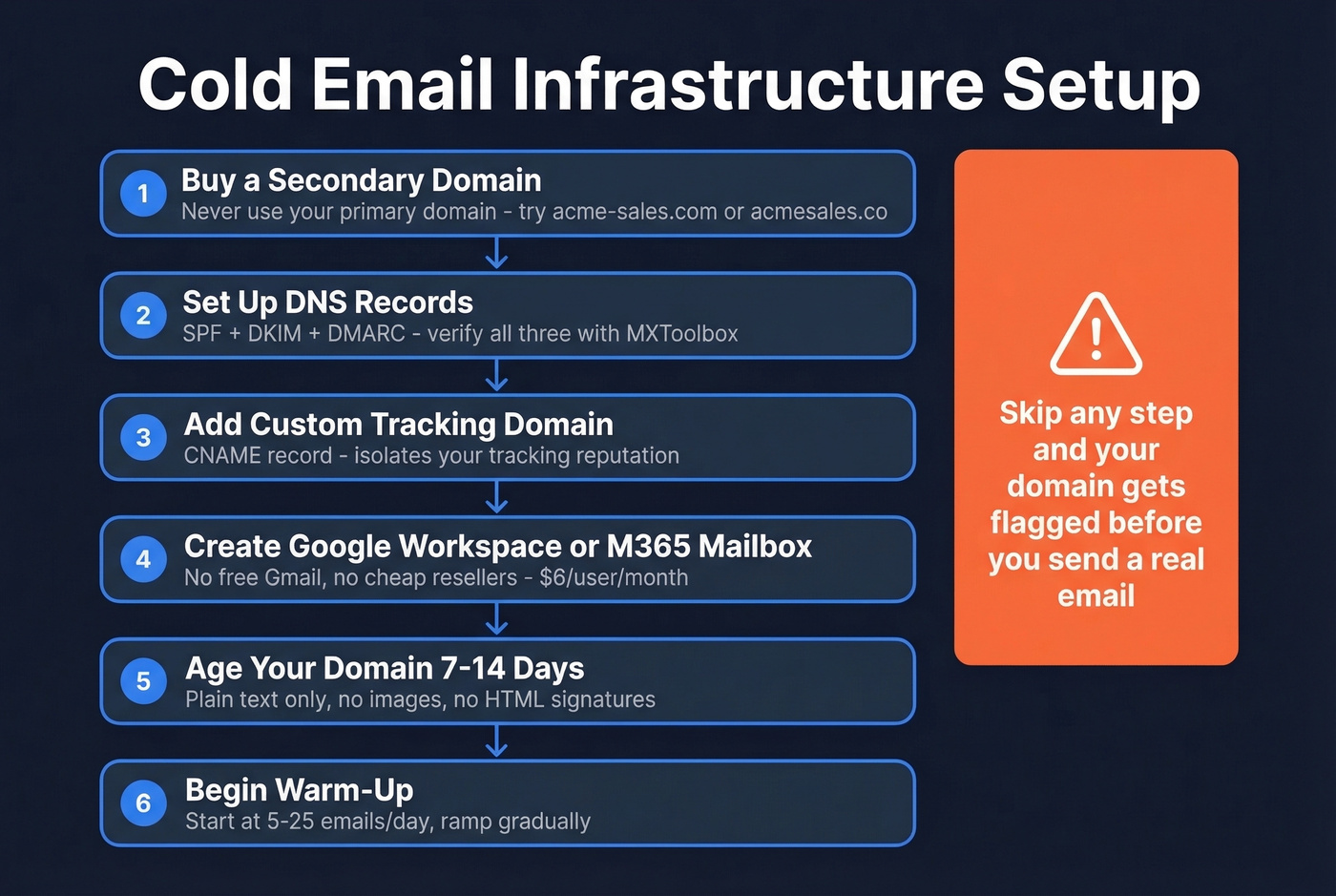
Buy a secondary domain that looks similar to your main one. If you run acmesales.com, grab acme-sales.com or acmesales.co. Set your "From" name to your real first and last name - not "Sales Team" or your company name. People reply to people. Learning how to introduce yourself in a cold email starts here: a real name and a clear reason you're reaching out beat any clever gimmick.
Once you've got the domain, set up these three DNS authentication records - no exceptions:
- SPF - tells receiving servers which IPs can send on your behalf
- DKIM - cryptographically signs your emails so they can't be spoofed
- DMARC - tells servers what to do when SPF or DKIM fails
Use MXToolbox to verify all three are configured correctly. If your sending tool supports custom tracking domains, set one up via a CNAME record - it's an easy deliverability win most beginners skip because it isolates your tracking reputation from shared defaults.
Then set up Google Workspace or Microsoft 365 on that domain. Don't use free Gmail or Yahoo for cold outreach, and avoid cheap inbox resellers. A lot of those accounts get suspended fast.
Let your domain age 7-14 days before sending anything. A brand-new domain blasting emails on day one is a red flag to every spam filter on the planet. During warm-up, stick to plain text: skip heavy HTML signatures, don't include images, and limit tracking.
Warm Up Your Domain
47% of global email traffic is spam. That's why email providers are paranoid about new senders. Warm-up builds your domain's reputation gradually so you don't get lumped in with the noise.
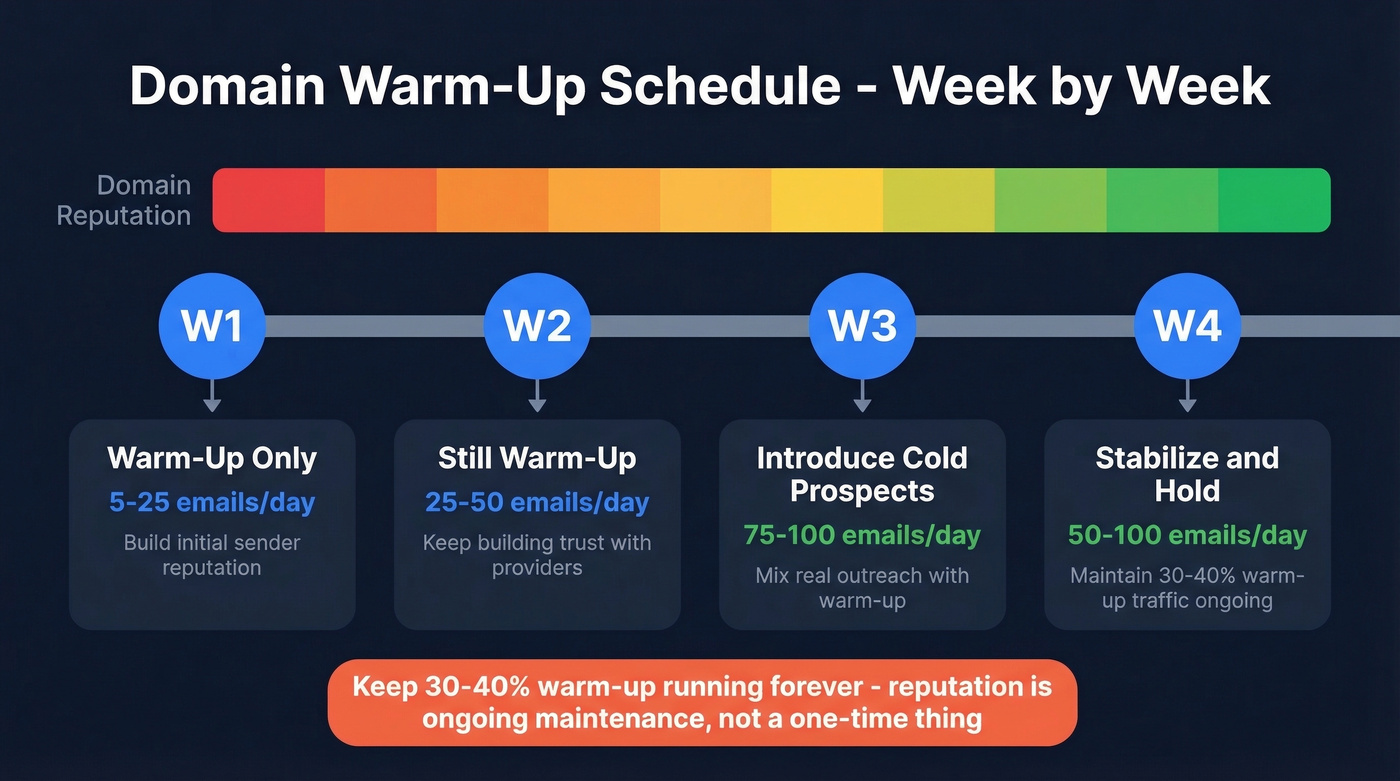
Here's the week-by-week schedule we recommend:
| Week | Daily Volume | What You're Doing |
|---|---|---|
| 1 | 5 to 25 | Warm-up emails only |
| 2 | 25 to 50 | Still warm-up only |
| 3 | 75 to 100 | Introduce cold prospects |
| 4 | Stabilize | Hold at 50-100/day |
Most sending tools like Instantly and Smartlead have built-in warm-up features. Use them. And here's the part people miss: keep 30-40% warm-up traffic running even after you launch real campaigns. Your domain reputation isn't a one-time achievement - it's ongoing maintenance.
Build and Verify Your List
B2B contact data decays 25-30% per year. People change jobs, companies get acquired, emails get deactivated. If you're sending to an unverified list, you're gambling with your brand-new domain's reputation.
Your bounce rate must stay under 2%. Above 5% and you're in the danger zone - inbox providers will throttle or block you. (If you want the deeper breakdown, see bounce rate benchmarks and fixes.)
Here's the thing: in our experience, the biggest gap between a 2% reply rate and a 5% reply rate is list quality, not copy. Verification isn't optional for beginners. It's the single most important step between "I have a list" and "my campaign actually works."
Prospeo handles both finding and verifying in one step - paste a URL or upload a CSV, and you get verified emails back in seconds at 98% accuracy. Its 5-step verification process includes catch-all handling, spam-trap removal, and honeypot filtering, so you're not just checking syntax but confirming real, deliverable inboxes. The free tier gives you 75 verified emails per month, enough to launch your first campaign without spending a dime on data.
For lead sourcing, Apollo's free tier (100 credits/month) works well for building your initial prospect list. But always run those contacts through verification before hitting send.

You just spent weeks warming up your domain. One bad list wipes that out. Prospeo verifies emails through a 5-step process - catch-all handling, spam-trap removal, honeypot filtering - so your bounce rate stays under 2% from day one.
Launch your first campaign on data that won't torch your domain.
Write an Opening That Gets Replies
Your first cold email doesn't need to be clever. It needs to be short, relevant, and easy to respond to.
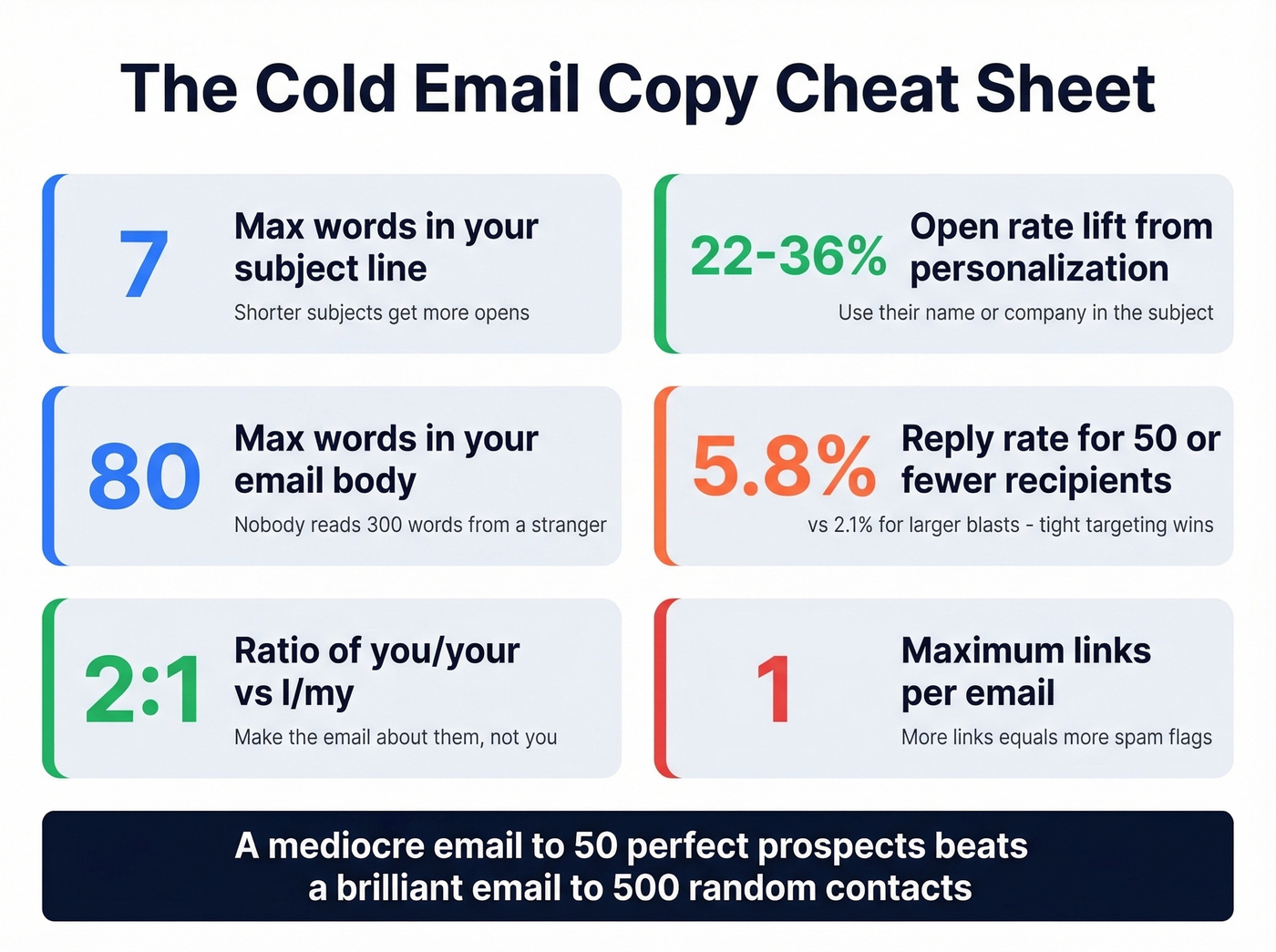
Keep subject lines under 7 words. Personalized subject lines lift open rates 22-36%. The body should be under 80 words with one clear call to action. No "I hope this finds you well." No three-paragraph company histories. Use "you" and "your" twice as often as "I" and "my" - prospects respond to emails about them, not about you. (If you need ideas, steal from these subject lines.)
Let's be honest: most beginners obsess over copywriting when their list is garbage. A mediocre email sent to 50 perfect-fit prospects will outperform a brilliant email sent to 500 random contacts every single time. Campaigns with 50 or fewer recipients average a 5.8% reply rate versus 2.1% for larger blasts. Tight targeting beats volume, always.
A complete example:
Subject: Quick question about Drift's outbound
Hi Sarah,
Noticed Drift is hiring 3 SDRs - sounds like outbound is a priority this quarter.
We help teams like yours book 40% more meetings by fixing the data layer (verified emails + direct dials instead of generic info@ addresses).
Worth a 15-minute call next week to see if it fits?
Jake Miller Acme Sales - 123 Main St, Austin TX 78701
That's 62 words. One observation, one value prop, one ask. A/B test one variable at a time - subject line, opening line, or CTA - running 20% of volume as the test, then deploying the winner to the remaining 80%. Run your copy through a spam-word checker too. Words like "guarantee," "free," and "profit" trigger filters faster than you'd expect.
Set Up Your Follow-Up Sequence
42% of cold email replies come from follow-ups. Stopping after one email means you're leaving nearly half your results on the table.
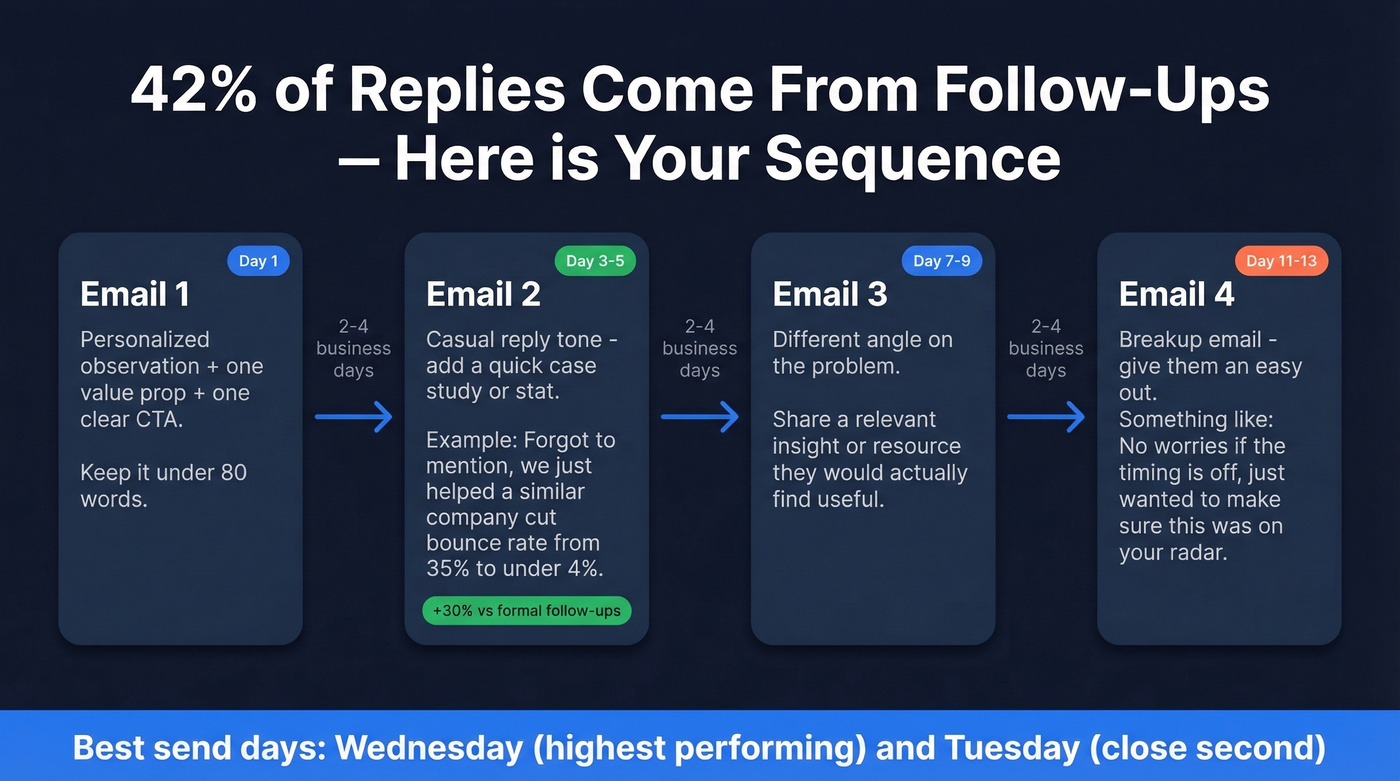
Build a sequence of 3-4 touches spaced 2-4 business days apart. Many high-performing sequences run 4-7 touches. Each follow-up should add new value - a relevant case study, a different angle on the problem, a quick stat. Never just "bumping this to the top of your inbox." (If you want plug-and-play copy, use these follow-up templates.)
One tactic that consistently outperforms in our campaigns: make your step 2 email feel like a casual reply rather than a formal follow-up. Something like "Forgot to mention - we just helped a similar company cut their bounce rate from 35% to under 4%." That conversational approach outperforms formal follow-ups by roughly 30%.
Wednesday is the highest-performing send day, with Tuesday a close second. Schedule accordingly. (More data here: best time to send.)
Is Cold Email Legal?
Yes - but there are rules. CAN-SPAM applies to all commercial email, including B2B. You must include a valid physical postal address, a clear opt-out mechanism, and a clear disclosure that the message is an ad. Honor unsubscribe requests within 10 business days. No deceptive subject lines - those fake "Re:" tricks will get you in trouble. Penalties run up to $53,088 per violating email.
If you're emailing into the EU, you need either explicit consent or a legitimate business interest for relevant B2B outreach. When in doubt, make your emails genuinely relevant and always include an easy opt-out.
Mistakes That Kill Campaigns
Skip this section if you've already launched successfully - it's aimed at people still setting up.
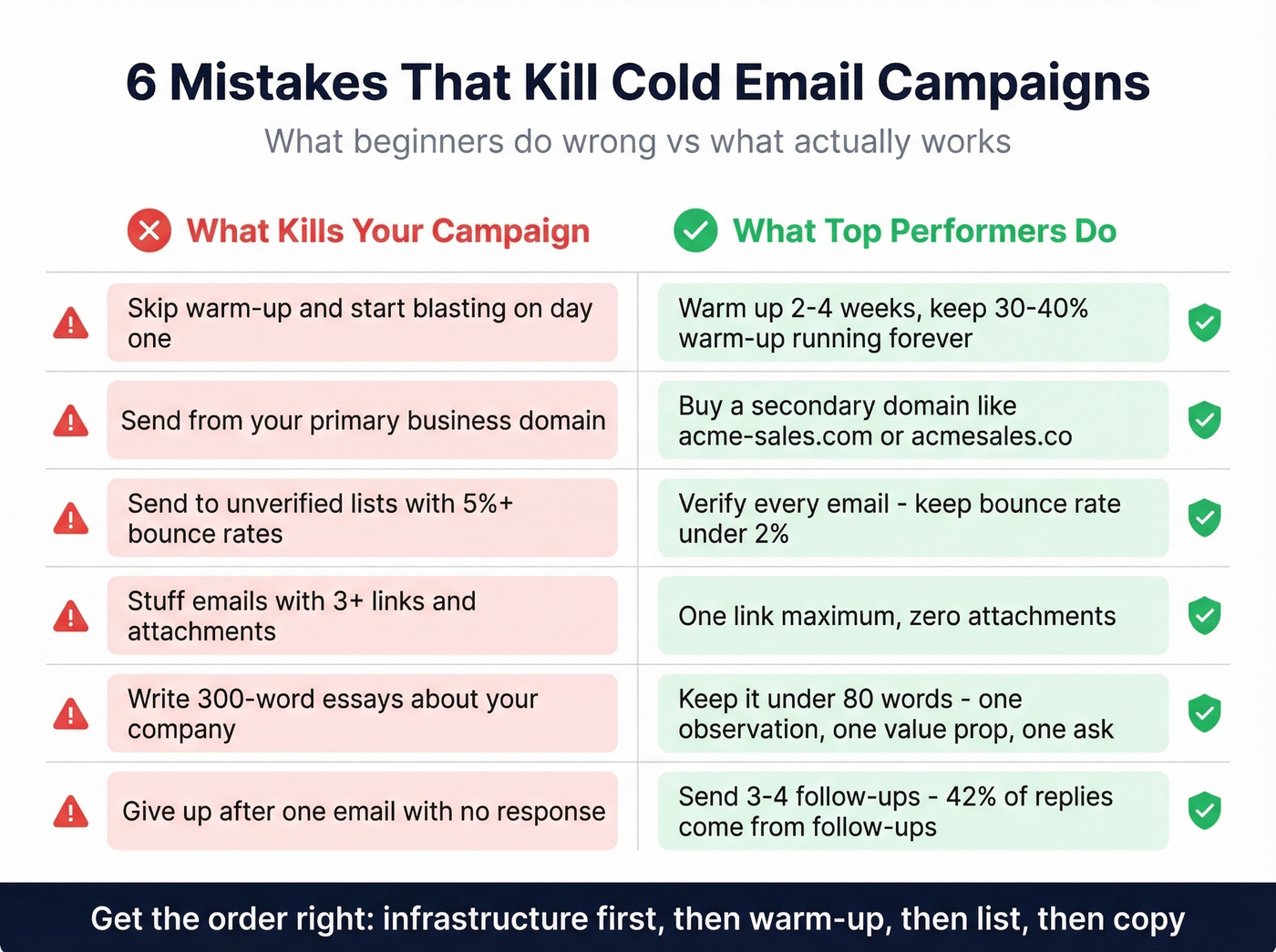
- Skipping warm-up - Your domain gets flagged before you send a real email. (Fix the root cause with an email deliverability checklist.)
- Sending from your primary domain - One spam complaint and your business email deliverability is compromised.
- No email verification - Bounce rates above 5% tank your reputation overnight.
- Too many links or attachments - Stick to one link maximum, zero attachments.
- Writing too much - Keep it under 80 words. Nobody reads a 300-word cold email from a stranger.
- Giving up after one email - 42% of replies come from follow-ups. Send 3-4 touches minimum.
FAQ
What's a good cold email reply rate?
The average across all campaigns is 3.43%, and the top 10% hit 10.7%+. If you're landing 3-4% as a beginner with a properly warmed domain and verified list, you're on track. Focus on tightening targeting before rewriting copy.
Do I need a separate domain?
Always. Buy a secondary domain similar to your main one - if your primary is acme.com, use acme-mail.com or getacme.com. If that domain gets flagged, your primary business email stays safe.
What's the best way to open a cold email?
Lead with a personalized observation about the prospect's company - a recent hire, a product launch, or a funding round. This signals you've done research and gives the reader a reason to keep going. Avoid generic openers like "I hope this finds you well" and get to relevance within the first sentence.
How do I keep my emails out of spam?
Configure SPF, DKIM, and DMARC. Set up a custom tracking domain. Warm up for 2-4 weeks. Verify every email address before sending. A 5-step verification process that includes catch-all handling and spam-trap removal keeps bounce rates well under 2% and helps you avoid spam traps entirely.
How many follow-ups should I send?
Three to four follow-ups spaced 2-4 business days apart. 42% of cold email replies come from follow-ups, so stopping after one email leaves nearly half your potential results behind.