

How to Start an Email to Someone You Don't Know - and Actually Get a Reply
You're staring at a blank compose window, cursor blinking, deciding between "Dear" and "Hi" like it's a life-altering choice. Here's the thing: the greeting is maybe 10% of the battle. The opening line - the sentence right after - is the other 90%. Data from 2M+ cold emails shows informal tone produces 78% more positive replies than formal. So if you're agonizing over "Dear Sir or Madam," stop. Focus on what comes next.
Quick version: Find their name. Use "Hi [First Name]." Write an opening line that earns the next sentence. Done.
Find Their Name First
The best cold email strategy is making the person not a stranger anymore. Spend 30 seconds finding their name instead of defaulting to "To Whom It May Concern." The whole challenge of addressing an unknown recipient gets dramatically easier once they're no longer unknown.
- Company website - check the About or Team page for names and titles.
- Professional profiles - search by company name + job title to surface the right person.
- B2B data tools - Prospeo covers 300M+ professional profiles with 98% email accuracy, and the free tier gives you 75 verified emails per month. More than enough to find the right contact before you write.
- Ask around - a mutual connection can give you the name and an intro that changes the entire dynamic.
Once you have the name, spend another 60 seconds scanning their recent posts, company news, or any public talks. This research fuels the personalized opening line that actually gets replies. We've seen it firsthand: an email to "Hi Sarah" with a reference to her latest project outperforms "Dear Hiring Manager" every single time, and it's not close.
Best Email Greetings for Strangers
| Greeting | When to Use | When to Avoid |
|---|---|---|
| Hi [First Name] | Default for most emails | Very formal industries |
| Hello [First Name] | Slightly more formal | Feels stiff in casual contexts |
| Dear [Full Name] | International, academic, legal | US startup culture |
| Hello | When name is truly unknown | When you could've found it |
| Hey [First Name] | Only if you've interacted before | First contact with strangers |
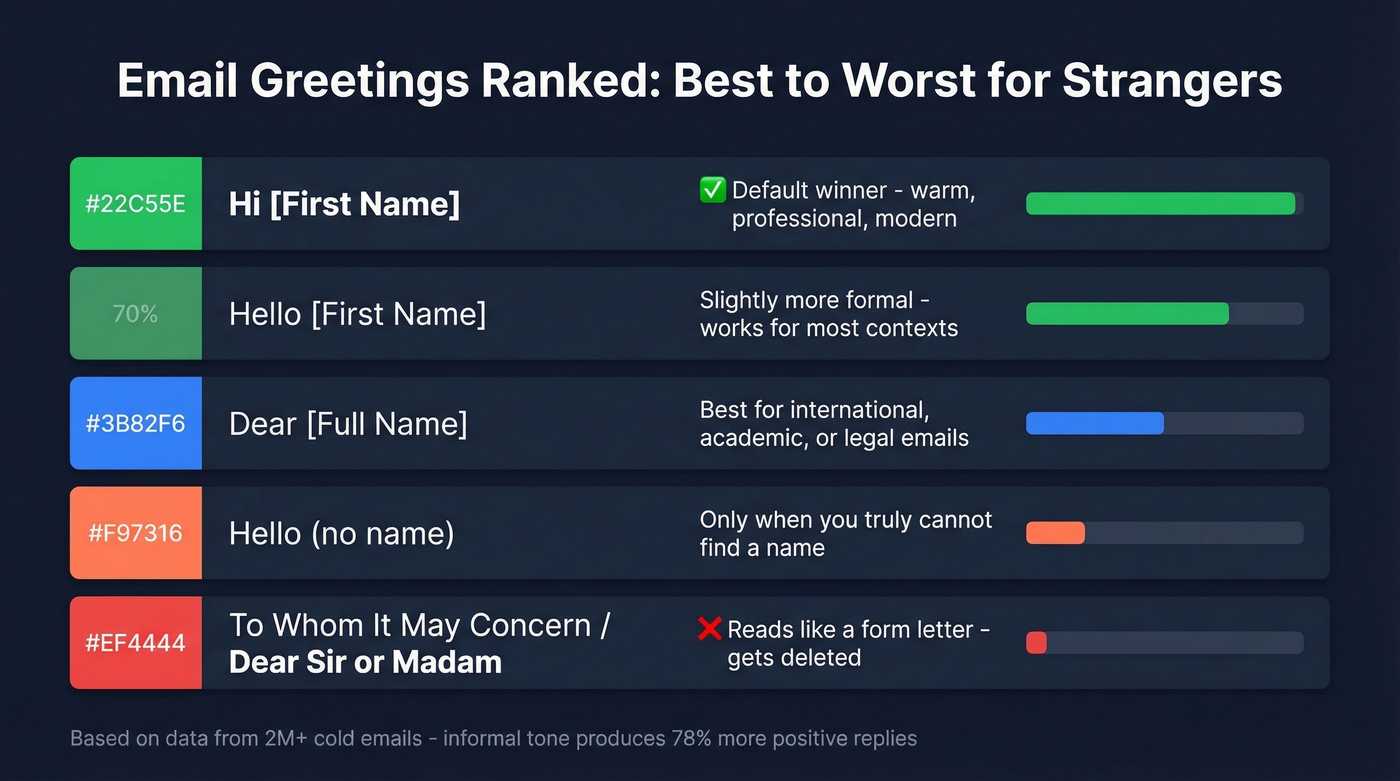
"Hi [First Name]" wins in almost every modern professional context. It's warm without being sloppy. "Dear" isn't wrong - it's just unnecessary formality for most 2026 business communication.
A few anti-patterns worth flagging: "To Whom It May Concern" reads like a form letter. "Dear Sir or Madam" signals you didn't bother researching. Both get deleted. When you're unsure of someone's gender or preferred title, use their full name - "Dear Alex Morgan" avoids assumptions entirely. One more thing: "Hi" pairs with first names, "Dear" pairs with full names. Mixing them - "Hi Jonathan Smith" - reads as awkward.
What to Write After the Greeting
Your greeting plus your first line is what recipients see in their inbox preview - basically the first visible text in Gmail and Outlook. That preview determines whether they open or scroll past. You've got about 6 seconds of attention once they do open.
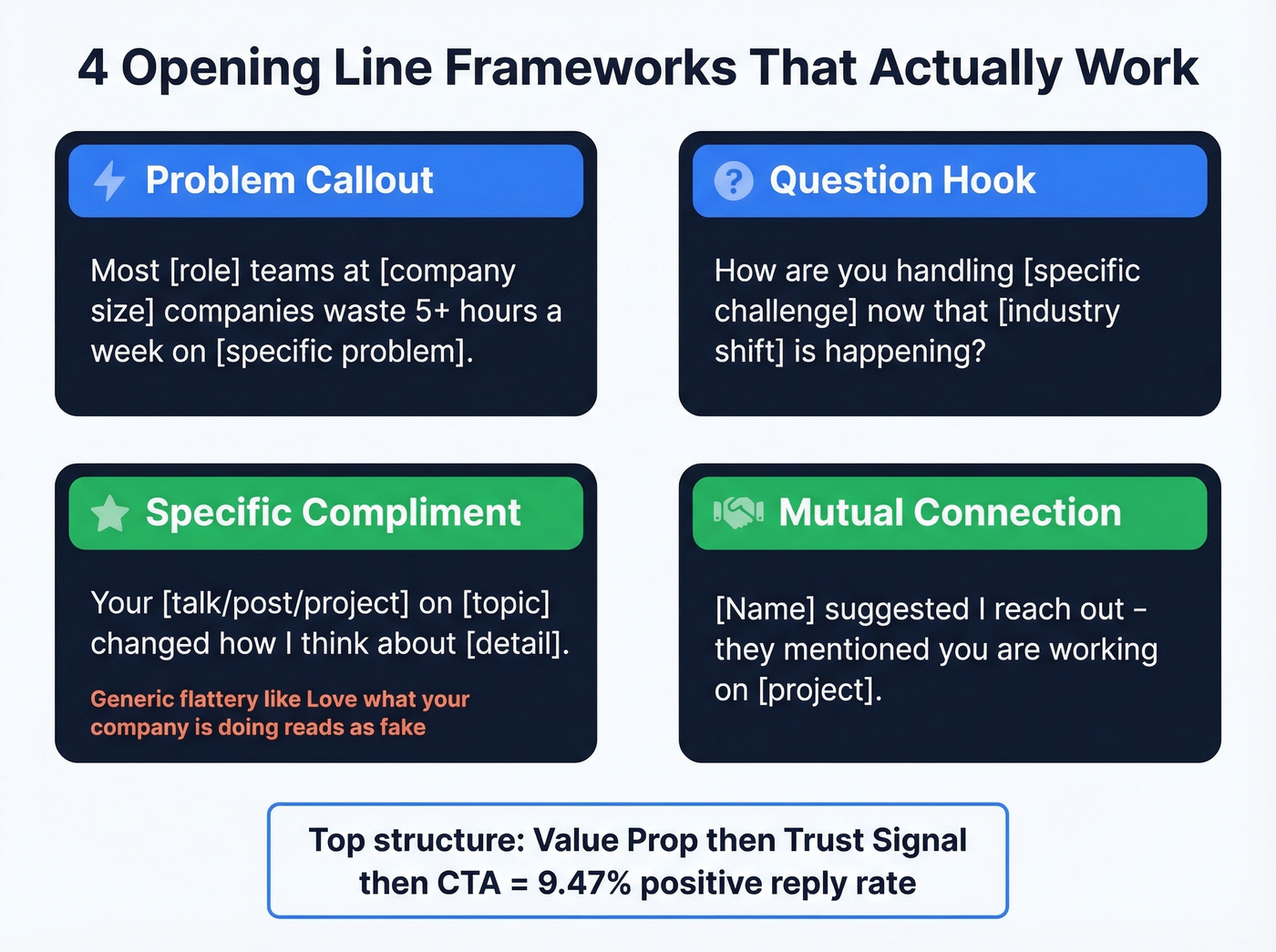
Four opening-line frameworks that work:
- Problem callout: "Most [role] teams at [company size] companies waste 5+ hours a week on [specific problem]."
- Question hook: "How are you handling [specific challenge] now that [industry shift] is happening?"
- Specific compliment: "Your [specific talk/post/project] on [topic] changed how I think about [detail]." Generic flattery like "Love what your company is doing" reads as fake - specificity builds trust.
- Mutual connection: "[Name] suggested I reach out - they mentioned you're working on [project]."
The highest-performing email structure across 2M+ emails follows a "VP -> Trust -> CTA" pattern - value proposition, then a trust signal, then a clear ask - hitting a 9.47% positive reply rate. Whatever you do, don't open with "I hope this email finds you well." It's the fastest way to signal you're sending a template.
Your CTA matters enormously here too. "Want to see it in action?" pulls a 30.05% positive rate among replies. "Mind if I send more info?" drops to 8.59%. Specific, confident asks outperform soft, permission-seeking ones every time. If you want more examples, borrow a few proven sales follow-up templates and adapt the tone.
Subject Lines That Get Opened
Subject lines around 30-60 characters hit the sweet spot for mobile, and specificity is the pattern that separates opens from ignores. A subject that references something real - a name, a role, a topic - earns the click. Vague subjects like "Quick question" or "Touching base" don't.
If you want a swipe file, pull ideas from these email subject line examples and keep them specific to the recipient.
Here's what works by scenario: for referrals, try "Saying hello via [Mutual Contact's Name]." For job inquiries, "[Role Title] - quick question" gets straight to the point. Networking emails land with "Your [talk/article] on [topic] - follow-up thought." Sales emails should name the pain: "[Specific problem] at [Company Name]?" And if someone recommended you reach out, say so directly in the subject line - it's the strongest open-rate signal you can send.

The article says it: "Hi [First Name]" beats "To Whom It May Concern" every time. Prospeo turns strangers into known contacts - 300M+ profiles, 98% email accuracy, and a free tier that gives you 75 verified emails per month. Find the name, nail the opening line, land the reply.
Never send another email to "Dear Sir or Madam" again.
What the Data Says
We've dug through two large cold email datasets this year. Here's what the numbers actually show:
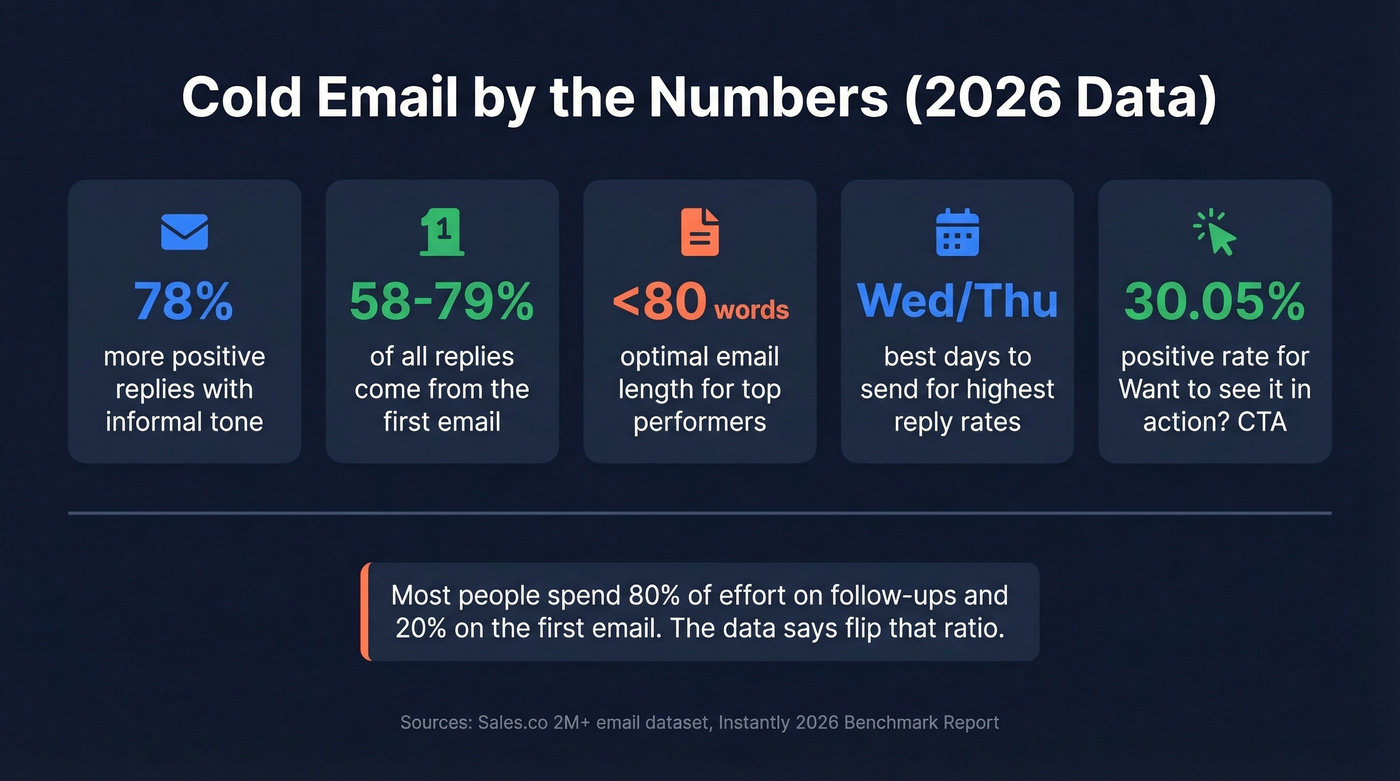
- Average reply rate: 2.09% across Sales.co's 2M+ email dataset; 3.43% across Instantly's 2026 benchmark, with top-quartile campaigns hitting 5.5%+
- First email drives most replies: 58% per Instantly, and as high as 79.4% in Sales.co's dataset - your follow-up sequence matters less than nailing the first touch
- Optimal length: Under 80 words. Top performers are ruthlessly short.
- Best send day: Wednesday sees the most replies overall in Instantly's benchmark; Sales.co shows Thursday has the highest positive reply rate
Let's be honest: most people spend 80% of their time on follow-up sequences and 20% on the first email. The data says that's exactly backwards. If your first email doesn't land, a fifth follow-up won't save it. If you're building a full sequence, use a simple B2B cold email sequence structure and iterate from there.
Mistakes That Get You Deleted
"Dear Sir or Madam, I hope this email finds you well" is an instant delete. Reddit threads on r/emailmarketingnow call this combo robotic and mass-template-coded, and in our experience, they're right - it's a reliable way to get ignored.
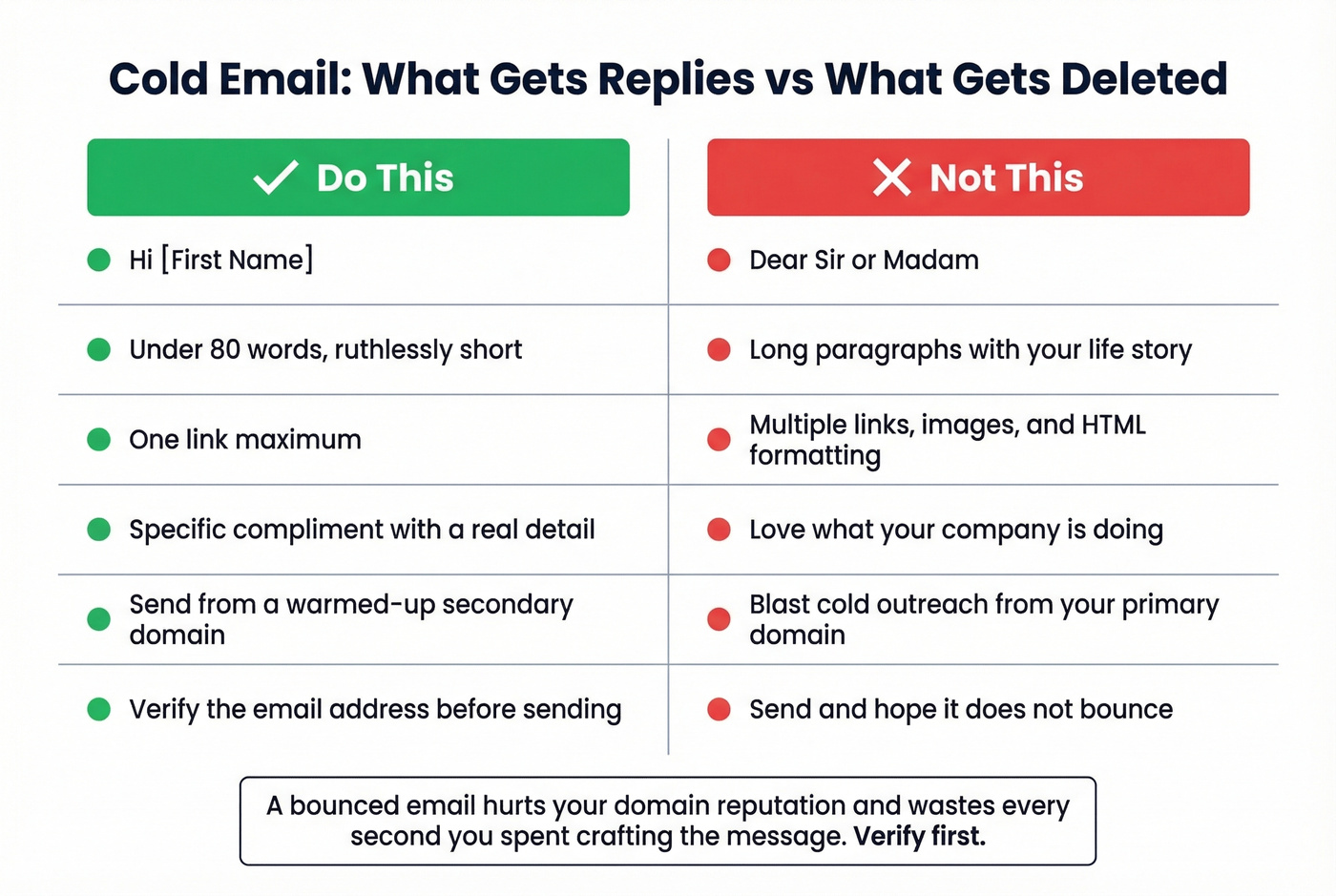
Keep cold emails under 150 words max, and if you want to play in the top-performing bracket, under 80 is better. Include one link maximum - more than that can trigger filters and looks like marketing material. Skip heavy HTML, logos, and images. Plain text outperforms formatted emails for cold outreach.
Generic flattery is the cold email equivalent of "you have a great personality." Be specific or skip it entirely. And never send to an unverified address - a bounced email hurts your domain reputation and wastes every second you spent crafting the message. (If you need a deeper fix list, start with an email deliverability guide and work outward.)
One mistake almost nobody talks about: sending cold outreach from your primary domain without warm-up. Don't do this. Use a secondary domain with SPF, DKIM, and DMARC configured. Cold outreach from your main domain risks your entire company's deliverability - and once that reputation tanks, it's brutal to recover. If you want the technical checklist, see SPF record examples and DMARC alignment.
Formal Emails Without a Name
Sometimes you've exhausted every research avenue and still can't find the recipient's name - government offices, large procurement teams, generic department inboxes. It happens.
"Hello" on its own is the cleanest option. It's neutral, professional, and doesn't carry the dated baggage of "To Whom It May Concern." For highly formal contexts like legal correspondence or academic outreach, "Dear [Department] Team" or "Dear Hiring Committee" at least narrows the audience. The key is to move past the greeting quickly and lead with a strong opening line - the less attention you draw to the missing name, the better.
Emailing Internationally
"Hi [First Name]" is primarily an English-speaking norm. If you're emailing across borders, adjust:
| Country | Greeting Norm | Key Note |
|---|---|---|
| Japan | [Last Name]-san | Always use last name |
| Germany | Herr/Frau [Last Name] | Include titles if known |
| India | Sir/Madam | Honorifics show respect |
| Saudi Arabia | As-salamu alaykum | Religious greeting common |
| France | Madame/Monsieur | Never "Mademoiselle" |
When in doubt, "Dear [Full Name]" is the safest universal option. It reads as respectful without assuming cultural familiarity.
Copy-Paste Templates
Networking
Subject: Your [specific talk/article] - a follow-up thought
Hi [First Name],
Your [content piece] on [topic] changed how I think about [specific detail]. I'm working on something similar and would love to hear your approach.
Open to a 15-minute call this month?
Best, [Your Name]
Job Inquiry
Subject: [Role Title] at [Company] - quick intro
Hi [First Name],
I saw the [Role Title] opening. I've spent [X years] doing [relevant skill] at [Company], where I [one accomplishment with a number]. Would it make sense to chat about how that maps to what you're building?
Thanks, [Your Name]
Business Email to a Stranger
Subject: [Specific problem] at [Company Name]?
Hi [First Name], most [role] teams at [company size] companies spend [X hours] on [problem]. We helped [similar company] cut that by [result]. Want a 2-minute walkthrough?
[Your Name]
Sign-off guidance: "Best" and "Thanks" are safe defaults for first contact. Skip "Cheers" with strangers - it reads as overly familiar. And "Sent from my iPhone" isn't a sign-off strategy.
Before you hit send: Verify the email address. A bounced email is worse than no email - it damages your domain reputation and guarantees you'll never reach them. If you don't have a verification tool, Prospeo's free tier handles this. If you're troubleshooting bounces, start with email bounce rate benchmarks and fixes.
Your first email drives 58-79% of all replies. Don't waste it on an unverified address that bounces and tanks your domain reputation. Prospeo's 5-step verification delivers 98% email accuracy at $0.01 per email - so every perfectly crafted opening line actually reaches a real inbox.
Great copy means nothing if the email bounces. Verify first.
FAQ
Is "Dear Sir or Madam" still acceptable?
Not in most modern contexts. Informal tone gets 78% more positive replies across 2M+ cold emails. Use "Hi [First Name]" or "Hello" instead - both read as professional without the dated formality that signals a mass template.
How do I address an email if I don't know the name?
Use "Hello" or "Hi there" - both are neutral and professional. Avoid "To Whom It May Concern," which reads like a mass email. For a specific department, "Hello [Department] Team" adds relevance without requiring a contact name. Better yet, spend 30 seconds with a B2B data tool to find the actual person's name before writing.
How long should a cold email be?
Under 80 words performs best across millions of emails benchmarked. State your purpose in two sentences and include one clear ask. Emails over 150 words see sharp drops in reply rates.
What's the best opening line for emailing a stranger?
Lead with a specific problem callout or a reference to the recipient's recent work - both outperform generic openers. The "VP -> Trust -> CTA" structure (value proposition, trust signal, clear ask) hits a 9.47% positive reply rate across 2M+ emails. Never open with "I hope this email finds you well."