

How to Use Spintax: The Practical Guide for Cold Email
A team ran 10 domains, 40 inboxes, spintaxed every line of every email, turned off open tracking, sent text-only - did everything "right." Within two weeks, inbox placement cratered from 98% to 50%. Spinning syntax didn't save them. It won't save you either - unless you understand how to use spintax properly, and what it can't do.
Here's the short version. The syntax is {option1|option2|option3}, but check your tool's flavor (table below). Spin at the section level - openers, CTAs, sign-offs - not just greetings. And treat spintax as hygiene, not strategy, because infrastructure and data quality matter 10x more.
What Is Spintax?
Spintax - short for "spinning syntax" - lets you write one email template that generates dozens or hundreds of unique versions. You wrap alternatives in curly braces, separated by pipes:
{Hello|Hi|Hey} {FirstName}, I noticed {your recent funding round|you're scaling the sales team|your job posting for a BDR}.
One send renders as: "Hi Sarah, I noticed your recent funding round." The next: "Hey Sarah, I noticed you're scaling the sales team." Same template, different output every time.
It's also used in LinkedIn messaging and connection request automation, but email outreach is where it delivers the most value.
Spintax Syntax by Platform
Spintax doesn't port cleanly between platforms. Instantly-style syntax won't work in GMass, and GMass syntax won't work in tools that expect {a|b|c}. Bookmark this table.
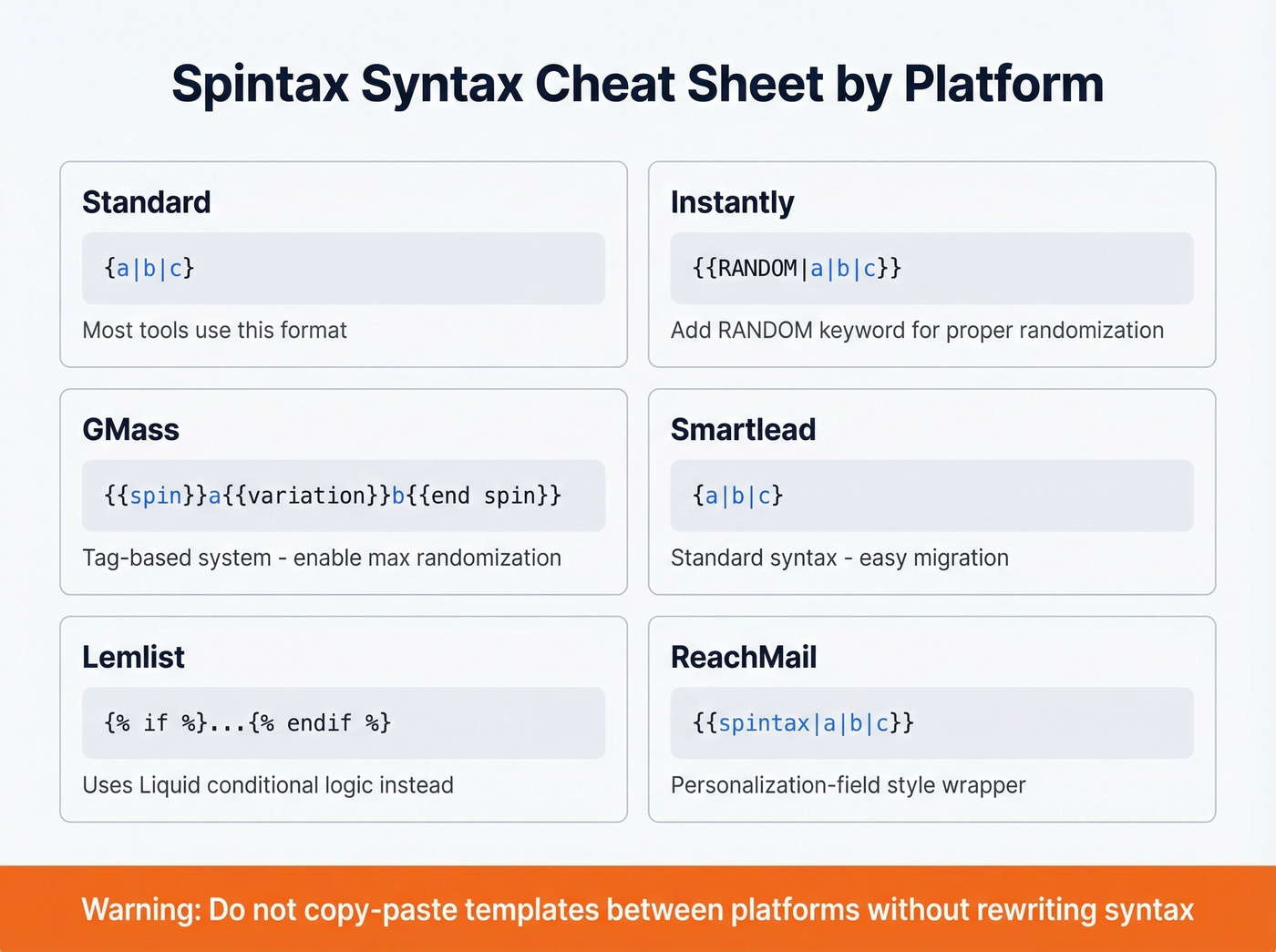
| Tool | Syntax | Notes |
|---|---|---|
| Standard | {a\|b\|c} |
Most tools use this |
| Instantly | {{RANDOM\|a\|b\|c}} |
Add RANDOM for proper randomization |
| GMass | {{spin}}a{{variation}}b{{end spin}} |
Tag-based; enable "Maximize spintax randomization" |
| Smartlead | {a\|b\|c} |
Standard syntax |
| Lemlist | {% if %}...{% endif %} |
Liquid conditional logic instead of RANDOM-style spintax |
| ReachMail | {{spintax\|a\|b\|c}} |
Personalization-field style |
If you're switching tools mid-campaign, rewrite your templates. Don't copy-paste and hope.
4-Step Process for Email Spintax
Four steps. The fourth is the one everyone skips.
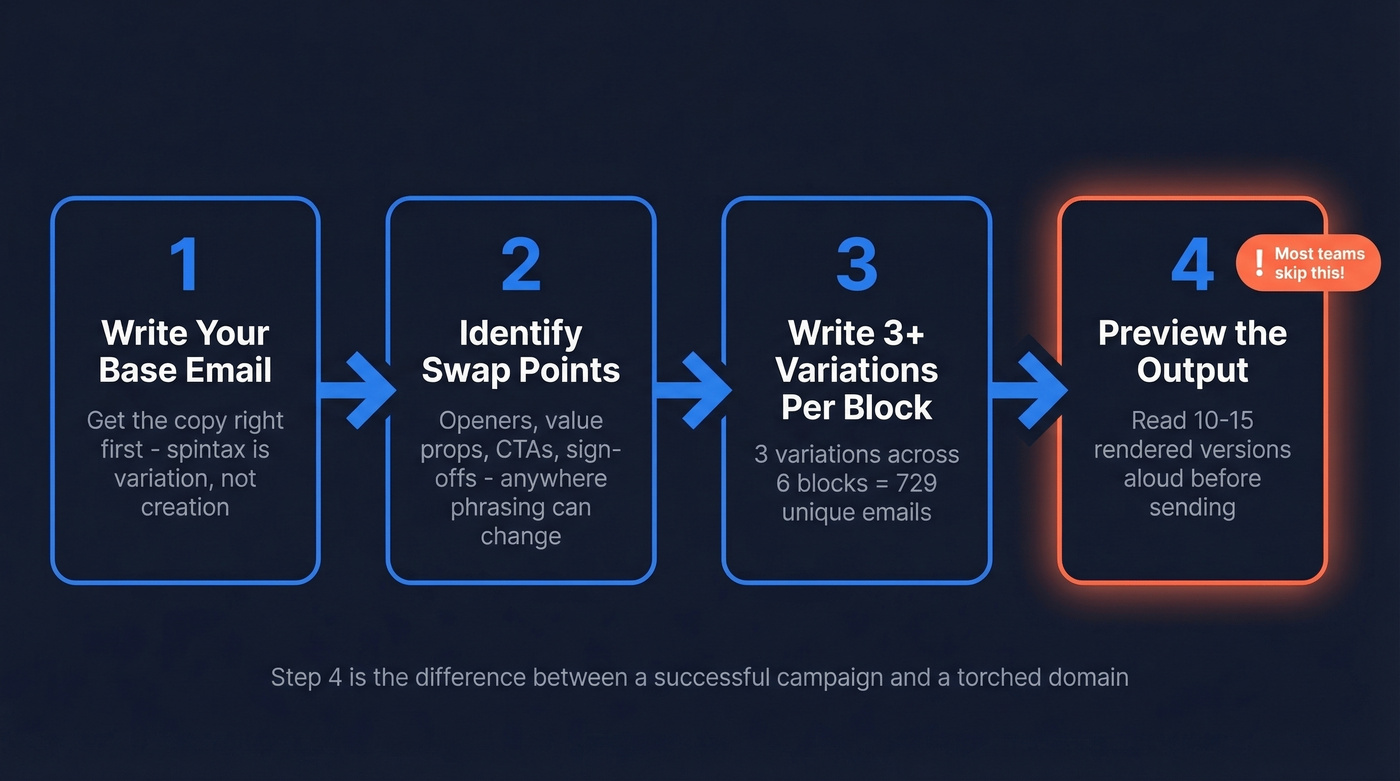
1. Write your base email. Get the copy right first. Spintax is variation, not creation. (If you need help tightening the core message, start with email copywriting.)
2. Identify swap points. Look for openers, value propositions, CTAs, and sign-offs - anywhere phrasing can change without changing meaning. For CTA ideas, see Email Call to Action.
3. Write 3+ variations per block. Aim for 6-10 blocks per email, each with 3+ variations. The math compounds fast: 3 variations across 6 blocks = 729 unique emails from a single template.
4. Preview the output. Click through 10-15 rendered versions. Read them aloud. Catch the awkward combinations before your prospects do. We've seen teams skip this step and torch a domain in a single afternoon - one broken sentence fragment going out to 400 people, each version slightly different but equally nonsensical.
Where to apply it: openers, pain-point framing, value props, CTAs, sign-offs, and PS lines. You can also nest for deeper variation - something like {your {recent post|latest update} on {social media|your blog}|the work you're doing at {{Company}}} gives you six combinations from a single block. Just don't go past a couple levels of nesting, or you'll create Frankenstein sentences nobody previewed.
Where NOT to apply it: don't just spin {Hi|Hey|Hello} and call it a day. Modern ESPs are savvy enough to spot shallow spinning and it can raise alarms. (If you're scaling, also watch email velocity so uniqueness isn't your only lever.)

Spintax multiplies your templates - but it also multiplies bad data. If 10% of your list bounces, spinning 729 variations just means 729 ways to torch your domain. Prospeo's 5-step verification delivers 98% email accuracy with catch-all handling and spam-trap removal, so every spintax variation lands in a real inbox.
Fix the data layer before you spin a single word.
Generate Variations with ChatGPT
Stop staring at your template trying to think of a third way to say "I hope this finds you well." Let ChatGPT do the grunt work. We've tested this prompt across dozens of templates, and the cross-combination constraint is the key:
You are a cold email copywriter. Spintax uses {option1|option2|option3}
to create variations. Rules:
- Use no more than 4 spintax blocks per sentence
- All combinations must be grammatically valid across ANY mix
  (not just 1,1,1 / 2,2,2   -   test cross-combinations)
- Keep tone consistent across all variations
- Maintain natural, conversational language

Update the following text to use spintax:

[PASTE YOUR EMAIL HERE]
Without the cross-combination rule, ChatGPT writes variations that only work when matched in order - first option with first option, second with second. That produces gibberish in production. Ask me how I know. (For a broader playbook, pair this with AI cold email outreach.)
Common Mistakes
Greeting-only spinning is the most common failure mode. {Hi|Hey|Hello} with identical body copy fools nobody.
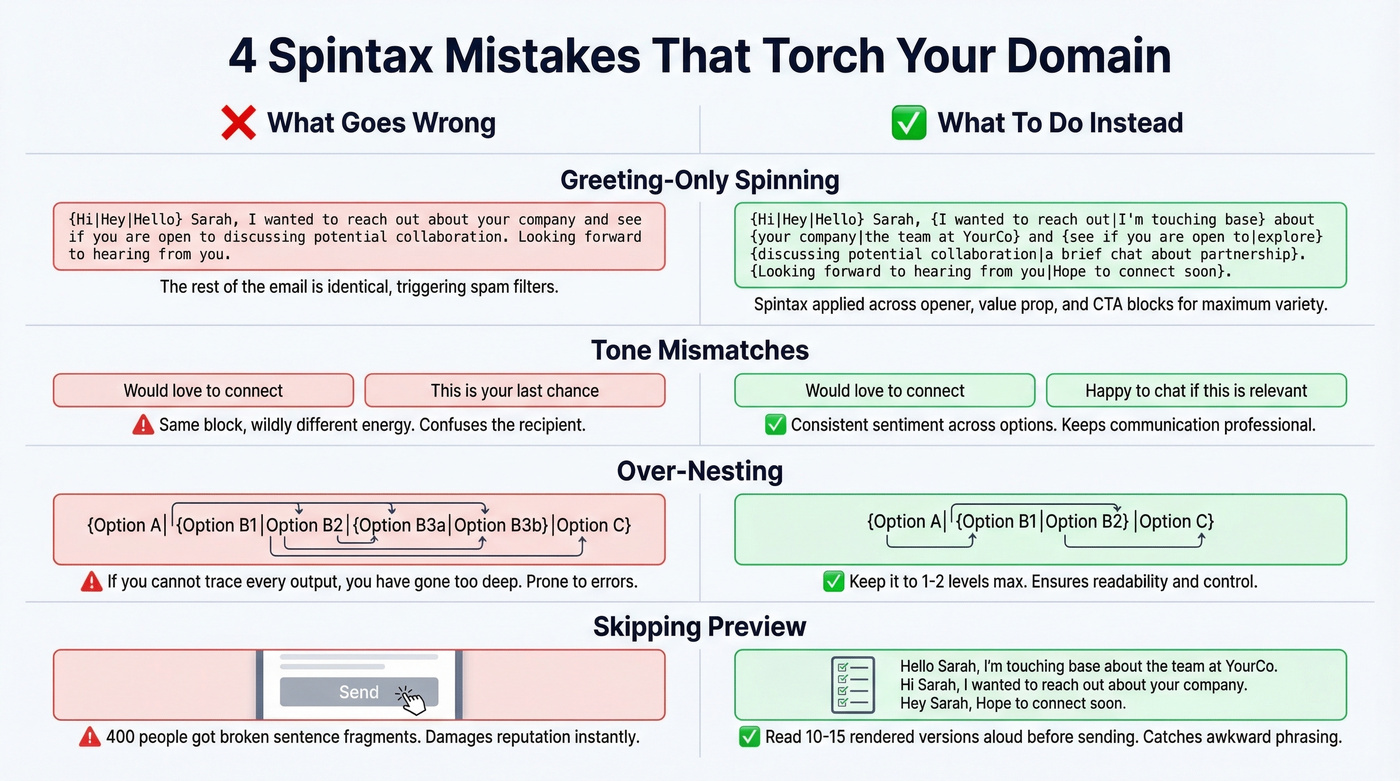
Tone mismatches kill credibility. One variation says "Would love to connect" while another says "This is your last chance." Same block, wildly different energy. Keep sentiment consistent across every option in a given block, or your email reads like it was written by two different people having an argument.
Over-nesting creates combinations nobody previewed. If you can't mentally trace every possible output, you've gone too deep. And ignoring syntax differences between platforms is equally dangerous - your Instantly template won't work in GMass. If you didn't read 15 rendered versions before hitting send, you're gambling with your domain reputation.
Why Spintax Won't Save Bad Infrastructure
Let's go back to that Reddit case study. The team warmed for about two weeks in Instantly, then ramped to 15 emails per inbox per day - roughly 600 daily. They spintaxed everything. Inbox placement still cratered to 50%.
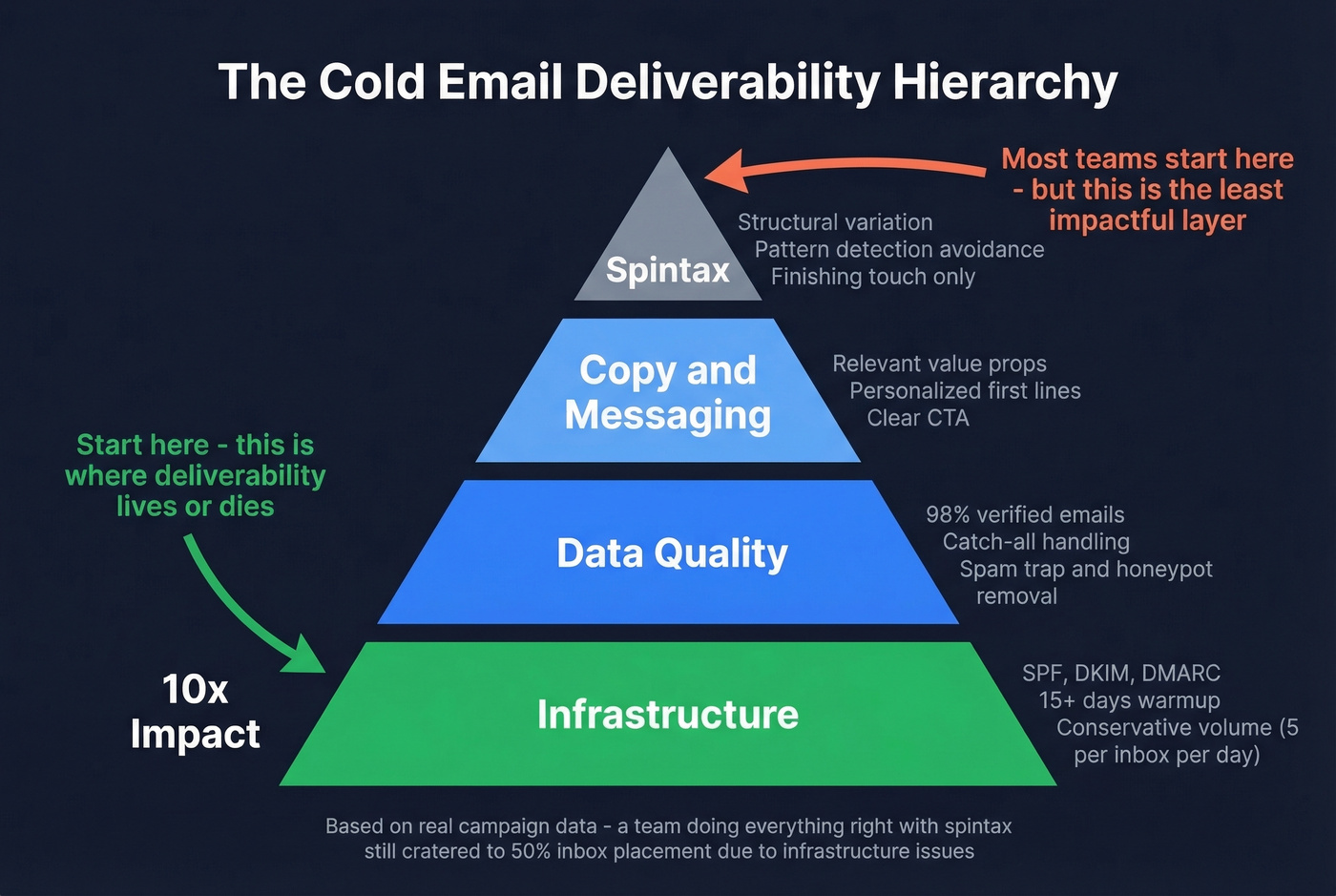
The fix wasn't better spinning. It was reducing volume to 5 emails per inbox per day and switching from custom SMTP to Google.
Here's the thing: there's a hierarchy, and spintax sits at the top of it - meaning it's the least impactful layer. Infrastructure (SPF/DKIM/DMARC, warmup for 15+ days, conservative volume) sits at the base. Data quality comes next. Then copy. Spintax is the finishing touch. Some teams also apply it during warm-up sequences to increase message uniqueness before campaigns launch, which is a smart move. (If you want the full stack, use an email deliverability guide and a checklist for how to improve sender reputation.)

If your bounce rate is above 5%, spintax is a distraction. Fix your list first. Spinning varies your words, but if half your list is invalid, you're burning sender reputation on bounces - and no amount of {Hey|Hi|Hello} variation fixes that. That's where email verification earns its keep. Prospeo's verification runs at 98% accuracy with catch-all handling, spam-trap removal, and honeypot filtering, which is the data quality layer that word variation can't touch. (Benchmarks and fixes: email bounce rate.)
Free Spintax Tools
Postly is the better option if you want a full toolkit - generator, validator, formatter, auto-fix, and preview up to 200 unique samples. It's free and tip-supported. Great for stress-testing your variations before pasting them into your sending tool.
Folderly is lighter and more email-specific. It generates variations with minimal setup, but skip it if you need advanced preview or validation features.
You just built a perfectly spintaxed template with 6 blocks and 3+ variations each. Now you need a list that won't waste it. Prospeo gives you 300M+ profiles with emails refreshed every 7 days - not the 6-week-old data that causes the bounce spikes spintax can't paper over.
Start with fresh data at $0.01 per verified email.
FAQ
Does spintax actually improve deliverability?
It helps at scale by reducing pattern detection, but infrastructure and data quality dominate outcomes. Get your SPF/DKIM/DMARC, warmup, and list quality right first - spinning adds a useful layer on top, not a foundation.
How many variations do I need per email?
Aim for 6-10 blocks with 3+ options each. One vendor example showed open rates improving from ~22% to 32% and spam rates dropping from ~8% to 2% at this level of variation.
Should I use spintax or AI-generated unique copy?
Use both. Spintax handles structural variation - openers, CTAs, sign-offs - where you want controlled, optimizable templates. AI handles personalization: first lines, company-specific hooks, pain-point framing. Feed your AI with enrichment data so personalization is specific, not generic. Prospeo returns 50+ data points per contact, giving your personalization layer real material to work with instead of vague guesses.