

How to Write Short Emails That Actually Get Read
A manager on r/ITManagers described an employee whose emails read like "books" - very linear, chronological, overwhelming, and routinely ignored because nobody could find the actual ask. Critical details got buried. Weeks of "well, I told you X/Y/Z two weeks ago" conversations followed, wasting everyone's time. Workers check email 88 times per day, and 60% say the volume adds stress. The fix isn't reading faster. It's writing shorter.
The Method (Quick Version)
If you're skimming, here's everything:
- The constraint: Five sentences or fewer. Every email, every time.
- The structure: Context (1 sentence) → Ask (1 sentence) → Sign-off.
- The proof: Across 18.5M+ cold emails studied, short emails get more replies than longer ones. Ultra-short emails hit ~8.8% positive reply rates; long emails drop to 6.42%.
Everything below expands on those three points with data, templates, and before/after rewrites you can steal.
Why Shorter Emails Get More Replies
Belkins analyzed 16.5 million cold emails across 93 business domains from January through December 2024. Emails with 6-8 sentences hit a 42.67% open rate and 6.9% reply rate. Messages under 200 words consistently outperformed longer ones.
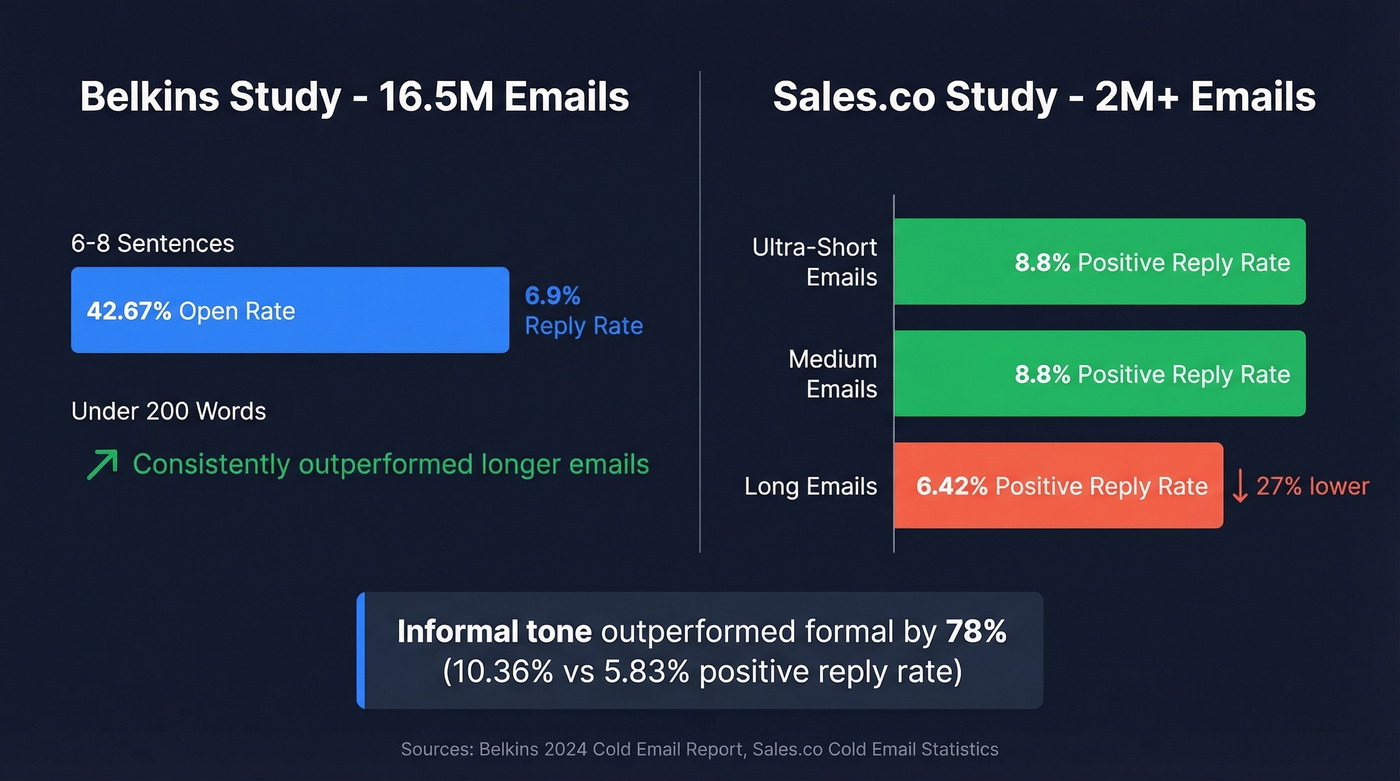
A separate Sales.co study covering 2M+ emails found the same pattern from a different angle. Ultra-short and medium-length emails tied at ~8.8% positive reply rate. Long emails dropped to 6.42% - about 27% lower.
Here's the kicker: informal tone outperformed formal by 78% (10.36% positive rate vs. 5.83%). The winning formula isn't just shorter. It's shorter and more human.
These studies focus on cold outreach, but the principle scales to every kind of workplace email. A status update to your VP doesn't need three paragraphs of context any more than a cold pitch does. Brevity wins regardless of audience.
The Five-Sentence Rule
The concept comes from five.sentenc.es, a micro-site by Mike Davidson that frames email like SMS: instead of counting characters, you count sentences. All email responses, regardless of recipient or subject, stay at five sentences or less.
Productivity expert Chris Bailey adopted it and says it cut his email time in half. He adds a line to his signature you can copy verbatim:
"To respect your time and mine, I keep emails to five sentences or less."
There are variants - two.sentenc.es, three.sentenc.es, four.sentenc.es - if five still feels generous. And as workplace communication expert Leigh Stringer puts it: "A long email is a signal you're using the wrong communication tool." If your email doesn't fit in five sentences, it's a meeting or a shared doc.
The Only Structure You Need
A popular Reddit template distills every email into four components. We've simplified it further:
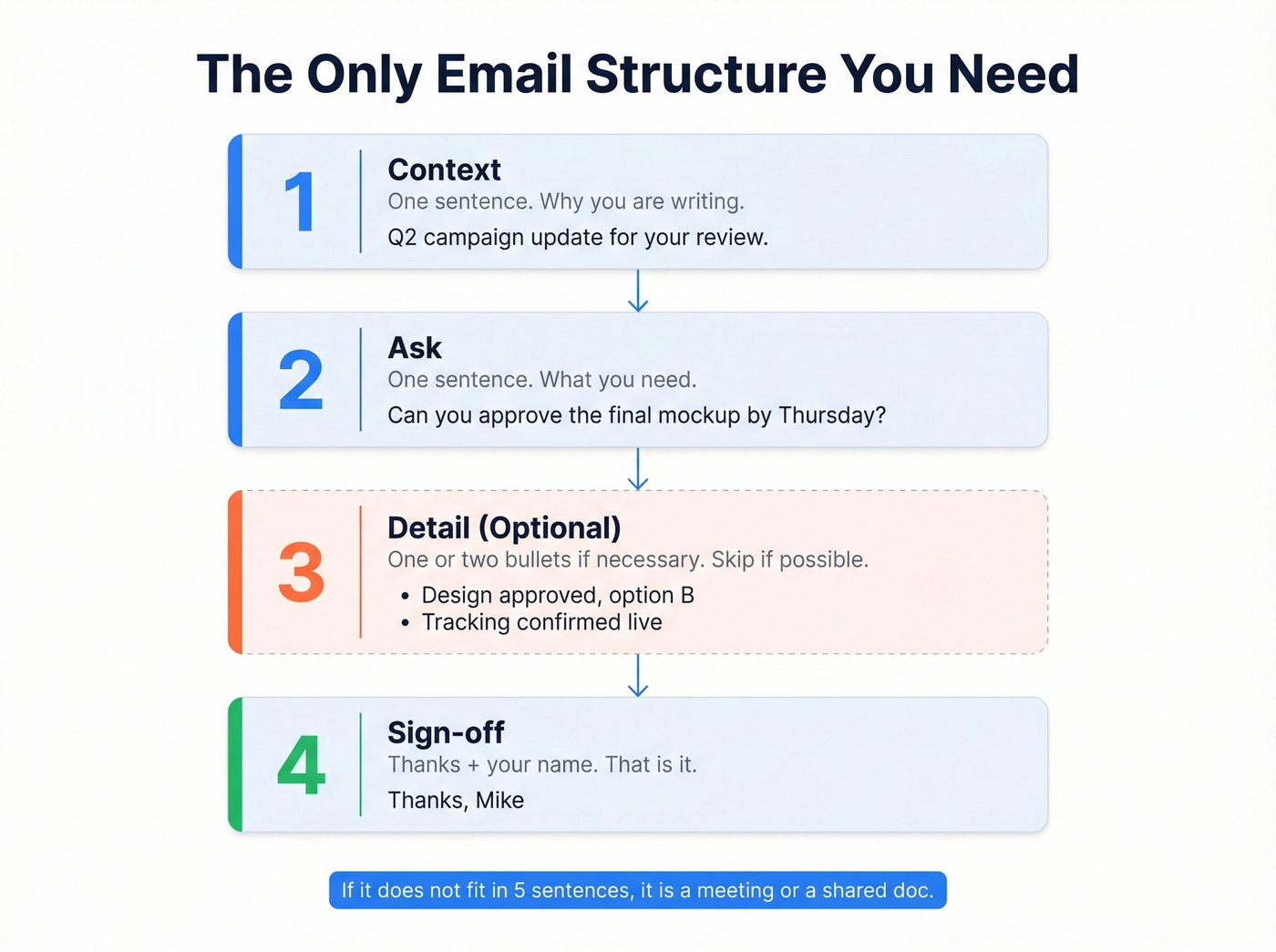
- Context - One sentence. Why you're writing.
- Ask - One sentence. What you need.
- Detail - One or two bullets if necessary. Skip if possible.
- Sign-off - Thanks + name.
That's the skeleton. It works for status updates, vendor requests, meeting invites, and cold outreach. We've rewritten hundreds of emails using this structure, and the pattern holds: if it doesn't fit, it's a meeting.

You just learned how to write emails that get read in three seconds. Now make sure they actually arrive. Prospeo's 98% verified emails mean your perfectly crafted five-sentence pitch hits real inboxes - not bounce logs.
A short email that bounces is worse than a long one that lands.
Before and After: 4 Emails Rewritten
Status Update to Manager
Before (87 words):
Hi Sarah, wanted to update you on the Q2 campaign. We met with design last Tuesday and chose option B for the landing page - strongest visual hierarchy and best brand fit. Copy is due Thursday. Analytics confirmed tracking is live. We're on track to launch Monday. I'll send the final mockup for review once copy is in. Let me know if you have concerns about the direction. Thanks, Mike
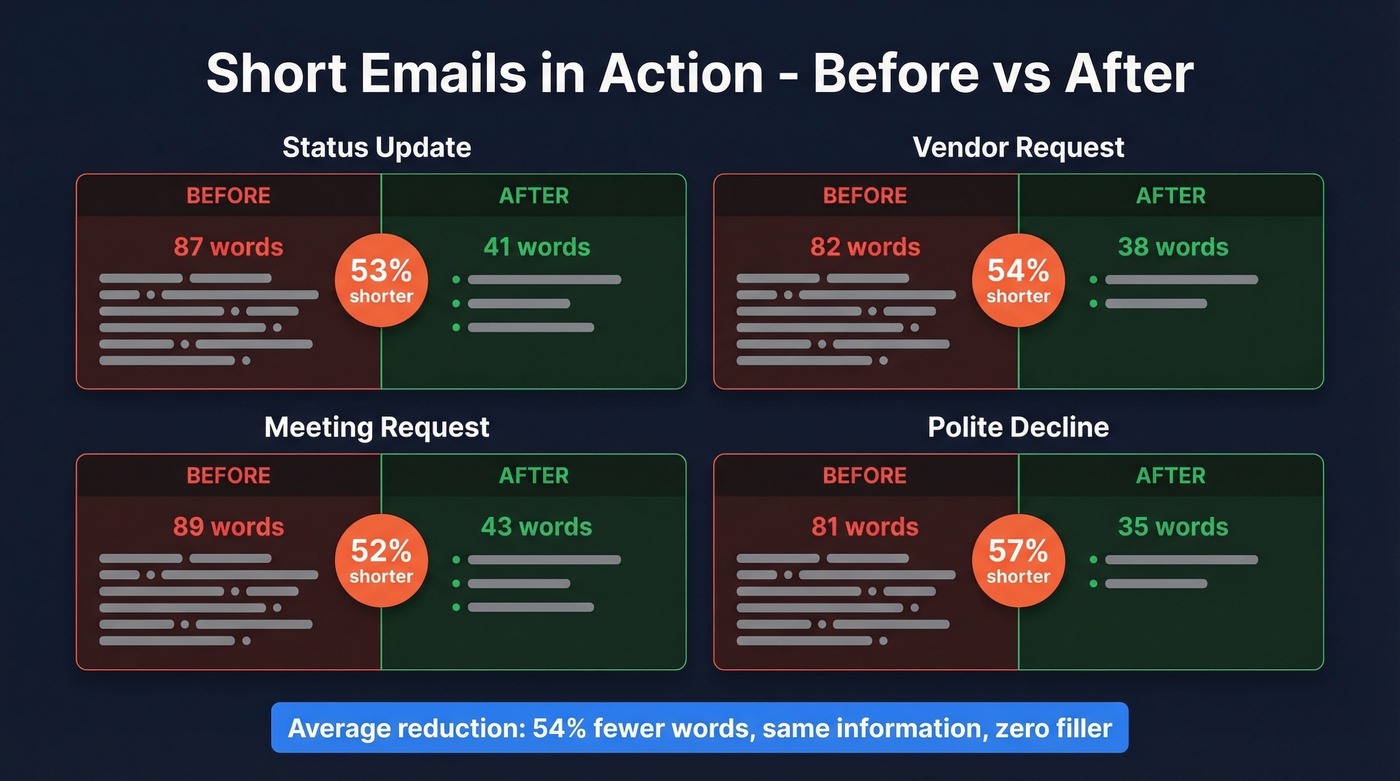
After (41 words):
Hi Sarah - Q2 campaign update:
- Landing page: design approved (option B), copy done Thursday
- Tracking: confirmed and live
- Launch: on track for Monday
I'll send the final mockup Friday for your review. Mike
72% shorter. The "after" takes three seconds to scan. The "before" takes thirty.
Vendor Request
Before (82 words):
Hi James, hope you're well. Our renewal is coming up and I'd like to discuss adjusting our plan - there are a few modules we haven't been using. Would you be available for a call next week to go over the details? I'm generally free Tuesday and Thursday afternoons. Looking forward to discussing how we can continue our partnership. Best regards, Lisa
After (38 words):
Hi James - our renewal is coming up and we'd like to adjust the plan (we're not using a few modules). Can we do a call Tuesday or Thursday afternoon? Lisa
54% shorter. Same information, zero filler.
Meeting Request
Here's what the email should look like:
Hi team - new account setup times are slipping. I've got data on the bottlenecks and a few fixes to propose.
Can product, support, and success do 30 min this week? Rachel
43 words. Now here's the bloated version it replaced - 89 words of preamble to say the same thing:
Hi team, I wanted to see if we could meet to discuss customer onboarding. Several new accounts have experienced setup delays and I think we should identify the bottlenecks together. I've been collecting data and have ideas for streamlining the workflow. If we could get product, support, and success in the same room for 30 minutes, we could make real progress. Please let me know your availability. Thanks, Rachel
Polite Decline
Before (81 words):
Hi David, thank you for thinking of me for this project. I appreciate you reaching out and can tell a lot of thought went into the proposal. Unfortunately, I don't think I'm the right fit at this time - my current workload is heavy and I wouldn't want to commit to something I can't give full attention. I wish you the best with the project and would love to reconnect if things change. Warm regards, Nina
After (35 words):
Hi David - thanks for thinking of me. I can't take this on right now given my current workload, but I'd love to reconnect next quarter if the timing works better. Nina
57% shorter. Still warm. Still professional. Zero guilt spiral.
How to Sound Warm in Three Sentences
Look, brief doesn't mean blunt. The difference between "Send by Friday" and "Could you get this done by Friday?" is one word - and it changes the entire tone.
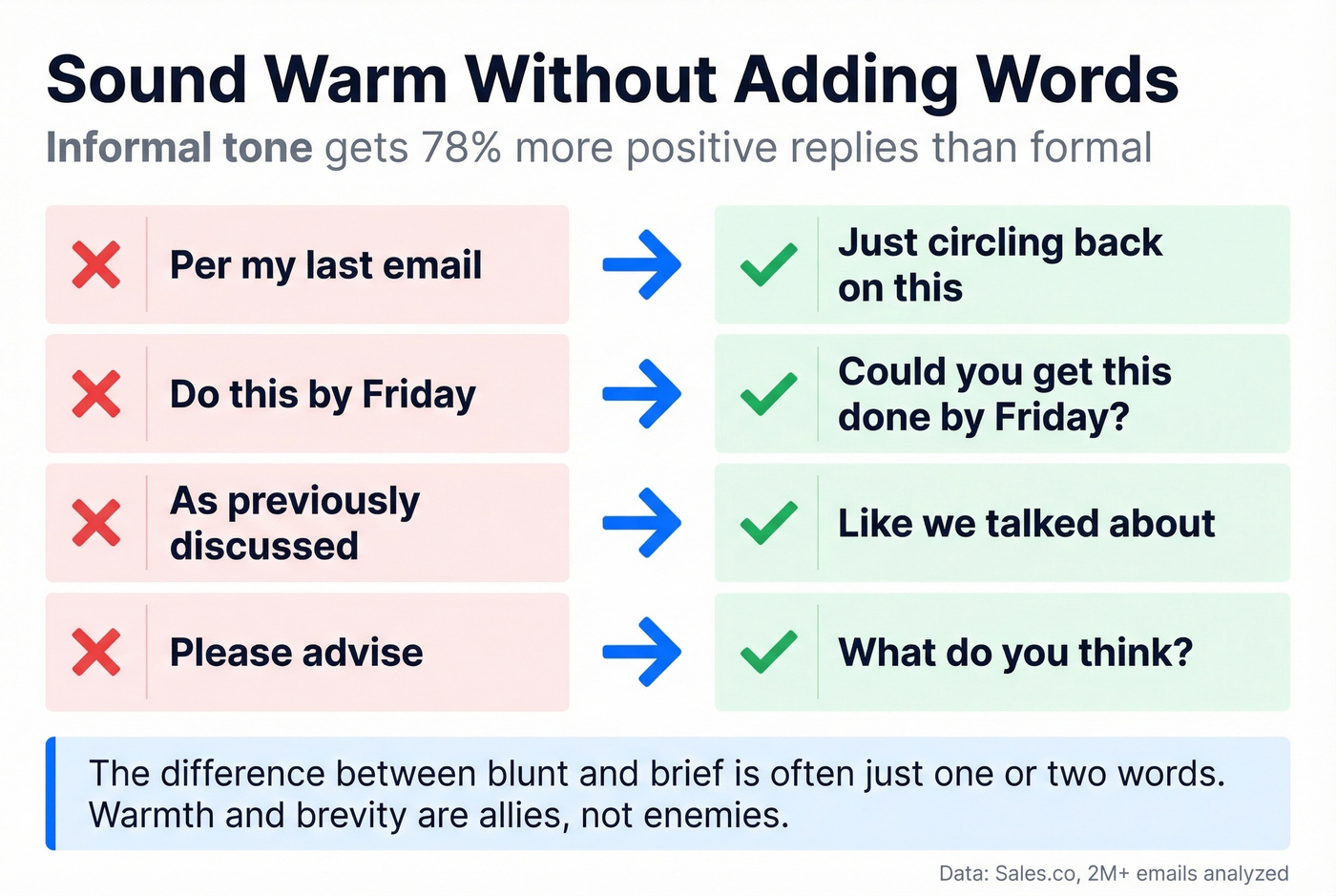
Concrete swaps that keep warmth without adding bulk:
- "Per my last email" → "Just circling back on this"
- "Do this by Friday" → "Could you get this done by Friday?"
- "As previously discussed" → "Like we talked about"
- "Please advise" → "What do you think?"
The Sales.co data backs this up: informal tone gets 78% more positive replies than formal. Warmth and brevity aren't at odds - they're allies. You don't need extra words to be human. You need the right words.
Your VP wants three bullets. Your peer wants a casual note. Match the format to the reader, and you'll never overthink tone again. In our experience, that audience-matching instinct matters more than raw word count.
Write for Mobile First
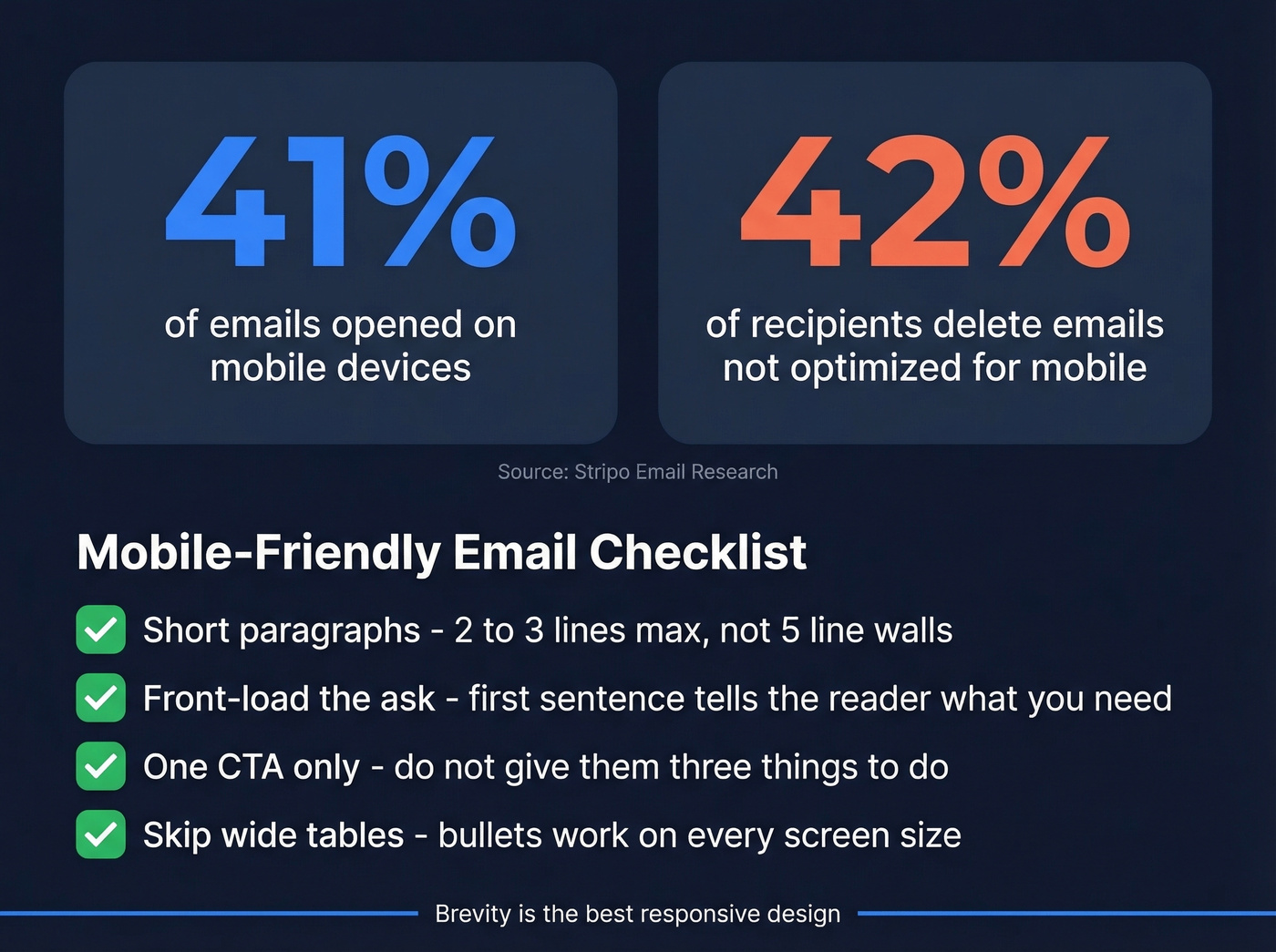
41% of emails are opened on mobile devices. About 42% of recipients delete emails that aren't optimized for mobile. That's nearly half your audience gone before they read a word.
Your email needs to survive a thumb-scroll on a 6-inch screen:
- Short paragraphs: 2-3 lines max. A five-line paragraph on desktop becomes a wall on mobile.
- Front-load the ask: First sentence tells the reader what you need.
- One CTA: Don't give them three things to do. Give them one. (If you need examples, see email call to action best practices.)
- Skip wide tables or complex formatting: They break on mobile clients. Bullets work everywhere.
I've seen teams cut their email response time in half just by front-loading the ask. If you keep messages brief and follow the five-sentence rule, you're already mobile-friendly by default. Brevity is the best responsive design.
Templates for 5 Common Scenarios
Cold Outreach
Hi {{first_name}} - noticed {{company}} just {{trigger event}}. We help similar teams {{one-line value prop}}.
Worth a 15-min call this week?
One trigger, one value prop, one question. No preamble. And before you hit send, verify the address - a bounced email has a 0% reply rate. Prospeo checks emails in real time with 98% accuracy, and the free tier covers 75 verifications per month.
Follow-Up Bump
Hi {{first_name}} - wanted to make sure my last note didn't get buried. Any thoughts on {{specific topic}}?
Two sentences. No guilt trip. Restates the topic so they don't have to scroll. If you want more options, steal from these follow-up templates.
Status Update
Hi {{name}} - quick update on {{project}}:
- {{milestone 1}}: done
- {{milestone 2}}: on track for {{date}}
- Blocker: {{one line or "none"}}
Bullets replace narrative. The reader gets status in three seconds.
Meeting Request
Hi {{name}} - I'd like to discuss {{topic}} (30 min). Does {{day}} at {{time}} work?
Context: {{one sentence on why}}.
A specific time beats "let me know your availability" every time. For more phrasing, see email wording to schedule a meeting.
Introduction
Hi {{name}} - {{mutual contact}} suggested I reach out. I run {{role/company}} and we {{one-line overlap}}.
Would love to connect - are you free for a quick call next week?
Name-drops the connection immediately, states relevance in one sentence, asks one question. You can also use this connection email framework.
Tools That Keep Emails Brief
Hemingway Editor - Free web version. Paste your draft before sending and it highlights complex sentences, passive voice, and unnecessary adverbs. It's the fastest way to trim 30% of your word count.
Grammarly - Free tier catches wordiness and suggests concise alternatives. The "conciseness" suggestions alone are worth installing. Paid plans start around $12/month.
Prospeo - Not a writing tool, but what you use after writing. It verifies the email address is real before you send. 143M+ verified emails, 7-day data refresh, and a free tier to start. A perfectly crafted three-sentence email means nothing if it bounces.
Let's be honest: most people obsess over email copy when their real problem is deliverability. If even 5% of your outreach bounces, your domain reputation takes a hit that no amount of clever writing can fix. Nail the data first, then worry about the words. (If you want the full checklist, start with this email deliverability guide and then monitor with email reputation tools.)
Short emails need the right recipient to work. Prospeo gives you 300M+ professional profiles with 30+ filters - buyer intent, job changes, technographics - so your three-sentence ask reaches the one person who can say yes.
Write less, reach more. Build your list in minutes for $0.01 per email.
FAQ
Is five sentences always enough?
For 90% of workplace emails, yes. If you can't fit the message in five sentences, the topic needs a shared doc, a call, or a 30-minute meeting. The email's job is to state the ask and provide just enough context to act - not to contain the entire discussion.
How short should a cold outreach email be?
Two to three sentences. Ultra-short emails match medium-length at ~8.8% positive reply rate, while long emails drop to 6.42%. Use an informal tone, include one clear question, and verify the address before sending.
Won't short emails seem rude?
Not if you choose the right words. "Could you send this by Friday?" is short and warm. "Send by Friday." is short and cold. The difference is a single word. 88% of workers say they've regretted an email right after hitting send - and the regret almost always comes from tone, not length. Informal language gets 78% more positive replies than formal.
What's the ideal word count for a professional email?
Under 200 words. Belkins' study of 16.5 million emails found that messages with 6-8 sentences - roughly 120-160 words - hit the highest reply rates. Front-load your ask, use bullets for details, and cut any sentence that doesn't move the reader toward action.