

HubSpot vs Yesware: Which Sales Tool Wins in 2026?
HubSpot and Yesware don't really compete head-to-head. One is a full CRM and revenue platform with sales engagement built in; the other is an inbox add-on that helps reps send, track, and follow up without living in a separate CRM tab all day.
So the real question isn't "which is better?" It's "what job are you hiring this tool to do?" Because if you buy the wrong one, you'll pay for features you won't use, or you'll duct-tape your way around missing basics for months.
Let's break it down.
The 30-second verdict: Pick HubSpot Sales Hub if you want CRM + pipeline + automation + reporting in one system. Pick Yesware if your team lives in Gmail or Outlook and needs tracking, templates, and simple campaigns fast. And if your real issue is bounces and bad emails, skip the tool debate and fix your data first (more on that below). If you’re building a broader stack, it can also help to compare other SDR tools before you commit.
What each tool actually does
HubSpot Sales Hub is CRM-first. You get deals, pipelines, tasks, forecasting, reporting, and automation that ties into the rest of HubSpot (Marketing Hub, Service Hub, Operations Hub). Yes, it connects to Gmail and Outlook. But the "center of gravity" is still HubSpot: that's where your workflows, reporting, and process live.
Yesware is inbox-first. It sits inside Gmail or Outlook and focuses on what reps do all day: send emails, reuse templates, track opens/clicks, and run multi-step campaigns without leaving the inbox. Vendasta acquired Yesware in 2022, and Yesware Premium later showed up in the Vendasta Marketplace with tighter ties to Vendasta's ecosystem.
One practical way to think about it: HubSpot is where you run the business. Yesware is where you run the day.
Pricing side-by-side (and what it really costs)
The cost curves aren't even close. HubSpot can be a bargain at the low end, then gets expensive the moment you need the features most outbound teams consider "table stakes." If you want a broader baseline for CRM costs, see these examples of a CRM.
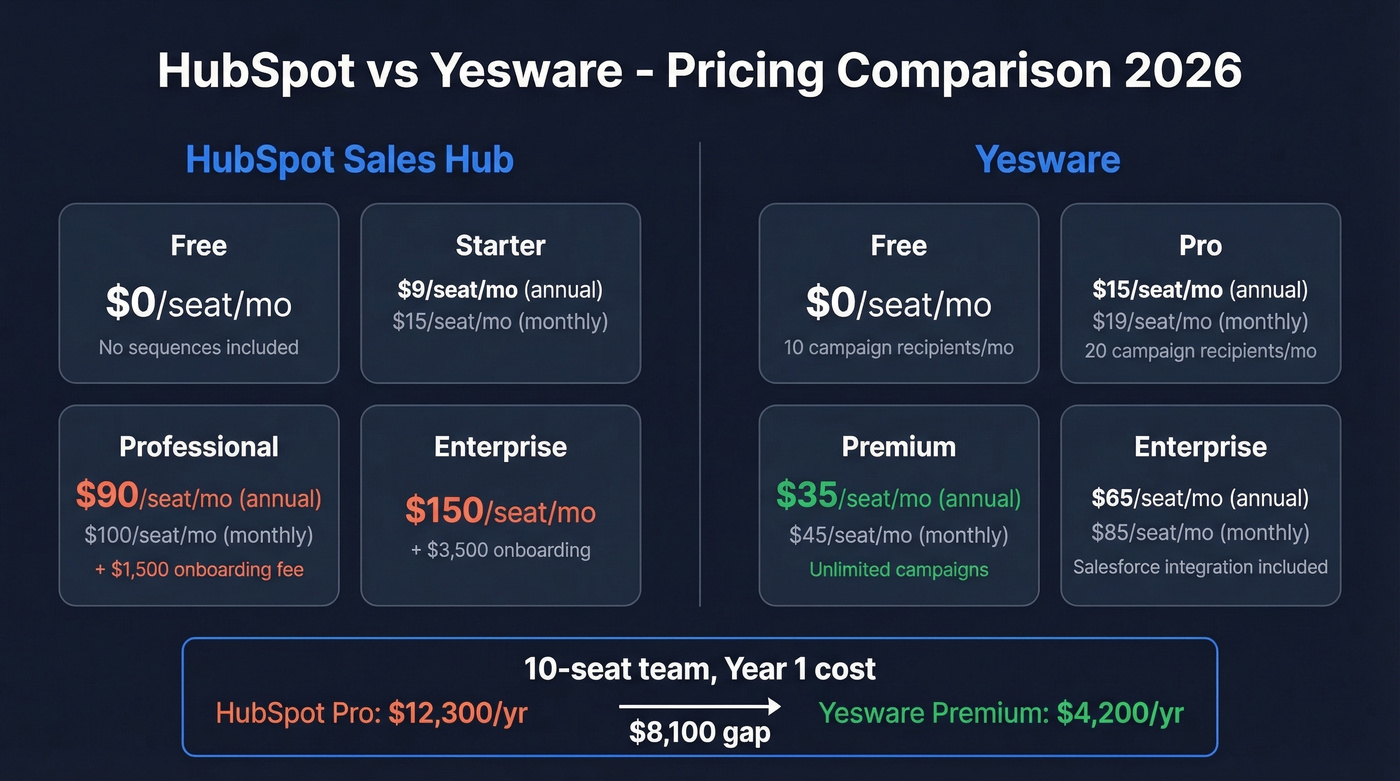
| HubSpot Sales Hub | Yesware | |
|---|---|---|
| Free | $0, no sequences | $0, 10 campaign recipients/month |
| Starter / Pro | Starter: $9/seat/mo (annual) or $15/seat/mo (monthly) | Pro: $15/seat/mo (annual) or $19/seat/mo (monthly), 20 campaign recipients/month |
| Professional / Premium | Pro: $90/seat/mo (annual) or $100/seat/mo (monthly) + $1,500 onboarding | Premium: $35/seat/mo (annual) or $45/seat/mo (monthly), unlimited campaign recipients |
| Enterprise | $150/seat/mo + $3,500 onboarding | Enterprise: $65/seat/mo (annual) or $85/seat/mo (monthly), Salesforce integration included |
Here's the number that tends to end the debate in finance reviews:
A 10-seat team on HubSpot Sales Hub Professional pays $12,300 in year one on annual billing ($90 x 10 x 12 + $1,500 onboarding). The same 10 seats on Yesware Premium cost $4,200/year ($35 x 10 x 12). That's an $8,100 gap before you even talk about whether you needed a CRM in the first place.
HubSpot does give you a way to control spend with its seat types (Sales Seats vs Core Seats on Pro/Enterprise). In our experience, that helps once you have a real RevOps owner who'll police access and keep the portal clean. Without that, costs creep fast.
Yesware's pricing is simpler, but there's one annoying catch: Salesforce integration sits behind the Enterprise tier. If Salesforce is non-negotiable, that gate matters.
Feature breakdown (what matters in real life)
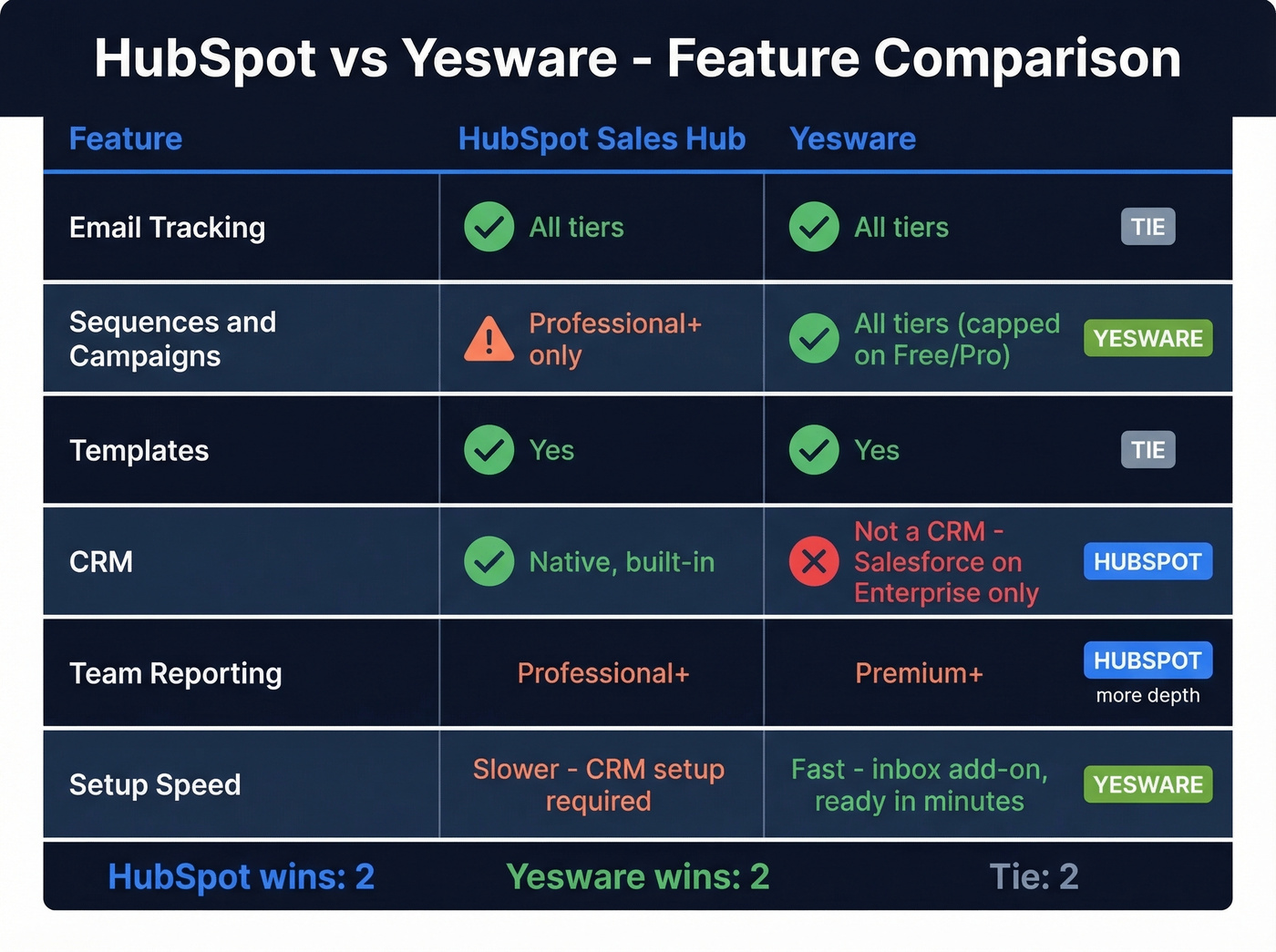
| Capability | HubSpot Sales Hub | Yesware | Winner |
|---|---|---|---|
| Email tracking | All tiers | All tiers | Tie |
| Sequences/campaigns | Professional+ | All tiers (capped on Free/Pro) | Yesware |
| Templates | Yes | Yes | Tie |
| CRM | Native, built-in | Not a CRM; Salesforce integration is Enterprise-only | HubSpot |
| Team reporting | Professional+ | Premium+ | HubSpot |
| Setup speed | Slower (CRM setup) | Fast (inbox add-on) | Yesware |
Both tools sit around 4.4/5 on G2, but they feel different in day-to-day use. HubSpot has far more reviews, and it shows in how mature the ecosystem is: more integrations, more admin controls, more "grown-up" reporting once you configure it properly.
Yesware wins on time-to-value. Install it, connect your inbox, and reps are off to the races. That's also why it can be a better fit for founder-led sales or small teams that don't want a CRM project.
Our take: if your average deal is under $10k and you're not running a real pipeline process, HubSpot Pro is often overkill. Yesware Premium gets you most of what reps actually touch every day for a lot less money. But if you need forecasting, lifecycle stages, automation, and clean reporting across a team, HubSpot starts paying for itself quickly. If forecasting is a core requirement, compare dedicated sales forecasting solutions too.

You're comparing engagement tools, but engagement tools don't fix bad data. Prospeo feeds HubSpot and Yesware with 98% accurate emails from 300M+ verified profiles - refreshed every 7 days, not every 6 weeks.
Stop blaming the tool when the list is the problem.
The stuff that bites after you commit
This is the part people don't put in comparison tables.
Yesware: tracking noise and campaign limits
Yesware's tracking can get noisy. Email opens aren't "truth" anymore: security scanners and firewalls can trigger tracking pixels, and suddenly your reps are chasing "hot" leads that never read the email. Real talk: this drives teams nuts because it feels like the tool's lying, even though it's the modern email environment that's broken. If you want to go deeper on how this works, see our guide to email tracking pixels.
There are also campaign limits worth checking against your volume. If you're the kind of team that uploads big lists and runs large blasts, make sure the caps match your workflow before you roll it out to everyone.
HubSpot: the free tier isn't the product most teams need
HubSpot's free tier is fine for basic CRM contact management. It's not what outbound teams think they're signing up for. No sequences, limited automation, and reporting that won't hold up once leadership asks, "What's working and why?"
We've tested this pattern with teams that start on Starter to "keep it lean," then hit a wall: they want sequences, they want better reporting, and they want automation that doesn't require three workarounds. Six months later, they're in a budget meeting explaining why the bill is about to jump 10x.
On the flip side, once HubSpot is configured well, it's hard to beat as a single system of record. It's just not cheap to get there.
The missing piece: contact data (the part both tools assume away)
Neither HubSpot nor Yesware solves the upstream problem: finding and verifying contacts. They assume your list is clean. If you’re evaluating vendors for this layer, start with these data enrichment services.
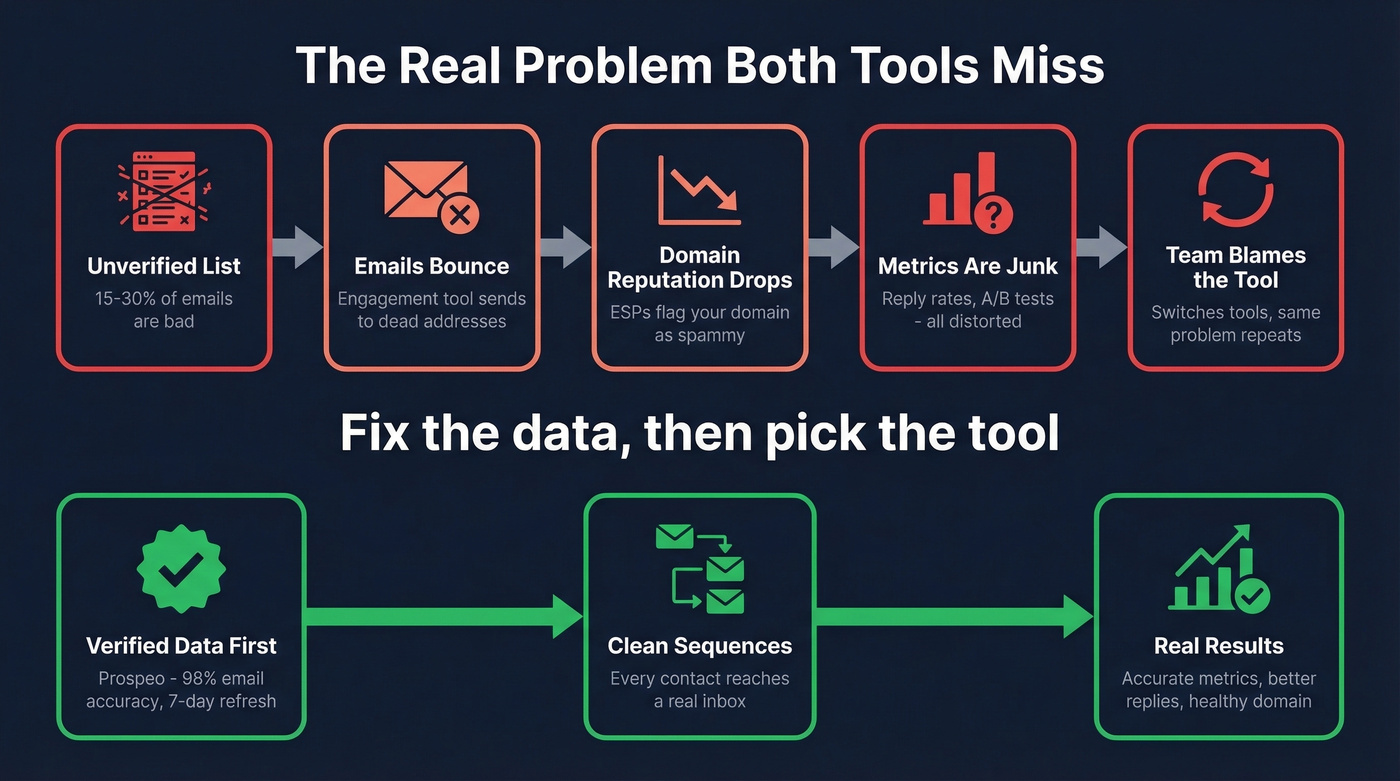
If 15-30% of your emails bounce on the first sequence, everything downstream gets distorted. Your reply rates look worse than they are, your domain reputation takes a hit, and your "A/B test" results are basically junk because half the sample never reached an inbox. (More benchmarks + fixes here: email bounce rate.)
This is where tools like Prospeo earn their keep. Prospeo gives you 300M+ professional profiles, 143M+ verified emails, and 125M+ verified mobile numbers, with 98% email accuracy and a 7-day data refresh cycle. It also integrates natively with HubSpot, so verified contacts can flow into your CRM before you ever enroll someone in a sequence.
A quick scenario we see a lot: a 5-rep team runs outbound from a scraped list, gets hammered with bounces, then blames the engagement tool. They switch from Tool A to Tool B, nothing improves, and now they're paying for migration pain on top of the original problem. Fix the data first, then pick the engagement layer.
Prospeo's free tier includes 75 verified emails per month, which is enough to run a clean test and see whether data quality is your bottleneck.
For deliverability basics and why bounces hurt more than people think, these are worth a read:
- https://support.google.com/a/answer/81126 (Google Workspace: email spoofing and authentication basics)
- https://learn.microsoft.com/en-us/microsoft-365/security/office-365-security/email-authentication-about (Microsoft: SPF/DKIM/DMARC overview)
- https://www.cloudflare.com/learning/email-security/dmarc-dkim-spf/ (Cloudflare: plain-English DMARC/DKIM/SPF)

That $8,100 gap between HubSpot Pro and Yesware Premium? It means nothing if 15-30% of your emails bounce. Prospeo integrates natively with HubSpot so every contact entering a sequence is verified - at roughly $0.01 per email.
Clean data costs less than one bad campaign.
Pick based on your team (not the feature list)
Choose HubSpot Sales Hub if...
You're already on HubSpot CRM, or you want a real system of record with pipeline management and reporting. HubSpot shines when you need consistency: lifecycle stages, deal hygiene, forecasting, and automation that doesn't fall apart the moment you add a second team. If you’re still deciding what “system of record” you actually need, start with contact management software.
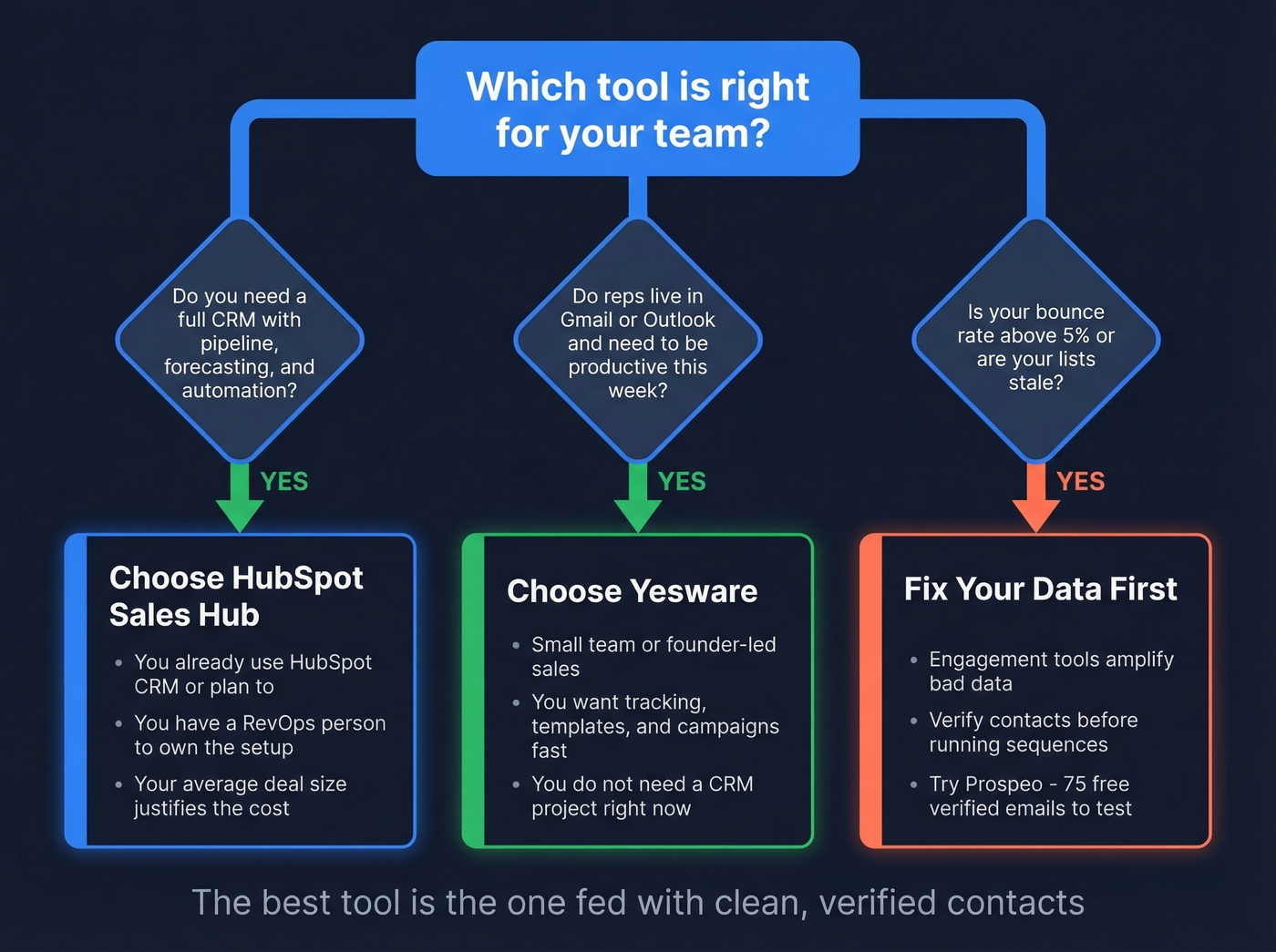
One more thing: if your org has even a light RevOps function, HubSpot gets easier to justify. Someone needs to own the setup, permissions, and reporting, or you'll end up with a messy portal and a lot of "why is this number different?" meetings.
Choose Yesware if...
Your reps live in Gmail or Outlook and you want them productive this week, not next quarter. Yesware Premium is usually the sweet spot for small teams: unlimited campaign recipients, shared templates, and team reporting without turning your rollout into a CRM implementation.
If you're a Salesforce shop, don't gloss over the integration tiering. That detail decides the whole purchase for some teams.
Skip both (for now) if...
Your bounce rate is ugly, your lists are stale, or you're constantly guessing whether an email is valid. Fix that first. Engagement tools amplify whatever you feed them, and garbage in still means garbage out. If you need a practical playbook, start with our email deliverability guide.
If you want a sanity check, the consensus in a lot of r/sales threads is basically: tracking features are nice, but clean lists and deliverability basics move the needle more than another template library.
Alternatives (quick hits)
- Mixmax: solid inbox-native option in the ~$29-49/user/mo range, good for teams that want scheduling + sequences without a full CRM. (More options here: Mixmax alternatives.)
- Apollo.io: database + basic sequencing bundled together, often used as an all-in-one starter stack.
- Outreach: enterprise-grade engagement for teams that have the budget and the process maturity to use it well.
FAQ
Is Yesware still standalone after the Vendasta acquisition?
Yes. It's still usable as a standalone inbox tool, but the product direction is clearly tied to Vendasta's ecosystem. If you're betting on long-term roadmap velocity, keep an eye on how much innovation lands outside the Vendasta context.
Can I use HubSpot Sales Hub for free?
You can use HubSpot's free CRM, but most outbound teams outgrow it quickly. The features people usually mean by "sales engagement" (sequences, stronger automation, deeper reporting) start at Professional, which is where the pricing jump happens.
What if my emails keep bouncing in either tool?
That's almost always a data problem, not an engagement-tool problem. Verify your list upstream, then run sequences. Prospeo's free tier gives you 75 verified emails per month, and the HubSpot integration makes it easy to push clean contacts straight into your CRM.
Which tool is better for small teams under 5 reps?
For under 5 reps, Yesware Premium is usually the cleanest value: fast setup, inbox-native workflow, and predictable pricing. HubSpot can still make sense if you need a real CRM process and reporting, but it's harder to justify if all you want is campaigns and tracking.