

"I Am Writing to Follow Up On" - Is It Correct? (+ Better Alternatives)
You sent a proposal three days ago. Radio silence. You open a new draft, type "i am writing you to follow up on..." and freeze. Something feels off. Meanwhile, the deal is cooling. Let's fix the grammar, give you sharper alternatives, and nail the timing so your follow-up actually gets a reply.
The Short Answer
- Grammar fix: "I am writing to you to follow up on" or "I'm writing to follow up on" - in business email, skip the "writing you" construction.
- The one phrase that works everywhere: "Wanted to circle back on [specific thing] - does [specific next step] work?"
- Timing rule: A 3-7-7 cadence captures 93% of replies that will ever come by Day 10.
Is This Phrase Grammatically Correct?
In professional email, "I'm writing you" reads nonstandard. Standard business English uses "I'm writing to you to follow up on" or, more cleanly, "I'm writing to follow up on." You'll also encounter the variation "I am writing this email to follow up" - grammatically fine, but wordier than it needs to be.
There's a semantic distinction worth knowing. "I'm writing to follow up on..." signals the entire purpose of your email is the follow-up. "I'm following up on..." is more general - you could be following up by phone, in person, or any channel.
You'll also see a style difference across regions: British business writing tends to be more indirect (more "would/could/might"), while American business writing tends to be more direct.
The real problem isn't grammar. It's that the phrase sounds formulaic. Whether you type "I am writing to follow up on my previous email" or any close variant, prospects have read it thousands of times. You can do better.
Better Alternatives by Formality
If you had to pick one phrase for every situation, go with: "Wanted to follow up on [specific thing] - [specific ask]." Warm without being sloppy, direct without being pushy.
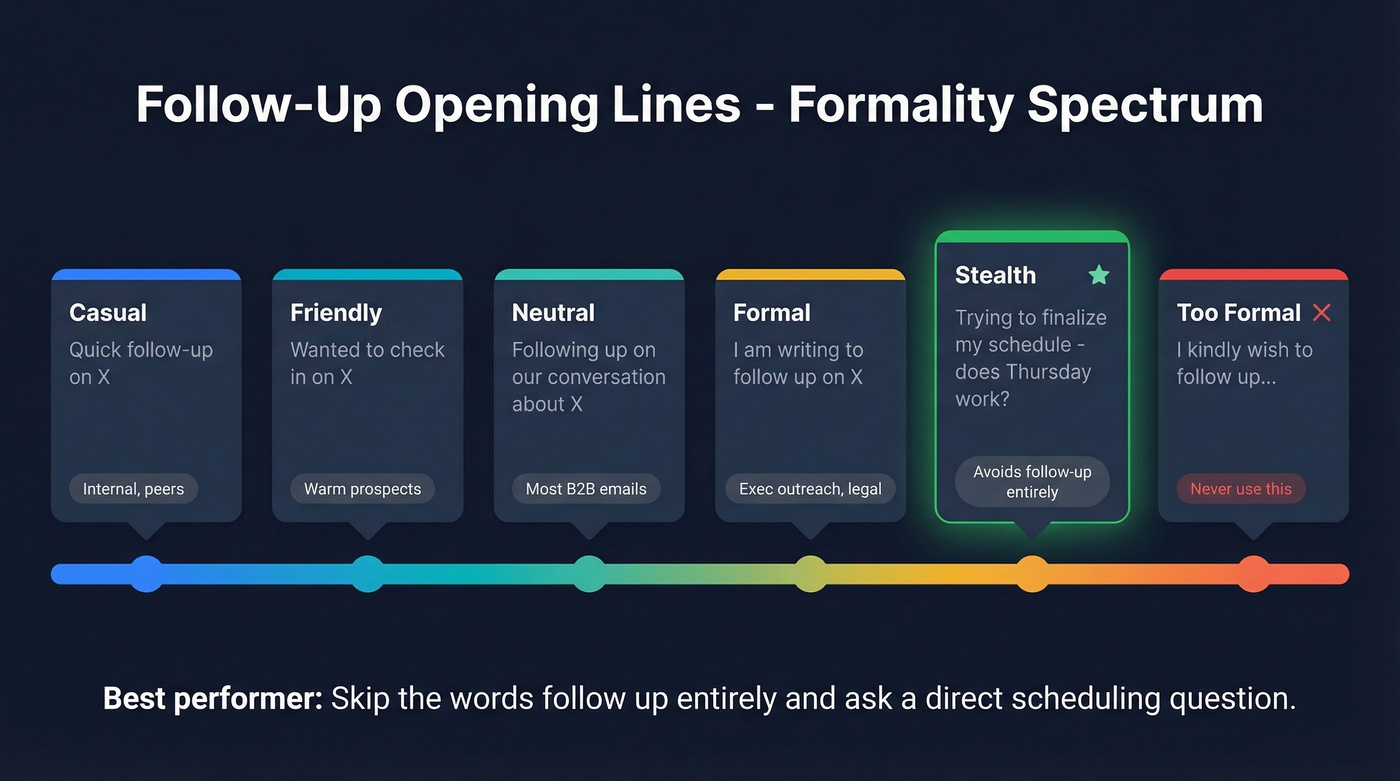
| Formality | Opening Line | When to Use |
|---|---|---|
| Casual | "Quick follow-up on X" | Internal, peers |
| Friendly | "Wanted to check in on X" | Warm prospects |
| Neutral | "Following up on our conversation about X" | Most B2B emails |
| Formal | "I'm writing to follow up on X" | Exec outreach, legal |
| Stealth | "Trying to finalize my schedule - does Thursday work?" | Avoid "follow-up" entirely |
| Too formal | "I kindly wish to follow up..." | Never - skip this |
"Kindly" in follow-ups reads as condescending in most English-speaking business cultures, even when you don't intend it. Same goes for "just checking in" - it can come off impatient or passive-aggressive. Drop both.
The best alternative doesn't mention "following up" at all. One approach from r/sales that I've seen outperform every standard variant: "I'm trying to finalize my schedule for next week - does Thursday at 2 PM work for you?" A direct question about someone's calendar almost never gets ignored.

A perfectly crafted follow-up that bounces is worse than no email at all. Prospeo verifies emails at 98% accuracy with a 5-step process that catches spam traps, honeypots, and catch-all domains - so your follow-up actually lands.
Stop writing follow-ups to dead inboxes. Verify first.
Follow-Up Templates by Scenario
Every template below follows the same structure: context reminder, new value, specific CTA. No "just checking in" - that's a naked bump with zero value.
Job Application (1-2 Weeks After Submitting)
Hi [Name], I applied for the [Role] on [date] and wanted to reiterate my interest. My experience in [specific skill] maps directly to [something from the JD]. Could we schedule a brief call this week?
Sales / Proposal Follow-Up (2-3 Days After Sending)
Hi [Name], following up on the proposal from [date]. One thing I didn't cover - [new insight or data point]. Worth 15 minutes on [specific day] to walk through pricing together?
No-Response Nudge (5-7 Days After Last Email)
Quick question - are you still looking to [solve specific problem]? If timing's off, happy to revisit in Q[X]. Just let me know either way.
For interviews and meetings, the 24-48 hour rule applies. Send your follow-up within that window while the conversation is fresh. A simple "this email is to follow up on our conversation yesterday" works when paired with a specific next step.
If you want more plug-and-play options, start with these sales follow-up templates.
When to Send Your Follow-Up
A single follow-up increases response rates by 49% on average (as attributed there to Belkins). And 55% of all cold email replies come from follow-ups, not the initial send.
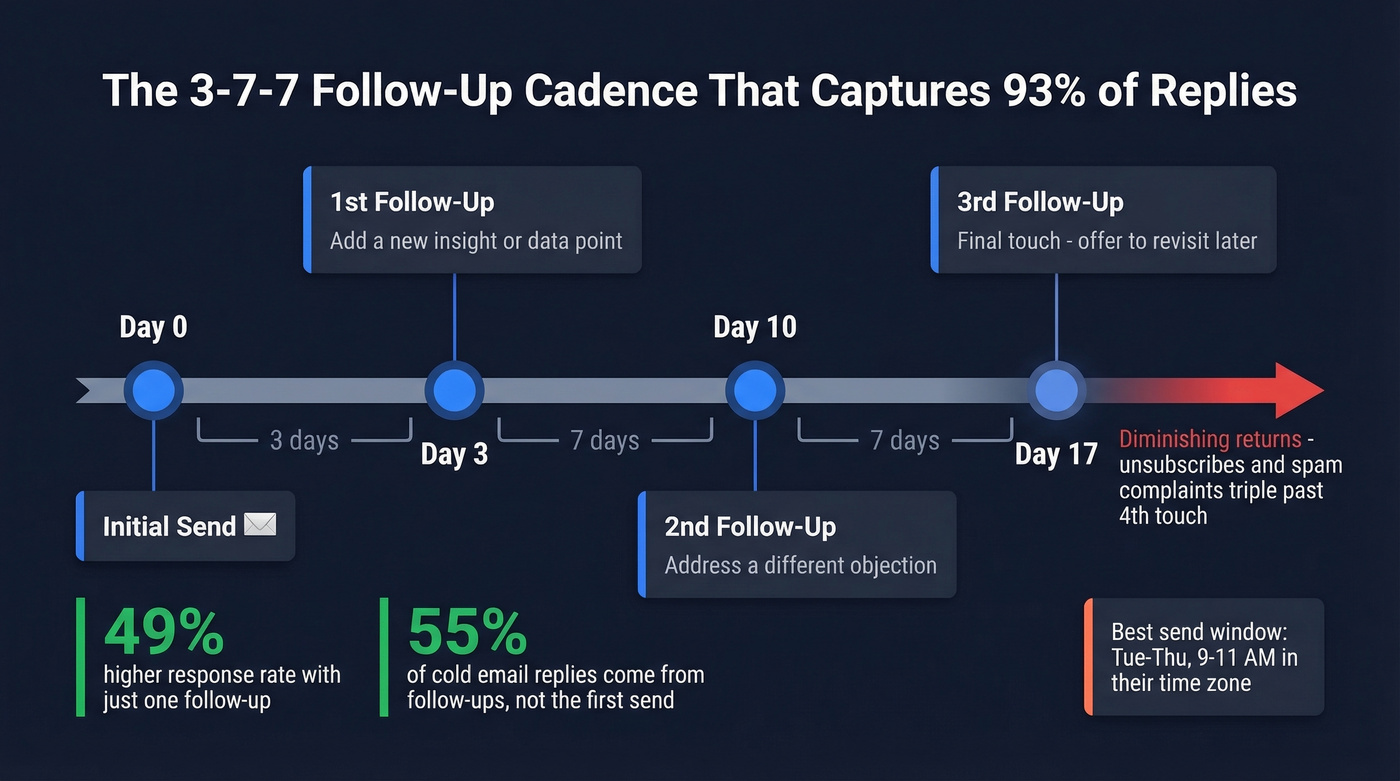
The cadence that captures the most replies: Day 0 (initial send), Day 3 (first follow-up), Day 10 (second), Day 17 (third). That 3-7-7 spacing captures 93% of replies that will ever come by Day 10. After that, diminishing returns.
Tuesday through Thursday, 9-11 AM in the recipient's time zone, consistently outperforms other slots. Avoid Mondays (inbox triage) and Fridays (mentally checked out). For a deeper breakdown, see the best time to send cold emails.
Hot take: Don't use static spacing like "every 3 days." It looks automated and it feels automated. Graduated spacing (2, 4, 7, 14 days) reads more human and avoids triggering spam filters. Also, use timeline-based hooks in your subject lines. They pull a 10.01% reply rate vs 4.39% for problem-based hooks - a 2.3× gap. And if you can segment your sends into cohorts of 50 contacts or fewer, expect reply rates to jump by 2.76×.
If you’re building a full sequence, this B2B cold email sequence guide will help you structure it.
Mistakes That Kill Your Follow-Up
Do this:
- Add new information in every follow-up - a case study, a stat, a different angle
- Keep it plain text, short, and sent as a reply in the original thread
- Address a different objection each time (no need, no urgency, no trust, no budget)
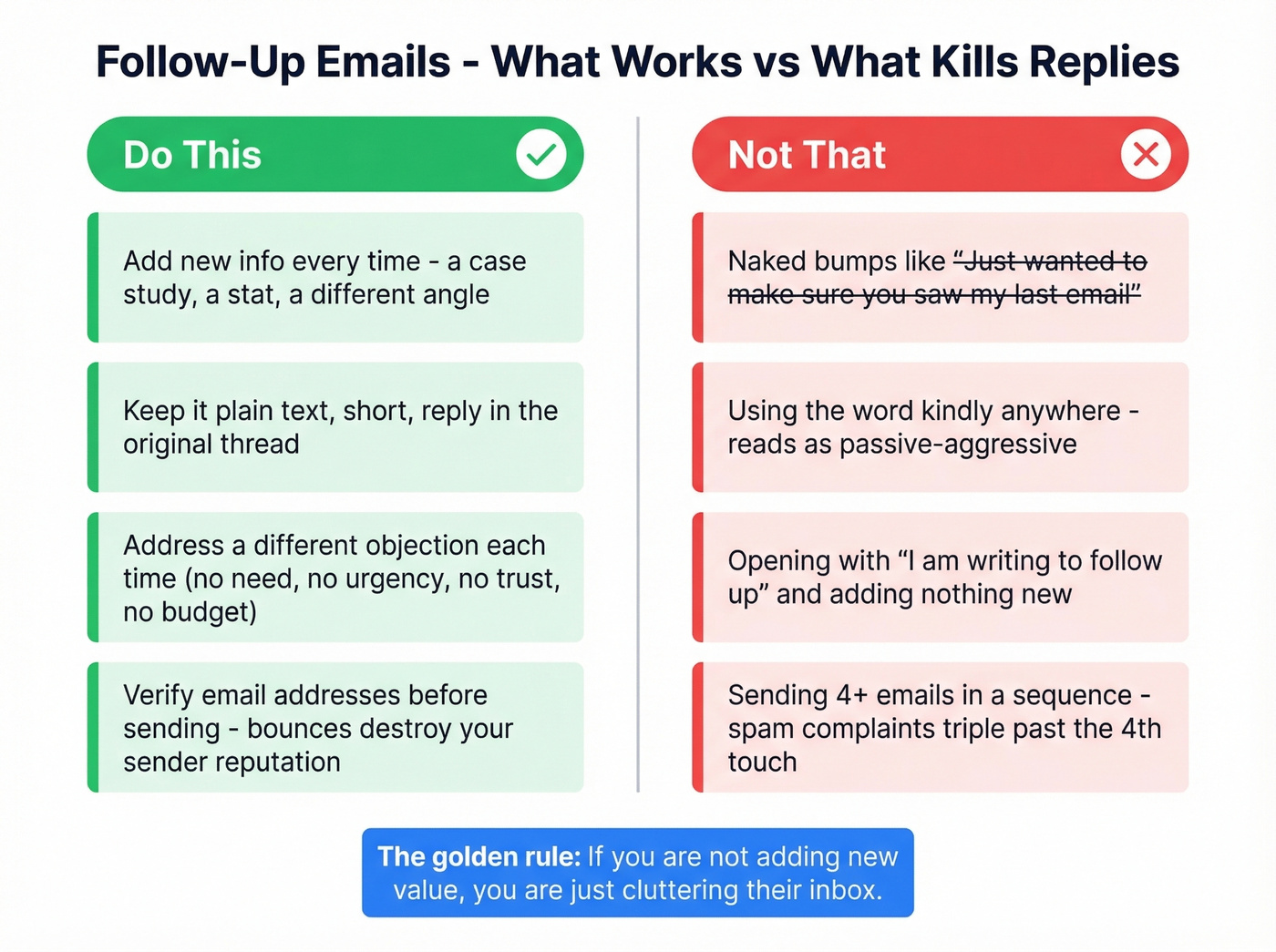
Not that:
- Naked bumps ("Just wanted to make sure you saw my last email") - these train recipients to ignore you
- Using "kindly" anywhere - passive-aggressive regardless of intent
- Opening with "I'm writing to follow up on my previous email" and nothing else - if you're not adding new value, you're just cluttering their inbox
- Sending 4+ emails in a sequence - a Belkins study of 16.5M cold emails (2024 data) found unsubscribes and spam complaints more than triple past the fourth touch
- Blasting follow-ups to unverified addresses - a perfectly crafted follow-up that bounces is worse than no email at all. Run your list through Prospeo's email verifier before you hit send
If you’re getting bounces, start by checking your email bounce rate and tightening your email deliverability.
Quick-Reference Cheat Sheet
| Scenario | Timing | Subject Line | Opening |
|---|---|---|---|
| Job application | 1-2 weeks | [Name] - [Role], [Company] | "Applied on [date]..." |
| Sales proposal | 2-3 days | Re: [original thread] | "Following up - one thing I missed..." |
| Meeting recap | 24-48 hrs | Re: [meeting topic] | "Great speaking today - here's..." |
| Cold no-response | Day 3 → Day 10 | Re: [original thread] | "Quick question - still looking to..." |
The pattern across every row: be specific, add value, ask a direct question. "Just following up" is never the answer - and neither is writing to follow up with nothing else behind it. Lead with the reason they should care, then make the ask easy to answer.
If you need better hooks, pull from these email subject line examples and refine your email copywriting.
Before you send that follow-up, make sure you're reaching the right person. Prospeo gives you verified emails and direct dials for 300M+ professionals - refreshed every 7 days, not 6 weeks. At $0.01 per email, bad data is no longer an excuse for silence.
Find the real email. Send the follow-up that actually connects.