

Your ICP Is a Slide Deck. Here's How to Make It an ABM System.
A marketing team we worked with launched an ABM program last year. Sales only worked half the target accounts - 50% of the budget, gone. Not because the strategy was wrong, but because the ICP was a PowerPoint slide nobody operationalized. Companies with a strong ICP-driven ABM strategy achieve 68% higher account win rates, and 91% of ABM teams report larger deal sizes than non-ABM programs. The gap between having an ideal customer profile and actually running it as an account-based system is where programs die.
Here's our hot take: most teams don't need a better ABM platform. They need a sharper ICP and cleaner data. A $200/month stack with disciplined execution will outperform a $30-100K+/year Demandbase contract built on a vague profile every single time.
Why ICP Precision Matters More in 2026
The 6sense Buyer Experience Report found that 95% of the time, the winning vendor is already on the Day One shortlist. First contact now happens at 61% of the buyer journey - about six weeks earlier than the year before. Show up at the 70% mark with a generic pitch and you've already lost.
That shrinking window changes the math on everything. You can't afford to spray budget across 5,000 accounts and hope the right ones notice. Precision isn't a nice-to-have anymore - it's the only way the economics work.
Build Your ICP From Data, Not Workshops
Export your last 50 closed-won deals. Look at industry, headcount, tech stack, deal cycle length, and the problem they hired you to solve. That's your ideal customer profile - not the whiteboard brainstorm from your offsite.
Firmographics alone will mislead you, though. One corporate learning platform had identical firmographic profiles across their wins, but deeper analysis revealed three distinct challenge clusters - M&A-driven onboarding, leadership churn, and aging leadership facing market disruption. Same company size, same industry, three completely different buying motivations. If you're not clustering by the problem your buyer is solving, you're targeting a lottery ticket.
Treat your ICP as a living document. Validate quarterly by correlating each dimension against closed-won and closed-lost data, then adjust weights accordingly.
The Scoring Model You Can Copy Today
You need a weighted scoring model that routes accounts to the right motion. We've tested variations of this across multiple programs, and this structure consistently holds up:
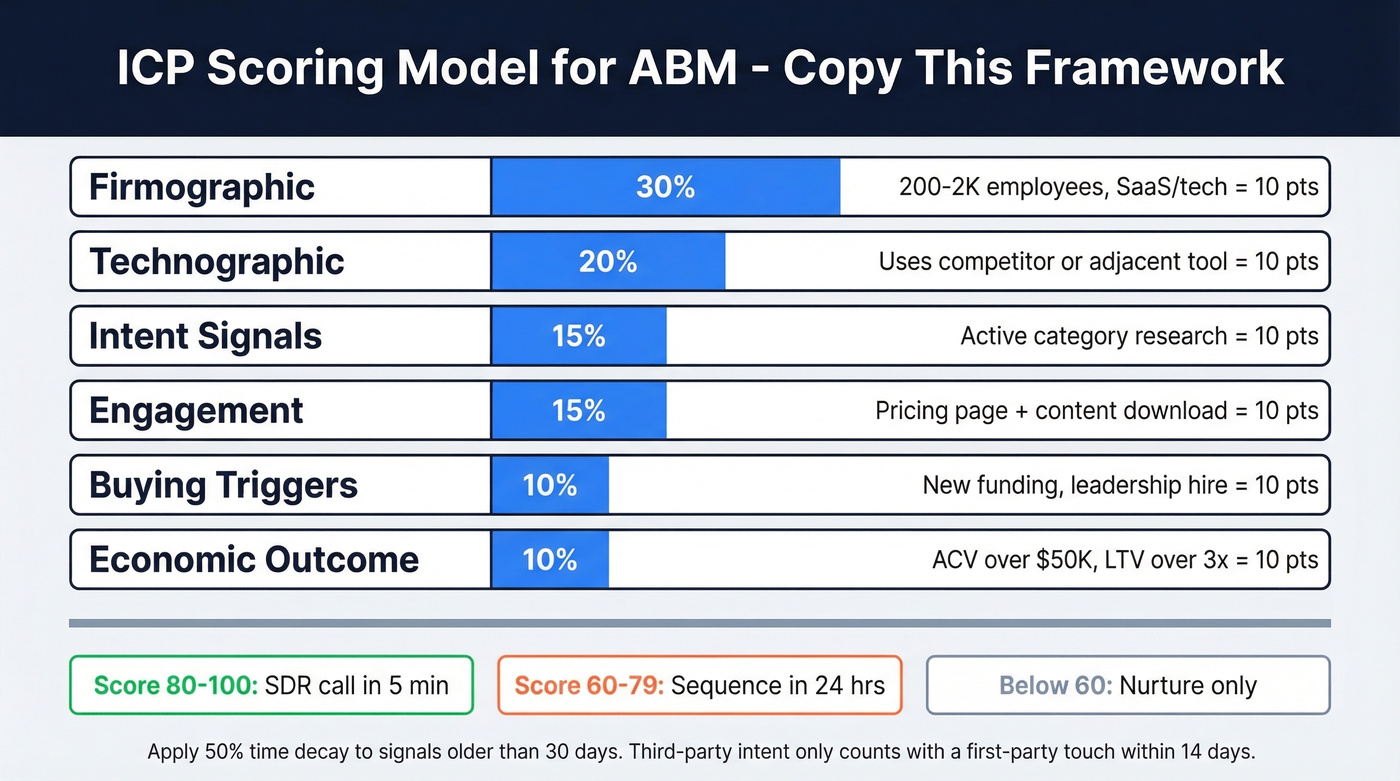
| Dimension | Weight | Ideal (10 pts) | Acceptable (5 pts) | Low Fit (1 pt) |
|---|---|---|---|---|
| Firmographic | 30% | 200-2K employees, SaaS/tech | 50-200 or adjacent vertical | <50 or mismatched |
| Technographic | 20% | Uses competitor/adjacent tool | Adjacent category | No stack signals |
| Intent | 15% | Active category research | Researching adjacent topics | No intent signals |
| Engagement | 15% | Pricing page + content download | Webinar attendance | Newsletter open only |
| Buying Triggers | 10% | New funding, leadership hire | Job postings in your area | No triggers |
| Economic Outcome | 10% | ACV >$50K, LTV >3x | ACV $20-50K | ACV <$20K |
Score each account 0-100 using the sum of weight times value across all dimensions. Apply time decay: any signal older than 30 days loses 50% of its value. Third-party intent only counts if there's at least one first-party touch within 14 days - otherwise it's noise.
Route based on score. 80-100 gets an SDR call within 5 minutes. 60-79 enters a sequence within 24 hours. Below 60, nurture.
If you want to go deeper on scoring logic, borrow a proven lead scoring framework and adapt it to accounts.

Your scoring model just routed a Tier 1 account to an SDR for a 5-minute call. But the email bounces and the mobile is disconnected. Prospeo fills every buying committee gap with 98% verified emails and 125M+ direct dials - refreshed every 7 days, not every 6 weeks.
Don't let stale data kill your highest-scoring accounts.
Define Your ABM Tiers
| Tier | Volume | Motion | Budget Heuristic |
|---|---|---|---|
| Tier 1 (1:1) | 10-20 | Full account plans, custom content | ~5% of ACV ($300K+ deals) |
| Tier 2 (1:few) | 50-100 | Segment playbooks, semi-personalized | ~3% of ACV ($150K-$300K) |
| Tier 3 (1:many) | 100-200+ | Scalable campaigns, programmatic ads | ~1% of ACV ($50K-$150K) |
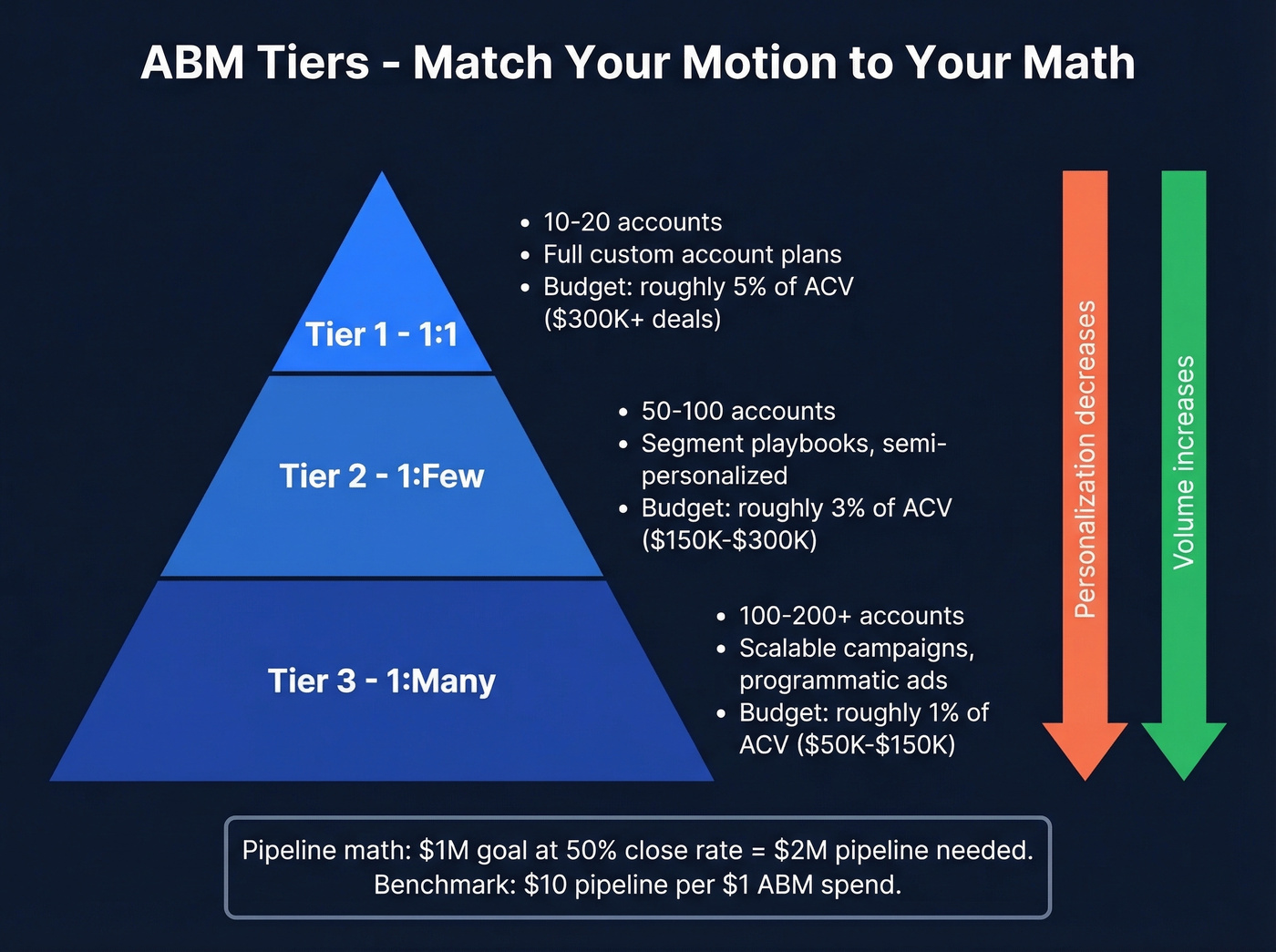
Size your Target Account List with pipeline math. If your goal is $1M closed-won and your close rate is 50%, you need $2M in pipeline. Divide by your average opportunity rate to get the number of accounts you need in play. For reference, Userpilot targets $10 in pipeline per $1 of ABM spend - use that as a benchmark.
Your total addressable market sets the ceiling, but your ICP narrows it to the accounts worth pursuing. Work backward from revenue, not forward from a wish list. (If you need a clean definition, start with addressable market basics.)
Map the Buying Committee
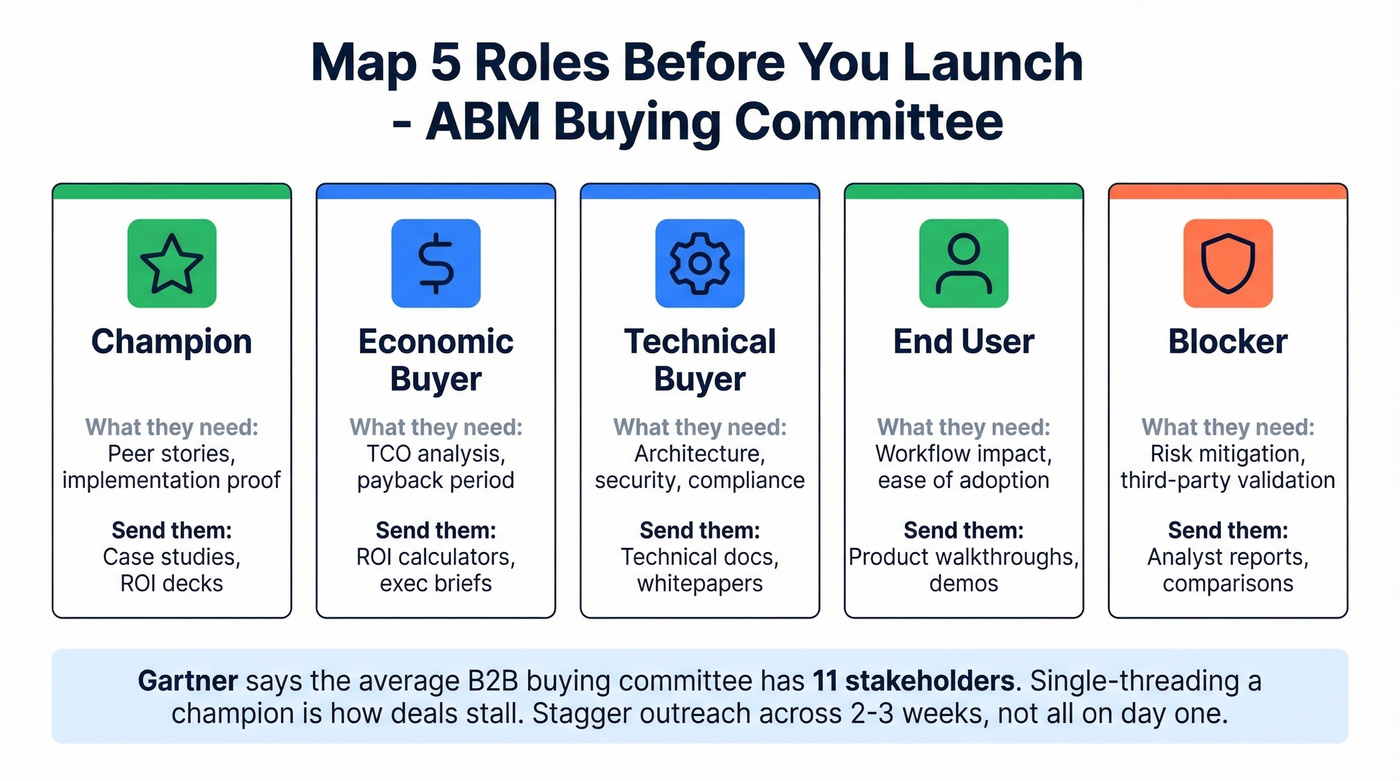
Gartner puts the average B2B buying committee at 11 stakeholders. Single-threading a champion is how deals stall. Map at least five roles before you launch:
| Role | What They Need | Content Format |
|---|---|---|
| Champion | Peer stories, implementation guides | Case studies, ROI decks |
| Economic Buyer | TCO analysis, payback period | ROI calculators, exec briefs |
| Technical Buyer | Architecture, security, compliance | Technical docs, whitepapers |
| End User | Workflow impact, ease of adoption | Product walkthroughs, demos |
| Blocker | Risk mitigation, third-party validation | Analyst reports, comparisons |
Stagger outreach across the committee over 2-3 weeks. Don't blast everyone on day one - it looks coordinated in the worst way. Measure account-level breadth, not individual response rates.
Before your first touch, fill contact gaps. Prospeo lets you paste a URL or upload a CSV to enrich buying committee records with verified emails and mobile numbers, pulling from 300M+ profiles with a 7-day refresh cycle.
Your ICP Is Only as Good as Your Data
Look, this is where most programs quietly fall apart. One Inverta analysis found that HQ location - a core ICP field - was only populated in 55% of their database, and the values that existed weren't standardized. B2B contact data decays fast as people change jobs, companies merge, and titles shift. Your perfect scoring model is worthless if half the fields are empty or stale.
If you're evaluating vendors, start with a shortlist of data enrichment services and compare refresh cadence + verification methodology.
We've seen this play out firsthand. When Snyk rolled out Prospeo across 50 AEs, their bounce rate dropped from 35-40% to under 5% and AE-sourced pipeline jumped 180%. That's what 98% email accuracy and a weekly data refresh does to an ABM program - it turns a scoring model into actual pipeline instead of a spreadsheet exercise.

Snyk's 50 AEs cut bounce rates from 35% to under 5% and grew AE-sourced pipeline 180% - because every contact in their ABM tiers had verified data behind it. Prospeo gives you 30+ filters including intent, technographics, and headcount growth to operationalize your ICP at $0.01 per email.
Turn your ICP slide deck into pipeline that closes.
Mistakes That Kill ABM Programs
Five patterns we see repeatedly:
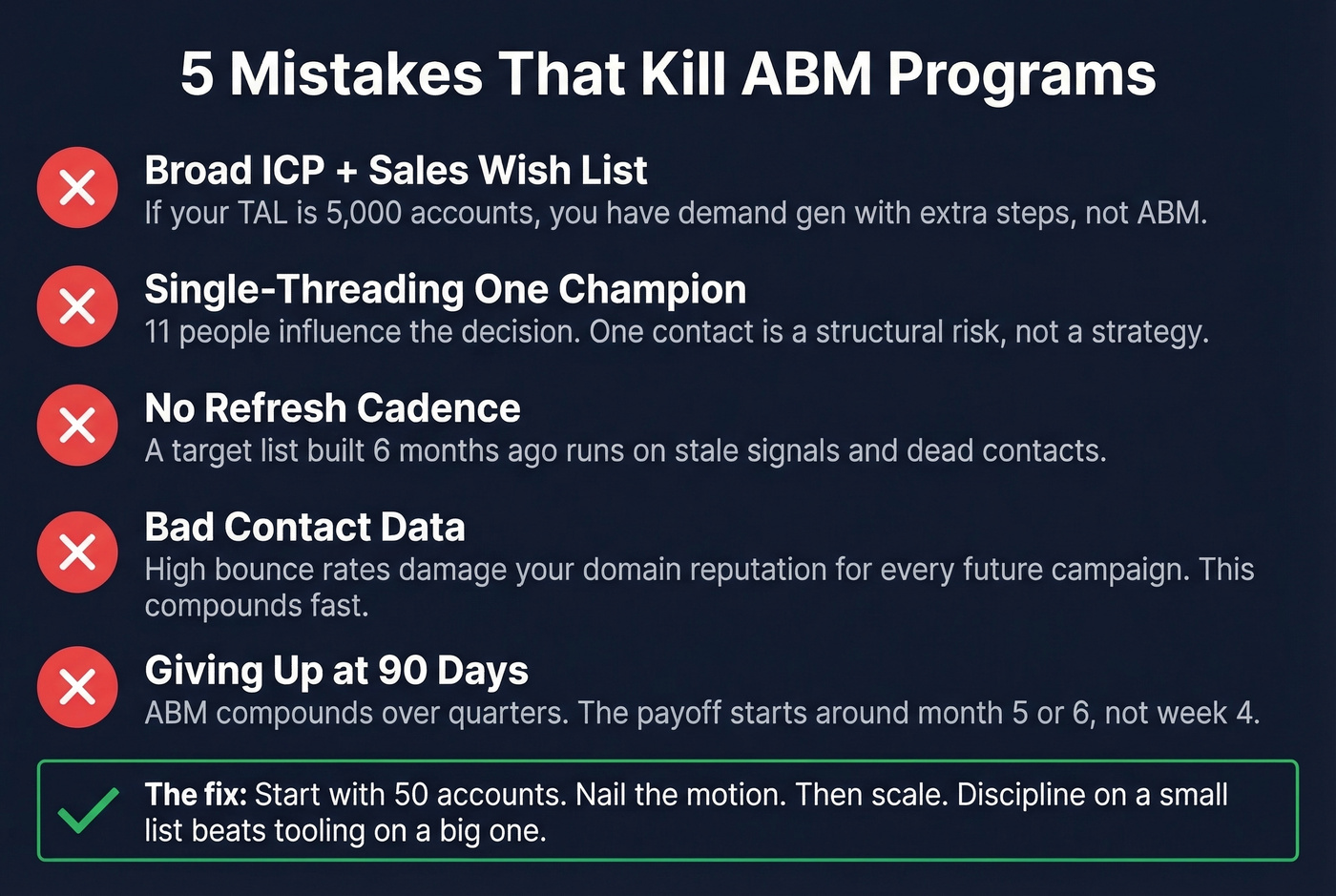
- Broad ICP + sales wish list. If your TAL is 5,000 accounts, you don't have ABM. You have demand gen with extra steps.
- Single-threading. One champion when 11 people influence the decision is a structural risk, not a strategy.
- No refresh cadence. A TAL built six months ago without re-scoring runs on stale signals and dead contacts.
- Bad contact data. High bounce rates damage your domain reputation for every future campaign you send. This compounds fast. (If you’re troubleshooting, start with email bounce rate benchmarks and root causes.)
- Giving up too early. ABM compounds over quarters, not weeks. The teams that kill programs at the 90-day mark never see the payoff that starts around month five or six.
Skip the enterprise ABM platform if your team is under 10 people. The consensus on r/sales and r/marketing is pretty clear: discipline on a small list beats tooling on a big one. Start with 50 accounts, nail the motion, then scale. If you need a tighter outbound motion, pull a few sales prospecting techniques that fit your ICP.
FAQ
What's the difference between an ICP and a buyer persona?
An ICP defines the company - firmographics, technographics, revenue range - while a buyer persona defines the person within that company: their role, pain points, and motivations. In account-based marketing, the ICP selects which accounts to pursue. Personas guide messaging to each buying committee member within those accounts. You need both, but the ICP comes first.
How often should you refresh your ICP for ABM?
Quarterly at minimum. Review closed-won and closed-lost data, adjust scoring weights, and re-validate with sales. Teams that treat their ideal customer profile as a living document see measurably better target account engagement than those who set it once and forget it.
Can small teams run ABM without enterprise platforms?
Yes. Use your CRM for tiering, a tool like Prospeo for verified contact data and intent signals (starting with 75 free credits/month), and Leadfeeder (from $99/mo) for website visitor identification. Enterprise platforms aren't required - disciplined execution on a focused TAL of 50-100 accounts matters more than tooling.
How many accounts should be on an ICP ABM target list?
Start with 50-100 accounts for Tier 1 and Tier 2 combined. Back into the number using pipeline math: divide your pipeline target by average deal size, then by your opportunity-to-close rate. Most mid-market teams oversize their lists by 3-5x, diluting both budget and personalization quality.