

ICP Marketing: How to Build, Score, and Activate Your Ideal Customer Profile
Your SDR team called 2,000 accounts last quarter. Three closed. The pipeline review was brutal, and the post-mortem pointed to the same root cause it always does: you were targeting the wrong companies. Not bad reps, not weak messaging - wrong accounts.
That's an ICP marketing problem, and it's the most expensive mistake in B2B because it compounds silently across every channel, every quarter, until someone finally does the math. A common objection on r/startups is that "you need a good amount of paying customers before you can decide" on an ideal customer profile. Partially true - but even with 10-15 customers, you can identify enough patterns to stop hemorrhaging budget on the wrong audience. If you're pre-revenue, five hypothesis-validation conversations beat zero targeting every time. Waiting for perfect data is just a polished way of wasting money.
What You Need (Quick Version)
Your ICP needs a scoring model, not a Google Doc collecting dust in a shared drive. Build it from 50-100 closed-won deals, score accounts on firmographics + technographics + intent signals, and tier them A/B/C so reps know exactly where to spend their time.
What Does ICP Stand for in Marketing?
ICP stands for Ideal Customer Profile. But the definition goes beyond that acronym: it's the practice of defining, scoring, and operationalizing the attributes of companies most likely to buy your product and become loyal, profitable customers. That's Gartner's framing - notice the emphasis on profitable, not just willing to sign.
This matters more now than five years ago because of buying committee complexity. The average B2B software purchase involves five decision-makers. If your profile is vague, your reps are navigating a five-person committee at companies that were never going to close. An ideal customer profile isn't a positioning exercise. It's an economic filter that determines where every dollar of pipeline investment goes.
ICP vs Buyer Persona vs Target Market
These three get conflated constantly, so let's be precise. Your ideal customer profile operates at the account level, sitting between your broad target market and the individual buyer personas within each account.
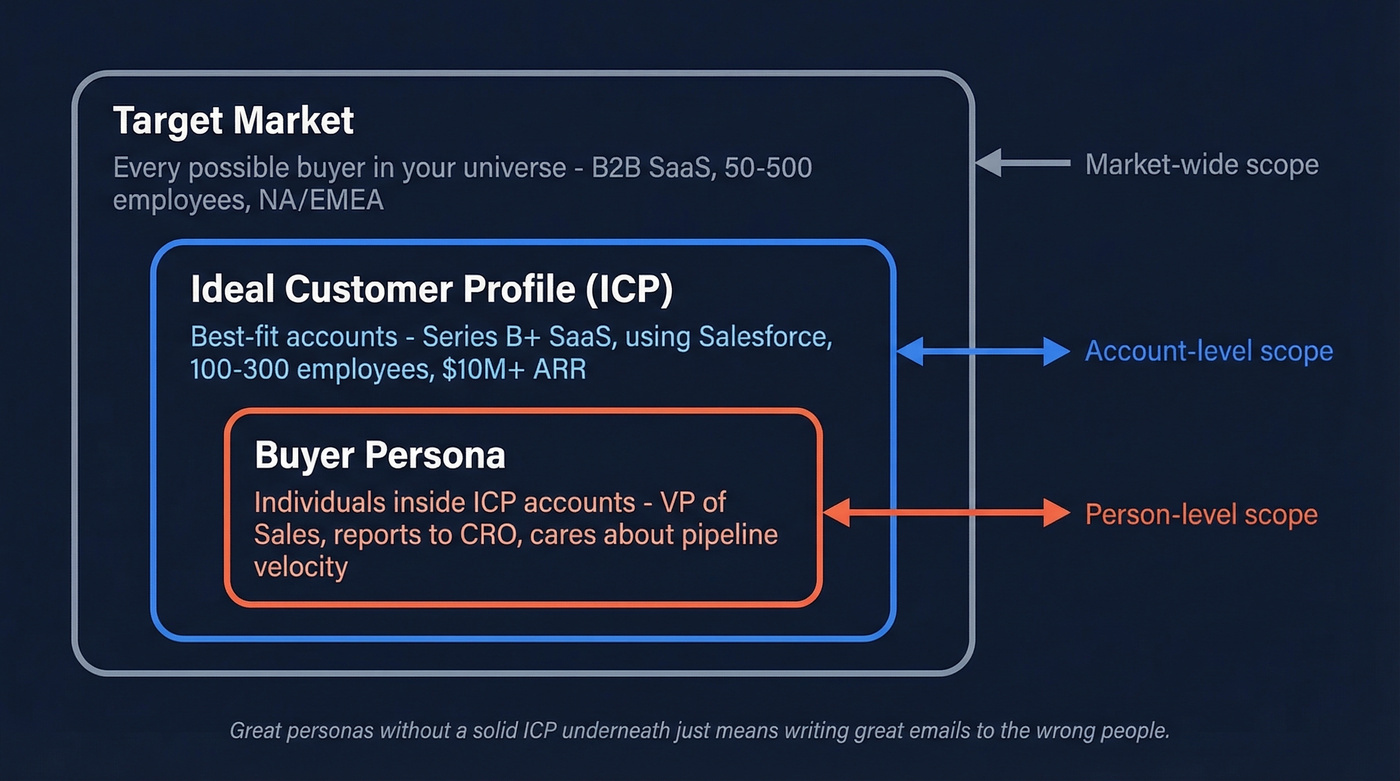
| Concept | Scope | Level | Example |
|---|---|---|---|
| Target Market | Every possible buyer | Market-wide | "B2B SaaS, 50-500 employees, NA/EMEA" |
| ICP | Best-fit companies | Account-level | "Series B+ SaaS, using Salesforce, 100-300 employees, $10M+ ARR" |
| Buyer Persona | Individuals within ICP accounts | Person-level | "VP of Sales, reports to CRO, cares about pipeline velocity" |
Your total addressable market is the universe. Your ideal customer profile narrows that universe to the companies where you actually win. Buyer personas then map the individuals inside those companies who influence the deal.
The distinction matters operationally: companies using well-defined buyer personas see up to 2x email open rates and 5x click-through rates. But personas without a solid profile underneath them just mean you're writing great emails to the wrong people.
Why This Approach Works
The ROI case isn't theoretical. Bain research shows companies aligned around a tight ICP grow revenue up to 2.5x faster than peers. In Snowflake's ABM rollout, accounts scored on intent and data maturity closed 34% faster than accounts selected by traditional methods.
On the marketing side, companies with a tightly defined ideal customer profile see 25-30% improvements in marketing ROI by cutting spend on poor-fit prospects. That's not a marginal gain - it's the difference between a marketing team that's a cost center and one that's a growth engine.
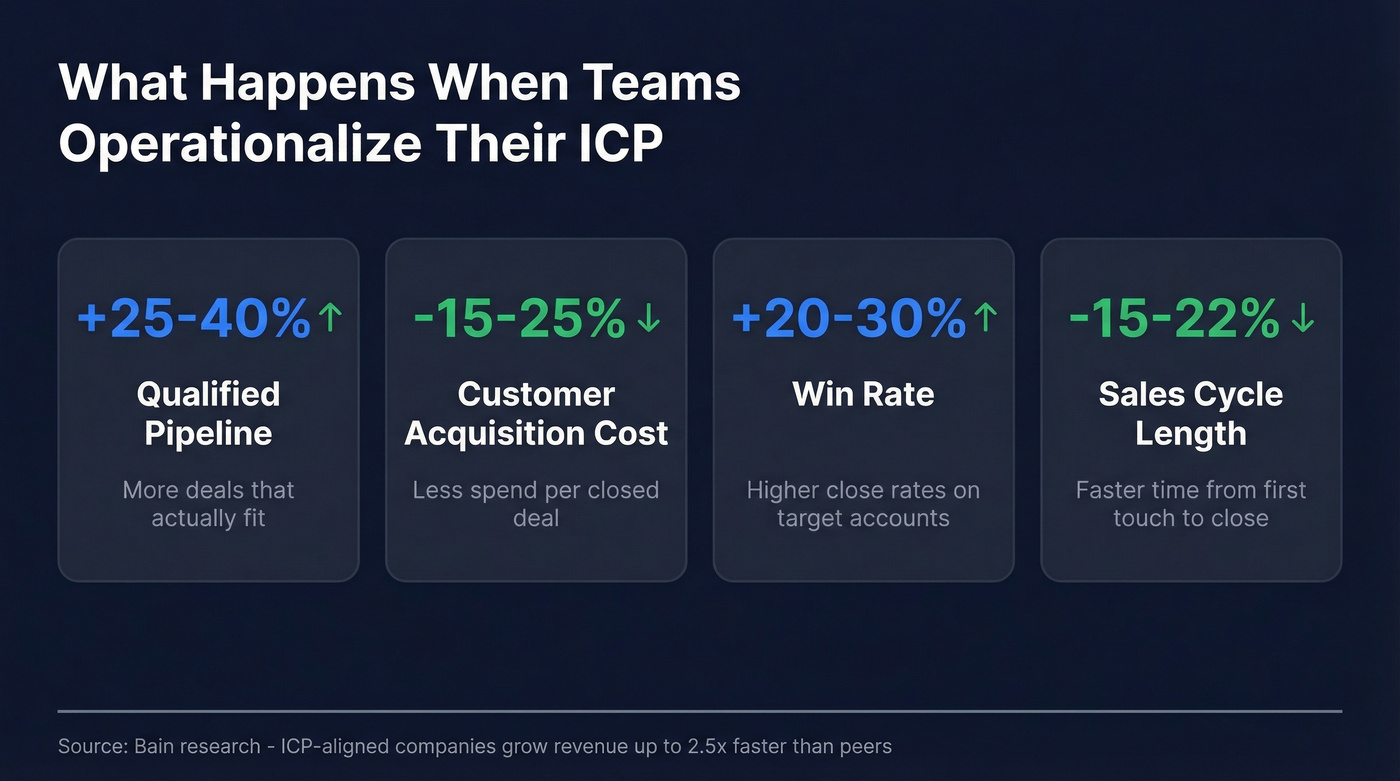
Here's what the benchmark ranges look like when teams operationalize their profiles:
| Metric | Typical Improvement |
|---|---|
| Qualified pipeline | +25-40% |
| Customer acquisition cost | -15-25% |
| Win rate | +20-30% |
| Sales cycle length | -15-22% |
These numbers vary by industry, but the direction is consistent. Focusing on fewer, better-fit accounts beats spraying across your entire TAM every time.
Here's the thing: if your average deal size is under $10K, you probably don't need ZoomInfo-level data or a 12-person ABM pod. A tight profile, a good enrichment tool, and disciplined outbound will outperform an expensive tech stack aimed at a fuzzy audience.
How to Build Your ICP in 2-4 Weeks
Initial development typically takes 2-4 weeks, with quarterly refinements after that.
Mine Your Closed-Won Data
Pull your last 50-100 closed-won deals and look for patterns. In our experience, 70-80% of wins share 3-5 traits - industry vertical, company size range, tech stack, growth stage, or a specific business trigger. Gartner recommends building from three data types: quantitative (CRM data, deal size, lifetime value), qualitative (sales and CS insights, win/loss interviews), and predictive (behavioral patterns from historical data).
Don't settle for generic "win/loss interviews." Ask questions that surface real emotion and decision-making friction:
- "Walk me through the moment you decided to evaluate solutions. What broke?"
- "Who almost killed the deal internally, and why?"
- "If you had to justify this purchase to a skeptical CFO in one sentence, what would you say?"
These prompts reveal the buying triggers and committee dynamics that firmographics alone will never capture.
Layer in Technographics and Intent
Firmographics alone aren't enough. The companies that close fastest usually share technology signals - they're already using a CRM like Salesforce or HubSpot, running outbound with tools like Outreach or Gong, or actively evaluating solutions in your category.
Intent data adds another dimension. If a company matching your firmographic and technographic profile is also actively researching your category, that's a Tier A account. Tools that combine tech stack detection with intent signals let you automate this scoring instead of manually researching each account.
Map the Buying Committee
Remember those five decision-makers? You need to know who they are for your ideal customer profile. Map the buying committee into three roles: deciders (who says yes), payers (who controls budget), and users (who'll actually live in the product). These are often different people, and treating them as interchangeable is a classic mistake that kills deals in committee.
Set a Review Cadence
Your profile isn't a one-time document. Set quarterly reviews tied to pipeline data. After any major product launch, market shift, or pricing change, trigger an ad-hoc review. Clustering algorithms applied to your CRM data can surface emerging patterns faster than manual analysis, especially when your deal volume grows past 200 closed-wons per year.

You just defined your ICP - now you need to find every account that matches it. Prospeo's database gives you 30+ filters including buyer intent, technographics, headcount growth, and funding stage to turn your scoring model into a live target list. 98% email accuracy means your reps reach real buyers, not dead inboxes.
Stop scoring accounts you can't actually reach.
The ICP Template
A good template covers five categories: company info, technographics, buying committee, jobs-to-be-done, and channels. Here's a filled-out B2B example you can copy and adapt.
B2B Example (Mid-Market SaaS)
| Category | Field | Example Value |
|---|---|---|
| Company Info | Industry | B2B SaaS |
| Company Info | Employee Count | 100-500 |
| Company Info | Revenue | $10M-$75M ARR |
| Company Info | Location | NA, UK, DACH |
| Company Info | Growth Stage | Series B-D |
| Technographics | CRM | Salesforce or HubSpot |
| Technographics | Outbound Stack | Outreach, Gong, or Salesloft |
| Buying Committee | Decider | VP Sales / CRO |
| Buying Committee | Payer | CFO / VP Finance |
| Buying Committee | User | SDR Manager / RevOps |
| JTBD | Primary | Increase pipeline velocity |
| JTBD | Secondary | Reduce CAC on outbound |
| Channels | Where They Learn | Podcasts, LinkedIn, SaaStr |
For B2C, the framework is identical but the attributes shift. Instead of firmographics, you're scoring on demographics like age, household income, and geography, plus psychographics and purchase behavior. Same logic - profile, score, activate - different inputs.
ICP Scoring: The 100-Point Model
Most teams have a profile document. Almost none have a scoring model.
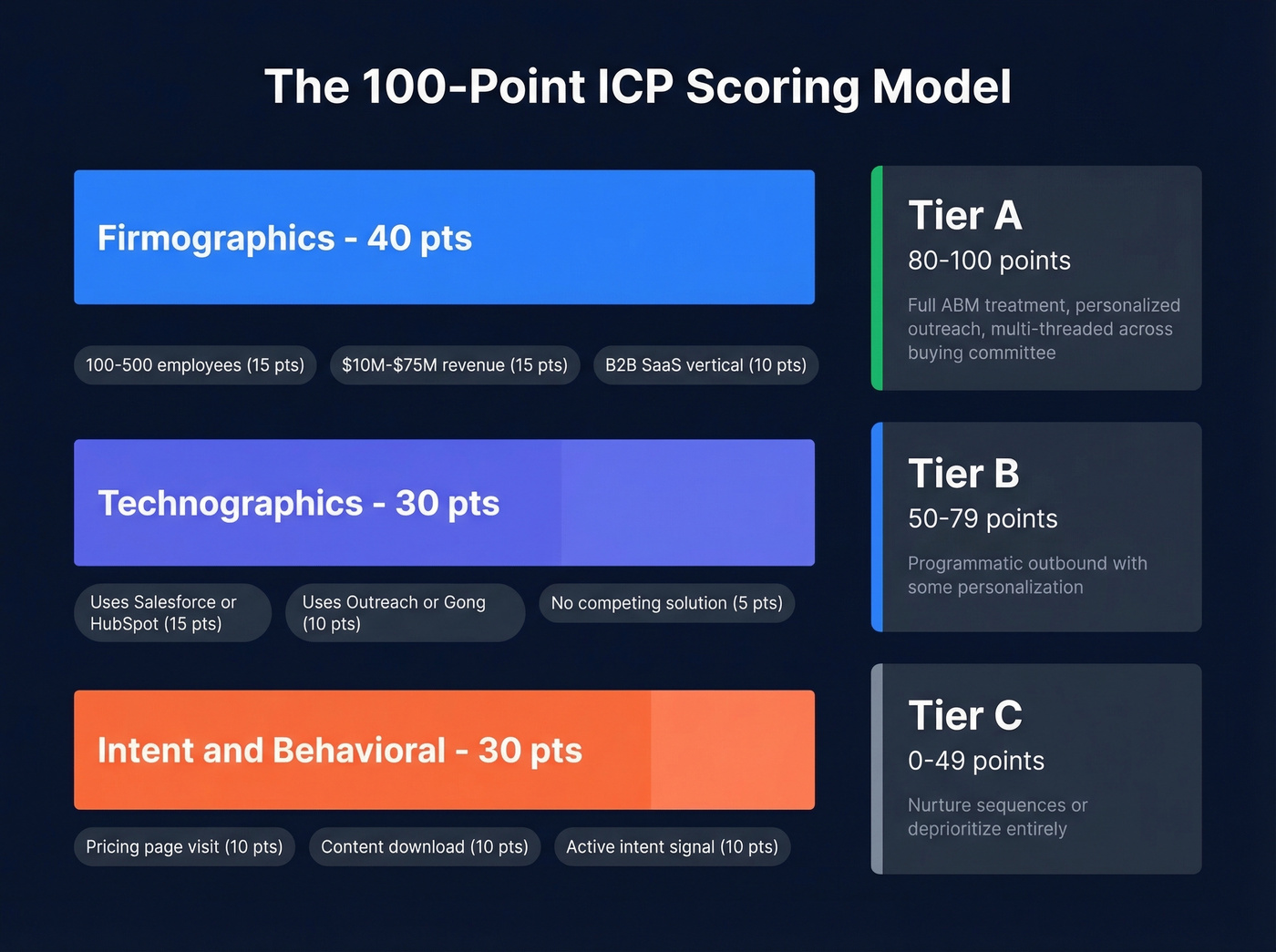
That's the gap between "we think these are good accounts" and "we know Tier A accounts close at 1.5-2x the rate of Tier B, 15-20% faster." Defining your ideal customer profile is one thing; turning that definition into a quantified scoring system is where revenue teams separate from everyone else.
Here's a 100-point scoring rubric for a B2B SaaS company:
| Category | Weight | Criteria | Points |
|---|---|---|---|
| Firmographics | 40 pts | 100-500 employees | 15 |
| $10M-$75M revenue | 15 | ||
| B2B SaaS vertical | 10 | ||
| Technographics | 30 pts | Uses Salesforce/HubSpot | 15 |
| Uses Outreach/Gong | 10 | ||
| No competing solution | 5 | ||
| Intent/Behavioral | 30 pts | Pricing page visit | 10 |
| Content download | 10 | ||
| Active intent signal | 10 |
Tier accounts based on total score: Tier A (80-100) gets full ABM treatment - personalized outreach, multi-threaded across the buying committee. Tier B (50-79) gets programmatic outbound with some personalization. Tier C (0-49) goes into nurture or gets deprioritized entirely.
For earlier-stage companies, an alternative weighting works well: revenue fit at 40%, company size at 25%, tech stack at 20%, and behavioral intent at 15%. The exact weights matter less than having weights at all. Once you're scoring, validate by tracking win rate, deal size, and cycle time by tier - then adjust quarterly.
The Anti-ICP: Who NOT to Target
Knowing who not to target is just as valuable as knowing who to target. Gartner explicitly recommends asking "What forms an account we can't sell to?" as part of the build process.
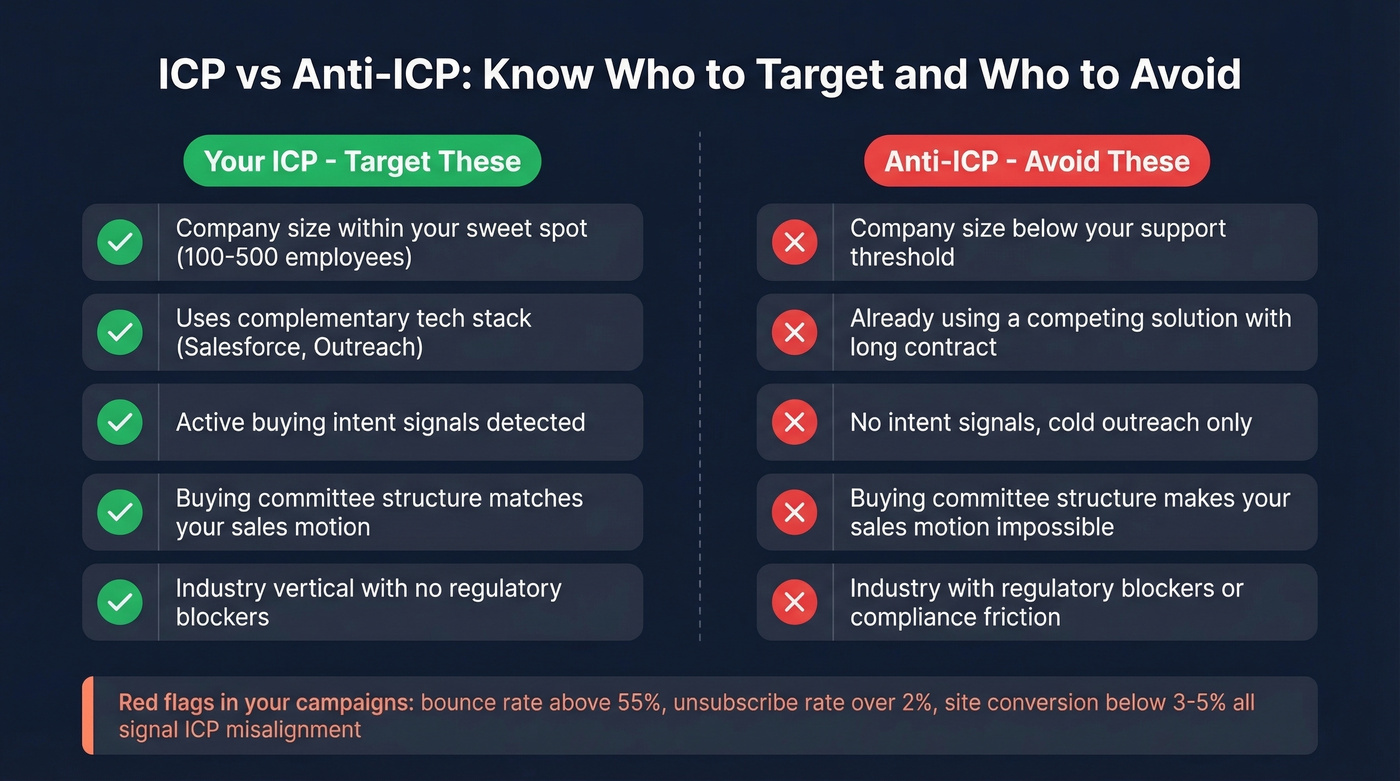
Build a negative profile by identifying patterns in your closed-lost deals, churned accounts, and longest sales cycles. Common disqualifiers include company size below your support threshold, industries with regulatory blockers, and accounts where the buying committee structure makes your sales motion impossible.
Watch for diagnostic red flags in your existing campaigns. A bounce rate above 55%, email unsubscribe rates over 2%, or site conversion below 3-5% all signal misalignment. If you're seeing these numbers, you're not just wasting budget - you're actively damaging your domain reputation.
Two traps to avoid. First, don't optimize for volume instead of profitability. Research consistently shows that 20% of customers drive 80% of profits. If your profile doesn't account for which customers are actually profitable - not just willing to buy - you'll fill your pipeline with accounts that close but churn or drain support resources. Second, don't make your criteria so specific that you're targeting 47 companies globally. An over-narrow profile starves your pipeline just as effectively as a vague one. If your Tier A list has fewer than 200 accounts, you've probably over-rotated.
Activating Your Ideal Customer Profile
A profile that lives in a Google Doc is worthless. Activation means three things: a scoring model, an enrichment tool that filters by your ICP attributes, and a quarterly review cadence that keeps the system honest.
Use your profile to drive lead routing where Tier A accounts go to senior reps, account-based marketing targeting where Tier A gets 1:1 campaigns, outbound sequencing with messaging mapped to pain points, content strategy written for your buying committee, and sales enablement with battle cards built around common objections.
Skip this if you're planning to activate manually. Exporting a CSV from your CRM and cross-referencing it with a spreadsheet of attributes doesn't scale past 50 accounts. You need tooling.
The activation workflow looks like this: set your criteria - industry, headcount range, tech stack, funding stage - and filter a database to return matching accounts with verified contact data. Prospeo's 30+ search filters handle this directly, with Bombora intent data across 15,000 topics surfacing which accounts are actively researching your category right now. The 7-day data refresh cycle means you're working with current records, not stale data.
| Tool | Starting Price | Best For |
|---|---|---|
| Prospeo | Free / ~$0.01 per email | ICP activation with verified data |
| ZoomInfo | ~$15K-$40K+/year | Enterprise GTM suites |
| Apollo | Free / $49-$79/user/mo | SMB prospecting + sequences |
| Clay | Free / $149-$800/mo | Custom enrichment workflows |
Layering technographics and intent data onto your ICP shouldn't require a six-figure contract. Prospeo tracks 15,000 intent topics via Bombora and detects tech stacks across 300M+ profiles - refreshed every 7 days, not every 6 weeks. At $0.01 per email, you get enterprise-grade ICP activation at a fraction of ZoomInfo's cost.
Tier your accounts with live intent signals for $0.01 per lead.
Real Pipeline Results
Theory is nice. Numbers are better.
| Company | Approach | Result |
|---|---|---|
| AVEVA @ GSK | ICP-scored ABM, personalized microsite | £7M pipeline, 46 new decision-maker relationships |
| Acxiom | Profile-driven vertical expansion | £1.5M pipeline in 120 days |
| BlueBotics | 1:few ABM, 12 target accounts | £4M+ opportunities, 100% engagement |
| GoodShape | Scored account list, 337 targets | 80% of accounts engaged, £1M+ pipeline |
The BlueBotics result is worth highlighting: 12 target accounts, 100% engagement, £4M+ in opportunities. That's what happens when your targeting is tight enough that every account on the list is genuinely worth pursuing. You don't need thousands of accounts. You need the right ones.
We've seen similar patterns with our own customers. Snyk's 50 AEs went from a 35-40% bounce rate to under 5% after tightening their ICP criteria and pairing it with verified contact data - AE-sourced pipeline jumped 180%, generating 200+ new opportunities per month.
FAQ
What is ICP in marketing?
ICP stands for Ideal Customer Profile - a data-driven description of the company most likely to buy your product, retain long-term, and generate strong unit economics. It focuses on account-level attributes like firmographics, technographics, and intent signals rather than individual demographics, and it drives every downstream decision from ad targeting to rep routing.
Can you build an ICP without existing customers?
Yes. Use 5-10 hypothesis-validation conversations with potential buyers, analyze willingness-to-pay signals, and study competitor customer bases for patterns. Pre-revenue profiling is harder and less precise, but skipping it entirely means burning budget on the wrong audience while you figure it out the expensive way.
How often should you update your ICP?
Quarterly at minimum, with ad-hoc reviews after any major product launch, pricing change, or market shift. If diagnostic metrics start flashing red - bounce rate above 55%, unsubscribe rate over 2% - that's your data telling you something changed and your profile needs recalibration.
What's the difference between ICP scoring and lead scoring?
ICP scoring evaluates account-level structural fit like firmographics, technographics, and best-customer match, while lead scoring evaluates individual behavioral engagement like email opens and page visits. You need both: account scoring tells you which companies to pursue, and lead scoring tells you which people at those companies are ready to talk.
What tools help activate an ICP?
You need an enrichment platform with filters matching your profile attributes - firmographics, technographics, intent signals, and growth indicators. The tools table above compares the main options by price point and use case, from self-serve platforms starting free to enterprise suites running $15K+ per year.