

ICP Segmentation That Actually Works: Scoring Model, Enforcement Rules, and the Mistake Everyone Makes
You built the ICP doc. It's beautiful - firmographics, technographics, a nice little persona slide. Then you look at your last 100 customers and only 12 match. Less than 10% of B2B SaaS companies have data-driven ICPs that factor in even one revenue metric like retention or LTV. The rest are running on vibes and a spreadsheet from 2023.
Here's our hot take: if your average deal size is under $15k and you're spending six figures on ABM tooling before you've validated a scoring model, you're lighting money on fire. Start with a spreadsheet, clean data, and the framework below.
The Quick Version
- Segment by who stays, not who signs up. Retention-led ideal customer profile segmentation outperforms conversion-led targeting every time.
- Score accounts on a 100-point rubric - firmographics 40, technographics 30, intent 30 - and enforce tiers in your CRM.
- Your scoring model is only as good as your contact data. Verify before you execute.
What ICP Segmentation Actually Is
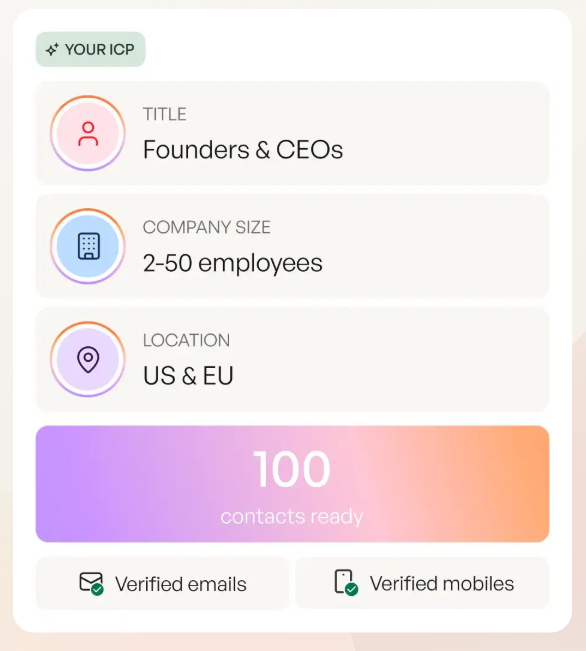
This process involves defining and scoring the companies most likely to become profitable, long-term customers, then organizing your go-to-market around those accounts. It's account-level, not individual-level. That's the key distinction from buyer personas, which describe the people inside those accounts - their roles, goals, and pain points.
It's also not broad market segmentation. You're not slicing a TAM into industries. You're identifying the narrow cluster of companies where your product creates the most value and your sales motion works best. Lenny Rachitsky's research found that successful B2B companies define their ICP with at least three attributes - and keep it tight. If your ICP has a dozen dimensions, you don't have an ICP. You have a wishlist.
Why Targeting ICP Segments Changes Unit Economics
The numbers aren't subtle. CXL cites a 68% higher ROI for ICP-targeted campaigns vs. broad targeting. HubSpot puts the conversion rate advantage at 36% for companies with clearly defined ICPs.
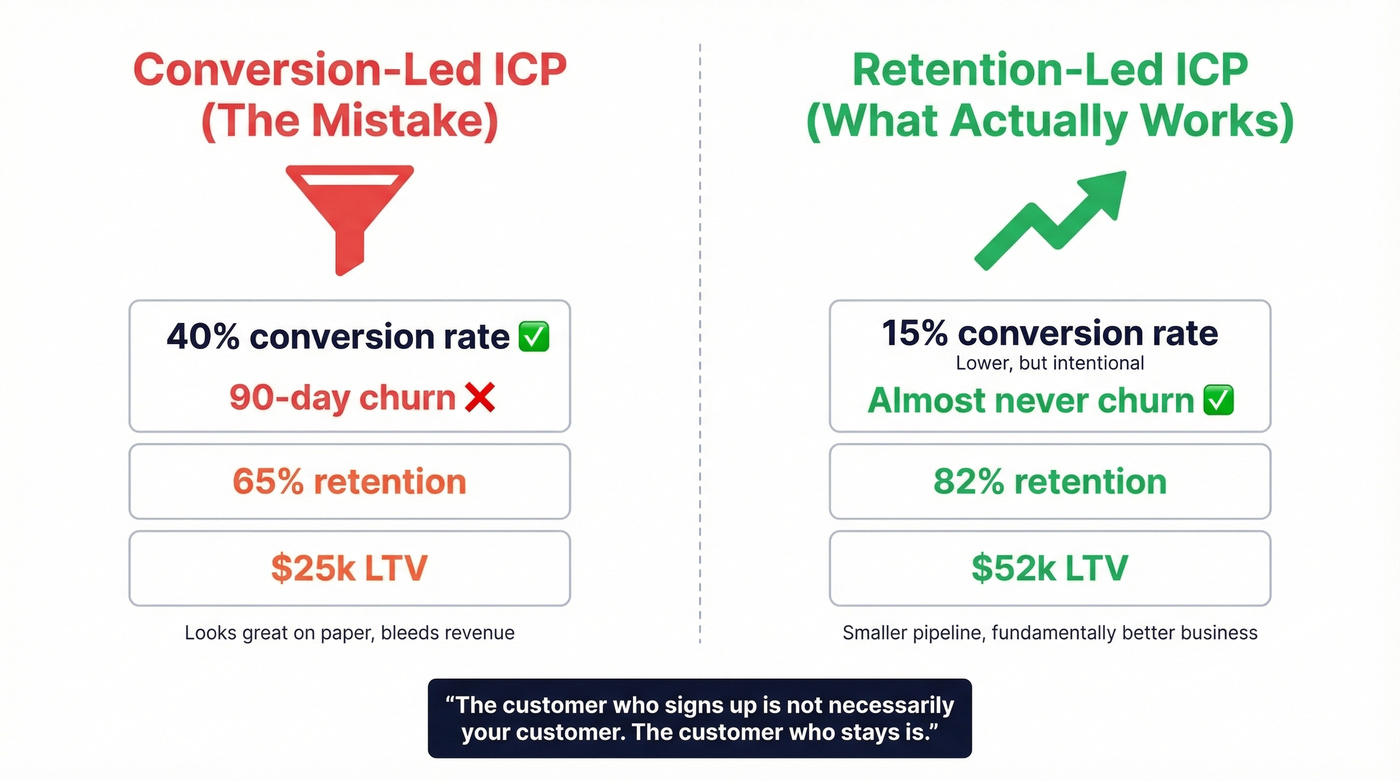
But the real story is downstream. One GTM write-up on HubSpot cites retention improving from 65% to 82%, customer LTV increasing from $25k to $52k, and revenue retention moving from 70% to 100% after ICP refinement. That's not a marginal improvement - that's a fundamentally different business.

Your 100-point scoring model needs accurate firmographic, technographic, and intent data to work. Prospeo enriches accounts with 50+ data points at an 83% match rate - refreshed every 7 days, not every 6 weeks like competitors. At $0.01 per email with 98% accuracy, your Tier A accounts get verified contact data, not decayed records that tank your scores.
Stop scoring accounts against stale data. Start enriching them in real time.
The Mistake Everyone Makes
Look, most teams build their ICP around who converts. That feels logical. But a SaaS founder on r/SaaS shared a story that should make you rethink everything - their highest-converting segment also had the highest churn. When they reanalyzed around retention, expansion, and referrals, a completely different ICP emerged: smaller companies in a specific niche who "almost never left." Short-term signups dropped. Medium-term revenue grew.
"The customer who signs up isn't necessarily your customer. The customer who stays is."
If you suspect your ICP is off, check these diagnostic thresholds:
- Bounce rate above 55% on targeted campaigns - you're reaching the wrong accounts
- Email unsubscribe rate over 2% - your messaging doesn't resonate with who you're targeting
- Site conversion below 3-5% - misalignment between your target ICP and your actual traffic
Build an Anti-ICP too. Explicitly define who you don't want - it saves reps time and keeps support costs from spiraling on accounts that were never a fit.
Scoring Model You Can Copy
Let's make this concrete. Pull 50-100 closed-won deals from the last 12 months. We've done this exercise with our own pipeline, and you'll find 70-80% share 3-5 common traits. Those traits become your scoring categories.
| Category | Points | What You're Scoring |
|---|---|---|
| Firmographics | 40 | Revenue, headcount, industry, geo |
| Technographics | 30 | Tech stack fit, competing tools |
| Intent signals | 30 | Topic research, job postings, growth |
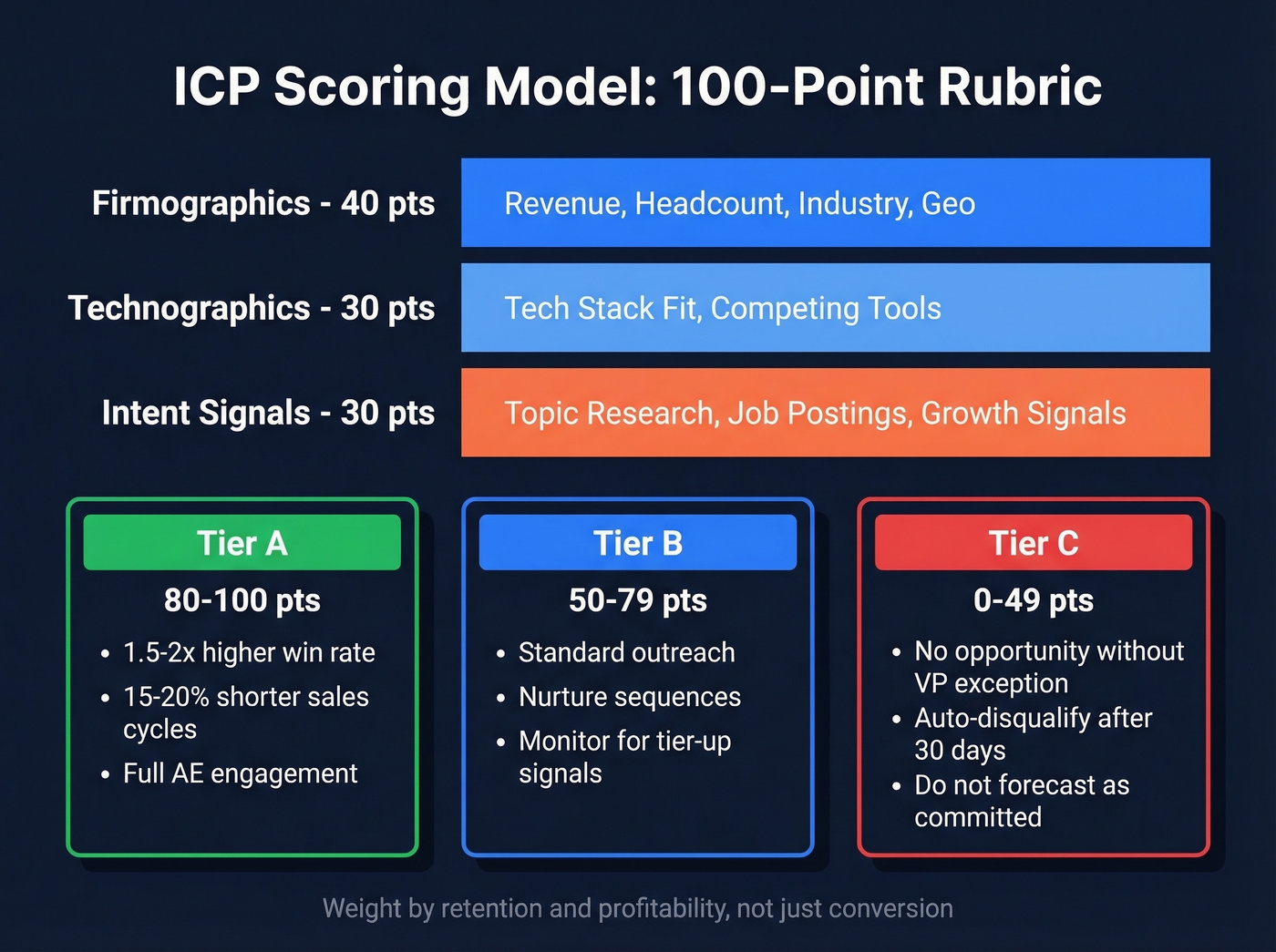
Weight each category by its correlation to retention and profitability, not just conversion. A segment that converts at 40% but churns in 90 days is worse than one that converts at 15% and stays for three years.
Set your tiers - Tier A (80-100), Tier B (50-79), Tier C (0-49) - and route accordingly. In our experience, Tier A win rates run 1.5-2x higher than Tier B, with 15-20% shorter sales cycles.
The five-step build process:
- Audit 50-100 closed-won deals for shared traits
- Define scoring categories across firmographic, technographic, and intent dimensions
- Assign point values weighted by correlation to retention and profitability
- Set tier thresholds and route accordingly
- Validate quarterly - if Tier A win rates drop below 1.5x Tier B, your model is stale
Two things most teams miss. First, profitability. Martech.org flags this as the most critical omission - you might be targeting customers who aren't in your profitable 20%. Second, map the buying committee into three roles: Deciders (the people who choose the tool), Payers (who write the check), and Users (who actually use it daily). It's increasingly rare that one person fills all three roles, and your segmentation model needs to account for that.
One practical test from Kalungi: if your ICP can't fit on a single slide, your filters are too complex. Keep it to 6-8 segments max.
Where does your team sit? Most teams are at Level 1 - intuition-based ICPs with no revenue metrics. The scoring model above gets you to Level 3: data-driven, retention-weighted, and enforced in your CRM. Level 4 means your ICP feeds predictive models and updates automatically. AI-driven tools are moving toward real-time behavioral scoring, but most teams aren't ready for that until their manual model is validated.
Enforcement in Your CRM
An ICP without enforcement rules is a wish list. Here's how to make it operational:
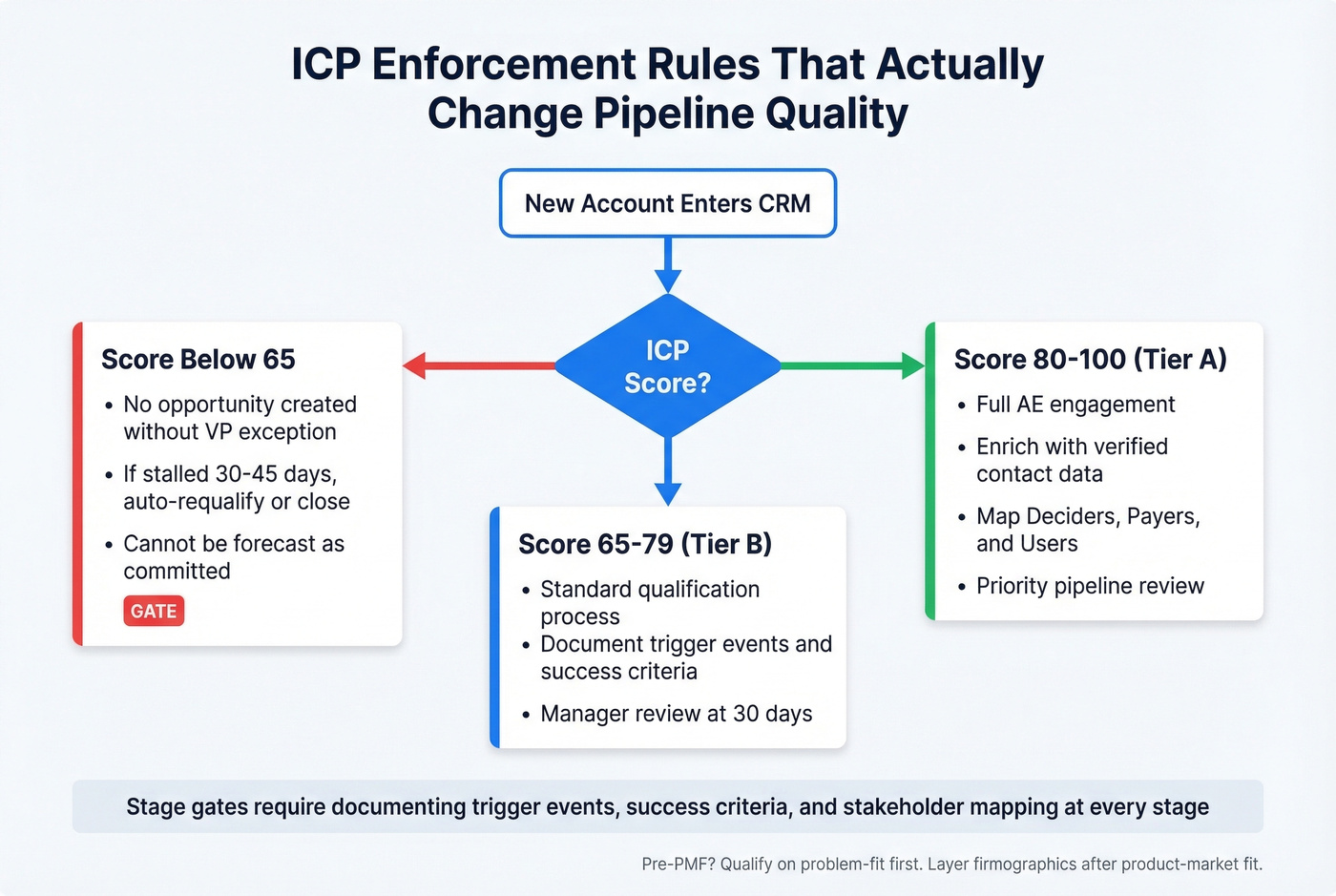
- No opportunity created below 65/100 without VP exception
- Low-ICP deals stalled 30-45 days get requalified or closed in manager review
- Low-ICP deals can't be forecast as committed - this alone changes pipeline hygiene overnight
- Stage gates require documenting trigger events, success criteria, and stakeholder mapping
The pushback from reps is real, but the pipeline quality improvement is undeniable. When reps know how to target ideal accounts with precision, they stop wasting cycles on deals that were never going to close. One nuance worth flagging: if you haven't hit product-market fit yet, don't over-index on firmographics. Pre-PMF, qualify on problem-fit - "do they clearly have the problem we solve?" Post-PMF, layer in firmographics and technographics for precision.
Enforcement only works if your account data is current. Before reps work Tier A accounts, enrich them. Prospeo returns 50+ data points per contact at an 83% enrichment match rate - firmographics, technographics, and verified contact info that feeds directly into your scoring fields. With a 7-day data refresh cycle vs. the 6-week industry average, your CRM scores stay current instead of decaying between quarterly reviews.
Tools to Operationalize Your Model
You don't need a $75k ABM platform. Start with clean data and a scoring model in your existing CRM. Here's what the stack looks like at different maturity levels:
| Tool | What It Does | Approx. Pricing |
|---|---|---|
| Prospeo | Enrichment + verification + 30+ search filters including buyer intent across 15,000 topics | Free tier; ~$0.01/email |
| Apollo | Prospecting + enrichment | Free; from $49/mo/user |
| Clearbit (Breeze) | Enrichment + reveal | From $30/mo (credits) |
| ZoomInfo | Full-stack sales intelligence | $15-40k/year |
| Bombora | Intent data | From ~$25k/year |
| 6sense | ABM + intent + orchestration | Custom, typically $75k+/yr |
| Demandbase | ABM + advertising + intent | Custom, typically $50k+/yr |
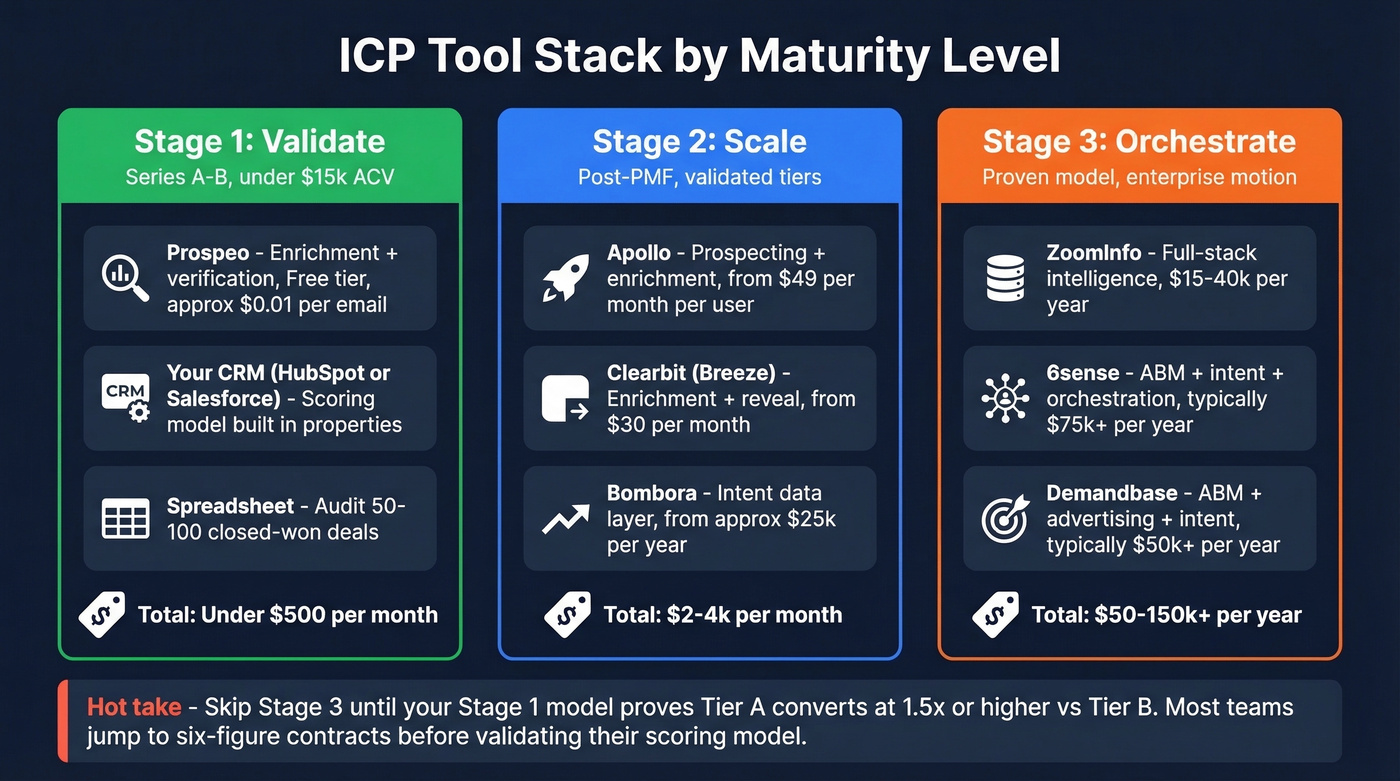
The bottleneck nobody talks about is data quality. The most common complaint about enterprise ABM platforms on Reddit and G2: you're locked into annual contracts before you've even validated your ICP model, implementation takes months, and the data is stale by the time it's loaded. We've seen teams that start with a lightweight enrichment tool and a validated scoring model consistently outperform teams that jump straight to six-figure ABM contracts.
Skip the big platforms if you're a Series A or B company. Start with clean enrichment data, build your scoring model in HubSpot or Salesforce, and add intent data when you've validated your tiers.
If you want to go deeper on list quality, data enrichment and lead enrichment are the two levers that usually move scores fastest.
ICP enforcement fails when reps can't reach the right buyers inside Tier A accounts. Prospeo gives you 143M+ verified emails and 125M+ mobile numbers with a 30% pickup rate - so your scoring model doesn't just sit in a slide deck. Map the Deciders, Payers, and Users with contact data that actually connects.
Turn your ICP tiers into booked meetings, not pipeline fiction.
FAQ
What's the difference between ICP and buyer persona?
An ICP defines the company - firmographics, technographics, revenue range, industry. A buyer persona defines the person within that company - their role, goals, and pain points. ICP is account-level; persona is contact-level. You need both, but ICP comes first because it determines which accounts are worth pursuing.
How often should you update your ICP segmentation?
Quarterly at minimum. Pull closed-won and churned data every 90 days and re-validate your scoring tiers. If Tier A win rates drop below 1.5x Tier B, your model needs recalibration.
What tools do you need to operationalize ICP segmentation?
A CRM like Salesforce or HubSpot, an enrichment tool for verified contact data, and optionally an intent data layer. Build the scoring model first, validate it with real pipeline data, then invest in tooling that matches your maturity.
Can you do ICP segmentation without expensive ABM software?
Yes - and you probably should. A spreadsheet audit of 50-100 closed-won deals, a 100-point scoring rubric in your CRM, and a reliable enrichment source covers 80% of what enterprise ABM platforms do. Add intent data and orchestration only after your manual model proves Tier A accounts convert at 1.5x+ Tier B rates.