

The B2B Ideal Customer Profile Template That Actually Gets Used
Your SDRs burned 200 hours last quarter working accounts that were never going to close. Marketing sent 4,000 MQLs to sales; sales ignored 2,100 of them. The finger-pointing started on a Monday.
This isn't a people problem - it's an ideal customer profile template problem. 53% of companies have a broken hand-off where sales follows up with fewer than 35% of marketing-engaged prospects, and only 11% achieve real alignment between the two teams.
You don't need a prettier template. You need a scoring model, a negative ICP, and a plan to actually embed the thing in your CRM so it doesn't rot in a slide deck by next quarter.
What You Need (Quick Version)
A usable B2B ideal customer profile template has three non-negotiable components:
- Firmographic template - the company-level, buying-committee, and channel attributes that define your best customer. Jump to template →
- Scoring rubric - a 100-point model that tiers accounts into A/B/C so reps know where to spend time. Jump to scoring →
- Negative ICP - the explicit exclusion criteria that keep bad-fit accounts out of your pipeline. Jump to negative ICP →
Here's the benchmark that matters: your ICP should disqualify roughly 70% of inbound. If it doesn't, it's too broad to be useful.
What Is an Ideal Customer Profile?
An ICP describes the type of company - and the buying committee inside it - that gets the most value from your product and delivers the most value back in revenue, retention, and expansion. It's not a demographic sketch of an individual. That's a buyer persona, and confusing the two is one of the most common mistakes in B2B marketing.
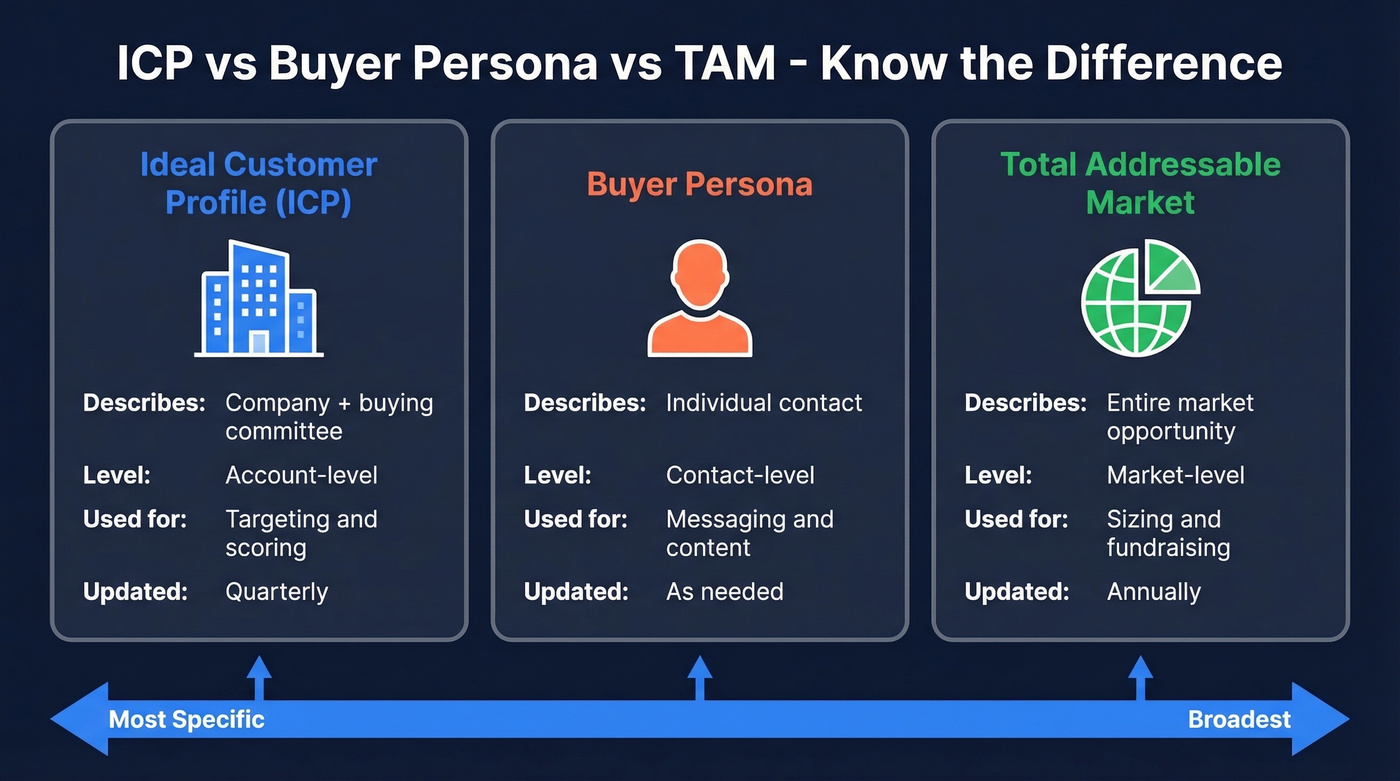
The distinction matters because B2B purchases involve committees, budgets, and organizational triggers that have nothing to do with whether your buyer listens to podcasts on their commute. The strongest ICPs combine three data types: quantitative data from your CRM, qualitative data from customer interviews, and predictive signals like buyer intent. Most teams stop at the first one and wonder why their targeting feels shallow.
| ICP | Buyer Persona | TAM | |
|---|---|---|---|
| Describes | Company + committee | Individual contact | Total addressable market |
| Level | Account-level | Contact-level | Market-level |
| When used | Targeting & scoring | Messaging & content | Sizing & fundraising |
Why Your ICP Template Matters
The Influ2 alignment study across 105 companies found that 53% have a broken hand-off between marketing and sales. Only 11% achieve both effective hand-off and high audience overlap. That gap is where pipeline goes to die.
Aligned organizations see 36% higher customer retention, 38% higher win rates, and 208% more marketing-generated revenue. On the cost side, wrong-fit clients consume 10-20% of your team's capacity while delivering 30-40% lower margins. Companies with strong sales-marketing alignment are 67% better at closing deals and see 20% average annual growth.
The ICP connects marketing volume to sales close rate. Without it, marketing optimizes for leads and sales optimizes for deals, and neither is optimizing for the same accounts.
Hot take: If your average deal size is under $10K, you probably don't need a 50-field ICP. Three to five firmographic attributes and a clear negative ICP will outperform a bloated template that nobody fills out. Complexity is the enemy of adoption.
The B2B ICP Template
This template has three layers. Most guides stop at layer one. Layers two and three are where the operational value lives.
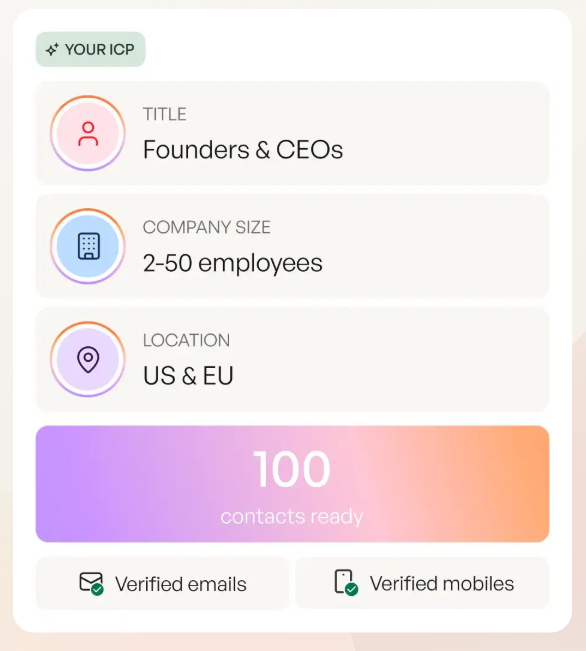
Layer 1 - Company Attributes
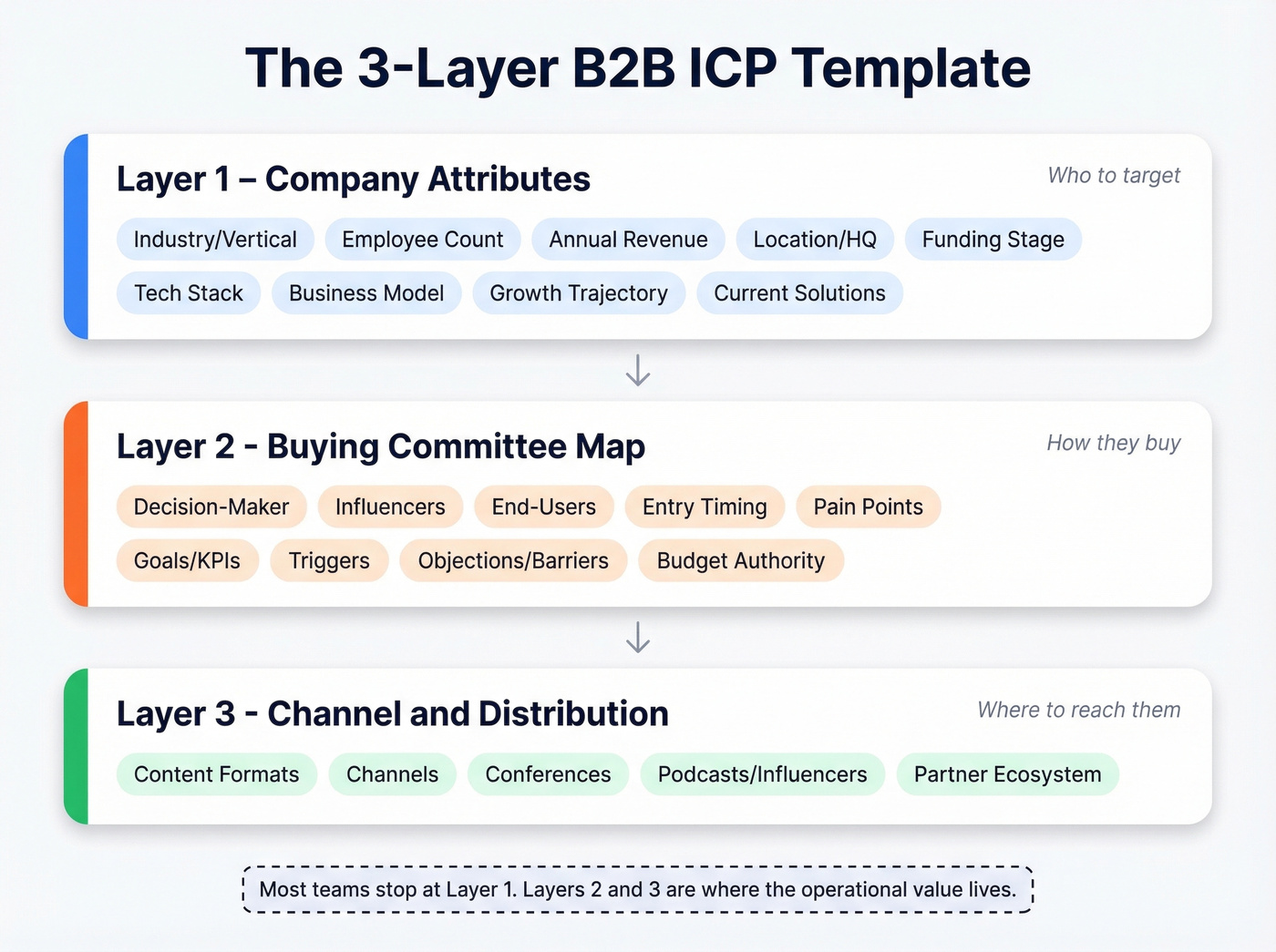
These are the firmographic and technographic filters that define which companies belong in your pipeline:
- Industry/vertical - be specific. "SaaS" isn't a vertical. "B2B SaaS selling to mid-market HR teams" is.
- Employee count - a range, not a single number.
- Annual revenue - or ARR for SaaS companies.
- Location/HQ - matters for compliance, time zones, and sales coverage.
- Funding stage - seed-stage companies buy differently than Series C.
- Tech stack - which tools they already use: CRM, marketing automation, complementary products.
- Business model - B2B, B2C, hybrid, marketplace.
- Growth trajectory - hiring velocity, revenue growth rate, recent funding.
- Current solutions - what they're using today that you'd replace or complement.
Layer 2 - Buying Committee Map
A company can be a perfect firmographic fit and still be impossible to sell into if you don't understand the committee. This layer is where most B2B customer profile templates fall short:
- Decision-maker - title, role, what they care about.
- Influencers - who shapes the decision without signing the contract.
- End-users - who actually uses the product daily.
- Entry timing - when each person enters the buying process.
- Primary pain points - at the organizational level, not individual.
- Goals/KPIs - what success looks like for the buying committee.
- Triggers - what makes them buy now: new funding, leadership change, failed tool, compliance deadline.
- Objections/barriers - procurement process, security review, budget cycle.
- Budget authority - who controls the money and how much they can spend.
Layer 3 - Channel & Distribution
This layer tells marketing where to show up and what format to use:
- Preferred content formats - case studies, ROI calculators, technical docs, video.
- Channels - communities, industry publications, social platforms.
- Conferences - which events they attend and sponsor.
- Podcasts/influencers - who they listen to and trust.
- Partner ecosystem - agencies, consultants, and tech partners in their orbit.
How to Build Your ICP in 5 Steps
Expect 2-6 weeks for your first ICP, including interviews and CRM analysis. Here's the process.
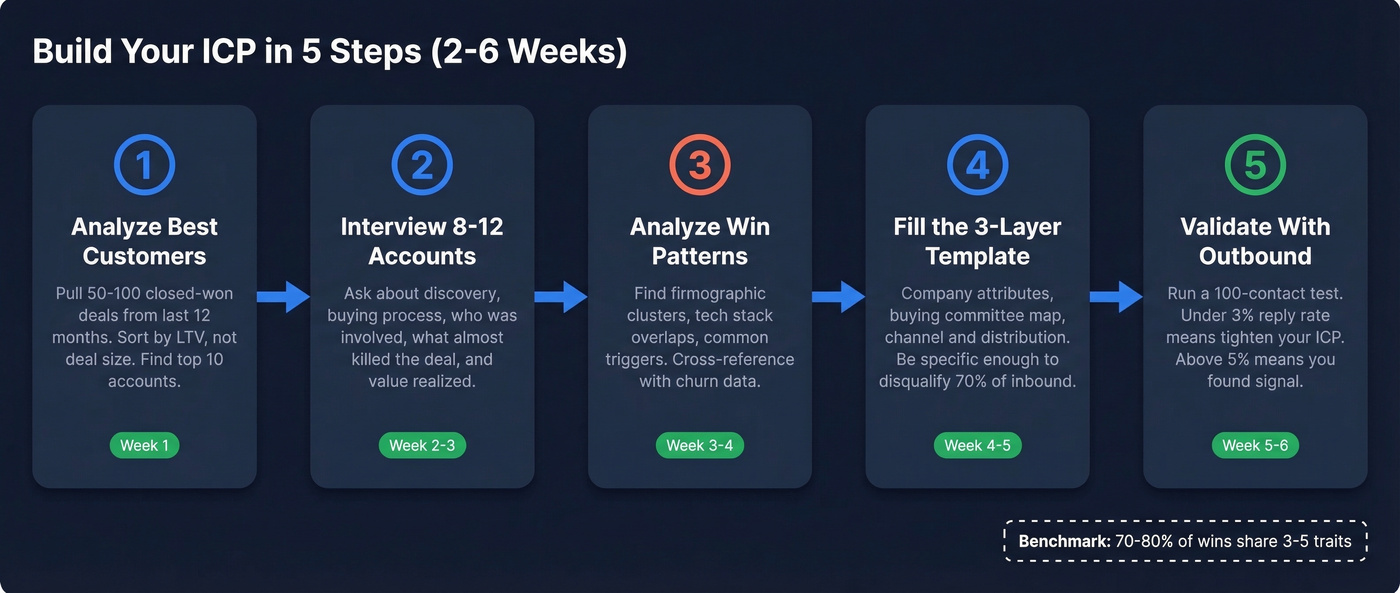
Start With Your Best Customers
Pull 50-100 closed-won deals from the last 12 months. Sort by LTV, not just deal size - you want customers who stay and expand, not just ones who signed fast. From that pool, identify your top 10 accounts by combined revenue, retention, and expansion. In our experience, 70-80% of wins share 3-5 traits. Start with revenue data, not market research. Your CRM knows more than your assumptions do.
Interview 8-12 Top Accounts
Talk to 8-12 of your best accounts. Start with discovery - what research did they do before evaluating you? How did they first hear about you? What was the primary problem they were trying to solve?
Then dig into the buying process. Who was involved in the decision? Who had final sign-off? What almost stopped the deal? What almost made them choose a competitor? How long did the process take from first conversation to signed contract?
Finish with value realization. What benefits have they seen since implementation? What would they lose if they stopped using you tomorrow? What's still not working the way they'd like?
Analyze Patterns Across Wins
Look for firmographic clusters - industry plus size plus funding stage - tech stack overlaps, and common triggers. Cross-reference with churn data. This step is critical. "Easy to close" and "easy to keep" aren't the same customer. The accounts that close in two weeks but churn at month six are actively hurting your business.
Fill Out the Template
Use the three-layer template above. Be specific enough that it disqualifies 70%+ of inbound leads. If your profile describes half the companies in your TAM, it's not an ICP - it's a market definition. For B2B SaaS teams, pay special attention to firmographic and technographic and funding-stage attributes, since these tend to be the strongest predictors of deal velocity and retention.
Validate With Outbound Data
Here's the step most teams skip. Build a small prospect list matching your ICP - filter by the exact firmographic and technographic attributes you defined - then run a 100-contact outbound test and measure reply rates. Under 3%? Your ICP needs tightening. Above 5%? You've found signal.

Your ICP template defines who to target. Prospeo's 30+ search filters - including buyer intent, technographics, funding stage, headcount growth, and revenue - let you operationalize it instantly. Filter 300M+ profiles to find accounts that match your ICP, then get 98% accurate emails for every contact on the buying committee.
Stop letting your ICP rot in a slide deck. Activate it with real data.
ICP Scoring: The 100-Point Model
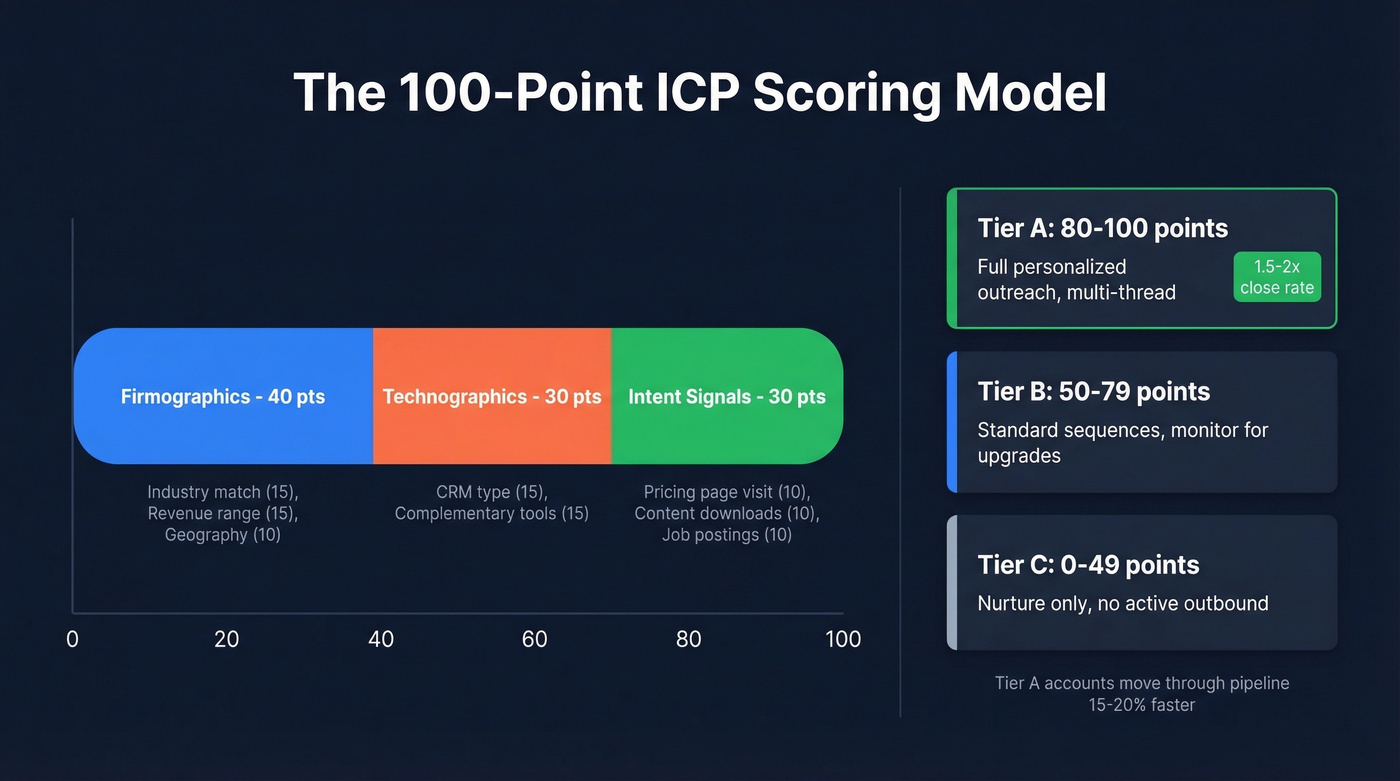
A template tells you who to target. A scoring model tells you how much to invest in each account. The difference between a Tier A and Tier C account should determine whether a rep spends 3 hours on personalized outreach or 30 seconds on a skip.

Here's the 100-point model we recommend:
| Category | Points | Example Sub-Criteria |
|---|---|---|
| Firmographics | 40 | Industry match (15), revenue range (15), geo (10) |
| Technographics | 30 | CRM type (15), complementary tools (15) |
| Intent Signals | 30 | Pricing page visit (10), content downloads (10), job postings (10) |
Tier thresholds:
| Tier | Score | Action |
|---|---|---|
| Tier A | 80-100 | Full personalized outreach, multi-thread |
| Tier B | 50-79 | Standard sequences, monitor for upgrades |
| Tier C | 0-49 | Nurture only, no active outbound |
Tier A accounts close at 1.5-2x the rate of Tier B and move through the pipeline 15-20% faster. That's the whole point - concentrating effort where it compounds.
One important distinction: ICP scoring is account-level structural fit. Lead scoring is contact-level engagement. They're complementary, not interchangeable. A Tier A account with a cold contact still needs warming. A Tier C account with a hot contact is still a bad bet.
Build a Negative ICP
Your negative ICP deserves the same rigor as your positive one. It's not an afterthought - it's a first-class artifact that saves your team from the accounts that look good on paper but drain resources.
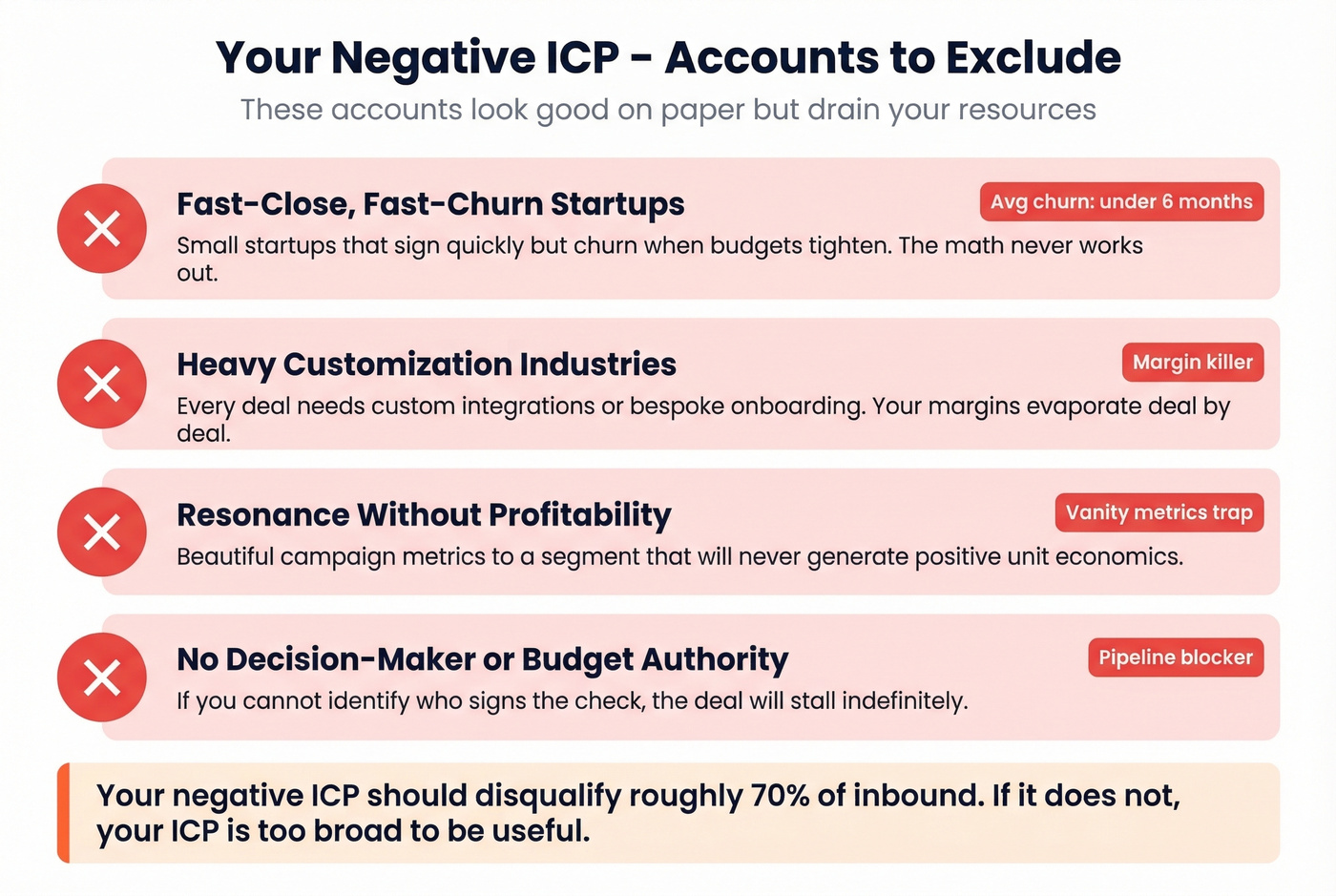
Red-flag patterns to codify:
- Small startups that sign quickly but churn when budgets tighten. Fast close, fast churn. The math never works.
- Industries requiring heavy customization that doesn't scale. If every deal needs custom integrations or bespoke onboarding, your margins evaporate.
- Segments where messaging resonates but profitability doesn't follow. You can run beautiful campaigns to a segment that'll never generate positive unit economics.
- Companies with no clear decision-maker or budget authority. If you can't identify who signs the check, the deal will stall indefinitely.
Excluding low-fit segments typically reduces wasted SDR activity by 20-40% in outbound-heavy teams. The key is embedding these exclusion criteria in CRM fields and routing rules - not leaving them in a document nobody opens.
Filled-Out ICP Examples
Example 1 - B2B SaaS Company
| Layer | Attribute | Value |
|---|---|---|
| Company | Industry | B2B SaaS (sales tech) |
| Company | Employees | 50-500 |
| Company | Revenue | $5M-$50M ARR |
| Company | Funding | Series A-C |
| Company | Tech stack | HubSpot or Salesforce CRM |
| Company | Trigger | New VP Sales hire, missed quota |
| Committee | Decision-maker | VP Sales or CRO |
| Committee | Influencer | RevOps lead |
| Committee | End-user | SDRs and AEs |
| Committee | Pain point | Low connect rates, stale data |
| Committee | Budget | $15K-$50K/year |
| Channel | Content | ROI calculators, case studies |
| Channel | Communities | r/sales, RevGenius, Pavilion |
| Channel | Events | SaaStr, Dreamforce |
Negative ICP: Pre-seed companies with no dedicated sales team. Enterprise orgs with 5,000+ employees and 12-month procurement cycles.
Example 2 - B2B Marketing Agency
| Layer | Attribute | Value |
|---|---|---|
| Company | Type | Digital marketing agency |
| Company | Employees | 10-75 |
| Company | Revenue | $1M-$10M |
| Company | Clients | Mid-market B2B |
| Company | In-house capability | Paid media + content, no dev |
| Committee | Decision-maker | Agency founder or MD |
| Committee | Collaboration style | Async, Slack-first |
| Committee | Budget capacity | $2K-$8K/mo per tool |
| Committee | Pain point | Scope creep, margin erosion |
| Channel | Content | Templates, playbooks, benchmarks |
| Channel | Communities | Agency-specific Slack groups |
Negative ICP: Solopreneurs with no recurring revenue. Agencies with 100+ employees and in-house dev teams that build rather than buy.
For agencies, the profile shifts toward budget capacity, decision-making structure, and collaboration style - dimensions that matter more than raw firmographics. Wrong-fit agency clients don't just churn; they burn your team out on the way down.
5 ICP Mistakes That Kill Pipeline
1. Fairytale personas built without customer input. Marketing creates a persona in a workshop, names it "Sales Sam," gives it hobbies and a backstory, and never talks to an actual customer. The consensus on r/sales is brutal - and correct. If sales wasn't in the room when the ICP was built, it won't be in the CRM when reps are prospecting.
2. B2C demographics applied to B2B contexts. Age, gender, and household income don't predict B2B purchase behavior. Buying committee structure, budget authority, and organizational triggers do.
3. Ignoring profitability. Your messaging can resonate beautifully with a segment that's unprofitable. We've seen teams celebrate high MQL volume from a segment that churned at 3x the average rate. Resonance and retention aren't the same thing.
4. Treating decider, payer, and user as one person. In most B2B deals, the person who decides, the person who controls the budget, and the person who uses the product daily are three different people with three different priorities. Your ICP needs to account for all three.
5. No operationalization path. Here's the thing: the ICP lives in a slide deck from Q1 kickoff. It never reaches CRM fields, lead routing rules, or outbound targeting criteria. By Q2, nobody remembers what it said. This is the most common failure mode, and it's entirely preventable.
How to Operationalize Your ICP
Most ICP documents go stale within a quarter unless they're embedded in the systems your team uses daily. Here's the three-step operationalization path.
Embed ICP attributes as CRM fields. In HubSpot or Salesforce, create custom properties for every Layer 1 attribute - industry vertical, employee range, funding stage, tech stack. This takes 1-2 days once the ICP is defined. It's not glamorous work, but it's the difference between a living ICP and a dead document.
Set up lead routing rules. Auto-score inbound leads against your ICP tiers. Tier A goes to your best reps immediately. Tier C goes to nurture. This alone can cut response time for high-fit accounts by 50% or more.
Build outbound prospect lists matching ICP attributes. Once your ideal customer profile template is locked, the next step is building a prospect list that actually matches it. Prospeo lets you filter by 30+ ICP-aligned attributes - industry, headcount, revenue, tech stack, funding stage, job changes, and buyer intent across 15,000 topics - with a 7-day data refresh cycle so you're not prospecting against stale records.

Layer 2 of your ICP maps the buying committee. Prospeo surfaces verified emails and direct dials for decision-makers, influencers, and end-users at your best-fit accounts - 125M+ mobile numbers, 143M+ verified emails, refreshed every 7 days so you're never working stale data.
Reach every person on the buying committee, not just the easy ones.
FAQ
Can a company have multiple ICPs?
Yes - many B2B companies run 2-3 ICPs for different product lines or market segments. Score and tier each one separately. Prioritize the ICP with the highest win rate and LTV.
How often should you update your ICP?
Review quarterly using closed-won and closed-lost data. If win rates drop or churn spikes in a segment you thought was Tier A, your ICP is stale. Tie maintenance to CRM reporting, not calendar reminders.
What's the difference between an ICP and a buyer persona?
An ICP defines the company and buying committee you target; a buyer persona profiles an individual contact's motivations and messaging preferences. Build the ICP first to select accounts, then layer personas on top for personalized outreach.
How do I find prospects that match my ICP?
Use a B2B data platform with filters that map to your ICP attributes - buyer intent, technographics, funding stage, headcount growth. Build a small batch first to validate reply rates before scaling outbound.
Is an ICP the same as a target account list?
No. An ICP is the criteria; a target account list is the output. Build the ICP first, then generate the list by filtering a database against those criteria. The ICP is the recipe. The account list is the meal.