

The Only Ideal Customer Profile Worksheet You Actually Need
Stop collecting templates. Most teams have an ideal customer profile worksheet saved somewhere and still haven't filled it out with real data. That's not a template problem - it's an execution problem.
What follows are seven sections: firmographics, technographics, buying committee, pain points and triggers, psychographic layer, qualification gates, and disqualification criteria. Use Google Sheets for scoring, a doc for the narrative ICP. Instead of downloading another template, fill one out today using your closed-won deals.
Why Most ICP Worksheets Fail
Companies with tight sales-marketing alignment see 36% higher customer retention, 38% higher win rates, and 208% growth in marketing-generated revenue. Those numbers are staggering. But most teams never get there because their ICP is a fairytale persona built in a conference room without a single customer interview.
The consensus on r/b2bmarketing is blunt: B2B ICPs fail when they're built like B2C profiles, stuffed with demographics instead of firmographics and purchase triggers. If your ICP reads like a dating profile - "Sarah, 34, likes hiking and SaaS" - you've already lost.
ICP vs. Buyer Persona
"Personas tell you who you're speaking to. ICPs tell you which companies are worth speaking to in the first place." - HubSpot
Your ICP is company-level: industry, size, tech stack, buying signals. Buyer personas sit inside the ICP - they're the people you'll actually email. Both matter, but the ICP comes first. Get the company wrong and no persona saves you.
The Complete 7-Section Worksheet
Every field you need, in seven categories. If an attribute appears in 60%+ of your best accounts, it belongs.
Firmographics
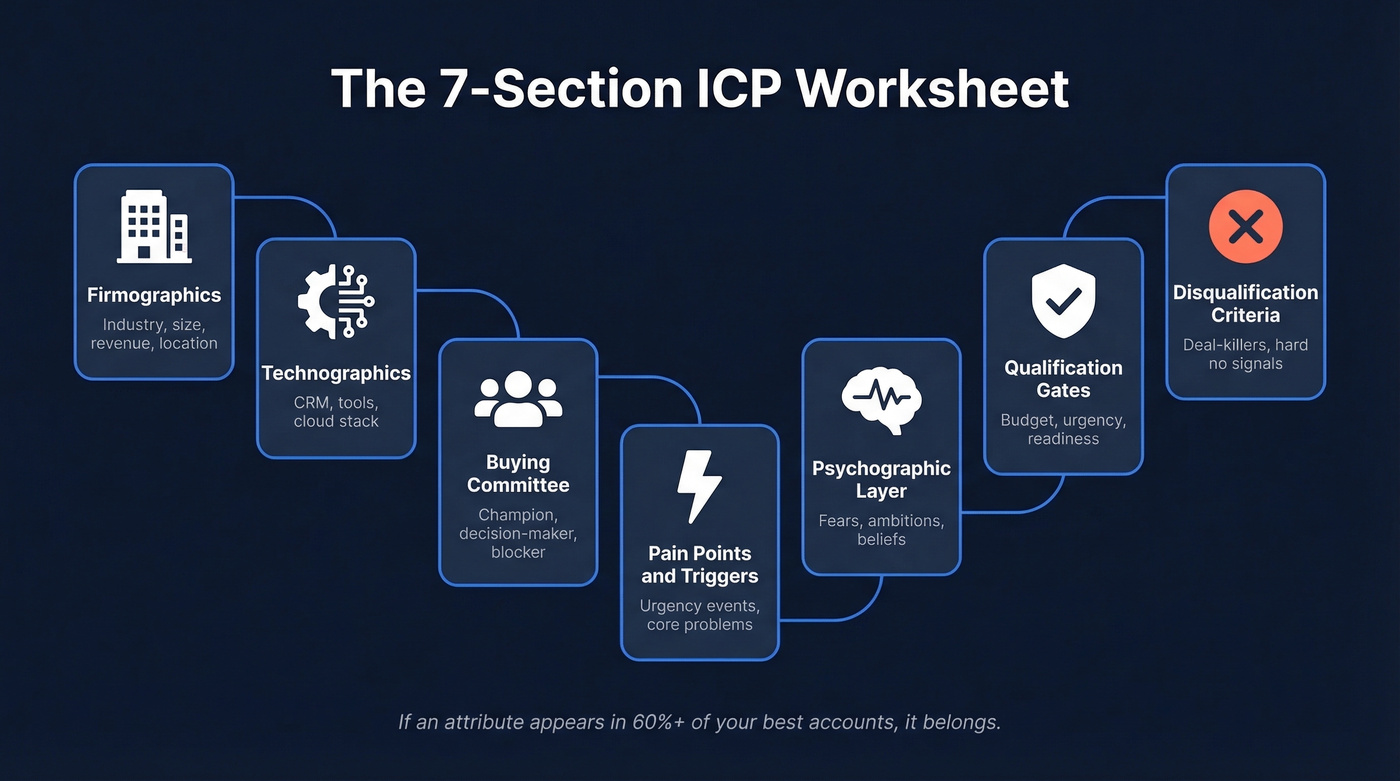
Industry (use SIC/NAICS codes), employee count range, annual revenue band, HQ location, ownership type - public, private, or PE-backed - plus growth indicators like funding rounds and hiring velocity. This is your foundation. But it's not enough alone, and teams that stop here end up with a profile so broad it describes half their TAM.
Technographics
Document the tech stack your best customers share: CRM (Salesforce, HubSpot), marketing automation, sales engagement tools, cloud infrastructure. In our experience, technographic overlap is one of the strongest fit predictors we've found - stronger than revenue band in many cases.
Buying Committee
Map the roles you need to win: champion (internal advocate), decision-maker (budget authority), influencer (shapes requirements), and any blockers who can kill the deal. The average B2B deal now involves six to ten stakeholders. One contact per account isn't mapping reality.
Pain Points & Triggers
Trigger events create urgency: new funding, hiring surges, leadership changes. Document the specific pains your product solves and what customers said they struggled with before buying. These are your messaging goldmines, and they're the reason two companies with identical firmographics can have wildly different close rates.
Psychographic Layer
Here's where most worksheets go blank. Capture the champion's biggest fears, biggest ambitions, and the beliefs shaping their decisions. A popular r/SaaS "avatar" template goes deep here - and it's what makes cold emails sound like you actually understand the reader's world rather than blasting a template.
Qualification Gates
Four checks: financial readiness, urgency and awareness, readiness to change, and stakeholder support. These gates prevent your team from chasing accounts that stall at stage two. Skip this section and your pipeline will look full while your close rate stays flat.
Disqualification Criteria
What kills a deal before it starts: too small, wrong tech stack, no budget authority, regulatory mismatches. As a rule of thumb, ICP-matching accounts should be under 10% of your TAM - meaning your disqualification list eliminates about 90%. That's the point.

Your ICP worksheet maps firmographics, technographics, and intent signals. Prospeo's database lets you filter by all three - across 300M+ profiles with 30+ filters including buyer intent, tech stack, headcount growth, and funding stage. At $0.01 per email with 98% accuracy, you go from worksheet to pipeline in minutes.
Stop defining your ICP and start filling your pipeline with it.
Filled-Out ICP Example
Here's a realistic profile for a mid-market SaaS workflow automation platform:
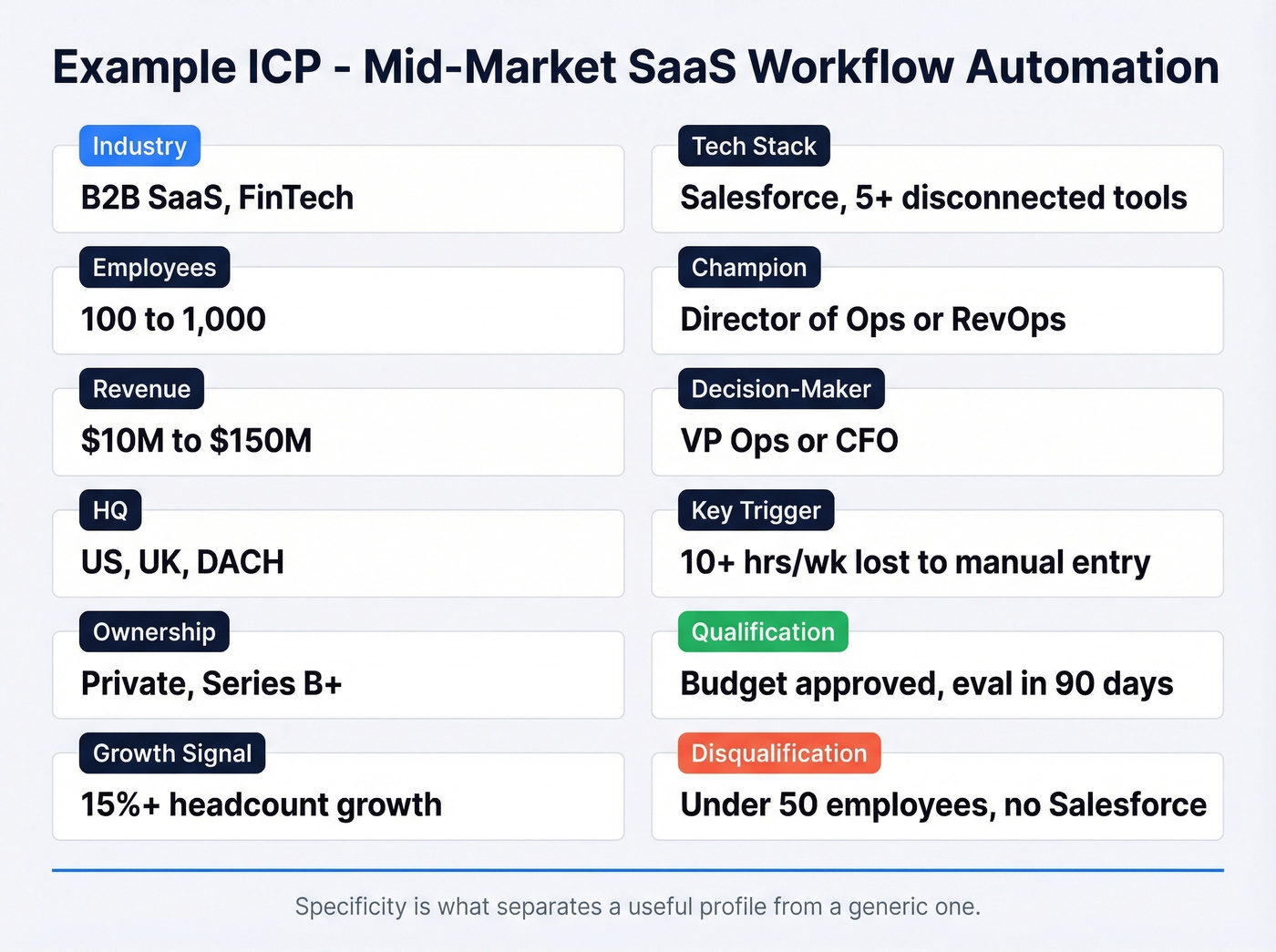
| Field | Example Values |
|---|---|
| Industry | B2B SaaS, FinTech |
| Employees | 100-1,000 |
| Revenue | $10M-$150M |
| HQ / Regions | US, UK, DACH |
| Ownership | Private, Series B+ |
| Growth signals | 15%+ headcount growth |
| Tech stack | Salesforce, 5+ disconnected tools |
| Champion | Director of Ops / RevOps |
| Decision-maker | VP Ops or CFO |
| Key trigger | 10+ hrs/wk lost to manual entry |
| Biggest fear | Competitors automating faster |
| Qualification | Budget approved, eval in 90 days |
| Disqualification | <50 employees, no Salesforce |
That level of specificity - "5+ disconnected tools, 10+ hours lost weekly" - is what separates a useful profile from a generic one. We've seen teams cut their sales cycle by weeks just by adding two or three disqualification fields that should've been obvious from their CRM data.
ICP Scoring Rubric
A worksheet without scoring is just a list. Here's a 100-point model:
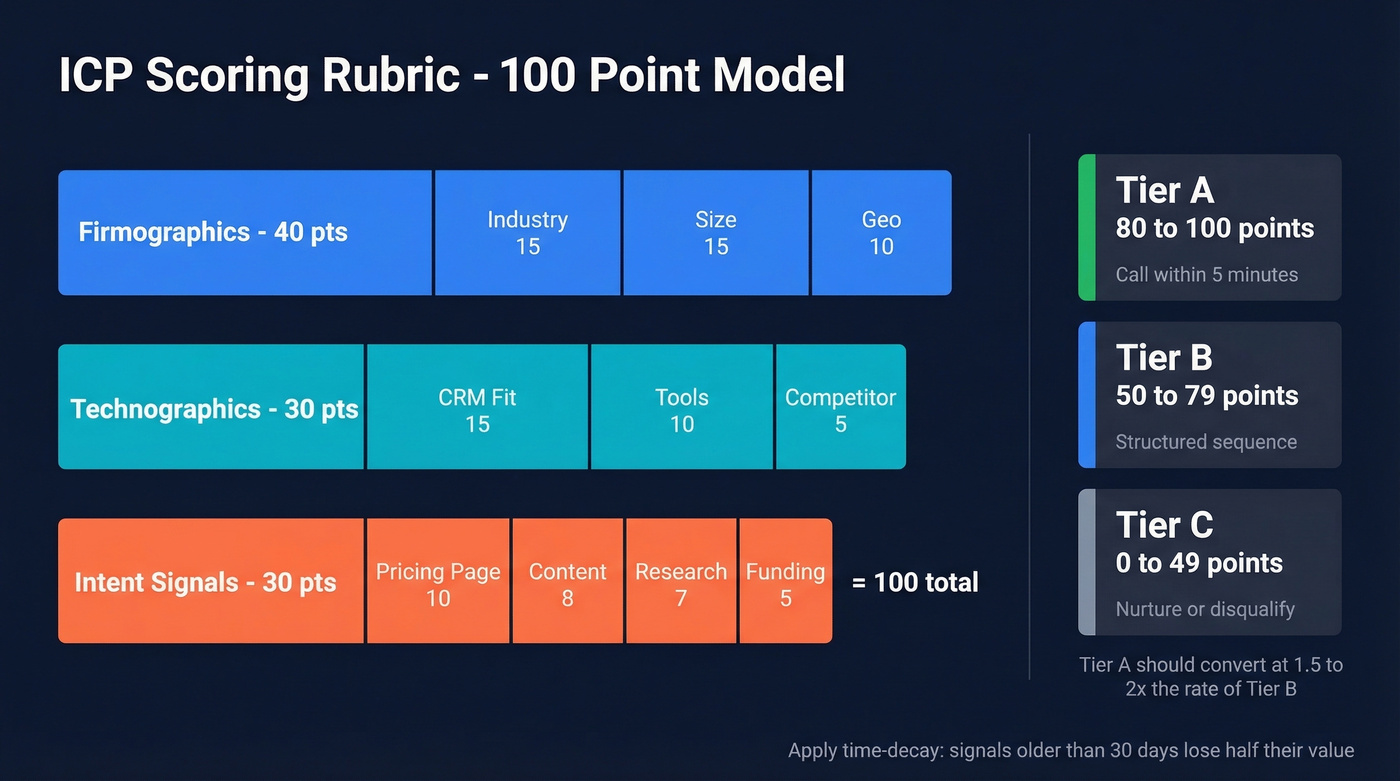
| Category | Points | Breakdown |
|---|---|---|
| Firmographics | 40 | Industry 15, Size 15, Geo 10 |
| Technographics | 30 | CRM fit 15, Tools 10, Competitor 5 |
| Intent signals | 30 | Pricing page 10, Content 8, Research 7, Funding 5 |
Tier your accounts: A (80-100), B (50-79), C (0-49). Tier A should convert at 1.5-2x the rate of Tier B with cycle times 15-20% shorter. If they don't, your scoring weights are off. Apply time-decay so signals older than 30 days lose half their value, and set routing SLAs - an 80+ account gets a call within 5 minutes, not a drip sequence.
Let's be honest: if your average deal size is under $10K, you probably don't need a 100-point scoring model. A simple three-question checklist (right industry, right size, right tech stack) will outperform an over-engineered rubric that nobody maintains.
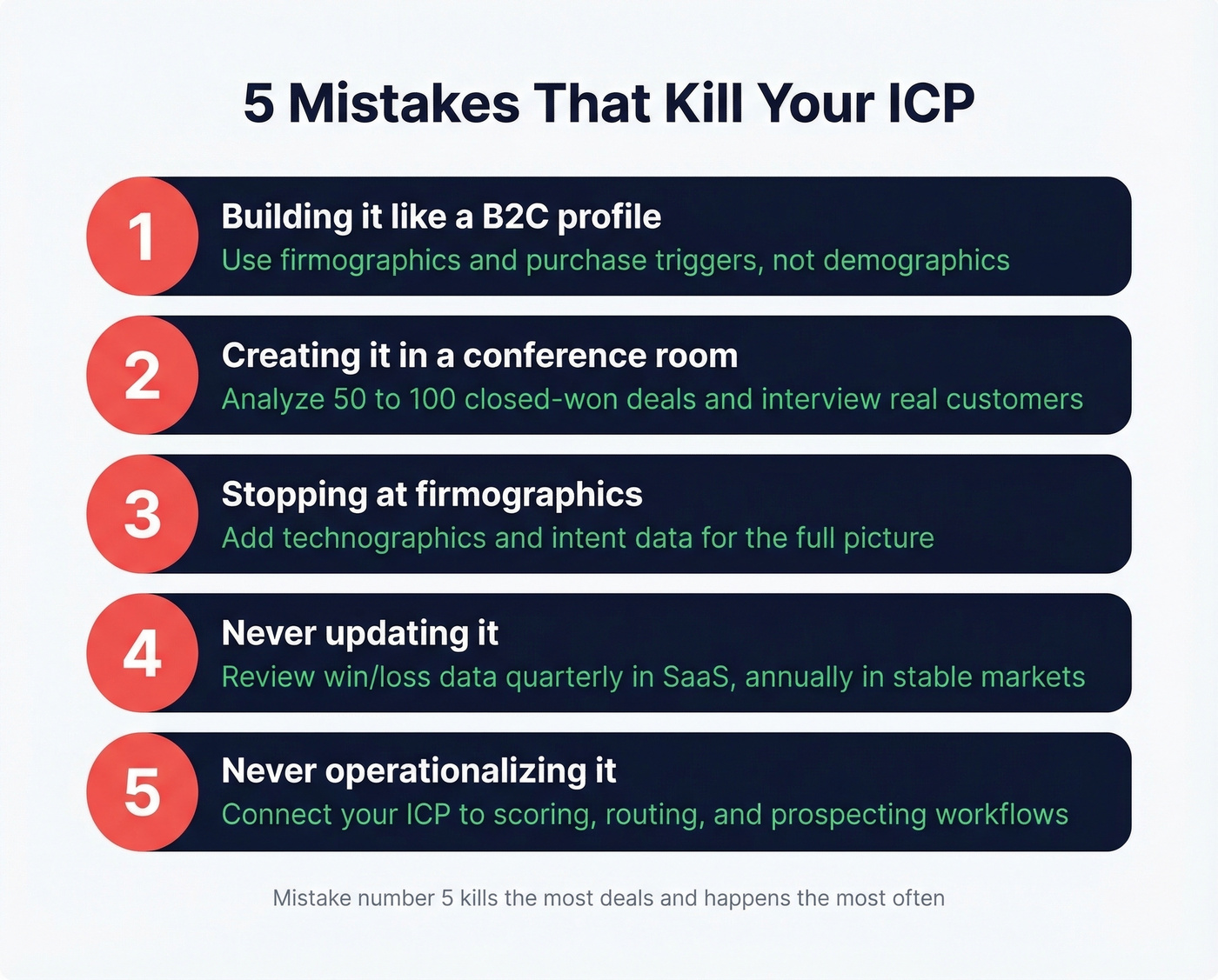
5 Mistakes That Kill Your ICP
- Building it like a B2C profile. Demographics instead of firmographics. Your ICP isn't a person - it's a company archetype.
- Creating it in a conference room. Without customer interviews or closed-won analysis, you get fairytale personas that collect dust.
- Stopping at firmographics. Missing technographics and intent data means you're scoring on half the picture.
- Never updating it. In fast-changing markets like SaaS, review win/loss data quarterly. In more stable industries, an annual review can work - but don't let it go longer than that.
- Never operationalizing it. A profile that doesn't connect to scoring, routing, and prospecting workflows is a document, not a strategy. This is the one that kills the most deals, and it's the one I see most often.
How to Source the Data
Start by analyzing 50-100 closed-won deals from the last 12 months. We've found that 70-80% share three to five common traits - that gives you your ICP draft. The harder part is sourcing live firmographic, technographic, and intent data for prospecting.
Prospeo's 30+ search filters map directly to your worksheet fields, with intent signals across 15,000 Bombora topics, headcount growth, and funding data on a 7-day refresh cycle. When you're ready to build contact lists at ICP-matching accounts, 98% email accuracy means your sequences actually land instead of bouncing into oblivion.
If you want to turn this into a repeatable outbound motion, pair your worksheet with lead scoring and a clear lead generation workflow.
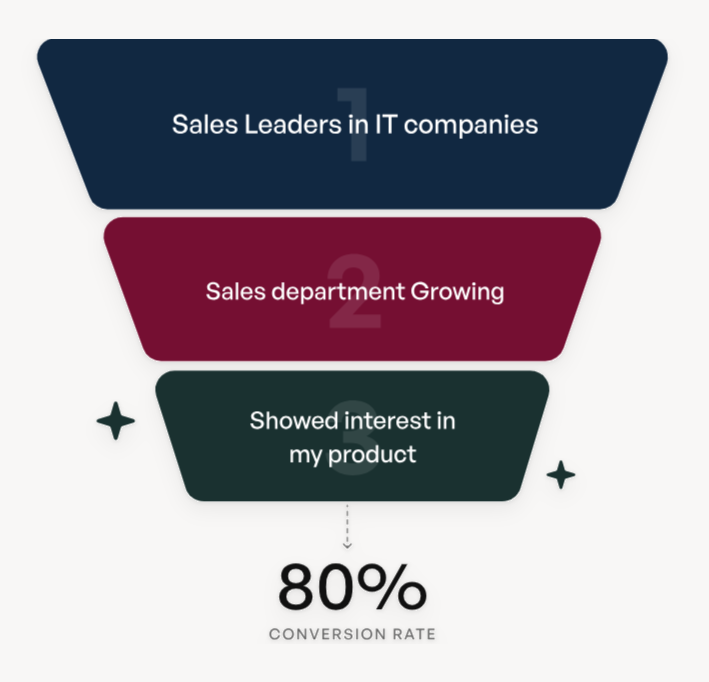
You just mapped your buying committee - champion, decision-maker, influencer. Now you need their verified contact data. Prospeo returns 98% accurate emails and 125M+ verified mobile numbers so your ICP scoring actually translates to booked meetings, not stalled sequences.
Turn every Tier A account into a conversation within minutes.
FAQ
How often should I update my ICP?
Quarterly in fast-moving industries like SaaS, annually in stable verticals. Review win/loss data each cycle and adjust technographic and intent criteria based on which Tier A accounts actually closed.
How many ICPs do I need?
Most B2B companies run one to three - typically one per distinct product line or market segment. If your profiles blur together, you're too broad. More than five means you aren't prioritizing.
What's the best format for an ICP worksheet?
Google Sheets for the scoring rubric - formulas and collaboration make it easy to maintain. A simple doc or Notion page for the narrative profile. Skip fancy whiteboard tools unless you're running a live workshop. The format matters less than actually filling it in with data from real deals.
What tools help operationalize an ICP?
For teams that need to go from worksheet to live prospecting, Prospeo lets you translate worksheet criteria into search filters - intent topics, tech stack, headcount growth, funding stage - and returns verified contacts at matching accounts. Pair it with your CRM for automated scoring and routing.