

Stop Looking for "The Decision Maker" - Map the Buying Committee Instead
You're three months into a deal. The champion goes quiet. Then an email lands from a VP you've never heard of - asking to "revisit the evaluation criteria." The deal just got reopened by someone who wasn't on your radar.
This happens because 86% of B2B purchases stall during the buying process, and the root cause is almost always the same: reps fail to identify decision makers across the full buying committee. Forrester's data shows an average of 13 people involved in every B2B purchase. Even when deals do close, 81% of buyers end up dissatisfied with their choice, often because the wrong stakeholders shaped the evaluation.
What You Actually Need
There's no single "decision maker" to find. You need three things:
- A framework to map the buying committee (MEDDPICC works best)
- Discovery questions that uncover who signs, who influences, and who can kill the deal
- A tool to find verified contact data for every stakeholder
Get those three right, and deals stop stalling at the finish line.
Why This Keeps Getting Harder
Gartner's research shows buyers loop back and revisit six buying jobs throughout the journey instead of moving through a clean, linear funnel. Meanwhile, 75% of B2B buyers say they'd prefer a rep-free experience entirely.
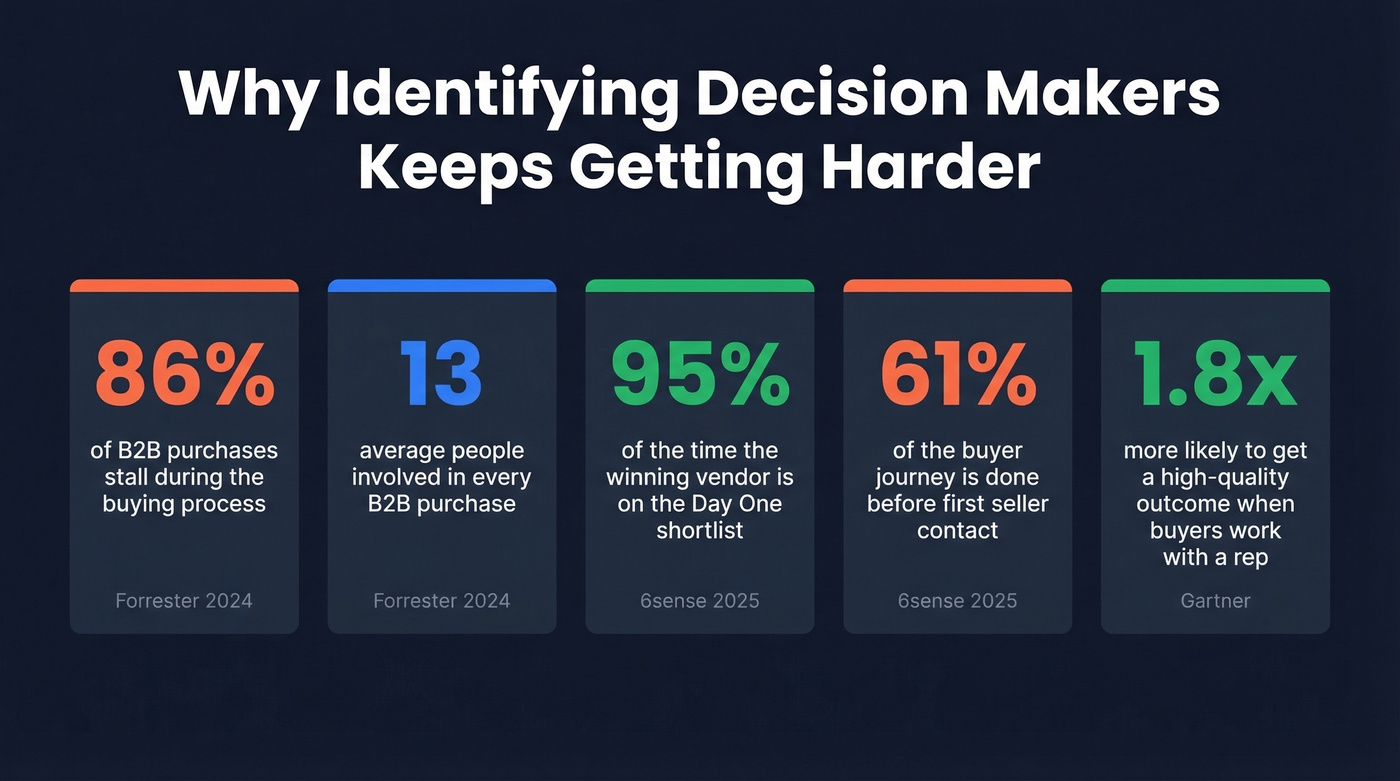
Here's the thing: 95% of the time, the winning vendor is already on the buyer's Day One shortlist, and the pre-contact favorite wins roughly 80% of the time. First seller contact now happens at 61% of the journey. But deals where buyers combine digital research with a sales rep are 1.8x more likely to result in a high-quality outcome. You still matter. You just need to target the right stakeholders early and across the full committee.
The 7 Roles in Every Buying Committee
Every complex deal has some version of these roles. Sometimes one person wears multiple hats. Map them anyway.
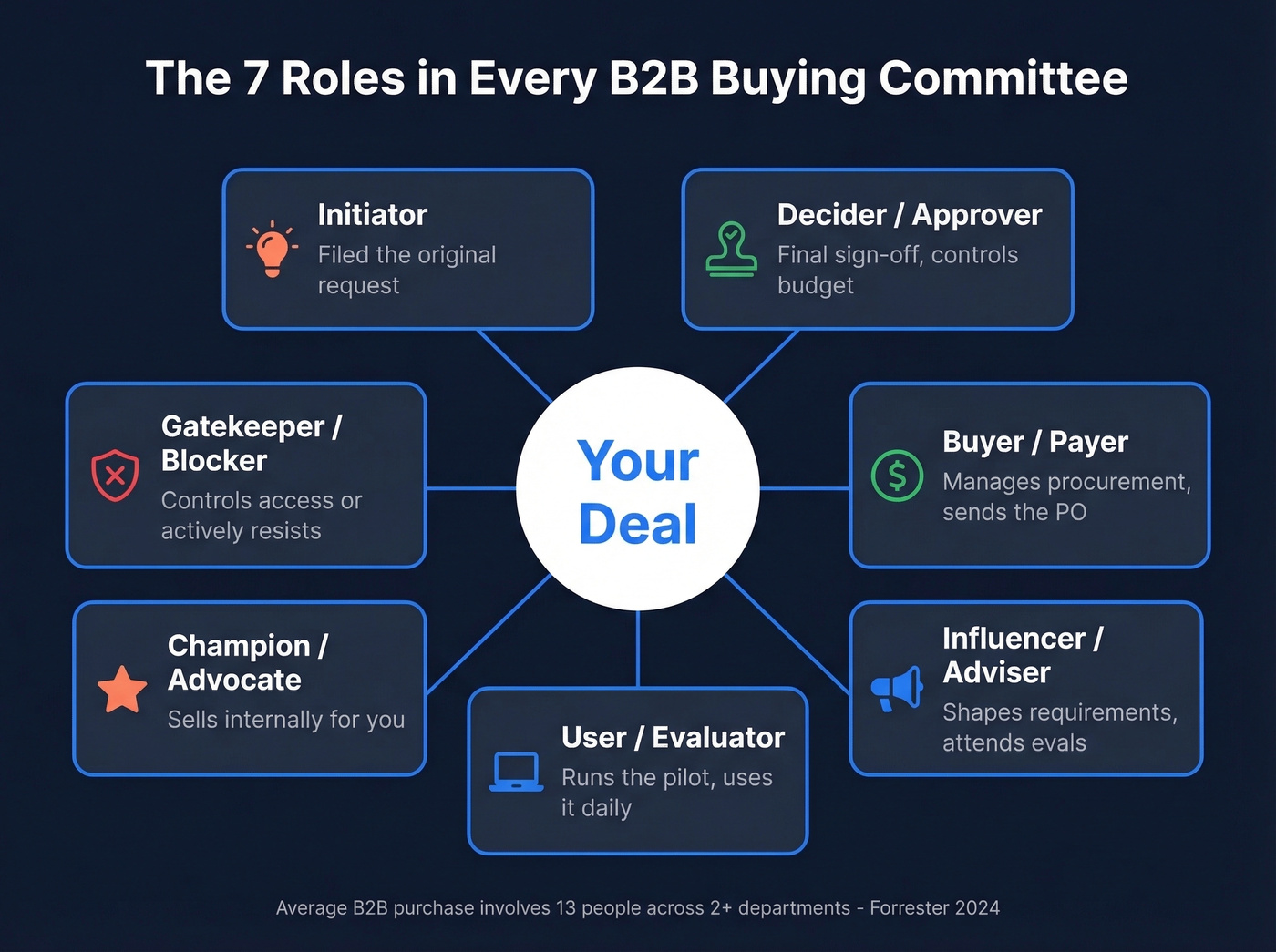
| Role | What They Do | Engagement Tip |
|---|---|---|
| Initiator | Filed the original request | Validate the pain they identified |
| Decider/Approver | Final sign-off, controls budget | Lead with ROI and risk reduction |
| Buyer/Payer | Manages procurement, sends the PO | Engage early on compliance and terms |
| Influencer/Adviser | Shapes requirements, attends evals | Provide specs and competitive detail |
| User/Evaluator | Runs the pilot, uses it daily | Offer trials and hands-on demos |
| Champion/Advocate | Sells internally for you | Arm with shareable business cases |
| Gatekeeper/Blocker | Controls access or actively resists | Address objections before they escalate |
The Outreach DMU framework recommends engaging these roles non-hierarchically. Don't wait to "move up the org chart." Start wide.
If you're running this as an account-based selling motion, this role map becomes your outreach plan.

You just mapped 7 roles in the buying committee. Now you need verified contact data for every one of them. Prospeo's 30+ search filters let you target by seniority, department, and buyer intent - then deliver 98% accurate emails so your outreach actually lands with the VP who can kill your deal.
Reach every stakeholder in the buying committee, not just the champion.
3 Mistakes That Kill Deals
1. Assuming the budget owner decides. We've seen deals where the CFO holds the purse strings but a department head three levels down drives vendor selection. Then at contract stage, six new stakeholders appear and the deal resets completely. This is also why team selling beats lone-wolf selling in complex accounts.
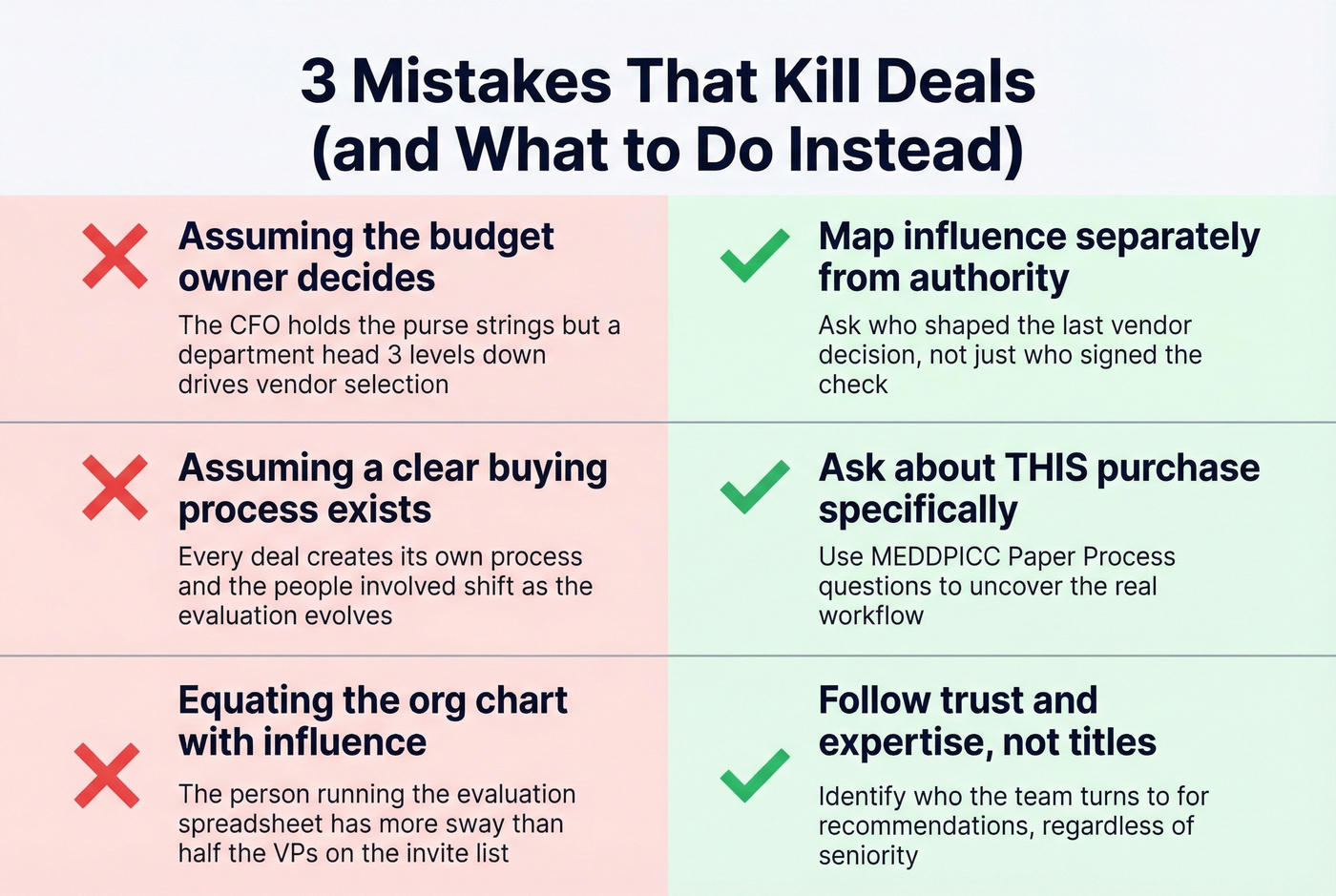
2. Assuming a clear buying process exists. If you ask "what's your buying process?" and get a confident answer, be skeptical. It probably describes how the last purchase went, not this one. Every deal creates its own process, and the people involved shift as the evaluation evolves. (If you want a deeper set of prompts, use these discovery questions.)
3. Equating the org chart with influence. Don't only target C-level. The director who never joins calls might have veto power. In our experience, the person running the evaluation spreadsheet has more sway than half the VPs on the invite list. Influence follows trust and expertise, not titles - and learning to identify decision makers means looking beyond hierarchy.
Use MEDDPICC to Map the Committee
73% of SaaS companies selling above $100K ARR use some version of MEDDPICC, and teams that fully adopt it see 18% higher win rates and 24% larger deal sizes. The framework's power for uncovering key stakeholders comes from three letters: E (Economic Buyer), D (Decision Process), and P (Paper Process). If you need a dedicated playbook for the E, start with the MEDDPICC Economic Buyer guide.
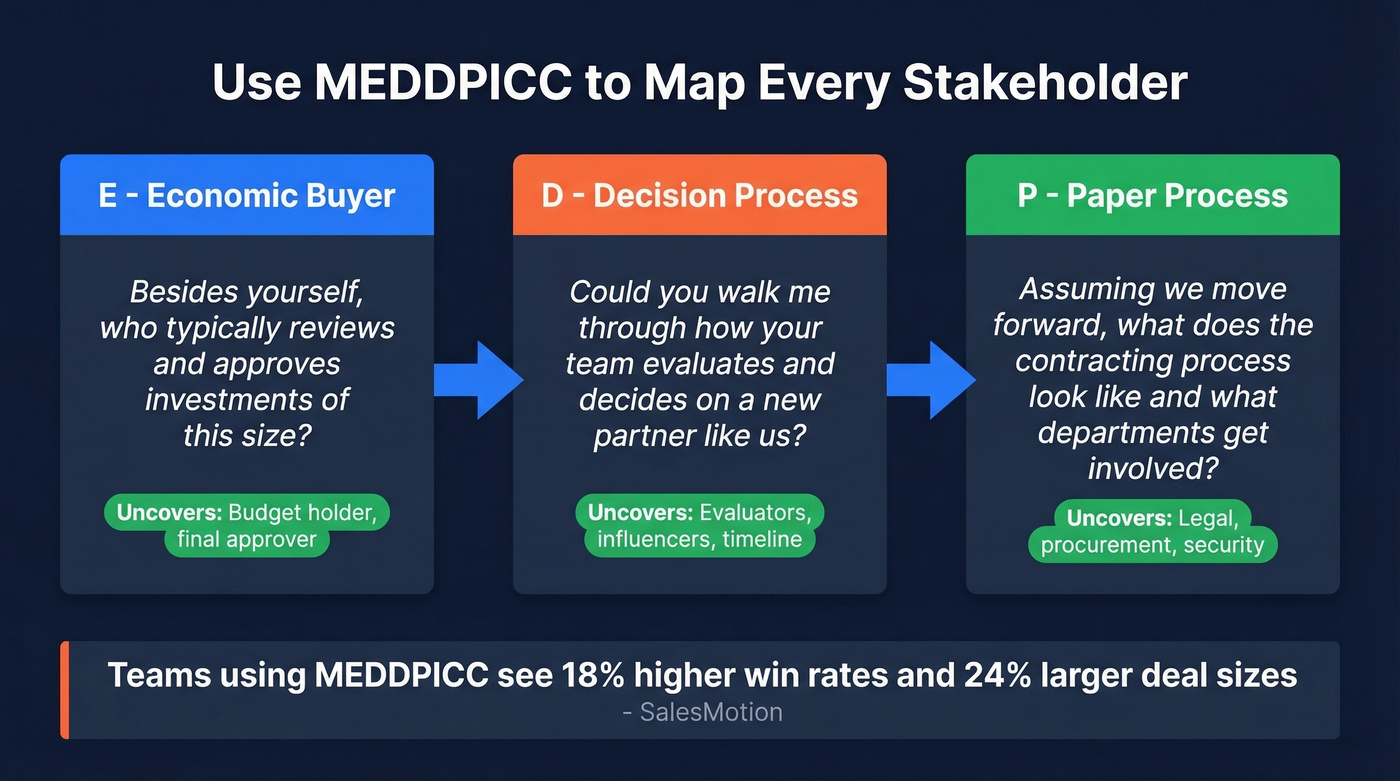
Use these discovery questions verbatim:
"Besides yourself, who typically reviews and approves investments of this size?"
"Could you walk me through how your team evaluates and decides on a new partner like us?"
"Assuming we move forward, what does the contracting process look like and what departments get involved?"
That last question is the one most reps skip. Paper Process uncovers legal, procurement, and security stakeholders who can delay a deal by weeks - sometimes months. I've watched a $200K deal sit in legal purgatory for 11 weeks because nobody asked about the contracting workflow until the champion had already said yes. The deal isn't won when the champion says yes. It's won when the contract clears procurement.
Tools for Reaching Every Stakeholder
You've mapped the committee. Now you need verified emails and direct dials for every person on it.

Apollo works as a free-tier starting point, with paid plans from $49/user/month. The database is large, but accuracy is lower than Prospeo's 98% benchmark, which means more bounces when reaching senior stakeholders who are least forgiving of sloppy outreach. If you're comparing databases, start with a shortlist of sales prospecting databases and validate accuracy before you scale.
ZoomInfo is the enterprise option and typically runs $15-40K/year with annual contracts. Overkill for most teams who just need accurate contact data for a mapped buying committee.
Let's be honest: if your average deal size is under $15K, you don't need ZoomInfo-level infrastructure. A credit-based tool that lets you pull verified emails for a 13-person buying committee for under $1 in email credits is a better fit - and won't lock you into an annual commitment you'll regret by Q2. Skip ZoomInfo unless you're running 50+ AEs and need deep org-chart mapping across thousands of accounts.
If you're building lists from names, a name to email workflow can speed up committee coverage.
A 13-person buying committee means 13 contacts you need verified data for - fast. Prospeo covers the full committee at ~$0.01/email with 98% accuracy and 125M+ verified mobile numbers for direct dials. No annual contracts. No sales calls. Just the data your MEDDPICC map demands.
Stop letting unknown stakeholders reopen your deals at the finish line.
FAQ
How do you identify decision makers in a complex B2B deal?
Map all seven buying committee roles using MEDDPICC discovery questions. Ask your champion who reviews, approves, and signs off on purchases of this size. Then use a B2B data platform to pull verified contact information for every stakeholder, filtering by seniority, department, and intent signals.
What's the difference between a decision maker and an influencer?
A decision maker has final sign-off authority and can approve budget. An influencer shapes the decision through recommendations but can't approve alone. Both matter - miss either and deals stall. Forrester's data shows 89% of purchases span two or more departments, so influence is distributed far wider than most reps assume.
How many people are involved in a typical B2B purchase?
Forrester's research shows an average of 13 people involved in every B2B purchase, spanning two or more departments in 89% of cases. Enterprise deals with $100K+ contract values often involve 15-20 stakeholders across finance, legal, IT security, and the business unit.
What's the fastest way to get contact data for a buying committee?
Search a B2B database by seniority, department, and company name to pull verified emails and direct dials for every stakeholder at once. We've found this takes minutes rather than the days of manual research most reps default to - and the accuracy difference between a 98% verified list and a scraped one is the difference between landing in the inbox and landing in spam.