

Inaccurate Forecasting: Causes, Costs, and What Actually Fixes It
A RevOps lead we know spent six figures on a new planning tool last year. The team built elaborate models, felt confident, and missed the quarter by 22%. Nobody had ever measured how accurate the old forecasts were, so they couldn't tell if the new tool helped. Inaccurate forecasting is rarely a model problem - it's a measurement and process problem. And even when you do improve accuracy, there's an 80% chance it won't change the outcome.
Most organizations talk about forecasts constantly but never measure accuracy with actual error rates. That gap between "we forecast" and "we measure our forecasts" is where hundreds of billions of dollars vanish every year across retail and supply chains alone.
Here's the short version: start by measuring forecast accuracy - many teams never do. 80% of accuracy improvements don't change the business outcome. Focus on the 20% of forecasts that drive real decisions. The highest-ROI fix isn't a better model - it's cleaner input data and cross-functional communication.
What Forecast Inaccuracy Actually Costs
The direct consequences hit fast. Stockouts and overstocking. Overstaffing or scrambling to hire. Missed revenue targets and broken board trust. Cash flow plans built on phantom pipeline. Marketing budgets allocated against revenue that never materializes.
Even after quotas were lowered by 13.3% in Fullcast's 2026 benchmarks, nearly 77% of sellers still missed - a sign the underlying forecasts were wrong, not just ambitious.
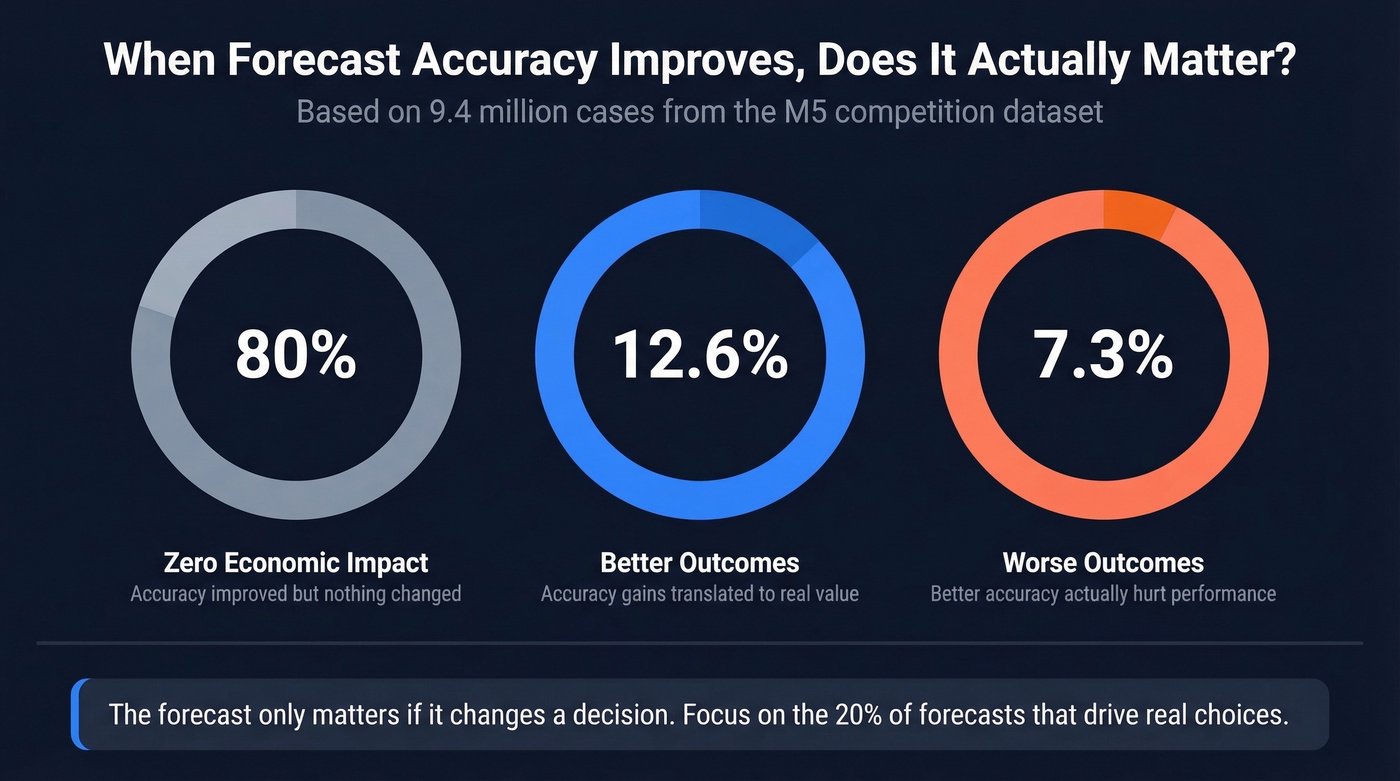
Now here's the counterintuitive part. A large-scale simulation using the M5 competition dataset - 32,000+ time series, 9.4 million distinct cases - found that when forecast accuracy improves, 80% of cases produce zero economic impact. Another 12.6% led to better outcomes, and 7.3% of accuracy improvements actually worsened economic performance. Improving your MAPE doesn't automatically improve your business. The forecast only matters if it changes a decision.
How to Measure Forecast Accuracy
Before you fix anything, you need a baseline. The most common metric is MAPE (Mean Absolute Percentage Error):
| Week | Forecast | Actual | Absolute % Error |
|---|---|---|---|
| 1 | 100 | 110 | 9.1% |
| 2 | 150 | 140 | 7.1% |
| 3 | 200 | 180 | 11.1% |
Add those up: (9.1% + 7.1% + 11.1%) / 3 = MAPE of 9.1%. Simple, but MAPE has real limitations - it explodes when actual demand is near zero and treats over-forecasting and under-forecasting equally. Track WMAPE (volume-weighted) alongside forecast bias separately. WMAPE tells you where the dollars are. Bias tells you if you're systematically optimistic or pessimistic.
What does "good" look like? It depends entirely on your domain:
| Domain | Metric | "Good" Range | Context |
|---|---|---|---|
| CPG / Food & Bev | MAPE | 15-25% | Demand planning |
| Manufacturing | MAPE | 20-40% | Supply chain |
| Pharma | MAPE | 10-20% | Stable demand |
| Apparel / Retail | MAPE | >30% typical | High variability |
| B2B Sales | Accuracy % | 85-95% | Pipeline forecasting |
| Contact Centers | Workload variance | +/-5% large / +/-10% small | Workforce planning |
In one supply chain survey, CPG companies averaged 39% WMAPE and chemicals averaged 36% - well above what most teams consider acceptable. If you're a B2B sales team below ~80% accuracy, you've usually got structural issues. If you're in apparel hitting 25% MAPE, you're doing well. Context matters more than the number.

Your forecast is only as good as the pipeline feeding it. When 35% of emails bounce, every conversion assumption is wrong - and your forecast compounds that error. Prospeo's 98% email accuracy and 7-day data refresh cycle means your CRM reflects real opportunities, not phantom pipeline.
Stop forecasting on bad data. Start with verified contacts.
Root Causes of Bad Forecasts
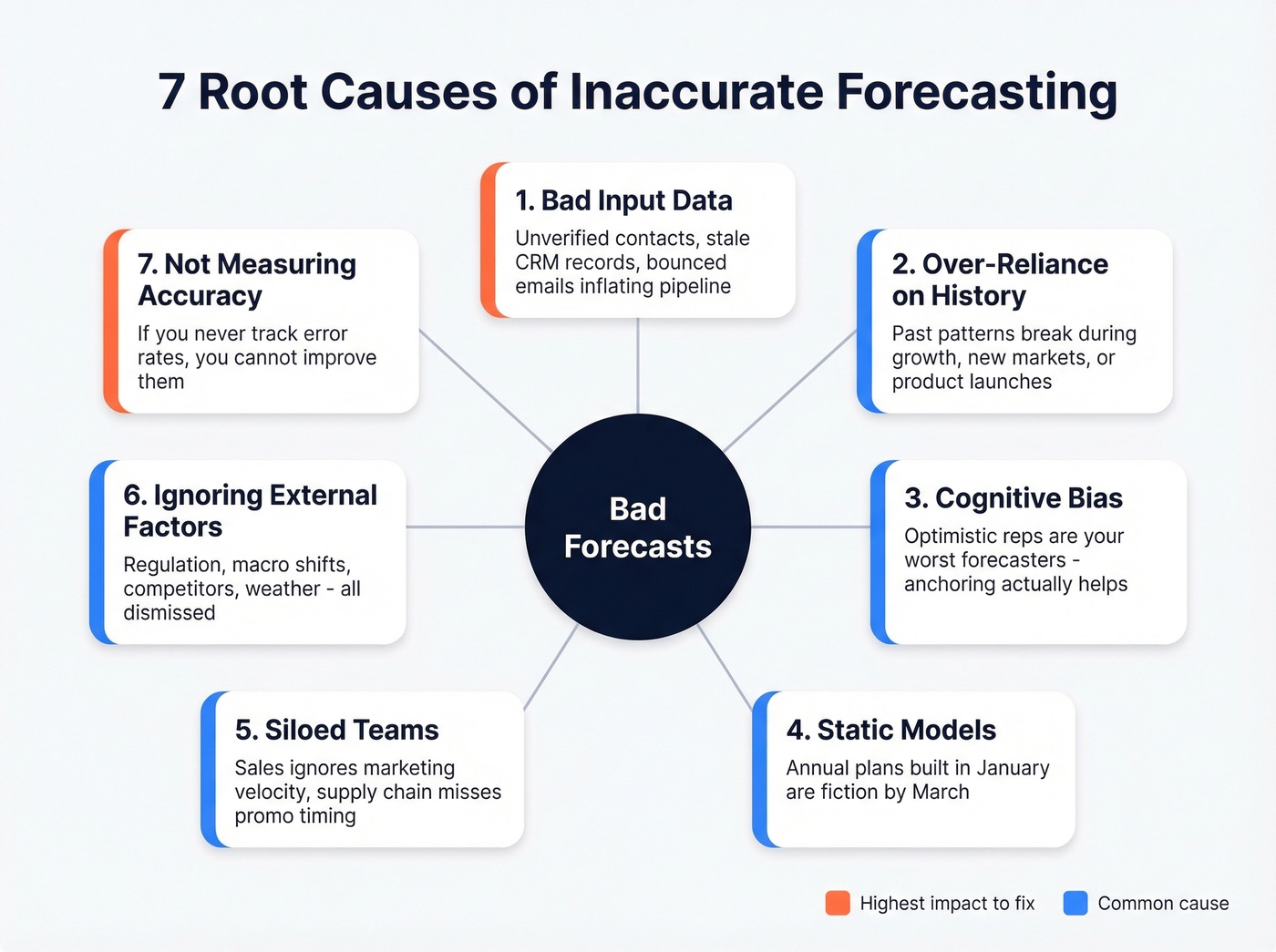
Seven causes we see most often, across sales, supply chain, finance, and workforce planning. Most teams assume the problem is their model when it's really a broken process upstream.
1. Bad Input Data
The most common root cause is also the most boring. For sales forecasts, if your pipeline is built on unverified emails and disconnected phone numbers, your conversion assumptions are wrong from the start. A rep marks a deal as "engaged" after sending five emails - but three bounced. That's not a real opportunity; it's noise dressed up as pipeline. Prospeo catches this before it enters your CRM, verifying contact data in real time with 98% email accuracy on a 7-day refresh cycle so pipeline reflects reality instead of stale records.

2. Over-Reliance on Historical Data
History is useful until it isn't. Growth-stage companies, new product launches, new market entries - historical patterns break in all of these. FinOps practitioners describe cloud cost forecasts off by 30-40% because tools naively extrapolate last month's trend. If your business is changing faster than your model's training window, you're forecasting the past. (For the broader context, see the State of FinOps 2026 Report.)
3. Cognitive Bias
Here's a genuinely counterintuitive finding: research on analyst forecasts found that optimism has a negative relationship with accuracy, while anchoring bias actually correlated positively with better predictions. Your most optimistic reps are probably your worst forecasters - and their guesswork drags down the entire team's numbers.
4. Static Models That Don't Adapt
Annual forecasts built in January are fiction by March. We've talked to teams whose tools extrapolate linearly and can't accept business context as input. If your tool can't incorporate a product launch or a pricing change, it's guessing. If you're evaluating platforms, compare sales forecasting solutions before committing to a long contract.
5. Siloed Teams
Sales forecasts that ignore marketing pipeline velocity. Supply chain forecasts that miss promotional timing. This is one of the most fixable problems and one of the most ignored. A 30-minute weekly sync between sales, marketing, and finance catches misalignment that no algorithm can. This is also where better sales communication tends to show up as forecast stability.
6. Ignoring External Factors
Regulation changes, macroeconomic shifts, competitor moves, weather patterns. Confirmation bias makes teams dismiss signals that contradict their model. Overfitting to internal data compounds the problem. If you're building a repeatable process, it helps to formalize a competitive intelligence strategy so external signals actually make it into planning.
7. Not Measuring Accuracy at All
The consensus on r/SalesOperations is that many orgs don't track forecast accuracy with actual error rates. If you don't measure it, you can't improve it - and you definitely can't calculate the ROI of improving it. Teams that do this well usually standardize on a small set of Sales Operations metrics and review them on a fixed cadence.
Why AI Isn't a Silver Bullet
Every forecasting vendor now claims AI will fix your accuracy problems. The numbers tell a different story.
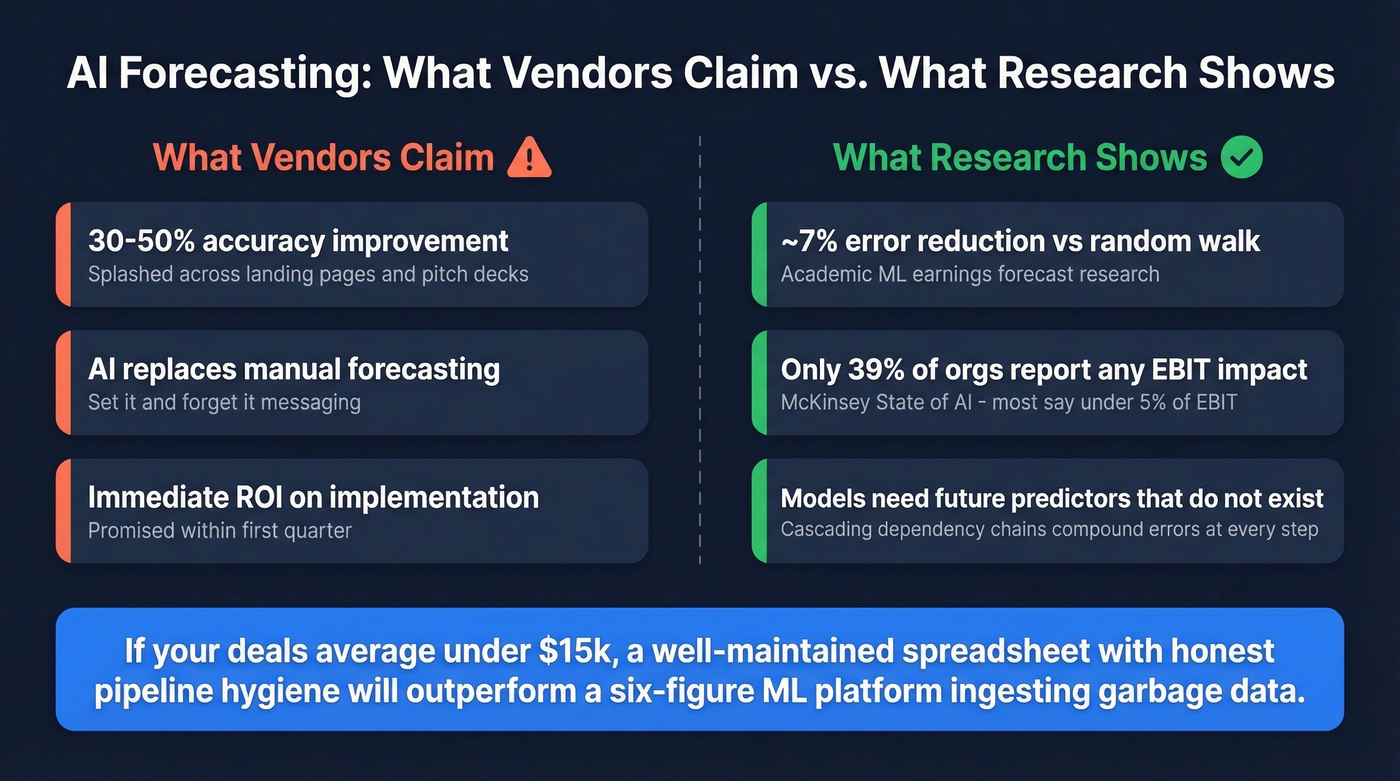
Academic research on ML-based earnings forecasting showed a ~7% reduction in forecast errors versus a random walk baseline. That's meaningful but modest - a far cry from the 30-50% improvement vendors splash across their landing pages. McKinsey's State of AI report shows 88% of organizations use AI in at least one function, but only 39% report any EBIT impact, and most say it's less than 5% of EBIT.
There's also a fundamental technical problem. Forecasting models often need future values of predictor variables that don't exist yet. You end up building models to predict the predictors, creating a cascading dependency chain where errors compound at every step.
Let's be honest: if your deals average under $15k, you probably don't need an AI forecasting tool. A well-maintained spreadsheet with rolling actuals and honest pipeline hygiene will outperform a six-figure ML platform that's ingesting garbage data. AI helps at the margins. Clean data and process fixes deliver more. If you're still shopping, start with a shortlist of the best sales forecasting tools and pressure-test their data requirements.
How to Fix Your Forecasting Process
Five fixes, ranked by impact-to-effort ratio.
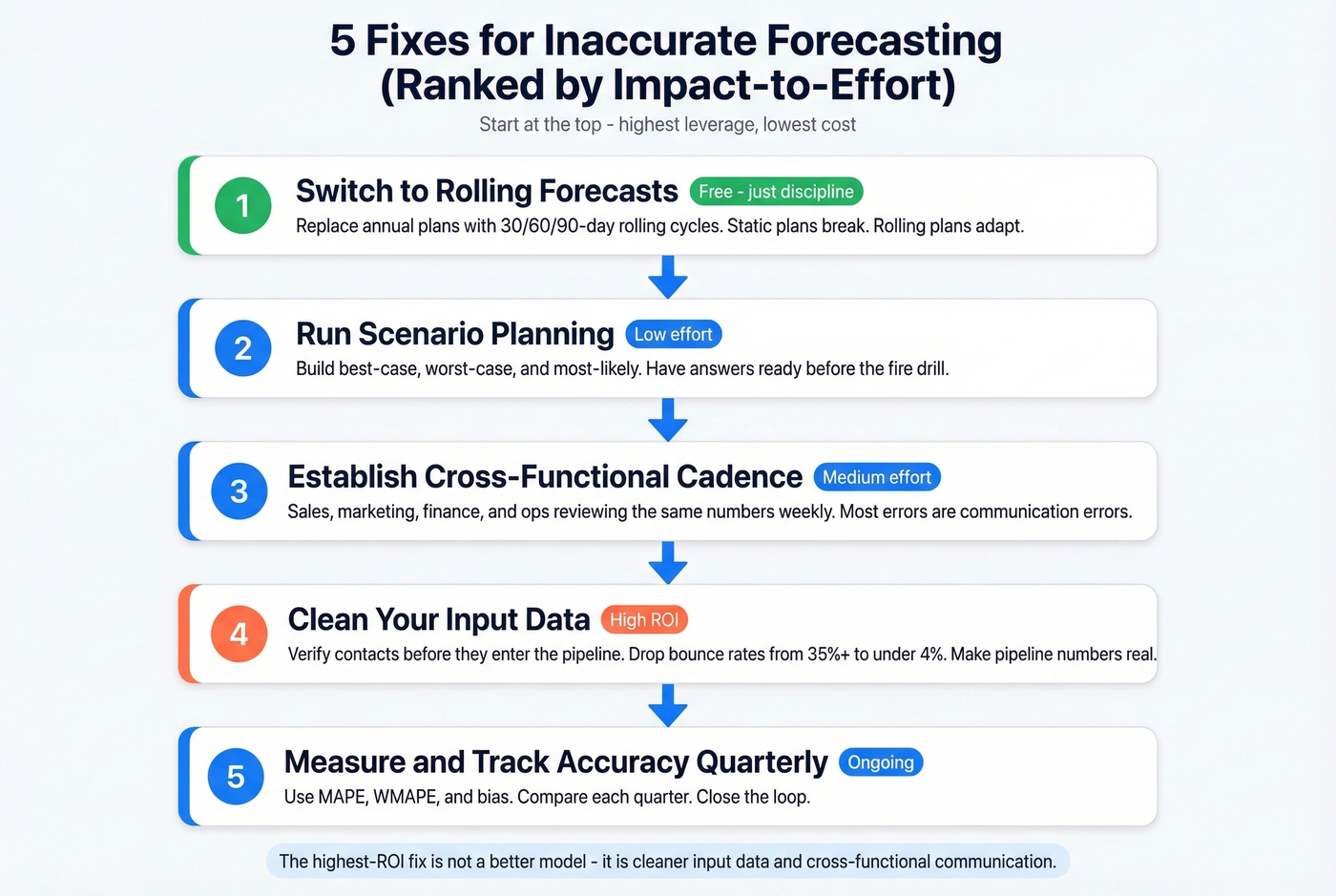
Switch to rolling forecasts. Replace the annual forecast with 30/60/90-day rolling cycles. Static plans break. Rolling plans adapt. This is the single highest-leverage process change most teams can make, and it costs nothing but discipline. (If you want a practical cadence template, borrow the structure from a 30/60/90-day plan.)
Run scenario planning. Build best-case, worst-case, and most-likely scenarios. When leadership asks "what if we miss by 15%?", you should already have the answer modeled. Don't wait for the fire drill.
Establish a cross-functional cadence. Sales, marketing, finance, and ops reviewing the same numbers on a regular schedule. In our experience, most forecast errors aren't model errors - they're communication errors between departments that never talk to each other.
Clean your input data. This one's personal for us. CRM forecast inaccuracy almost always traces back to dirty records - dead contacts inflate conversion rates, and your pipeline numbers lie to you. Verify before data enters the pipeline, not after the quarter closes. Teams using Prospeo's CRM enrichment have seen bounce rates drop from 35%+ to under 4%, which means the deals in your pipeline are real conversations, not phantom opportunities. If you're comparing vendors, start with data enrichment services and work backward from your CRM fields.
Measure and track accuracy quarterly. Close the loop. Use MAPE, WMAPE, and bias. Compare each quarter to the last. Demand that your tools accept business context - product launches, market shifts, promotional timing - as inputs, not just historical data. This is also where it helps to clarify sales forecast vs sales goal so teams stop mixing targets with predictions.
You just read that 80% of accuracy improvements don't change outcomes. The 20% that do? They fix input quality. Prospeo replaces stale, unverified contacts with 300M+ profiles refreshed every 7 days - so your pipeline numbers actually mean something before they hit the forecast.
The highest-ROI forecast fix starts at $0.01 per verified email.
FAQ
What's a good MAPE for sales forecasting?
For B2B sales, 85-95% accuracy (5-15% MAPE) is considered good, with world-class teams hitting 95%+. Below ~80% usually signals structural issues - dirty pipeline data, siloed teams, or no measurement cadence - worth diagnosing before investing in new tools.
Can AI fix inaccurate forecasting on its own?
No. Research shows ML improves forecast errors by roughly 7%, not the 30-50% vendors claim. AI works best when paired with clean input data, human judgment, and cross-functional review - it's an accelerant, not a replacement for process discipline.
How does bad contact data cause forecast errors?
Outdated emails and disconnected numbers make dead deals look active, inflating pipeline conversion assumptions from day one. When bounce rates sit at 35%+, a huge chunk of your "engaged pipeline" isn't engaged at all - it's undeliverable. Cleaning that data before it enters your CRM is the fastest way to get forecasts closer to reality.
What's the fastest way to improve forecast accuracy?
Start by measuring your current error rate with MAPE and bias - most teams skip this entirely. Then switch to rolling forecasts and clean your input data. These two changes alone eliminate the majority of guesswork that plagues quarterly planning.